Oregon’s Death with Dignity Act (DWDA), enacted in late 1997, allows terminally-ill adult Oregonians to obtain and use prescriptions from their physicians for self-administered, lethal doses of medications. The Oregon Public Health Division is required by the Act to collect information on compliance and to issue an annual report. The key findings from 2013 are listed below. The number of people for whom DWDA prescriptions were written (DWDA prescription recipients) and deaths that occurred as a result of ingesting prescribed DWDA medications (DWDA deaths) reported in this summary are based on paperwork and death certificates received by the Oregon Public Health Division as of January 22, 2014. For more detail, please view the figures and tables on our web
site: http://www.healthoregon.org/dwd. 24 33 39 44 58 68 60 65 65 85 88 95 97 114 116 122 16 27 27 21 38 42 37 38 46 49 60 59 65 71 85 71* 0 10 20 30 40 50 60 70 80 90 100 110 120 130 140 1998 1999 2000 2001 2002 2003 2004 2005 2006 2007 2008 2009 2010 2011 2012 2013 Nu mb er Year Figure 1:
Oregon DWDA Prescription Recipients and Deaths*, 1998-2013
DWDA prescription recipients DWDA deaths
*As of January 22, 2014
http://public.health.oregon.gov/ProviderPartnerResources/EvaluationResearch/
Oregon Public Health Division – 2013 DWDA Report
x As of January 22, 2014, prescriptions for lethal medications were written for 122 people during 2013 under the provisions of the DWDA, compared to 116 during 2012 (Figure 1). At the time of this report, there were 71 known DWDA deaths during 2013. This corresponds to 21.9 DWDA deaths per 10,000 total deaths.1
x Since the law was passed in 1997, a total of 1,173 people have had DWDA prescriptions written and 752 patients have died from ingesting medications prescribed under the DWDA.
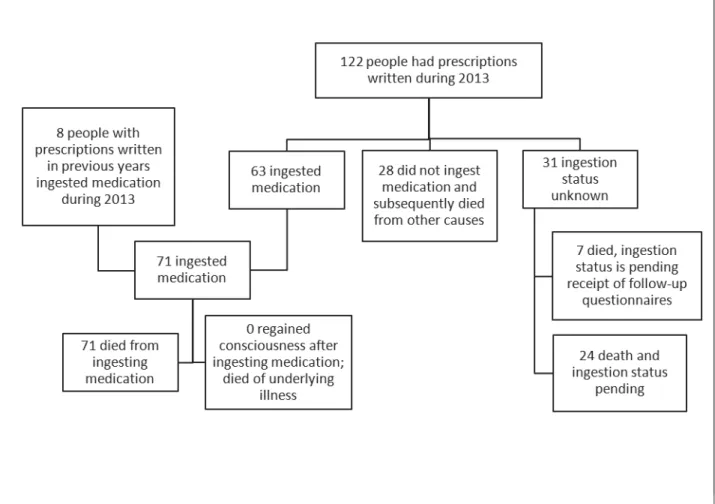
x Of the 122 patients for whom DWDA prescriptions were written during 2013, 63 (51.6%) ingested and died from the medication. Eight (8) patients with prescriptions written during the previous years (2011 and 2012) died after ingesting the medication during 2013, for a total of 71 DWDA deaths.
x Twenty-eight (28) of the 122 patients who received DWDA prescriptions during 2013 did not take the medications and subsequently died of other causes.
x Ingestion status is unknown for 31 patients who were prescribed DWDA medications in 2013. Seven (7) of these patients died, but follow-up
questionnaires indicating ingestion status have not yet been received. For the remaining 24 patients, both death and ingestion status are pending (Figure 2).
x Of the 71 DWDA deaths during 2013, most (69.0%) were aged 65 years or older; the median age was 71 years (42 years – 96 years). As in previous years, most were white (94.4%), well-educated (53.5% had a least a baccalaureate degree), and had cancer (64.8%). In 2013, fewer patients had cancer (64.8%) compared to previous years (80.4%), and more patients had chronic lower respiratory disease (9.9%), and other underlying illnesses (16.9%).
x Most (97.2%) DWDA patients died at home, and most (85.7%) were enrolled in hospice care either at the time the DWDA prescription was written or at the time of death. Excluding unknown cases, most (96.7%) had some form of
1 The rate per 10,000 deaths is calculated using the total number of Oregon resident deaths in 2012 (32,475), the
most recent year for which final death data are available.
http://public.health.oregon.gov/ProviderPartnerResources/EvaluationResearch/
DeathwithDignityAct/Documents/year16.pdf Page 2 of 7
health care insurance. The number of patients who had private insurance (43.5%) was lower in 2013 than in previous years (64.7%), and the number of patients who had only Medicare or Medicaid insurance was higher than in previous years (53.2% compared to 33.7%).
x As in previous years, the three most frequently mentioned end-of-life concerns were: loss of autonomy (93.0%), decreasing ability to participate in activities that made life enjoyable (88.7%), and loss of dignity (73.2%).
x Two of the 71 DWDA patients who died during 2013 were referred for formal psychiatric or psychological evaluation.
x Prescribing physicians were present at the time of death for eight patients (11.4%) during 2013 compared to 16.5% in previous years.
x A procedure revision was made mid-year in 2010 to standardize reporting on the follow-up questionnaire. The new procedure accepts information about the time of death and circumstances surrounding death only when the physician or another health care provider was present at the time of death. Due to this change, data on time from ingestion to death is available for 11 of the 71 DWDA deaths during 2013. Among those 11 patients, time from
ingestion until death ranged from 5 minutes to 5.6 hours.
x Sixty-two (62) physicians wrote the 122 prescriptions provided during 2013 (range 1-10 prescriptions per physician).
x During 2013, no referrals were made to the Oregon Medical Board for failure to comply with DWDA requirements.
http://public.health.oregon.gov/ProviderPartnerResources/EvaluationResearch/
Oregon Public Health Division – 2013 DWDA Report
Figure 2: Summary of DWDA Prescriptions Written and Medications Ingested in 2013, as of January 22, 2014
http://public.health.oregon.gov/ProviderPartnerResources/EvaluationResearch/
http://public.health.oregon.gov/ProviderPartnerResources/EvaluationResearch/DeathwithDignityAct/Documents/year16.pdf Page 5 of 7 N (%)1 N (%)1 N (%)1 44 (62.0) 352 (51.7) 396 (52.7) 27 (38.0) 329 (48.3) 356 (47.3) 0 (0.0) 6 (0.9) 6 (0.8) 1 (1.4) 15 (2.2) 16 (2.1) 6 (8.5) 52 (7.6) 58 (7.7) 15 (21.1) 141 (20.7) 156 (20.7) 23 (32.4) 194 (28.5) 217 (28.9) 17 (23.9) 189 (27.8) 206 (27.4) 9 (12.7) 84 (12.3) 93 (12.4) 71 (42-96) 71 (25-96) 71 (25-96) 67 (94.4) 662 (97.6) 729 (97.3) 0 (0.0) 1 (0.1) 1 (0.1) 1 (1.4) 1 (0.1) 2 (0.3) 0 (0.0) 8 (1.2) 8 (1.1) 0 (0.0) 1 (0.1) 1 (0.1) 1 (1.4) 0 (0.0) 1 (0.1) 2 (2.8) 0 (0.0) 2 (0.3) 0 (0.0) 5 (0.7) 5 (0.7) 36 (50.7) 310 (45.7) 346 (46.2) 13 (18.3) 158 (23.3) 171 (22.8) Never married (%) 8 (11.3) 55 (8.1) 63 (8.4) Divorced (%) 14 (19.7) 155 (22.9) 169 (22.6) 2 (2.8) 42 (6.2) 44 (5.9) 10 (14.1) 154 (22.8) 164 (22.0) 21 (29.6) 177 (26.2) 198 (26.5) 38 (53.5) 303 (44.8) 341 (45.6) 25 (35.2) 289 (42.6) 314 (41.9) 5 (7.0) 51 (7.5) 56 (7.5) 33 (46.5) 292 (43.1) 325 (43.4) 8 (11.3) 46 (6.8) 54 (7.2) Enrolled (%)4 60 (85.7) 593 (90.5) 653 (90.1) Not enrolled (%) 10 (14.3) 62 (9.5) 72 (9.9) Unknown Private (%)5 27 (43.5) 424 (64.7) 451 (62.9)
Medicare, Medicaid or Other Governmental (%) 33 (53.2) 221 (33.7) 254 (35.4)
None (%) 2 (3.2) 10 (1.5) 12 (1.7) Unknown 3 3 0 5 5 0 26 35 1 African American (%) American Indian (%) 3 3 3 0 3 0
Two or more races (%) Asian (%) Unknown Marital Status Married (%)2 Widowed (%) Pacific Islander (%) Other (%) Hispanic (%) Total (N=752)
of Medication as of January 17, 2014, Oregon, 1998-2013
Male (%) Female (%) Sex Age 18-34 (%) 2013 (N=71) 1998-2012 (N=681) Characteristics 35-44 (%) 45-54 (%) 55-64 (%) 65-74 (%) 75-84 (%) 85+ (%)
Median years (range)
Race
White (%)
End of life care Unknown
Some college (%)
Insurance
Unknown
East of the Cascades (%) Baccalaureate or higher (%)
9 Unknown
Less than high school (%)
Education
Hospice
Other western counties (%) Coastal counties (%) Metro counties (%)3
Residence
High school graduate (%)
Oregon Public Health Division - 2013 DWDA Report http://public.health.oregon.gov/ProviderPartnerResources/EvaluationResearch/DeathwithDignityAct/Documents/year16.pdf Page 6 of 7 Total (N=752) 2013 (N=71) 1998-2012 (N=681) Characteristics 46 (64.8) 545 (80.4) 591 (78.9)
Lung and bronchus (%) 10 (14.1) 129 (19.0) 139 (18.6)
Breast (%) 1 (1.4) 56 (8.3) 57 (7.6) Colon (%) 6 (8.5) 43 (6.3) 49 (6.5) Pancreas (%) 2 (2.8) 45 (6.6) 47 (6.3) Prostate (%) 2 (2.8) 31 (4.6) 33 (4.4) Ovary (%) 1 (1.4) 27 (4.0) 28 (3.7) Other (%) 24 (33.8) 214 (31.6) 238 (31.8) 5 (7.0) 49 (7.2) 54 (7.2) 7 (9.9) 27 (4.0) 34 (4.5) 1 (1.4) 13 (1.9) 14 (1.9) 0 (0.0) 9 (1.3) 9 (1.2) 12 (16.9) 35 (5.2) 47 (6.3) 2 (2.8) 42 (6.2) 44 (5.9)
Patient informed family of decision (%)7 62 (91.2) 570 (93.9) 632 (93.8)
Home (patient, family or friend) (%) 69 (97.2) 645 (95.1) 714 (95.3)
Long term care, assisted living or foster care facility (%) 2 (2.8) 27 (4.0) 29 (3.9)
Hospital (%) 0 (0.0) 1 (0.1) 1 (0.1) Other (%) 0 (0.0) 5 (0.7) 5 (0.7) Unknown Secobarbital (%) 7 (9.9) 396 (58.1) 403 (53.6) Pentobarbital (%) 64 (90.1) 278 (40.8) 342 (45.5) Other (%)8 0 (0.0) 7 (1.0) 7 (0.9) 66 (93.0) 618 (91.3) 684 (91.4) 63 (88.7) 602 (88.9) 665 (88.9) 52 (73.2) 452 (81.9) 504 (80.9) 26 (36.6) 350 (51.7) 376 (50.3) 35 (49.3) 264 (39.0) 299 (40.0) 20 (28.2) 157 (23.2) 177 (23.7) 4 (5.6) 18 (2.7) 22 (2.9) Prescribing physician
Other provider, prescribing physician not present No provider
Unknown
Prescribing physician (%) 8 (11.4) 99 (16.5) 107 (16.0)
Other provider, prescribing physician not present (%) 5 (7.1) 258 (43.1) 263 (39.3)
No provider (%) 57 (81.4) 242 (40.4) 299 (44.7) Unknown Other 0 3 3 0 (N=71) (N=752) 6 6 0 13
Less able to engage in activities making life enjoyable (%) Losing autonomy (%)
End of life concerns9
22 0 477 182 22 0 Burden on family, friends/caregivers (%)
(N=682) (N=611)
(N=71)
(N=681) 12
Losing control of bodily functions (%) Loss of dignity (%)10
(N=748) (N=677)
Inadequate pain control or concern about it (%)
1 Unknown 57 3 3 Complications12 At time of death
When medication was ingested12
Health-care provider present11
Other outcomes
Regained consciousness after ingesting DWDA medications13 None
Seizures Regurgitated
(N=71)
Financial implications of treatment (%)
8 1 HIV/AIDS (%) Underlying illness Lethal medication Patient died at
Referred for psychiatric evaluation (%) Unknown
Amyotrophic lateral sclerosis (%)
DWDA process
Chronic lower respiratory disease (%)
Other illnesses (%)6 192 73 235 111 249 76 238 119 3 3 487 241 0 0 10 59 0 1 Heart Disease (%) Malignant neoplasms (%)
http://public.health.oregon.gov/ProviderPartnerResources/EvaluationResearch/DeathwithDignityAct/Documents/year16.pdf Page 7 of 7 Median
Range
Number of patients with information available Number of patients with information unknown
Median Range
Number of patients with information available Number of patients with information unknown
Median Range
Number of patients with information available Number of patients with information unknown
Median
Range (minutes - hours)
Number of patients with information available Number of patients with information unknown 1 2 3 4 5 6 7 8 9 10 11 12 13 14
Duration (days) between 1st request and death Duration (weeks) of patient-physician relationship14
Timing of DWDA event
52 46 47 71 12 12 0-1905 0-1905 13 1-719 25 25 5 750 679 752 681 71 487 476 11 0 2 2 15-692 15-1009 15-1009 0 0 0 1-38 1-38
Previous reports listed 20 records missing the date care began with the attending physician. Further research with these cases has reduced the number of unknowns.
First recorded beginning in 2001. Since then, 31 patients (4.6%) have chosen not to inform their families, and 12 patients (1.8%) have had no family to inform. There was one unknown case in 2002, two in 2005, one in 2009, and three in 2013.
Other includes combinations of secobarbital, pentobarbital, and/or morphine.
The data shown are for 2001-2013 since information about the presence of a health care provider/volunteer, in the absence of the prescribing physician, was first collected in 2001.
There have been a total of six patients who regained consciousness after ingesting prescribed lethal medications. These patients are not included in the total number of DWDA deaths. These deaths occurred in 2005 (1 death), 2010 (2 deaths), 2011 (2 deaths) and 2012 (1 death). Please refer to the appropriate years’ annual reports on our website (http://www.healthoregon.org/dwd) for more detail on these deaths.
A procedure revision was made mid-year in 2010 to standardize reporting on the follow-up questionnaire. The new procedure accepts information about time of death and circumstances surrounding death only when the physician or another health care provider is present at the time of death. This resulted in a larger number of unknowns beginning in 2010.
Minutes between ingestion and death11
Minutes between ingestion and unconsciousness11
492 481
11 60
Unknowns are excluded when calculating percentages.
Clackamas, Multnomah, and Washington counties.
Includes deaths due to benign and uncertain neoplasms, other respiratory diseases, diseases of the nervous system (including multiple sclerosis, Parkinson's disease and Huntington's disease), musculoskeletal and connective tissue diseases, viral hepatitis, diabetes mellitus, cerebrovascular disease, and alcoholic liver disease.
Private insurance category includes those with private insurance alone or in combination with other insurance.
205 265
Affirmative answers only ("Don't know" included in negative answers). Categories are not mutually exclusive. Data unavailable for four patients in 2001.
First asked in 2003. Data available for all 71 patients in 2013, 552 patients between 1998-2012, and 623 patients for all years. Includes patients that were enrolled in hospice at the time the prescription was written or at time of death.
5 5
2-25
Includes Oregon Registered Domestic Partnerships.
60
5min-5.6hrs 1min-104hrs 1min-104hrs
200 260