TECHNICAL UNIVERSITY OF CLUJ-NAPOCA
ACTA TECHNICA NAPOCENSIS
Series: Applied Mathematics, Mechanics, and Engineering Vol. 61, Issue I, March, 2018
MECHANICAL PROPERTIES OF THE STRUCTURAL ELEMENTS
OF MACHINE-TOOLS
Mihai CIUPAN, Marcel POPA
Abstract: The paper presents the mechanical properties of materials which are already used or could be used in building structural elements of machine tools. The materials presented are metals, natural stone, ceramics, metal foams, fiber reinforced polymers, polymer concrete (mineral casting) and hybrid structures. The most common characteristics of structural elements are detailed and categorized. A methodology for choosing the optimum material is detailed at the end of the paper and a performance metric shows graphically why mineral casting is better suited for milling machines and lathes than cast iron with lamellar graphite.
Key words: machine-tool, structural elements, mechanical properties, materials, comparison, mineral casting.
1. PROBLEM DESCRIPTION
Designing a machine-tool involves, among many phases, choosing the right material or combination of materials for the structural elements such as machine bed, slides, tables, columns and portals. This is done based on consideration of overall dimensions and mounting surfaces, forces that act on the structure, precision, weight and inertia, damping characteristics and thermodynamic characteristics [20]. The economical aspect also plays a major role [18]. What is the cost of manufacturing the part from such a material and can sufficient raw material be obtained? Are the necessary personnel and equipment for manufacturing the part available? One final problem is what happens with the part at the end of its life: can it be recycled in a cost effective manner or will it end up as waste [12]?
2. CHARACTERISTICS OF THE
STRUCTURAL ELEMENTS OF
MACHINE-TOOLS
Machine-tool structural elements fulfill a series of requirements in order to function properly. Firstly, they have to conform to the overall dimensions and the mounting interfaces of the rest of the assembly. Secondly, the nature of the loads (static, dynamic), their amplitude and the place where they act are important. Based on this data, a series of options can be drafted for the same component and the performance, cost and manufacturing time evaluated. These options can be obtained by modifying the material or the combination of materials used and by topology optimization. However, selecting the materials is the first step and takes into consideration the parts desired properties.
Important characteristics of machine-tool structures are [19], [42]:
dimensional stability; rigidity;
strength; toughness;
vibration damping capabilities; thermal properties;
Among the previous characteristics, dimensional stability is key for machine-tools. Even if a component fulfills all the other requirements, if it distorts as time passes, it increases machining errors and needs to be
recalibrated, adjusted or replaced. The
following are the materials most widely used in machine-tool building:
cut, welded and stress relieved steel (good dimensional stability);
cast iron that has been naturally or
artificially aged (very good
dimensional stability);
granite (excellent dimensional stability; it’s used in high precision machines and coordinate measuring machines). The most common measures used to describe mechanical properties and to simulate linear part behavior are [7]:
Young’s modulus E [Pa];
Poisson’s ratio ν;
transverse modulus of elasticity G [Pa];
density ρ [kg/m3];
tensile strength Rm [Pa].
The thermal properties are described by:
density ρ [kg/m3];
thermal expansion coefficient α [K-1];
thermal conductivity λ
⋅K m W ;
specific heat c
⋅K kg J .
Vibration damping characteristics are
defined by [3], [6], [15], [16], [21], [27], [35]: Young’s modulus E [Pa];
Poisson’s ratio ν;
transverse modulus of elasticity G [Pa];
density ρ [kg/m3];
damping ratio ζ or loss factor η.
The following sections present the different material classes used for machine tool structures.
3.METALS
3.1 Cast irons
Cast iron is an iron alloy with a minimum of 2,03% carbon and other alloying elements such as silicon, manganese, chromium etc. [38]. Due to the large percentage of carbon, part of it separates and forms lamellar, spheroidal or
compacted graphite. The type of graphite, the other alloying elements and the thermal and mechanical influences that acted on the material determine the properties of the cast iron. In regards to the type of graphite, the nodular type confers cast iron a greater mechanical and impact resistance, but the lamellar one has an increased capacity of damping vibrations due to its increased internal friction [29] and is as such preferred for building machine-tools.
Zhang, Perez and Lavernia [45] presents numerical data regarding the vibration damping characteristics of several types of cast iron. The data are listed in table 1 and graphically displayed in figure 1.
Table 1
Loss factors of several types of cast iron Material Loss factor η
Iron with 2,0-3,3 C (lamellar graphite) 3 10 16 9 , 1 − × −
Iron with 2,5-3,3 C (spheroidal graphite) 3 10 63 , 0 14 , 0 − × −
Iron with 2.5C, 1.9Si, 1.0Mn, 20.7Ni, 1.9Cr, 0.13P (inoculated lamellar graphite) 3 10 7 , 30 − ×
3.3C, 2.2Si, 0.5Mn, 0.14P, 0.03S (noninoculated lamellar graphite)
3 10 5 , 13 − ×
3.3C, 2.2Si, 0.5Mn, 0.14P, 0.03S (inoculated lamellar graphite)
3 10 6 , 11 − ×
3.66C, 1.8Si, 0.4Mn, 0.76Ni, 0.06Mg, 0.03P, 0.01S, 0.003Ce (spheroidal graphite) 3 10 2 , 2 − ×
Fig. 1. Loss factors for cast iron
Steel is another material commonly used for machine-tools due to its low cost and high
Young’s modulus. Components can be
manufactured by cutting and welding sheets and profiles. The components are stress relieved at the end in order to minimize internal stresses generated by welding and thus improve their dimensional stability.
This material represents an alternative for cast iron when building a small number of machines or very large machines. The main disadvantage of this material is the reduced vibration damping capability which leads to lower precision in use.
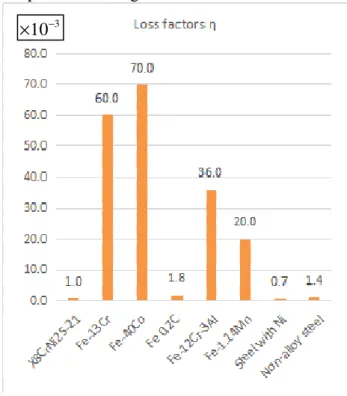
Zhang, Perez and Lavernia [45] presents numerical data regarding the vibration damping capabilities of several types of steels. The data are presented in figure 2.
Fig. 2. Loss factors for steel
3.3 Aluminum
Aluminum alloys are used to reduce mass and thus allow for greater acceleration and
deceleration of moving parts. Another
advantage is that aluminum conducts heat rapidly, thus decreasing the heat gradient inside the part and minimizing thermal distortion. Due to this characteristic it is used for certain coordinate measuring machines as it simplifies the system that compensates for thermal deformation.
Aluminum excels in low temperature environments also. Compared to steel, it exhibits an increase in tensile strength as the temperature decreases, while its toughness remains roughly the same. An application for this could be parts used in cryogenic machining.
Unfortunately, aluminum exhibits poor vibration damping capabilities as shown in figure 3.
Fig. 3. Loss factors for aluminum
3.4 Magnesium
Magnesium weighs only 2/3 of aluminum and has excellent mechanical properties. Because of this it’s used in application ranging from portable devices (e.g.: mobile phones, laptops) to the auto and aviation industry. Another advantage is its great vibration damping capability which makes it a good choice for housings of moving parts (e.g.: gearboxes) and machine tool structures.
The alloys of this metal have high dimensional stability and usually do not require any normalizing treatments, aging or stress relieving. The parts obtained by casting can be directly machined in order to turn them into the final product. Any possible dimensional changes are very small and predictable [46]. 3
10−
×
3
10−
Furthermore, magnesium has very good toughness which suggests it could be used in highly stressed components (e.g. milling heads). Its disadvantages are a significantly higher cost and lower Young’s modulus than aluminum and ferrous metals. The properties of some magnesium alloys are rendered in table 2 [47].
Table 2
The mechanical properties of some magnesium alloys
Alloy State Rp0,2
[MPa] Rm [MPa]
Brinell hardness [HB]
AM100A T61 117 235 69 AZ63A T6 110 235 73 AZ91C T6 110 235 73
WE43 T6 162 250 85
3.5 Hidamets
Hidamets are metals with high vibration damping properties. They represent alloys that efficiently transform mechanical vibration into heat due to high internal friction [39]. They offer certain advantages compared to the polymers traditionally used for this job: hidamets have superior mechanical properties and are able to operate at much larger temperatures [44].
Typical hidamets are Mn-Cu alloys (trade name: Sonoston), Cu-Zn-Al (Proteus), TiNi (Nitinol) [34]. Sonoston is an alloy used for submarine propellers due to the fact that it minimizes vibration that could be picked up by sonar. Typical properties are listed in table 3.
Table 3
Sonoston’s mechanical properties
Property Range Avg. value
Rp0,1 [MPa] 250-280 270
Tensile strength [MPa] 540-590 565
Elongation [%] 13-30 25
Brinell hardness [HB] 130-170 150
Izod [J] 25-55 40
Young’s modulus [GPa] 80
Density [kg/m3] 7100
Specific damping capacity [%] 30
4.NATURAL STONE
Natural stone, granite in particular, is often used for machine beds, portals and other components of coordinate measuring machines or of machines for precision machining [4]. It has a series of advantages: it is easily available in large quantities, it has a moderate cost and has great dimensional stability. Other strong points are its small thermal expansion coefficient and good vibration damping
properties [23]. However its reduced
mechanical properties such as tensile strength and Young’s modulus [36], [40] lead to the need of designing very robust parts compared to cast iron ones and limit natural stone usage to applications that involve small stresses. Table 4 lists the mechanical properties of different types of stone.
Table 4
The mechanical properties of different stone types
Stone type Tensile strength
[MPa] E [GPa]
Basalt 13,1 34
Limestone 8,3 77
Quartz 16,3 -
Granite 11,7 73
Marble 7,5 -
5. CERAMICS
Ceramics are inorganic materials which contain mainly metals and metalloids bonded by ionic and covalent bonds. Due to internal micro cracks they have a small tensile strength, but have high compression strength and hardness. Many ceramics are porous as a result of being manufactured by sintering particles. This class of materials also offers besides high hardness, high values for Young’s modulus [32].
According to [14] the advantages of ceramics are:
high specific rigidity leads to small deformations;
the small thermal expansion coefficient results in small deformations;
dimensional stability is maintained due to the lack of plastic deformation at ambient temperature;
The main disadvantages presented by the same paper are:
ceramics are brittle and don’t handle shocks;
reduced vibration damping capacity; the porous structure can’t withstand
concentrated forces.
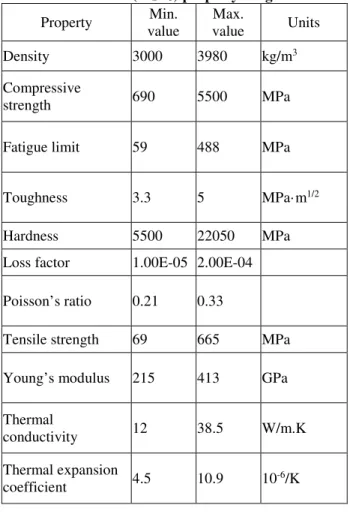
Table 5 presents the interval into which alumina properties fit depending on the composition.
Table 5
Alumina (Al2O3) property range
Property Min. value
Max.
value Units Density 3000 3980 kg/m3 Compressive
strength 690 5500 MPa
Fatigue limit 59 488 MPa
Toughness 3.3 5 MPa·m1/2 Hardness 5500 22050 MPa Loss factor 1.00E-05 2.00E-04 Poisson’s ratio 0.21 0.33
Tensile strength 69 665 MPa Young’s modulus 215 413 GPa
Thermal
conductivity 12 38.5 W/m.K Thermal expansion
coefficient 4.5 10.9 10 -6/K
6. METAL FOAMS
Another category of materials used for machine-tools are metal foams. They are formed of a metal that has numerous cavities filled with gas. If the cavities are separate from one another, the material is called metal foam, and if these are interconnected it’s called a porous metal.
The notable properties of these materials are reduced mass (just 5-25% of the volume is occupied by the metal) and very good tensile and compressive strength [1]. Due to the
porosity, the structures have an excellent capacity of absorbing energy and damping vibrations [48].
Metal foams are manufactured by creating gas bubbles inside the molten metal and let it solidify in this state. The bubbles can be obtained by any of the following three methods: Injecting gas into the molten metal from
an external source;
Precipitating gas that was previously dissolved into the molten metal;
Using foaming agents for creating gas bubbles directly inside the metal. The most frequently used metals are aluminum and titanium, but others such as nickel, molybdenum can be used.
Table 6 gives the mechanical properties of three metal foams which differ only as volume and size of pores, and table 7 lists the damping ratios of these materials. The values show that the mechanical properties decrease nonlinearly as the porosity increases, but the damping ratio has a maximum value for the medium pores and drops greatly for large pores [10].
Table 6
Strength-density relationship of metal foams [10]
Table 7
Porosity-damping ratio of metal foams [10]
7.FIBER REINFORCED POLYMERS
FRP composites consist of fibers and a polymer matrix. The most utilized fibers are: fiberglass, carbon fiber, aramid fibers (e.g.: Kevlar) and basalt fibers. The polymers used
are divided into thermoplastics (e.g.:
polypropylene) and thermosets (e.g.: epoxy resins, polyester resins).
short fibers; whiskers; long fibers; woven fibers [28]. Parts can be manufactured by:
manual lay-up;
resin transfer molding; pultrusion;
molding;
thermoforming [28].
Carbon fiber is commonly used for machine- tools due to its excellent mechanical resistance, a large Young’s modulus, small density and good vibration damping. The disadvantages of this material are the high cost of the material and especially of the manufacturing process, but there is also a problem of dimensional stability over long periods of time due to aging of the plastics used [11].
Typical structural elements which use carbon fiber are rams and slides, but can also include milling heads or tool extensions. Figure 4 [31] presents a spindle ram made originally of CFRP on the left and the same component with a hybrid CFRP and cork design on the right.
Fig. 4. a) Original carbon fiber component, b) Carbon and cork hybrid component [31]
8. POLYMER CONCRETE (MINERAL CASTING)
Polymer concrete, also known as mineral casting, consist of a mix of aggregates and a thermosetting resin [22]. The aggregates include basalt, granite, quartz sand, quartz and other materials. It’s important that the mineral particles are dust free and dry so that they bond well to the plastic [13].
The resin and hardener give an exothermic reaction during the hardening phase. If this chemical reaction produces too much heat in too little time, then the matrix can develop
cracks. Resin and hardener systems with a long curing time are chosen based on the manufacturer’s specifications in order to avoid cracking. An approximate ratio between the aggregates and the resin is 9:1, but varies depending on the size of the particles and their percentage [5]. A higher percentage of fine particles requires more resin due to their larger surface area.
Common mineral particle sizes vary from 0,01 to 10 mm [17].
The density of polymer concrete varies
between 2100 and 2400 kg/m3 and is about a
third of cast iron. This aspect, correlated with the high damping of this material [37], results in the possibility of obtaining structures with high resonance frequencies and low amplitudes. Some mechanical properties are of two mineral casting formulations are presented in table 8.
Table 8
The mechanical properties of two mineral casting formulations
Material
Tensile strength
[MPa]
Compression strength
[MPa]
E
[GPa] Poisson ’s ratio Kepczak and
Pawlowski (2013)
18,4 106,6 30 0,22 Schneeberger
Techcon 7 130 40 -
Important aspects to consider when
designing mineral castings are its small tensile strength [25] and the rapid decrease with temperature increase. Depending on the aggregates and the polymer matrix, tensile strength can vary from 15 to 40 MPa at approximately 20˚C. But a temperature of 80˚C can lead to a 50% drop in the initial strength [24]. Cooling pipes are integrated in the casting to avoid higher temperatures [33], [41].
Mineral casting also has significant
economic advantages. Even if the raw material for a part is similar in cost to cast iron, major price savings develop because of the minimal equipment necessary for manufacturing [9]. This material is well suited to a company with small assets which wishes to start making high-performance machine-tools in a short time.
9. HYBRID STRUCTURES
Hybrid structures represent combinations of multiple materials for the same part and offer better performance or cost than the use of a single material. The materials are held together by bonding with adhesives or mechanical fixation (e.g.: screws). The hybrid structures are often used to reduce the mass of a structure without decreasing its rigidity. Mass savings lead to the increase of natural frequencies of the part and allow the use of less powerful servomotors for the same performance.
Combinations that have been successfully used with good results are: mineral casting with steel [43]; steel and carbon fiber [8]; carbon fiber, fiberglass and aramid honeycomb [26];
sandwich structures (e.g.: aluminum
honeycomb covered by carbon fiber and steel sheet) [30].
10. PERFORMANCE METRICS
When choosing a material for a machine-tool’s structural component, it’s important to decide on the performance criteria that are most important for that particular application and their weights. Paper [2] describes how to create performance metrics based on these criteria and obtain an optimum trade-off surface. The paper describes a few methods of choosing the most appropriate material:
the trade-off surface is established and studied, using intuition to select between non-dominated solutions;
all but one of the objectives are re-formulated as constraints by setting lower and upper limits for them, thereby allowing the solution which minimizes the remaining objective to be read off;
a composite objective function or value function, V, is formulated; the solution with the minimum value of V is the overall optimum.
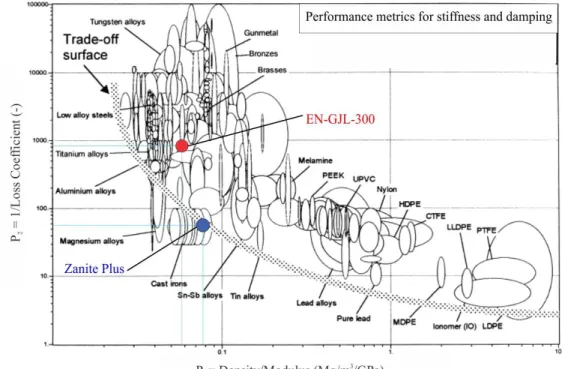
If we imagine that we are to design components of a machine-tool such as a milling machine or lathe, then we would probably be interested in stiffness, mass and damping capacity. Paper [2] uses Young’s modulus, density and the loss coefficient for these properties. Figure 5 shows a performance metric adapted from [2].
Outlined in red is the cast iron EN-GJL-300 and outlined in blue is a mineral casting formulation called Zanite Plus. The data used for their representation have been taken from the individual material specification sheets and processed so as to be superimposed on the metric calculated by [2]. It can easily be seen that Zanite Plus represents a much better option for designing machine tool structures than cast iron, and this is only when considering density, Young’s modulus and damping properties.
Also Zanite Plus offers significant cost
savings in the casting and subsequent production phases. So the mineral casting seems to be a more economical and higher performing material than the normally used lamellar graphite cast iron.
11. FUTURE RESEARCH
Future research will concentrate on
developing the know-how of using mineral casting for structural elements of machine-tools through numerical simulation. The authors intend to model aggregates and assign material properties to them and then to simulate the mixing of the aggregates in order to generate a representative volume element (RVE). The RVE can offer insight into the early failure mechanism of the material and can then be repeated a number of times to optimize the aggregate types and percentages, matrix used and manufacturing process (e.g.: mixing process and time). This data can be compared to experiments and real measurements and be developed into a process for calculating optimal formulas of mineral casting for specific applications.
12. CONCLUSIONS
The paper presents numerous materials used for the structural components of machine-tools and the properties which make them suited to particular applications.
Both the properties for static and dynamic loading are considered in order to give a wider view of the materials used in this domain.
Summing up the data presented in the current paper, mineral casting proves itself as a viable and attractive option for the difficult European and North American machine-tool markets. Mineral casting has a series of advantages such as:
low cost of raw material
low-cost and easy to set-up fabrication; small fabrication costs;
low energy consumption for making the
raw material and structure
manufacturing, and thus becomes an ecological material;
excellent dynamic behavior; good dimensional stability.
13. REFERENCES
[1]Aggogeri, F., Borboni, A., Merlo, A., Pellegrini, N., & Ricatto, R. (2017). Vibration Damping Analysis of Lightweight Structures in Machine Tools. Materials, 10, 297. https://doi.org/10.3390/ma10030297 [2]Ashby, M. F. (2000). Multi-Objective
Optimization in Material Design and Selection. Acta Materalia, 48, 359–369. [3]ASTM International. (2005). E 756 – 05:
Standard Test Method for Measuring Vibration-Damping Properties of Materials. ASTM International.
[4]Brecher, C., Utsch, P., Klar, R., & Wenzel, C. (2010). Compact design for high
precision machine-tools. International
Journal of MachineTools & Manufacture, 50(328–334).
https://doi.org/10.1016/j.ijmachtools.2009.1 1.007
[5]Bruni, C., Forcellese, A., Gabrielli, F. & Simoncini, M. (2008). Hard turning of an alloy steel on a machine tool with a polymer
concrete bed. Journal of Materials
Processing Technology, 202, 493-499. https://doi.org/10.1016/j.jmatprotec.2007.10. 031
[6]Cai, C., & Sun, Q. (2010). Measurement and Evaluation of Damping Properties of Damping Material (pp. 231–216). Presented at the IMEKO TC3, TC5 and TC22, Pattaya, Chonburi, Thailand.
[7]Cambridge University Engineering
Department. (2003). Materials Data Book. Cambridge University.
[8]Chang, S. H., Kim, P. J., Lee, D. G., & Choi, J. K. (2001). Steel Composite Hybrid Headstock for High-precision Grinding Machines. Composite Structures, 53, 1–8. [9]Ciupan, M. (2016). Proiectarea unor
componente structurale din material
compozit pentru un centru de prelucrare
CNC, Universitatea Tehnică din
Cluj-Napoca (Lucrare de disertație).
[11]Department Of Defense. (2002). Composite Materials Handbook (Vol. 3. Polymer Matrix Composites Materials Usage, Design, And Analysis). Department Of Defense. [12]Dobrzanski, L. A. (2006). Significance of
materials science for the future development of societies. Journal of Materials Processing
Technology, 175, 133–148.
https://doi.org/10.1016/j.jmatprotec.2005.04. 003
[13]Erbe, T., Krol, J., & Theska, R. (n.d.). Mineral Casting As Material For Machine Base-Frames Of Precision Machines.
[14]Furukawa, Y., Moronuki, N., & Kitagawa, K. (1986). Development of Ultra Precision Machine Tool Made of Ceramics. CIRP, 35(1), 279–282.
[15]Graesser, E. J., & Wong, C. R. (1991). The
Relationship of Traditional Damping
Measures for Materials with High Damping Capacity. David Taylor Research Center. [16]Graham Kelly, S. (2000). Fundamentals of
Mechanical Vibrations (2nd ed.). McGraw Hill.
[17]Haddad, H., & Al Kobaisi, M. (2012). Optimization of the polymer concrete used for manufacturing bases for precision tool machines. Composites: Part B, 43, 3061– 3068.
[18]Harib, K. H., Sharif Ullah, A. M. M., & Moustafa, K. A. F. (2013). Optimal design for improved hybrid kinematic machine tools. In Procedia CIRP (Vol. 12, pp. 109 –
114). Elsevier B.V.
https://doi.org/10.1016/j.procir.2013.09.020 [19]Huo, D., & Cheng, K. (2008). A
dynamics-driven approach to the design of precision machine tools for micro-manufacturing and its implementation perspectives. In Proc.
IMechE (Vol. 222).
https://doi.org/10.1243/09544054JEM839 [20]Huo, D., Cheng, K., & Wardle, F. (2010).
Design of a five-axis ultra-precision micro-milling machine—UltraMill. Part 1: holistic design approach, design considerations and specifications. Int J Adv Manuf Technol,
(47), 867–877.
https://doi.org/10.1007/s00170-009-2128-2
[21]Irvine, T. (2005). The Half Power
Bandwidth Method For Damping
Calculation.
[22]Jackisch, U.-V. (2002). Mineralguss fuer den Maschinenbau, Die Bibliothek der Technik 231, Verlag Moderne Industrie. ISBN 3-478-93273-4.
[23]Jaglinski, T., Kochmann, D., Stone, D., & Lake, R. S. (2007). Composite Materials with Viscoelastic Stiffness Greater Than
Diamond. Science, 315, 620.
https://doi.org/10.1126/science.1135837 [24]Kepczak, N., & Pawlowski, W. (2013).
Application of Mineral Casting for Machine Tools Beds. Mechanics and Mechanical Engineering, 17(4), 285–289.
[25]Kepczak, N., Pawlowski, W., &
Blazejewski, W. (2014). The Study of the Mechanical Properties of the Mineral Cast
Material. Archives of Mechanical
Technology and Automation, 34(2), 25–32. [26]Lee, D. G., Suh, J. D., Kim, H. S., & Kim,
J. M. (2004). Design and manufacture of
composite high speed machine tool
structures. Composites Science and
Technology, 64, 1523–1530.
[27]Macioce, P. (n.d.). Viscoelastic Damping 101. Roush Industries Inc.
[28]McDaniel, G., & Knight, C. (2014). Fiber Reinforced Polymer (FRP) Composites. Presented at the Design Training Expo. [29]Mechanical properties of gray cast iron.
(n.d.). Siempelkamp Giesserei.
[30]Merlo, A., Ricciardi, D., Cremona, A., Meo, F., & Aggogeri, F. (n.d.). Advanced composite materials in precision machine tools sector – Applications and perspectives. [31]Moehring, H. C. (2017). Composites in
production machines. In Procedia CIRP
(Vol. 66, pp. 2–9). Elsevier B.V.
https://doi.org/doi:
10.1016/j.procir.2017.04.013
[32]Moehring, H.-C., Brecher, C., Abele, E., Fleischer, J. & Bleicher, F. (2015). Materials in machine tool structures. CIRP Annals - Manufacturing Technology, 64 (2), 725– 748.
http://dx.doi.org/10.1016/j.cirp.2015.05.005 [33]Neugebauer R, Drossel W-G, Ihlenfeldt S,
Thermal Error Compensation of Machine Tool Structures with Graded Mineral Casting, MATAR2012-12053, MM Science Journal. 9th International Conference on Machine Tools, Automation, Technology and Robotics, 12–14 September, 2012, Prague, Czech Republic.
[34]Pan, Q., & Cho, C. (2008). Damping
Property Of Shape Memory Alloys.
Presented At The Metal 2008.
[35]Parkinson, Armson, Cooknell, Dixon, Martin, & Morgan. (1990). Damped Natural Vibration. Open University.
[36]Perras, M. A., & Diedrichs, M. S. (2014). A Review of the Tensile Strength of Rock: Concepts and Testing. Geotech Geol Eng. https://doi.org/10.1007/s10706-014-9732-0 [37]Piratelli-Filho, A., & Flamínio, L.-N.
(2010). Behavior of Granite-Epoxy
Composite Beams Subjected to Mechanical Vibrations. Materials Research, 13(4), 497– 503.
[38]Radzikowska, J. M. (n.d.). Metallography and Microstructures of Cast Iron. In ASM Handbook (Vol. 9: Metallography and Microstructures, pp. 565–587). Materials Park, Ohio, USA: ASM International.
[39]Ritchie, I. G., & Pan, Z.-L. (1991). High-Damping Metals and Alloys. Metallurgical Transactions, 22A, 607–616.
[40]Sbowe, R. L. (1969). Strength And Deformation Properties Of Granite, Basalt, Limestone And Tuff At Various Loading Rates.
[41]Schneider, M. (2012). Das intelligente
Mineralgussbett—Ein Beitrag zur
Reduzierung von thermisch bedingten
Fehlern an Werkzeugmaschinen,
Maschinengestelle heute—Werkstoffe
Konzepte Innovationen. Proceedings
Wangener Maschinen Tage, 09–10 May 2012, Wangen, Germany, 65–77.
[42]SOLIDWORKS Material Properties in Simulation. (n.d.). GoEngineer.
[43]Suh, J. D., & Lee, D. G. (2008). Design and manufacture of hybrid polymer concrete bed for high-speed CNC milling machine. Int J
Mech Mater Des, (4), 113–121.
https://doi.org/10.1007/s10999-007-9033-3 [44]Watanabe, Y., Suga, Y., Sato, H.,
Tsukamoto, H., & Nishino, Y. (2013). Damping Capacity of Fe17mass%Mn High Damping Alloy with Variant Controlled
Microstructure. Materials Transactions,
54(8), 1288–1294.
[45]Zhang, J., Perez, R. J., & Lavernia, E. J. (1993). Documentation of damping capacity of metallic, ceramic and metal-matrix composite materials. Journal Of Materials Science, 28, 2395–2404.
[46]http://www.afsinc.org/content.cfm?ItemNu mber=6895.
[47]http://aviationandaccessories.tpub.com/TM -43-0106/
[48]https://www.americanelements.com/foams. html
Proprietăți mecanice ale elementelor structurale ale maşinilor-unelte
Rezumat: Lucrarea prezintă proprietățile mecanice ale materialelor care sunt deja sau ar putea fi utilizate în construcția elementelor structurale ale maşinilor-unelte. Materialele prezentate includ metale, piatră naturală, materiale ceramice, spume metalice, materiale compozite cu fibre, betoane polimerice (compozit mineral) şi structuri hibride. Cele mai uzuale caracteristici ale elementelor structurale sunt detaliate şi categorizate. La final este detaliată o metodologie pentru alegerea materialului optim si un grafic de performanțe arată de ce compozitul mineral este mai potrivit pentru maşini-unelte aşchietoare decât fonta cu grafit lamelar.
Mihai CIUPAN, Eng., Technical University of Cluj-Napoca, Department of Manufacturing Engineering, 103-105 Muncii Blvd., 400641 Cluj-Napoca, email: [email protected], phone: +4 0755 178 271.
![Fig. 4. a) Original carbon fiber component, b) Carbon and cork hybrid component [31]](https://thumb-us.123doks.com/thumbv2/123dok_us/7998520.2120725/6.892.70.410.662.818/fig-original-carbon-fiber-component-carbon-hybrid-component.webp)