Dr Vidya Venugopal et al JMSCR Volume 07 Issue 05 May 2019 Page 752
Original Article
Efficacy of Psidium guajava leaf extract on Streptococcus mutans and
Enterococcus faecalis – an in vitro study
Authors
Dr Vidya Venugopal
1, Dr Gopinath Prakasan
2, Sandeep P M
3, Dr Anuradha E Sunil
4,
Dr Archana Mukunda
5*, Dr Steffy Rachel Samuel
61,6
PG student, Dept of Oral & Maxillofacial Pathology, Royal Dental College, Chalissery, Kerala
2
Reader, Dept of Microbiology, Royal Dental College, Chalissery, Kerala
3
Lecturer, Dept of Microbiology, Royal Dental College, Chalissery, Kerala
4,5
Professor, Dept of Oral & Maxillofacial Pathology, Royal Dental College, Chalissery, Kerala *Corresponding Author
Dr Archana Mukunda
Professor, Dept of Oral & Maxillofacial Pathology, Royal Dental College, Chalissery, Kerala, India
Abstract
Introduction: The general health of the body is governed largely by oral health. The most common oral diseases are dental caries and gingivitis both of which are caused by micro organisms. Streptococcus mutans and Enterococcus faecalis are the common causative bacteria which are traditionally treated with antibiotics. Many herbal preparations have also known to exhibit potent antibacterial activity.
Objective: To evaluate the antibacterial activity of Psidium guvajava leaf extract on Streptococcus mutans and Enterococcus faecalis
Methods: In vitro study, in which the ethanolic extract of Psidium guajava leaf extract was prepared using solvent extraction apparatus. The extract was then diluted in normal saline to 3 different concentrations. Well diffusion method was used to determine the zone of inhibition of various concentrations of Psidium guajava leaf extract against Streptococcus mutans and Enterococcus faecalis. Zone of inhibition was measured in mm.
Result: At all concentrations guava leaf extract showed zone of inhibition against Streptococcus mutans (S. mutan) and Enterococcus faecalis (E.faecalis). Zone of inhibition increased with concentration of the extract.
Conclusion: Psidium guajava leaf extract demonstrate an anti-microbial property against Streptococcus mutans and Enterococcus faecalis
Keywords: Enterococcus faecalis, Psidium guajava, Streptococcus mutans, zone of inhibition.
Introduction
Oral cavity has been delineated as “window to the overall health.” Person cannot be considered healthy unless he is free of dental infections like
dental caries, gingivitis, halitosis, periodontitis e.t.c irrespective of his general physical health. The most common oral diseases are gingivitis, periodontitis, halitosis and dental caries all of
www.jmscr.igmpublication.org Index Copernicus Value: 79.54
ISSN (e)-2347-176x ISSN (p) 2455-0450
Dr Vidya Venugopal et al JMSCR Volume 07 Issue 05 May 2019 Page 753 which develop from microorganisms. The most
common pathogen isolated from oral diseases is Streptococcus mutans (SM) from dental plaque and Enterococcus faecalis (EF) from infected root canals and periodontal disease.1
Treatments in modern dentistry are aimed more towards treating the diseases symptomatically rather than eliminating the etiology specifically. Hence there is a sudden surge in development of newer treatment modalities which aim at not only treating the diseases but also eliminate the etiology permanently.2
Microbiological origin infections are traditionally treated with various synthetic medicines which are associated with various adverse effects. Hence there are numerous alternative researches developing based on phytomedicine which has shown promising results with least possible side effects and are thus considered to be safer than synthetic drugs.3 Phytomedicines use crude herbs and can be used for prolonged duration of time and are thus different from chemical drugs. Various natural products such as curcuma zedoaria calendula, Azadirachtaindica, aloe vera, thulasi and other herbs are effectively to treat oral disease.4 The antibacterial activity of herbal based medicine is executed directly by inhibiting cell wall synthesis along with inhibition of protein synthesis and nucleic acid synthesis and indirectly by immune modulation and inhibiting the adherence of the bacteria all of which collectively have bactericidal effects.5
Psidium guajava belonging to the family of Myrtaceae is a common plant found in India. It is known as “poor man’s apple of the tropic” and has also been long known for its medicinal values. Historically it has been used from past to manage various systemic conditions and also enhances oral health.6 Guava leaf constitute various bioactive substance like phenolic compounds, isoflavanoids, gallic acid, catechin, epicatechin, rutin, narigenin, kaempferol having hepatoprotective antioxidant, anti-inflammatory, antispasmodic, anticancer, antimicrobial, anti-hyperglycemic, analgesic action.7
Based on the above facts this current study was undertaken to assess the potent and prompt antimicrobial action of guava leaves so as to be used as a new effective antimicrobial treatment against oral micro-organism.
Aim of the study
To evaluate the antibacterial activity of Psidium guajavaleaf extract on Streptococcus mutans and Enterococcusfaecalis
Objectives of the study
To assess anti bacterial activity of 3 different concentration of Psidiumguajava leaf extract on Streptococcus mutans To assess anti bacterial activity of 3
different concentration of Psidiumguajava leaf extract on Enterococcus faecalis To compare the anti bacterial activity of
Psidium guajava leaf extract against Streptococcus mutans and Enterococcus faecalis
Materials and Methods
The current study was an in vitro study conducted to assess the antimicrobial activity of Psidium guava leaf extract on Streptococcus mutans and Enterococcus fecalis.
Preparation of Guava extract
Dr Vidya Venugopal et al JMSCR Volume 07 Issue 05 May 2019 Page 754
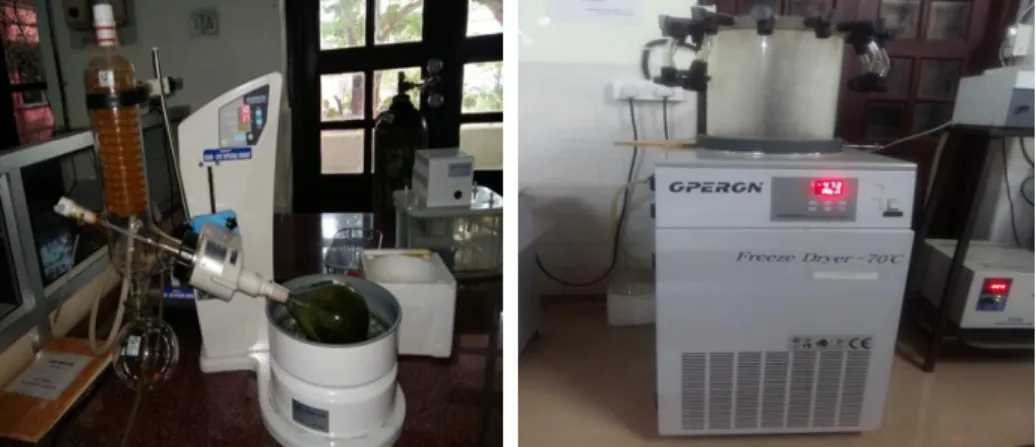
Fig 1: Showing rotary flash evaporator and freeze dryer
Sample Preparation
Mutans Sanguis agar and Mueller Hinton agar were used as the culture medium to obtain stains of Streptococcus mutans and Enterococcus
faecalis respectively (fig 2 and 3). The colonies of bacteria obtained after incubation was confirmed by smearing the bacterial colonies onto clean glass slides which were then stained with Gram’s stain.
Fig 2: showing white beaded colonies of Streptococcus mutans on Mutans Sanguis agar
Dr Vidya Venugopal et al JMSCR Volume 07 Issue 05 May 2019 Page 755 The strains of confirmed Streptococcus mutans
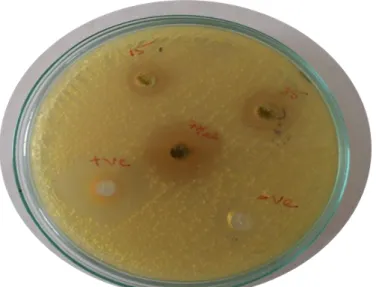
and Enterococcus fecalis were smeared on to Mutans sanguis agar plates and Muller’s Hinton agar plates respectively. 5 circular wells of uniform dimension were prepared on the agar plates. 3 wells were filled with different concentration of guava leaf extract (75mg/ml, 35mg/ml and 15mg/ml) 1 was filled with positive
control (chlorhexidine) and 1 was filled with negative control (saline) (fig 4). The agar plates were then incubated aerobically at 37°C for 24 hrs. After 24hrs the zone of inhibition around each well was measured in mm. The zone of inhibition around each concentrate of the extract along with positive and negative control in both agar plates were tabulated in excel sheets.
Fig 4: showing 3 wells for three different concentration of guava leaf extract (75mg/ml, 35mg/ml and 15mg/ml)
Results
The data obtained were evaluated by observational analysis, so no statistical tests were required. The zone of inhibition noted on Mutans sanguis agar plates against Streptococcus mutans showed a steady increase along with increase in concentration of guava leaf extract. The zone of
inhibition noted with 15mg/ml extract was 9mm, 35mg/ml extract was 15mm and maximum zone of inhibition of 26mm with 75mg/ml. The zone of inhibition around positive control (cholorhexidine) was 29mm whereas with negative control (saline) was only 1mm (Fig 5).
Fig 5: showing varying measurement of zone of inhibition of Streptococcus mutans around different concentration of guava leaf extract, positive control and negative control
We noted that the zone of inhibition noted on Mueller’s Hinton agar plates with Enterococcus
Dr Vidya Venugopal et al JMSCR Volume 07 Issue 05 May 2019 Page 756 The zone of inhibition noted with 15mg/ml extract
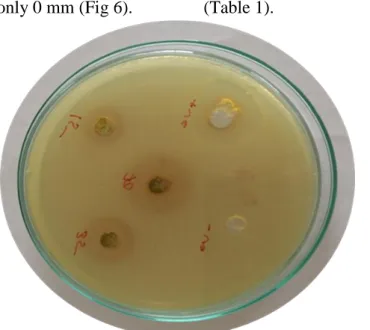
was 7 mm, 35mg/ml extract was 12 mm and maximum zone of inhibition of 19 mm with 75mg/ml. The zone of inhibition around positive control (cholorhexidine) was 26 mm whereas with negative control (saline) was only 0 mm (Fig 6).
We generally found that the zone of inhibition around both bacteria increased with increase in concentration of guava leaf extract. However the zone of inhibition around SM was greater than EF with same concentration of guava leaf extract (Table 1).
Fig 6: showing varying measurement of zone of inhibition of Enterococcus fecalis around different concentration of guava leaf extract, positive control and negative control
Table 1: showing measurements of zone of inhibition of SM and EF
CONCENTRATION IN MG/ML
70MG/ML 35MG/ML 15MG/ML POSITIVE
CONTROL
NEGATIVE CONTROL
Streptococcus mutans 26mm 15mm 9mm 29mm 1mm
Enterococcus fecalis 19mm 12mm 7mm 26mm 0mm
Discussion
Optimization of people’s health is the major goal among the health care professionals. Currently dental infections are one of the common health problems affecting larger numbers of population. Dental problems have recently been thought to give rise to systemic problems as well. Primary prevention of oral diseases though considered as the best treatment option available however is often very difficult to achieve. Imprudent use of synthetic medicine has produced resistance against many strains. They are also known to be associated with many adverse effects. Therefore, recent researches had been more focused on herbal preparation; these are effective with least possible side effect.
Psidiumguajava is a phytotherapeutic plant which is rich in tannins, phenols, triterpenes, favonoids,
essential oils, saponins, carotenoids, lectins, vitamins, bre and fatty acids.6 The leaves of guava are rich in favonoids, particularly quercetin known for its spasmolytic, antioxidant, antimicrobial, anti-inflammatory actions and guaijaverin known for its antibacterial action.8
Dr Vidya Venugopal et al JMSCR Volume 07 Issue 05 May 2019 Page 757 Studies in the past have highlighted the
antibacterial activity of guava leaf extract against Staphylococcus aureus, Escherichia coli, Salmonella enteritidis, and Bacillus cereus which can cause food borne illness and spoilage.5
The antibacterial activity of guava leaves has been comprised into various modes of action. It is suggested that the extract penetrate the lipid bilayer of the cell membrane resulting in increased permeability leading to leakage of vital contents. The tannins present in guava leaf are polyphenolic compounds that bind to proline rich protein that interferes with protein synthesis thereby exert antibacterial activity. Flavonoids are hydroxylated polyphenolic compounds present in guava leaves form complexes with extracellular and soluble proteins in bacterial cell wall.5
Chlorhexidine is the most commonly used antimicrobial agent against S. mutans and E.fecalis but it is well known for its side effects such as staining of teeth and restorations, alteration in taste sensations and also they produce resistance against microorganism, these limitations may limit the long term use of chlorehexidine.
In our in vitro study, we assessed the antibacterial activity of Psidium guava leaf extract on the most common oral pathogens Gram positive cocci-Streptococcus mutans and Enterococcus fecalis. Well diffusion method was used to assess the antibacterial property of the 3 different concentration of extract at 75mg/ml, 35mg/ml and 15mg/ml. The antibacterial activity of the extract was noted as zone of inhibition and measured in mm.
As a general finding we noted that zone of inhibition increased as the concentration of the extract increased. We also noted that the maximum zone of inhibition was observed with 75mg/ml concentrate extract and the least with 15mg/ml concentration extract.
In Streptococcus mutan the maximum zone of inhibition observed with 75mg/ml guava leaf extract was 26mm which was almost similar to the zone of inhibition obtained with positive control
(29mm). In Enterococcus fecalis we observed a maximum zone of inhibition of 19mm with 75mg/ml guava leaf extract. This was close to the zone of inhibition we observed with positive control (26mm).
We additionally compared the antibacterial activity of guava leaf extract between Streptococcus mutans and Enterococcus fecalis. We noted that the antibacterial activity of guava leaf extract was more potent with larger zones of inhibition with Streptococcus mutans than Enterococcus fecalis in all the 3 concentrations used in this study.
The findings of our study prompt us to highlight the potential use of herbal medicine into day to day practice as they are easily available, economically feasible and culturally acceptable with potentially less side effects and may offer to be a lucrative substitute to synthetic preparations.
Conclusion
The result of the current study highlights on the validation of therapeutic potential of Psidium guajava leaf extract against various dental problems. It can be used in as an ingredient in may pharmaceutical preparation as they are effective economical and free of side effects. This is our effort in exploring and valuing the phytotherapeutic effect of guava leaf extract against various dental problems. Intense research efforts in clinical trials should be emphasized so it could be further developed for prevention and as an adjuvant in the treatment of various dental problems.
Source of support: Nil Conflict of interest:
References
Dr Vidya Venugopal et al JMSCR Volume 07 Issue 05 May 2019 Page 758 2. R. Pai, L.D. Ahcarya, and N. Udupa,
Evaluation of anti-plaque activity of azadirachtaindica leaf extract gel – a 6 week clinical study. Journal of Ethno pharmacology, 90, 2004, 99-103.
3. Kumbhar AB, Chaudhari P. D. Shaikh K, Dongaonkar C. Modern Approaches For The Treatment Of Periodontitis: A Review. WJPPS 2017;6:628-647.
4. K. Ravi and P. Divyashree, psidiumguajava: Review on its potential as an adjunt in treating periodontal disease. Pharmacognosy review, 8(16), 2014; 96-100.
5. Bipul Biswas, Kimberly Rogers, Fredrick McLaughlin, Dwayne Daniels, and Anand Yadav, Antimicrobial Activities of Leaf Extracts of Guava (Psidiumguajava L.) on Two Gram-Negative and Gram-Positive Bacteria. International journal for microbiology. 2013
6. J. V. Kamath, Nair Rahul, C. K. Ashok Kumar, S. Mohana Lakshmi, Psidiumguajava L: A review. International Journal of Green Pharmacy. 2, 2008; 9-12 7. Barbalho SM, Farinazzi-Machado FM, de
AlvaresGoulart R, Brunnati AC, Ottoboni AM. Psidiumguajava (Guava): A plant of multipurpose medicinal plants. Med Aromat Plants. 2012;1:104
8. Rishika D, Sharma R. An update of pharmacological activity of Psidiumguajava in the management of various disorders. Int J Pharm Sci Res. 2012;3:3577–84.