African Journal of Reproductive Health December 2019; 23 (4):35
ORIGINAL RESEARCH ARTICLE
Government Ownership and Adaptation in Scale-Up: Experiences from
Community-Based Family Planning Programme in the Democratic
Republic of the Congo
DOI: 10.29063/ajrh2019/v23i4.5
Murtala Mai
1, Elham Hassen
1, Alexis B. Ntabona
2, Jacqueline Bapura
3, Meera Sarathy
1*, Rachel
Yodi
3and Zenon Mujani
4Pathfinder International/E2A Project1; ExpandNet2; Pathfinder International/DRC3; Ministry of Health, DRC4
*For Correspondence: E-mail: [email protected]; Phone: 202-804-4561
Abstract
A systematic approach to scale-up was applied to expand an integrated package of family planning and primary healthcare services from the Democratic Republic of the Congo‘s South Kivu province to health zones in Lomami, Lualaba, and Kasai Central provinces. This approach was based on recommendations from the ExpandNet/WHO guide Beginning with the end in mind. The approach emphasized application of three recommendations: engaging government stakeholders, ensuring the relevance of the intervention, and tailoring the innovation to the setting. This approach led to successful scale-up of community-based family planning, increasing access to and uptake of contraception and demonstrating potential for sustainability; 231,566 new acceptors were recruited and 149,826 couple-years of protection were generated. The systematic scale-up approach led to integration of community-based family planning indicators in the national health information system and transferred ownership of the interventions to the government, creating and strengthening government platforms with potential to sustain the interventions. (Afr J Reprod Health 2019; 23[4]:35-45).
Keywords: DRC, family planning, communities, systematic scale-up, integration, adaptation
Résumé
Une approche systématique de l'intensification a été appliquée pour étendre un ensemble intégré de services de planification familiale et de soins de santé primaires de la province du Sud-Kivu en République Démocratique du Congo aux zones de santé des provinces de Lomami, Lualaba et Kasaï Central. Cette approche était basée sur les recommandations du Guide ExpandNet / OMS Commencer avec la fin à l‘esprit. L'approche a mis l'accent sur l'application de trois recommandations: impliquer les parties prenantes gouvernementales, garantir la pertinence de l'intervention et adapter l'innovation au contexte. Cette approche a conduit à une intensification réussie de la planification familiale à base communautaire, à un meilleur accès à la contraception et à son utilisation et à démontrer un potentiel de durabilité; 231 566 nouveaux accepteurs ont été recrutés et 149 826 années de protection ont été générées. L'approche de mise à l'échelle systématique a conduit à l'intégration des indicateurs de planification familiale à base communautaire dans le système national d'information sanitaire et a transféré la propriété des interventions au gouvernement, créant et renforçant des plateformes gouvernementales susceptibles de soutenir les interventions. (Afr J Reprod Health 2019; 23[4]: 35-45).
Mots-clés: RDC, planification familiale, communautés, extension systématique, intégration, adaptation
Introduction
For the past five decades, family planning projects in sub-Saharan Africa have allowed many women and girls to reach their reproductive aspirations and exercise their rights to health and development. However, such family planning interventions have rarely moved from pilot to scale, reaching only limited populations in select countries. This has left many communities, especially the most rural, poor, and vulnerable, without sustainable access to family planning services and contraceptive choice. As a
result, sub-Saharan Africa is home to the largest proportion of women with an unmet need for family planning—21 percent1. In the Democratic of Republic of the Congo (DRC), especially in rural areas, women have an average of seven children, the modern contraceptive prevalence rate hovers at four to five percent2, and 730 out of every 100,000 live births end in a maternal death3.
African Journal of Reproductive Health December 2019; 23 (4):36
Pathfinder International, in partnership with ExpandNet, IntraHealth International, Management Sciences for Health, and PATH, has sought to change this pattern by shifting emphasis from a narrow project approach to the use of systematic strategies to scale-up. Such a strategy was implemented in the DRC, where successful pilot interventions that provided integrated community-based family planning and primary healthcare services in one province (South Kivu) were scaled up in three additional provinces (Lomami, Lualaba, and Kasai Central).
From 2008 to 2013, USAID supported Pathfinder International to implement the Flexible Family Planning, Reproductive Health and Gender-Based Violence Services for Transition Situations (Flex-FP) Project in two health zones of South Kivu Province. This project sought to identify, test, and analyze flexible approaches, packaged into context-specific models of community-based family planning, reproductive health, and management of gender-based violence (GBV) for refugees, internally displaced persons (IDPs), returnees, and other transitory populations. South Kivu, in Eastern DRC, was a post-conflict area with a significant transitory population that lacked access to basic health and education services. Additionally, South Kivu had one of the world‘s highest rates of sexual and gender-based violence (SGBV) where rape was used as weapon of war.
After five years testing different approaches in South Kivu, the Flex-FP Project identified a successful, scalable model: a package of integrated, community-based family planning and primary healthcare services for transitory populations. The project engaged community health volunteers (relais communautaires) and trained them to be community-based distributors (CBDs) of family planning services. The CBDs provided condoms, Cyclebeads, oral contraceptive pills, and counseling on lactational amenorrhea. In addition, unemployed nurses living in the targeted communities were recruited to provide the same non-clinical methods of family planning as well as injectable contraceptives in rural communities. Mobile outreach services staffed by facility-based providers covered primary healthcare services, including treatment of malaria, acute respiratory infection, and diarrhea.
Based on the success of this pilot project in increasing access to and uptake of family planning services, USAID/DRC approached the E2A Project to implement similar integrated community-based
family planning and primary healthcare services on a wider scale in 15 out of the 25 priority rural health zones in DRC‘s Lomami, Lualaba, and Kasai Central provinces. This paper describes the process and results of this scale-up effort.
Background
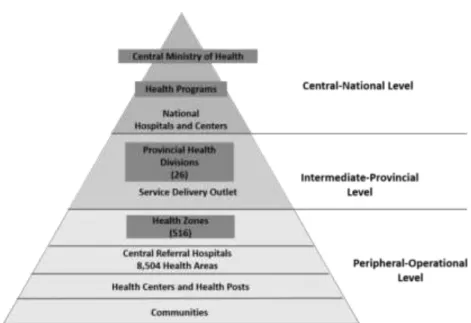
The interventions of the E2A community-based family planning project were implemented within the structure of the DRC health system, which consists of: (1) the central Ministry of Health (MOH) and its specific programs, such as the National Reproductive Health Program (NRHP) and the Integrated Child Health Program (ICHP); (2) the 26 provincial health divisions; and (3) the 516 health zones, which have 16 to 17 health areas each, or 8,504 health areas total, the level at which community-based activities took place. Almost all health areas—97% or 8,266—have one public health center. An estimated 5,000 to 10,000 people live in each health area (Figure 1).
Also at the health area level, two types of community health volunteers function in the three new provinces: the community health promoters (relais promotionnels) who conduct health awareness activities and community treatment workers (relais prestataires) who staff the community health huts (sites de soins communautaires) in rural, hard-to-reach areas. Community health huts provide basic preventative and treatment services for diarrhea, fever, and acute respiratory infection; distribution of a limited package of non-clinical family planning (FP) commodities, and referral of malnourished children to health centers. However, in most health areas, without donor support, community health volunteers are inactive.
The Government of DRC has demonstrated significant political will to make FP, especially long-acting methods, a national priority. In 2009, the government organized a national conference on family planning to reaffirm stakeholders‘ commitment to advancing FP, which led to the creation of the national multi-sectorial FP technical committee under the leadership of the NRHP. The NRHP developed the 2014-2020 National Strategic Plan for Family Planning, which lays out the government‘s intentions to budget for contraceptives and to increase access to a range of modern contraceptive methods in the country. The government has committed to finance FP activities in
African Journal of Reproductive Health December 2019; 23 (4):37
Figure 1: Democratic Republic of the Congo (DRC) Health System Structure
system, but the DRC has allowed organizations to charge a small fee, according to the client‘s ability to pay, to increase sustainability of the system4. The national strategic plan also includes a goal of providing three CBD agents per health area. Additionally, FP is listed among the country‘s priorities for improving maternal, newborn and child health outcomes and is included in the minimum package of activities delivered through the primary health care system.
However, the funding allocated to FP in the DRC is limited: bilateral and multilateral donors, including USAID, United Nations Population Fund (UNFPA), Department for International Development (DFID), and International Planned Parenthood Federation (IPPF) contribute about 85% of national spending on FP, and the central government less than 1%5. The availability of FP services and commodities remains a challenge: in a 2014 study that randomly sampled 1555 facilities of all levels across the country, 33% were found to offer FP services and only 14% had at least three types of FP methods available, most commonly condoms, pills, and injectable contraceptives. Higher-level facilities were more likely to offer FP than lower level facilities: 53.1% of hospitals, 38.5% of referral health centers, 31.1% of health centers, and only 8.9% of health posts offered FP6. Human resources for health are limited, with a large proportion of health services
provided through donor-funded projects. A lack of consistent standards across the public and private
sectors have led to variation in trainings and service quality, particularly in rural areas and in newly created health facilities7. Community health volunteers are expected to fill gaps in rural areas, but they are unpaid, which limits their availability. Non-payment of community health workers, and the low salary for health workers in general, is a challenge in recruiting, training, and retaining health personnel and sustaining health programs. Continued provision of regular technical and financial support for supervision and monitoring at all levels of the health system (national, regional, and district) is often unavailable.
The interventions to be scaled up through the E2A project built on the existing health system and government inputs, including developing capacities of the community health volunteers (both relais prestataires and relais promotionnels) to become community-based distributors (CBDs) of non-clinical family planning methods and oral rehydration salts and zinc. These newly trained CBDs would then work alongside nurses from facilities at outreach events to provide integrated FP and basic maternal and child health (MCH) services. E2A‘s project interventions were meant to complement the efforts of the ongoing Integrated Health Project (IHP)/Projet de Santé Intégré (PROSANI), led by Management Sciences for Health, which supported
comprehensive, integrated facility-based health service delivery including family planning
African Journal of Reproductive Health December 2019; 23 (4):38
Methods
Use of the ExpandNet scale-up tool “Beginning
with the end in mind”
The scale-up guide Beginning with the end in mind,
developed by ExpandNet in collaboration with the World Health Organization‘s Department of Reproductive Health and Research,was usedto adapt and scale up community-based family planning interventions in the DRC8. The guide offers 12 recommendations on how to design projects and small-scale programmatic interventions with successful scale-up in mind. The most relevant recommendations from this guidance tool for scaling up the community-based family planning interventions from one province to three additional ones were the following:
1. Engage in a participatory process involving key stakeholders.
2. Ensure the relevance of the proposed innovation. 3. Tailor the innovation to the sociocultural and
institutional settings
4.
Test the innovation under routine operating conditions.In applying these recommendations, E2A, in collaboration with the DRC government, worked within the existing health system to expand the reach and impact of the interventions to benefit more people and to make the interventions sustainable.
Participatory process with government in the
lead
Adapting and scaling up the community-based family planning interventions was a government-led participatory process. Such an approach is not only validated by the literature on scale-up9 but was also identified as important to the DRC government health authorities. Representatives from the central Ministry of Health expressed deep reservations and reluctance about yet another initiative that would circumvent existing health structures and create a parallel system. They were critical of the typical ―project mentality‖ where interventions are dictated by external partners and without meaningful engagement with
government and community leaders. One
policymaker stated:
―You know very well how projects usually operate: the hand that gives is always above
the one that receives! The consequence is that projects kill programs. Make an effort so that this is not the case again!‖
Recognizing that ownership of the interventions needed to reside within the DRC government, informal discussions were held with the NRHP to shift ownership from the E2A Project to government health authorities at all levels. This change was announced formally at a national stakeholders meeting.
NRHP authorities expressed enthusiasm for the ownership role. They developed and followed a detailed work plan for the planning and design of the project. They then convened several meetings and established the agenda for each subsequent engagement with partners and national, provincial, and zonal health authorities.
NRHP proposed that in-country project staff co-locate within provincial health offices to facilitate team building, better align interventions with other health initiatives, and build capacity of the provincial government counterparts. Provincial health authorities were invited to several national meetings and selected key priority rural health zones for project interventions.
Building ownership within the NRHP required nearly six months and a significant amount of effort. NRHP had to substantially adjust its work plans to accommodate this new role and negotiate with other MOH programs to secure their commitment and participation. The protracted transition time to shift ownership from E2A to the government led to frustrations among the in-country project team, who had already been recruited, trained, and were ready to begin project interventions, which was compounded by donor expectations and repeated enquiries regarding the timeline for project start-up. Project leadership carefully managed and addressed these frustrations and expectations through multiple meetings, reflections, and continual learnings. Similar complexities involved in changing the roles and responsibilities of development partners have been corroborated elsewhere10,11.
African Journal of Reproductive Health December 2019; 23 (4):39
(described below) that was conducted in the three provinces to inform the design of the project and (2) to regularly guide the project during the implementation phase, serving in a supervisory role.
The TAG initially held monthly coordination meetings with NRHP, but after the start-up phase, switched to meeting quarterly. Regular two-way communication between the TAG and the provincial and zonal health authorities ensured integration of E2A project activities within the provincial and zonal health operational plans. On a semi-annual basis, the TAG conducted field visits to the provinces at all the levels (provincial, zonal, health facility, and community) to observe implementation and provide feedback.
With government taking the lead, E2A‘s role largely shifted to that of facilitator among donor, government, and other implementing partners. However, there were certain responsibilities that government still lacked capacity to finance and manage and therefore delegated to the project, such as: procurement of equipment and supplies; forecasting and distribution of contraceptives (including communication with central and provincial warehousing) to the health zones and areas of intervention; financial disbursement and transportation logistics for the management of the community-based interventions; and financial support for the training of facility-based nurses and midwives, community volunteers and adult and youth community leaders and champions.
In-depth assessment with multiple stakeholders
prior to implementation
Prior to implementation, the MOH conducted an in-depth assessment, inviting the E2A Project, including ExpandNet and Pathfinder, and IHP/PROSANI, as key partners in the three provinces, to participate. The MOH-led team emphasized the need to examine how the initial South Kivu model needed to be adapted to succeed within the different provincial service delivery and social contexts.
The objectives of the assessment were to:
a. Evaluate the relevance of the intervention package in the new context.
b. Observe the on-the-ground realities of the healthcare delivery system.
c.
Engage and solicit the views, priorities, and concerns of a broad range of stakeholders withresponsibility for implementing the intervention package.
With support from partners, the team developed assessment tools for a predominantly qualitative and participatory approach. The assessment entailed 45 in-depth interviews with provincial and zonal health authorities, facility-based nurses and midwives,
Health Development Committee (CODESA)
members who are charged with setting health priorities in their communities and developing strategies to address salient health issues, and community volunteers. The assessment also entailed nine focus group discussions with members of the community (men and women of reproductive age) evenly distributed across all three provinces.
Assessment findings confirmed the relevance and vital need for a community-based family planning and healthcare service delivery model in rural health zones of the three new provinces. The population is widely dispersed and accessing health facilities is costly and difficult due to the lengthy travel time across tough terrain. However, the MOH-led team found that adaptation of the intervention package applied in South Kivu to the contexts of these new settings was critical.
Adaptation
of the South Kivu model to the new
provinces
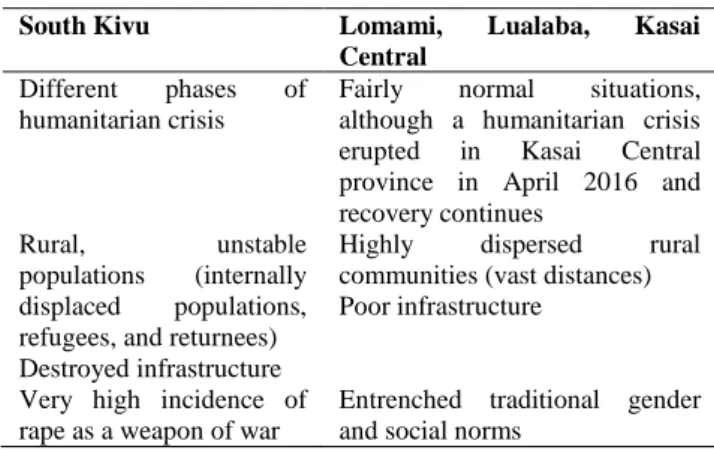
Lomami, Lualaba, and Kasai Central provinces differ substantially from South Kivu (Table 1). The assessment showed that the three provinces were more stable, had lower rates of GBV, and had a larger and more capable health workforce, indicating that adaptation would be a necessary part of the scale-up process as follows:
Shift to engagement of existing nurses and midwives for FP outreach work: The South Kivu model mobilized unemployed nurses to provide injectable contraceptives (DMPA IM) within the community to complement other CBDs‘ family planning work. During the assessment in all three provinces, such an approach was met with resistance from nurses and midwives at facilities. For example, a head nurse commented:
African Journal of Reproductive Health December 2019; 23 (4):40
Table 1: Contexts for service delivery: South Kivu versus Lomami, Lualaba, and Kasai Central
South Kivu Lomami, Lualaba, Kasai
Central
Different phases of humanitarian crisis
Fairly normal situations, although a humanitarian crisis erupted in Kasai Central province in April 2016 and recovery continues
Rural, unstable populations (internally displaced populations, refugees, and returnees) Destroyed infrastructure
Highly dispersed rural communities (vast distances) Poor infrastructure
Very high incidence of rape as a weapon of war
Entrenched traditional gender and social norms
Table 2: Adaptations from South Kivu South Kivu to Lomami, Lualaba, and Kasai Central
South Kivu Lomami, Lualaba, and Kasai Central
Mobile primary health care (PHC) services
Link the provision of free FP with basic treatment services for MCH during outreaches
Community-based provision of ORS/zinc
Community-based distribution of non-clinical methods and Depo Provera® injections
Addition of community-based provision of implants and DMPA SC/Sayana Press® Addition of community-based adolescent and youth sexual and reproductive health component Prevention and case
management of sexual and gender-based violence (SGBV) especially rape
Replaced SGBV interventions with a focus on gender issues through equitable representation of women and male involvement in RH/FP
Selection process for CBDs done by project
Selection of CBDs done jointly with the communities (as per national guidelines)
A combination of
CBDs and
unemployed nurses (all unpaid) provide family planning services
Existing facility-based nurses and midwives (paid) focus on delivering implants and injectables through outreaches while CBDs provide non-clinical methods
Addition of community-based men, women and youth champions Project monitoring
using crisis updates (community-based data)
Program monitoring using service data distinguishing between facilities and communities
Government-led periodic reviews at all levels of the health system Evaluation process
based on project monitoring & evaluation indicators
Government-led definition of results and process indicators
that is the best way to go. People know us and trust us—we are part of the formal health system. Why don‘t you, instead of paying
them, work with us so that we will be able to do what we are meant to be doing?‖
The relatively high number of nurses and midwives in service at the health facilities meant that the capacity existed to conduct regular community outreach work and supervise community-based healthcare delivery. Moreover, nurses and midwives had the mandate to conduct such community-based work. However, they lacked the necessary resources.
The approach in the three provinces was therefore adapted to engage existing nurses and midwives during bimonthly outreaches in the community instead of unemployed nurses. The project provided bicycles to nurses and midwives for transportation to do outreach and supervision work. Similarly, supervisors from zonal health offices were provided with motorcycles to facilitate their supervisory activities at the outreaches.
Integrate other health services with family planning during outreaches: The Flex-FP Project in South Kivu provided outreach services to improve the access of IDPs and refugees to primary healthcare services. Through in-depth interviews with providers and provincial and zonal health authorities during the assessment and joint supervision visits in the three new provinces, the idea emerged to link the provision of free FP with basic treatment services for MCH, at a reduced cost (compared to facility fees) during the outreaches by nurses and midwives. Providing an integrated service at the community level addressed the challenge of the population‘s access to health facilities. Moreover, linking the two services would cover a substantial portion of the cost of the outreaches by generating revenue for the health facilities. Therefore, the project determined that during outreaches nurses and midwives should not only provide clinical contraceptive services (injectables and implants), but also care for referral cases related to the treatment of malaria, acute respiratory infection, and diarrhea in children.
Incorporate community health huts into the model:
African Journal of Reproductive Health December 2019; 23 (4):41
Linkages between the health centers and the health huts needed to be strengthened through regular reporting and monitoring of activities to improve access for clients. To accomplish this, health huts were considered as implementation units just like health centers. Providers at health huts conducted commodity forecasting based on usage and provided quarterly requests for commodities to the respective health center of affiliation. Utilizing these community health huts, which were closer to the communities than health centers, as an additional depot for family planning commodities made timely replenishment of stocks for the trained and supported CBDs less burdensome and faster and increased access and availability of services for clients.
Emphasize women‘s and youth leadership: SGBV case management was a crucial component of the South Kivu model due to the high incidence of rape; however, the assessment findings indicated that in the three new provinces, SGBV case management was not as critical given that they were relatively stable. Conducting quality SGBV prevention work was complex and required intensive financial and human resources as well as rigorous monitoring and supervision. Following the field assessment, it was decided that these additional components would not be sustainable within the existing health system in the three new provinces. Nevertheless, other gender and youth components were determined to be important and feasible and were therefore added to the model that was scaled up. These elements were: (1) ensuring equitable representation of women within CODESAs, in the recruitment of CBDs, and in recruiting women and youth as community champions and (2) counseling for couples during household visits by CBDs to encourage joint decision making.
Project Implementation
Selection of CBDs and community champions
Implementation in 15 select health zones (51 health areas total) in the new provinces began in May 2015. Existing community health volunteers in the intervention health areas were largely not functioning due to lack of training, supplies, and regular supervision. Using a participatory process, community leaders, in consultation with the health zone‘s community outreach unit and CODESAs, identified female and male community volunteers who met selection criteria to be CBDs and respected community members to be community champions.
The selection criteria for CBDs were: elected and supported by local authorities; residents in their villages for more than six months; known, accepted in village; willing to volunteer; available two to three hours daily; able to speak the local language; and literate. A total of 408 CBDs (8 per health area, up to 40% female) were trained and supported to provide family planning/child health services at the community level, and 425 adults and 306 youth community leaders/champions were identified by the community to participate in the community-based family planning project.
Trainings
The project began its first major and highly visible field activity with a two-tier cascade training of trainers on FP: national government trainers initially trained 58 provincial trainers, who then conducted the second-tier training to 100 head nurses and supervisors from project health zones. These trainings were conducted using the national curricula for contraceptive technology and counseling (including youth-friendly service delivery) and commodity forecasting and logistics. In addition, since there were no national guidelines and training curricula on gender, with the exception of GBV prevention guidelines, E2A developed a training guide on gender and FP, which was validated by a team of experts from the MOH and the Ministry of Gender and Family Affairs, and conducted the gender and behavioral change training, including the training of trainers.
All CBDs received training on interpersonal communication and FP counseling with emphasis on healthy timing and spacing of pregnancy; provision of non-clinical FP methods (oral pill refills, male condoms and Cycle beads) and referrals for methods they were not authorized to provide; and provision of oral rehydration salts and zinc for prevention of dehydration due to diarrhea in children. Additionally, they were oriented on data collection, reporting, and basic commodity forecasting and re-supply processes; planning community outreaches; youth-friendly service approaches; and gender norms related to sexual and reproductive health. Adult and youth community leaders/champions were also trained in interpersonal communication and community sensitization, FP counseling, and provision of referrals.
African Journal of Reproductive Health December 2019; 23 (4):42
clinical (injectables, implants, and intrauterine contraceptive devices) and non-clinical methods; prevention and management of dehydration; principles of supportive supervision of CBD activities and community health huts; youth-friendly service approaches; and gender norms as related to sexual and reproductive health. Further, all service providers (facility and community) received training on organizing and conducting community outreaches and commodity forecasting and logistics management. The latter training was conducted jointly with other health zone teams responsible for managing the health zone‘s commodities and essential drug supplies.
All project staff, health zone teams, CBDs, facility-based nurses and midwives, and CODESAs were oriented on gender issues, including how gender impacts the acceptance and use of FP and MCH services, and relevant national laws and human rights principles. This orientation was infused in all trainings throughout the project period and during supervision visits by the various supervisors.
Community-based
distribution
of
family
planning services
Post training, E2A equipped CBDs with kits consisting of bicycles, T-shirts, bags, pens and notepads, calculators, and rain apparel; job aids adapted for the project; commodities and supplies; and simplified reporting forms for service statistics. They were expected to carry out household visits at least three days a week and small group discussions at least twice a month.
The main tasks of CBDs were to:
a. Provide comprehensive family planning information and counseling on all methods and counseling on exclusive breastfeeding.
b. Provide short-acting methods (condoms, Cycle beads, and oral contraceptive pills), and conduct referrals to health facilities for serious side-effects management and clinical methods of contraception.
c. Collect data on FP counseling, distribution of non-clinical methods, and referrals at the community level, provide monthly reports to respective health facility-based nurse/midwife supervisors, and discuss performance with supervisors.
d. Provide oral rehydration salts and zinc, as necessary.
e. Address gender issues that have historically inhibited the uptake of family planning methods when providing family planning counseling to individuals and especially couples.
f.
Conduct demand-generation activities in communities, including group sensitizations on topics such as HTSP, FP, hygiene, safe delivery, and diarrheal management from waterborne illnesses.Demand generation through community leaders
and champions
Adult and youth community leaders/champions conducted demand-generation activities for family planning through group discussions, community meetings, educational sessions, and community dramas/plays. Community leaders/champions met under the leadership of the head nurse or midwife and with CBDs quarterly. They discussed their community mobilization plans and target populations (e.g., reaching married or unmarried women and men, out-of-school or in-school youth, religious groups or other key influencers such as village elders, mothers-in-law) and achievements and challenges. E2A provided financial support for these meetings and events, as well as informational and educational materials, some of which required prior adaptation.
Outreach events
The CBDs and community leaders, in coordination with their respective health centers and health huts, organized community outreach events to provide family planning and basic MCH treatment services twice a month and mobilized the community to attend these events, which are usually held during market days or other large community gatherings. The community identified a private and confidential space for the nurses and midwives to work in during these outreaches. A system of triage was employed: those seeking curative information and health services would first be seen by the CBDs. Clients opting for long-acting reversible contraceptives that CBDs do not provide (injectables and implants), or who had other health concerns that required a higher level of care, would be referred to the nurses and midwives. E2A supported these outreach events through the provision of motorbikes to health zone offices and
payment of stipends to service providers for service delivery and to CBDs for demand
African Journal of Reproductive Health December 2019; 23 (4):43
Supportive supervision
Linkages and referrals between the health huts and health centers were strengthened through monthly reporting, monitoring, and supervision of CBDs and health huts by the head nurse or midwife from the health center. Zonal and provincial health authorities, with financial support from E2A, led quarterly supportive supervision visits to health centers and health huts.
Project extension
In June 2018, the project closed with a scale-up workshop to respond to the government health authorities‘ request to move away from the typical ―project mentality‖ of development efforts. In keeping with the systematic approach to scale-up described in Beginning with the end in mind, the project, along with government partners, followed specific steps to document the successful adaptations and develop a scaling-up strategy to sustain the interventions in the three provinces and expand this initiative to additional health areas in the country.
Following project close-out and the elaboration of this scale-up strategy, E2A was awarded additional funding to continue this approach in selected health zones and expand to several new health zones in the Kasai Central, Lomami, and Kasai Oriental provinces from March 2019 to January 2020. In addition to horizontal scale-up, this phase of the project will continue to institutionalize key components of the intervention that were newly introduced in the provision of FP community-based services, such as the provision of long-acting FP methods by nurses in community outreaches, through the revision of national norms and guidelines.
Results
Building government ownership through ongoing engagement and collaborative decision-making with partners and contextual adaptation achieved significant positive outcomes. Key quantitative results are presented below. Although non-family planning health service provision during CBDs‘ daily work and the community outreaches constituted a major component of the outreach events, these types of services were not tracked by the community-based family planning project.
Figure 2 depicts new family planning users who accessed short-acting methods (condoms, Cyclebeads, and oral contraceptive pills) through
CBDs during regular household visits and communal gatherings. Additionally, Figure 2 includes new family planning users who accessed long-acting reversible contraceptive implants (Jadelle and Nexplanon) and injectables (DMPA and Sayana Press) through nurses and midwives at bi-monthly outreach events. A total of 231,566 acceptors of family planning services were new to modern contraception. Throughout the project, a total of 149,826 couple years of protection were generated.
Out of all the methods provided, community members most often opted for Cycle beads, which they said were easy to use, considered a ―natural‖ method without side-effects, and aligned with religious and cultural preferences. Men also demonstrated increased interest in this method and some even took it upon themselves to wear the beads as a necklace and use it as a tool to engage in discussion with their wives related to their sexual and reproductive lives. Implants made significant contribution to couple years of protection achieved through the innovative approach of provision of family planning services by nurses and midwives at outreach events. Increased demand for both Cycle beads and implants were significant enough to require substantial adjustments in commodity forecasting, for which E2A took responsibility. Once available, results from the extension phase are expected to further demonstrate the successes and barriers to sustainability as the intervention is scaled to new localities and as government leadership transitions to new individuals.
Discussion
Shifting to government ownership to guide the adaptation and scale-up of community-based family planning and primary healthcare interventions from South Kivu to Lomami, Lualaba, and Kasai Central provinces increased the potential for sustainability of the interventions. The government-led TAG, created through applying the first recommendation of
Beginning with the end in mind -- engaging in a participatory process with government -- continued to play an instrumental role in sustaining the community-based family planning interventions. Advocacy efforts by the TAG resulted in the institutionalization of community-based family planning indicators and their digitalization into the national health information system.
African Journal of Reproductive Health December 2019; 23 (4):44
Figure 2: New family planning acceptors by service delivery point
Figure 3: Couple years protection gained from CBD and outreach events
integrated family planning services and basic care for children closer to the communities. At a cost of $60-$80 per outreach, with close to half of the cost recovered through user fees, outreaches have great potential to be self-sustaining and provide an efficient
approach to increase accessibility of needed services at the community level.
The key adaptations to the initial package of interventions would not have been possible without the concerted effort and wide-ranging, systematic, participatory process carried out during the MOH-led assessment in the new provinces. The significant gains in service utilization have good potential to be sustained due to the leadership and management practices that were integrated into government‘s routine systems and processes. These practices included regular quarterly meetings and field visits of the TAG to assess progress and discuss gaps and challenges in family planning, including adolescent and youth reproductive health and primary preventive healthcare.
While E2A was responsible for leading commodity forecasting exercises throughout implementation of the community-based family planning project, the MOH expressed interest in provincial and zonal health authorities assuming this responsibility. In this regard, E2A supported the creation of provincially-based multi-sectorial family planning technical committees in the Lualaba, Lomami, and Kasai Central provinces that include provincial health authorities, civil society, local and international implementing partners, and community representatives. Within each of these committees a thematic group has been established that has the potential to assume ownership of commodities forecasting and logistics for the provinces.
Sustainability of project interventions nonetheless remain constrained by limited government financial resources, particularly in terms of support to: transportation of commodities for the community-based healthcare delivery model, conducting outreaches, and training nurses and midwives, CBDs, and adult and youth community leaders/champions. Limited capacity in commodity logistics and forecasting and non-payment of community health workers are barriers to sustaining project accomplishments and will require additional inputs beyond the project and current levels of governmental investment. To date, these health system challenges remain and require continued system strengthening and capacity building.
Conclusion
In applying key recommendations from the ExpandNet guidance tool, Beginning with the end in
59,394 64,939
73,554
5,996
10,219
17,464
0 20000 40000 60000 80000
Y1 (April 2015-March 2016)
Y2 (April 2016-March 2017)
Y3 (April 2017-March 2018)
Nu
m
b
er
o
f
n
ew
f
am
ily
p
lan
n
in
g
ac
ce
p
to
rs
Health facility outreach events Community based distributor
0 10,000 20,000 30,000 40,000 50,000 60,000
Y1 (April 2015-March 2016)
Y2 (April 2016-March 2017)
Y3 (April 2017-March 2018)
C
o
u
p
le
Yea
rs
o
f
P
ro
tectio
n
Implants Oral contraceptives
Cycle Beads Male Condoms
African Journal of Reproductive Health December 2019; 23 (4):45 mind, the E2A Project, in collaboration with the DRC
government, worked within the existing health system to expand the reach and impact of interventions originally tested in one province to benefit more people and to make the interventions sustainable. This experience affirms the lesson from the literature on scale-up: that successful scale-up requires ownership of future implementers—in this case the DRC government—and an ongoing process of adapting the intervention package to fit the context while maintaining fidelity to the key principles that made the pilot intervention successful. The necessary mindset shift of the implementing partner—from a role of doing to one of facilitation—and of the government accepting increasing responsibility and accountability were fundamental changes that required significant adjustments in perspectives and practices and took substantial time. Although government ownership of the interventions shows significant potential for sustainability, it will remain to be seen whether provincial costed health operational plans will include a budget line item dedicated for community-based family planning services to enable continuation of the current services. The project extension and additional investment reflects the positive response the project engendered from both the DRC government and USAID. This continuation will serve as a mechanism to sustain gains made under the program and further achieve scale and sustainability through government ownership.
While the DRC is somewhat unique in its extensive dependence on donor financing and constrained public-sector resources, the ongoing transfer of responsibility to government ownership provides important lessons for sustainably scaling up piloted interventions not only for the DRC but for other countries as well.
Contribution of Authors
MM and ABN designed and implemented the project with JB, RY, and ZM. JB collected the data and EH and MS analyzed the data. EH and MS prepared the manuscript.
References
1. Guttmacher Institute. Adding It Up: Investing in
Contraception and Maternal and Newborn Health, 2017. https://www.guttmacher.org/fact-sheet/adding-it-up-contraception-mnh-2017#seenote. Accessed November 21, 2017.
2. Ministère du Plan et Suivi de la Mise en Oeuvre de la Révolution de la Modernité (MPSMRM), Ministère de la Santé Publique (MSP) et ICF International. Enquête Démographique et de Santé en République Démocratique du Congo 2013-2014. http://dhsprogram.com/pubs/pdf/FR300/FR300.pdf. Published 2014.
3. Population Reference Bureau. 2015 World Population Data Sheet. https://www.prb.org/wp- content/uploads/2015/12/2015-world-population-data-sheet_eng.pdf. Published 2015.
4. ―Commodities.‖ Family Planning in the DRC. Tulane University. http://www.familyplanning-drc.net/commodites.php. Accessed November 2018. 5. Ministre de la Santé Publique. Planification Familiale Plan
Stratégique National à vision multisectorielle (2014-2020). http://www.familyplanning-drc.net/docs/Final%20Plan%20Strategique%20version %20officielle.pdf. Published 2014.
6. Mpunga D, Lumbayi JP, Dikamba N, Mwebo A, Mapatano MA and Webiondinga G. Availability and Quality of Family Planning Services in the Democratic Republic of the Congo: High Potential for Improvement. GHSP. 2017; 5(2):274-285.
7. Ministry of Public Health. Plan National de Développement Sanitaire: 2011-2015. http://www.familyplanning-drc.net/docs/17_PlanNationaleDeDeveloppementSanita ire_PNSD_2011_2015.pdf. Published 2010. Accessed October 31, 2018.
8. ExpandNet and the World Health Organization. Beginning with the end in mind: Planning pilot projects and other programmatic research for successful scaling up.
http://www.expandnet.net/PDFs/ExpandNet-
WHO%20-%20beginning%20with%20the%20end%20in%20mind %20-%202011.pdf. Published 2011. Accessed June 12, 2017.
9. Evidence to Action Project. Bibliography: Systematic approaches for scale of best practices.
https://www.e2aproject.org/wp-content/uploads/systematic-approaches-for.pdf. Published March 2017. Accessed June 12, 2017. 10. Aichatou B, Seck C, Anne TSB, Deguenovo GC, Ntabona A
and Simmons R. Strengthening Government Leadership in Family Planning Programming in Senegal: From Proof of Concept to Proof of Implementation in 2 Districts. GHSP. 2016; 4(4):568-581.