ISSN: 2147-611X
www.ijemst.com
The Implementation of Integrated
Science Technology, Engineering and
Mathematics (STEM) Instruction using
Robotics in the Middle School Science
Classroom
Celestin Ntemngwa1, J. Steve Oliver2
1University of Houston Downtown 2University of Georgia
To cite this article:
Ntemngwa, C. & Oliver, J.S. (2018). The Implementation of Integrated Science Technology,
Engineering and Mathematics (STEM) Instruction using Robotics in the Middle School
Science Classroom.
International Journal of Education in Mathematics, Science and
Technology (IJEMST), 6
(1), 12-40. DOI:10.18404/ijemst.380617
This article may be used for research, teaching, and private study purposes.
Any substantial or systematic reproduction, redistribution, reselling, loan, sub-licensing,
systematic supply, or distribution in any form to anyone is expressly forbidden.
Authors alone are responsible for the contents of their articles. The journal owns the
copyright of the articles.
Volume 6, Number 1, 2018
DOI:10.18404/ijemst.380617
The Implementation of Integrated Science Technology, Engineering and
Mathematics (STEM) Instruction using Robotics in the Middle School
Science Classroom
Celestin Ntemngwa, J. Steve Oliver
Article Info
Abstract
Article History
Received: 10 July 2016
The research study reported here was conducted to investigate the implementation of integrated STEM lessons within courses that have a single subject science focus. The purpose also included development of a pedagogical theory. This technology-based teaching was conceptualized by school administrators and teachers in order to provide middle school science students with a formal classroom instructional session in which science curricular were modified to include an integrated STEM activity. To this end, the authors examined and generated an account of the implementation processes including: the nature of the instruction, type of scaffolds, challenges teachers faced, the interaction among teachers, and students and teachers‘ perceptions of the integrated STEM instruction. Qualitative data were collected from interviews and classroom observations and then analyzed using grounded theory methods, specifically the constant comparative method. The results of study showed that teachers required support in the form of an expert technology teacher in order to accomplish a successful classroom implementation of integrated STEM with robotics. Additionally, it was found that teachers did not revise their existing science curriculum but rather selected integrated STEM activities that fit into the overall science course objectives and goals.
Accepted: 01 November 2017
Keywords
Integrated STEM education Middle grades Teaching and learning STEM assessment Educational robotics
Introduction
The call to improve science, technology, engineering, and mathematics (STEM) education has received national attention (Weber, Fox, Levings & Bouma-Gearhart, 2013). These calls suggest that improving the STEM education will lead to the enhancement of the workforce development and global economic competitiveness for the United States (Brown, Reardon, & Merrill, 2011; Herschbach, 2011; The President‘s Council of Advisors on Science and Technology, 2011; Wieman, 2012). Among the proposed changes to improve STEM education are the calls for the curricular integration of these STEM concepts and skills (Weber et al., 2013).
Specifically, we have sought to characterize and analyze the implementation process that middle school science and technology teachers undertook in order to implement the Lego Mindstorms software and hardware. Lego Mindstorms is a technology that was used to focus students on science and engineering problem solving using computer programming and robotics. This technology was introduced into middle school science classrooms in order to give students an integrative STEM experience (i.e., expose the students to what experts in the STEM fields do).
The study focused on the core components of the teacher style including: goals, practice, types of the scaffolds, assessment and views of the integrative project as well as, teacher to teacher interaction or collaboration, teacher to student interaction, challenges or barriers faced by the teachers, resolution of these challenges, and transformations enacted as teachers implemented and refined their strategies for use of this new technology. Overall goals created collaboratively by the science teachers and the technology/computer teacher included teaching computer programming in the middle school science classrooms, engaging students in engineering design, enhancing student problem solving skills, fostering cooperative learning among students and most importantly exposing them to STEM education by helping them make connections among STEM subjects and concepts. The study contributes to the literature on the benefits, limitations and strategies of integrated STEM implementation and how to use this technology to inform decision-making in STEM instruction.
The robotics technology was a new addition to the science classroom curricula in this school and the teachers started off without a well-defined goal of what to do, limited experience in this area, and very limited technology content knowledge. The original directive for the project arose from the school‘s administration and was propelled by their belief that this initial foray into integrated STEM could be accomplished by integrating technology into their regular science classroom instruction. This belief was derived in part from the successes of their students working with the robotics technology, mostly as club or after-school activities. In this study, we documented and analyzed the transformations these teachers undertook as their thinking matured from vague initial goals toward subsequent understanding. . An example of impact of a vague goal was a teacher saying that she just wanted to incorporate the robotics into her life science lesson, but did not know exactly how to initiate the preparation for the instruction.
The purpose of this study was to examine the relationships or links between the actions of the teachers in preparing to teaching integrated STEM lessons, the successes or failures of the classroom enactment and the teachers‘ evaluation of the entire process as a means to create understanding in the form of a pedagogical theory or knowledge claim, which could guide subsequent development and implementation of integrated STEM education. The study aims to provide research support for informed decision-making on technology integration in STEM education as a means to improve student learning in science and other STEM disciplines.
Research Questions
The study presented here was conducted in attempt to answer the following research questions: How do Science and Technology teachers modify the middle school science curriculum and instruction in order to integrate /implement STEM objectives emphasizing robotics into science classroom activities ?
What are the teachers and student perceptions of the STEM integration into single subject science classroom instruction?
Relevant Literature Review
STEM and STEM Education
do with one or more of the STEM disciplines. As we perused the literature on STEM and STEM education, we have realized that STEM and STEM education are often used interchangeably. However, we do believe that these are two different concepts and we have treated them as two concepts with different meanings. In this study, we (the researchers) used STEM as an acronym for science, technology, engineering and mathematics contrasting with STEM education as the process of receiving or giving methodical instruction in the STEM disciplines.
Basham and Marino (2013) described STEM education as a representation of educative efforts that exploit ―a symbiotic relationship among the four interwoven fields.‖ (p. 9). This definition of STEM education stressed the interdependence of the four disciplines. This interdependent nature of STEM education fields led to the idea of integrated STEM education. Integrated STEM education can be described as efforts to meld two or more of the four domains within STEM for educational purposes. One primary goal is to encourage students to solve authentic problems and asks them to work with others to build real solutions in order to follow the model of real-life STEM endeavors. STEM education initiatives have been shown to improve test scores in math and science and prepare students for college and career (Becker & Park, 2011). It is also seen as an excellent means to engage students and increase motivation especially using project-based learning (Laboy-Rush, 2011).
Integrated STEM Education
What is integrated STEM Education?
Over the past the past twenty years, scholarly journals, and articles in various STEM areas published many articles devoted to areas such as integrated instruction, interdisciplinary approaches, fused, trans disciplinary, and thematic teaching (e.g., Berlin & White, 1995; Brazee & Capelluti, 1995, Stinson, Harkness, Meyer, & Stallworth, 2009). Shoemaker (1991) suggested that there are "an equal number of terms to describe the various ways integrated instruction might be approached" (p. 793). Some researchers like Ellis and Fouts (1993) simply equate such terms as interdisciplinary curriculum and integrated studies. Others like Beane (1995,1997) who made distinctions between interdisciplinary and integrative curricula, see it from a different perspective. Associated with interdisciplinary approaches, Beane's (1993, 1997) view was summed up in his recommendations that disciplinary boundaries should be moderated so that they are viewed in terms of individual contribution to a specific project. He wrote that : ―Disciplines, especially reflected in school subjects, represent what he called the "hardening of the categories" (1997, p. 39). Other scholars have written that integrative undertakings within the curriculum should draw knowledge regardless of whether it is from the school subject area or discipline with which it might traditionally be related (Gavelek, Raphael, Blondo & Wang, 2000). Other researchers seem to see it otherwise, asserting that, "interdisciplinary" curricula preserves disciplinary boundaries while "integrated" does not (Gavelek et al., 2000, p.4). Also, Pring (1973, p.135) argued that integration includes the notion of unity among forms of knowledge and their corresponding disciplines. However, to Petrie (1992) "interdisciplinary" means a combination or blending of disciplines while "multidisciplinary" suggest the presence and preservation of boundaries across these disciplines. Sanders (2009, p.21) defined integrative approaches as ―approaches that explore teaching and learning between/among any two or more of the STEM subject areas, and /or between a STEM subject and one or more other school subjects‖. Using this language, integrated STEM education can thus be understood as interdisciplinary education that seeks to combine science, technology, engineering, and mathematics within an experience represented as one or a few courses or curricula (Micah et al, 2011).
Based on these different definitions, the researchers developed their own definition of integrated STEM education. STEM education is a pedagogical approach in which concepts and objectives from two or more STEM disciplines are incorporated into a single project, so that students are exposed to the connections among and across these concepts and/or practices, learn or apply the concepts simultaneously rather than in isolation and relate them to real life situations. In this way, students could learn to apply these concepts in authentic real life problems, which are integrated in nature and may also acquire skills like problem solving.
Educational Robotics: Their Value in Schools
Robotics has also assisted teachers to combine technology and engineering topics to concretize science and mathematics concepts in real-world applications. As a result, benefits in different concepts and skills, as well as positive long-term effects, have been observed (Benitti & Spolaôr, 2017). Robotics has also been used in schools to promote students‘ creativity Zawieska & Duffy, 2015), teamwork and problem solving. Robotics have been used to provide a constructivist learning environment for students.
However, there is still much empirical research needed in the area of robotics and its impact on student learning. This claim is based on the study conducted by Benitti & Spolaôr (2017) aimed at identifying state-of-the-art robotics applications to support STEM teaching. They carried out a methodical literature review to identify, evaluate, and synthesize relevant papers published from 2013. One of their results showed that only 25% of the 60 research quantitatively and qualitatively evaluated learning. Even though Papert and Harel (1991) argued that robotics have the potential to improve classroom learning.
Goals of Integrated STEM Education
According to the Committee on highly successful schools or programs in K-12 STEM education of the National Research Council (NRC, 2011), some goals of K-12 integrated STEM include helping students learn STEM content and practices, developing positive dispositions toward STEM, and also preparing students to be lifelong learners. The report from the Committee further stated that a successful STEM program would raise the number of students who ultimately engage in advanced degrees and careers in STEM fields as well as boost interest and engagement in the STEM-capable workforce, and enhance STEM literacy for all students as well as increase women and minorities‘ participation. The President‘s Council of Advisors on Science and Technology (PCAST, year?) pinpointed four main goals of STEM education. At least for the United State, these goals were aimed at ensuring a STEM-capable citizenry, cultivating future STEM experts, building a STEM proficient workforce and closing the achievement and participation gapwith regard to the number of minority and women who participate in STEM to make full use of the country‘s potential.
Benefits of Integrated STEM in Classroom Learning
Becker and Park (2011) pointed out that integrative approaches improve student interest and learning in STEM. Their findings were based on a meta-analysis of twenty-eight studies that examined the effects of integrative approaches among STEM subjects and concluded that students who participated in these experiences demonstrated greater achievement in STEM subjects.
According to NAE and NRC (2014), when STEM education is taught in a more connected manner and in real life contexts, the content becomes more relevant to the students and teachers. Increased relevance is related to motivation to learn and improvements in student achievement, interest and determination (NAE & NRC, 2014, p.1). Wai et al. (2010) found that STEM learning activities in which students practice using integrated skills to solve problems allow for deeper and more meaningful student learning. This implied that encouraging students to work together to design solutions to problems in a foundational and authentic environment using real-world data and problems would improve student achievement. Additional studies support this contention, see for instance Meyrick, 2011 and Dyer, Reed, & Berry, 2006. Integrated curriculum ―provides opportunities for more relevant, less fragmented, and more stimulating experiences for learners‖ (Furner & Kumar, 2007, p. 186). This examination of the literature make clear integrated STEM learning activities are associated with student gains in both affective and knowledge related variables. Thus, these studies provide a foundation on which our research can build as both of these forms of student accomplishment are important for understanding STEM curricular enactments in schools.
Method
Brown (1992), there are several independent aspects that characterize the classroom settings. These independent aspects like curriculum selection, testing, training must be considered as a whole operating system (Krange et al., 2008). This means that in using this methodology, the context of study must be taken into consideration, even though it might not be included as part of the units of analysis (Krange et al., 2008). The technology and thus the classroom activities implemented was new to the middle school science students and teachers. The teachers started off without a clear understanding, goal or approach of how to integrate these technology objectives with their science objectives into their classroom, but were determined to implement it anyway. This implied that there would be an iterative and continual testing and refinement process, details and evidence of which needed to be captured and analyzed.
In order to capture the necessary data for this study, we documented support the teachers received, the ideas for project sources, assessments and their overall impressions and perceptions about this instructional approach. We observed classroom instruction and interviewed students and teachers to get their viewpoints on integrated STEM instruction. To conduct an analysis of the data described above, we employed the constant comparative data analysis method (Glaser & Strauss, 1967). The design-based-research approach (Design-based research collective, 2003) was also used to capture fine details of any iterative processes that were being enacted. Likewise, teachers‘ reasons for making changes (if any) in the implementation process were documented and analyzed. Further data were collected regarding how the integrated STEM project was implemented, details of the instructional approach and classroom practices, and evidence of the impact of this integrated STEM instruction on student learning and practices. Instructional practices observed included science inquiry, engineering design and encouragement for engagement in the learning process.
The data collection process provided access to student achievements or outcomes (as defined and assessed by the teachers or expressed by the students) within the process. We conducted mini-interviews as the students engaged in the integrated STEM activities and we looked at their artifacts that resulted from their work. Students were asked to explain their work and purpose. All of this data was analyzed with the goal of developing a pedagogical theory or framework to offer recommendations that will help to direct future implementations of integrative STEM classroom instruction. All research was conducted with human subjects approval granted by an IRB system at both the university and the school.
Research Site
This study was conducted in a middle school in the Southeastern United States. According to the school website, the school is an independent, co-ed day school. It offers classes from 3-year-olds through twelfth grade. It has nine hundred and fifty-seven students from 19 countries and 18% minority enrollment. It offers after- school programs like robotics and has a dedicated and highly qualified faculty. The research focused on the middle school‘s grades fifth through eighth and, in particular, the interface of science instruction with robotics in those grades. We chose this particular school because it represented a unique opportunity to study an attempt to create an integrated STEM implementation within the curriculum that had previously been only been taught as single subject science. Further the school has a large and successful student robotics program, which has been operating as a club in the school. Students who have participated in this club have also had experience in many robotics tournaments like the FIRST LEGO tournaments.
Participants
Data Collection
Data for this study were coded from transcripts from teacher interviews, student interviews, and one of the researcher‘s classroom observation notes. We employed the participant observation and interviewing techniques to collect data (Glesne & Peshkin, 1992). We designed an observational protocol and the interview questions based on the research questions and the literature review in the area of integrated STEM education implementation. In designing the observation protocol, we focused on actions and words taken and used by the students and teachers while working on their integrated STEM project in the classroom.
Teachers participating in the study were aware of the research project being conducted. Prior to the start of the lesson, we interviewed the science teachers to understand their goals for the classroom implementation of integrated STEM. The results indicated that the teachers were focused on using robotics to teach their respective science topics. However, we found their short-term goals to be rather vague because the teachers did not provide us with a clear outline or plan on how they were going to teach these lessons. They did not know exactly how they were going to assess student learning or even how to manipulate the robotics. However, we observed and took notes as they worked with the technology teacher to identify robotics projects that would align with their respective science lessons.
We participated in meeting with these teachers as they planned the lessons with the technology teacher and other experts. One such expert was a graduate engineering student who came in to help with the programming of the robots. When the lessons were planned, we followed the teachers into the classroom from the first day to the last day of the implementation. The researchers‘ role was that of participant-observer. In the beginning of the first lesson, the teachers introduced the researchers to the students. He informed the students that we was there to do research about the teaching of technology and science objectives using robotics and would be asking some questions to the students as they worked on their projects. By the second day of the project, the students were already familiar with us. The students were also comfortable talking to us while working on their project. The eighth grade classes were the places where the integrated STEM lessons were enacted with the longest duration. Thus, this is where the greatest data collection occurred. These classes had eighty students divided into four sections. Each class section was subdivided into team consisting of two or three students. Students were placed into specific teams by the teacher. There were eight teams in each class section. Thus, each day of the data collection had four sessions and we attended all the sessions for two weeks. We randomly selected from each group two teams and audio recorded their group interactions. we informed the selected teams that we was going to leave an audio recorder at their table so that we could capture their communications.
Data Analysis
Data collected from multiple sources (students and teacher interviews and classroom observations) were analyzed using the inductive approach. The specific form of the analysis used was the constant comparative method (Glaser & Strauss, 1967). We developed themes of students and teachers‘ data collected on perspectives as well as from data from teachers‘ implementation of the project. As the project continued new data was compared to previously collected data (Charmaz, 2000; Glasser & Strauss, 1967). In order to develop these themes, we used the recommendations from Glaser & Strauss (1967) and Charmaz (2000). According to Glasser & Strauss (1967), constant comparative methodology includes four stages ―(1) comparing incidents applicable to each category, (2) integrating categories and their properties, (3) delimiting the theory, and (4) writing the theory‖ p. 105). Charmaz (2000) further proposed some points of comparisons that might be taken into consideration when developing themes from data. These include comparing (a) different people (especially their actions, experiences, situations, accounts, viewpoints (b) data from the same individuals with themselves at different points in time, (c) incident with incident, (d) data with category, and (e) a category with other categories (Charmaz, 2000, p. 515). I used these recommendations to compare student group interactions, and compare categories and themes from teachers‘ and student interview transcripts.
Following this method, the data was analyzed in different stages. The first stage involved coding the data set and then comparing these codes so as to eliminate repetitive ones. Then the classroom observations notes and student and teachers‘ interview transcripts were coding using open coding (Strauss & Corbin, 1990). Axial and selective coding completed the process.
all of them. The question being addressed by this process was: does everyone express the same/similar opinion or the experience? If yes, it counted as a similarity or if a majority of the respondents expressed a particular view, then it was viewed as a consensus between the respondents. During analysis, we constantly asked a reflective question adapted from Bowden (1994): ―What does this statement tell me about the way that integrated STEM was perceived?‖
Results and Discussion
The research questions for this study were constructed to direct the examination of the implementation process for an integrated STEM curriculum unit and the perceptions of teachers and students with regard to this implementation. Those findings are presented below.
The Implementation Process
In order to provide a better understanding of the results of this study, the researchers divided the implementation process into various steps. The basis for these steps arose from an examination of the entire process of implementation from the analysis of teacher interviews and the classroom observations (sixth and eighth grades). The steps for the implementation process that emerged from this analysis included teachers‘ preparation and the support they received, selection of robotics activities and alignment of them with the science curriculum, and the actual implementation strategy in the classroom. Implementation included the teacher‘s role such as the type of support provided to the student and the assessment techniques used. Implementation in the classroom also included how students worked on the projects.
Teachers’ preparation and preplanning of the Integrated STEM instruction and the support they received
Teachers collaborated and received support from Mario, the technology teacher
During the teacher interviews, we asked how they approached the implementation of the integrated STEM instruction in their classrooms. Data analysis from teacher interviews revealed that each teacher mentioned that he/she spent more time than they usually do planning how to implement the robotics projects in their science classroom. This preparation included a short training (workshop) session that all these teachers said they attended. For example, Mitch, the seventh grade teacher, stated, ―We had a two-day workshop where we learned how to use the NXT robotics program.‖ A staff member from a nearby university engineering school with experience in robotics did the training. However, the workshop focused solely on how to build and program robots using the Lego Mindstorms NXT 2.0 kit. The kit that the teachers actually used in the project was the new EV3 kit, not the NXT 2.0. Lego Mindstorms EV3 is the third-generation robot in the Mindstorms robotics line, replacing the second-generation Lego Mindstorms NXT 2.0 robot. Thus, the teachers who attended the training session did not find it directly relevant to the project. However, they all admitted that it did offer them some basic ideas about the construction and programming of robots. The eighth grade science teacher, Steve, also mentioned that he did receive the support of another engineering student who helped him in designing a project to study acceleration in his eighth grade class.
Another finding that emerged from the analysis of the teacher interviews was prior experience in incorporating robotics into science teaching. The teachers indicated that having prior experience would have been helpful, for instance, in selecting the robotics activity. However, only one teacher (Shelley) mentioned that she had worked with robotics in school before. The other teachers had no prior experience. Shelley said she was a faculty sponsor for a robotics club in her former school. Here is what she said:
Shelley: we did have a tiny bit of background from my being the faculty sponsor at my old school for the robotics program (Teacher Interview).
She then selected one of the activities (in collaboration with Mario) that she had become aware of while working at the robotics club. This was the ―Body ForwardTM‖ activity that she used in her sixth grade
Mitch: Mario and we had a little bit of time to do some planning and looked for the activity to be used (teacher interview).
Doris: He [Mario] helped to look for an activity that we had to use (Teacher Interviews).
These comments indicated that Mario played an indispensable role in the selection of the activity or project to be used in the classrooms. Thus, the science teachers and Mario worked together to figure out which activity to implement in various grades. Even Shelley, who said she had some prior experience, and Steve, who had received support from a graduate engineering student, still emphasized that they had to collaborate with Mario during the planning because of his expertise in robotics technology. The teachers‘ lack of expertise created a dependence on the technology teacher. He has been working with students as their instructor and coach for the First Lego League tournament for many years. Thus, the teachers revealed that the collaboration and support from Mario was indispensable for the success of the project.
Some of the support that Mario provided included:
o Helping the teachers to select the relevant activities that would be implemented in each of the grade-level classes.
o Participating in the introduction of the activities to each class; spending time during the classroom activities assisting the teachers who had difficulties in helping students with the robotics construction and programming.
o Answering questions from students about the robotics kit and the software program. (We observed as Mario and Steve introduced the project in eighth grade. During the introduction, they showed students a video about the importance of programming and explained various real-life tasks that robots can perform as well as the importance of relating technology to science and other STEM disciplines.)
o Being present to help the teachers and students with any technical difficulties related to the robot, such as troubleshooting, dealing with various recognized bugs, configuration management; chassis design options, drivetrains, positioning algorithms, connecting Lego sensors and their limitations.
In addition to collaborating with Mario, the science teachers also mentioned that they relied on him for assistance and support. Examples of representative statements, from Doris and Shelley illustrate their reliance on Mario‘s support.
Doris: ―we didn‘t know anything about robotics. Mario [technology teacher] was my advisor, so to speak, and he was the one we went to when we found out we had to incorporate robotics into my classroom‖ (teacher interview).
Shelly‘s comments echoed those of Doris: ―There was a lot of collaboration with Mario, because he certainly has the most knowledge, so he was my go-to for questions and logistics, and how to do it‖ (teacher interview).
These statements suggest that these teachers not only relied on him but also that they also lacked the knowledge to satisfactorily enact this specific project.
Restructuring the science curriculum and aligning it with the robotics project
The degree to which the teachers had to restructure their science curriculum in order to fit the robotics activities in during the preparation for instruction was an issue of great interest. Analysis of the teacher interviews created codes that captured statements that indicating the degree to which the science curriculum was reorganized in order to incorporate the robotics project. To this end, the teachers stated that they selected the integrated STEM activities based on their existing curriculum. The integrated STEM activities were created to fit with the science topics that they would otherwise have taught. For instance, in the sixth grade, the teacher was teaching the human body systems, and she wanted activities that would support or help students apply their understanding of the human body systems. So she chose the ―Body ForwardTM‖ activity from among the choices available in the
his existing science periods and did not extend any class periods during the duration of the project. He also did not do any restructuring of his physical science curriculum.
Nature and sources of the activities and aligning the robotics activities to the science curriculum
The next issue focused on how the teachers decided which activities to implement in the classroom during the instruction planning. The results showed that some activities used were taken from the past First Lego League (FLL) tournament challenge activities and others from websites of institutions like Carnegie Mellon University that routinely design robotics-based activities. Every fall, FLL releases a challenge, which is centered on a real-world scientific topic (FLL, 2014). According to the FLL website, each challenge is divided into three parts: the robot games, the project, and the FLL core values. Some of the past challenges have focused on topics such as nanotechnology, climate, transportation, and quality of life for individuals with physical handicaps (FLL, 2014). Three of the teachers adopted some of the FLL past challenge themes. For example, in the sixth grade, the activity chosen for implementation was known as ―Body Forward,‖ which was the FLL challenge theme for 2010. This challenge is based on the principles of biomedical engineering. In this challenge, students explore the world of biomedical engineering to discover innovative ways to repair injuries, overcome genetic predispositions, and maximize the body‘s potential, with the ultimate goal of living a happier and healthier life (FLL, 2014).
The analysis further showed that each teacher indicated that he or she wanted an activity that aligned with his or her science curricular goals. They spoke of wanting an activity that they considered to be aligned with their science standards and then provide an integrated STEM experience. For example, the sixth grade teacher had this to say about incorporating the robotics into her life science lesson:
Shelley: Well, when we were first told, we thought, well, how was that going to work? Because we have a very life science based curriculum and we didn‘t just want to drop it [robotics] in the middle and not incorporate it [life science] into it, it had to make sense to me that it was in there. So we kept thinking of how could we tie it into body systems and then that is what we ended up doing. They built and programmed their robot to fix something in a body system, so they either cleared a clot in a vein, or they fixed a broken bone, or they regenerated nerve cells, or they had a pill dispenser where they dispensed the correct amount of pills. So that was my tie-in. And we‘re also talking about engineering all the time, we just do that as a theme all year talking about STEM projects and engineering and so we‘ve looked at a lot of inventions and technology, so that was another kind of smooth transition. We‘d been talking about people that fix things and this is a way, so it worked. It worked actually great to tie in the health, the body systems and the engineering together. we was really pleased, because at first we thought, I‘m not going to make this work with my curriculum, but we did, it was great (teacher interview).
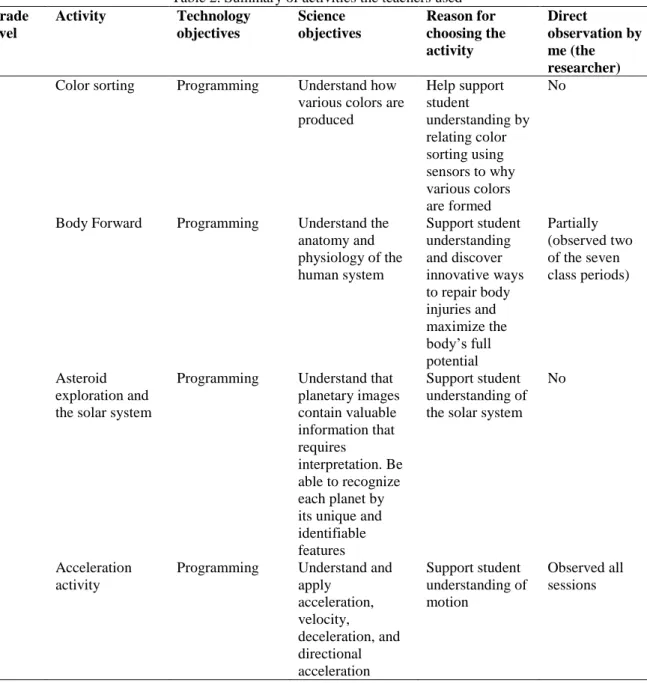
All of the activities chosen involved science objectives, as can be seen in table 2. For instance, in the eighth grade the science objectives were for students to understand and apply the concepts of acceleration, deceleration, directional acceleration, and velocity by programming their robots to follow a predetermined path. In the sixth grade, the teacher wanted the students to understand and apply their understanding of the physiology and anatomy of the human body system to design a robot that would perform certain tasks in the body like repair a broken bone, and dispense pills. Another activity that was used in the seventh grade was based on astronomy concepts. This was a problem-based activity that had to do with asteroid exploration. It was fitted into the ongoing unit of the solar system in the seventh grade. The seventh grade teacher in this study reported that the activity was chosen because it suited the science content they had already covered in the classroom about asteroids and their presence in our solar system and space in general. The eighth grade activity was directly related to the concepts of acceleration and linear motion in general, where students had to program their robot to follow a certain track determined by their science teacher. Students had to build, program and test their robot. Table 4 shows a summary of the various activities used.
Instructional approach used was student-centered, project-based and problem-based
learning and to learn from one other, constructing authentic real life tasks, and motivating students to participate in the tasks. In order to determine the instructional approach employed, we used data from teacher interviews that related to descriptions of their approaches and from our observations of the actions and behaviors of the eighth grade teacher in the classroom.
During the teacher interviews, we asked them to describe the approach that they used to incorporate the technology objectives with the science objectives. We also observed all of the class sessions in the eighth grade and two sessions in the seventh grade. We then analyzed the teacher interviews for descriptions of their implementation approach. The common features that emerged from these descriptions showed that each teacher started with a preparation stage, which consisted of introducing the project to the students. For example, in the eighth grade we observed that the technology instructor and the science instructor jointly introduce the project. In the introduction, the students watched a video about programming and the two teachers talked to them about the importance of coding or programming in society. Then the physical science teacher reviewed students‘ prior knowledge by asking them questions about velocity, which was the topic from the lessons just prior to this project. He explained that he placed students in various teams with each team made up of two to three students.
Table 2. Summary of activities the teachers used Grade
level
Activity Technology
objectives Science objectives Reason for choosing the activity Direct observation by me (the researcher) 5 Color sorting Programming Understand how
various colors are produced Help support student understanding by relating color sorting using sensors to why various colors are formed
No
6 Body Forward Programming Understand the anatomy and physiology of the human system
Support student understanding and discover innovative ways to repair body injuries and maximize the body‘s full potential Partially (observed two of the seven class periods)
7 Asteroid
exploration and the solar system
Programming Understand that planetary images contain valuable information that requires
interpretation. Be able to recognize each planet by its unique and identifiable features
Support student understanding of the solar system
No
8 Acceleration
activity
The teacher distributed materials to the students, for example each team‘s robotics kit and the rubric for assessments, and showed students the diagram of the pathway and the actual pathway, which were placed in the classroom. The students had to maintain their teams for the total length of the project (three weeks in each grade level). Based on interviews with teachers of other classes, this introduction parallels what happened in the classes that we did not observe. After students watched the introductory video about programming, they were assigned to teams, provided with the robotics kits, showed where to test their robots and told how the project would be assessed, and then they started to work on their project.
During this implementation, we wanted to understand the instructional strategy that the teacher was using. We did this by observing the teacher‘s actions in the classroom. For instance, we was thinking of the teacher‘s actions in terms of questions such as: Did he lecture to the students?; Did he move from one team to the other asking students questions?; and Did he provide feedback to the students as they worked? These questions were posed to the teachers whose classes we did not observe. We then coded these responses for statements that indicated the actions and behavior that they exhibited in the classroom. For instance, when Shelley said that she ―had to step back and let the students do the learning and only provided them with clues to come up with the solution,‖ we coded this as ―encouraging students to do discovery learning.‖ When Mitch said, ―we placed [the students] in teams and encouraged [them] to work together and assist each other,‖ we coded this as ―encouraging students to learn from each other.‖ In the teachers‘ descriptions, they also made statements such as, ―we moved from one team to the other, asking them questions about what they were doing,‖ ―we allowed students to actively share their experiences with me‖ and ―we made sure each student was participating by asking them to rotate roles.‖ We coded all of these to indicate that they were related to teacher promotion of student-centered learning.
The teachers also mentioned during the interviews that while working on the projects, the students solved problems, answered questions, formulated questions of their own, discussed in their teams, offered explanations to their teammates and to the teacher, debated in their teams, and brainstormed during the activity. Here are statements from Mitch and Shelley, which represent what these teachers said about the instructional approach:
Mitch: During the activity, students were very involved in solving problems in the task. You know, in their teams they brainstormed, asked each other questions, came up with solutions, discussed among themselves, and explained their ideas pretty well. In fact they were very active in the learning process and we am glad we, Mario and I, designed the instruction to encourage that. we do believe that this was the case in other classes.
Shelley: We had to sit back and let the students do the work. They took the responsibility for their own learning.
Steve: We used open-ended problems in the class and asked them open-ended questions (Teacher Interviews).
We did observe the eighth grade teacher move from team to team encouraging the students to think critically and offering clues to help them learn the underlying concepts of acceleration. For example, he stated, ―You have to think of how to make your robot move smoothly on the track,‖ and we coded this as prompting students to think critically. He also moved around encouraging students to participate in the project by asking them to rotate roles within the team. This teacher moved from team to team, interacting with the students and asking them questions about the project. He also answered a question from a student about the project.
Across the board, each of the teachers offered similar descriptions of their instructional approaches and of what their students did. On no occasion did the teachers mention or exhibit lecturing. When we summed up the actions that each teacher had used, we came to the conclusion that the teachers were using the student-centered approach. This was based on Weimer‘s (2002) characterization of student-centered learning, mentioned previously, which includes encouraging the students to do more discovery learning and to learn from one other, constructing authentic real life tasks and motivating students to participate in the tasks.
Teacher’s Role in the Classroom during the Project was that of a facilitator
their responses, we coded statements that indicated that they guided, instigated, and motivated students. For instance when a teacher said, ―I asked students open-ended questions which permitted them to think critically,‖ We coded that as indicating that they instigated or prompted the students to learn by considering the evidence available to them. Statements such as ―I provided the students with clear instructions on what they were expected to do‖ were coded to indicate that the teacher guided the students to learn. In order to conclude that a teacher was a facilitator, we had to be able to code statements from his or her responses that indicated that he or she guided, motivated, and instigated. In the end we could only identify and code such statements from the sixth and eighth grade teachers. For the fifth and seventh grade teachers, we did not find sufficient statements about guidance, motivation, and instigation to reach the conclusion that they were facilitators.
Observations of classes resulted in concurrence to the interviews. During the observation we recorded verbal expressions that they used during the project. These expressions were then analyzed with regard to their intentions to motivate, guide, or instigate students to learn. Some of the expressions included ―you are getting there,‖ ―you have done a great job so far.‖ These were coded to indicate verbal statements that were intended as motivation for students. Here are representative questions from Steve that emerged from the classroom observations and which focused on stimulating students to think: ―why is your robot not accelerating when it is supposed to?‖ and ―why do you have a power of 30 and four rotations here?‖ These questions were coded as providing guidance and instigating students to think critically. The teacher stated that his reason for asking such questions was so that the students would think for themselves. Shelley used statements such as ―make sure your program is saved‖ and ―you can test your robot and make changes.‖ These were coded as providing guidance. In their responses, the teachers also explicitly articulated how they acted as facilitators. Here is a representative statement from Shelley that emerged from the data analysis:
Shelley: And it was very interesting, we try not to do more and more, and I said to myself that I am the facilitator instead of the teacher, so it was very - step back and let them do it, and to watch them do it and do it successfully and find success and for me to step back, it was powerful to see, and humbling in a way, too, that if you give them what they need, they can create the answers, and humbling that they don‘t need you to tell them every single thing (teacher interviews).
This statement, representative of many given, suggests that it was not easy for these teachers to take the role of facilitator instead of as a teacher. However, these teachers believed that it was beneficial for the students when the teacher‘s role in such activities was that of a facilitator.
Teachers Assessed Student Learning in the Integrated STEM Instruction
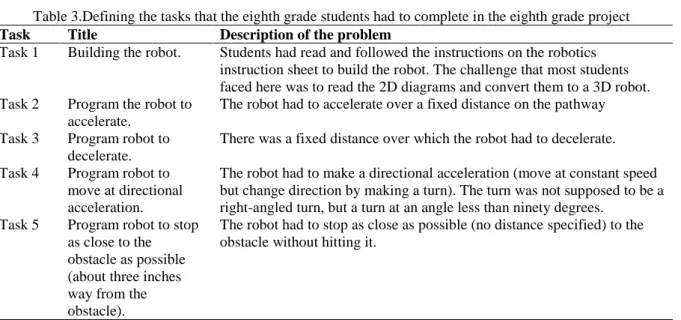
The overall integrated STEM project involved five tasks. Each task had at least one sub-component of the overall problem that the students had to identify and solve. These tasks are shown in Table 3.
Table 3.Defining the tasks that the eighth grade students had to complete in the eighth grade project
Task Title Description of the problem
Task 1 Building the robot. Students had read and followed the instructions on the robotics instruction sheet to build the robot. The challenge that most students faced here was to read the 2D diagrams and convert them to a 3D robot. Task 2 Program the robot to
accelerate.
The robot had to accelerate over a fixed distance on the pathway Task 3 Program robot to
decelerate.
There was a fixed distance over which the robot had to decelerate. Task 4 Program robot to
move at directional acceleration.
The robot had to make a directional acceleration (move at constant speed but change direction by making a turn). The turn was not supposed to be a right-angled turn, but a turn at an angle less than ninety degrees.
Task 5 Program robot to stop as close to the obstacle as possible (about three inches way from the obstacle).
In tasks 2 to 5, students manipulated variables. These variables included: time, number of rotations of the wheels, number of turns and angle of turns, number of steering moves controlling the angle of turn, and power. It was observed that various teams used time differently. For example one team changed the time for a chosen number of rotations or time required to cover a given distance. For the number of rotations, students had the options of programming a different number of rotations for each wheel or just programming the same time and number of rotations for all the wheels.
Analysis of data, related to how teachers assessed students learning, showed that three out of the four science teachers reported their efforts at assessment of student learning while the students were participating in the robotics activity. These teachers assessed students using different techniques. Some assessment techniques were informal, as in the eighth grade where we observed that the teacher went around from team to team asking questions of the students. The teachers also mentioned that they used formal techniques; for example, Shelley indicated that she used a rubric. Only the fifth grade teacher stated that she did not assess the student learning during the robotics activity. She explained that this was because she never really understood how to incorporate the project into her science objectives, though the tasks paralleled those in eighth grade. The eighth grade teacher stated that he assessed the student learning formally using a rubric, which was divided into two sections: one section had to do with task accomplishment (80%) and the other with peer evaluation (20%).
Within that breakdown of scores, task completion was used to give the students a maximum number of points from within the 80% of the total points that was based on robotics tasks. The grades for tasks were broken down as follows: 75% (or 60 points from a possible 80) was the maximum total score if the students only completed the construction of the robot, 80% was the maximum total score if the students completed the construction and also were able to program their robot to positively accelerate, 85% was the maximum total score if the students completed the construction, and also achieved positive acceleration and negative acceleration. A 90% total score was the maximum possible if the students completed the construction and controlled the robot through positive acceleration, negative acceleration and also directional acceleration. The maximum total score of 95%-100% was possible if the students completed the construction of the robot, used it to accelerate, decelerate, perform directional acceleration, and also were able to program the sensor to come to a stop as close as possible to the wall (obstacle) without touching it. As for how close to the obstacle it had to be in order to receive credit, the teacher did not specify. ―Close as possible,‖ was estimated by the teacher, and from my observation was three inches or less away from the obstacle.
For each of these tasks, when students felt sufficiently confident after testing their robot, then they indicated to the teacher that they were ready to demonstrate it and the teacher would observe and notify them if they had accomplished the task or not. If they did not accomplish the task, then they would continue working. It was observed that many students made several attempts before getting it right. However, about 70% of the students who contacted the teacher were able to have the robot satisfactorily complete the task in fewer than three attempts. This level of success resulted from the testing of the robots that students completed prior to calling on the teacher for an evaluative observation and feedback. For peer evaluation, the results showed that the teacher provided each student with a worksheet to record (describe) their own contribution to the project, stating explicitly what he/she did, and the partner signed off to confirm that the record was accurate. Then the teacher graded the student work. Results from the teacher interviews about the student performance revealed that all of the students in the eighth grade achieved at least two tasks, which resulted in grades of high B‘s and A‘s.
Teachers believed that students showed interest in the project, learned science concepts, and also acquired skills during their participation in the projects
The analysis of the teacher interview with respect to their perceptions of student interest and learning revealed that three of the four teachers believed that students exhibited interest in and motivation to the activity. Here are some representative examples of the statements that we coded to indicate that teachers believed the students showed interest in the activity. Steve, the eighth grade teacher, had this to say about student interest:
This was coded to indicate, ―Students showed interest because they were involved in the tasks.‖ Below, the sixth grade teacher, Shelley, talked about general student interest:
Shelley: We had two weeks where every single student was excited, we had to kick them out [of classroom] because they didn‘t want to leave, and I had to hold them off at the door because they were excited to come in. So as a teacher, to see that it involved every single child, even kids that you would never imagine would be interested in this, loved it the entire time. And we can say all seventy-two of them, which was shocking to me (teacher interview).
The teacher above was describing how students showed general interest in the activity. Analysis of the teacher interviews showed that three of the four teachers mentioned that the students showed this kind of general interest in the activity. For the most part, these teachers talked about interest in a very general way. They did not talk about the interest of individual students or teams but just addressed general interest. For example, Shelley made the following comment about student interest. ―My students showed great interest in learning the body system during this activity. They stayed focused on what they had to do during the entire project‖ (teacher interview).We coded this statement as ―interest in learning the science content,‖ which was biological content (the body system). We also coded ―interest in doing the project.‖ However, the teacher did not say if this interest varied across students. Here is what Doris had to say about the student interest:
―The students showed interest in learning about robots: designing them, figure out ways to put pieces together in the right place, figure how to resolve what is wrong with their design. That is problem solving. They did show great interest in problem solving‖ (teacher interview).
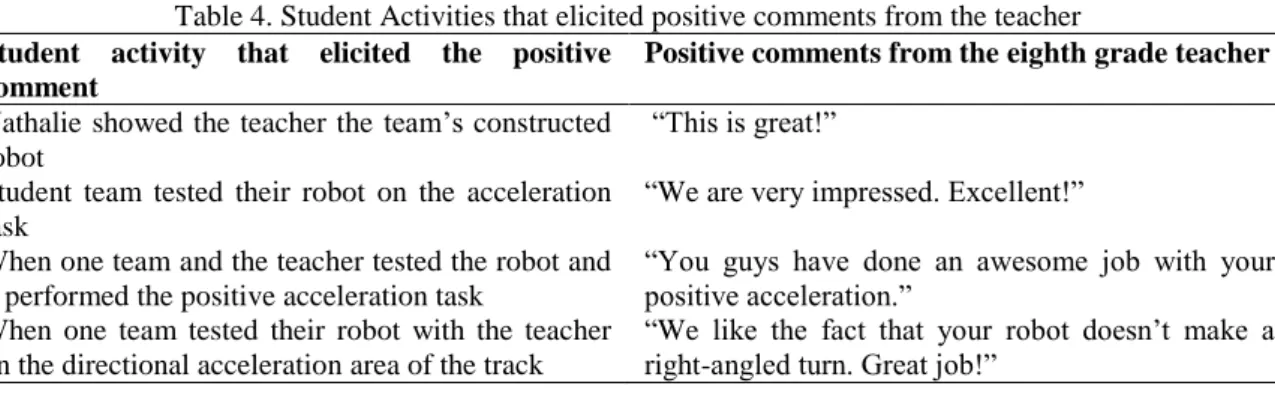
This was coded as showing ―interest in learning about robotics design‖ and ―interest in problem solving.‖ This manner of describing student interest in a general way carried over to teacher-student group interactions. In observations of the eighth grade student interest, teachers tended to respond to all the children within a given team collectively, giving positive feedback about their interest when they noticed that a group had completed specific tasks, such as acceleration. The teacher directed comments to specific teams, not the whole class. We observed that the teacher tended to recognize student interest during their participation in the project. This recognition consisted typically of a positive comment the teacher made each time a team of students presented their robot for testing and the robot performed the task as required (i.e., passed the test) or when the teacher came to the student workstation and observed what they were doing. For example, if the teacher observed a task where a team‘s robot accelerated within the required area or made the required turn on the track and then came to a stop, the teacher tended to make a positive comment. The students appreciated these positive comments about their work. They often reacted emotionally, with expressions such as, ―We got it!‖ or ―We rock!‖ or ―We are the best!‖ This reaction was a response to the teacher‘s comment after testing the robot with the students. Although the students were able to recognize success when it happened, they also required the teacher‘s approval to be fully identified as success. Students also reacted emotionally foe having been successful at the task. Table 4 shows the behaviors exhibited by a specific group or team of students that tended to get the teacher‘s attention and elicited a positive comment from him/her.
Table 4. Student Activities that elicited positive comments from the teacher Student activity that elicited the positive
comment
Positive comments from the eighth grade teacher
Nathalie showed the teacher the team‘s constructed robot
―This is great!‖ Student team tested their robot on the acceleration
task
―We are very impressed. Excellent!‖ When one team and the teacher tested the robot and
it performed the positive acceleration task
―You guys have done an awesome job with your positive acceleration.‖
When one team tested their robot with the teacher on the directional acceleration area of the track
―We like the fact that your robot doesn‘t make a right-angled turn. Great job!‖
Teachers believed students acquired problem-solving skills
identified this because the teachers mentioned problem solving skills explicitly in their responses. Here are examples of the expressions from teachers and how we coded the problem solving skills they described:
Steve: ―we think the kids acquired and applied a lot of problem solving skills in the course of the project. They worked together pretty well to figure out what to do‖ (teacher interview). ―Acquired‖ and ―applied‖ were separate codes we concluded that Steve believed that the students acquired problem solving skills and were also able to apply those skills in the robotics project. The teacher‘s second statement also suggested that there is a difference between learning problem solving skills and learning to work as a member of a group. He also mentioned that they ―worked together‖ to figure out what to do. Thus, the problem solving arose as an aspect of collaboration. Shelly‘s statements concurred in some ways with those given above by Steve but not completely. Shelley: ―They acquired skills such as problem solving and working together as a team‖ (teacher interview). This was coded as ―learning to work together,‖ without a specific emphasis on this as a factor in learning. Here, Shelley does not absolutely link problem solving to teamwork. Therefore, Steve‘s view of problem solving is different from Shelley‘s; Steve linked problem solving to teamwork while Shelley did not. Another feature of the students‘ problem solving approach was described by Doris: ―They soon learned to make decisions to put certain pieces together, not knowing for sure what the right piece was, then they get to like six steps down and it (robot) is not working, they had to figure out what to do—for them to recognize how to resolve this design problem, they have to go back step by step backward. To me, that was problem solving‖ (teacher interview). This is a version of ―trial and error‖ was a factor in problem solving. Doris‘s use of ―they‖ indicated that she thought it was important for the students to have done this collaboratively.
The results of the analysis showed that all of the teachers made somewhat similar statements that also contained elements of difference in their views. These results suggested that:
o There is a difference between learning problem solving skills and learning problem solving skills as a member of a group.
o Students applied and acquired problems solving skills during the project.
o Trial and error is a factor in problem solving.
Teachers believed that this instructional approach (integrated STEM) will have some effect on their future teaching practice and identified areas where they will make changes
During the teacher interviews, we asked whether they believed they would use this integrated STEM teaching approach in their future teaching practice. In analyzing the data, we noticed that all the teachers mentioned explicitly that they would implement this integrated STEM approach in their future teaching. Here are representative statements from the analysis.
Doris: ―Sure. I had already told Mario [the Technology teacher] during our little two-day workshop when we started seeing some of the sensors and the different things, we said, ―My gosh, this is kind of cool.‖ ―I will be using more of it in the future‖ (teacher interview).
We coded this as indicating that Doris saw the potential benefit of this instructional approach and would be using it. She did not put any qualifications on her future use of the instruction.
Shelley: ―Absolutely, yes‖ (teacher interview).
We coded this as indicating that the teacher would definitely use this instructional approach in her teaching. She also did not qualify her statement.
Steve: ―Yes. It depends on the budget. With these kits, they‘re expensive, totally depends on the budget we would say. You know, we think the hard part is deciding really what you want to teach‖ (teacher interview).
We coded this as indicating that the teacher would like to use this instruction, but that there are two considerations with respect to its use: budgetary considerations and course goals or objectives.
We coded this to mean that he would like to use this type of instruction, but it would depend on what he wanted to teach and whether he believed it was the best method to use. Therefore, all the teachers said they would like to use this instructional approach in their future science teaching, though some teachers noted qualifications with regard to their intentions. We also found that the experienced teachers expressed a greater likelihood than the inexperienced teacher for future use of this method. Furthermore, the teachers did mention aspects of future teaching that they would change to ensure that the integrated STEM instruction was more effective in their science classrooms. These representative statements cover a range of qualifications that the teachers placed on their future work.
Mitch: One thing that we have been thinking about working with different forms of technology, we are very lucky to have so many technology based tools as far as video recording, audio recording, methods that students can create and innovate. As far as the robotics kits go, we don‘t know if that will come into it in multiple units, but definitely at least using the robotics‘ kits and kind of working with the computer programming element at least in that astronomy unit and maybe moving it into a different unit because it can be molded to fit really any of our content areas (teacher interview).
Thus, Mitch explained that he wanted to expand his use of robotics into other science topics in his class and not just limit it to Astronomy.
Doris: we will make them [robotics lessons] simpler. we think kids learn—I‘ve always said that, we will do a lot of hands-on stuff with the robotics; kids learn more from doing than listening. Even if the robotics are used and we‘re doing these different sensors early in the year, we can remind them of it when we get to that unit later and say, remember the ultrasonic sensor, let‘s talk about how ultrasonic sensors could be used and relate it. We do think that it‘s very valuable. We don‘t think we used it at its best way this time (teacher interview).
Here, we coded that Doris wanted ―more hands-on activities with robotics.‖ She also wanted ―simpler‖ projects. This suggests that the activity might have been too complex for her fifth graders. Also, she wants to use robotics as a method of ―applying the science knowledge that students have learned.‖
Shelley: You know, we think the hard part is deciding really what you want to teach. Do we want to go in depth on a certain topic or do we want to cover a number of topics? Sometimes we have to prepare students for high school in some areas. Like chemistry, we really have to get them ready for the things that they get in high school because it‘s so useful. And we do a lot of labs with that. On this physics unit that we do, we really—like we said, I‘m open to doing a lot, I‘m open to doing a lot more, maybe some open-ended stuff (teacher interview).
Shelley did not really have any specific changes in mind, but believed that she would use it in a variety of topics, especially open-ended activities.
Steve: we think that I‘m going to keep with this plan for next year, but what‘s going to be interesting is my students will have had a robotics unit in 5th grade, so they‘ll come to me—you know, we had to start my 6th graders this year with basic knowledge and how to build the robot and how to program. This year, though—next year, my 6th graders will have had a robotics unit in 5th grade, so I‘m going to have to take it further (teacher interview).
Challenges that teachers Encountered during integrated STEM instruction
During the teacher interviews, we asked about challenges that they encountered with the instruction. By challenges we meant anything that hindered implementation or prevented the teacher from meeting his/her intended lesson objectives. Analysis of the teachers‘ responses revealed that all of the teachers mentioned that they faced one or more challenges during the implementation of the project.
Teachers lacked technology and engineering content knowledge
During the analysis, the first challenge that teachers mentioned in the interviews was their own lack of technology and engineering content knowledge. They all were trained in science education, but said they did not have any technology or engineering education training. All of these teachers also indicated that they relied on the technology teacher for support on how to help students with technology content knowledge, such as helping them with questions about how to download the robotics program, how to answer questions about coding, and troubleshooting problems with their robots. For example, Doris, the fifth grade teacher, mentioned that her students never programmed the robot because the technology teacher was not available to help them the day she had planned to perform the programming. As a result, she did not conduct the programming with the students because she ―did not know anything about programming.‖ Here is what she had to say:
―My support person[‘s] (―my support person‖ here is the same as ―the technology teacher‖ and not an aide) schedule did not allow him to be in my classroom as a support for me all the time. That made it even more uncomfortable and awkward for me. There were questions we couldn‘t answer. The day that some of the kids were ready to do computer programming, but we wasn‘t prepared...we did not know anything about programming. I am not the knowledgeable one there. I had to make a decision about not programming because I knew nothing else to do‖ (teacher interview).
Time barrier: Not enough time to plan and implement integrated STEM instruction in a regular science classroom
Another challenge that emerged from the analysis of the teacher interview was lack of sufficient time for lesson preparation and instruction. Three of the four teachers mentioned during the interviews that there was not enough time for them to plan and implement the instruction in their science classrooms. They stated that they needed additional time (than what they take to plan their normal science instruction) to plan and implement the integrated STEM instruction. In planning, they spent more time searching for robotics activities that would fit into their science objectives without extending the class period. In implementation, they needed more time during the lessons, because it took them longer to assist students with technology-related questions. For example, Doris mentioned that she never completed the programming part of the project in her class because they (she and her students) spent too much time building the robot.
The analysis suggests the importance of making sure that there is enough time for teachers to plan and implement the activity in the science classroom. However, during the analysis of the interviews, we also noticed that Steve, the eighth grade teacher, stated explicitly that he did not have any problem with time:
―Time-wise we think we worked well. Time-wise we think things worked really well with this project. We felt like we hit at about the right amount of time‖ (Teacher interview).