31
4
C H A P T E R
Forecasting
D
ISCUSSIONQ
UESTIONS1. Qualitative models incorporate subjective factors into the forecasting model. Qualitative models are useful when subjective factors are important. When quantitative data are difficult to ob-tain, qualitative models may be appropriate.
2. Approaches are qualitative and quantitative. Qualitative is relatively subjective; quantitative uses numeric models.
3. Short-range (under 3 months), medium-range (3 to 18 months), and long-range (over 18 months).
4. The steps that should be used to develop a forecasting system are:
(a) Determine the purpose and use of the forecast (b) Select the item or quantities that are to be forecasted (c) Determine the time horizon of the forecast
(d) Select the type of forecasting model to be used (e) Gather the necessary data
(f) Validate the forecasting model (g) Make the forecast
(h) Implement the results (i) Evaluate the results
5. Any three of: sales planning, production planning and budget-ing, cash budgetbudget-ing, analyzing various operating plans.
6. There is no mechanism for growth in these models; they are built exclusively from historical demand values. Such methods will always lag trends.
7. Exponential smoothing is a weighted moving average where all previous values are weighted with a set of weights that decline exponentially.
8. MAD, MSE, and MAPE are common measures of forecast accuracy. To find the more accurate forecasting model, forecast with each tool for several periods where the demand outcome is known, and calculate MSE, MAPE, or MAD for each. The smaller error indicates the better forecast.
9. The Delphi technique involves:
(a) Assembling a group of experts in such a manner as to pre-clude direct communication between identifiable members of the group
(b) Assembling the responses of each expert to the questions or problems of interest
(c) Summarizing these responses
(d) Providing each expert with the summary of all responses (e) Asking each expert to study the summary of the responses
and respond again to the questions or problems of interest. (f) Repeating steps (b) through (e) several times as necessary
to obtain convergence in responses. If convergence has not been obtained by the end of the fourth cycle, the re-sponses at that time should probably be accepted and the process terminated—little additional convergence is likely if the process is continued.
10. A time series model predicts on the basis of the assumption that the future is a function of the past, whereas a causal model incorporates into the model the variables of factors that might influence the quantity being forecast.
11. A time series is a sequence of evenly spaced data points with the four components of trend, seasonality, cyclical, and random variation.
12. When the smoothing constant, D, is large (close to 1.0), more weight is given to recent data; when D is low (close to 0.0), more weight is given to past data.
13. Seasonal patterns are of fixed duration and repeat regularly. Cycles vary in length and regularity. Seasonal indexes allow “generic” forecasts to be made specific to the month, week, etc., of the application.
14. Exponential smoothing weighs all previous values with a set of weights that decline exponentially. It can place a full weight on the most recent period (with an alpha of 1.0). This, in effect, is the naïve approach, which places all its emphasis on last period’s actual demand.
15. Adaptive forecasting refers to computer monitoring of track-ing signals and self-adjustment if a signal passes its present limit.
16. Tracking signals alert the user of a forecasting tool to peri-ods in which the forecast was in significant error.
17. The correlation coefficient measures the degree to which the independent and dependent variables move together. A negative value would mean that as X increases, Y tends to fall. The vari-ables move together, but move in opposite directions.
18. Independent variable (x) is said to cause variations in the dependent variable (y).
19. Nearly every industry has seasonality. The seasonality must be filtered out for good medium-range planning (of production and inventory) and performance evaluation.
20. There are many examples. Demand for raw materials and component parts such as steel or tires is a function of demand for goods such as automobiles.
21. Obviously, as we go farther into the future, it becomes more difficult to make forecasts, and we must diminish our reliance on the forecasts.
E
THICALD
ILEMMAThis exercise, derived from an actual situation, deals as much with ethics as with forecasting. Here are a few points to consider:
No one likes a system they don’t understand, and most college presidents would feel uncomfortable with this one. It does offer the advantage of depoliticizing the funds al- location if used wisely and fairly. But to do so means all parties must have input to the process (such as smoothing constants) and all data need to be open to everyone. The smoothing constants could be selected by an
agreed-upon criteria (such as lowest MAD) or could be based on input from experts on the board as well as the college. Abuse of the system is tied to assigning alphas based on
what results they yield, rather than what alphas make the most sense.
Regression is open to abuse as well. Models can use many years of data yielding one result, or few years yielding a totally different forecast. Selection of associative variables can have a major impact on results as well.
ACTIVE MODEL EXERCISES
ACTIVE MODEL 4.1: Moving Averages
1. What does the graph look like when n = 1The forecast graph mirrors the data graph but one period later.
2. What happens to the GRAPH as the number of periods in the moving average increases?
The forecast graph becomes shorter and smoother. 3. What value for n minimizes the MAD for this data?
n = 1 (a naive forecast)
ACTIVE MODEL 4.2: Exponential Smoothing
1. What happens to the graph when alpha equals zero?The graph is a straight line. The forecast is the same in each period.
2. What happens to the graph when alpha equals one?
The forecast follows the same pattern as the demand (ex-cept for the first forecast) but is offset by one period. This is a naive forecast.
3. Generalize what happens to a forecast as alpha increases.
As alpha increases the forecast is more sensitive to changes in demand.
4. At what level of alpha is the mean absolute deviation (MAD) minimized?
Alpha = .16
ACTIVE MODEL 4.3: Exponential Smoothing with
Trend Adjustment1. Scroll through different values for alpha and beta. Which smoothing constant appears to have the greater affect on the graph?
Alpha
2. With beta set to zero, find the best alpha and observe the MAD. Now find the best beta. Observe the MAD. Does the addi-tion of a trend improve the forecast?
Alpha = .11, MAD = 2.59; Beta above .6 changes the MAD (by a little) to 2.54.
ACTIVE MODEL 4.4: Trend Projections
1. What is the annual trend in the data?10.54
2. Use the scrollbars for the slope and intercept to determine the values that minimize the MAD. Are these the same values that regression yields?
No they are NOT the same values. For example, an inter-cept of 57.81 with a slope of 9.44 yields a MAD of 7.17.
E
ND-
OF-C
HAPTERP
ROBLEMS374 + 368 + 381
(a) 374.33 pints 3
4.1
(b)
Week of Pints Used
Weighted Moving Average
August 31 360
September 7 389 381 u .1 = 38.1 September 14 410 368 u .3 = 110.4 September 21 381 374 u .6 = 224.4 September 28 368 372.9 October 5 374
Forecast 372.9
(c)
The forecast is 374.26.
Week of Pints Forecast
Forecasting Error
Error
u .20 Forecast
August 31 360 360 0 0 360 September 7 389 360 29 5.8 365.8 September 14 410 365.8 44.2 8.84 374.64 September 21 381 374.64 6.36 1.272 375.912 September 28 368 375.912 –7.912 –1.5824 374.3296 October 5 374 374.3296 –.3296 –.06592 374.2636
4.2 (a) No, the data appear to have no consistent pattern.
Year 1 2 3 4 5 6 7 8 9 10 11 Forecast
Demand 7 9 5 9.0 13.0 8.0 12.0 13.0 9.0 11.0 7.0
(b) 3-year moving 7.0 7.7 9.0 10.0 11.0 11.0 11.3 11.0 9.0
(d) The three-year moving average appears to give better results.
Naïve tracks the ups and downs best, but lags the data by one period. Exponential smoothing is probably better be-cause it smoothens the data and does not have as much variation.
TEACHING NOTE: Notice how well exponential smooth-ing forecasts the naïve.
July June
August July
(a) 0.2(Forecasting error) 42 0.2(40 42) 41.6 (b) 0.2(Forecasting error) 41.6 0.2(45 41.6) 42.3
F F
F F
4.4
(c) Because the banking industry has a great deal of season-ality in its processing requirements
3, 700 + 3,800
(a) 3,750 ml. 2
4.5
(b)
Year Mileage
Two-Year
Moving Average Error |Error|
1 3,000 2 4,000
3 3,400 3,500 –100 100
4 3,800 3,700 100 100
5 3,700 3,600 100 100
Totals 100 300
300 100. 3 MAD
4.5 (c) Weighted 2 year M.A. with .6 weight for most recent year.
Year Mileage Forecast Error |Error|
1 3,000 2 4,000
3 3,400 3,600 –200 200
4 3,800 3,640 160 160
5 3,700 3,640 60 60
420
Forecast for year 6 is 3,740 miles.
420 140
3 MAD §¨ ·¸
© ¹
4.5 (d)
Year Mileage Forecast
Forecast Error
Error u D = .50
New Forecast
1 3,000 3,000 0 0 3,000 2 4,000 3,000 1,000 500 3,500 3 3,400 3,500 –100 –50 3,450 4 3,800 3,450 350 175 3,625 5 3,700 3,625 75 38 3,663
Total 1,325
The forecast is 3,663 miles. 4.6
Y Sales X Period X2
XY
January 20 1 1 20
February 21 2 4 42
March 15 3 9 45
April 14 4 16 56
May 13 5 25 65
June 16 6 36 96
July 17 7 49 119
August 18 8 64 144
September 20 9 81 180
October 20 10 100 200
November 21 11 121 231
December 23 12 144 276
Sum 218 78 650 1474
Average 18.2 6.5
(a)
4.3 Year 1 2 3 4 5 6 7 8 9 10 11 Forecast
Demand 7 9.0 5.0 9.0 13.0 8.0 12.0 13.0 9.0 11.0 7.0 Naïve 7.0 9.0 5.0 9.0 13.0 8.0 12.0 13.0 9.0 11.0 7.0 Exp. Smoothing 6 6.4 7.4 6.5 7.5 9.7 9.0 10.2 11.3 10.4 10.6 9.2
(b) x Naive The coming January = December = 23
x 3-month moving (20 + 21 + 23)/3 = 21.33
x 6-month weighted (0.1 u 17) + (.1 u 18) + (0.1 u 20) + (0.2 u 20) + (0.2 u 21) + (0.3 u 23) = 20.6
x Exponential smoothing with alpha = 0.3
|
18 0.3(20 18) 18.6 18.6 0.3(20 18.6) 19.02 19.02 0.3(21 19.02) 19.6 19.6 0.3(23 19.6) 20.62 21
Oct Nov Dec Jan
F F F F
x Trend ¦ x 78, x 6.5, ¦y =218, y 18.17
2
1474 (12)(6.5)(18.2) 54.4 0.38 650 12(6.5) 143 18.2 0.38(6.5) 15.73 b
a
Forecast = 15.73 + .38(13) = 20.67, where next January is the 13th month.
(c) Only trend provides an equation that can extend beyond one month
4.7 Using MAD for this problem,
(4) (6)
(3) Marketing (5) Operations (1) (2) Marketing VP’s Error Operations VP’s Error Year Sales VP’s Forecast [(2)–(3)] VP’s Forecast [(2)–(5)]
1 167,325 170,000 2,675 160,000 7,325 2 175,362 170,000 5,362 165,000 10,362 3 172,536 180,000 7,464 170,000 2,536 4 156,732 180,000 23,268 175,000 18,268 5 176,325 165,000 11,325 165,000 11,325
Totals 50,094 49,816
MAD (marketing VP) = 50,094/5 = 10,018.8.
MAD (operations VP) = 49,816/5 = 9,963.2.
Therefore, based on past data, the VP of operations has been presenting better forecasts.
(96 88 90) (a) 91.3
3
4.8
(88 90) (b) 89
2 (c)
Temperature 2 day M.A. |Error| (Error)2
Absolute % Error
93 — — — —
94 — — — —
93 93.5 0.5 0.25 100(.5/93) = 0.54% 95 93.5 1.5 2.25 100(1.5/95) = 1.58% 96 94.0 2.0 4.00 100(2/96) = 2.08% 88 95.5 7.5 56.25 100(7.5/88) = 8.52% 90 92.0 2.0 4.00 100(2/90) = 2.22%
13.5 66.75 14.94%
MAD = 13.5/5 = 2.7
(d) MSE = 66.75/5 = 13.35 (e) MAPE = 14.94%/5 = 2.99%
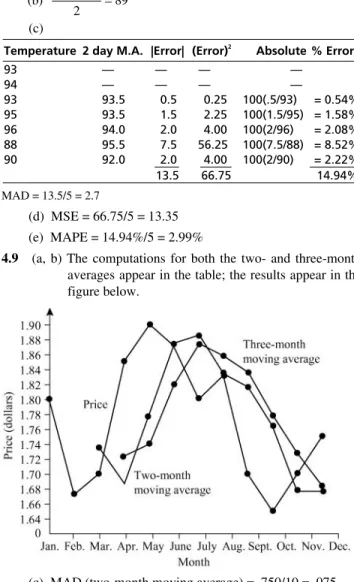
4.9 (a, b) The computations for both the two- and three-month averages appear in the table; the results appear in the figure below.
(c) MAD (two-month moving average) = .750/10 = .075 MAD (three-month moving average) = .793/9 = .088 Therefore, the two-month moving average seems to have per-formed better.
Table for Problem 4.9 (a, b, c)
Forecast |Error|
Two-Month Three-Month Two-Month Three-Month
Price per Moving Moving Moving Moving
Month Chip Average Average Average Average
January $1.80 February 1.67
March 1.70 1.735 .035
April 1.85 1.685 1.723 .165 .127
May 1.90 1.775 1.740 .125 .160
June 1.87 1.875 1.817 .005 .053
July 1.80 1.885 1.873 .085 .073
August 1.83 1.835 1.857 .005 .027
September 1.70 1.815 1.833 .115 .133
October 1.65 1.765 1.777 .115 .127
November 1.70 1.675 1.727 .025 .027 December 1.75 1.675 1.683 .075 .067
(c) The forecasts are about the same.
4.9 (d) Table for Problem 4.9(d).
D = .1 D = .3 D = .5
Month Price per Chip Forecast |Error| Forecast |Error| Forecast |Error|
January $1.80 $1.80 $.00 $1.80 $.00 $1.80 $.00 February 1.67 1.80 .13 1.80 .13 1.80 .13 March 1.70 1.79 .09 1.76 .06 1.74 .04 April 1.85 1.78 .07 1.74 .11 1.72 .13 May 1.90 1.79 .11 1.77 .13 1.78 .12 June 1.87 1.80 .07 1.81 .06 1.84 .03 July 1.80 1.80 .00 1.83 .03 1.86 .06 August 1.83 1.80 .03 1.82 .01 1.83 .00 September 1.70 1.81 .11 1.82 .12 1.83 .13 October 1.65 1.80 .15 1.79 .14 1.76 .11 November 1.70 1.78 .08 1.75 .05 1.71 .01 December 1.75 1.77 .02 1.73 .02 1.70 .05
Totals $.86 $.86 $.81
MAD (total/12) $.072 $.072 $.0675
D = .5 is preferable, using MAD, to D = .1 or D = .3. One could also justify excluding the January error and then dividing by n = 11 to compute the MAD. These numbers would be $.078 (forD = .1), $.078 (for D = .3), and $.074 (for D = .5)
4.10 Year 1 2 3 4 5 6 7 8 9 10 11 Forecast
Demand 4 6 4 5.0 10.0 8.0 7.0 9.0 12.0 14.0 15.0
(a) 3-year moving 4.7 5.0 6.3 7.7 8.3 8.0 9.3 11.7 13.7
(b) 3-year weighted 4.5 5.0 7.3 7.8 8.0 8.3 10.0 12.3 14.0
4.11 Year 1 2 3 4 5 6 7 8 9 10 11 Forecast
Demand 4 6.0 4.0 5.0 10.0 8.0 7.0 9.0 12.0 14.0 15.0 Exp. Smoothing 5 4.7 5.1 4.8 4.8 6.4 6.9 6.9 7.5 8.9 10.4 11.8
4.13 (a) Exponential smoothing, D = 0.6:
Exponential Absolute
Year Demand Smoothing D = 0.6 Deviation
1 45 41 4.0
2 50 41.0 + 0.6(45–41) = 43.4 6.6 3 52 43.4 + 0.6(50–43.4) = 47.4 4.6 4 56 47.4 + 0.6(52–47.4) = 50.2 5.8 5 58 50.2 + 0.6(56–50.2) = 53.7 4.3 6 ? 53.7 + 0.6(58–53.7) = 56.3
6 = 25.3 MAD = 5.06 Exponential smoothing, D = 0.9:
Exponential Absolute Year Demand Smoothing D = 0.9 Deviation
1 45 41 4.0
2 50 41.0 + 0.9(45–41) = 44.6 5.4 3 52 44.6 + 0.9(50–44.6 ) = 49.5 2.5 4 56 49.5 + 0.9(52–49.5) = 51.8 4.2 5 58 51.8 + 0.9(56–51.8) = 55.6 2.4 6 ? 55.6 + 0.9(58–55.6) = 57.8
6 = 18.5 MAD = 3.7 (b) 3-year moving average:
Three-Year Absolute
Year Demand Moving Average Deviation
1 45 2 50 3 52
4 56 (45 + 50 + 52)/3 = 49 7 5 58 (50 + 52 + 56)/3 = 52.7 5.3 6 ? (52 + 56 + 58)/3 = 55.3
6 = 12.3 MAD = 6.2 (c) Trend projection:
Absolute
Year Demand Trend Projection Deviation
1 45 42.6 + 3.2 u 1 = 45.8 0.8 2 50 42.6 + 3.2 u 2 = 49.0 1.0 3 52 42.6 + 3.2 u 3 = 52.2 0.2 4 56 42.6 + 3.2 u 4 = 55.4 0.6 5 58 42.6 + 3.2 u 5 = 58.6 0.6 6 ? 42.6 + 3.2 u 6 = 61.8
6 = 3.2 MAD = 0.64
¦
¦
2 2
Y a bX XY nXY b
X nX a Y bX
X Y XY X2
1 45 45 1 2 50 100 4 3 52 156 9 4 56 224 16 5 58 290 25
Then:6X = 15,6Y = 261,6XY = 815,6X2 = 55, X= 3, Y= 52.2 Therefore
6
815 5 3 52.2 3.2 55 5 3 3 52.20 3.20 3 42.6
42.6 3.2 6 61.8 b
a Y
u u u u
u
u
4.14 Comparing the results of the forecasting methodologies for Problem 4.13:
Forecast Methodology MAD
Exponential smoothing, D = 0.6 5.06 Exponential smoothing, D = 0.9 3.7 3-year moving average 6.2 Trend projection 0.64
Based on a mean absolute deviation criterion, the trend projection is to be preferred over the exponential smoothing with D = 0.6, exponential smoothing with D = 0.9, or the 3-year moving average forecast methodologies.
4.15
Forecast Three Year Absolute Year Sales Moving Average Deviation
2001 450 2002 495 2003 518
2004 563 (450 + 495 + 518)/3 = 487.7 75.3 2005 584 (495 + 518 + 563)/3 = 525.3 58.7 2006 (518 + 563 + 584)/3 = 555.0
6 = 134 MAD = 67
4.12 |Error| = |Actual – Forecast|
Year 1 2 3 4 5 6 7 8 9 10 11 MAD
3-year moving 0.3 5.0 1.7 0.7 0.7 4.0 4.7 3.3 2.5 3-year weighted 0.5 5.0 0.8 0.8 1.0 3.8 4.0 2.8 2.3 Exp. smoothing 1 1.3 1.1 0.2 5.2 1.6 0.1 2.1 4.5 5.1 4.6 2.4
These calculations were completed in Excel. Calculations are slightly different in Excel OM and POM for Windows, due to rounding differences. The 3-year weighted average was slightly better.
4.16
Year Time Period X Sales Y X2
XY
2001 1 450 1 450
2002 2 495 4 990
2003 3 518 9 1554
2004 4 563 16 2252
2005 5 584 25 2920
6 = 2610 6 = 55 6 = 8166
X = 3, Y = 522
¦
¦
u
2 2
8166 (5)(3)(522) 336 33.6 55 (5)(9) 10 22 (33.6)(3) 421.2 421.2 33.6
421.2 33.6 6 622.8 Y a bX
XY nXY b
X nX a Y bX
y x
y
Year Sales Forecast Trend Absolute Deviation
2001 450 454.8 4.8
2002 495 488.4 6.6
2003 518 522.0 4.0
2004 563 555.6 7.4
2005 584 589.2 5.2
2006 622.8
6 = 28 MAD = 5.6
4.17
Forecast Exponential Absolute Year Sales Smoothing D = 0.6 Deviation
2001 450 410.0 40.0
2002 495 410 + 0.6(450 – 410) = 434.0 61.0 2003 518 434 + 0.6(495 – 434) = 470.6 47.4 2004 563 470.6 + 0.6(518 – 470.6) = 499.0 64.0 2005 584 499 + 0.6(563 – 499) = 537.4 46.6 2006 537.4 + 0.6(584 – 537.4) = 565.6
6 = 259 MAD = 51.8
Forecast Exponential Absolute Year Sales Smoothing D = 0.9 Deviation
2001 450 410.0 40.0
2002 495 410 + 0.9(450 – 410) = 446.0 49.0 2003 518 446 + 0.9(495 – 446) = 490.1 27.9 2004 563 490.1 + 0.9(518 – 490.1) = 515.2 47.8 2005 584 515.2 + 0.9(563 – 515.2) = 558.2 25.8 2006 558.2 + 0.9(584 – 558.2) = 581.4
6 = 190.5 MAD = 38.1 (Refer to Solved Problem 4.1)
ForD = 0.3, absolute deviations for 2001–2005 are: 40.0, 73.0, 74.1, 96.9, 88.8, respectively. So the MAD = 372.8/5 = 74.6.
0.3 0.6 0.9
74.6 51.8 38.1 MAD
MAD MAD
D D D
Because it gives the lowest MAD, the smoothing constant of
D = 0.9 gives the most accurate forecast.
4.18
0.3 3 year moving average trend
74.6 67 5.6 MAD
MAD
MAD
D
One would use the trend (regression) forecast because it has the lowest MAD.
4.19 Trend adjusted exponential smoothing: D = 0.1, E = 0.2
Unadjusted Adjusted
Month Income Forecast Trend Forecast |Error| Error2
February 70.0 65.0 0.0 65 5.0 25.0 March 68.5 65.5 0.1 65.6 2.9 8.4 April 64.8 65.9 0.16 66.05 1.2 1.6 May 71.7 65.92 0.13 66.06 5.6 31.9 June 71.3 66.62 0.25 66.87 4.4 19.7 July 72.8 67.31 0.33 67.64 5.2 26.6 August 68.16 68.60 24.3 113.2
MAD = 24.3/6 = 4.05, MSE = 113.2/6 = 18.87: note all numbers are rounded
Note: To use POM for Windows to solve this problem, a period 0, which contains the initial forecast and initial trend, must be added.
Unadjusted Adjusted Month Demand (y) Forecast Trend Forecast Error |Error| Error2
February 70.0 65.0 0 65.0 5.00 5.0 25.00 March 68.5 65.5 0.4 65.9 2.60 2.6 6.76 April 64.8 66.16 0.61 66.77 –1.97 1.97 3.87 May 71.7 66.57 0.45 67.02 4.68 4.68 21.89 June 71.3 67.49 0.82 68.31 2.99 2.99 8.91 July 72.8 68.61 1.06 69.68 3.12 3.12 9.76
Totals 419.1 16.42 20.36 76.19
Average 69.85 2.74 3.39 12.70 August Forecast 71.30 (Bias) (MAD) (MSE)
Based upon the MSE criterion, the exponential smoothing with D = 0.1, E = 0.8 is to be preferred over the exponential smoothing with D = 0.1, E = 0.2. Its MSE of 12.70 is lower. Its MAD of 3.39 is also lower than that in Problem 4.19.
4.20 Trend adjusted exponential smoothing: D = 0.1, E = 0.8
D D
5 4 4 4
1 0.2 19 0.8 20.14
3.8 16.11 19.91
F A F T
4.21
5 5 4 1 4 0.4 19.91 17.82
0.6 2.32 0.4 2.09 1.39 0.84 1.39 2.23
T E F F E T
5 5 5 19.91 2.23 22.14
FIT F T
6 5 1 5 5 0.2 24 0.8 22.14
4.8 17.71 22.51
F DA D F T
6 6 5 1 5 0.4 22.51 19.91 0.6 2.23
0.4 2.6 1.34 1.04 1.34 2.38
T E F F E T
6 6 6 22.51 2.38 24.89
FIT F T
7 6 6 6
7 7 6 6
7 7 7
(1 )( ) (0.2)(21) (0.8)(24.89) 4.2 19.91 24.11 ( ) (1 ) (0.4)(24.11 22.51)
(0.6)(2.38) 2.07 24.11 2.07 26.18
F A F T
T F F T
FIT F T
D D
E E
4.22
8 7 (1 )( 7 7) (0.2)(31)
(0.8)(26.18) 27.14 F DA D F T
8 8 7 1 7 0.4 27.14 24.11
0.6 2.07 2.45
T E F F E T
D D
8 8 8
9 8 8 8
27.14 2.45 29.59
1 0.2 28
0.8 29.59 29.28 FIT F T
F A F T
9 9 8 1 8 0.4 29.28 27.14
0.6 2.45 2.32
T E F F E T
9 9 9 29.28 2.32 31.60
FIT F T
4.23 Students must determine the naive forecast for the four months. The naive forecast for March is the February actual of 83, etc.
(a) Actual Forecast |Error| |% Error|
March 101 120 19 100 (19/101) = 18.81% April 96 114 18 100 (18/96) = 18.75% May 89 110 21 100 (21/89) = 23.60% June 108 108 0 100 (0/108) = 0%
58 61.16%
58 E.S. MAD (for manager) 14.5
4 61.16%
MAPE (for manager) 15.29% 4
(b) Actual Naive |Error| |% Error|
March 101 83 18 100 (18/101) = 17.82% April 96 101 5 100 (5/96) = 5.21% May 89 96 7 100 (7/89) = 7.87% June 108 89 19 100 (19/108) = 17.59%
49 48.49%
49 MAD (for naive) 12.25
4 48.49%
MAPE (for naive) 12.12%. 4
(c) MAD for the manager’s technique is 14.5, while MAD for the naive forecast is only 12.25. MAPEs are 15.29% and 12.12%, respectively. So the naive method is better.
4.24 (a) Graph of Demand
The observations obviously do not form a straight line, but do tend to cluster about a straight line over the range shown.
Note: To use POM for Win-dows to solve this problem, a period 0, which contains the initial forecast and initial trend, must be added.
(b) Least Squares Regression:
¦
¦
2 2
Y a bX XY nXY b
X nX a Y bX Assume
Appearances X Demand Y X2
Y2
XY
3 3 9 9 9
4 6 16 36 24
7 7 49 49 49
6 5 36 25 30
8 10 64 100 80
5 8 25 64 40
9 ?
6X = 33, 6Y = 39, 6XY = 232, 6X2 = 199, X= 5.5, Y = 6.5. Therefore
u u
u u
u
232 6 5.5 6.5 1 199 6 5.5 5.5 6.5 1 5.5 1 1 1
b a
Y X
The following figure shows both the data and the resulting equation:
If there are nine performances by Green Shades, the esti-mated sales are:
9 1 1 9 1 9 1 0 drums
Y u
4.25
Number of
Accidents
Month (y) x xy x2
January 30 1 30 1 February 40 2 80 4 March 60 3 180 9 April 90 4 360 16 Totals 220 10 650 30 Averages y = 55 x = 2.5
2 2 2
650 4(2.5)(55) 650 550 30 25 30 4(2.5)
100 20 5
55 (20)(2.5) 5
xy n x y b
x nx
a y bx
¦
¦
The regression line is y = 5 + 20x. The forecast for May (x = 5) is y = 5 + 20(5) = 105.
4.26
Season Year1 Demand
Year2 Demand
Average Year1Year2 Demand
Average Season Demand
Seasonal Index
Year3 Demand
Fall 200 250 225.0 250 0.90 270 Winter 350 300 325.0 250 1.30 390 Spring 150 165 157.5 250 0.63 189 Summer 300 285 292.5 250 1.17 351
4.27
Day of Week Day Average Day Relative Index
Monday 84.75 0.903 = 84.75/93.86 Tuesday 74.25 0.791 = 74.25/93.86 Wednesday 87.00 0.927 = 87.00/93.86 Thursday 97.00 1.033 = 97.00/93.86 Friday 133.50 1.422 = 133.50/93.86 Saturday 138.75 1.478 = 138.75/93.86 Sunday 41.75 0.445 = 41.75/93.86 Average daily sales 93.86
4.28
Quarter 2003 2004 2005
Average Demand
Average Quarterly
Demand
Seasonal Index
Winter 73 65 89 75.67 106.67 0.709 Spring 104 82 146 110.67 106.67 1.037 Summer 168 124 205 165.67 106.67 1.553 Fall 74 52 98 74.67 106.67 0.700
ª º
« »
¬ ¼
u
1 2 1 2
1 2
1 2
3
Average to Demand Demand 2
Demand for season
Sum of Ave to Demand Average seasonal demand
4
Average to Demand Seasonal index =
Average Seasonal Demand New Annual Demand
S 4
Yr Yr Yr Yr
Yr Yr Yr Yr
Yr
u
easonal Index 1200
Seasonal Index 4
4.29 2007 is 25 years beyond 1982. Therefore, the quarter num-bers are 101 through 104.
(5)
(2) (3) (4) Adjusted
(1) Quarter Forecast Seasonal Forecast Quarter Number (77 + .43Q) Factor [(3) u (4)]
Winter 101 120.43 .8 96.344
Spring 102 120.86 1.1 132.946 Summer 103 121.29 1.4 169.806 Fall 104 121.72 .7 85.204
4.30 Given Y = 36 + 4.3X (a) Y = 36 + 4.3(70) = 337 (b) Y = 36 + 4.3(80) = 380 (c) Y = 36 + 4.3(90) = 423
4.31 (a)
Sales
Year Season (y) (x) (xy) x2
1 SS 26,825 1 26,825 1 FW 5,722 2 11,444 4 2 SS 28,630 3 85,890 9 FW 7,633 4 30,532 16 3 SS 30,255 5 151,275 25 FW 8,745 6 52,470 36 Totals 107,810 21 358,436 91
y = 17,968.33 x = 3.5
2
358,436 6(3.5)(17,968.33) 91 6(3.5)
358,436 377,335 18,899
1,080 91 73.5 17.5
17,968.33 3.5( 1,080) 17,968.33 3,780 21,748.33 21.748 1,080
b
a
y x
(b) The problem with this line is that it shows a decreasing trend when sales have been rising each year.
(c) Two separate forecast lines should be generated—one for Spring/Summer and one for Fall/Winter—or the analysis can be performed as a multiple regression.
4.32 (a)
2 2 2
60 15 4 1,280
320 4
19,560 4(15)(320) 360 18 20 920 4(15)
320 18(15) 50 50 18
x y
xy nx y b
x nx a y bx
Y x
¦
¦
(b) If the forecast is for 20 guests, the bar sales forecast is 50 + 18(20) = $410. Each guest accounts for an additional $18 in bar sales.
4.33 (a) See the table below.
2
2,880 5(3)(180) 2,880 2,700 55 45 55 5(3)
180 18 10
180 3(18) 180 54 126 126 18
b
a
y x
For next year (x = 6), the number of transistors (in millions) is forecasted as y = 126 + 18(6) = 126 + 108 = 234.
(b) MSE = 160/5 = 32
(c) MAPE = 13.23%/4 = 2.65%
4.34 Y = 7.5 + 3.5X1 + 4.5X2 + 2.5X3 (a) 28
(b) 43 (c) 58
4.35 (a) ˆY = 13,473 + 37.65(1860) = 83,502
(b) The predicted selling price is $83,502, but this is the average price for a house of this size. There are other Table for Problem 4.33
Year Transistors
(x) (y) xy x2
126 + 18x Error Error2
|% Error|
1 140 140 1 144 –4 16 100 (4/140) = 2.86% 2 160 320 4 162 –2 4 100 (2/160) = 1.25% 3 190 570 9 180 10 100 100 (10/190) = 5.26% 4 200 800 16 198 2 4 100 (2/200) = 1.00% 5 210 1,050 25 216 –6 36 100 (6/210) = 2.86% Totals 15 900 2,800 55 160 13.23%
x= 3 y=180
x y xy x2
16 330 5,280 256 12 270 3,240 144 18 380 6,840 324 14 300 4,200 196 60 1,280 19,560 920
factors besides square footage that will impact the sell-ing price of a house. If such a house sold for $95,000, then these other factors could be contributing to the additional value.
(c) Some other quantitative variables would be age of the house, number of bedrooms, size of the lot, and size of the garage, etc.
(d) Coefficient of determination = (0.63)2 = 0.397. This means that only about 39.7% of the variability in the sales price of a house is explained by this regression model that only includes square footage as the explana-tory variable.
4.36 (a) Given: Y = 90 + 48.5X1 + 0.4X2 where:
1 2
expected travel cost number of days on the road distance traveled, in miles 0.68 (coefficient of correlation) Y
X X r If:
Number of days on the road oX1 = 5 and distance traveled
oX2 = 300 then:
Y = 90 + 48.5 u 5 + 0.4 u 300 = 90 + 242.5 + 120 = 452.5 Therefore, the expected cost of the trip is $452.50. (b) The reimbursement request is much higher than
pre-dicted by the model. This request should probably be questioned by the accountant.
(c) A number of other variables should be included, such as: 1. the type of travel (air or car)
2. conference fees, if any 3. costs of entertaining customers
4. other transportation costs—cab, limousine, special tolls, or parking
In addition, the correlation coefficient of 0.68 is not exceptionally high. It indicates that the model explains approximately 46% of the overall variation in trip cost. This correlation coefficient would suggest that the model is not a particularly good one.
4.37 (a), (b)
Period Demand Forecast Error Running sum |error|
1 20 20 0.00 0.00 0.00
2 21 21.5 –0.50 –0.50 0.50 3 28 21.25 6.75 6.25 6.75 4 37 24.63 12.38 18.63 12.38 5 25 30.81 –5.81 12.82 5.81 6 29 27.91 1.09 13.91 1.09 7 36 28.45 7.55 21.46 7.55 8 22 32.23 –10.23 11.23 10.23 9 25 27.11 –2.11 9.12 2.11 10 28 26.06 1.94 11.06 1.94
MAD 4.84
RSFE = 11.06; MAD = 4.84 Tracking = 11.06/4.84 2.29
4.38 (a) least squares equation: Y = –0.158 + 0.1308X (b) Y = – 0.158 + 0.1308(22) = 2.719
(c) coefficient of correlation = r = 0.966 coefficient of determination = r2 = 0.934
4.39
Year X Patients Y X2
Y2
XY
1 36 1 1296 36 2 33 4 1089 66 3 40 9 1600 120 4 41 16 1681 164 5 40 25 1600 200 6 55 36 3025 330 7 60 49 3600 420 8 54 64 2916 432 9 58 81 3364 522 10 61 100 3721 610 55 478 385 23892 2900
Given:Y = a + bX where:
2 2
XY nXY b
X nX a Y bX
¦
¦
and6X = 55, 6Y = 478, 6XY = 2900, 6X2 = 385, 6Y2 = 23892, X = 5.5, Y = 47.8, Then:
2
2900 10 5.5 47.8 2900 2629 271 3.28 385 302.5 82.5 385 10 5.5
47.8 3.28 5.5 29.76 b
a
u u
u
u
andY = 29.76 + 3.28X. For:
11: 29.76 3.28 11 65.8 12 : 29.76 3.28 12 69.1
X Y
X Y
u
u
Therefore:
Year 11 o 65.8 patients Year 12 o 69.1 patients
The model “seems” to fit the data pretty well. One should, how-ever, be more precise in judging the adequacy of the model. Two possible approaches are computation of (a) the correlation coefficient, or (b) the mean absolute deviation. The correlation coefficient:
2 22 2
2 2
2
10 2900 55 478 10 385 55 10 23892 478
29000 26290 3850 3025 238920 228484
2710 2710 0.924 2934.3 825 10436
0.853
n XY X Y
r
n X X n Y Y
r
¦ ¦ ¦
ª ¦ ¦ º ª ¦ ¦ º
« » « »
¬ ¼ ¬ ¼
u u
ª u º ª u º
¬ ¼ ¬ ¼
ª º ª º
¬ ¼ ¬ ¼
u
The coefficient of determination of 0.853 is quite respectable— indicating our original judgment of a “good” fit was appropriate.
2
2
71.59 0.511 27.1 0.159 352.9 12 2
71.59 13.85 56.11 .163 10
.404 (rounded to .407 in POM for Windows software) yx
Y a Y b XY
S
n
¦ ¦ ¦
u u
Year Patients Trend Absolute
X Y Forecast Deviation Deviation
1 36 29.8 + 3.28 u 1 = 33.1 2.9 2.9 2 33 29.8 + 3.28 u 2 = 36.3 –3.3 3.3 3 40 29.8 + 3.28 u 3 = 39.6 0.4 0.4 4 41 29.8 + 3.28 u 4 = 42.9 –1.9 1.9 5 40 29.8 + 3.28 u 5 = 46.2 –6.2 6.2 6 55 29.8 + 3.28 u 6 = 49.4 5.6 5.6 7 60 29.8 + 3.28 u 7 = 52.7 7.3 7.3 8 54 29.8 + 3.28 u 8 = 56.1 –2.1 2.1 9 58 29.8 + 3.28 u 9 = 59.3 –1.3 1.3 10 61 29.8 + 3.28 u 10 = 62.6 –1.6 1.6
6 = 32.6 MAD = 3.26 TheMAD is 3.26—this is approximately 7% of the average num-ber of patients and 10% of the minimum numnum-ber of patients. We also see absolute deviations, for years 5, 6, and 7 in the range 5.6–7.3. The comparison of the MAD with the average and mini-mum number of patients and the comparatively large deviations during the middle years indicate that the forecast model is not ex-ceptionally accurate. It is more useful for predicting general trends than the actual number of patients to be seen in a specific year.
4.40
Crime Patients
Year Rate X Y X2
Y2
XY
1 58.3 36 3398.9 1296 2098.8 2 61.1 33 3733.2 1089 2016.3 3 73.4 40 5387.6 1600 2936.0 4 75.7 41 5730.5 1681 3103.7 5 81.1 40 6577.2 1600 3244.0 6 89.0 55 7921.0 3025 4895.0 7 101.1 60 10221.2 3600 6066.0 8 94.8 54 8987.0 2916 5119.2 9 103.3 58 10670.9 3364 5991.4 10 116.2 61 13502.4 3721 7088.2 Column Totals 854.0 478 76129.9 23892 42558.6
Given:Y = a + bX where
2 2
XY nXY b
X nX a Y bX
¦
¦
and 6X = 854, 6Y = 478, 6XY = 42558.6, 6X2 = 76129.9,
6Y2 = 23892, X = 85.4, Y = 47.8. Then:
2
42558.6 10 85.4 47.8 42558.6 40821.2 76129.9 72931.6 76129.9 10 85.4
1737.4 0.543 3197.3
47.8 0.543 85.4 1.43 b
a
u u
u
u
andY = 1.43 + 0.543X For:
131.2 : 1.43 0.543(131.2) 72.7 90.6 : 1.43 0.543(90.6) 50.6
X Y
X Y
Therefore:
Crime rate = 131.2 o 72.7 patients Crime rate = 90.6 o 50.6 patients
Note that rounding differences occur when solving with Excel.
4.41 (a) It appears from the following graph that the points do scatter around a straight line.
(b) Developing the regression relationship, we have:
(Summer Tourists Ridership months) (Millions) (1,000,000s) Year (X) (Y) X2
Y2
XY
1 7 1.5 49 2.25 10.5 2 2 1.0 4 1.00 2.0 3 6 1.3 36 1.69 7.8 4 4 1.5 16 2.25 6.0 5 14 2.5 196 6.25 35.0 6 15 2.7 225 7.29 40.5 7 16 2.4 256 5.76 38.4 8 12 2.0 144 4.00 24.0 9 14 2.7 196 7.29 37.8
10 20 4.4 400 19.36 88.0
11 15 3.4 225 11.56 51.0
12 7 1.7 49 2.89 11.9
Given:Y = a + bX where:
2 2
XY nXY b
X nX a Y bX
¦
¦
and 6X = 132, 6Y = 27.1, 6XY = 352.9, 6X2 = 1796,
6Y2 = 71.59, X = 11, Y = 2.26. Then: Then:
2
352.9 12 11 2.26 352.9 298.3 54.6 0.159 1796 1452 344 1796 12 11
2.26 0.159 11 0.511 b
a
u u
u
u
and Y = 0.511 + 0.159X
(c) Given a tourist population of 10,000,000, the model predicts a ridership of:
Y = 0.511 + 0.159Xu 10 = 2.101 or 2,101,000 persons. (d) If there are no tourists at all, the model predicts a
rider-ship of 0.511, or 511,000 persons. One would not place much confidence in this forecast, however, because the number of tourists is outside the range of data used to develop the model.
(f) The correlation coefficient and the coefficient of deter-mination are given by:
2 22 2
2 2
2
12 352.9 132 27.1 12 1796 132 12 71.59 27.1
4234.8 3577.2
21552 17424 859.08 734.41 657.6 657.6
0.917 64.25 11.166 4128 124.67
and 0.840
n XY X Y
r
n X X n Y Y
r
¦ ¦ ¦
ª ¦ ¦ º ª ¦ ¦ º
« » « »
¬ ¼ ¬ ¼
u u
ª u º ª u º
¬ ¼ ¬ ¼
ª º ª º
¬ ¼ ¬ ¼
u u
4.42 (a) This problem gives students a chance to tackle a realis-tic problem in business, i.e., not enough data to make a good forecast. As can be seen in the accompanying fig-ure, the data contains both seasonal and trend factors.
Averaging methods are not appropriate with trend, seasonal, or other patterns in the data. Moving averages smooth out season-ality. Exponential smoothing can forecast January next year, but not further. Because seasonality is strong, a naïve model that students create on their own might be best.
One model might be: Ft+1 = At–11
That is forecastnext period = actualone year earlier to account for seasonality. But this ignores the trend.
One very good approach would be to calculate the increase from each month last year to each month this year, sum all 12 increases, and divide by 12. The forecast for next year would equal the value for the same month this year plus the average increase over the 12 months of last year.
Using this model, the January forecast for next year becomes:
25
148
17 17 12 29 12
F
where 148 = total increases from last year to this year.
The forecasts for each of the months of next year then become:
Jan 29 July 56
Feb 26 Aug 53
Mar 32 Sep 45
Apr 35 Oct 35
May 42 Nov 38
Jun 50 Dec 29
Both history and forecast for the next year are shown in the ac-companying figure:
4.43 (a) and (b) See the following table.
Actual Smoothed Smoothed
Week Value Value Forecast Value Forecast t A(t) Ft(D = 0.2) Error Ft(D = 0.6) Error
1 50 +50.0 +0.0 +50.0 +0.0 2 35 +50.0 –15.0 +50.0 –15.0 3 25 +47.0 –22.0 +41.0 –16.0 4 40 +42.6 –2.6 +31.4 +8.6 5 45 +42.1 –2.9 +36.6 +8.4 6 35 +42.7 –7.7 +41.6 –6.6 7 20 +41.1 –21.1 +37.6 –17.6 8 30 +36.9 –6.9 +27.1 +2.9 9 35 +35.5 –0.5 +28.8 +6.2 10 20 +35.4 –15.4 +32.5 –12.5 11 15 +32.3 –17.3 +25.0 –10.0 12 40 +28.9 +11.1 +19.0 +21.0 13 55 +31.1 +23.9 +31.6 +23.4 14 35 +35.9 –0.9 +45.6 –10.6 15 25 +36.7 –10.7 +39.3 –14.3 16 55 +33.6 +21.4 +30.7 +24.3 17 55 +37.8 +17.2 +45.3 +9.7 18 40 +41.3 –1.3 +51.1 –11.1 19 35 +41.0 –6.0 +44.4 –9.4 20 60 +39.8 +20.2 +38.8 +21.2 21 75 +43.9 +31.1 +51.5 +23.5 22 50 +50.1 –0.1 +65.6 –15.6 23 40 +50.1 –10.1 +56.2 –16.2 24 65 +48.1 +16.9 +46.5 +18.5 25 +51.4 +57.6
MAD = 11.8 MAD = 13.45
(c) Students should note how stable the smoothed values are for D = 0.2. When compared to actual week 25 calls of 85, the smoothing constant, D = 0.6, appears to do a slightly better job. On the basis of the standard error of the estimate and the MAD, the 0.2 constant is better. However, other smoothing constants need to be examined.
To evaluate the trend adjusted exponential smoothing model, actual week 25 calls are compared to the forecasted value. The model appears to be producing a forecast approximately mid-range between that given by simple exponential smoothing using
D = 0.2 and D = 0.6. Trend adjustment does not appear to give any significant improvement.
4.45 We begin by reordering the numbers in the table to account for the fact that enrollment lags birth by 5 years. Notice that the table in the problem contains some extraneous information.
Enrollment
Births 5 Years Later
Year (x) (y) xy x2
1 131 148 19,388 17,161
2 192 188 36,098 36,864
3 158 155 24,490 24,964
4 93 110 10,230 8,649
5 107 124 13,268 11,339
Totals 681 725 103,472 99,087 x= 136.2 y= 145
2
103,472 5(136.2)(145) 99,087 5(136.2) 103,472 98,745 4,727
.746 99,087 92,752.2 6,334.8
145 .746(136.2) 145 101.6052 43.3948 b
a
We now can use this equation for the next 2 years.
Births Projected
5 Years Enrollment
Year Earlier (43.3948 + .746x)
11 130 140.3748
12 128 138.8828
4.46 X Y X2
Y2
XY
421 2.90 177241 8.41 1220.9 377 2.93 142129 8.58 1104.6 585 3.00 342225 9.00 1755.0 690 3.45 476100 11.90 2380.5 608 3.66 369664 13.40 2225.3 390 2.88 152100 8.29 1123.2 415 2.15 172225 4.62 892.3 481 2.53 231361 6.40 1216.9 729 3.22 531441 10.37 2347.4 501 1.99 251001 3.96 997.0 613 2.75 375769 7.56 1685.8 709 3.90 502681 15.21 2765.1 366 1.60 133956 2.56 585.6 Column totals 6885 36.96 3857893 110.26 20299.5
Given:Y = a + bX where:
2 2
XY nXY b
X nX a Y bX
¦
¦
4.44
Week Actual Value Smoothed Value Trend Estimate Forecast Forecast t At Ft(D= 0.3) Tt(E = 0.2) FITt Error
1 50.000 50.000 0.000 50.000 0.000 2 35.000 50.000 0.000 50.000 –15.000 3 25.000 45.500 –0.900 44.600 –19.600 4 40.000 38.720 –2.076 36.644 3.356 5 45.000 37.651 –1.875 35.776 9.224 6 35.000 38.543 –1.321 37.222 –2.222 7 20.000 36.555 –1.455 35.101 –15.101 8 30.000 30.571 –2.361 28.210 1.790 9 35.000 28.747 –2.253 26.494 8.506 10 20.000 29.046 –1.743 27.303 –7.303 11 15.000 25.112 –2.181 22.931 –7.931 12 40.000 20.552 –2.657 17.895 22.105 13 55.000 24.526 –1.331 23.196 31.804 14 35.000 32.737 0.578 33.315 1.685 15 25.000 33.820 0.679 34.499 –9.499 16 55.000 31.649 0.109 31.758 23.242 17 55.000 38.731 1.503 40.234 14.766 18 40.000 44.664 2.389 47.053 –7.053 19 35.000 44.937 1.966 46.903 –11.903 20 60.000 43.332 1.252 44.584 15.416 21 75.000 49.209 2.177 51.386 23.614 22 50.000 58.470 3.594 62.064 –12.064 23 40.000 58.445 2.870 61.315 –21.315 24 65.000 54.920 1.591 56.511 8.489
25 59.058 2.100 61.158
Note: To use POM for Windows to solve this problem, a period 0, which contains the initial fore cast and initial trend, must be added.
and6X = 6885, 6X = 36.96, 6XY = 20299.5, 6X2 = 3857893,
6Y2 = 110.26, X = 529.6, Y = 2.843, Then:
2
20299.5 13 529.6 2.843 20299.5 19573.5 3857893 3646190 3857893 13 529.6
726
0.0034 211703
2.84 0.0034 529.6 1.03 b
a
u u
u
u
andY = 1.03 + 0.0034X
As an indication of the usefulness of this relationship, we can calculate the correlation coefficient:
2 22 2
2 2
13 20299.5 6885 36.96 13 3857893 6885 13 110.26 36.96
263893.5 254469.6
50152609 47403225 1433.4 1366.0 9423.9
2749384 67.0 9423.9
0.69 1658.13 8.21
n XY X Y
r
n X X n Y Y
¦ ¦ ¦
ª ¦ ¦ º ª ¦ ¦ º
« » « »
¬ ¼ ¬ ¼
u u
ª u º ª u º
¬ ¼ ¬ ¼
ª º ª º
¬ ¼ ¬ ¼
u
u 2
2 0.479
r
A correlation coefficient of 0.692 is not particularly high. The coefficient of determination, r2, indicates that the model explains only 47.9% of the overall variation. Therefore, while the model does provide an estimate of GPA, there is considerable variation in GPA, which is as yet unexplained. For
350 : 1.03 0.0034 350 2.22 800 : 1.03 0.0034 800 3.75
X Y
X Y
u
u
Note: When solving this problem, care must be taken to interpret significant digits.
4.47 (a) There is not a strong linear trend in sales over time. (b,c) Amit wants to forecast by exponential smoothing
(set-ting February’s forecast equal to January’s sales) with alpha 0.1 Barbara wants to use a 3-period moving average
Sales Amit Barbara Amit error Barbara error
January 400 — — — — February 380 400 — 20.0 — March 410 398 — 12.0 — April 375 399.2 396.67 24.2 21.67 May 405 396.8 388.33 8.22 16.67
MAD 16.11 19.17
(d) Note that Amit has more forecast observations, while Bar-bara’s moving average does not start until month 4. Also note that the MAD for Amit is an average of 4 numbers, while Barbara’s is only 2.
Amit’s MAD for exponential smoothing (16.11) is lower than that of Barbara’s moving average (19.17). So his fore-cast seems to be better.
4.48 (a)
Quarter Contracts X Sales Y X2
Y2
XY
1 153 8 23,409 64 1,224 2 172 10 29,584 100 1,720 3 197 15 38,809 225 2,955 4 178 9 31,684 81 1,602 5 185 12 34,225 144 2,220 6 199 13 39,601 169 2,587 7 205 12 42,025 144 2,460 8 226 16 51,076 256 3,616 Totals 1,515 95 290,413 1,183 18,384 Average 189.375 11.875
b = (18384 – 8 u 189.375 u 11.875)/(290,413 – 8 u 189.375
u 189.375) = 0.1121
a = 11.875 – 0.1121 u 189.375 = –9.3495 Sales(y) = –9.349 + 0.1121 (Contracts) (b)
2 2
xy 2
(8 18384 1515 95) / ((8 290,413 1515 )(8 1183 95 )) 0.8963
S (1183 ( 9.3495 95) (0.112 18384 / 6) 1.3408 .8034
r
r
u u u u
u u
4.49 (a)
Method o Exponential Smoothing
0.6 = D
Year Deposits (Y) Forecast |Error| Error2
1 0.25 0.25 0.00 0.00 2 0.24 0.25 0.01 0.0001 3 0.24 0.244 0.004 0.0000 4 0.26 0.241 0.018 0.0003 5 0.25 0.252 0.002 0.00 6 0.30 0.251 0.048 0.0023 7 0.31 0.280 0.029 0.0008 8 0.32 0.298 0.021 0.0004 9 0.24 0.311 0.071 0.0051 10 0.26 0.268 0.008 0.0000 11 0.25 0.263 0.013 0.0002 12 0.33 0.255 0.074 0.0055 13 0.50 0.300 0.199 0.0399 14 0.95 0.420 0.529 0.2808 15 1.70 0.738 0.961 0.925 16 2.30 1.315 0.984 0.9698 17 2.80 1.906 0.893 0.7990 18 2.80 2.442 0.357 0.1278 19 2.70 2.656 0.043 0.0018 20 3.90 2.682 1.217 1.4816 21 4.90 3.413 1.486 2.2108 22 5.30 4.305 0.994 0.9895 23 6.20 4.90 1.297 1.6845 24 4.10 5.680 1.580 2.499 25 4.50 4.732 0.232 0.0540 26 6.10 4.592 1.507 2.2712 27 7.70 5.497 2.202 4.8524
28 10.10 6.818 3.281 10.7658 29 15.20 8.787 6.412 41.1195
4.49 (a) Continued
Method o Exponential Smoothing
0.6 = D
Year Deposits (Y) Forecast |Error| Error2
30 18.10 12.6350 5.46498 29.8660
31 24.10 15.9140 8.19 67.01 32 25.60 20.8256 4.774 22.7949 33 30.30 23.69 6.60976 43.69
34 36.00 27.6561 8.34390 69.62 35 31.10 32.6624 1.56244 2.44121 36 31.70 31.72 0.024975 0.000624 37 38.50 31.71 6.79 46.1042
38 47.90 35.784 12.116 146.798 39 49.10 43.0536 6.046 36.56 40 55.80 46.6814 9.11856 83.1481
41 70.10 52.1526 17.9474 322.11 42 70.90 62.9210 7.97897 63.66
43 79.10 67.7084 11.3916 129.768 44 94.00 74.5434 19.4566 378.561
TOTALS 787.30 150.3 1513.22
AVERAGE 17.8932 3.416 34.39
(MAD) (MSE)
Next period forecast = 86.2173 Standard error = 6.07519
Method o Linear Regression (Trend Analysis) Year Period (X) Deposits (Y) Forecast Error2
1 1 0.25 –17.330 309.061 2 2 0.24 –15.692 253.823 3 3 0.24 –14.054 204.31 4 4 0.26 –12.415 160.662 5 5 0.25 –10.777 121.594 6 6 0.30 –9.1387 89.0883 7 7 0.31 –7.50 61.0019 8 8 0.32 –5.8621 38.2181 9 9 0.24 –4.2238 19.9254 10 10 0.26 –2.5855 8.09681 11 11 0.25 –0.947 1.43328 12 12 0.33 0.691098 0.130392 13 13 0.50 2.329 3.34667 14 14 0.95 3.96769 9.10642 15 15 1.70 5.60598 15.2567 16 16 2.30 7.24427 24.4458 17 17 2.80 8.88257 36.9976 18 18 2.80 10.52 59.6117 19 19 2.70 12.1592 89.4756 20 20 3.90 13.7974 97.9594 21 21 4.90 15.4357 111.0 22 22 5.30 17.0740 138.628 23 23 6.20 18.7123 156.558 24 24 4.10 20.35 264.083 25 25 4.50 21.99 305.862 26 26 6.10 23.6272 307.203 27 27 7.70 25.2655 308.547 28 28 10.10 26.9038 282.367 29 29 15.20 28.5421 178.011 30 30 18.10 30.18 145.936 31 31 24.10 31.8187 59.58 32 32 25.60 33.46 61.73 33 33 30.30 35.0953 22.9945 34 34 36.00 36.7336 0.5381 35 35 31.10 38.3718 52.8798 36 36 31.70 40.01 69.0585 37 37 38.50 41.6484 9.91266
38 38 47.90 43.2867 21.2823 39 39 49.10 44.9250 17.43 40 40 55.80 46.5633 85.3163 41 41 70.10 48.2016 479.54 42 42 70.90 49.84 443.528 43 43 79.10 51.4782 762.964 44 44 94.00 53.1165 1671.46
TOTALS 990.00 787.30 7559.95
AVERAGE 22.50 17.893 171.817
(MSE)
Method o Least Squares–Simple Regression on GSP
a b
–17.636 13.5936
Coefficients: GPS Deposits
Year (X) (Y) Forecast |Error| Error2
1 0.40 0.25 –12.198 12.4482 154.957 2 0.40 0.24 –12.198 12.4382 154.71 3 0.50 0.24 –10.839 11.0788 122.740 4 0.70 0.26 –8.12 8.38 70.226 5 0.90 0.25 –5.4014 5.65137 31.94 6 1.00 0.30 –4.0420 4.342 18.8530 7 1.40 0.31 1.39545 1.08545 1.17820 8 1.70 0.32 5.47354 5.15354 26.56 9 1.30 0.24 0.036086 0.203914 0.041581 10 1.20 0.26 –1.3233 1.58328 2.50676 11 1.10 0.25 –2.6826 2.93264 8.60038 12 0.90 0.33 –5.4014 5.73137 32.8486 13 1.20 0.50 –1.3233 1.82328 3.32434 14 1.20 0.95 –1.3233 2.27328 5.16779 15 1.20 1.70 –1.3233 3.02328 9.14020 16 1.60 2.30 4.11418 1.81418 3.29124 17 1.50 2.80 2.75481 0.045186 0.002042 18 1.60 2.80 4.11418 1.31418 1.727 19 1.70 2.70 5.47354 2.77354 7.69253 20 1.90 3.90 8.19227 4.29227 18.4236 21 1.90 4.90 8.19227 3.29227 10.8390 22 2.30 5.30 13.6297 8.32972 69.3843 23 2.50 6.20 16.3484 10.1484 102.991 24 2.80 4.10 20.4265 16.3265 266.556 25 2.90 4.50 21.79 17.29 298.80 26 3.40 6.10 28.5827 22.4827 505.473 27 3.80 7.70 34.02 26.32 692.752 28 4.10 10.10 38.0983 27.9983 783.90 29 4.00 15.20 36.74 21.54 463.924 30 4.00 18.10 36.74 18.64 347.41 31 3.90 24.10 35.3795 11.2795 127.228 32 3.80 25.60 34.02 8.42018 70.8994 33 3.80 30.30 34.02 3.72018 13.8397 34 3.70 36.00 32.66 3.33918 11.15 35 4.10 31.10 38.0983 6.99827 48.9757 36 4.10 31.70 38.0983 6.39827 40.9378 37 4.00 38.50 36.74 1.76 3.10146 38 4.50 47.90 43.5357 4.36428 19.05 39 4.60 49.10 44.8951 4.20491 17.6813 40 4.50 55.80 43.5357 12.2643 150.412 41 4.60 70.10 44.8951 25.20 635.288 42 4.60 70.90 44.8951 26.00 676.256
43 4.70 79.10 46.2544 32.8456 1078.83 44 5.00 94.00 50.3325 43.6675 1906.85
TOTALS 451.223 9016.45
AVERAGE 10.2551 204.92
Given that one wishes to develop a five-year forecast, trend analysis is the appropriate choice. Measures of er-ror and goodness-of-fit are really irrelevant. Exponential smoothing provides a forecast only of deposits for the next year—and thus does not address the five-year fore-cast problem. In order to use the regression model based upon GSP, one must first develop a model to forecast GSP, and then use the forecast of GSP in the model to forecast deposits. This requires the development of two models—one of which (the model for GSP) must be based solely on time as the independent variable (time is the only other variable we are given).
(b) One could make a case for exclusion of the older data. Were we to exclude data from roughly the first 25 years, the forecasts for the later years would likely be consid-erably more accurate. Our argument would be that a change that caused an increase in the rate of growth ap-pears to have taken place at the end of that period. Ex-clusion of this data, however, would not change our choice of forecasting model because we still need to forecast deposits for a future five-year period.
I
NTERNETH
OMEWORKP
ROBLEMSThese problems appears on our companion web site at www.prenhall. com/heizer
4.50
Forecasting Summary Table
Exponential Linear Regression
Method used: Smoothing (Trend Analysis) Linear Regression Y = –18.968 + Y = –17.636 + 1.638 uYEAR 13.59364 u GSP
MAD 3.416 10.587 10.255
MSE 34.39 171.817 204.919
Standard Error using 6.075 13.416 14.651
n – 2 in denominator
Correlation coefficient 0.846 0.813
Week 1 2 3 4 5 6 7 8 9 10 Forecast
Registration 22 21 25 27 35 29 33 37 41 37 (a) Naïve 22 21 25 27 35 29 33 37 41 37 (b) 2-week moving 21.5 23 26 31 32 31 35 39 39
4.51
Period Demand Exponentially Smoothed Forecast
1 7 5
2 9 5 + 0.2 u (7 – 5) = 5.4 3 5 5.4 + 0.2 u (9 – 5.4) = 6.12 4 9 6.12 + 0.2 u (5 – 6.12) = 5.90 5 13 5.90 + 0.2 u (9 – 5.90) = 6.52 6 8 6.52 + 0.2 u (13 – 6.52) = 7.82 7 Forecast 7.82 + 0.2 u (8 – 7.82) = 7.86
4.52
Actual Forecast |Error| Error2
95 100 5 25
108 110 2 4
123 120 3 9
130 130 0 0
10 38
MAD = 10/4 = 2.5, MSE = 38/4 = 9.5
4.53 (a) 3-month moving average:
Three-Month Absolute
Month Sales Moving Average Deviation
January 11 February 14 March 16
April 10 (11 + 14 + 16)/3 = 13.67 3.67 May 15 (14 + 16 + 10)/3 = 13.33 1.67 June 17 (16 + 10 + 15)/3 = 13.67 3.33 July 11 (10 + 15 + 17)/3 = 14.00 3.00 August 14 (15 + 17 + 11)/3 = 14.33 0.33 September 17 (17 + 11 + 14)/3 = 14.00 3.00 October 12 (11 + 14 + 17)/3 = 14.00 2.00 November 14 (14 + 17 + 12)/3 = 14.33 0.33 December 16 (17 + 12 + 14)/3 = 14.33 1.67 January 11 (12 + 14 + 16)/3 = 14.00 3.00 February (14 + 16 + 11)/3 = 13.67
6 = 22.00 MAD = 2.20
(b) 3-month weighted moving average
(c) Based on a Mean Absolute Deviation criterion, the 3-month moving average with MAD = 2.2 is to be pre-ferred over the 3-month weighted moving average with MAD = 2.72.
(d) Other factors that might be included in a more complex model are interest rates and cycle or seasonal factors.
4.54 (a)
Actual Cum. Tracking
Week Miles Forecast Error RSFE 6 |Error| MAD Signal
1 17 17.00 0.00 – 0.00 0 2 21 17.00 –4.00 –4.00 4.00 2 –2 3 19 17.80 –1.20 –5.20 5.20 1.73 –3 4 23 18.04 –4.96 –10.16 10.16 2.54 –4 5 18 19.03 +1.03 –9.13 11.19 2.24 –4
6 16 18.83 +2.83 –6.30 14.02 2.34 –2.7 7 20 18.26 –1.74 –8.04 15.76 2.25 –3.6 8 18 18.61 +0.61 –7.43 16.37 2.05 –3.6 9 22 18.49 –3.51 –10.94 19.88 2.21 –5
10 20 19.19 –0.81 –11.75 20.69 2.07 –5.7 11 15 19.35 +4.35 –7.40 25.04 2.28 –3.2 12 22 18.48 –3.52 –10.92 28.56 2.38 –4.6
(b) The MAD = 28.56/12 = 2.38
(c) The RSFE and tracking signals appear to be consis-tently negative, and at week 10, the tracking signal exceeds 5 MADs.
4.55 y x x2 xy
7 1 1 7 9 2 4 18 5 3 9 15 11 4 16 44 10 5 25 50
13 6 36 78
55 21 91 212
9.17 3.5 5.27 1.11 y
x
y x
Period 7 forecast = 13.07
Period 12 forecast = 18.64, but this is far outside the range of valid data.
Month Sales Three-Month Moving Average Moving Absolute Deviation
January 11 February 14 March 16
April 10 (1 u 11 + 2 u 14 + 3 u 16)/6 = 14.50 4.50 May 15 (1 u 14 + 2 u 16 + 3 u 10)/6 = 12.67 2.33 June 17 (1 u 16 + 2 u 10 + 3 u 15)/6 = 13.50 3.50 July 11 (1 u 10 + 2 u 15 + 3 u 17)/6 = 15.17 4.17 August 14 (1 u 15 + 2 u 17 + 3 u 11)/6 = 13.67 0.33 September 17 (1 u 17 + 2 u 11 + 3 u 14)/6 = 13.50 3.50 October 12 (1 u 11 + 2 u 14 + 3 u 17)/6 = 15.00 3.00 November 14 (1 u 14 + 2 u 17 + 3 u 12)/6 = 14.00 0.00 December 16 (1 u 17 + 2 u 12 + 3 u 14)/6 = 13.83 2.17 January 11 (1 u 12 + 2 u 14 + 3 u 16)/6 = 14.67 3.67 February (1 u 14 + 2 u 16 + 3 u 11)/6 = 13.17
6 = 27.17 MAD = 2.72
4.56 To compute seasonalized or adjusted sales forecast, we just multiply each seasonalized index by the appropriate trend forecast.
Seasonal Trend forecast
ˆ ˆ
Y Index Yu
Hence, for
ˆ
Quarter I: 1.25 120,000 150,000 ˆ
Quarter II: 0.90 140,000 126,000 ˆ
Quarter III: 0.75 160,000 120,000 ˆ
Quarter IV: 1.10 180,000 198,000 I II III IV Y Y Y Y u u u u 4.57
(a) Seasonal indexes
1.066 (Mon) 0.873 (Tue) 1.25 (Wed) 1.07 (Thu) 0.828 (Fri) 0.913 (Sat)
(b) To calculate for Monday of Week 5 = 201.74 + 0.18(25)u 1.066 = 219.9 rounded to 220
Forecast 220 (Mon) 180 (Tue) 258 (Wed) 221 (Thu) 171 (Fri) 189 (Sat)
4.58 (a) 4000 + 0.20(15,000) = 7,000 (b) 4000 + 0.20(25,000) = 9,000
4.59 (a) 35 + 20(80) + 50(3.0) = 1,785 (b) 35 + 20(70) + 50(2.5) = 1,560
4.60 Given:6X = 15, 6Y = 20, 6XY = 70, 6X2 = 55, 6Y2 = 130, X = 3, Y= 4
2 2
2
( )
70 5 3 4 70 60 10 1 55 45 10 55 5 3
4 1 3 4 3 1 1 1
XY nXY a
b
X nX a Y bX b a Y X ¦ ¦ u u u u
(b) Correlation coefficient:
2 22 2
2 2
5 70 15 20 5 55 15 5 130 20
350 300 50
50 250 275 225 650 400
50
0.45 111.80
n XY X Y
r
n X X n Y Y
¦ ¦ ¦
ª ¦ ¦ º ª ¦ ¦ º
« » « »
¬ ¼ ¬ ¼
u u
ª u º ª u º
¬ ¼ ¬ ¼
u
ª º ª º
¬ ¼ ¬ ¼
The correlation coefficient indicates that there is a positive correlation between bank deposits and consumer price indices in
Birmingham, Alabama—i.e., as one variable tends to increase (or decrease), the other tends to increase (or decrease).
4.60 (c) Standard error of the estimate:
2 130 1 20 1 70
2 3
130 20 70 40
13.3 3.65
3 3
yx
Y a Y b XY
S
n
¦ ¦ ¦ u u
4.61
X Y X2
Y2
XY
2 4 4 16 8
1 1 1 1 1
4 4 16 16 16
5 6 25 36 30
3 5 9 25 15
Column Totals 15 20 55 94 70
Given:Y = a + bX where:
2 2
XY nXY b
X nX a Y bX
¦
¦
and6X = 15, 6Y = 20, 6XY = 70, 6X2 = 55, 6Y2 = 94, X = 3, Y = 4. Then:
2
70 5 4 3 70 60 1.0 55 45 55 5 3
4 1 3 1.0 b a u u u u
andY = 1.0 + 1.0X. The correlation coefficient:
Mon Tue Wed Thu Fri Sat
Week 1 210 178 250 215 160 180 Week 2 215 180 250 213 165 185 Week 3 220 176 260 220 175 190 Week 4 225 178 260 225 176 190
Averages 217.5 178 255 218.3 169 186.3 Overall average = 204
2 22 2
2 2
5 70 15 20 350 300
275 225 470 400 5 55 15 5 94 20
50 50
0.845 59.16 50 70
n XY X Y
r
n X X n Y Y
¦ ¦ ¦
ª ¦ ¦ º ª ¦ ¦ º
« » « »
¬ ¼ ¬ ¼
u u
ª u º ª u º ª¬ º ª¼ ¬ º¼
¬ ¼ ¬ ¼