Open Access
Debate
Learning from the problems of problem-based learning
Richard J Epstein*
Address: Department of Medicine, University of Hong Kong, Queen Mary Hospital, Pokfulam, Hong Kong
Email: Richard J Epstein* - [email protected] * Corresponding author
medical educationknowledge management
Abstract
Background: The last decade has witnessed a rapid expansion of biomedical knowledge. Despite this, fashions in medical education over the same period have shifted away from factual (didactic) teaching and towards contextual, or problem-based, learning (PBL). This paradigm shift has been justified by studies showing that PBL improves reasoning and communication while being associated with few if any detectable knowledge deficits.
Discussion: Analysis of the literature indicates that the recent rapid rise of PBL has closely paralleled the timing of the information explosion. The growing dominance of PBL could thus worsen the problems of information management in medical education via several mechanisms: first, by creating the impression that a defined spectrum of core factual knowledge suffices for clinical competence despite ongoing knowledge expansion (quality cost); second, by dissuading teachers from refining the educational utility of didactic modalities (improvement cost); and third, by reducing faculty time for developing reusable resources to impart factual knowledge more efficiently (opportunity cost).
Summary: These costs of PBL imply a need for strengthening the knowledge base of 21st-century medical graduates. New initiatives towards this end could include the development of more integrated cognitive techniques for facilitating the comprehension of complex data; the design of differentiated medical curricula for producing graduates with defined high-priority skill sets; and the encouragement of more cost-effective faculty teaching activities focused on the prototyping and testing of innovative commercializable educational tools.
Background
Many doctors have commented that their medical educa-tion began in earnest on the first day that they entered the hospital wards as a hands-on practitioner. Claims of this kind support the view that the apprenticeship model of professional learning – which has been the backbone of training in the healing arts for thousands of years [1] – remains as central to medical career development today as ever [2]. A perennial complaint of the medical
apprentice-in-training is that there are too few structured teaching activities within the busy world of postgraduate work [3], a concern which many institutions have addressed by developing formalised continuing education initiatives reminiscent of medical school courses [4-6]. Predictably, different complaints prevail at the pre-licensure phase of the training spectrum, where students often feel more motivated to acquire the (implicit) competence of the
Published: 09 January 2004
BMC Medical Education 2004, 4:1
Received: 31 October 2003 Accepted: 09 January 2004
This article is available from: http://www.biomedcentral.com/1472-6920/4/1
practising doctor [7,8] than to absorb large volumes of (explicit) scientific and/or humanistic theory [9,10].
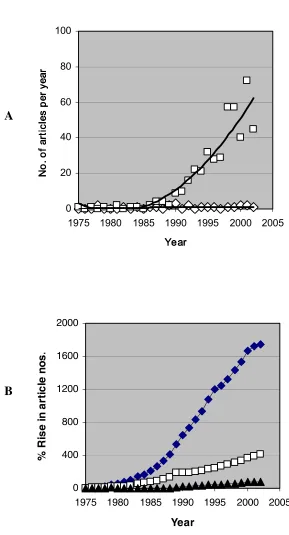
Such feelings underlie an unresolved debate over the opti-mal balance between factual ('teaching', or content-based) and practical ('training', or performance-content-based) components of professional development [11] and, as such, could explain a recent drift away from the didactic emphasis of older biomedical educative approaches [12] and towards quasi-experiential, or problem-based, learn-ing [13,14] (PBL; Figure 1A). This hypothesis cannot fully account for the PBL-led transformation of medical teach-ing in the 1990s, however, overlookteach-ing as it does a pow-erful contrary trend: the explosive proliferation of biomedical knowledge [15,16] as epitomized by the com-pletion of the Human Genome Project [17]. Although at first sight contradictory, this reciprocal relationship between knowledge growth and didactic teaching invites a unifying explanation: namely, that the switch of educa-tional philosophy to non-didactic methods represents a strategy for teachers and students to cope with the expan-sile information environment [18,19].
There are many things which a fresh medical student, unburdened by factual knowledge, can begin to learn: basic surgical methods, resuscitation interventions, generic reasoning skills, and counselling techniques, to name a few. The pivotal question, then, is not whether such context-dependent (but sequence-independent) learning will prove effective [20]; rather, it is why this reo-rientation of teaching philosophy has occurred at all, and at this time. Or to put the issue another way: what is the hard evidence indicating that the original educational sys-tem was broken and that the new syssys-tem is likely to fix it?
A secondary issue, which has been a prime concern of PBL critics [21], is whether there may prove to be long-term hidden costs payable for the clear short-term benefits afforded by the PBL teaching philosophy. Since there are major differences in the way that PBL is implemented between schools, evidence to confirm or refute such hypotheses may be impossible to assemble. By the same token, it is an oversimplification to view all PBL as having low fact-based content, just as it is to equate all older teaching methods with rote learning. Nonetheless, since PBL veers more to the active/contextual, and didactic teaching to the passive/factual, it is plausible that one bias occurs at the expense of the other.
Discussion
What is knowledge – anyone know?
The traditional educational sequence involves theory pre-ceding application, an accelerated model of which has long been satirized in clinical circles as "watch one, do one, teach one". As noted above, however, some
applica-tions may be learned in the absence of theoretical knowl-edge, just as some subsets of theoretical knowledge may be unassociated with any obvious application. Is it possi-ble, then, to define a minimum essential "core knowl-edge" spectrum for the student of biomedicine? If so, should such knowledge expand in parallel with other bio-medical information, or should any such expansion be restricted by its relevance to changes in clinical perform-ance (the 'barefoot doctor' model)? In the latter case, how long can healthcare competence and credibility be main-tained in the face of rising constraints on scientific core knowledge [22]?
If core knowledge is indeed expanding at a rate similar to that of non-core knowledge, then the strategy of solving the broad problem of knowledge expansion by defining a narrower core can only be a temporizing measure. On the other hand, if the quantum of core knowledge is deemed non-expansile – arbitrarily defined, for example, to repre-sent the amount of knowledge capable of being instilled in an average student by x teaching hours per week spread over y years – then any expansion of non-core knowledge will cause the core to shrink as a proportion of total knowledge. In 1984, for example, a list of two hundred drugs was hailed as a solution to information overload in the field of pharmacology [23]; but by 2000 the overload problem in this discipline was perceived to have deterio-rated despite both the embracement of PBL and relentless efforts to re-define a core curriculum [24].
A key difficulty in addressing this problem is that expan-sion of biomedical information is asymmetric – different areas of knowledge grow at different rates which in turn vary (and are ascribed differing priorities) during different periods (Fig. 1B). In practice, most curricula cope with dif-ferential knowledge growth by adding new core modules to cover areas of rapid growth [25]; the problem with this approach is that the notion of "core" becomes fluid, inval-idating the concept. Moreover, it is difficult to discard age-ing core knowledge at the same rate as addage-ing new information, since the credibility of newer information tends by its nature to be weaker than that of older content. Rigid conservation of the core leaves trainees selectively deficient in new knowledge areas, on the other hand, making them less competitive in the marketplace. Dis-crepancies emerging between planned (taught) and actual (learned) medical curricula [26] further weaken the prac-ticability of paradigms based on core knowledge.
Comparison of growth rates of PBL and biomedical knowledge
Figure 1
Comparison of growth rates of PBL and biomedical knowledge. (A), Relative growth of interest in PBL versus lecture-based teaching based on PubMed keyword frequencies between 1975 and 2000. The Title fields of the journal database were searched each year for the strings "problem-based learning" (open squares) or "lecture" (open diamonds); the retrieved items were then scrutinized to determine those dealing with the subject of teaching style (e.g., eponymous "lectures" were
excluded). (B), Growth rates of journal articles dealing with subject matter relating to science, medicine and education. The strings "gene" (solid diamonds), "clinical" (open squares) and "medical education" (solid triangles) are shown here, illustrative of the frequencies of many other keywords searched.
0 20 40 60 80 100
1975 1980 1985 1990 1995 2000 2005 Year
Year Year Year
N
o.
of
ar
tic
les
per
year
N
o.
of
ar
tic
les
per
year
N
o.
of
ar
tic
le
s
pe
rye
ar
N
o.
of
ar
tic
les
per
year
0 400 800 1200 1600 2000
1975 1980 1985 1990 1995 2000 2005
Year
%
Ri
se i
n
art
icl
e
n
o
s
.
A
maintenance of professional competence [28]. Moreover, practicality should not be the sole criterion by which core knowledge is judged; a medical training system cannot succeed by simply cloning service-based doctors, but must also produce academics, researchers, visionaries and lead-ers able to develop the service infrastructure [29]. It is against the background of these diverse challenges that the recent growth of PBL should be appraised.
The lure of the non-expert
A traditional authoritative doctor who dares challenge the information explosion faces the same risk as the immova-ble object confronting the irresistiimmova-ble force. The outcome has been to shatter the image of the omniscient doctor, as well as to dent the plausibility of experts in all fields. This slide from grace of the specialist – formerly a dominant figure in the medical educational pantheon, and a revered colleague in the battle against information overload [30] – has paralleled the decline of the lecture as a teaching medium. These linked trends suggest that the internet-empowered medical customer of the 21st century (whether patient or student) now questions information promulgated by mere individuals, thus threatening clini-cal and teaching paradigms formerly assumed unassailable.
This problem has created a niche for PBL, rejecting as it has the old curriculum's reliance upon experts and spe-cialists [31]. The reported disadvantages of non-expert biomedical teaching with respect to knowledge transmis-sion [32] and disease understanding [33] have been par-ried by numerous studies showing no detectable information deficits in PBL-trained (compared to lecture-taught) students [34-38]. Such negative data may be of limited reassurance, however, given the insensitivity of the endpoints used to measure what is in practice a rather limited curricular divergence [39]. It is likewise arguable that endpoints such as knowledge acquisition and clinical skills are surrogates, and that the most critical deliverable of medical training – namely, the quality of patient out-comes – has not been measured in any controlled trial of PBL [40]. These points lend credence to criticisms that the present-day popularity of PBL has so far been driven more by individual enthusiasm and conjecture than by objec-tive scientific evidence [41].
Who, then, stands to gain from PBL? Medical teachers are perhaps the most immediate beneficiaries [42]. Reduced self-perceptions of fallibility may be one attraction for teachers, as new PBL supervisors find that their educa-tional contributions are no longer falsifiable by their pupils. In addition, responsibility for providing a suffi-cient knowledge base can be passed from teacher to stu-dent under the PBL auspices of 'self-directed learning' [43]. Yet another benefit relates to the lack of formal
prep-aration required to initiate a PBL session [44] – an advan-tage which suggests a gain in efficiency. But does this bear scrutiny [45]?
Things have changed
Efficiency can be calculated by dividing (productivity) by (time and effort). What do we mean in this context by pro-ductivity? A half-century ago, the only responsibility of a medical school was to produce clinicians to serve the local community; today, however, teaching activities incorpo-rate postgraduate specialist education, continuing medi-cal education, professional and career development, public and patient awareness programmes, education-related research, conference and workshop organization, national and international collaborative initiatives, pro-fessional accreditation and audit activities, development of electronic teaching resources, and so on. Hence, a mod-ern faculty's teaching productivity is not able to be gauged exclusively (or even predominantly) by the number and quality of its outgoing medical graduates, but rather must be judged by the sum total of its useful educational output.
This raises short- and long-term issues as to the most effi-cient ways to utilize faculty time and effort: traditional teaching service activities (e.g., tutorials, mentoring) must compete with more ambitious developmental activities (e.g., production of journal articles, books, software or web resources). Small-group tutorials are a time-hon-oured teaching modality, but the opportunity cost is high; while there must surely remain a place for personalized teaching, it seems doubtful whether the modern academic system can tolerate the luxury of an accelerating trend in this direction [46]. In contrast, the traditional apprentice-ship training approach seems cost-effective, relying as it does upon the learner assisting a professional in the exe-cution of his/her paid duties.
From words to actions
Solutions lie in compromise. Such change is painful because it involves the abandonment of ideals formerly attainable; the vision of a one-size-fits-all medical school becomes no longer practical, and ever more difficult deci-sions will be needed as to what style(s) of graduate is most urgent for a faculty to produce. This process of curricular differentiation has started, but the pace is set to quicken as medical markets emerge and diverge, and as competition for faculty survival sharpens. To what extent, though, should these divisive educational decisions be made by markets, faculties, students, patients or governments?
Contrary to popular thought, there will remain a strong need – and possibly an enlarging one – for a subset of highly-trained medical graduates from a knowledge-intensive learning environment who are capable of assim-ilating the complexities of science, informatics, humani-ties and logistics that comprise modern medicine. Since the proportion of individuals and faculties suitable for this leadership mission looks set to decline, however, a larger number will need to accept the equally daunting compromise of skills prioritization.
Teachers cannot teach without students, but students can learn without teachers. This belated insight has trans-formed the role of teachers into that of learning facilita-tors, akin to a culture of "thinking apprenticeship". Paradoxically, in an age when even complex skills such as landing aircraft are learned using robotic simulators, the trend in medical education has switched back to labor-intensive small-group teaching under the guise of PBL. This at first seems all the more curious given the unprece-dented availability of alternative technologies for teaching clinical reasoning, the increasing importance of an ade-quate knowledge base in an ever more sophisticated pro-fessional environment, the growing pressures on faculties to use limited fiscal resources in the most cost-effective manner, and the novel opportunities for commercializing educational activities and products via the development of software and web-based resources.
The rise in PBL popularity over the 1990s thus suggests a retreat from the fallout of the biomedical information explosion. Although this response seems rational enough as a short-term adaptive measure, it should not be regarded as a solution to the problem of knowledge expansion. Just as PBL was originally pioneered as a reac-tion against complacency in tradireac-tional pedagogy, so must today's medical schools reject expediency and con-front the unresolved information-management chal-lenges of 21st-century medical education. The formulation of more efficient techniques for imparting factual knowledge, a greater emphasis on directing lim-ited resources to the production of reusable teaching tools
[63], and a willingness to experiment with differentiated medical curricula that prioritise graduate skill subsets, can all play a role in driving educational reform as a positive and ongoing adaptive process.
Summary
The knowledge explosion of the last two decades has been accompanied by a decreasing reliance on didactic teach-ing. This educational paradigm shift has been led by wide-spread embracement of PBL, the original rationale of which was to improve students' ability to reason and com-municate. In recent years, however, PBL has grown more rapidly in apparent response to information overload in medical school curricula, and may thus be viewed as a symptom of the problem of biomedical knowledge expansion.
The challenge of defining the right balance between what is taught, what is learned, and what remains unlearned will not disappear. Although few knowledge deficits have been detected in today's PBL-educated students, a decreas-ing concern with the adequacy of the professional knowl-edge base could yet erode the future credibility of the medical profession. By continuing to rely on popular PBL escape clauses such as 'self-directed learning' and 'infor-mation management', today's medical educators risk los-ing sight of this longterm threat.
The era of active learning began thousands of years ago with the first apprentice. We now live in a new era with new challenges, one of which is exponential information expansion. PBL provides one way for faculty and students to cope with this challenge, but sidesteps deeper issues relating to the widening core of essential professional knowledge. Innovative curricular experiments using edu-cational strategies complementary to PBL would therefore appear timely.
Abbreviations
PBL, problem-based learning
Competing interests
None declared.Acknowledgements
The author thanks Professor Joe Muller, as well as two named journal reviewers, for constructive feedback on the manuscript.
References
1. Kreisman JJ: The curandero's apprentice: a therapeutic inte-gration of folk and medical healing. Am J Psychiatry 1975,
132:81-83.
2. Bleakley A: Pre-registration house officers and ward-based learning: a 'new apprenticeship' model. Med Educ 2002,
36:9-15.
4. Taylor KL, Chudley AE: Meeting the needs of future physicians: a core curriculum initiative for postgraduate medical educa-tion at a Canadian university.Med Educ 2001, 35:973-82. 5. Markova T, Roth LM: E-conferencing for delivery of residency
didactics.Acad Med 2002, 77:748-49.
6. Minor S, Poenaru D: The in-house education of clinical clerks in surgery and the role of housestaff.Am J Surg 2002, 184:471-5. 7. Rosenberg WM, Sackett DL: On the need for evidence-based
medicine.Therapie 1996, 51:212-7.
8. Phinney AO, Hager WD: Teaching senior medical students in an office setting: the apprentice system revisited.Conn Med
1998, 62:337-41.
9. Turner TH, Collinson SR, Fry HS: Doctor in the house: the med-ical student as academic, attendant and apprentice. Med Teach 2001, 23:514-16.
10. Rolfe IE, Sanson-Fisher RW: Translating learning skills into prac-tice: a new strategy for learning clinical skills.Med Educ 2002,
36:345-52.
11. Marckmann G: Teaching science vs. the apprentice model – do we really have the choice?Med Health Care Philos 2001, 4:85-89. 12. Wallace AG: Educating tomorrow's doctors: the thing that
really matters is that we care.Acad Med 1997, 72:253-58. 13. Norman GR, Schmidt HG: Effectiveness of problem-based
learning curricula: theory, practice and paper darts.Med Educ
2000, 34:721-8.
14. Finucane PM, Johnson SM, Prideaux DJ: Problem-based learning: its rationale and efficacy.Med J Aust 1998, 168:429-30. 15. Hunt RE, Newman RG: Medical knowledge overload: a
disturb-ing trend for physicians.Health Care Manage Rev 1997, 22:70-75. 16. Laine C, Weinberg DS: How can physicians keep up-to-date?
Annu Rev Med 1999, 50:99-110.
17. Collins FS, Morgan M, Patrinos A: The human genome project: lessons from large-scale biology.Science 2003, 300:286-90. 18. Carlile S, Barnet S, Sefton A, Uther J: Medical problem based
learning supported by intranet technology: a natural student centred approach.Int J Med Inf 1998, 50:225-33.
19. Smith HC: A course director's perspectives on problem-based learning curricula in biochemistry.Acad Med 2002, 77:1189-98. 20. Webster C, McLinden S, Begler K: Why Johnny can't reengineer health care processes with information technology.Medinfo
1995, 8:1283-7.
21. Monkhouse WS, Farrell TB: Tomorrow's doctors: today's mistakes?Clin Anat 1999, 12:131-4.
22. Maudsley G, Strivens J: 'Science', 'critical thinking' and 'compe-tence' for tomorrow's doctors: a review of terms and concepts.Med Educ 2000, 34:53-60.
23. Riley MW: Reducing 'information overload' in the teaching of pharmacology: the '200 Drug List'.J Med Educ 1984, 59:508-11. 24. Achike FI, Ogle CW: Information overload in the teaching of
pharmacology.J Clin Pharmacol 2000, 40:177-83.
25. Vidic B, Weitlauf HM: Horizontal and vertical integration of academic disciplines in the medical school curriculum.Clin Anat 2002, 15:233-5.
26. Verhoeven BH, Verwijnen GM, Scherpbier AJ, van der Vleuten CP:
Growth of medical knowledge.Med Educ 2002, 36:711-17. 27. Simpson JG, Furnace J, Crosby J et al.: The Scottish doctor –
learning outcomes for the medical undergraduate in Scot-land – a foundation for competent and reflexive practitioners.Med Teach 2002, 24:136-43.
28. Whipp JL, Ferguson DJ, Wells LM, Iacopino AM: Rethinking knowl-edge and pedagogy in dental education. J Dent Educ 2000,
64:860-66.
29. Hammel J, Royeen CH, Bagatell N, Chandler B, Jensen G, Loveland R, Stone G: Student perspectives on problem-based learning in an occupational therapy curriculum: a multiyear qualitative evaluation.Am J Occup Ther 1999, 53:199-206.
30. Cullen R: The medical specialist: information gateway or gatekeeper for the family practitioner.Bull Med Lib Assoc 1997,
85:348-55.
31. Maudsley G: Making sense of trying not to teach: an interview study of tutors' ideas of problem-based learning.Acad Med
2002, 77:162-72.
32. Hay PJ, Katsikitis M: The 'expert' in problem-based and case-based learning: necessary or not?Med Educ 2001, 35:22-26. 33. Jones A, McArdle PJ, O'Neill PA: Perceptions of how well
gradu-ates are prepared for the role of pre-registration house
officer: a comparison of outcomes from a traditional and an integrated PBL curriculum.Med Educ 2002, 36:16-25.
34. Kaufman DM, Mann KV: Comparing achievement on the Medi-cal Council of Canada Qualifying Examination Part I of stu-dents in conventional and problem-based learning curricula.
Acad Med 1998, 73:852-3.
35. Antepohl W, Herzig S: Problem-based learning versus lecture-based learning in a course of basic pharmacology: a control-led randomized study.Med Educ 1999, 33:106-13.
36. Alleyne T, Shirley A, Bennett C et al.: Problem-based compared with traditional methods at the Faculty of Medical Sciences, University of the West Indies: a model study.Med Teach 2002,
24:273-9.
37. Whitfield CF, Mauger EA, Zwicker J, Lehman EB: Differences between students in problem-based and lecture-based cur-ricula measured by clerkship performance ratings at the beginning of the third year.Teach Learn Med 2002, 14:211-17. 38. Prince KJ, van Mameren H, Hylkema N, Drukker J, Scherpbier AJ, van
der Vleuten CP: Does problem-based learning lead to deficien-cies in basic science knowledge?Med Educ 2003, 37:15-21. 39. Albanese M: Problem-based learning: why curricula are likely
to show little effect on knowledge and clinical skills.Med Educ
2000, 34:729-38.
40. Thomas RE: Problem-based learning: measurable outcomes.
Med Educ 1997, 31:320-29.
41. Colliver JA: Educational theory and medical education prac-tice: a cautionary note for medical school faculty.Acad Med
2002, 77:1217-20.
42. Hsu SC, Ong GH: Evaluation of problem-based learning: a lec-turer's perspective.Ann Acad Med Singapore 2001, 30:524-7. 43. Miflin BM, Campbell CB, Price DA: A conceptual framework to
guide the development of self-directed, lifelong learning in problem-based medical curricula.Med Educ 2000, 34:299-306. 44. Mennin SP, Martinez-Burrola N: The cost of problem-based vs.
traditional medical education.Med Educ 1986, 20:187-94. 45. Doucet MD, Purdy RA, Kaufman DM, Langille DB: Comparison of
problem-based learning and lecture format in continuing medical education based on headache diagnosis and management.Med Educ 1998, 32:590-96.
46. Jonas HS, Etzel SI, Barzansky B: Educational programs in US medical schools.JAMA 1991, 266:913-20.
47. Nowacek GA, Bailey BA, Sturgill BC: Influence of the interview on the evaluation of applicants to medical school.Acad Med
1996, 71:1093-95.
48. Carrothers RM, Gregory SW, Gallagher TJ: Measuring emotional intelligence of medical school applicants. Acad Med 2000,
75:456-63.
49. Edwards JC, Elam CL, Wagoner NE: An admission model for medical schools.Acad Med 2001, 76:1207-12.
50. Barnard D, Quill T, Hafferty FW, Arnold R, Plumb J, Bulger R, Field M: Preparing the ground: contributions of the preclinical years to medical education for care near the end of life.Acad Med 1999, 74:499-505.
51. Weiss SC: Humanities in medical education: revisiting the doctor-patient relationship.Med Law 2000, 19:559-67. 52. Kirklin D: Responding to the implications of the genetics
rev-olution for the education and training of doctors: a medical humanities approach.Med Educ 2003, 37:168-73.
53. Walsh WJ: The McMaster programme of medical education, Hamilton, Ontario, Canada: developing problem-solving activities.Public Health Pap 1978, 70:69-77.
54. Thorne S: Medical school tuition fees reach record levels as MD incomes shrink.Can Med Assoc J 1996, 155:979-81.
55. Godwin M, Seguin R, Wilson R: Queen's University alternative funding plan: effect on patients, staff and faculty in the Department of Family Medicine. Can Fam Phys 2000,
46:1438-44.
56. Kwong JC, Dhalla IA, Streiner DL, Baddour RE, Waddell AE, Johnson IL: Effects of rising tuition fees on medical school class com-position and financial outlook. Can Med Assoc J 2002,
166:1023-28.
57. Robins LS, White CB, Fantone JC: The difficulty of sustaining cur-ricular reforms: a study of "drift" at one school.Acad Med
Publish with BioMed Central and every scientist can read your work free of charge "BioMed Central will be the most significant development for disseminating the results of biomedical researc h in our lifetime."
Sir Paul Nurse, Cancer Research UK
Your research papers will be:
available free of charge to the entire biomedical community
peer reviewed and published immediately upon acceptance
cited in PubMed and archived on PubMed Central
yours — you keep the copyright
Submit your manuscript here:
http://www.biomedcentral.com/info/publishing_adv.asp
BioMedcentral
58. Kenny AJ, Kendall S: Serving two masters: quality teaching and learning versus economic rationalism.Nurs Educ Today 2001,
21:648-55.
59. Woolliscroft JO, Van Harrison R, Anderson MB: Faculty views of reimbursement changes and clinical training: a survey of award-winning clinical teachers. Teach Learn Med 2002,
14:77-86.
60. Gelijns AC, Thier SO: Medical innovation and institutional interdependence: rethinking university-industry connections.JAMA 2002, 287:72-77.
61. Harden RM, Hart IR: An international virtual medical school (IVIMEDS): the future for medical education?Med Teach 2002,
24:261-67.
62. Cohen JR, Fox S: Developing a new faculty practice plan with a model for funding flow between the hospital and the plan.
Acad Med 2003, 78:119-2.
63. Adler MD, Johnson KB: Quantifying the literature of computer-aided instruction in medical education. Acad Med 2000,
75:1025-8.
Pre-publication history
The pre-publication history for this paper can be accessed here: