Research Article
Marital quality and its relation with depression: a case-control study
Priyanka Jaiswal, Abdul Q. Jilani, Devashish Shukla*, P. K. Dalal, Adarsh Tripathi,
Shweta Singh, Savita Jain
INTRODUCTION
Depression is disorder of major public health importance. It has been estimated that by the year 2020, depression will be the second leading cause of disability throughout the world, trailing only ischemic heart disease.1
Though, depression prevails across all genders, ages, and backgrounds, but average age of onset is reproductive period. The lifetime risk and prevalence is twice in females than males. Family structure, relationships and functions like marital quality, emotional involvement and perceived criticism, burden of care affect course and prognosis of psychiatric disorders including major depression.2-4
Physical health may also be affected by quality of marital life. Positive marital processes (e.g., marital satisfaction, marital happiness) are beneficial, whereas negative (e.g. marital conflict) have detrimental impact on physical
health, further compromising quality of marriage and hence depression.5
India is a country where marriage is considered pious rituals for reproduction and healthy life. Spouses are also main caregiver and are responsible for management of affected partner in developing countries due to lack of formal psychiatric health care. Hence they may be considered to bear the perceived burden of care beside the negative effect of depression. In depression, emotion is negatively affected along with associability and poor interpersonal relationship. This may further impair the marital quality.
There is dearth of information from India regarding quality of marriage in patient with depression emphasizing the need to explore this area. The proposed study included assessment of marital quality of depressed patients using marital quality scale in Indian setup.
ABSTRACT
Background: Marital relationship may be adversely affected due to depression in spouse. Usually the non-affected partner is main caregiver and responsible for caregiving.
Methods: This was cross sectional case control study with sample size of 252 subjects (151 cases and 151 healthy controls). Cases were diagnosed as per DSM-IV-TR criteria. Quality of marriage was assessed using Marital Quality Scale.
Results: Quality of marital relationship was significantly poor among cases. Marital quality further worsened with severity of Depression.
Conclusions: Depression negatively affects quality of marriage.
Keywords: Marital quality, Depression, Quality of marriage in India
Department of Psychiatry, King George's Medical University, Lucknow, India
Received: 25 March 2016
Accepted: 10 May 2016
*Correspondence:
Dr. Devashish Shukla,
E-mail: [email protected]
Copyright: © the author(s), publisher and licensee Medip Academy. This is an open-access article distributed under the terms of the Creative Commons Attribution Non-Commercial License, which permits unrestricted non-commercial use, distribution, and reproduction in any medium, provided the original work is properly cited.
METHODS
This was single point case control study at Department of Psychiatry, King George’s Medical University, Lucknow for a period of one year. The first two patients attending outdoor of department, aged between 18 to 60 years with diagnosis of Major depressive disorder as per DSM-IV were screened for inclusion in case group. Controls were recruited from rural and urban areas of Lucknow with the help of NGO (Samajdarshan). The NGO had close liaising with department. Informed consent was taken from both cases and controls. Two fifty two subjects were recruited in study including 151 cases and 151 age, sex and domicile matched healthy controls after applying screening criteria.
Sociodemographic and clinical details were recorded on semi structured proforma. Cases were assessed using HAMD-216 for severity of depression. Controls were assessed using GHQ to rule out possibility of psychiatric disorders. Marital quality in both groups was assessed using drafted version of MQS in Hindi.6
Tools used
1. HAMD-21: This is most widely used scale to rate the severity of depression on the basis of clinical interview and observation made by the clinician. This contains 21 items. Each item scored on from 0 to 4. Severity is categorized as Mild- 8 to 13, moderate- 14 to 18, severe- 19 to 23, and severe ≥246.6
2. MQS: This is a multi-dimensional scale with 50 items and each item is rated on four point rating scale. Of 50 items, 28 items positive and 22 are negative. There is different male and female form of this scale. Each item is rated on a four point rating scale. Total score is calculated by summing positive and negative items. Total range varies from 50-200. The higher score indicates poor the marital quality life.7 The original English version of MQS tool was first translated in Hindi by three translators independently. These three translated versions were compared and newer version was drafted. This version was tested on 20 literate and 20 illiterate people from the community for simplicity, clarity, understanding and precision. Changes were made accordingly. Two bilingual experts translated back the Hindi version into English to establish meaning equivalence. The primary translators and the back translators discussed questionnaire item by item to ensure that the translations were approximate as closely as possible. The final drafted version of MQS in Hindi was used in study. polypropylene).
Procedure
The assessment as per study protocol was completed on the same day or after appointment on a mutually convenient day. Information regarding details of identification data, demographic details, history of
present and past illness was recorded on a semi structured proforma. The diagnosis was made by consensus between the investigator and one of the supervisors as per DSM-IV-TR criteria. Assessment of Depressive patients was done by applying the Hamilton depression scale and Marital Quality Scale. For the control group, a geographically defined area was identified; door to door survey was done. Control group was matched on age, sex, education and family income, and those fulfilling the inclusion, exclusion criteria formed the sample of the study.
Data management and analysis
Data were expressed as proportion, percentage or mean±SD as appropriate. The test on the proportions between groups was performed using Chi- square test or Fisher’s exact test. For comparison between groups, Student unpaired t test and One-Way analysis of variance (ANOVA) were applied. P value less than 0.05 was considered as statistically significant.
RESULTS
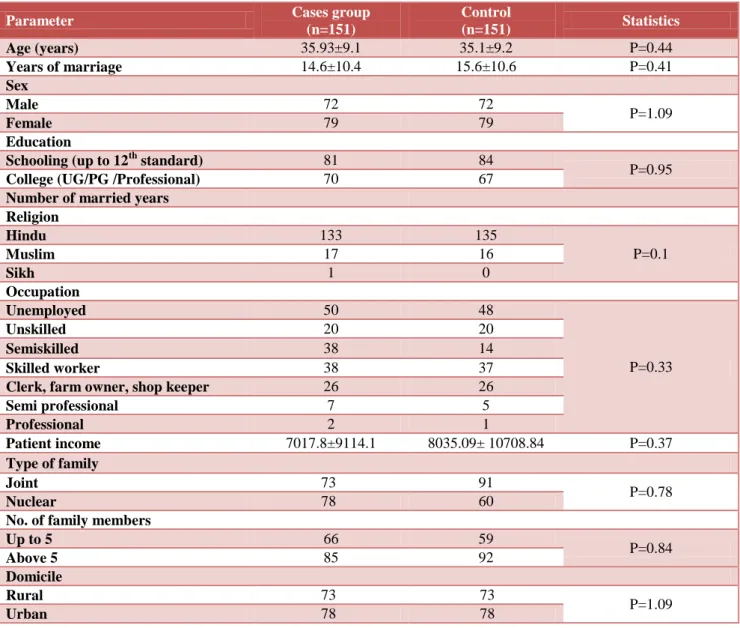
The mean age of cases and controls were 35.93±9.1 and 35.1±9.2 years respectively. Females outnumbered males in either of groups. Cases and controls were age and sex matched and were comparable in term of education, number of married years, occupation, patient’s income, family income, number of family members, type of family and domicile. There were also equal numbers of subjects from rural and urban areas in both the groups as given in Table 1.
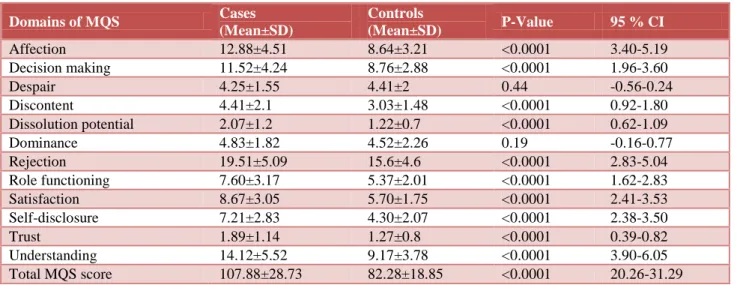
As assessed by marital quality scale, it was found the quality of marriage was significantly poor in cases. Except despair and dominance, the other domains of MQS were significantly affected in cases as shown in Table 2.
The quality of marriage worsened with increasing severity of depression. Cases of Mild depression (HAM-D: 8-13) were having MQS score of 90.25±17.44; moderate depression (HAM-D: 14-18) of 1.07±22.87; severe depression (HAM-D: 19-23) of MQS of 1.22±30.13; and severe depression (HAM-D: >23) of 1.18± 36.25.
DISCUSSION
such as excessive reassurance-seeking can be burdensome for one’s spouse, who may respond with criticism or rejection.13 In the present study marital quality was assessed and compared in both cases and controls. The poor marital quality among cases as in present study is similar to other studies.13,14
Longitudinal studies also show that poor marital satisfaction predicts increases in depressive symptoms over time and co-varies with changes in depressive symptoms, and associated with increases risk of relapse within a year.15-17
Marital predictors of well-being have been variously labeled as marital quality, success, happiness, satisfaction, discord, adjustment, and well-being.18 Empirical studies link the marital variables to spouse’s personal well-being. For example, both cross-sectional and longitudinal studies indicated an association between spouse’s personal well-being and marital love, and conflict, marital satisfaction, and marital discord.19,20,12
In this study all the domains of MQS like affection, decision-making, discontent, dissolution potential, rejection, role functioning, satisfaction, self-disclosure, trust and understanding except despair and dominance were significantly different in cases and controls. The findings are similar to study by Coyne JC et al which revealed that there were decreased expression of affection and excess marital complaints in either gender of depressed patients.21 Decision making plays important role in marital quality. As per view of male partner, marital quality is good when they have more decision making power than their wives and vice versa. As per perception of women, better marital quality when decision power is equally shared.22 In the present study we concluded that decision making is important factor for happiness in marriages. Individuals with marital disharmony scored significantly higher on the factors for understanding, rejection, satisfaction, affection, despair, decision-making, discontent, dissolution-potential, self-disclosure, trust, and role functioning similar to other study.7
Table 1: Socio-demographic characteristics of case and control.
Parameter Cases group
(n=151)
Control
(n=151) Statistics
Age (years) 35.93±9.1 35.1±9.2 P=0.44
Years of marriage 14.6±10.4 15.6±10.6 P=0.41
Sex
Male 72 72
P=1.09
Female 79 79
Education
Schooling (up to 12th standard) 81 84
P=0.95
College (UG/PG /Professional) 70 67
Number of married years Religion
Hindu 133 135
P=0.1
Muslim 17 16
Sikh 1 0
Occupation
Unemployed 50 48
P=0.33
Unskilled 20 20
Semiskilled 38 14
Skilled worker 38 37
Clerk, farm owner, shop keeper 26 26
Semi professional 7 5
Professional 2 1
Patient income 7017.8±9114.1 8035.09± 10708.84 P=0.37
Type of family
Joint 73 91
P=0.78
Nuclear 78 60
No. of family members
Up to 5 66 59
P=0.84
Above 5 85 92
Domicile
Rural 73 73
P=1.09
Table 2: Analysis of marital quality and their domains.
Domains of MQS Cases
(Mean±SD)
Controls
(Mean±SD) P-Value 95 % CI
Affection 12.88±4.51 8.64±3.21 <0.0001 3.40-5.19
Decision making 11.52±4.24 8.76±2.88 <0.0001 1.96-3.60
Despair 4.25±1.55 4.41±2 0.44 -0.56-0.24
Discontent 4.41±2.1 3.03±1.48 <0.0001 0.92-1.80
Dissolution potential 2.07±1.2 1.22±0.7 <0.0001 0.62-1.09
Dominance 4.83±1.82 4.52±2.26 0.19 -0.16-0.77
Rejection 19.51±5.09 15.6±4.6 <0.0001 2.83-5.04
Role functioning 7.60±3.17 5.37±2.01 <0.0001 1.62-2.83
Satisfaction 8.67±3.05 5.70±1.75 <0.0001 2.41-3.53
Self-disclosure 7.21±2.83 4.30±2.07 <0.0001 2.38-3.50
Trust 1.89±1.14 1.27±0.8 <0.0001 0.39-0.82
Understanding 14.12±5.52 9.17±3.78 <0.0001 3.90-6.05
Total MQS score 107.88±28.73 82.28±18.85 <0.0001 20.26-31.29
P value less than 0.05 was considered as statistically significant.
Despair is an important and related concept in understanding marital disharmony in the indian context. Shah et al in order to establish the clinical validity of MQS administered the scale to clinical group of 15 males and 15 females with marital disharmony and compared with matched healthy controls.7 In accordance with present study, the common findings were presence of despair due to helplessness and importance of decision making. Exclusion of the spouse from decision making process and discontent with the spouse along with inability to fulfill the sexual and relationship needs were indicated as in present study. Similarly, dimension of dominance was insignificant variable among the two groups.7,23
Conflict resolution is an important factor which indicates that marital quality plays crucial role in determining quality of dyadic relationship.24 Trust is recognized as an important factor in interpersonal relationships, but only some studies have examined the direct link between trust and marital satisfaction itself.25 Previous research found that for female partner's trust is predictive of levels of marital satisfaction, and that interpersonal trust is correlated with marital adjustment.26 In couples, inconsistency in reported levels of trust are also linked to lower levels of marital satisfaction, further suggesting that trust may be an important factor in marital satisfaction. The partner trust scale is also associated with levels of marital satisfaction.27
Furthermore, it is important to point out that marital quality and symptoms of depression are known to be reliably related.28 Similar to the present study which revealed that increase of severity of depression was associated with poor marital quality. Bookwala and jacobs found that negative marital processes (e.g., level of disagreement) were associated with more depressed affect, and positive marital processes (e.g., marital
happiness) were associated with lower depressed affect in young and old married individuals.29 Similarly, whisman et al, in a review of the literature linking marital quality and symptoms of depression, reported that marital dissatisfaction was significantly associated with both clinical depression and milder symptoms of depression.30
CONCLUSION
There is inverse relationship between depression and marital quality. Except despair and dominance, other domains of marital quality are significantly lower in spouse of depressed individuals. Impairment in marital quality also varies with severity of depression.
Funding: No funding sources Conflict of interest: None declared
Ethical approval: The study was approved by the institutional ethics committee
REFERENCES
1. Murray C, Lopez A. The global burden of disease. [Cambridge, Mass.]: Published by the Harvard School of Public Health on behalf of the World Health Organization and the World Bank; 1996.
2. Narrow WE. One-year prevalence of mental
disorders, excluding substance use disorders, in the US: NIMH ECA prospective data. Population estimates based on US Census estimated residential population age 18 and over on July 1, 1998. Unpublished. Online: www. nimh. gov. 1998.
3. Gurman AS, Lebow JL, Snyder DK. Clinical
Handbook of Couple Therapy. 5th ed. Guilford Publications; 2015: 753.
4. Beach SRH, Sandeen E, O’Leary KD. Depression in
5. The Short-Term and Decade-Long Effects of Divorce on Women’s Midlife Health [Internet].
[cited 2016 Mar 23]. Available from:
http://hsb.sagepub.com/content/47/2/111.short 6. Hamilton M. A rating scale for depression. Journal
of neurology, neurosurgery, and psychiatry. 1960;23(1):56.
7. Shah A. Clinical validity of Marital Quality Scale. NIMHANS Journal. 1995;13(1):23–31.
8. Glenn N, Weaver C. The Contribution of Marital Happiness to Global Happiness. Journal of Marriage and the Family. 1981;43(1):161.
9. Pearlin LI, Lieberman MA. Social sources of emotional distress. Research in community and mental health. 1979;1:217-48.
10. Whisman M, Baucom D. Intimate Relationships and Psychopathology. Clinical Child and Family Psychology Review. 2011;15(1):4-13.
11. Fincham FD, Beach SRH. Conflict in marriage: Implications for Working with Couples. Annual Review of Psychology. 1999;50(1):47–77.
12. Christian J, O'Leary K, Vivian D. Depressive symptomatology in maritally discordant women and men: The role of individual and relationship
variables. Journal of Family Psychology.
1994;8(1):32-42.
13. Coyne J. Depression and the response of others. Journal of Abnormal Psychology. 1976;85(2):186-93.
14. Culp L, Beach S. Marriage and depressive
symptoms. Psychol of Women Q. 1998;22(4):647-63.
15. Beach S, O'Leary K. Dysphoria and marital discord: are dysphoric individuals at risk for marital maladjustment. Journal of Marital and Family Therapy. 1993;19(4):355-68.
16. Karney BR. Depressive symptoms and marital satisfaction in the early years of marriage: Narrowing the gap between theory and research. In: Marital and family processes in depression: A scientific foundation for clinical practice. Washington, DC, US: American Psychological Association; 2001;45–68.
17. Whisman M, Bruce M. Marital dissatisfaction and incidence of major depressive episode in a
community sample. Journal of Abnormal
Psychology. 1999;108(4):674-8.
18. Fincham F, Bradbury T. The Assessment of Marital Quality: A Revaluation. Journal of Marriage and the Family. 1987;49(4):797.
19. Cox M, Paley B, Burchinal M, Payne C. Marital Perceptions and Interactions Across the Transition to Parenthood. Journal of Marriage and the Family. 1999;61(3):611.
20. Beach SRH, Arias I, O’Leary KD. The relationship of marital satisfaction and social support to depressive symptomatology. J Psychopathol Behav Assess. 1986;8(4):305–16.
21. Coyne J, Thompson R, Palmer S. Marital quality, coping with conflict, marital complaints, and affection in couples with a depressed wife. Journal of Family Psychology. 2002;16(1):26-37.
22. Smock PJ. Review of Alone Together: How
Marriage in America Is Changing. Contemporary Sociology. 2008;37(1):34–6.
23. Preliminary report of psychiatric disorders in survivors of a severe earthquake: American Journal of Psychiatry: Vol 153, No 4 [Internet].
24. [cited 2016 Mar 23]. Available from:
http://ajp.psychiatryonline.org/doi/abs/10.1176/ajp.1 53.4.556
25. Brackett M, Warner R, Bosco J. Emotional
intelligence and relationship quality among couples. Personal Relationships. 2005;12(2):197-212. 26. Gurtman M. Trust, distrust, and interpersonal
problems: A circumplex analysis. Journal of Personality and Social Psychology. 1992;62(6):989-1002.
27. Johnson S, Talitman E. Predictors of success in emotionally focused Marital Therapy. Journal of Marital and Family Therapy. 1997;23(2):135-52. 28. Couch L, Jones W. Measuring Levels of Trust.
Journal of Research in Personality. 1997;31(3):319-36.
29. Sandberg J, Miller R, Harper J. A Qualitative Study of Marital Process and Depressionin Older Couples. Family Relations. 2002;51(3):256-64.
30. Bookwala J, Jacobs J. Age, Marital Processes, and
Depressed Affect. The Gerontologist.
2004;44(3):328-38.
31. Whisman MA. The association between depression and marital dissatisfaction. In: Beach SRH, editor. Marital and family processes in depression: A scientific foundation for clinical practice. Washington, DC: APA; 2001: 3–24.