95 All Rights Reserved © 2012 IJARCSEE
PCA Based Palm-Print Recognition System
Using DM3730
T. Nagarjuna Reddy, S. Karunakar Reddy,
(M.Tech), Embedded Systems, Assoc. Professor, ECE,
Aurora‟s Technological Research Institute, Aurora‟s Technological Research Institute,
Abstract— Palm-print technology is one of the biometric techniques used to identify an individual. Recognition of palm prints is based on the features like palm lines, texture, ridges etc. Several line and texture extraction techniques have already been proposed. This paper presented rapid and effective palm-print recognition based on DM3730 chip which is a Da Vinci™ digital media processor. Paper deployed USB camera as a palm-print images’ acquisition equipment, used the ARM + DSP multi-core DM3730 processor technology as palm-print image recognition processing, and sent the recognition results to the user interface ultimately. Linux Operating System run in the ARM side, DSP/BIOS Operating System service in the DSP side oppositely. This paper’s palm-print recognition algorithm based on wavelet reconstruction and local DCT and 2DPCA. Palmprint recognition by the nearest neighbour classifier at last.
Keywords: DM3730, Palm-print Recognition, Wavelet Reconstruction, Local DCT, 2DPCA.
I. INTRODUCTION
Biometrics is a technique to identify a human being by his/her physical or behavioral characteristics, which, compared to smart card and passwords, are not easy to lose or forget. Most biometrics techniques try to identify a person using his body parts or behaviors such as face, fingerprint,and iris.It was not until recently that researchers started to pay attention to hand-based biometrics like palm print for personal authentication. The inner surface of the palm normally consists of principal lines and wrinkles. Researchers found that these non-genetically deterministic patterns are even different for identical twins and thus they are very useful for personal identification. Compared with other biometric traits, the advantages of palm-prints are the availability of large surface areas of the palm for feature extraction, ease of capture, and higher level of user acceptance.
Following the Da Vinci chips DM644x available, Texas Instruments (TI) also launched a series of successive ARM + DSP or ARM + video co-processor, multimedia processor platforms, such as DM643x, DM35x/36x, DM6467, OMAP Lx and so on. They enhanced the overall performance of image processing equipment greatly. In particular, the DM3730 chip that launched recently is such a chip leader. DM3730 processor with 1 GHz ARM ® Cortex ™-A8 core and 800 MHz TMS320C64x + ™ DSP, provide a more comprehensive peripheral interfaces.
In this paper we are using DM3730 chip as the core, and developed a nice user interface to convenience user to control often affected by illumination and the pseudo-principal line that is a operations and to make a secondary development in ARM-side, and achieved efficient palm-print recognition algorithm in DSPside.
II. PALM-PRINT RECOGNITION ALGORITHM
First of all, this paper involves lifting wavelet transform to preprocess palm-print image. The horizontal and diagonal and vertical component of the received image was processed by coefficient threshold processing. Then Lifting Wavelet inverse transform was deployed to enhance reconstruction palm-print image. Pseudo-noise on the main line that caused from the non-planar of the palm has been eliminated, while simplified the computing complexity.
However, the palm-print image enhanced by the wavelet reconstruction is very sensitive to noise in certain regions. Based on this, paper deployed the Local DCT for the reconstructed palm-print images, reduced the feature dimension effectively , while retained the no-light-sensitive information. Following, paper deployed 2DPCA for the feature extraction. At last, paper had got the results through Nearest Neighbor Classifier.
A. Lifting Wavelet Reconstruction
The basic idea of the lifting wavelet transformation was built on the basic wavelet, and made a more favorable new wavelet. It consisted of following steps: decomposition, prediction and update. In the decomposition step, the data divided into even and odd sequence; in the prediction step, even sequence was deployed to predict odd sequence, and the result of prediction bias was the high frequency component of the transformation; in the update step, the prediction bias was deployed to update the even sequence.
96 All Rights Reserved © 2012 IJARCSEE
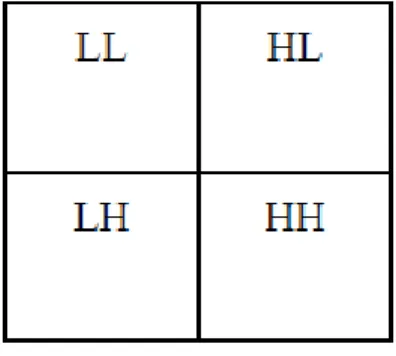
and HL keep detailed information such as wrinkles, ridges, etc. Sub band HH depicts the overall characteristics of the original palm-print image, which is feature extraction is performed by projecting a new palm print result of the arch of the palm print.
Palm-print image‟s low-frequency sub- bands were maintained the original palm-print image‟s main features of the palm-print with appropriate levels of wavelet decomposition. Thought restrained sub-bands HH,L H,HL, paper deployed the lifting wavelet transformation to get the reconstructed image, based on four sub-band images. It can be remove some noise signal information of the image.
Figure 1. Wavelet transformation.
For the noise characteristics of each sub-band
image, paper preserved parts of the image contour without threshold processing for the sub-band images, and deployed different threshold to process for the different high-frequency sub-band images. From 1 to 2 for each layer, they selected a threshold value. It deployed the non-linear wavelet soft-threshold de-noising processing for each layer‟s High-frequency coefficients. In the end, paper used second layer‟s low frequency coefficients and the first and second layers‟ high frequency coefficients to reconstruct image.
B. Local DCT (Discrete Cosine Transform)
DCT is a common image data compression method. It has a feature which named energy aggregation. Most of the signal information tends to be concentrated in the low-frequency DCT component, these low-frequency components that have greater magnitude can be used to reconstruct the image. DCT is DFT (Discrete Fourier Transform)‟s special form. If the periodic function is even function, then its Fourier series will contain only the cosine item. If a given sequence was prolongated even symmetry column, its‟ DFT only contained cosine items.
In the image processing, Fourier Transform was usually deployed to control image noise. The noise often distributed in the high-frequency components. So the component that was less than a certain threshold was taken to zero. Then its anti- DCT transform can be achieved the signal noise suppression. And the DCT does not affect the distance between data points. This means that the DCT does not affect the topology of the data.
C. 2DPCA(two-dimensional principal component analysis)
Palm-print recognition method based on eigen space technology. The original palm-print images used in training are transformed into a small set of characteristic feature images, called „„Eigen palms‟‟, which are the eigenvectors of the training set. Then
image into the subspace spanned by the „„Eigen palms‟‟. Let the training samples of the palm-print images be x1; x2; . . . ; xM,
where M is the number of images in the training set. The average palm-print image of the training set is defined by
The difference between each palm-print image and the average image is given by 𝜑𝑖 = 𝑥𝑖-μ. Then, we can obtain the covariance matrix of {xi} as follows:
where the matrix X =[ 𝜑1 𝜑2. . . 𝜑𝑀 ] .
Determining the eigen vectors and eigen values of the matrix 𝐶 𝐶 ∈ 𝑅𝑁2×𝑁2 is an intractable task for a typical image size.
Cv
=
λv
(3)where v refers to the eigenvector of the matrix C, and
λ
is the eigen value of matrix C.The eigenvectors (v) and eigen values (λ) of matrix C are much easier to calculate. Therefore, we have
(A-
λI)v=0
(4)In order for non-zero vector v to satisfy this eqation A- λI must not be invertible. Then the determinant must be equal to zero.
P(
λ)= det(
A-
λI)
(5)By this we can find the eigen values and eigen vectors of C.
U
TC U = Λ, Λ
∈
R
(c+q)*(c+q) (6)It expressed diagonal matrix that formed by the eigen values. U was orthogonal matrix that formed by the eigenvectors, which correspond with eigen values. Hypothesis, covariance matrix G‟s eigen values was expressed as λi(i=1, 2, …,c+q),
λ1≥λ2≥…≥λ3.The corresponding eigenvector was expressed as
97 All Rights Reserved © 2012 IJARCSEE
(7)
where 𝑈 = {𝑢𝑖,𝐾 = 1, … . , 𝑀}
choose the eigenvectors ui (i=1, 2, …, d) (d≤c+q), that corresponded
former larger d eigen-values to construct feature vector subspace, then
(8)
That was Yd=XiUd ,i=1, 2, …, M.
In the formula, 𝑌𝑑 ∈ 𝑅𝑃×𝑑.
It was named training samples‟ projective features, expressed as
𝑌𝑑= 𝑦1 𝑦2 …. 𝑦𝑑 . (9) Random projective feature of test samples was expressed as
𝑌𝑑′ = [𝑦1′ 𝑦2′… 𝑦𝑑′]. (10)
So its Euclidean distance was
𝐷 𝑌𝑑′, 𝑌𝑑 = 𝑑𝑘=1 𝑝𝑗 =1| 𝑦𝑘𝑗′ − 𝑦𝑘𝑗 |2. (11) Palm print recognition by the nearest neighbour classifier at last.
III. LITERATURE SURVEY
Here, we discuss about the palmprint recognition process in detail. We start with a survey of the state-of-art methods of palmprint recognition. The section provides a step by step procedural description of the recognition process and the various techniques and methods prevalent to achieve required results in literature.
Palmprint recognition process has the following major steps:
Image Capture Image Preprocessing, Feature extraction, Matching.
IV. IMPLEMENTATION PROCEDURE
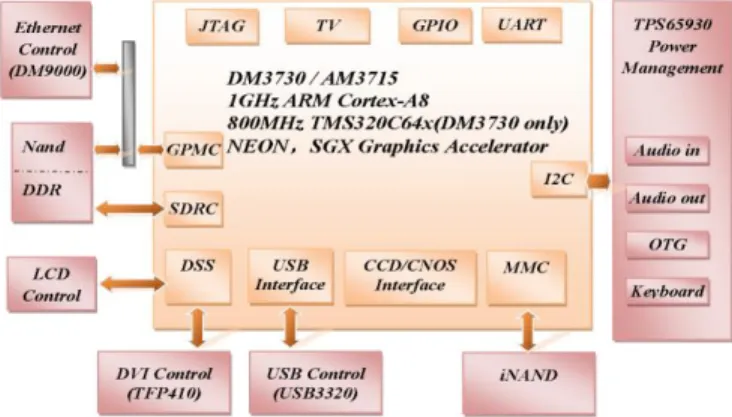
DevKit8500D/A is based on TI DM3730/AM3715processor. The processor integrates ARM Cortex™-A8 kernel at 1 GHz and DSP core (DM3730 only) running at 800 MHz with high-level digital signal processing functions, and provides rich peripheral interfaces. As shown in the Figure 2.
Figure 2. Hardware Schematic Diagram.
Here the focus on an introduction of the development based on the linux operating system, Figure 3 showed the system software architecture diagram:
Figure 3. System Software Architecture Diagram.
System used a common USB camera as the palm image capture terminal, which enhanced the system versatility. This paper used the linux OS had supported USB camera driver, so it can be statically compiled USB camera drivers into the kernel image. By running the program, System can capture palm-print images in Real-Time.
98 All Rights Reserved © 2012 IJARCSEE
DVSDK (Digital Video Software Development Kit) provided by TI included a complete set of tools and much useful resources. It can be easily used to develop an application of ARM + DSP. DVSDK is based on the DSPLINK (DSP / BIOS Link). Paper deployed DSPLINK to develop low-level driver on the DSP side. You can look DM3730‟s IVA2.2 subsystem (such as DSP side) as a peripheral of the DM3730‟s ARM side. It can also be understood as a co-processor. System is running in the linux OS. The DSP side mounted to the system as a device, thought dynamic module loading drive. Paper deployed this method to use the DSP side.
CE (Codec Engine) is the core of DVSDK. Other software modules are CE-around. CE is a bridge connected ARM-side and DSP-ARM-side. This software module was between the application layer (ARM-side application) and signal-processing layer (DSP side of the algorithm). It will be need the support of CE, when you compiled DSP side executable code and ARMside application code. This system‟s image processing part was also supported by CE.
CE‟s low-level communication between ARM-side and DSP-side was based on DSPLINK. DSPLINK also have the ARM part and DSP part. In the ARM part, it have some drives based on the linux OS and library files supplied for the program calls; in the DSP part, DSPLINK run on DSP / BIOS operating system, and DSP executable code need to include DSPLINK‟s library file.
A large number of data exchange through CMEM. CMEM was used to allocate the continuous physical memory space
beyond the linux OS. It converted the physical address to virtual address, as well as the virtual address to physical address space. In order to avoid multiple copies of data, they need to build data space that shared ARM-side and DSP-side. ARM-side and DSP-side can directly access the data-space through CMEM management. For the ARM-side, CMEM was a driver on the system. It achieved memory allocation or converted address through IOCTL. As the DSP-side can access any physical address space, the pointer that sent from ARM to DSP must be physical address.
As the palm-print images that collected from USB camera was saved in JPEG format, so this paper deployed TI‟s decoding library (jpegdec.l64P) to decode the image at first. Paper converted the palm-print image into a grayscale image,then to BMP image which sent to the sections of palm recognition algorithm.
Figure 4: shows the palm-print recognition algorithm flowchart.
image enhanced by the wavelet reconstruction is very sensitive to noise in certain regions. Based on this, the Local DCT for the reconstructed palm-print images, reduced the feature dimension effectively, while retained the no-light-sensitive information. Then 2DPCA is used for the feature extraction.
Figure 5. The Result Of Palm-print Feature Extraction
V. EXPERIMENTAL RESULTS
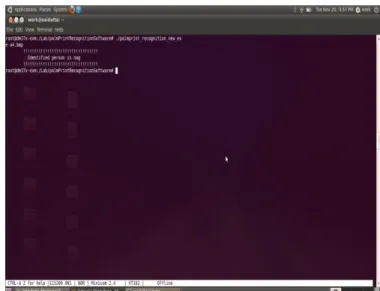
In the process, the image of the palm will taken by using usb camera. The trained image stored in database and we assign a name to that palm image. If the test palmprint image is matched with trained database palmprint image, the result will be shown as “Identified person is nag”.
Figure 6. Screen shot of test image and trained image matched result
If the test palmprint image is not matched with trained database image, the result will be shown as “Access is denied, sorry user is not authenticated”.
Palm-print images
Wavelet Transform
Discrete Cosine Transform
Feature Extraction by 2DPCA Nearest
Neighbor Classifier Recognition
99 All Rights Reserved © 2012 IJARCSEE
Figure 7. Screen shot of test image and trained image unmatched result
VI. CONCLUSION
Palmprint identification provides a new way for authentication identity. Palmprint is an important complement of personal identification. There are many features in a palmprint, such as structural features, statistical features, etc. The palm-print recognition algorithm based on wavelet reconstruction and local DCT and 2DPCA,supported by the DM3730‟s development tool DVSDK. To fully exploit the DM3730 multi-core digital signal processing chip‟s system capacity. This paper expanded the application fields for the DM3730 processors, meanwhile provided a hardware platform which can be more rapid developed an application system like fingerprint recognition system and iris recognition system.
REFERENCES
[1] G.M. Lu, D. Zhang, and K.Q. Wang, Palm-print recognition using eigen palms features, Pattern Recogn Lett 24 (2003).
[2] C.C. Han, H.L. Cheng, C.L. Lin, and K.C. Fan, Personal authentication using palm-print features, Pattern Recogn 36 (2003). [3] D. Zhang, W.K. Kong, J. You, and Michael Wong, On-line palm-print identification, IEEE Trans Pattern Anal Machine Intelligence, 25 (2003).
[4] W. Li, Z. David, and Z. Xu, Palm-print identification by Fourier transform, Int J Pattern Recogn Art Intell 16 (2002).
[5] A. Kumar and H. C. Shen, Recognition of palm-prints using wavelet based features, Proceedings of the international Conference on Systems and Cybernetics, SCI-2002, Orlando, FL, July 2002.
Nagarjuna Reddy .T received my B.Tech degree in Electronics & Communication Engineerimg from JNTU, Kakinada in 2010. Currently a M.Tech student in the department of Embedded Systems at JNTU, Hyderabad university.