An Integrated Distributed Storage
Design Offering Data Retrievability
and Recoverability Using Soft
Decision Decoding of Block Codes
C. K. Shyamala and T. R. Padmanabhan
Department of Computer Science and Engineering, Amrita Vishwa Vidyapeetham (University), Coimbatore, India
Active distributed storages need to assure both con-sistency and dynamic data support, in addition to availability, confidentiality and resiliency. Further, since storage durability suffers in untrusted and unreliable environments, it becomes crucial to (a)select the most reliable set of servers to assure data retrievability and (b)dynamically identify errant servers and restore the data to ensure data recoverability. We address the issues of concurrency, consistency, dynamic data support, data share repair, and trust management in providing persis-tent storage and access. The paper focuses primarily on erasure coded distributed storages (storages employing erasure coding for data dispersal). Integration of Quorum based approach using Notification propagation, with a reliability model based on server trust-reputation forms the comprehensive design proposed. Treating servers and their data shares equally at data reconstructions during data retrievals is rather inadequate in untrusted environments. The design provides a suitable platform for use of Soft Decision Decoding to overcome this inad-equacy. The design has been validated by the simulation, study, and analysis carried out for Reed Solomon coded storage with varying levels of resiliency and concurrency. The proposed design can be suitably adapted in typi-cal distributed information storages catering to global networked audience in public, untrusted, and unreliable operating environments.
Keywords: distributed storage systems, data retriev-ability, data recoverretriev-ability, block codes, soft decision decoding
1. Introduction
Distributed storages operate with a huge user base, across public networks and no longer function in trusted and reliable environments (M. Placek and R. Buyya, 2006). In this regard
there is continuous effort to maintain and as-sure guarantees to persistent storage and access. Storage designs evolve to incorporate measures that circumvent issues introduced by malicious activities and hybrid failures (crash and non-crash). It centers primarily on enabling trusted & reliable servers and correct & consistent data. A comprehensive design guaranteeing persis-tent storage and access in untrusted and un-reliable environments is in focus. The work primarily focuses on active distributed storage systems employing erasure coding for data dis-persal(DSS-D).
up-to-date servers. To meet this restriction on the minimal set of servers and file shares, it is essen-tial that the design provides for both dynamic data support and consistency. Further, opera-tion in untrusted and unreliable environments is expected and storages invariably endure hybrid failures (crash and non-crash, malicious activ-ities). Evidently, the restriction on file shares for data retrievability becomes more stringent; kcorrect and up-to-date file shares are required. It implies that a minimal set of any k correct & up-to-date servers need to be judiciously se-lected at retrievals for reconstruction. Further, it is rather infeasible to continue retrieving files by treating servers and their shares equally – usage of HDD is limited here.
Hybrid failures are a threat, not only to data correctness but also to the coordination that has to be achieved among the servers for dynamic data support and consistency. Data recover-ability at errant servers(that have suffered loss of propagation or file share corruption)is cru-cial for persistent storage & access and storage durability. Therefore, it is not only mandatory to identify correct & up-to-date servers at re-trievals, but it is equally important to restore file shares at those servers that have suffered loss of propagation or file share corruptions. Evidently, addressing the issues of concurrency, consistency, dynamic data support along with dynamic identification of errant servers, file share repair, and trust are central to persistent storage and access in DSS-D. In this paper, we address these issues to guarantee retriev-ability and recoverretriev-ability for persistent storage and access at DSS-D. The proposed DSS-D de-sign is equipped with mechanisms for dynamic data support, consistency, trust management, dynamic identification of errant servers, and correction of their file shares. Integration of a Quorum based approach using Notification propagation, with a reliability model based on server trust-reputation forms the comprehensive design proposed.
Our contributions in the proposed work for era-sure coded active storages comprises a suffi-ciently comprehensive design that:
i. guarantees significant resiliency to malicious activities and hybrid failures at storage.
ii. does not compel a rather imperceptive and equal treatment of servers and their file shares in unreliable and untrusted environments. iii. permits reads, writes, and updates to be
per-formed persistently and reliably with only a marginal increase in the associated com-plexity.
iv. integrates a reliability model based on server trust-reputation in providing a platform for the use of SDD in reconstructions at data retrievals.
v. permits reliable and persistent access despite severe defective fractions at storage.
The paper presents a qualitative assessment of the proposed design examining the probability of availability of the quorum of servers, the re-sponse time and the communication overhead in terms of the number of messages required to perform reads, writes and updates. The study, analysis, and validation of the byte oriented access of the RS code set (255,k) for vary-ing levels of resiliency and concurrency brvary-ing out the effectiveness of the design in tolerating severe defective fractions at storage. Signifi-cantly, the design can be adapted suitably in typical distributed information stores of organi-zational data (such as federal, healthcare &c) that cater to a global networked audience in any public untrusted and unreliable operating envi-ronments.
design for response time, availability and com-munication overhead. Further, validation of the design through the simulation carried out for byte oriented access with a set of (255,k)RS codes for varying levels of resiliency and con-currency is discussed. Interesting observations that validate availability, persistent access and storage are listed and discussed. Finally, Sec-tion 5 concludes the paper highlighting the com-prehensiveness of the design in enabling the most appropriate mechanisms to prevent ma-licious activities and hybrid failures from ob-structing availability, persistent storage & ac-cess, and storage durability.
2. Related Works
DSS (Distributed Storage System) operate in globally networked servicing arena with con-tinuous efforts to improve collective perfor-mance. To enable recovery amongst server errors and failures, DSS typically spread data across servers with redundancy (K. D. Bowers et al., 2009, L. Gao et al., 2010). While repli-cation is used in storages, dispersal techniques (M. Rabin, 1989, J. A. Garay et al., 2000, G. R. Goodson et al., 2004, J. Hendricks et al., 2007) provide a classic alternative in achieving redun-dancy. Information Dispersal Algorithm(IDA) (M. Rabin, 1989)fragments data into shares and disperses them among storage servers, reducing the level of redundancy needed to achieve ro-bustness amidst server errors and failures. A significant line of research has been on the use of block (erasure) codes (K. D. Bowers et al., 2009, G. R. Goodson et al., 2004, M. Lillibridge et al., 2003, C. Wang et al., 2009, A. Juels, and B. S. Kaliski Jr., 2007, C. Cachin and S. Tes-saro, 2005, C. Cachin and S. TesTes-saro, 2006, L. Pamies-Juarez, F. Oggier and A. Datta, 2013) to achieve dispersal.
Storages operate with a huge user base, across public networks and face the challenges of unre-liability, unpredictability and potentially mali-cious behavior(M. Placek and R. Buyya, 2006). They do not limit themselves to providing as-surance for static files – archival storages; they expand to provide for file updates – active stor-ages. Efforts to provide persistent storage and access in DSSs are directed towards addressing concurrency, consistency, durability and their
related issues in the presence of data updates at storage. Research has focused on consis-tency issues in the presence of Byzantine fail-ures for erasure coded storage(G. R. Goodson et al., 2004, C. Cachin and S. Tessaro, 2006). Although Cachin and Tessaro (2006) ensure consistent stored information despite Byzantine faults, they do not address the issues of concur-rency and versioning. In addition to versioning, Goodson et al. (2004) also perform file share repair among the servers. They exploit local data versioning within the storage nodes to pro-vide consistency and perform file share repair by using additional historical fragments fetched from the servers. RobuSTore(H. Xia and A. A. Chien, 2007)in an attempt to increase data ac-cess performances in distributive environments, combines rateless erasure code with speculative access. Updates, though not the main focus, are also considered. With no adversaries as-sumed in the distributive environment, accesses to stored data are devoid of correctness issues here.
Adversary models representing malicious activ-ities in distributed storage have progressed(K. M. Martin, 2008)from passive to active and to mobile adversaries. Significant line of research has taken into consideration active adversaries (K. D. Bowers et al., 2009, C. Wang et al., 2009, J. Kubiatowicz et al., 2000). Focus of research is on strong(C. Wang et al., 2009)and mobile adversary as well (K. D. Bowers et al., 2009). OceanStore(J. Kubiatowicz et al., 2000), pro-vides for both active and archival storages in untrusted environment, using repetition coding for the former and erasure coding for the lat-ter. A primary tier of replicas cooperate with one another in a Byzantine agreement proto-col to choose the final commit order for up-dates; updates are epidemically communicated to the secondary tier. HAIL (K. D. Bowers et al., 2009)addresses the related issues regarding verification and correction of file shares among mobile adversaries. It uses a proactive strategy that cryptographically verifies and reactively re-allocates file shares to prove that stored files are intact and retrievable. The protocols here pro-vide assurance for static files and not for file updates.
storages that operate amongst hybrid failures, this flexibility of reconstructing the original data from a minimal possible (k) set of data shares is linked primarily to the selection of reliable servers. Clearly, data availability directly de-pends on the minimal possible (k) set of data shares from reliable servers. Verification of dis-persed data among servers can assure the supply of the minimal data share set for reconstruction. Integrity checks on remote storage can be done by clients – playing the role of a verifier (K. D. Bowers et al., 2009, C. Wang et al., 2009)or can be enforced within the storage servers them-selves(J. A. Garay et al., 2000, G. R. Goodson et al., 2004, J. Hendricks et al., 2007, C. Cachin and S. Tessaro, 2006). Cryptography based ver-ification approaches have been used in(M. Lil-libridge et al., 2003, C. Wang et al., 2009, A. Juels, and B. S. Kaliski Jr., 2007, C. Cachin and S. Tessaro, 2005, D. L. G. Filho and P. S. L. M. Barreto, 2006, M. A. Shah et al., 2007, H. Krawczyk, 1993)to perform integrity checks. Clearly, levels of unpredictability and unreli-ability in the operating environments are not merely governed by hardware related failures. Occurrences of malicious activities and non-crash faults bring in the issues of trust; the oper-ating environment is no longer the usually more trusted one, it is rather partially trusted and at the extreme totally untrusted (M. Placek and R. Buyya, 2006). Efforts to provide persistent storage and access should further extend to in-clude those that circumvent issues introduced by malicious activities. It centers primarily on enabling trusted & reliable servers and correct & consistent data. While trust can be established via Byznatine protocol (A. Adya et al., 2002, J. Kubiatowicz, et al., 2000), it can be also es-tablished based on the reliable information pro-vided on their behavior by a trusted third party – not always feasible(F. G´omez M´armol and G. Mart´ınez P´erez , 2010). On the other hand, an alternative way to establish trust(H. Li and M. Singhal, 2007)is via Reputation Scheme – re-warding and penalizing good and bad behavior (M. Placek and R. Buyya, 2006). Trust/ Rep-utation models have been developed using An-alytic expressions, Fuzzy Logic, Bayesian Net-works, Social Networks and Bio-inspired algo-rithms(A. Boukerche et al., 2007, G. Zacharia and P. Maes, 2000, C. Huang et al., 2006, S. Kamvar et al., 2003). A trust-reputation
ap-proach based on the concept of ‘Server Trust’ is established in (C. K. Shyamala and T. R. Pad-manabhan, 2014). The work presents a well-organized scheme for selection of the most reli-able set of servers to supply relireli-able data shares for reconstruction of data based on the trust-reputation of the servers’ themselves.
It is evident that hybrid failures in storage envi-ronments restrict reconstruction of the original data to a set of reliable servers(to serve correct data shares). This demands that thekfile shares used in decoding be correct; it also implies that file shares need not be treated equally in decod-ing. Conventional RS decoding treats all file shares equally and reconstructs the file using the well established Hard Decision Decoding (HDD). For such an approach with DSS-D, ev-ery storage server – malicious as well as non-malicious – has to be treated equally; this is not practical. This requirement is best served by using a Soft Decision Decoding(SDD) al-gorithm(B. Yamuna, and T. R. Padmanabhan, 2012)in place of a na¨ıve approach using HDD. SDD algorithms chalk out an optimal iterative procedure to identify the correctkfile share set in reconstructing the original data.
3. Proposed Work
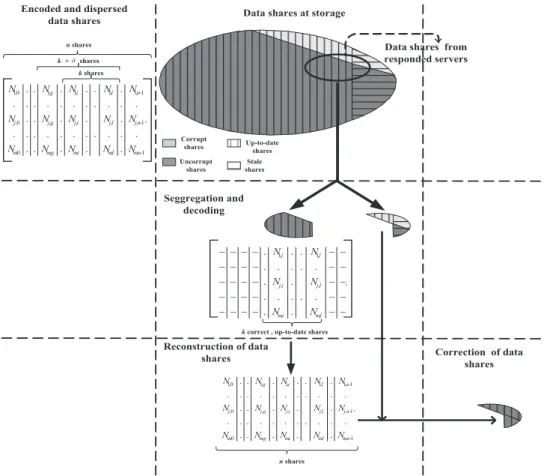
A DSS-D with n storage servers guarantees a successful read of stored file(data)F, with the availability of a minimal set of any k servers. Here, at most n−k failures are tolerated im-plying resiliency level ofn−k. Further, a con-fidentiality level of k is also implied; that is, no collusion of at most k− 1 storage servers (among the total ofn)can retrieveF. Figure 1 is an overview of data retrieval and restoration in DSS-D, highlighting the need and the role played by mechanisms that allow dynamic iden-tification of errant servers and correction of file shares in assuring persistent access and storage. A two-tiered locally centralized architecture(M. Placek and R. Buyya, 2006)is adopted for the DSS-D design. T2, the Storage tier, is an untrusted tier of servers to which the storage responsibility is entrusted. T1 is the Client-Servicing tier of high performing, trusted super nodes, sufficient in number, interacting with the T2 servers for file read, update and write
−F(r−u−w). DSS-D clients(Service Clients)
have no direct access to the T2 servers; they contact directly T1 servers forF(r−u−w). For an(n,k)code dispersal in DSS-D, each of then storage servers stores a file share/fragment of fileF. A minimum of kof these file shares is required to reconstruct a file dispersed amongn storage servers(C. Cachin and S. Tessaro, 2005, S. Lin and D. J. Costello Jr., 2004). The design here uses (n = 255,k) Reed Solomon (RS) code(Lin and D. J. Costello Jr., 2004, S. Peter, 2002, R. H. Morelos-Zaragosa, 2006). How-ever, it is general enough to be applicable to any other block code. The byte oriented access of this code makes it the most logical choice for DSS-D. Availability, confidentiality, resiliency levels, and concurrency potential for a set of (255,k)RS codes are in Table 1.
3.1. DSS-D Design Issues
The issues that arise in guaranteeing retrievabil-ity and recoverabilretrievabil-ity for persistent access and storage in DSS-D and the proposed mechanisms adopted in our design are:
. . . . . . . . . . . . . . . . . . . . . . . . . . . . . . . . . . . . . . . 1 , , , , 0 , 1 , , , , 0 , 1 , 1 , 1 , 1 , 1 0 , 1 n m l m i m g m m n j l j i j g j j n l i g N N N N N N N N N N N N N N N
n shares
. . . . . . . . . . . . . . . . . . , , , , , 1 , 1 l m i m l j i j l i N N N N N N
k correct , up-to-date shares
. . . . . . . . . . . . . . . . . . . . . . . . . . . . . . . . . . . . . . . 1 , , , , 0 , 1 , , , , 0 , 1 , 1 , 1 , 1 , 1 0 , 1 n m l m i m g m m n j l j i j g j j n l i g N N N N N N N N N N N N N N N
k shares
k + shares G
n shares
Encoded and dispersed
data shares Data shares at storage
Seggregation and decoding
Reconstruction of data
shares Correction of data shares
Corrupt shares Uncorrupt shares Up-to-date shares Stale shares
Data shares from responded servers
Code Availability Confidentiality level Resiliency level Concurrency potential
(n/k) k k– 1 n–k n / k
(255,46) 46 45 209 5.54
(255,64) 64 63 191 3.98
(255,110) 110 109 145 2.31
(255,238) 238 237 17 1.07
Table 1.Attributes and their values for(255,k)code.
1. In active DSS-D storages, data retrievability requires that a minimal set of anyk servers be available for reconstruction, each with its own up-to-date file share. An (n,k) code implicitly offers potential for concurrency, based on the extent to whichnis greater than k, as given in Table 1. Providing monotonic reads and sequential consistency with con-current reads and writes demands preserving the same level of write at the T2 tier – the first issue. For this, the proposed design is augmented with a push-pull mechanism to preserve the same level of writes at T2. Using Notification Propagation, file writes are pushed to the T2 tier; subsequently, the file shares are pulled by the corresponding servers. A file write is performed on(k+) file shares with (k + ) participating T2 servers. Write notification is propagated to the rest of the non-participating T2 servers (having the remainingn−(k+)file shares). Updates are supported at file level; a file is updated by overwriting its shares at the servers. Concurrent writes are performed by serialization of writes(concurrent writes are not aborted); this enables ordering and ser-vicing of concurrent write requests on files. 2. In the presence of hybrid failures at T2 tier, data retrievability demands a minimum ofk up-to-date & correct file shares – the next issue. The availability of reliable servers – a minimal set ofkreliable servers – is required for reconstruction. In our design, we adopt a reliability model based on server trust-reputation built over the periods of DSS-D servicing (C. K. Shyamala and T. R. Pad-manabhan, 2014) to provide a judicious means for selecting a set(minimal)ofk reli-able servers for file reconstruction. We uti-lize the trust-reputation approach based on the concept of ‘Server Trust’ with SDD to identify the correctkfile share set.
3. With concurrent reads and writes, the design discussed so far is still insufficient to guaran-tee that a read must always return the last up-dated file – the third issue. Measures should be in place to ensure that only the same cor-rect & up-to-date copy of the file is returned at every successive file read. For a concur-rent read with write, the last updated file / the file not older than the last read should be returned(old copy of the file is never re-turned on a read). We exploit the Quorum based approach to reach a consensus on the latest updated copy of the file shares. A file read can be performed with (k+)file shares from k reliable servers, only after a consensus on the latest updated copy of the file shares is reached in the Quorum.
4. Hybrid failures at T2 tier pose a threat for storage correctness – the fourth issue. We adopt a reactive approach towards guaran-teeing storage correctness. Successful re-constructions with k reliable servers ( pro-viding k correct & up-to-date file shares) allow allnfile shares to be generated. With these n file shares, dynamic identification and correction of incorrect and stale (not up-to-date) file shares in the T2 tier follow directly. Thus, data recoverability is guaran-teed in the design.
We propose a sufficiently comprehensive de-sign that addresses these four issues central to guaranteeing retrievability and recoverabil-ity for persistent storage and access in DSS-Ds. The design integrates:
i. Notification propagation to preserve the sa-me levels of writes
ii. Reliability model based on server trust-repu-tation for selection of reliable servers iii. Quorum based approach to reach a
The integration makes it possible – with the highest probability – to supplyk correct & up-to-date file shares during reads; similarly cor-rect and to-date version number for data up-dates. The design is augmented with a reactive approach to ensure correctness at the storage tier.
3.2. Data Updates
Active storages allow updates on data; the chal-lenge is to assure that a read always returns the result of the latest completed update. With up-dates of fileFin DSS-D, a read ofFshould re-turn only the up-to-date version ofFand signif-icantly, the same up-to-date version ofFshould be returned for every successive read ofF. Consistency: It should be always practicable with a high probability to return the same up-to-date version of file F, for any two or more
successive reads of F. Consistency guarantees can be assured if the design supports:
i. consensus on updated version of the data for reads
ii. propagation of the same level of data on writes.
3.2.1. Support for Consistency
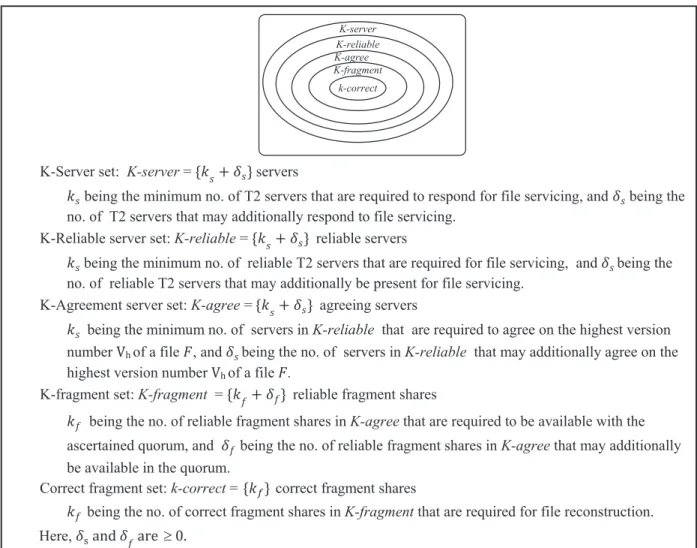
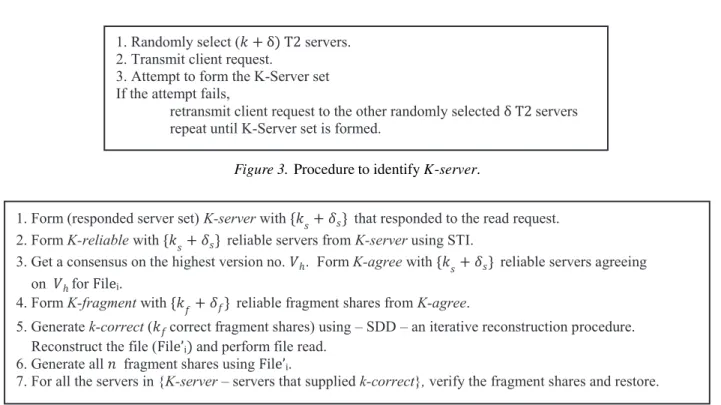
The unit of operation inF(r−u−w)is (k), the minimum number of fragments of file F re-quired to perform an operation ofF. Structuring of server and fragment sets for performing an F(r−u−w) is illustrated in Figure 2. Servers are pooled and K-server is formed as in Fig-ure 3. A fileF and each of its fragments have distinct identification (Figure 5). A new file write−F(w)– is performed by writing the file fragments to the responded server set in the
k-correct K-fragmentK-agree
K-reliable K-server
K-Server set: K-server = ሼ݇ݏ ߜݏሽservers
݇ݏbeing the minimum no. of T2 servers that are required to respond for file servicing, and ߜݏbeing the
no. of T2 servers that may additionally respond to file servicing. K-Reliable server set: K-reliable = ሼ݇ݏ ߜݏሽreliable servers
݇ݏbeing the minimum no. of reliable T2 servers that are required for file servicing, and ߜݏbeing the
no. of reliable T2 servers that may additionally be present for file servicing. K-Agreement server set: K-agree =ሼ݇ݏ ߜݏሽagreeing servers
݇ݏbeing the minimum no. of servers in K-reliable that are required to agree on the highest version number of a file ܨ, and ߜݏbeing the no. of servers in K-reliable that may additionally agree on the
highest version number of a file ܨ.
K-fragment set: K-fragment = ሼ݂݇ ߜ݂ሽreliable fragment shares
݂݇being the no. of reliable fragment shares in K-agree that are required to be available with the
ascertained quorum, and ߜ݂being the no. of reliable fragment shares in K-agree that may additionally
be available in the quorum.
Correct fragment set: k-correct =ሼ݇ሽcorrect fragment shares
݂݇being the no. of correct fragment shares in K-fragment that are required for file reconstruction. Here, ߜߜ݂tͲǤ
1. Randomly select (݇Ɂሻʹ servers. 2. Transmit client request.
3. Attempt to form the K-Server set If the attempt fails,
retransmit client request to the other randomly selected Ɂʹservers repeat until K-Server set is formed.
Figure 3.Procedure to identifyK-server.
1. Form (responded server set) K-server with ሼ݇ݏ ߜݏሽthat responded to the read request.
2. Form K-reliable with ሼ݇ݏ ߜݏሽreliable servers from K-server using STI.
3. Get a consensus on the highest version no. ܸ݄. Form K-agree with ሼ݇ݏ ߜݏሽreliable servers agreeing
on ܸ݄for .
4. Form K-fragment with ሼ݂݇ ߜ݂ሽreliable fragment shares from K-agree.
5. Generate k-correct (݂݇correct fragment shares) using – SDD – an iterative reconstruction procedure.
Reconstruct the file ( ǯሻand perform file read. 6. Generate all ݊ fragment shares using ǯ.
7. For all the servers in {K-server– servers that supplied k-correct}, verify the fragment shares and restore.
Figure 4.Procedure for quorum formation forF(r).
1. Form (responded server set) K-server with ሼ݇ݏ ߜݏሽthat responded to the write
request.
2. Generate the new version no. (current logical clock(L. Lamport, 1978)) for Ǥ 3. Encode and generate the ݊ fragment shares.
4. Write any ሼ݂݇ ߜ݂ሽfragment shares of in K-server. File ID Fragment ID
File tag || Version no. || Server ID Fragment tag || File ID
Unique file tag || current logical clock
|| T1 server ID Unique fragment tag || File ID
Figure 5.Procedure for quorum formation forF(w).
1. Form (responded server set) K-server with ሼ݇ݏ ߜݏሽthat responded to the update
request.
2. Form K-reliable with ሼ݇ݏ ߜݏሽreliable servers from K-server using STI.
3. Get a consensus on the highest version no. ܸ݄. Form K-agree with ሼ݇ݏ ߜݏሽreliable
servers agreeing on ܸ݄for .
4. Generate the updated version no. ( ͳ) for the updated file Ǥ
5. Encode and generate ݊fragment shares. 6. Write ሼ݂݇ ߜ݂ሽfragment shares of in K-server.
Figure 6.Procedure for quorum formation forF(u).
write quorum (Figure 5). Updates on files are supported at the file level; a file is updated by overwriting its shares at the servers. An up-date on F−F(u)– is performed as illustrated
in Figure 6. A consensus is reached on Vh –
to the responded server set in the quorum. A file read −F(r)– is performed as illustrated in Figure 4. A consensus on the latest updated copy of the file shares is reached in the read quorum. A reliable fragment set, K-fragment is formed with K-agree. Using SDD, a cor-rect fragment set, k-correct is obtained from K-fragment. The file is reconstructed and alln fragments are generated facilitating subsequent verification and correction.
3.2.2. Dynamic Data Support
The same level of write of F among all T2 servers is required in order to enable a read ofF to return the up-to-date version. Dynamic data support at DSS-D mandates integration of an appropriate propagation mechanism with the quorum design discussed above. The challenge here is to achieve a well-organized coordina-tion among the client servicing servers and the servers that share storage responsibility. To meet this requirement, we take advantage of Notification Propagation (L. Gao et al., 2010) to propagate writes ofF to the non-participant T2 servers. Significantly, the integration of the Quorum based approach with Notification prop-agation in our design eliminates the need for the intersection of reads and writes (D. Agrawal and A. El Abbadi, 1990)mandatory in the tra-ditional quorums.
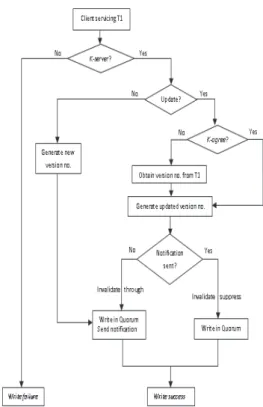
A push technology is employed to push write (new file write / file update) information to the non-participant T2 servers. The proposed propagation scheme propagates notification of new file writes and file updates to the non-participants using Instate and Invalidate mes-sages respectively. Non-participants of a new file write are a class of servers – instated server class – that should be informed of the file write. Non-participants of a file update are a class of servers – invalidated server class – that should not only be informed but also be invalidated for the file update. The push is subsequently fol-lowed by a pull; the non-participants equipped with information about the latest write pull the necessary (pull technology) from T1. Client initiated file writes and updates are acknowl-edged when a write is performed in the quorum for a minimum of k fragments at a minimum of kservers. Server initiated writes follow file writes and updates. There are two cases of no-tification as in Figure 8:
i. Invalidate Through: Notification is sent to the T2 non-participants and they are invali-dated on a file update.
ii. Invalidate Suppress: In the case where inval-idation has been performed in the previous update ofF, the notification is suppressed.
3.3. Reliable Reads and Writes
A new file write is straightforward(Figure 5). For file update, the quorum based approach of the design requires a consensus onVhofF(
Fig-ure 6). The design permitsVhofFto be fetched
from the current T1(performing the servicing) on failure to reach a consensus in the quorum (Figure 8). A read requires a quorum of reliable servers to agree onVh ofF before proceeding
to reconstruct the file. The design permits file reads with cases of read hit and varying levels of read miss (Figure 7). A Read Hit occurs when the client-servicing T1 is itself the parent T1 of the requested file. A Read Miss-Level1 occurs when K-agree serves the k-correct for successful reconstruction. A Read Miss-Level2 occurs ifK-agreeis not formed or if it is unable
Figure 8.Write-Update notification cases.
to serve thek-correct. It requires thek-correct to be fetched from the Parent T1 for successful reconstruction. Clearly, the design permits file reads, writes, and updates to be performed per-sistently and reliably; failure occurs only when K-server cannot be obtained.
3.3.1. Concurrent Reads and Writes
An (n,k) code implicitly offers potential for concurrency, based on the extent to which nis greater thank, as given in Table 1. Concurrency potential in general is given by the quantityn/k, signifying the capacity of the DSS-D to support concurrent reads and writes. Distributed
repli-cation refers to the number ofk-correctsets of F, supplied for concurrent reads and updates of F. This implies thatn/k such sets are pos-sible to be formed concurrently at any given time by the system to service as many reads and updates. The quantityn−(kn/k) signifies the number of storage server faults and failures that can be tolerated by the system in satisfying
n/k concurrent reads and updates. Further, in the worst case, there can be a total ofn−k
failures in the system and yet enabling it to ser-vice a single read or update. Typical figures for a(n=255,k)scheme are given in Table 2. The design permits concurrent reads and writes without conflicts.
3.4. Trust Model
Data retrievability and recoverability guarantees in DSS-D rely heavily on the selection of reli-ablekservers from the available servers. There should be a judicious means for selecting a mini-mal set ofkreliable servers among the available servers for file reconstruction. Step 2 in Fig-ure 4 as well as in FigFig-ure 6 requires the reliable server set to be generated from the respondent servers. This involves the judicious selection of the servers. We adopt the reliability model (C. K. Shyamala and T. R. Padmanabhan, 2014) based on server trust-reputations built over the periods of DSS-D servicing, to provide an ap-propriate judicious selection procedure.
The model is – context specific, multifaceted and dynamic – comprehensive(Y. Wang and J. Vassileva, 2003). The basic model meets the four primary requirements(F. G´omez M´armol and G. Mart´ınez P´erez, 2010) for DSS-D ac-cess:
A. Prevention of behavioral oscillations along time
RS code Concurrency potential Distributed replication Resiliency Level
(n, k) n/k n/k n−(kn/k)
(255,46) 5.54 5 25
(255,64) 3.98 3 63
(255,110) 2.31 2 35
(255,238) 1.07 1 17
B. Redemption of past malicious servers who have become benign
C. Prevention of abuse of a good achieved rep-utation
D. Assurance of reasonable level of participa-tion for re-entrants.
Cumulative file share submission status in the past performances of servers forms the metric – ‘Server Trust Index’(STI). Server STIs are used for selection of reliable server at data retrievals. They are refreshed based on the servers’ perfor-mance in the current servicing by appropriate reward/punishment.
Update of STIs is given by:
STI−new= SS∗∗−+pon punishmenton reward (1)
where,S∗=
n i=n−ca
n−iS i
nc andn,a
n−i,S
i;c+1
andnc being total number of servicing,
weigh-tage for the performance inithservicing and STI
atithservicing, moving average window length
and lastcservicing respectively.
In the distributed penalty scheme, penalty for jthserver is:
pj= (Sjnd−S0)nd
i=1Si−S0
(2)
nd, S0, and Sj being the total number of
er-rant participants in current servicing, least STI amongndparticipants, punishment unit and last
STI of thejthserver respectively.
The subjective approach in the model treats er-rant severs in a singular way. It provides a statistical means of reward & punishment, and selection ofkreliable servers.
3.4.1. Extended Trust Model
The integrated design for active DSS-D extends the basic trust model to meet the two addi-tional requirements(F. G´omez M´armol and G. Mart´ınez P´erez, 2010):
E. Different trust-reputation rating based on the type of servicing
F. Importance of a transaction and its associ-ated risk influencing subsequent punishment /reward.
The ordering of theF(r−u−w)DSS-D servic-ing in terms of importance and risk is directly related to the role it plays in verification and data restoration at the T2 severs. F(r) is treated as the most important as it guarantees both verifi-cation and data restoration at the T2 severs. The F(u) requirement that a consensus be reached on the highest file version number allows verifi-cation at this level and not data restoration. The F(w)requires any set ofkservers to perform the write; it plays no role in verification and restora-tion and is treated as the least important. The same ordering applies to the trust-reputation rat-ing and risk associated withF(r−u−w).
ForF(r−u−w)servicing,r,u,wis used in
place of the reward in (1) and r,u,w in
place of in(2). The more important the DSS-D servicing with respect to verification and restoration, the greater are the associated and . The distributed penalty scheme in(2)varies the trust-reputation rating for the F(r−u−w) servicing. A new file write performed on the respondent server set results in only rewarding the participants. On a file read or update the participants are suitably rewarded only on en-abling consensus of version number and supply of correct fragments as required; they end up receiving penalty otherwise. After every ser-vicing, the T2 servers are updated for their STI with the awarded reward or penalty using the extended trust model.
4. Design Evaluation
4.1. Analytical Evaluation
4.1.1. Response Time
A client connects to a T1 server through LAN connection, and a T1 connects to T1 and T2 servers through WAN connection, with RTTs of tlan(6 ms RTT)and twan(86 ms RTT)
respec-tively (L. Gao et al., 2010). Let,r be the read % and 1−rbe the write %. Ifrdis hit andriis
miss-level1, then miss-level2 isr−rd−ri. The
best case and the worst case average response times are evaluated and given in Table 3.
4.1.2. Availability
New file write or file update is performed with the access of at least one T1 along with the quo-rum. It is rejected when (i) none of the T1s is available, or (ii) when enough number (k) of T2s is not available even though a T1 is ac-cessed. Simultaneously, anykor more T2s not agreeing on version number does not affect the resultant file update(Figure 8). Read(Figure 7) is performed with the access of(i)the parent T1 (hit), or(ii)any one of the non parent T1s along with the quorum(miss- level1), or(iii)any one of the non parent T1s along with the availabil-ity of the parent T1 on an unsuccessful quorum (miss- level2).
Let,rbe the read % and 1−rbe the write % and the number of servers in T1 tier be n1with p1,
the probability of a T1 server being unavailable and 1 − p1, the probability of it being
avail-able. Let the number of servers in T2 tier be n2withp2, the probability of a T2 server being
unavailable and 1−p2, the probability of it
be-ing available. Let 1−pshmbe the probability of a T2 server being non-errant andpshmbe the probability of it being errant. The availability ofF(r−u−w)and its non-availability are given below in(i)and(ii)respectively:
(i) (1−pn1
1)
n2−k
i=0 n2C
k+i(1−p2)k+i(p2)n2−k−i
+r1 n1 +r
1−n1
1 n2−k
i=0 n2C
k+i(1−p2)k+i·
·(p2)n2−k−i k+iCk+j i
j=0(1−pshm)
k+j(pshm)j
+r
1−n1
1
(1−p1)
1−
n
2−k
i=0 n2C
k+i(1−p2)k+i·
(p2)n2−k−i k+iCk+j i
j=0(1−pshm)
k+j(pshm)j
(ii) (1−r)
(pn1
1) + (1−pn11)
k−1
i=0 n2C
i(1−p2)i(p2)n2−i
+rpn1
1 +r(1−pn11) k−1
i=0 n2C
i(1−p2)i(p2)n2−i
+r(1−pn1 1 )(p1)
1−
n
2−k
i=0 n2C
k+i(1−p2)k+i·
·(p2)n2−k−i k+iCk+j i
j=0(1−pshm)
k+j(pshm)j
Here,
• (1−pn1
1 )
n2−k i=0
n2Ck+i(1−p2)k+i(p2)n2−k−i
is the probability that at least one T1 and, simultaneously, anykor more T2s are avail-able for a write/update.
where,
(1−p2)k+i(p2)n2−k−i: probability that one
set ofk+iT2 alone is available and all others are not available.
n2Ck+i(1−p2)k+i(p2)n2−k−i: probability that
all possible sets ofk+iT2 are available and, simultaneously, the others are not available. (1−pn1
1 ): probability that at least one T1 is
available (one or more up to n1 T1s
avail-able) and, simultaneously, n2−k
i=0
n2Ck+i(1−
p2)k+i(p2)n2−k−i: probability that all
possi-ble sets ofkor more T2 are available.
• pn1
1 +(1−pn11)
k−1
i=0
n2C
i(1−p2)i(p2)n2−i
is the probability that none of the T1s is avail-able or that enough number (k) of T2s are not available with availability of one or more T1s for a write/update.
where, pn1
1 : probability that none of the T1s is
avail-able. (1−pn1
1 ): probability that at least one T1 is
available (one or more up to n1 T1s
(1−p2)i(p2)n2−i: probability that only a
spe-cific set ofiT2s are available and all others are not available.
n2Ci(1− p2)i(p2)n2−i: probability that all
possible sets of i T2s are available and all others are not available.
k−1
i=0
n2Ci(1 − p2)i(p2)n2−i: probability that
the number of T2s available is less thankin all possible ways.
• n1
1 +
1−n1
1 n2−k
i=0 n2C
k+i(1−p2)k+i(p2)n2−k−i·
k+iC k+j
i
j=0(1−pshm)
k+j(pshm)j
+
1−n1
1
(1−p1)
1−
n2−k
i=0 n2C
k+i(1−p2)k+i(p2)n2−k−i·
· k+iCk
+j
i
j=0(1−pshm)
k+j(pshm)j
is the probability that the file is reconstructed directly from the parent T1(hit)or indirectly from the quorum with any one of the non parent T1s’ access (miss -level1). Further, in case of unsuccessful attempt at quorum with a non-parent T1 for read, the file can be reconstructed by reverting to the parent T1 itself(miss -level2).
where,
n2−k i=0
n2Ck+i(1−p2)k+i(p2)n2−k−iis the
prob-ability that any set ofkor more T2 are avail-able.
Further, for any i in this, the probability that at least k of the k+i T2s are regular:
k+iC k+j
i j=0(
1−pshm)k+j(pshm)j.
1− n1
1
(1−p1): probability that at least
one T1 is available(one or more up ton1T1s
available) along with the parent T1s avail-ability.
• pn1
1 + (1−pn11) k−1
i=0 n2C
i(1−p2)i(p2)n2−i
+ (1−pn1 1)(p1)
1−
n
2−k
i=0 n2C
k+i(1−p2)k+i·
·(p2)n2−k−i k+iCk+j i
j=0(1−pshm)
k+j(pshm)j
is the probability that there is a no read at a hit(pn1
1 )or
at a miss, level1(1−pn1
1 )
k−1
i=0
n2Ci(1−p2)i
(p2)n2−i, or
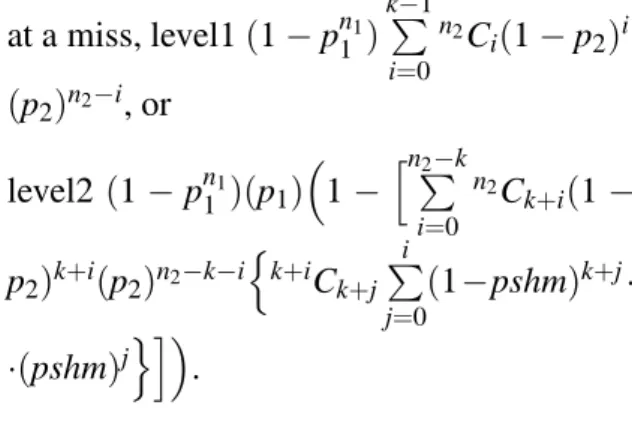
level2 (1−pn1
1 )(p1)
1−n2−k
i=0
n2Ck+i(1−
p2)k+i(p2)n2−k−i
k+iC
k+j i
j=0(1−pshm)
k+j·
·(pshm)j.
4.1.3. Communication Overhead
Let|Qr|,|Qw|, and|Qu|be the size of the read,
write, and update quorum respectively and let
|Qri|be the number of errant T2 servers in the
read quorum. All messages are assumed to be of equal cost. A read hit costs 2 messages and a read miss of level1 costs 1+|Qr|+|Qri|+n1
messages, whereas the cost of a read miss of level2 is 2+|Qr|+|Qri|+n1 messages. The
cost of a write is 1 + |Qw| + n2 + n1
mes-sages. The cost of an update with invalidate suppress is 1+2|Qu|+n1 messages, whereas
the cost of an update with invalidate through is 1+|Qu|+n2+n1messages.
Best case average response time
Read hit or Read miss- level 1 + Notification suppress (rd)[tlan] or (ri)[tlan+3twan] + (1−r)[tlan+3twan]
Worst case average response time
Read miss - level 2 + Notification through (r−rd−ri)[tlan+4twan] + (1−r)[tlan+4twan]
Table 3.Response Time.
4.2. Simulation and Observations
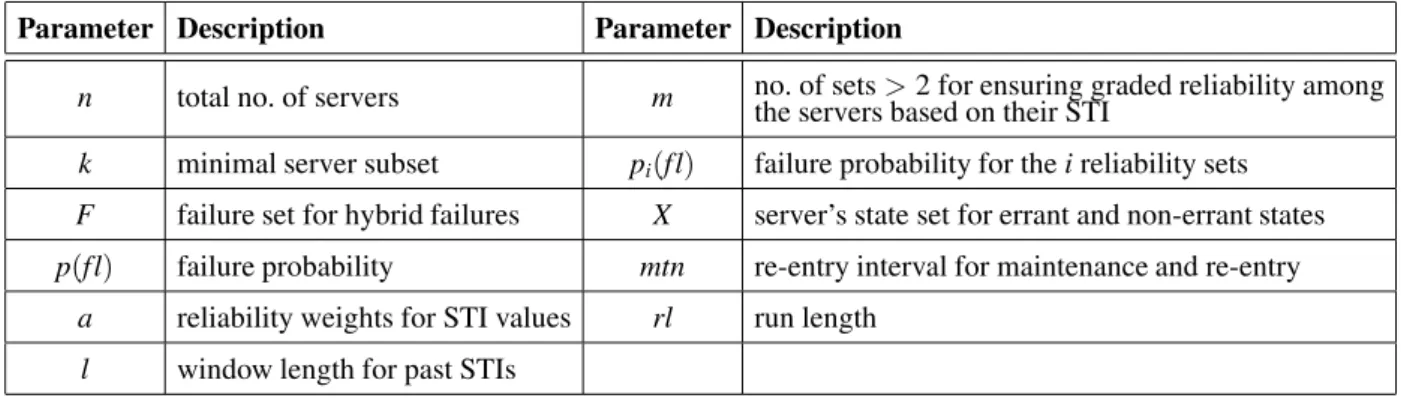
Parameter Description Parameter Description
n total no. of servers m no. of setsthe servers based on their STI>2 for ensuring graded reliability among
k minimal server subset pi(fl) failure probability for theireliability sets
F failure set for hybrid failures X server’s state set for errant and non-errant states p(fl) failure probability mtn re-entry interval for maintenance and re-entry
a reliability weights for STI values rl run length l window length for past STIs
Table 4.Configuration parameters for simulation of archival DSS-Ds.
level of resiliency for each servicing in a run. For an(n,k)code with concurrency potential of n/k%, a distributed replication ofn/k, and a resiliency level ofn−(kn/k),clandkdrange with 1. . .n/kand 1. . .(n−(kn/k))/cl re-spectively.
The DSS-D with a set of(255,k)codes for vary-ing levels of concurrency and resiliency lev-els are analyzed in both concurrent and non-concurrent modes of servicing. STI updations in each run of the simulation are associated with and p for F(r−u−w) and conform to (1)and(2)of the extended trust model. Apart from the obvious encoding / decoding efforts required to write and read data with k-correct, levels of complexity vary primarily in file reads and updates based on the effort expended to-wards obtaining Vh and k-correct in the
quo-rums. The reads and updates are categorized (Table 5)based on this variation in the required effort in the quorums.
A few clarifications on the levels of complex-ity encountered in file writes, reads and up-dates(given in Table 5)are in order here. File reads and writes primarily demand k reliable, agreeing servers. O(k) complexity signifies the effort being limited to the first k in the respective server set; but, with the presence of defective fractions in this set, the associ-ated complexity for k increases as its power – O(kdefective fraction). With greater defective
fractions in this set, the need of an access to a T1 server further increases the complexity marginally to O(kdefective fraction) +1. Sig-nificantly, the order of complexity is limited to the maximum ofOkdefective fractionitself.
A new file write with any k available servers is straightforward. It has a complexity ofO(k) and is always Type A. A read hit by default has O(k) complexity, whereas a read miss varies in the levels of complexity. A read miss re-quires k-correct to be obtained from the quo-rum for F(r). It can be obtained from the first k in K-reliable with O(k) or from any k inK-reliablein a read miss-level1 of complex-ity Okdefective fraction. Failing which, it may
be fetched from the parent T1 in a read miss-level2 of complexityO(kdefective fraction) +1. This results in Type A, B and C categoriza-tions respectively for file reads(as evident from Table 5). File updates too vary in the levels of complexity, irrespective of whether they are associated with invalidate through or suppress. Consensus on Vh, may be obtained from the firstk inK-reliablewith a complexity ofO(k), or it can be obtained from any k in K-reliable with a complexity of O(kdefective fraction). Fail-ing which, it may be fetched from the client-servicing T1 with only a marginal increase in complexity of O(kdefective fraction) +1. This results in Type A, B and C categorizations re-spectively for updates (as evident from Table 5).
F(r-u-w) Complexity at Quorum Remarks
1.Update Vhconsensus inK-reliable
Type A O(k) firstkinK-reliable
Type B O(kdefective fraction) anykinK-reliable Type C O(kdefective fraction) +1 not inK-reliable
2. Read k-correctinK-agree
Type A O(k) Client-servicing parent T1 – Read hitfirstkinK-agree– Read miss- Level1/
Type B O(kdefective fraction) anykinK-agree– Read miss-Level1 Type C O(kdefective fraction) +1 not inK-agree -Read miss-Level2
3.Write kinK-server
Type A O(k) anykinK-server
Table 5. F(r−u−w)Complexity.
mtn shown in Figure 9 is adopted from (C. K. Shyamala and T. R. Padmanabhan, 2014); clearly anymtnof 50 or less permits leastk cor-rect severs to be available in every run, ( facil-itating servicing without interruption)enabling a well balanced schedule.
Concurrent and non-concurrent modes of sim-ulation were carried out for(255,k)codes with an mtn of 50 for varying degrees of concur-rency and resiliency levels (Table 2). Failure set (F) and failure probability (p(f l)) defined hybrid failures (defective fraction), with num-ber of non-malicious failures less than malicious failures. The effect of defective fractions at T2 servers on availability(see Section 4.1)and related complexity in F(r−u−w)were studied and analyzed.
Consider the DSS-D simulation after the defec-tive servers have been repaired/replaced as part of the maintenance activity. Letxbe the prob-ability of defectives at the access; x represents the absolute defective fraction at every subse-quent access. Fraction of non-defectives at the 1st access = (1−x). At the 2nd access a
frac-tion of(1−x)out of the 1staccess remains non-defective; that is, the non-defective fraction at
the second access is(1−x)2. The non-defective
fraction at theithaccess is(1−x)i. The
cumu-lative defective fraction in the mtn successive
accesses until the next maintenance instance is:
mtn
i=1
{1−(1−x)i} (3)
dno– the average defective fraction during the interval{1,mtn}is given by:
dno= m1
tm mtn
i=1
{1−(1−x)i}
= m1
tm
mtn−(1−x)1−(1−x) mtn
x
(4) Here,dnocan be seen to approach 1 asx→ 1. For the specific cases illustrated here, mtn has
been taken as 50. Values ofdno(%)computed for differentx(%)values are in Table 6. Writes being Type A by default do not offer any additional insight and hence are excluded in the sequel. Type A servicing fails even with a single defective server in the firstk of the k-reliable; it is not resilient to malicious activities
x 0.9 1.8 2.7 3.6 4.5 5.4 6.3 7.2
dno 19.91 34.89 46.27 55.01 61.80 67.15 71.40 74.84
at T2. Figure 10 depicts the variation of Type A servicing forF(r−u)for different minimal sets ofkwith varying defective fractions. The high-lighted lines signify the plot based on the simu-lation found to be essentially of Type A(calling for lowest effort at the respective quorums). As long as the minimal set size k is greater than 110, this quantum falls down rapidly, even with the increase of defective fractions to 20%(d1),
(the point identified by ‘*’). Beyondd1,
irre-spective of the minimal set size,kthe quantum essentially becomes zero, giving way to Types B and C.
0 0
100 300
100 200 300 400 1000
f
Maintenance interval
Service
Duration
50
Figure 9.Variation of service duration withmtn.
64
100
0
T
ype A
(%
)
Defective fraction (d no)
d0 d1
dn
Minimal set (k) 46
110 238
*
Figure 10.Variation of Type A servicing for varying minimal set(k)and defective fraction(dno).
Figures 11 and 12 depict the various types of servicing for non-concurrent and concurrent modes. They put Type A, B, and C servicing in the proper perspective for the complete(255,k) code set, as discussed below.
In the non-concurrent mode (Figure 11a)Type A servicing drops to zero beyond the range of
dno0% to 35%, confirming the lack resiliency beyond this. Type B servicing fails with greater than n −k defective servers (up till n) in the k-reliable; it is highly resilient to malicious ac-tivities at T2. Further, in the mid range ofdno 46% to 67% Type B servicing dominates, sub-sequently it tapers, giving way to ascendancy of Type C. Increase in percentage of malicious activities at T2 servers does not obstruct ser-vicing; persistent access is provided even with severe defective fractions with Type C servic-ing. The results signify provision of persistent and reliable servicing in the proposed DSS-D design.
0 20 40 60 80 100 120
20 35 46 55 62 67 71 75
%
of
re
ads
and update
s
Defective fraction k=64: Non-concurrent
Type A Type B Type C
Figure 11a.Code(255,64)Non-concurrent mode.
0 20 40 60 80 100 120
20 35 46 55 62 67 71 75
%
of
re
ads
and update
s
Defective fraction k=64: Concurrent with cl=2
Type A Type B Type C
Figure 11b.Code(255,64)Concurrent mode(2).
0 20 40 60 80 100 120
20 35 46 55 62 67 71 75
%
of
re
ads
and update
s
Defective fraction k=64: Concurrent with cl=3
Type A Type B Type C
A look at the resiliency offered by the proposed design for concurrent servicing is revealing. For (255,64)code at concurrency levelcl=2 Fig-ure 11b, Type A servicing is limited todnoin the range 0 to 20%, the rise of Type B at 20 % itself is quite early and extends to 67%, giving way to Type C beyond. Forcl=3 Figure 11c, the max-imum concurrency level for the code, Type C is present at a very early value dno(20%)itself. This trend is in contrast to non-concurrent mode of servicing(Figure 11a), where the dominance of B and C type services takes over at conspic-uously higherdnovalues.
Similar trends with other codes(Figure 12)are indicative of the consistency of the behaviour. The results discussed here further emphasise persistent and reliable servicing in the proposed DSS-D design for concurrent servicing as well. The study and analysis carried out for the code set(255,k)for varying levels of resiliency and concurrency validate availability with persistent access and storage in the proposed design.
0 20 40 60 80 100 120
20 35 46 55 62 67 71 75
%
of
re
ads
and update
s
Defective fraction k=110: Non-concurrent
Type A Type B Type C
Figure 12a.Code(255,110)Non-concurrent mode.
0 20 40 60 80 100 120
20 35 46 55 62 67 71 75
%
of
re
ads
and update
s
Defective fraction
k=110: Concurrent with cl=2
Type A Type B Type C
Figure 12b.Code(255,110)Concurrent mode(2).
i. Malicious activities at T2 do not obstruct availability, persistent access, or storage dura-bility.
ii. Type A servicing is not resilient to malicious activities; it fails even with a single defective server in the first k of the k-reliable. Type B servicing, on the other hand, is highly re-silient to malicious activities; it fails with greater than n−k defective servers (up to n)in thek-reliable. Even in the presence of severe defective fractions persistent access is still guaranteed with Type C servicing. iii. Types A, B and C in F(r−u−w) are
asso-ciated with an increase in complexity in the same order, independent of the response time and communication overheads(see Section 4.1).
iv. The verification of T2 tier correctness in the non-concurrent mode at file reads and up-dates is equally in attendance in concurrent modes as well. Reads in addition allowed restoration of files shares at the participating errant T2 servers. This reactive strategy at file reads guarantees persistence at the stor-age.
v. Supply ofkcorrect & up-to-date file shares for file reads and similarly correct & up-to-date version number for file updates is enabled reliably and persistently.
4.2.1. Comparison with Systematic Coding Based Schemes at Storage
System security, system availability, data re-trievability, data recoverability and storage dura-bility have a direct effect on continual access guaranteed at storage. Table 7 compares the proposed scheme with those that employ sys-tematic coding among untrusted entities at stor-age for the above listed criteria. The comparison clearly brings out the effect and control of: i. data dispersal using non-systematic coding ii. trusted layer of super servers on persistent
I. Scheme using systematic form II. Scheme using non-systematic form A. Security: Resilience to collusion attacks
Code Level Feature:
Encoding Storage Level Feature:Server discrimination Code Level Feature:Encoding Storage Level Feature:Server indiscrimination Data is encoded as
infor-mation and parity blocks Theinated asnservers are discrim-k information servers, storing informa-tion blocks andm(=n−k) parity severs, storing par-ity blocks
Data is encoded as mere
fragment shares Servers are not discrimi-nated as information and parity servers; each server stores a unique fragment share
a. Collusion of thekinformation servers directly yields the original data
a. Collusion of k servers does not directly yield the original data
b. Distribution security is limited by mere k server collusions
b. Distribution security is not limited by merekserver collusions
B. Availability: Clients servicing despite failed servers Code Level Feature:
Redundancy Storage Level Feature:Fault tolerance Code Level Feature:Redundancy Storage Level Feature:Fault tolerance n−kis the measure of
re-dundant information in the codeword
Redundant servers are n−kin number; Storage system availability is lim-ited ton−kserver failures
n−kis the measure of redundant information in the codeword
Redundant servers are n−kin number; Storage system availability is lim-ited ton−kserver failures Storage system is rendered unavailable beyondn−kservers failures
II. Scheme without trusted layer II. Scheme with trusted layer C. Retrievability: Retrieve data despite corruptions/errors at available servers Code Level Feature:
Error correction capability Storage Level Feature:Data retrievability Code Level Feature:Error correction capability Storage Level Feature:Data retrievability Code decoding is limited
to either(n−k)/2errors or(n−k)erasures
Retrievability is limited to either (n−k)/2 avail-able but erroneous servers or(n−k)unavailable servers
Code decoding is limited to either(n−k)/2errors or(n−k)erasures
Retrievability is not lim-ited to(n−k)/2 avail-able but erroneous servers; it is limited to only(n−k) unavailable servers a. Data retrievability depends on the availability ofk
non-erroneous shares at the available servers
a. Data retrievability is relatively independent of the availability of k non-erroneous shares at avail-able servers; On the unavailability ofknon-erroneous shares, correct shares are fetched from the parent server(trusted layer)that originated the latest write b. Data retrievability is limited by the unavailability of
knon-erroneous servers
b. Data retrievability is not limited by the unavailability ofknon-erroneous servers
D. Recoverability: Restore servers’ data share errors/corruptions Code Level Feature:
Error correction capability Storage Level Feature:Storage durability Code Level Feature:Error correction capability Storage Level Feature:Storage durability Code decoding is limited
to either(n−k)/2errors or(n−k)erasures
Durability is limited to ei-ther(n−k)/2erroneous servers or(n−k) unavail-able servers
Code decoding is limited to either(n−k)/2errors or(n−k)erasures
Durability is not limited to (n−k)/2 available but erroneous servers; it is limited only to (n−k) unavailable servers a. Restoring of shares at erroneous servers depends
on the availability ofk non-erroneous shares at the available servers
a. Restoring of shares at erroneous servers is relatively independent of the availability of k non-erroneous shares at the available servers; On unavailability ofk non-erroneous shares, correct shares are fetched from the parent server (trusted layer) that performed the latest write
b. There is a very high probability of storage durability eventually deteriorating
b. There is a relatively less probability of storage durability eventually deteriorating
5. Conclusion
A comprehensive design for active DSS-D stor-ages guaranteeing persistent storage and access in untrusted and unreliable environment is in focus. Issues of concurrency, consistency, dy-namic data support, along with dydy-namic identi-fication of errant servers, file share repair, and trust have been addressed to guarantee retriev-ability and recoverretriev-ability. The design integrates notification propagation to preserve the same levels of updates, reliability model based on server trust-reputation for selection of reliable servers, and quorum based approach, to reach a consensus on up-to-date file shares for file reads and writes. Significantly, the design does not compel a rather imperceptive and equal treat-ment of servers and their file shares in unreliable and untrusted environments. Modeling server trust-reputation for use of SDD in erasure coded distributed storages is a significant contribution. The design permits reads, writes, and updates to be performed persistently and reliably, with only a marginal increase in the associated com-plexity. Verification of T2 tier correctness in the non-concurrent mode at file reads and updates is equally in attendance in concurrent modes as well. File reads, in addition, allow restoration of file shares at the participating errant T2 servers. The design guarantees significant resiliency to malicious activities and hybrid failures at stor-age. Malicious activities at T2 do not obstruct availability, persistent access, or storage dura-bility. Even in the presence of severe defective fractions, persistent access is guaranteed with Type C servicing. The effectiveness of the de-sign in tolerating severe defective fractions at storage has been established – forming a signif-icant contribution of the work. The proposed design can be suitably adapted in typical dis-tributed information storages catering to global networked audience in public, untrusted, and unreliable operating environments.
References
[1] A. ADYA, W. J. BOLOSKY, M. CASTRO, G. CER -MAK, R. CHAIKEN, J. R. DOUCEUR, J. HOWELL, J. R. LORCH, M. THEIMER,ANDR. P. WATTENHOFER, Farsite: federated, available, and reliable storage for an incompletely trusted environment, SIGOPS Operating Systems Review36,(2002), 1–14.
[2] A. BOUKERCHE, L. XU, K. EL-KHATIB, Trust-based
security for wireless ad hoc and sensor networks, Computer Communications, 30(11–12) ,(2007), 2413–2427.
[3] A. JUELS,ANDB. S. KALISKIJR., PORs: Proofs of
Retrievability for Large Files,CCS ’07 ACM, New York, USA,(2007), 584–597.
[4] B. YAMUNA,ANDT. R. PADMANABHAN, A
Relia-bility Level List Based SDD Algorithm for Binary Cyclic Block Codes,International Journal of Com-puters, Communications & Control, 7(2), (2012), 388–395.
[5] C. CACHIN ANDS. TESSARO, Asynchronous Verifi-able Information Dispersal,24th Symposium SRD, (2005),191–202.
[6] C. CACHIN AND S. TESSARO, Optimal resilience
for erasure-coded Byzantine distributed storage, DSN‘06,(2006), 115—124.
[7] C. HUANG, H. HU, Z. WANG, A dynamic trust model
based on feedback control mechanism for P2P appli-cations,Autonomic and Trusted Computing LNCS, (Springer, Wuhan, China, No. 4158 (2006), 312– 321.
[8] C. K. SHYAMALA ANDT. R. PADMANABHAN, A
trust-reputation model offering data retrievability and correctness in distributed storages, International Journal of Computers and Applications, 36(2), 2014.
[9] C. WANG, Q. WANG, K. REN ANDW. LOU, Ensuring Data Storage Security in Cloud Computing,IACR, Eprint archive 2009/08,(2009).
[10] D. AGRAWAL AND A. ELABBADI, Integrating se-curity with fault-tolerant distributed databases,The Computer Journal, 33(1),(1990), 71–78.
[11] D. L. G. FILHO ANDP. S. L. M. BARRETO,
Demon-strating data possession and uncheatable data trans-fer,IACR, eArchive 2006/150,(2006).
[12] F. G ´OMEZM ´ARMOL ANDG. MART´INEZP´EREZ,
To-wards pre-standardization of trust and reputation models for distributed and heterogeneous systems, Computer Standards & Interfaces, Elsevier Science Publishers 32(4),(2010),185–196.
[13] G. R. GOODSON, J. J. WYLIE, G. R. GANGER,AND
M. K. REITER, Efficient byzantine-tolerant
era-sure coded storage,34th International Conference on Dependable Systems and Networks, (2004), 135–144.
[14] G. ZACHARIA, AND P. MAES, Trust management
through reputation mechanisms, Applied Artificial Intelligence 14,(2000), 881–907.
[15] H. KRAWCZYK, Distributed fingerprints and secure
information dispersal,Proc. of the12thACM
Sym-posium on Principles of Distributed Computing
(PODC),(1993), 207–218.
[16] H. LI ANDM. SINGHAL, Trust management in