Antibiotic Use for Treating Dental Infections in Children: A Survey of Dentists’ Prescribing Practices
by
William R. Cherry III, DDS
A thesis submitted to the faculty of the University of North Carolina at Chapel Hill in partial fulfillment of the requirements for the degree of Master of Science in the Department of Pediatric Dentistry in the School of Dentistry.
Chapel Hill 2011
Approved by:
Jessica Y. Lee DDS, MPH, PhD
Dan A. Shugars, DDS, PhD
Raymond P. White, DDS, PhD
ii 2011
iii ABSTRACT
Antibiotic Use for Treating Dental Infections in Children: A Survey of Dentists’ Prescribing Practices
(Under the direction of Jessica Y. Lee DDS, MPH, PhD)
Objective: To examine the antibiotic prescribing practices of general and pediatric dentists in the management of odontogenic infections in children.
Design: We relied upon a cross-sectional study design. The survey instrument consisted of five clinical case scenarios that included antibiotic-prescribing decisions in a
self-completed questionnaire. The participants were privately practicing dentists attending
one of four CE courses. Practitioner responses for each case were compared to the
prescribing guidelines provided by the AAPD and the ADA.
Results: The sample included 153 surveys (response rate: 55%). For the 3 in-office case scenarios, adherence to guidelines was as follows: 11%, 26%, and 32%, respectively. For
the 2 after-hours case scenarios, adherence dropped to 15% and17%, respectively.
Dentists who had completed post-graduate training were more likely (P<.05) to adhere to guidelines. No statistical difference was found between general and pediatric dentists.
iv
ACKNOWLEDGEMENTS AND THANKS
To my thesis advisor, Dr. Jessica Y. Lee, for her support, friendship and mentorship throughout this process. Having Dr. Lee as a teacher and research mentor has been among the most fulfilling of my educational experiences because she has taught me so much more than I ever expected to learn while doing this project. I thank her for being inspiring, dedicated, helpful, always available, and challenging. She was gracious in her help while also always expecting the highest standards from me. She embraces a teaching philosophy of mutual respect and encourages me to believe in what I think I know and what I have learned. I will be forever grateful for the opportunity to have had Dr. Lee as my thesis advisor not only because of all that she taught me, but more
importantly, the friendship that I have gained.
To committee member, Dr. William F. Vann, Jr., for his unwavering support, friendship, and mentorship. I would not be where I am today without his guidance and support. I feel privileged to have been a student of his over the years and thank him for instilling in me a strong and burning desire to continue to drink deeply from the well.
To committee member, Dr. Dan A. Shugars for his support, friendship, and guidance. His knowledge about dentists’ thought process and ideas has been invaluable, and I thank him for his insight into the design of the project, his suggestions with data analysis, and his help in writing my thesis.
To committee member, Dr. Raymond P. White for his support and guidance. His
knowledge about antibiotics and their indications for use in dentistry has been invaluable, and I thank him for his insight into the organization of the submitted manuscript and for his help in writing my thesis.
To Diane Baker for her help with doctor recruitment and survey completion.
To Shadi Cinpinski, Sue Felton, and Lindsay McCollum for their help in the recruitment of dentists.
To Ceib Phillips and Debbie Price for their help with statistical analysis.
To my fellow pediatric dental residents for their moral support and friendship.
v
vi
TABLE OF CONTENTS
CHAPTER
I. BACKGROUND AND SIGNIFICANCE………...1
Antibiotic Resistance Phenomenon………1
Antibiotic Use and Indications in Dentistry………...2
Professional Organization and Guidelines………...3
II. SPECIFIC AIMS...………5
III. METHODS AND MATERIALS………..6
Study Design and Sample………...……...6
Survey Development………..6
Data Collection and Statistical Analysis.………...7
IV. RESULTS………..9
V. DISCUSSION.………..………...12
Limitations and Strengths………….……….….14
Future Research ………...…...15
VI. CONCLUSIONS………...………...15
vii LIST OF FIGURES
Figure 1: Professional Guidelines for the Use of Antibiotics…...16
viii LIST OF TABLES
Table 1: Demographics and Practice Characteristics of Study Sample………18
Table 2: Responses to Clinical Scenarios: Adherence to Professional
Guidelines……….20
BACKGROUND AND SIGNIFICANCE Antibiotic Resistance Phenomenon
Antibiotics should be used for the management of active infectious diseases and/or to
prevent the systemic spread of infection1,2,3 and should not be used to treat viral
diseases.1,4 Antibiotic resistance occurs when bacteria modify themselves by mutations or
by exchanging resistant determinants so they can survive even though antibiotics are
being used against them.5,6 Antibiotic resistance is most commonly attributed to two
main processes: 1) genetic mutations or 2) the exchange of resistant determinants
between sensitive and resistant organisms.5 Many argue that reduction in antibiotic
resistance can only occur following a significant reduction in antibiotic use.5, 7
Misuse of antibiotics have given rise to the growing problem of antibiotic
resistance.1,3 Even when used correctly, there can still be problems because past antibiotic
use can be linked to an individual developing resistant microbes;8,9,10 therefore, the
decision to prescribe an antibiotic is extremely important because the negative
consequences outweigh the positive results in magnitude and number.11 Pallasch argues
that there are six possible results with antibiotic prescriptions and only one of them is a
positive outcome for the patient.11 The benefit occurs when the antibiotic assists a host’s
immune systems to gain control and eliminate the infection.11 The negative results
mentioned include toxicity, allergy, superinfection with resistant bacteria, chromosomal
2
resistant genes.11 In short, the potential negative outcomes make the use and choice of
antibiotics crucial to their continued success in treating both dental and medical
infections.
Widespread use of antibiotics by the health professions and the livestock industry
has resulted in an alarming increase in the prevalence of drug-resistant bacterial
infections; moreover, the increase in antibiotic resistance has contributed significantly to
the morbidity and mortality of infectious diseases.5,12,13 Several studies have found that
children treated recently with an antibiotic were more likely to be colonized with bacteria
resistant to the same antibiotic.1,2,3,5 More importantly, it appears that some type of
resistance has been developed for all currently available antibiotics.5,14 Because there is a growing and persistent problem with antibiotic overuse, it is imperative that dentists,
along with their medical colleagues, help address this growing and potentially devastating
problem by prescribing antibiotics only when appropriate and necessary for resolving an
infection.
Antibiotic Use and Indications in Dentistry
In the US more antibiotics are sold than over-the-counter drugs.1 Dentistry accounts
for roughly 200-300 million prescriptions annually in the US.15 Although dentists do not
treat as many patients with antibiotics as physicians, antibiotic therapy is a valuable
treatment option for certain dental infections. Currently, antibiotics and analgesics are the
most commonly prescribed medications by dentists1,16 and it is estimated that 10% of
antibiotic prescriptions in the USA are dentally-related.17
There are several indications for the use of antibiotics in dentistry including the
3
placement of dental implants. The two major reasons that antibiotics are used in children
are: 1) to treat oral infections and 2) to prevent a bacteremia caused by dental treatment.18
The goal of antibiotic treatment is to use the smallest amount of the drug that is most
effective against the organism causing the infection.19 Antibiotic therapy for orofacial
infections can achieve excellent benefits in selected clinical situations3 but should not be the primary treatment modality for orofacial infections unless there is spreading
cellulitis.1 Orofacial infections often need to be treated with local drainage. This may
include removal of the infected tooth to achieve drainage through the socket or drainage
through an incision of the area. Antibiotics should be considered as an adjunct to
treatment when there are signs of systemic involvement such as fever or diffuse swelling.
When used, the minimal duration of the prescription should be five days past the
improvement or resolution of the patient’s symptoms.14
To prevent misuse of antibiotics, dentists need to know the indications and
contraindications for prescribing them, proper dosing schedules, and the risk of allergic
and toxic adverse reactions, superinfections, and development of antibiotic-resistant
organisms.3 A major distinction between medical and dental conditions is that most
dental infections can be treated successfully by removal of the source.7
Professional Organizations and Guidelines
Many medical and dental practitioners and professional associations have
recognized the growing problem of antibiotic resistance. Two dental organizations have
promulgated guidelines (Figure 1) to try and cope with the growing problem. The
American Academy of Pediatric Dentistry (AAPD) is concerned with the upward trend of
4
The AAPD Guidelines rely upon clinical scenarios to underscore conservative antibiotic
use. The American Dental Association (ADA) has acknowledged the antibiotic
resistance phenomenon and its relevance to dentistry in a 2004 article in JADA entitled,
5 SPECIFIC AIMS
Previous investigations have examined physicians’ antibiotic prescribing practices
but to date few have examined US dentists’ practices and none have examined pediatric
dentists’ practices. This study examined the antibiotic prescribing practices among
general and pediatric dentists in North Carolina (NC) for children with odontogenic
infections with various symptoms and under varying circumstances. Specifically, we
examined dentists’ adherence to professional guidelines and explored prescribing
6
MATERIALS AND METHODS
Study Design and Sample
We relied upon cross-sectional-survey approved by the UNC-CH Institutional
Review Board to assess the antibiotic prescribing practices of general and pediatric
dentists in NC. A convenience sample of general and pediatric dentists was identified
during professional meetings and continuing education courses. Dentists were surveyed
if they attended one of the meetings where data collection occurred. Exclusion criteria
included full- time faculty members at UNC-CH, those not engaged in clinical practice,
and those who did treat children less than 15 years of age.
Survey Development
Prior to data collection, the development and pre-testing of a survey instrument
was completed in three phases: 1) expert panel review, 2) recorded and transcribed
semi-structured interviews, and 3) piloting testing. Open-ended interview questions were
developed by an expert panel of two pediatric dentists, a general dentist, and an oral
surgeon. Content of the survey questionnaires was based on the objectives of the overall
study, information obtained from a review of the literature, the AAPD and ADA
guidelines, and from structured interviews with practicing dentists.
A total of nine one-hour structured interviews were conducted with pediatric,
general, and public health dentists. The interviews were taped and transcribed. AAPD
and ADA clinical guidelines (Figure 1) were reviewed to determine the recommended
7
were reviewed by the expert panel and the survey instrument was developed. The draft
survey instrument covered three main domains: dentist characteristics, practice
characteristics, and case scenarios involving the decision-making process for prescribing
antibiotics during selected clinical situations (Figure 2).
To assist with modifications for survey content, clarity, and length, the survey
instrument was pilot-tested with four general and six pediatric dentists in private practice
in the community. The final survey instrument was a three-page, self-completed
questionnaire consisting of Likert-type responses for most questions. It included
demographic questions consisting of those related to their personal characteristics as well
as their practice characteristics. The five clinical case scenarios are illustrated in Figure 2.
Each case varied by the clinical signs, symptoms, and presentation. Clinical signs and
symptoms included pain, fever, localized swelling, warmness of skin and facial swelling.
Practice-related presentation (during regular office hours, after hours, being patients of
record) was also structured into the scenarios. Dentists were asked to respond whether
they would prescribe based on the case information provided.
Data Collection and Statistical Analysis
The surveys were distributed and collected during professional and continuing
education courses. At the course registration, dentists were asked if they treated children
in their practice and if so, they were asked to participate in the study. Two trained data
collectors collected the data.
The final survey instrument was produced using the scannable TeleForm format
by the UNC School of Dentistry Data Capture Unit. The TeleForm format reduced
8
prior to scanning. Questionnaires were scanned and data analyzed by the Biostatistical
Support Unit at the UNC School of Public Health. Data were analyzed using SAS
statistical software (SAS Corporation, Cary, North Carolina). The primary outcome
measure was dentists’ prescribing decisions/recommendations for each of the five clinical
9 RESULTS
A total of 280 dentists attended the four meetings where data collection occurred.
For those who attended more than one meeting, only one survey was completed. The
final sample included the 153 dentists who treated children in their practices and agreed
to participate.
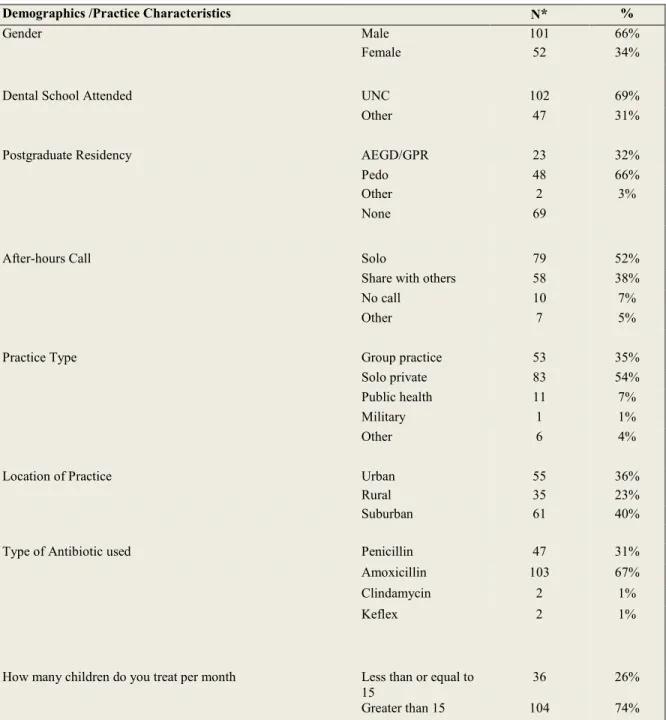
Dentists’ practice and demographic characteristics are presented in Table 1. The
mean age was 47 with a range of 27-68. The mean number of years in practice was 19
with a range of 1-43. Nearly 30% were pediatric dentists and 70% were general dentists.
The majority of respondents were males (66%) and UNC-CH School of Dentistry alumni
(69%). Among the general dentists, 33% completed a general practice residency (GPR)
or advanced general education in dentistry (AEGD) post-graduate training program. The
majority was in a solo private practice setting (54%).
Relative to hours emergency care coverage, 51% reported taking solo
after-hours emergency call duties. Amoxicillin was the most commonly reported antibiotic
used (67%). One third reported seldom writing prescriptions for dental infections.
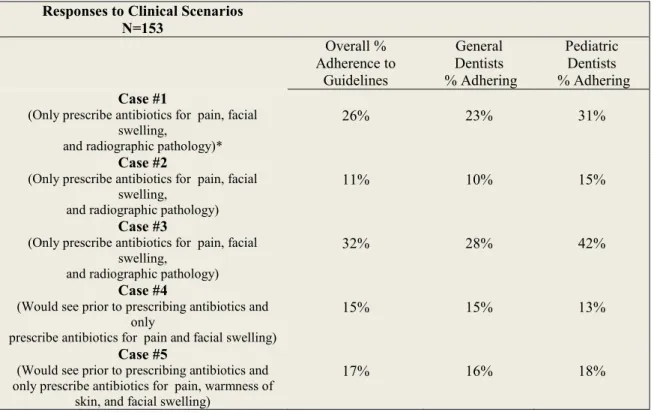
The responses to the clinical case scenarios are presented in Table 2. Dentists
were deemed to be in adherence with professional guidelines if they reported they would
prescribe for the appropriate collective signs/symptoms. Clinical scenarios 1, 2, and 3
were in-office cases and clinical case scenarios 4 and 5 were after-hours/weekend cases.
10
guidelines if they would see the child prior to prescribing antibiotics and prescribed for
the appropriate collective sign/symptoms.
Overall, adherence rates were low, ranging from 11%-32%. Pediatric dentists had
higher levels of adherence to professional guidelines versus general dentists. According to professional guidelines, antibiotics should be prescribed when a patient presents with
facial swelling with or without pain, and/or radiographic pathology. Case 1 represents
the collective symptoms of facial swelling, pain, and radiographic pathology. Overall,
26% of the dentists in the study were in adherence to the professional guidelines. Among
the pediatric dentists, 31% were in adherence to the professional guidelines versus 23% of general dentists. When fever was added to the list of collective signs and symptoms
(Case 2), the overall adherence level dropped to 11%. When local swelling was added
and fever removed from the list of collective signs and symptoms (Case 3), the overall
adherence level increased to 32%.
Dentists’ adherence to professional guidelines dropped for the after
hours/weekend cases. According to the guidelines, dentists should see the patient prior to
prescribing antibiotics. Less than one quarter (Case 4=15% and case 5=17%) of the
dentists reported that they would see the patient prior to prescribing antibiotics.
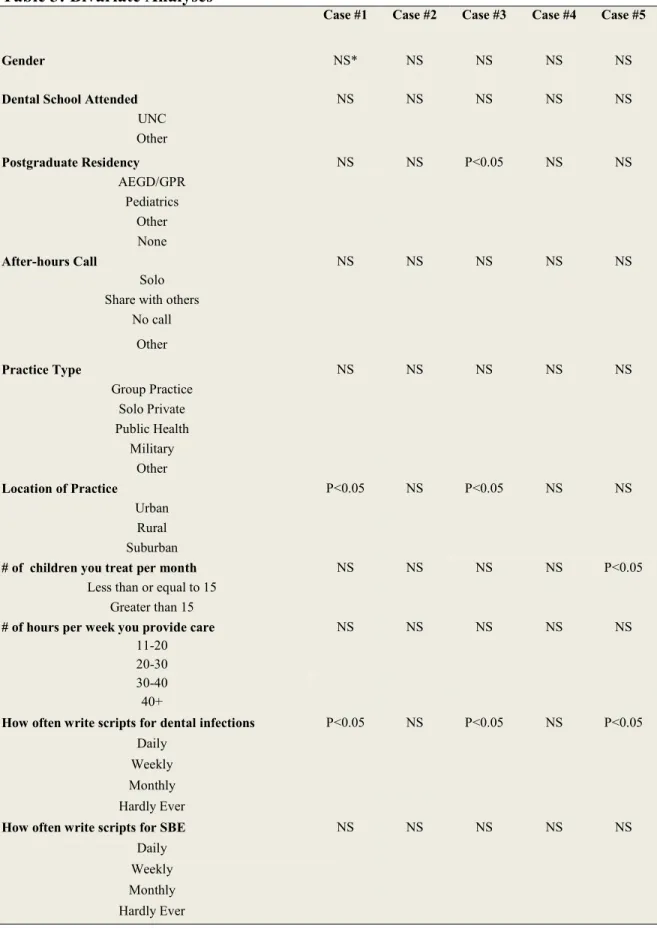
The bivariate analyses examining factors associated with antibiotic prescribing
practices are presented in Table 3. For all the in-office cases (1, 2 and 3), dentists who
reported prescribing antibiotics more frequently were more likely to not be in adherence
to professional guidelines (p<0.05). Specifically for cases 1 and 3, practicing in rural
areas was associated (p<0.05) with not adhering to the professional guidelines. In these
11
not associated with adherence to the guidelines. Dentists who had completed some type
of post-graduate training were more likely to prescribe antibiotics consistent with
12 DISCUSSION
This is the first study to investigate the use of antibiotics to treat dental infections
in children. Overall, adherence to professional guidelines for prescribing antibiotics for
odontogenic infections in children was low. On the basis of our findings, there is a lack
of adherence between how dentists in NC are treating dental infections in children and
what the recommended professional guidelines suggest. Our results would indicate there
is a potential problem in how antibiotics are being used to treat dental infections in
children.
We hypothesized that there would be a difference between general dentists and
pediatric dentists because they treat children more often, usually have more years of
training through their respective residency programs, and the AAPD guidelines offer
clinical scenarios and more specific guidance than do the ADA guidelines (Figure 1). In
four of the five cases, when the pediatric dentists were analyzed separately, they
prescribed antibiotics more closely to the recommended professional guidelines;
however, the differences were only modestly better and none were statistically significant
(p<0.05). The findings reveal a low percentage of adherence ranging from 11-32%.
Previous investigations examining dentists’ adherence to professional guidelines have
also found low adherence. Nelson and colleagues found that dentists and physicians had
low adherence (32.9%) when prescribing antibiotics for SBE coverage.20 Hu and
13
users and explained that most of the dentists were unfamiliar with the guidelines and did
not follow them.21
On the basis of these findings, although one might conclude that the participants
are either unaware or unwilling to adhere to guidelines, there may be another explanation.
It is possible that the professional guidelines are lacking in clear direction for certain
clinical situations. The ADA guidelines (Figure 1) do not provide clinical situations to
support prescribing practices. Although most clinical situations are individually
different, the guidelines might be more helpful if there were representative clinical cases
available to illustrate recommended prescribing patterns. The AAPD guidelines appear
to be more specific than the ADA guidelines, but maybe these too could be expanded or
explained further. Moreover, given the significance of this issue, both organizations could
undertake more active roles in educating their members.
The demographic data gathered were not inconsistent with expectations for a
survey of NC dentists.22 The majority attended UNC-CH for dental school and the mean
age was 47 years with a the average number of years in practice being 19. Almost the
entire sample reported taking some type of solo call or sharing call with others for
after-hours emergency cases. In addition, most of the practices were either solo or group
practices. Most of the dentists’ labeled their practice as being in either a suburban or
urban location within NC. Amoxicillin was the drug of choice for treating dental
infections. Almost 90% of the sample practiced over 30 hours per week. Interestingly,
the vast majority reported that they did not write prescriptions for dental infections very
14 Limitations and Strengths
These results should be considered in the light of some study limitations. The
cross-sectional design limited potential to draw causal inferences. Because the survey
was self-completed and based on case scenarios, responses may be susceptible to
response bias. Dentists, who attended the continuing education courses where the surveys
were distributed, may not be a representative sample of NC dentists. For example, those
that attended the courses may have been more informed and more eager to learn about
new ideas in dentistry. Participant dentists may have been more informed or more
comfortable with the topic. In the aggregate, these limitations hint that professional
adherence to the guidelines for antibiotic use may be worse than reported here. Another
limitation of our study is the power of the study. Although a few trends were evident, the
sample size was small so inferences were difficult.
Despite these limitations, this study has several strengths including it is the first to
report on this topic of importance and clinical relevance. Very little is known about
antibiotic prescribing practices of dentists in the US and almost nothing is known about
prescribing practices when treating children. The study provides preliminary data for one
state on the extent to which the dental professionals are adhering to professional
guidelines for prescribing antibiotics for children with dental infections. The data also
include factors associated with prescribing practices. Understanding these factors will
15 Future Research
This study sets the stage for future research. We obtained self-reported practices,
which is a first first-step to understanding dentists’ antibiotic prescribing practices.
Future research should include a more randomized approach with more participants to
increase statistical power. Practice-based networks would be an excellent research
environment for further study of this topic.
Conclusions
Adherence to professional guidelines for prescribing antibiotics for odontogenic
infections in children was extremely low. There appears to be a lack of concordance
between the recommended professional guidelines and the antibiotic prescribing practices
16
Figure 1: Professional Guidelines for the Use of Antibiotics Recommended Professional Guidelines for Antibiotic use
American Dental Association (ADA)
1. Make an accurate diagnosis.
2. Use appropriate antibiotics anddosing schedules.
3. Consider using narrow-spectrum antibacterial drugs in simple infections to minimize disturbance of the normal microflora, and preserve the use of broad-spectrumdrugs for morecomplex infections.
4. Avoid unnecessary use of antibacterial drugs in treating viralinfections.
5. Iftreating empirically, revise treatment regimen based on patientprogress or test results.
6. Obtain thorough knowledge of the side effects and drug interactions of an antibacterial drugbefore prescribing it.
7. Educate the patient regarding properuse of the drug and stressthe importance of completing thefull course of therapy (thatis, taking all doses for the prescribed treatment time).
8. Diagnosis and antibiotic selection should be based on thorough medical and dental history.
9. Weigh the known risks against the benefits of antibiotic use for treatment. 10.Use drugs in an appropriate manner.
American Academy of Pediatric Dentistry (AAPD)
1. Oral Wound Management. Antibiotic therapy should be considered with oral wounds that are at an increased risk of bacterial contamination. Examples are: soft tissue lacerations, complicated crown fractures, severe tooth displacement, extensive gingivectomy, and severe ulcerations.
2. Pulpitis/apical periodontitis/draining sinus tract/localized intraoral swelling. If child has acute symptoms of pulpitis and the infection is contained within the pulpal tissue or the immediate surrounding tissue, treatment should be performed and an antibiotic should not be prescribed.
3. Acute facial swelling of dental origin. Facial swelling secondary to a dental infection should receive immediate dental attention. Treatment is usually either, extracting or treating the tooth with antibiotic coverage or antibiotic coverage for a few days to contain the spread of the infection and then treat the tooth.
4. Dental Trauma. Antibiotic to the root surface of an avulsed tooth is recommended to prevent resorption and increase rate of pulpal revascularization. Systemic antibiotics are unclear as to the necessity to use them with avulsions.
5. Pediatric periodontal diseases. In pediatric periodontal diseases associated with other systemic diseases such as nuetropenia, Papillon-LeFevre syndrome, and leukocyte adhesion deficiency, antibiotic therapy is indicated.
17
Figure 2: Clinical Case Scenarios for Use of Antibiotics Clinical Scenarios
Case #1
A healthy (ASA I) 9 year old, who is a patient of record, presents to your office during regular business hours with tooth pain in the lower right. On clinical exam you notice a deep carious lesion on #T (lower right primary 2nd molar). Would you prescribe antibiotics for: Pain only? Symptoms of pain and local swelling with no radiographic pathology? Symptoms of pain and local swelling with radiographic pathology? Symptoms of pain and facial swelling with radiographic pathology?
Case #2
A healthy (ASA I) 9 year old, who is a patient of record, presents to your office during regular business hours with tooth pain in the lower right and a fever of 101 degrees. On clinical exam you notice a deep carious lesion on #T (lower right primary 2nd molar). Would you prescribe antibiotics for: Pain and fever? Symptoms of pain and local swelling with no radiographic pathology? Symptoms of pain and local swelling with radiographic pathology? Symptoms of pain and facial swelling with radiographic pathology?
Case #3
A healthy (ASA I) 9 year old, who is a patient of record, presents to your office during regular business hours with tooth pain in the lower right. No fever. On clinical exam you notice a deep carious lesion on #T (lower right primary 2nd molar) along with a draining fistula. Would you prescribe antibiotics for: Pain only? Symptoms of pain and local swelling with no radiographic pathology? Symptoms of pain and local swelling with radiographic pathology? Symptoms of pain and facial swelling with radiographic pathology?
Case #4
A healthy (ASA I) 9 year old, who is a patient of record, calls you on Saturday afternoon with a chief complaint of tooth pain in the lower right. Please review the following symptoms that mom describes on the phone and answer if you would prescribe antibiotics for: Pain only? Symptoms of pain and local swelling? Symptoms of pain and facial swelling? Would you see the child prior to prescribing antibiotics?
Case #5
18
Table 1: Demographics and Practice Characteristics of Study Sample (N=153)
Demographics /Practice Characteristics N* %
Gender Male 101 66%
Female 52 34%
Dental School Attended UNC 102 69%
Other 47 31%
Postgraduate Residency AEGD/GPR 23 32%
Pedo 48 66%
Other 2 3%
None 69
After-hours Call Solo 79 52%
Share with others 58 38%
No call 10 7%
Other 7 5%
Practice Type Group practice 53 35%
Solo private 83 54%
Public health 11 7%
Military 1 1%
Other 6 4%
Location of Practice Urban 55 36%
Rural 35 23%
Suburban 61 40%
Type of Antibiotic used Penicillin 47 31%
Amoxicillin 103 67%
Clindamycin 2 1%
Keflex 2 1%
How many children do you treat per month Less than or equal to
15
36 26%
19
Table 1 (Cont’d): Demographics and Practice Characteristics of Study Sample (N=153) Demographics/Practice Characteristics N %
How many hours per week do you provide pt care 10-20 5 3%
21-30 15 10%
30+ 134 87%
How often do you write scripts for dental infections Daily 11 7%
Weekly 41 27%
Monthly 51 33%
Hardly ever 50 33%
How often do you write scripts for SBE Daily 4 3%
Weekly 17 11%
Monthly 40 26%
Age
Years in practice
Hardly ever 92
Mean
47 years 19
60%
Range
27-68 1-43
20
Table 2: Responses to Clinical Scenarios: Adherence to Professional Guidelines Responses to Clinical Scenarios
N=153 Overall % Adherence to Guidelines General Dentists % Adhering Pediatric Dentists % Adhering Case #1
(Only prescribe antibiotics for pain, facial swelling,
and radiographic pathology)*
26% 23% 31%
Case #2
(Only prescribe antibiotics for pain, facial swelling,
and radiographic pathology)
11% 10% 15%
Case #3
(Only prescribe antibiotics for pain, facial swelling,
and radiographic pathology)
32% 28% 42%
Case #4
(Would see prior to prescribing antibiotics and only
prescribe antibiotics for pain and facial swelling)
15% 15% 13%
Case #5
(Would see prior to prescribing antibiotics and only prescribe antibiotics for pain, warmness of
skin, and facial swelling)
21 Table 3: Bivariate Analyses
Case #1 Case #2 Case #3 Case #4 Case #5
Gender NS* NS NS NS NS
Dental School Attended NS NS NS NS NS UNC
Other
Postgraduate Residency NS NS P<0.05 NS NS AEGD/GPR
Pediatrics Other None
After-hours Call NS NS NS NS NS Solo
Share with others No call
Other
Practice Type NS NS NS NS NS
Group Practice Solo Private Public Health
Military Other
Location of Practice P<0.05 NS P<0.05 NS NS Urban
Rural Suburban
# of children you treat per month NS NS NS NS P<0.05 Less than or equal to 15
Greater than 15
# of hours per week you provide care NS NS NS NS NS 11-20
20-30 30-40 40+
How often write scripts for dental infections P<0.05 NS P<0.05 NS P<0.05 Daily
Weekly Monthly Hardly Ever
How often write scripts for SBE NS NS NS NS NS Daily
22 Literature Cited
1. Haas DA, Epstein JB, Eggert FM. Antimicrobial resistance: dentistry's role. J Can Dent Assoc 1998;64(7):496-502.
2. Pallasch TJ. Pharmacokinetic principles of antimicrobial therapy. Periodontol 2000 1996;10:5-11.
3. Slots J, Pallasch TJ. Dentists' role in halting antimicrobial resistance. J Dent Res 1996;75(6):1338-41.
4. Standing Medical Advisory Committee; Subgroup on Antimicrobial Resistance.
The Path of Least Resistance. The Stationery Office, London, UK. 1998.
5. American Dental Association Council on Scientific Affairs. Combating antibiotic resistance. J Am Dent Assoc 2004;135(4):484-7.
6. http://www.cdc.gov/ncidod/dhqp/ar_mrsa_spotlight_2006.html (accessed December 2008).
7. Sweeney LC, Dave J, Chambers PA, Heritage J. Antibiotic resistance in general dental practice--a cause for concern? J Antimicrob Chemother 2004;53(4):567-76.
8. Dowell SF, Schwartz B. Resistant pneumococci: protecting patients through judicious use of antibiotics. Am Fam Physician 1997;55(5):1647-54,1657-8.
9. Arnold KE, Leggiadro RJ, Breiman RF, Lipman HB, Schwartz B, Appleton MA,Cleveland KO, Szeto HC, Hill BC, Tenover FC, Elliott JA, Facklam RR. Risk factors for carriage of drug-resistant Streptococcus pneumoniae among children in Memphis, Tennessee. J Pediatr 1996; 128(6):757-64.
10.Reichler MR, Allphin AA, Breiman RF, Schreiber JR, Arnold JE, McDougal LK et al. The spread of multiply resistant Streptococcus pnuemoniae at a day care centre in Ohio. J Infect Dis 1992;166:1346-53.
11.Pallasch TJ. Antibiotic resistance. Dent Clin North Am 2003;47(4):623-39.
12.Musoke RN, Revathi G. Emergence of multidrug-resistant gram-negative organisms in a neonatal unit and the therapeutic implications. J Trop Pediatr 2000;46(2):86-91.
23
14.American Academy on Pediatric Dentistry Council on Clinical Affairs. Guideline on appropriate use of antibiotic therapy for pediatric dental patients. Pediatr Dent. 2008-2009;11(6 Suppl):225-27.
15.Greg Critser. Generation Rx How prescription drugs are altering American lives, minds, and bodies. 2005. New York, New York, USA.: Houghton Mifflin
Company.
16.Jaunay T, Sambrook P, Goss A. Antibiotic prescribing practices by South Australian general dental practitioners. Aust Dent J 2000;45(3):179-86.
17.Poveda Roda R, Bagan JV, Sanchis Bielsa JM, Carbonell Pastor E. Antibiotic use in dental practice. A review. Med Oral Patol Oral Cir Bucal. 2007;12(3):E186-92.
18.Hills-Smith H, Schuman NJ. Antibiotic therapy in pediatric dentistry. II. Treatment of oral infection and management of systemic disease. Pediatr Dent 1983;5(1):45-50.
19.Wagner JG. Relevant pharmacokinetics of antimicrobial drugs. Med Clin North Am 1974;58(3):479-92.
20.Nelson CL, Van Blaricum CS. Physician and dentist compliance with American Heart Association guidelines for prevention of bacterial endocarditis. J Am Dent Assoc. 1989 Feb;118 (2):169-73.
21.Hu S, Pallonen U, McAlister AL, Howard B, Kaminski R, Stevenson G, Servos T. Knowing how to help tobacco users. Dentists' familiarity and compliance with the clinical practice guideline. J Am Dent Assoc. 2006 Feb;137 (2):170-9.