Fear Learning Predicts Posttraumatic Stress Disorder Symptoms in Children After Hurricane Florence
Allison R. Naudé
Undergraduate Thesis Committee:
Abstract
Fear Learning Predicts Posttraumatic Stress Disorder Symptoms in Children After Hurricane Florence
In September of 2018, Hurricane Florence wreaked havoc throughout North Carolina. This catastrophe is an example of a traumatic event, and can cause more damage than just wreckage – it can also leave those affected at risk for developing posttraumatic stress disorder (PTSD). A diagnosis of PTSD can have serious life-long consequences and cause those
diagnosed with the disorder to exhibit a variety of symptoms. According to the Diagnostic and Statistical Manual of Mental Disorders (5th ed.; DSM-5; American Psychiatric Association [APA], 2013), PTSD symptoms are sorted into three clusters for young children: intrusion symptoms, such as recurrent memories or dreams about the traumatic event, avoidance symptoms, such as avoiding the location where the event occurred, and increased arousal symptoms, such as hypervigilance. For adults, a fifth cluster, negative cognitions and mood, is included. In the DSM-5, for a child to be diagnosed with PTSD, they must have been exposed to a traumatic event and exhibit at least one intrusion symptom, at least one avoidance symptom, at least two increased arousal symptoms, and the symptoms must persist for at least one month (APA, 2013).
Consequences, Development, and Treatment of PTSD
A large body of research shows that PTSD and related disorders cause negative
outcomes, such as hypersensitivity to perceived threats and dissociation from the world (APA, 2013; Fani, Tone, Phifer, & Norrholm, 2012; Glover et al., 2011). However, the vast majority of this research has focused on adults and adolescents, with little research done on younger
older children, research related to PTSD in younger age groups is critical in order to allow for early intervention and prevention of these negative outcomes.
If left untreated, PTSD is likely to negatively affect the individual for many years following onset (Smith et al., 2007). Fortunately, it can be diagnosed in young children, making early intervention possible (APA, 2013). Once diagnosed, PTSD in childhood is correlated with impaired performance in school and poorer social functioning (Smith et al., 2007). The disorder can also lead to risky behaviors and negative affect and cognition (APA, 2013). The downstream effects of PTSD emphasize the importance of early identification of children with PTSD, as it would allow for early evidence-based treatment to prevent the future negative outcomes of the disorder.
Currently, a popular and effective method for treating children with PTSD is trauma-focused cognitive-behavioral therapy (CBT) (Cohen, Mannarino, Perel, & Staron, 2007). TF-CBT has been shown to decrease PTSD symptoms, improve child behavior, and is effective in both elementary school-aged children and adolescents (Cohen et al., 2007; Jaycox et al., 2010). One study found that TF-CBT improved PTSD symptoms and behavior more effectively than other therapies in a sample of children ranging from three to 16 years of age (Smith et al., 2007). TF-CBT is administered over 12 sessions by a therapist and involves cognitive processing of the traumatic event(s), mood management, and learning coping skills (Cohen et al., 2007; Jaycox et al., 2010; Smith et al., 2007).
those with PTSD will have a chronic diagnosis, such that the disorder may persist for more than three months (Santiago et al., 2013). Factors such as the severity and type of trauma impact the probability of PTSD development. Additionally, the prevalence of the disorder decreases over time for those who have experienced non-intentional trauma whereas it increases over time for those who have experienced intentional trauma (Santiago et al., 2013). In adults, the prevalence of the disorder following rape is 80% whereas following a disaster it is between 30% and 40% (Javidi & Yadollahie, 2012). In children, the prevalence of the disorder following abuse or a natural disaster has been found to be even higher than in adults (Javidi & Yadollahie, 2012). In addition, the unexpected injury or death of a loved one is especially impactful for children, which may co-occur with a natural disaster, thus possibly worsening the impact of the disaster on the child and increasing the likelihood of developing PTSD following the disaster (Javidi & Yadollahie, 2012).
Research has investigated the mechanisms through which some individuals develop PTSD following exposure to trauma. There are a few proposed pathways through which the disorder develops (Fani et al., 2012; Lanius et al., 2010). Some models posit that individuals with PTSD pay more attention than those without the disorder to environmental stimuli that appear to be threatening or related to threat, or that PTSD is caused by learned helplessness (Fani et al., 2012; Lanius et al., 2010). Another theory suggests that individuals develop PTSD from atypical fear learning in that they display an exaggerated response to a stimulus and continue to exhibit this response even after the stimulus is gone (Fani et al., 2012; Lanius et al., 2010). Past work hypothesized that trauma led to the development of PTSD by way of upregulation of the
this idea (Lanius et al., 2010). The present study examined a different aspect of the stress response, physiological reactivity, to determine whether reactivity during a fear learning paradigm completed before a traumatic event, Hurricane Florence, predicted PTSD symptoms after the hurricane.
Once developed, PTSD can lead to maladaptive fear responses that interfere with normal life. These responses may occur and/or persist even in safe situations (Glover et al., 2011). These fear responses impede information processing and interrupt memory retrieval (Fani et al., 2012). PTSD is a type of anxiety disorder, and adults and adolescents with anxiety exhibit atypical fear learning, making baseline anxiety an important factor to control when examining the relationship between fear learning and PTSD (Lau et al., 2008). Studies have also shown that childhood anxiety is correlated with developing other psychopathology later in life (Britton, Lissek, Grillon, Norcross, & Pine, 2011). As PTSD falls under the anxiety umbrella, it is possible that childhood PTSD may also be predictive of future psychopathology.
As previously discussed, PTSD can cause different physiological responses to stimuli (APA, 2013). One way to detect these changes is by monitoring the heart rate or skin
predictive of PTSD following trauma in the same age range. Using the following literature as a basis, we hypothesize that impaired differentiation between threat and safety during fear learning will predict PTSD symptoms in children ages four to seven following Hurricane Florence, a traumatic event.
Fear Learning in Children
Fear learning is a type of classical conditioning paradigm. For children in research studies, fear learning tasks are often designed so that a certain stimulus, (the conditioned stimulus; CS), is paired with a loud noise (the unconditioned stimulus; US). Another stimulus, also a CS, is not paired with the US. The CS that is reinforced with the US is called the CS+. Through exposure to these pairings, the children learn to be afraid of the CS+, and it becomes the threat cue. The CS that is not reinforced with the US is called the CS-, and the children learn that this stimulus is the safety cue.
Multiple studies have evidenced that fear learning occurs in children using skin
However, children who have experienced early life adversity have different fear learning patterns than healthy children. To understand how experiences of abuse affect fear learning, a study was conducted in which a sample of children and adolescents ages six to 18 who had experienced maltreatment completed a fear learning task (McLaughlin et al., 2016). Children with a history of abuse showed a blunted skin conductance response (SCR) to the CS+ during conditioning (McLaughlin et al., 2016). They also did not show differential SCR to the CS+ and CS- during the early part of conditioning as compared to healthy controls (McLaughlin et al., 2016). In contrast, another team of researchers found that children ages four to seven who had experienced threat exhibited differential SCR to the CS+ and CS-, whereas healthy controls did not exhibit differential SCR until later ages (Machlin, Miller, Snyder, McLaughlin, & Sheridan, 2019).
fear learning predicts anxiety, a cluster of disorders that includes PTSD. Consequently, fear learning may also predict PTSD development in children after trauma exposure.
Fear Learning and PTSD in Children
Little research has examined the interaction between PTSD and fear learning in children. One study examined a sample of children between the ages of 8 and thirteen and investigated the effect of sex on fear learning in relation to PTSD (Gamwell et al., 2015). The researchers found that SCR was correlated with PTSD symptoms and that the children’s fear responses were not related to hyperarousal symptoms as has been found in adults with PTSD (Gamwell et al., 2015). McLaughlin et al. (2016) found that youth with PTSD showed blunted SCR to the CS+ during fear conditioning. It was also shown that maltreated children showed a blunted SCR to the CS+ (McLaughlin et al., 2016). Therefore, it seems possible that children with PTSD and children with a history of abuse may exhibit similar fear learning patterns. Finally, in line with the present study’s hypothesis, anxious children with an impaired response to the CS- may be at risk for developing PTSD later in life (Jovanovic et al., 2014). In other words, these children have inappropriate reactions to safety cues, and this may be predictive of later PTSD onset. Fear Learning, Psychopathology, and PTSD in Adults
both fear learning and extinction, whereas the control group did not exhibit differential SCR during extinction. Adults with PTSD also had trouble inhibiting fear responses to safety cues (Glover et al., 2011). With regard to similar psychopathology, adults with panic disorder had trouble learning to discriminate threat from safety and inhibiting their fear response under safe circumstances (Britton et al., 2011).
These studies show that fear learning and PTSD are closely related in adults, however they do not clarify whether fear learning can predict PTSD. One study examined whether PTSD could be predicted by fear learning in adolescents. Physiological reactivity data to the Trier Social Stress Test was collected from the sample of adolescents who participated in this study about one year before the Boston Marathon Bombings using heart rate data (Busso et al., 2014). After the bombings, a survey was administered to the participants that included a measure of PTSD symptoms and media exposure to the traumatic event (Busso et al., 2014). The researchers found that media exposure moderated autonomic reactivity to predict PTSD following the
bombings. This study suggested that fear learning could predict PTSD in adolescents, and also introduced a moderator of this relationship.
The Present Study
information could be used to advise caregivers regarding their children’s media intake surrounding a traumatic event in order to lessen risk for PTSD.
In the current study, we investigated the presence of PTSD symptoms in a sample of preschool-age children following Hurricane Florence, a traumatic event in North Carolina that affected our sample. The Category One hurricane swept through the state in September 2018 and caused major flooding, damage, and deaths (Andone, 2018). We measured the children’s
exposure to the hurricane through parent self-report questionnaires. We used fear learning data collected from these same children a year prior to the hurricane to assess the relation between their fear learning patterns and PTSD symptom onset post-hurricane, controlling for baseline anxiety symptoms also collected a year prior. Following the Busso et al. (2014) study, we hypothesize that child exposure to the hurricane’s destruction will moderate fear learning to predict PTSD in our sample following the hurricane.
Methods Participants
condition, a neurological illness, were not sufficiently fluent in English, or if they had a pervasive developmental disorder. Of the original sample of 65, 60 families participated in the follow-up survey. However, two participants did not complete the questions regarding their child’s hurricane exposure and PTSD symptoms, leaving a sample of 58 for the follow-up. Of the remaining 58 participants, seven children were missing fear learning physiological data due to technological issues, five refused to complete the fear learning task, two were dropped due to bad physiological file data quality, one aborted the task, and one was allergic to the materials and thus did not complete the task, leaving a fear learning sample subset of 42. The sample of 58 was used in one analysis that did not examine fear learning, while the sample of 42 was used in the rest of our analyses.
Procedure
Participants came to the lab for a three-hour period to complete the study (Machlin et al., 2019). After consent and assent, the primary caregiver completed a series of questionnaires measuring child deprivation, threat (including exposure to traumatic events), and
psychopathology. The child completed various tests and tasks, including an interview with a researcher about adverse experiences and a fear learning and extinction paradigm.
Approximately one year after the in-person visit, a follow-up survey was sent out to the families via Qualtrics, an online survey platform, to assess the impact of Hurricane Florence, which had just occurred. The survey measured the children’s Posttraumatic Stress Disorder symptoms. Fear Conditioning
safety cue and the other the threat cue. During acquisition, there were four blocks in which the CS+, or threat cue, was reinforced with the US (US block), four blocks in which the CS+ was not reinforced with the US (CS+ block), and four blocks of the CS-, or safety cue (CS- block). The CS+ was reinforced 80% of the time with an aversive loud sound during acquisition US blocks while the CS- was not reinforced with the aversive loud sound during CS- blocks. During extinction, there were four blocks in which the CS+ was not reinforced with the US and four blocks of the CS-. To ensure attention, participants pressed a key when they saw a dot on the screen during the task and were asked “Which shape was on the screen when you heard a sound?” twice throughout fear learning.
Measures
Posttraumatic Stress Disorder. Symptoms of PTSD were assessed in the follow-up survey using the 19 questions from the UCLA PTSD Index that feed into Criteria B, C, and D for a diagnosis of PTSD according to the DSM-IV (Steinberg et al., 2004). Items such as “My child feels alone inside and not close to other people” were included, and for each statement, parents indicated how often it had been true for their child in the past month on a scale from 0 (none) to 4 (most). They also had the option to indicate if they did not know the frequency.
In the present study, a symptom count score was used to measure overall PTSD
symptoms. We constructed the symptom score by creating a count of all non-zero responses to the PTSD symptom criteria questions. We also constructed categorical variables for each of the three symptom criteria: for Criterion B, children received a one if they had at least one symptom that fell into cluster B, for Criterion C, children received a one if they had at least three
zero if they did not meet the symptom cutoff. The UCLA PTSD Index has been found to have good convergent validity between its scores and a diagnosis of PTSD and has also been found to have good test-retest reliability (Cronbach’s alpha = 0.93) (Steinberg et al., 2004).
Child psychopathology. Child psychopathology was assessed using the Diagnostic Interview Schedule for Children – Young Child (DISC-YC) (Shaffer, Fisher, Lucas, Dulcan, & Schwab-Stone, 2000). The DISC is a diagnostic interview given to the parent or caregiver that assesses their child’s symptoms of psychopathology. In the present study, trained research assistants and graduate students administered the DISC. The DISC was generated by a computer and scored by the program’s algorithm. The DISC-YC has been found to be a reliable and valid measure of child psychopathology (Rijlaarsdam et al., 2015). We constructed an anxiety sum variable by summing the criteria scores for Generalized Anxiety Disorder, PTSD, Social Phobia, Separation Anxiety Disorder, and Specific Phobia. Then, we constructed a categorical DISC anxiety variable out of the anxiety sum variable in which children who displayed at least one symptom of any of the five aforementioned disorders received a one and children with no symptoms of any of the disorders received a zero. We used this categorical DISC variable to control for previous anxiety and PTSD during analyses.
Exposure to Hurricane Florence. The survey following the hurricane was sent out approximately a month after the hurricane hit the region. We collected responses from parents up to three months following the hurricane. We asked questions regarding child and parent
To construct the child exposure to the hurricane’s destruction variable, we summed answers to the following questions: “How many people in your immediate family OR people you live with were injured or killed by Hurricane Florence?,” “How many people in your extended family were injured or killed by Hurricane Florence?,” and “On a scale of 1 (no damage at all) to 5 (severe damage), did Hurricane Florence damage your home (e.g. flooding, broken windows, roof damage)?” We then constructed a categorical hurricane exposure variable using the sum exposure variable for use in analyses (Cronbach’s alpha = 0.80).
Physiological. We collected skin conductance responses (SCRs) during the fear
conditioning paradigm using Mindware BioLab 3.1.5. A researcher attached two gel electrodes to the palm of the participant’s non-dominant hand to measure skin conductance (Machlin et al., 2019). Skin conductance was measured at 1000 Hz using Mindware 3.1.5 and was cleaned in Mindware EDA Analysis 3.1.5. SCRs in the acquisition and extinction blocks were determined as the amplitude of the response (minimum response: 0.05 microsiemens) up to five seconds following the stimulus. In order to compare SCRs across participants, we calculated a range correction for SCRs by dividing each SCR amplitude by the participant’s maximum skin conductance (Lykken & Venables, 1971; Machlin et al., 2019). Then, for each stimulus, we averaged this value across the first two blocks of acquisition.
Statistical Analyses
First, to determine whether child exposure to the hurricane’s destruction can predict PTSD symptoms, we ran a linear regression, controlling for age, gender, and previous DISC anxiety.
amplitude to the CS- and CS+ during acquisition, age, gender, and previous anxiety as assessed using the DISC at the original visit. We hypothesized that SCR amplitude to the CS+ would predict PTSD symptoms reported in the follow-up survey controlling for the CS-, age, gender, and previous DISC anxiety. To determine which of the three clusters of PTSD symptoms were predicted by fear learning, we ran logistic regressions using each of three symptom clusters, Criteria B, C, and D, as the outcome, and the SCR to the CS+ as the predictor, controlling for SCR to the CS-, previous DISC anxiety, age, and gender.
Finally, to test the hypothesis that child exposure to the hurricane’s destruction would moderate the ability of fear learning to predict PTSD symptoms following the hurricane, we examined the interaction between SCR amplitude to the CS+ and child hurricane exposure. We hypothesized that significant exposure to the hurricane’s destruction would predict PTSD symptoms in children, controlling for the CS-, age, gender, and previous DISC anxiety.
Results Sample Characteristics
population in which we were most interested. Fifty-five out of the 58 parents who completed the follow up reported talking to their child about the hurricane and eight out of 58 children reported exposure to the hurricane’s destruction. The participants who were missing fear learning data were not significantly different from the subset of 42 used in fear learning analyses regarding age, gender, race, PTSD symptoms, previous DISC anxiety, and exposure to the hurricane’s destruction.
Child Hurricane Exposure and PTSD Symptoms
To determine if child exposure to the hurricane’s destruction predicted PTSD symptoms, we conducted a multiple linear regression analysis. Covariates included previous DISC anxiety, age, and gender. Results of the regression analysis indicated that child exposure to destruction significantly predicted PTSD symptoms following the hurricane, b = 4.41, SE = 1.72, t (52) = 2.56, p = .013 (Table 2). None of the other covariates significantly predicted PTSD symptoms. Fear Learning and PTSD Symptoms
To determine if amplitude of the SCR to the CS+ predicted PTSD symptoms following Hurricane Florence, we conducted a multiple linear regression analysis. Covariates included SCR amplitude to the CS-, previous DISC anxiety, age, and gender. Results of the regression analysis indicated that SCR amplitude to the CS+ marginally significantly predicted PTSD symptoms following the hurricane, b = 6.99, SE = 3.54, t (36) = 1.98, p = .056 (Table 3). None of the other covariates significantly predicted PTSD symptoms.
Predicting Clusters of PTSD Symptoms
To predict a specific cluster of PTSD symptoms, we examined if amplitude of the SCR to the CS+ predicted PTSD symptom clusters B, C, and D, using a binary logistic regression
age, and gender. Results of the regression analysis for Criterion D, increased arousal symptoms, indicated that SCR amplitude to the CS+ significantly predicted the Criterion D symptom cluster, b = 5.84, SE = 2.78, OR = 344.21, p = .036 (Table 4). None of the other covariates significantly predicted PTSD symptoms following the hurricane, although gender was marginally significant, b = -2.13, SE = 1.23, OR = 0.12, p = .083 (Table 4). Results of the regression analysis predicting Criterion B, re-experiencing symptoms, were not significant, nor was the regression predicting Criterion C, avoidance symptoms (p > .3).
Moderating Effect of Child Hurricane Exposure
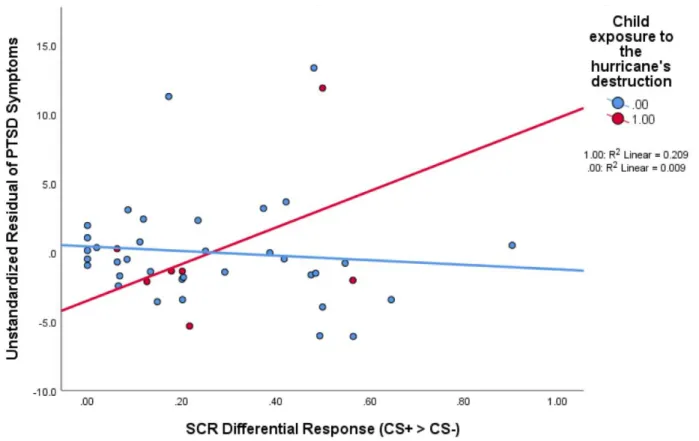
To determine whether child exposure to the hurricane’s destruction moderated the ability of SCR amplitude to the CS+ to predict PTSD symptoms, we examined the interaction between SCR amplitude to the CS+ and child exposure to the hurricane’s destruction using the PROCESS macro in SPSS (Hayes, 2017). Covariates included SCR amplitude to the CS-, previous DISC anxiety, age, and gender. Results of the moderation analysis indicated a marginally significant moderating effect of child hurricane exposure on the ability of SCR to the CS+ to predict PTSD symptoms, b = 19.87, SE = 11.33, t (34) = 1.75, p = .088 (Table 5; Figure 1). Girls were also marginally significantly more likely to have PTSD symptoms than boys in the model, b = -2.52, SE = 1.47, t (34) = -1.72, p = .095 (Table 5).
Discussion
symptoms following the hurricane. We found a marginally significant interaction effect that was driven by a significant relationship between fear learning and PTSD symptoms specifically in children with hurricane exposure.
As expected, child exposure to the hurricane’s destruction predicted PTSD symptoms. This is supported by research on the impact of natural disasters, which has found that they are highly likely to cause PTSD in children (Javidi & Yadollahie, 2012). Children are also strongly impacted by the injury or death of a loved one, data that families reported and we used to
construct our child exposure variable (Javidi & Yadollahie, 2012). This finding contributes to the body of research regarding the impact of natural disasters on children and the subsequent
prevalence of PTSD. In the face of a natural disaster, parents and clinicians should monitor children for displays of atypical behavior that may be related to PTSD.
Fear learning measured through SCR to the CS+ marginally predicted PTSD symptoms following Hurricane Florence. As no research has examined this relationship in young children before, this suggests the possibility that fear learning has a similar relationship to PTSD as it does in adults, although the studies in adults examined fear learning after the onset of the
We also found that SCR amplitude to the CS+ predicted PTSD Criterion D specifically, which captures increased arousal symptoms. This finding is consistent with the literature on PTSD in adults – adults’ fear responses to safety cues during fear conditioning are associated with PTSD hyperarousal symptoms (Gamwell et al., 2015). The finding that SCR to the CS+ predicted increased arousal symptoms suggests that childhood PTSD may express itself similarly to adult PTSD during fear learning.
The moderation analysis showed that child hurricane exposure marginally moderated SCR to the CS+ to predict PTSD symptoms. The results of the moderation analysis are driven by children with exposure to the hurricane’s destruction: fear learning measured through SCR to the CS+ predicts PTSD symptoms in children with hurricane exposure (Figure 1). In contrast, Busso and colleagues (2014) found that at low levels of physiological reactivity, adolescents with high levels of media exposure to the Boston Marathon Bombings had higher levels of PTSD
symptoms following the bombings than those with low levels of media exposure. The difference between our finding in young children and the Busso et al. (2014) finding in adolescents
regarding fear learning and PTSD is similar to the differences in fear learning found between young children and adolescents with histories of abuse: young children who had experienced adversity exhibited differential SCR during fear learning while healthy controls did not, whereas adolescents who had experienced maltreatment and those who had PTSD exhibited a blunted SCR response to threat cues during fear conditioning (Machlin et al., 2019; McLaughlin et al., 2016). Thus, it is possible that the adolescents who had experienced the Boston Marathon Bombings were exhibiting blunted physiological reactivity.
differences in adults regarding PTSD: women are more likely to develop PTSD than men (Inslicht et al., 2013; Javidi & Yadollahie, 2012). Not much research has been conducted on PTSD in young children to determine the prevalence of the disorder by gender. However, research has found a higher prevalence of anxiety disorders in girls compared to boys, which supports our finding as PTSD is one of many anxiety disorders (Gamwell et al., 2015).
Additionally, this result is supported by our logistic regression analysis predicting Criterion D symptoms, as it showed that girls were marginally more likely than boys to have PTSD Criterion D symptoms.
One reason that there is not much research examining PTSD in younger age groups is that it requires a sample of children who have been exposed to a traumatic event and with whom pre-trauma data has been collected (Garza & Jovanovic, 2017). As we had collected baseline data on the participants prior to the hurricane, we were able to compare the children’s PTSD symptoms following the natural disaster to their baseline data, thus increasing the likelihood that the PTSD symptoms found in our sample were due to the effects of the hurricane and allowing us to form predictions.
The prevalence of PTSD decreases over time for those who experience non-intentional trauma (Santiago et al., 2013). The traumatic event examined in the present study, Hurricane Florence, is an example of non-intentional trauma, and so it is possible that the prevalence of PTSD symptoms following the hurricane would decrease over time. However, since we assessed symptoms approximately one month following the hurricane it is likely that we were able to capture the majority of PTSD symptoms that appeared directly following the hurricane.
as a useful tool to investigate PTSD symptom development following trauma (Javidi & Yadollahie, 2012).
Although the present study sought to address the gap in the literature regarding which children may be at risk for developing PTSD, several limitations exist. Since our sample was recruited from central North Carolina, most of the children did not have significant exposure to the hurricane’s destruction, thus limiting the power of our hurricane exposure variable. Only eight families endorsed the questions that were included in this variable, and of those, only one participant reported immediate and extended family who were injured or killed by the hurricane. In addition, most individuals develop PTSD symptoms within three months following trauma, so it is possible that we missed capturing some children who would go on to develop symptoms after the follow up survey was administered (Santiago et al., 2013). The power of our fear learning variables was also limited, as about one-third of the sample was missing physiological data for the fear conditioning paradigm. Seeing as the participants in our study were very young, it was often difficult to get them to sit still for the duration of the task, which created noise in the data or incomplete data collection.
of this type of work is the ability to measure constructs of interest following spontaneous trauma and have access to the participants’ baseline data.
The present study has shown that the destruction Hurricane Florence caused was not limited to houses and towns – it also caused psychological damage. Families reported noticing PTSD symptoms in their children after the hurricane, and child hurricane exposure predicted these symptoms. Our analyses showed that SCR to the CS+ predicts Criterion D (increased arousal) PTSD symptoms and that SCR to the CS+ marginally significantly predicts PTSD symptoms overall. Similarly, studies in adults have shown that those with PTSD exhibit greater differential SCR as well as attention bias to the CS+ as compared to controls (Fani et al., 2012; McTeague et al., 2010; Orr et al., 2000).
The observation that SCR to fear learning predicts PTSD symptoms is a valuable tool for the treatment of childhood PTSD, as previously discussed. Our results show that adults and children with PTSD demonstrate similar physiological responses to fear conditioning, thereby opening the door to implement interventions on children based on treatments used for adults. An important next step would be to test one of these adult interventions in a sample of children with PTSD to determine its effectiveness. Alternatively, new treatments could be developed to target heightened physiological reactivity in children following trauma. It is also possible that TF-CBT could decrease risk for PTSD symptoms through this mechanism.
References
American Psychiatric Association. (2013). Trauma- and stressor-related disorders. In Diagnostic
and statistical manual of mental disorders (5th ed.). Arlington, VA:
doi:10.1176/appi.books.9780890425596.dsm07.
Andone, D. (2018, Sept. 17). ‘Storm of a lifetime’ how Hurricane Florence battered the Carolinas, day by day. Cable News Network. Retrieved from https://www.cnn.com/ Britton, J.C., Lissek, S., Grillon, C., Norcross, M.A., & Pine, D.S. (2011). Development of
anxiety: The role of threat appraisal and fear learning. Depression and Anxiety, 28(1), 5-17. doi:10.1002/da.20733
Busso, D.S., McLaughlin, K.A., & Sheridan, M.A. (2014). Media exposure and sympathetic nervous system reactivity predict PTSD symptoms after the Boston Marathon bombings.
Depression and Anxiety, 31(7), 551-558. doi:10.1002/da.22282
Cohen, J.A., Mannarino, A.P., Perel, J.M., & Staron, V. (2007). A pilot randomized controlled trial of combined trauma-focused CBT and sertraline for childhood PTSD symptoms.
Journal of the American Academy of Child and Adolescent Psychiatry, 46(7), 811-819.
doi:10.1097/chi.0b013e3180547105
Fani, N., Tone, E.B., Phifer, J., & Norrholm, S.D. (2012). Attention bias toward threat is associated with exaggerated fear expression and impaired extinction in PTSD.
Psychological Medicine, 42(3), 533-543. doi:10.1017/S0033291711001565
Gao, Y., Raine, A., Venables, P.H., Dawson, M.E., & Mednick, S.A. (2009). The development of skin conductance fear conditioning in children from ages 3 to 8 years. Developmental
Science, 13(1), 201-212. doi:10.1111/j.1467-7687.2009.00874.x
Garza, K., & Jovanovic, T. (2017). Impact of gender on child and adolescent PTSD. Current
Psychiatry Reports, 19(87). doi:10.1007/s11920-017-0830-6
Glenn, C.R., Klein, D.N., Lissek, S., Britton, J.C., Pine, D.S., & Hajcak, G. (2012). The development of fear learning and generalization in 8 to 13 year-olds. Developmental
Psychobiology, 54(7), 675-684. doi:10.1002/dev.20616
Glover, E.M., Phifer, J.E., Crain, D.F., Norrholm, S.D., Davis, M., Bradley, B.,… Jovanovic, T. (2011). Tools for translational neuroscience: PTSD is associated with heightened fears responses using acoustic startle but not skin conductance measures. Depression and
Anxiety, 28(12), 1058-1066. doi:10.1002/da.20880
Hayes, A.F. (2017). Introduction to mediation, moderation, and conditional process analysis (T.D. Little, Ed.) (2nd edition). The Guilford Press.
Inslicht, S.S., Metzler, T.J., Garcia, N.M., Pineles, S.L., Milad, M.R., Orr, S.P.,… Neylan, T.C. (2013). Sex differences in fear conditioning in posttraumatic stress disorder. Journal of
Psychiatric Research, 47(1), 64-71. doi:10.1016/j.jpsychires.2012.08.027
Javidi, H., & Yadollahie, M. (2012). Post-traumatic stress disorder. The International Journal of
Occupational and Environmental Medicine, 3(1), 2-9. Retrieved from
https://theijoem.com/ijoem/index.php/ijoem/index/
Jaycox, L.H., Cohen, J.A., Mannarino, A.P., Walker, D.W., Langley, A.K., Gegenheimer,
A field trial of trauma-focused psychotherapies. Journal of Traumatic Stress, 23(2), 223-231. doi:10.1002/jts.20518
Jovanovic, T., Nylocks, K.M., Gamwell, K.L., Smith, A., Davis, T.A., Norrholm, S.D., &
Bradley, B. (2014). Development of fear acquisition and extinction in children: Effects of age and anxiety. Neurobiology of Learning and Memory, 113, 135-142.
doi:10.1016/j.nlm.2013.10.016
Lanius, R.A., Frewen, P.A., Vermetten, E., & Yehuda, R. (2010). Fear conditioning and early life vulnerabilities: two distinct pathways of emotional dysregulation and brain
dysfunction in PTSD. European Journal of Psychotraumatology, 1(1),. doi:10.3402/ejpt.v1i0.5467
Lau, J.Y.F., Lissek, S., Nelson, E.E., Lee, Y., Roberson-Nay, R., Poeth, K.,… Pine, D.S. (2008). Fear conditioning in adolescents with anxiety disorders: Results from a novel
experimental paradigm. Journal of the American Academy of Child and Adolescent
Psychiatry, 47(1), 94-102. doi:10.1097/chi.0b01e31815a5f01
Liberman, L.C., Lipp, O.V., Spence, S.H., & March, S. (2006). Evidence for retarded extinction of aversive learning in anxious children. Behaviour Research and Therapy, 44(10), 1491-1502. doi:10.1016/j.brat.2005.11.004
Lykken, D. T., and Venables, P. H. (1971). Direct measurement of skin conductance: A proposal for standardization. Psychophysiology,8(5), 656–672. doi:
10.1111/j.1469-8986.1971.tb00501.x
early childhood. Frontiers in Behavioral Neuroscience, 13, 80. doi:10.3389/fnbeh.2019.00080
McLaughlin, K.A., Sheridan, M.A., Gold, A.L., Duys, A., Lambert, H.K., Peverill, M.,… Pine, D.S. (2016). Maltreatment exposure, brain structure, and fear conditioning in children and adolescents. Neuropsychopharmacology, 41(8), 1956-1964.
doi:10.1038/npp.2015.365
McTeague, L.M., Lang, P.J., Laplante, M., Cuthbert, B.N., Shumen, J.R., & Bradley, M.M. (2010). Aversive imagery in posttraumatic stress disorder: Trauma recurrence, comorbidity, and physiological reactivity. Biological Psychiatry, 67(4), 346-356. doi:10.1016/j.biopsych.2009.08.023
Milner, J. S. (1994). Assessing physical child abuse risk: The child abuse potential inventory.
Clinical Psychology Review, 14(6), 547–583. doi:10.1016/0272-7358(94)90017-5
Orr, S.P., Metzger, L.J., Lasko, N.B., Macklin, M.L., Peri, T., & Pitman, R.K. (2000). De novo conditioning in trauma-exposed individuals with and without posttraumatic stress disorder. Journal of Abnormal Psychology, 109(2), 290-298. doi:10.1037/0021-843X.109.2.290
Rijlaarsdam, J., Stevens, G.W.J.M., van der Ende, J., Hofman, A., Jaddoe, V.W.V., Verhulst, F.C., & Tiemeier, H. (2015). Prevalence of DSM-IV disorders in a population-based sample of 5- to 8-year-old children: the impact of impairment criteria. European Child
and Adolescent Psychiatry, 24, 1339-1348. doi:10.1007/s00787-015-0684-6
DSM-5 defined trauma exposed populations: Intentional and non-intentional traumatic events.
PLoS One, 8(4), e59236. doi:10.1371/journal.pone.0059236
Shaffer, D., Fisher, P., Lucas, C.P., Dulcan, M.K., & Schwab-Stone, M.E. (2000). NIMH Diagnostic Interview Schedule for Children Version IV (NIMH DISC-IV): Description, differences from previous versions, and reliability of some common diagnoses. Journal
of the American Academy of Child and Adolescent Psychiatry, 39(1), 28-38.
doi:10.1097/00004583-200001000-00014
Smith, P., Yule, W., Perrin, S., Tranah, T., Dalgleish, T., & Clark, D.M. (2007). Cognitive-behavioral therapy for PTSD in children and adolescents: A preliminary randomized controlled trial. Journal of the American Academy of Child and Adolescent Psychiatry, 46(8), 1051-1061. doi:10.1097/CHI.0b013e318067e288
Steinberg, A.M., Brymer, M.J., Decker, K.B., & Pynoos, R.S. (2004). The University of California at Los Angeles Post-traumatic Stress Disorder Reaction Index. Current
Table 1
Participant characteristics (N = 42)
Minimum Maximum Mean SD
Age (months) 51 95 73.02 13.49
% n
Female 50.0 21
Race/Ethnicity
White 52.4 22
African American 31.0 13
Asian 2.4 1
Multiracial/Other 14.3 6
Table 2
Multiple regression analysis predicting PTSD symptoms from child hurricane exposure (N = 58)
B SE B β t p
Constant 1.58 3.50 0.45 0.653
Child exposure to the hurricane’s destruction
4.41 1.72 0.33 2.56 0.013
Baseline DISC Anxiety -0.67 1.46 -0.06 -0.46 0.649
Age (months) 0.04 0.04 0.11 0.85 0.398
Table 3
Multiple regression analysis predicting PTSD symptoms from SCR to the CS+ (N = 42)
B SE B β t p
Constant 1.87 4.57 0.41 0.685
Amplitude of SCR to the CS+ during early fear learning
6.99 3.54 0.33 1.98 0.056
Amplitude of the SCR to the CS- during early fear learning
-1.05 3.49 -0.05 -0.30 0.766
Baseline DISC Anxiety -0.27 1.79 -0.02 -0.15 0.881
Age (months) 0.02 0.06 0.05 0.33 0.747
Table 4
Binary logistic regression analysis predicting Criterion D PTSD symptoms from SCR to the CS+ (N = 42)
B SE Wald df p OR
Constant -4.54 3.44 1.74 1 0.187 0.01
Amplitude of SCR to the CS+ during early fear learning
5.84 2.78 4.40 1 0.036 344.21
Amplitude of the SCR to the CS- during early fear learning
-4.16 3.12 1.78 1 0.182 0.02
Baseline DISC Anxiety 0.90 1.48 0.37 1 0.542 2.46
Age (months) 0.03 0.04 0.61 1 0.436 1.03
Table 5
Interaction between SCR and child hurricane exposure predicting PTSD symptoms (N = 42)
B SE B β t p
Constant 2.64 4.41 0.60 0.553
Interaction of SCR amplitude to the CS+ with child
hurricane exposure
19.87 11.33 0.54 1.75 0.088
Child exposure to the hurricane’s destruction
-2.39 3.41 -0.20 -0.70 0.489
Amplitude of SCR to the CS+ during early fear learning
5.67 3.48 0.27 1.63 0.112
Amplitude of the SCR to the CS- during early fear learning
-4.51 3.75 -0.21 -1.20 0.238
Baseline DISC Anxiety -0.27 1.73 -0.03 -0.16 0.876
Age (months) 0.02 0.05 0.06 0.41 0.686