Mining Concept-Drifting Data Streams using
Ensemble Classifiers
Haixun Wang
Wei Fan
Philip S. Yu
1Jiawei Han
IBM T. J. Watson Research, Hawthorne, NY 10532,{haixun,weifan,psyu}@us.ibm.com 1Dept. of Computer Science, Univ. of Illinois, Urbana, IL 61801, [email protected]
ABSTRACT
Recently, mining data streams with concept drifts for actionable insights has become an important and challenging task for a wide range of applications including credit card fraud protection, target marketing, network intrusion detection, etc. Conventional knowl-edge discovery tools are facing two challenges, the overwhelming volume of the streaming data, and the concept drifts. In this paper, we propose a general framework for mining concept-drifting data streams using weighted ensemble classifiers. We train an ensemble of classification models, such as C4.5, RIPPER, naive Bayesian, etc., from sequential chunks of the data stream. The classifiers in the ensemble are judiciously weighted based on their expected clas-sification accuracy on the test data under the time-evolving environ-ment. Thus, the ensemble approach improves both the efficiency in learning the model and the accuracy in performing classification. Our empirical study shows that the proposed methods have sub-stantial advantage over single-classifier approaches in prediction accuracy, and the ensemble framework is effective for a variety of classification models.
1.
INTRODUCTION
The scalability of data mining methods is constantly being chal-lenged by real-time production systems that generate tremendous amount of data at unprecedented rates. Examples of such data streams include network event logs, telephone call records, credit card transactional flows, sensoring and surveillance video streams, etc. Other than the huge data volume, streaming data are also char-acterized by their drifting concepts. In other words, the underlying data generating mechanism, or the concept that we try to learn from the data, is constantly evolving. Knowledge discovery on streaming data is a research topic of growing interest [1, 5, 7, 21]. The funda-mental problem we need to solve is the following: given an infinite amount of continuous measurements, how do we model them in or-der to capture time-evolving trends and patterns in the stream, and make time-critical predictions?
Huge data volume and drifting concepts are not unfamiliar to the data mining community. One of the goals of traditional data mining algorithms is to mine models from large databases with
bounded-Permission to make digital or hard copies of all or part of this work for personal or classroom use is granted without fee provided that copies are not made or distributed for profit or commercial advantage and that copies bear this notice and the full citation on the first page. To copy otherwise, to republish, to post on servers or to redistribute to lists, requires prior specific permission and/or a fee.
Copyright 2002 ACM X-XXXXX-XX-X/XX/XX ...$5.00.
memory. This goal has been achieved by a number of classification methods, including Sprint [25], RainForest [16], BOAT [15], etc. Nevertheless, the fact that these algorithms require multiple scans of the training data makes them inappropriate in the streaming data environment where the examples are coming in at a higher rate than they can be repeatedly analyzed.
Incremental or online data mining methods [29, 15] are another option for mining data streams. These methods continuously revise and refine a model by incorporating new data as they arrive. How-ever, in order to guarantee that the model trained incrementally is identical to the model trained in the batch mode, most online algo-rithms rely on a costly model updating procedure, which sometimes makes the learning even slower than it is in batch mode. Recently, an efficient incremental decision tree algorithm called VFDT is in-troduced by Domingos et al [7]. For streams made up of discrete type of data, Hoeffding bounds guarantee that the output model of VFDT is asymptotically nearly identical to that of a batch learner.
The above mentioned algorithms, including incremental and on-line methods such as VFDT, all produce a single model that repre-sents the entire data stream. It suffers in prediction accuracy in the presence of concept drifts. This is because the streaming data are not generated by a stationary stochastic process, indeed, the future examples we need to classify may have a very different distribution from the historical data.
In order to make time-critical predictions, the model learned from the streaming data must be able to capture up-to-date trends and transient patterns in the stream. To do this, as we revise the model by incorporating new examples, we must also eliminate the effects of examples representing outdated concepts. This is a non-trivial task. The challenge of maintaining an accurate and up-to-date classifier for infinite data streams with concept drifts including the following:
• ACCURACY. It is difficult to decide what are the exam-ples that represent outdated concepts, and hence their effects should be excluded from the current model. A commonly used approach is to ‘forget’ old examples at a constant rate. However, a higher rate would lower the accuracy of the ‘up-to-date’ model as it is supported by a less amount of training data and a lower rate would make the model less sensitive to the current trend and prevent it from discovering transient patterns.
• EFFICIENCY. Decision trees are constructed in a greedy divide-and-conquer manner, and they are non-stable. Even a slight drift of the underlying concepts may trigger substantial changes (e.g., replacing old branches with new branches, re-growing or building alternative subbranches) in the tree, and severely compromise learning efficiency.
• EASE OFUSE. Substantial implementation efforts are re-quired to adapt classification methods such as decision trees to handle data streams with drifting concepts in an incremen-tal manner [21]. The usability of this approach is limited as state-of-the-art learning methods cannot be applied directly. In light of these challenges, we propose using weighted
classi-fier ensembles to mine streaming data with concept drifts. Instead
of continuously revising a single model, we train an ensemble of classifiers from sequential data chunks in the stream. Maintaining a most up-to-date classifier is not necessarily the ideal choice, be-cause potentially valuable information may be wasted by discard-ing results of previously-trained less-accurate classifiers. We show that, in order to avoid overfitting and the problems of conflicting concepts, the expiration of old data must rely on data’s distribution instead of only their arrival time. The ensemble approach offers this capability by giving each classifier a weight based on its ex-pected prediction accuracy on the current test examples. Another benefit of the ensemble approach is its efficiency and ease-of-use. In this paper, we also consider issues in cost-sensitive learning, and present an instance-based ensemble pruning method that shows in a cost-sensitive scenario a pruned ensemble delivers the same level of benefits as the entire set of classifiers.
Paper Organization.
The rest of the paper is organized as fol-lows. In Section 2 we discuss the data expiration problem in min-ing concept-driftmin-ing data streams. In Section 3, we prove the error reduction property of the classifier ensemble in the presence of con-cept drifts. Section 4 outlines an algorithm framework for solving the problem. In Section 5, we present a method that allows us to greatly reduce the number of classifiers in an ensemble with little loss. Experiments and related work are shown in Section 6 and Section 7.2.
THE DATA EXPIRATION PROBLEM
The fundamental problem in learning drifting concepts is how to identify in a timely manner those data in the training set that are no longer consistent with the current concepts. These data must be discarded. A straightforward solution, which is used in many cur-rent approaches, discards data indiscriminately after they become old, that is, after a fixed period of timeT has passed since their arrival. Although this solution is conceptually simple, it tends to complicate the logic of the learning algorithm. More importantly, it creates the following dilemma which makes it vulnerable to unpre-dictable conceptual changes in the data: ifT is large, the training set is likely to contain outdated concepts, which reduces classifica-tion accuracy; ifT is small, the training set may not have enough data, and as a result, the learned model will likely carry a large variance due to overfitting.
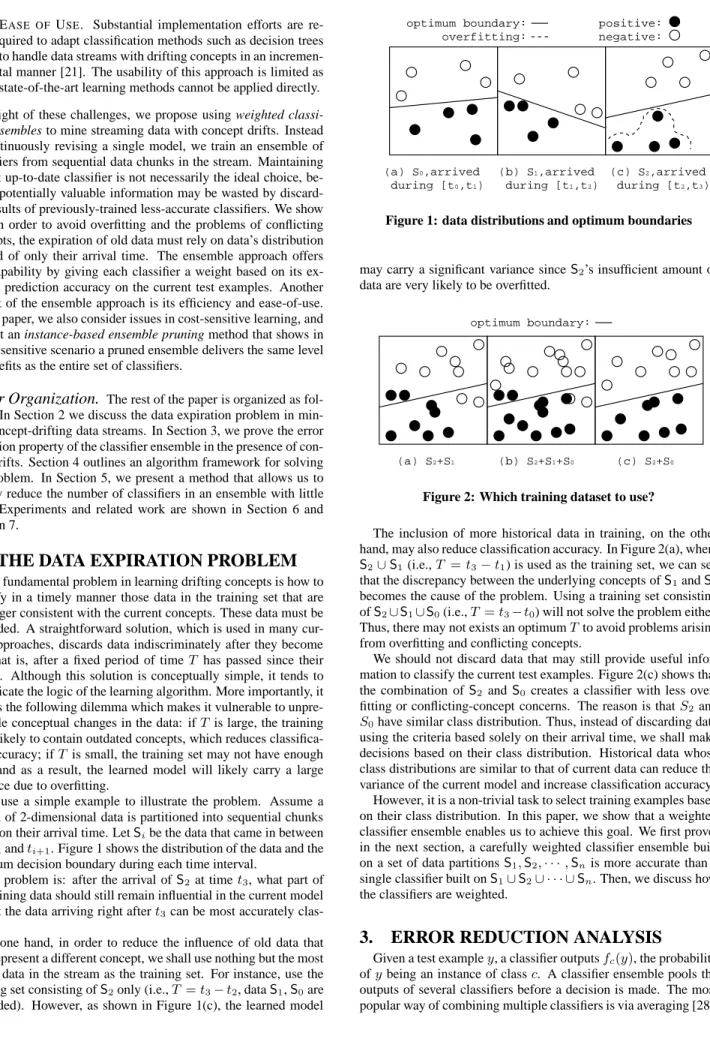
We use a simple example to illustrate the problem. Assume a stream of 2-dimensional data is partitioned into sequential chunks based on their arrival time. LetSibe the data that came in between timetiandti+1. Figure 1 shows the distribution of the data and the optimum decision boundary during each time interval.
The problem is: after the arrival ofS2 at timet3, what part of the training data should still remain influential in the current model so that the data arriving right aftert3can be most accurately clas-sified?
On one hand, in order to reduce the influence of old data that
may represent a different concept, we shall use nothing but the most
recent data in the stream as the training set. For instance, use the training set consisting ofS2only (i.e.,T =t3−t2, dataS1,S0are discarded). However, as shown in Figure 1(c), the learned model
optimum boundary: overfitting: (a) S0,arrived during [t0,t1) (b) S1,arrived during [t1,t2) (c) S2,arrived during [t2,t3) positive: negative:
Figure 1: data distributions and optimum boundaries
may carry a significant variance sinceS2’s insufficient amount of data are very likely to be overfitted.
optimum boundary:
(a) S2+S1 (b) S2+S1+S0 (c) S2+S0
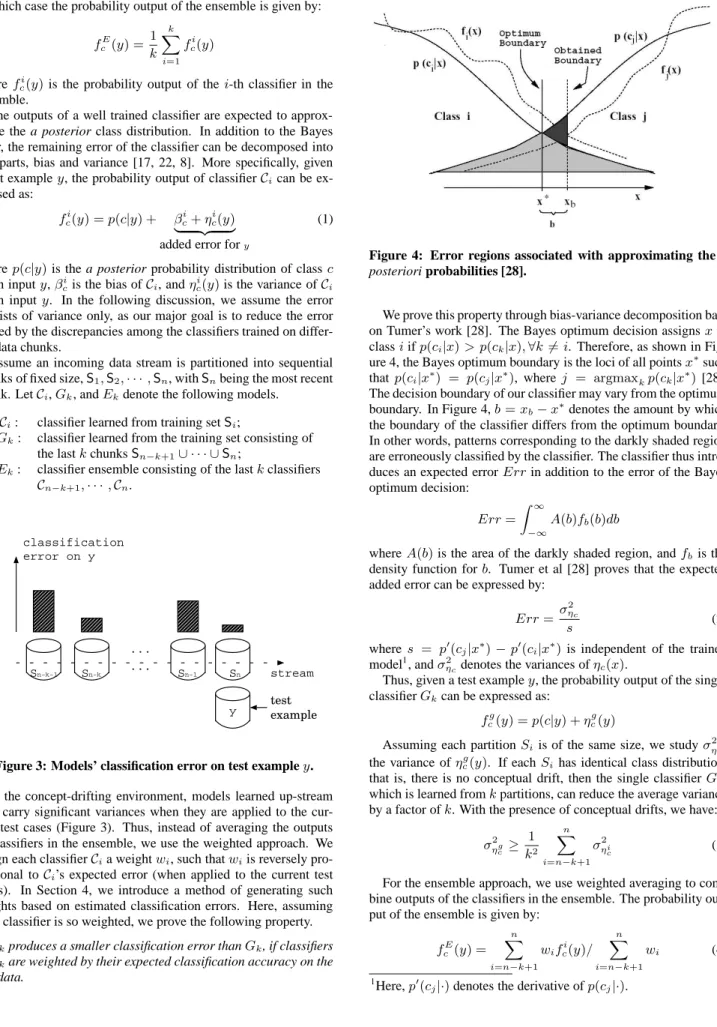
Figure 2: Which training dataset to use?
The inclusion of more historical data in training, on the other hand, may also reduce classification accuracy. In Figure 2(a), where S2∪S1(i.e.,T =t3−t1) is used as the training set, we can see that the discrepancy between the underlying concepts ofS1andS2 becomes the cause of the problem. Using a training set consisting ofS2∪S1∪S0(i.e.,T =t3−t0) will not solve the problem either. Thus, there may not exists an optimumTto avoid problems arising from overfitting and conflicting concepts.
We should not discard data that may still provide useful infor-mation to classify the current test examples. Figure 2(c) shows that the combination ofS2 andS0 creates a classifier with less over-fitting or conflicting-concept concerns. The reason is thatS2 and S0have similar class distribution. Thus, instead of discarding data using the criteria based solely on their arrival time, we shall make decisions based on their class distribution. Historical data whose class distributions are similar to that of current data can reduce the variance of the current model and increase classification accuracy.
However, it is a non-trivial task to select training examples based on their class distribution. In this paper, we show that a weighted classifier ensemble enables us to achieve this goal. We first prove, in the next section, a carefully weighted classifier ensemble built on a set of data partitionsS1,S2,· · ·,Snis more accurate than a single classifier built onS1∪S2∪ · · · ∪Sn. Then, we discuss how
the classifiers are weighted.
3.
ERROR REDUCTION ANALYSIS
Given a test exampley, a classifier outputsfc(y), the probability
ofybeing an instance of classc. A classifier ensemble pools the outputs of several classifiers before a decision is made. The most popular way of combining multiple classifiers is via averaging [28],
in which case the probability output of the ensemble is given by: fcE(y) = 1 k k X i=1 fci(y) wherefi
c(y)is the probability output of thei-th classifier in the
ensemble.
The outputs of a well trained classifier are expected to approx-imate the a posterior class distribution. In addition to the Bayes error, the remaining error of the classifier can be decomposed into two parts, bias and variance [17, 22, 8]. More specifically, given a test exampley, the probability output of classifierCican be
ex-pressed as: fci(y) =p(c|y) + β i c+η i c(y) | {z } added error fory
(1)
wherep(c|y)is the a posterior probability distribution of classc given inputy,βi
cis the bias ofCi, andηic(y)is the variance ofCi
given inputy. In the following discussion, we assume the error consists of variance only, as our major goal is to reduce the error caused by the discrepancies among the classifiers trained on differ-ent data chunks.
Assume an incoming data stream is partitioned into sequential chunks of fixed size,S1,S2,· · ·,Sn, withSnbeing the most recent
chunk. LetCi,Gk, andEkdenote the following models.
Ci: classifier learned from training setSi;
Gk: classifier learned from the training set consisting of
the lastkchunksSn−k+1∪ · · · ∪Sn;
Ek: classifier ensemble consisting of the lastkclassifiers
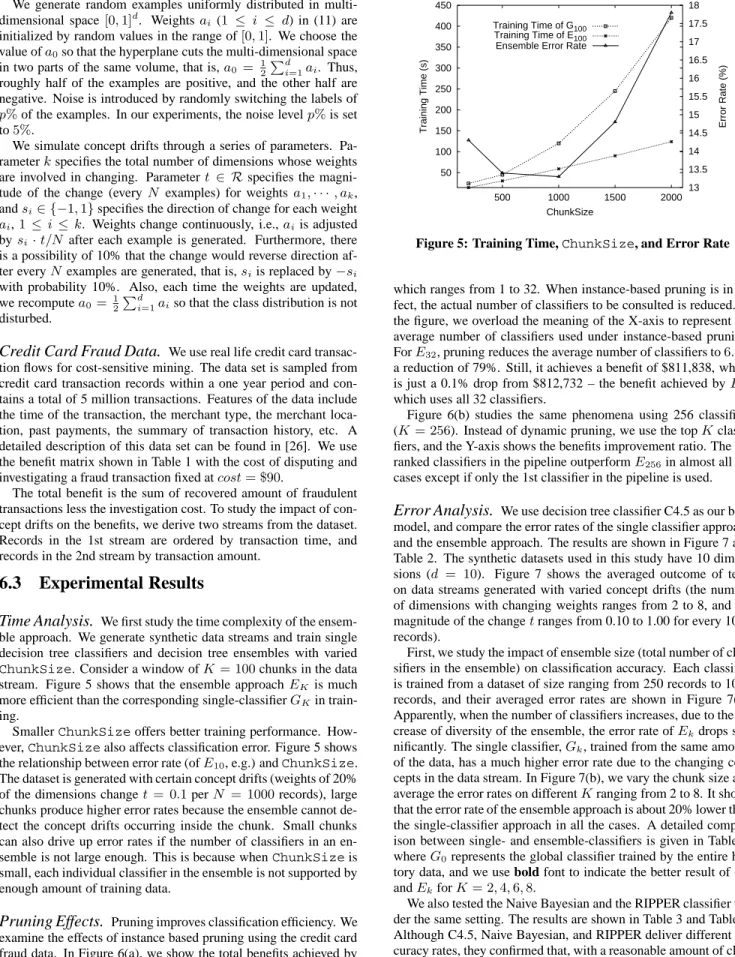
Cn−k+1,· · ·,Cn. classification error on y ... ... ... ... stream Sn Sn-1 test example y Sn-k Sn-k-1
Figure 3: Models’ classification error on test exampley.
In the concept-drifting environment, models learned up-stream may carry significant variances when they are applied to the cur-rent test cases (Figure 3). Thus, instead of averaging the outputs of classifiers in the ensemble, we use the weighted approach. We assign each classifierCia weightwi, such thatwiis reversely
pro-portional toCi’s expected error (when applied to the current test
cases). In Section 4, we introduce a method of generating such weights based on estimated classification errors. Here, assuming each classifier is so weighted, we prove the following property.
Ekproduces a smaller classification error thanGk, if classifiers inEkare weighted by their expected classification accuracy on the test data.
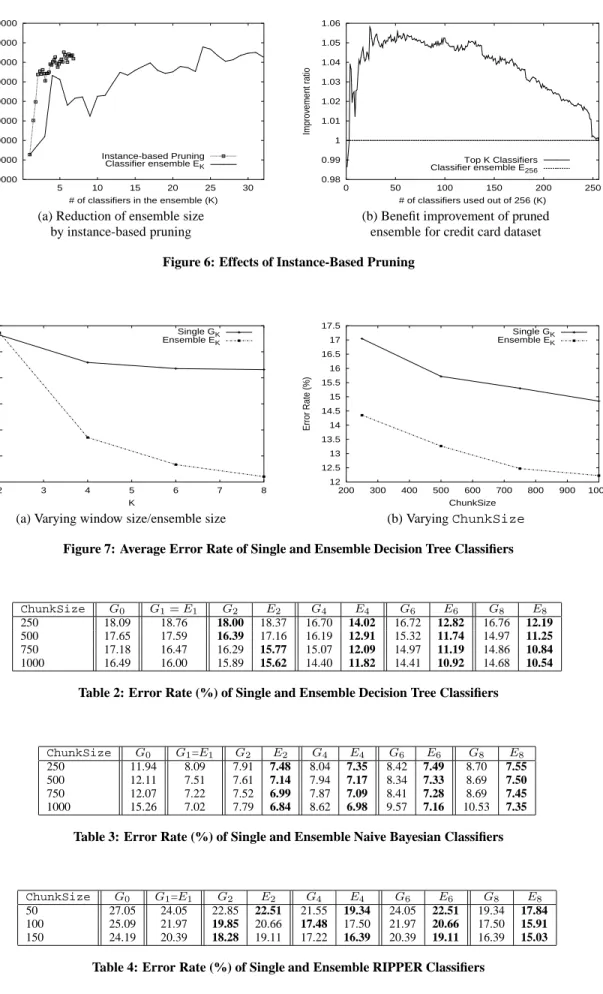
Figure 4: Error regions associated with approximating the a posteriori probabilities [28].
We prove this property through bias-variance decomposition based on Tumer’s work [28]. The Bayes optimum decision assignsxto classiifp(ci|x)> p(ck|x),∀k6=i. Therefore, as shown in
Fig-ure 4, the Bayes optimum boundary is the loci of all pointsx∗such that p(ci|x∗) = p(cj|x∗), wherej = argmaxkp(ck|x∗) [28].
The decision boundary of our classifier may vary from the optimum boundary. In Figure 4,b=xb−x∗denotes the amount by which
the boundary of the classifier differs from the optimum boundary. In other words, patterns corresponding to the darkly shaded region are erroneously classified by the classifier. The classifier thus intro-duces an expected errorErrin addition to the error of the Bayes optimum decision:
Err= Z ∞
−∞
A(b)fb(b)db
whereA(b)is the area of the darkly shaded region, andfbis the
density function forb. Tumer et al [28] proves that the expected added error can be expressed by:
Err= σ
2
ηc
s (2)
wheres = p0(cj|x∗)−p0(ci|x∗) is independent of the trained
model1, andσ2
ηcdenotes the variances ofηc(x).
Thus, given a test exampley, the probability output of the single classifierGkcan be expressed as:
fg
c(y) =p(c|y) +ηgc(y)
Assuming each partitionSi is of the same size, we studyση2g c, the variance ofηg
c(y). If eachSihas identical class distribution,
that is, there is no conceptual drift, then the single classifierGk,
which is learned fromkpartitions, can reduce the average variance by a factor ofk. With the presence of conceptual drifts, we have:
σ2ηgc ≥ 1 k2 n X i=n−k+1 ση2i c (3)
For the ensemble approach, we use weighted averaging to com-bine outputs of the classifiers in the ensemble. The probability out-put of the ensemble is given by:
fcE(y) = n X i=n−k+1 wifci(y)/ n X i=n−k+1 wi (4) 1 Here,p0(c
wherewiis the weight of thei-th classifier, which is assumed to be
reversely proportional toErri(cis a constant):
wi= c σ2 ηi c (5) The probability outputEk(4) can also be expressed as:
fcE(y) =p(c|y) +η E c(y) where ηEc(y) = n X i=n−k+1 wiηci(y)/ n X i=n−k+1 wi
Assuming the variances of different classifiers are independent, we derive the variance ofηE
c(y): σ2ηE c = n X i=n−k+1 w2iσ 2 ηi c/( n X i=n−k+1 wi)2 (6)
We use the reverse proportional assumption of (5) to simplify (6) to the following: σ2ηE c = 1/ n X i=n−k+1 1 σ2 ηi c (7) It is easy to prove: n X i=n−k+1 σ2ηi c n X i=n−k+1 1 σ2 ηi c ≥k2 or equivalently: 1/ n X i=n−k+1 1 σ2 ηi c ≤ 1 k2 n X i=n−k+1 σ2ηi c
which based on (3) and (7) means: σ2ηE
c ≤σ 2
ηgc
and thus, we have proved:
ErrE≤ErrG
This means, compared with the single classifier Gk, which is
learned from the examples in the entire window ofkchunks, the classifier ensemble approach is capable of reducing classification error through a weighting scheme where a classifier’s weight is re-versely proportional to its expected error.
Note that the above property does not guarantee that Ek has
higher accuracy than classifierGjifj < k. For instance, if the
con-cept drifts between the partitions are so dramatic thatSn−1andSn represent totally conflicting concepts, then addingCn−1in decision making will only raise classification error. A weighting scheme should assign classifiers representing totally conflicting concepts near-zero weights. We discuss how to tune weights in detail in Section 4.
4.
CLASSIFIER ENSEMBLE FOR
DRIFT-ING CONCEPTS
The proof of the error reduction property in Section 3 showed that a classifier ensemble can outperform a single classifier in the presence of concept drifts. To apply it to real-world problems we need to assign an actual weight to each classifier that reflects its predictive accuracy on the current testing data.
4.1
Accuracy-Weighted Ensembles
The incoming data stream is partitioned into sequential chunks, S1,S2,· · ·,Sn, withSnbeing the most up-to-date chunk, and each chunk is of the same size, orChunkSize. We learn a classifierCi
for eachSi,i≥1.
According to the error reduction property, given test examplesT, we should give each classifierCia weight reversely proportional to
the expected error ofCiin classifyingT. To do this, we need to
know the actual function being learned, which is unavailable. We derive the weight of classifierCiby estimating its expected
prediction error on the test examples. We assume the class distri-bution ofSn, the most recent training data, is closest to the class distribution of the current test data. Thus, the weights of the clas-sifiers can be approximated by computing their classification error onSn.
More specifically, assume thatSnconsists of records in the form of(x, c), wherecis the true label of the record.Ci’s classification
error of example(x, c)is1−fi
c(x), wherefci(x)is the probability
given byCithatxis an instance of classc. Thus, the mean square
error of classifierCican be expressed by:
MSEi= 1 |Sn| X (x,c)∈Sn (1−fi c(x)) 2
The weight of classifierCishould be reversely proportional to MSEi.
On the other hand, a classifier predicts randomly (that is, the proba-bility ofxbeing classified as classcequals toc’s class distributions p(c)) will have mean square error:
MSEr=
X
c
p(c)(1−p(c))2
For instance, ifc∈ {0,1}and the class distribution is uniform, we have MSEr=.25. Since a random model does not contain useful
knowledge about the data, we use MSEr, the error rate of the
ran-dom classifier as a threshold in weighting the classifiers. That is, we discard classifiers whose error is equal to or larger than MSEr.
Fur-thermore, to make computation easy, we use the following weight wifor classifierCi:
wi=MSEr−MSEi (8)
For cost-sensitive applications such as credit card fraud detection, we use the benefits (e.g., total fraud amount detected) achieved by classifierCion the most recent training dataSnas its weight.
predictf raud predict¬f raud actualf raud t(x)−cost 0
actual¬f raud −cost 0
Table 1: Benefit matrixbc,c0
Assume the benefit of classifying transactionxof actual classc as a case of classc0isb
c,c0(x). Based on the benefit matrix shown
in Table 1 (wheret(x)is the transaction amount, andcostis the fraud investigation cost), the total benefits achieved byCiis:
bi= X (x,c)∈Sn X c0 bc,c0(x)·fci0(x)
and we assign the following weight toCi:
wi=bi−br (9)
wherebr is the benefits achieved by a classifier that predicts
Since we are handling infinite incoming data flows, we will learn an infinite number of classifiers over the time. It is impossible and unnecessary to keep and use all the classifiers for prediction. In-stead, we only keep the topKclassifiers with the highest predic-tion accuracy on the current training data. In Secpredic-tion 5, we dis-cuss ensemble pruning in more detail and present a technique for instance-based pruning.
Algorithm 1 gives an outline of the classifier ensemble approach for mining concept-drifting data streams. Whenever a new chunk of data has arrived, we build a classifier from the data, and use the data to tune the weights of the previous classifiers. Usually,
ChunkSizeis small (our experiments use chunks of size ranging from 1,000 to 25,000 records), and the entire chunk can be held in memory with ease.
The algorithm for classification is straightforward, and it is omit-ted here. Basically, given a test casey, each of theKclassifiers is applied ony, and their outputs are combined through weighted av-eraging.
Input:S: a dataset ofChunkSizefrom the incoming stream K: the total number of classifiers
C: a set ofKpreviously trained classifiers
Output:C: a set ofKclassifiers with updated weights train classifierC0fromS;
compute error rate / benefits ofC0via cross validation onS;
derive weightw0forC0using (8) or (9);
for each classifierCi∈ Cdo
applyCionSto derive MSEiorbi;
computewibased on (8) and (9);
C ←Kof the top weighted classifiers inC∪ {C0}; returnC;
Algorithm 1: A classifier ensemble approach for mining concept-drifting data streams
4.2
Complexity
Assume the complexity for building a classifier on a data set of sizesisf(s). The complexity to classify a test data set in order to tune its weight is linear in the size of the test data set. Suppose the entire data stream is divided into a set ofnpartitions, then the complexity of Algorithm 1 isO(n·f(s/n) +Ks), wheren K. On the other hand, building a single classifier ons requires O(f(s)). For most classifier algorithms,f(·)is super-linear, which means the ensemble approach is more efficient.
5.
ENSEMBLE PRUNING
A classifier ensemble combines the probability or the benefit out-put of a set of classifiers. Given a test exampley, we need to consult every classifier in the ensemble, which is often time consuming in an online streaming environment.
5.1
Overview
In many applications, the combined result of the classifiers usu-ally converges to the final value well before all classifiers are con-sulted. The goal of pruning is to identify a subset of classifiers that achieves the same level of total benefits as the entire ensemble.
Traditional pruning is based on classifiers’ overall performances (e.g., average error rate, average benefits, etc.). Several criteria can be used in pruning. The first criterion is mean square error. The
goal is to find a set ofnclassifiers that has the minimum mean square error. The second approach favors classifier diversity, as diversity is the major factor in error reduction. KL-distance, or relative entropy, is a widely used measure for difference between two distributions. The KL-distance between two distributionspand qis defined asD(p||q) =Pxp(x) logp(x)/q(x). In our case,p andqare the class distributions given by two classifiers. The goal is then to find the set of classifiersSthat maximizes mutual KL-distances.
It is, however, impractical to search for the optimal set of clas-sifiers based on the MSE criterion or the KL-distance criterion. Even greedy methods are time consuming: the complexities of the greedy methods of the two approaches are O(|T| ·N ·K) and O(|T| ·N·K2)respectively, whereNis the total number of avail-able classifiers.
Besides the complexity issue, the above two approaches do not apply to cost-sensitive applications. Moreover, the applicability of the KL-distance criterion is limited to streams with no or mild con-cept drifting only, since concon-cept drifts also enlarge the KL-distance. In this paper, we apply the instance-based pruning technique [9] to data streams with conceptual drifts.
5.2
Instance Based Pruning
Cost-sensitive applications usually provide higher error toler-ance. For instance, in credit card fraud detection, the decision threshold of whether to launch an investigation or not is:
p(fraud|y)·t(y)> cost
wheret(y)is the amount of transactiony. In other words, as long asp(fraud|y)> cost/t(y), transactionywill be classified as fraud no matter what the exact value ofp(fraud|y)is. For example, as-suming t(y) = $900, cost = $90, bothp(fraud|y) = 0.2and p(fraud|y) = 0.4result in the same prediction. This property helps reduce the “expected” number of classifiers needed in prediction.
We use the following approach for instance based ensemble prun-ing [9]. For a given ensembleSconsisting ofKclassifiers, we first order theKclassifiers by their decreasing weight into a “pipeline”. (The weights are tuned for the most-recent training set.) To classify a test exampley, the classifier with the highest weight is consulted first, followed by other classifiers in the pipeline. This pipeline procedure stops as soon as a “confident prediction” can be made or there are no more classifiers in the pipeline.
More specifically, assume thatC1,· · ·,CK are the classifiers in
the pipeline, withC1having the highest weight. After consulting the firstk classifiersC1,· · ·,Ck, we derive the current weighted
probability as: Fk(x) = Pk i=1wi·pi(fraud|x) Pk i=1wi
The final weighted probability, derived after allKclassifiers are consulted, isFK(x). Letk(x) = Fk(x)−FK(x)be the error
at stagek. The question is, if we ignorek(x)and useFk(x)to
decide whether to launch a fraud investigation or not, how much confidence do we have that usingFK(x)would have reached the
same decision?
Algorithm 2 estimates the confidence. We compute the mean and the variance ofk(x), assuming thatk(x)follows normal
distri-bution. The mean and variance statistics can be obtained by eval-uatingFk(.)on the current training set for every classifierCk. To
reduce the possible error range, we study the distribution under a finer grain. We divide[0,1], the range ofFk(·), intoξbins. An
com-puteµk,iandσ2k,i, the mean and the variance of the error of those
training examples in biniat stagek.
Algorithm 3 outlines the procedure of classifying an unknown instancey. We use the following decision rules after we have ap-plied the firstkclassifiers in the pipeline on instancey:
Fk(y)−µk,i−t·σk,i> cost/t(y), fraud
Fk(y) +µk,i+t·σk,i≤cost/t(y), non-fraud
otherwise, uncertain
(10) whereiis the binybelongs to, andtis a confidence interval
param-eter. Under the assumption of normal distribution,t= 3delivers
a confidence of 99.7%, andt= 2of confidence 95%. When the prediction is uncertain, that is, the instance falls out of thetsigma
region, the next classifier in the pipeline,Ck+1, is employed, and the rules are applied again. If there are no classifiers left in the pipeline, the current prediction is returned. As a result, an exam-ple does not need to use all classifiers in the pipeline to compute a confident prediction. The “expected” number of classifiers can be reduced.
Input:S: a dataset ofChunkSizefrom the incoming stream K: the total number of classifiers
ξ: number of bins
C: a set ofKpreviously trained classifiers
Output:C: a set ofKclassifiers with updated weights µ, σ: mean and variance for each stage and each bin train classifierC0fromS;
compute error rate / benefits ofC0via cross validation onS; derive weightw0forC0using (8) or (9);
for each classifierCk∈ Cdo
applyCkonSto derive MSEkorbk;
computewkbased on (8) and (9);
C ←Kof the top weighted classifiers inC ∪ {C0};
for eachy∈Sdo
computeFk(y)fork= 1,· · ·, K;
ybelongs to bin(i, k)ifFk(y)∈[ξi,i+1ξ );
incrementally updatesµi,kandσi,kfor bin(i, k);
Algorithm 2: Obtaining µk,i and σk,i during ensemble
con-struction
5.3
Complexity
Algorithm 3 outlines the procedure of instance based pruning. To classify a dataset of sizes, the worst case complexity isO(Ks). In the experiments, we show that the actual number of classifiers can be reduced dramatically without affecting the classification perfor-mance.
The cost of instance based pruning mainly comes from updating µk,iandσ2k,ifor eachkandi. These statistics are obtained during
training time. The procedure shown in Algorithm 2 is an improved version of Algorithm 1. The complexity of Algorithm 2 remains O(n·f(s/n)+Ks)(updating of the statistics costsO(Ks)), where sis the size of the data stream, andnis the number of partitions of the data stream.
6.
EXPERIMENTS
We conducted extensive experiments on both synthetic and real life data streams. Our goals are to demonstrate the error reduction effects of weighted classifier ensembles, to evaluate the impact of
Input:y: a test example
t: confidence level
C: a set ofKpreviously trained classifiers
Output: prediction ofy’s class
LetC={C1,· · ·,Cn}withwi≥wj fori < j;
F0(y)←0; w←0; fork={1,· · ·, K}do Fk(y)← Fk−1·w+wk·pk(f raud|x) w+wk ; w←w+wk;
letibe the binybelongs to;
apply rules in (10) to check ifyis int-σregion; return fraud/non-fraud ift-σconfidence is reached; ifFK(y)> cost/t(y)then
return fraud; else
return non-fraud;
Algorithm 3: Classification with Instance Based Pruning
the frequency and magnitude of the concept drifts on prediction accuracy, and to analyze the advantage of our approach over alter-native methods such as incremental learning.
The base models used in our tests are C4.5 [24], the RIPPER rule learner [6], and the Naive Bayesian method [23]. The tests are conducted on a Linux machine with a 770 MHz CPU and 256 MB main memory.
6.1
Algorithms used in Comparison
We denote a classifier ensemble with a capacity ofKclassifiers asEK. Each classifier is trained by a data set of sizeChunkSize.
We compare with algorithms that rely on a single classifier for min-ing streammin-ing data. We assume the classifier is continuously bemin-ing revised by the data that have just arrived and the data being faded out. We call it a window classifier, since only the data in the most recent window have influence on the model. We denote such a clas-sifier byGK, whereKis the number of data chunks in the window,
and the total number of the records in the window isK·ChunkSize. Thus, ensembleEKandGKare trained from the same amount of
data. Particularly, we haveE1 = G1. We also useG0to denote the classifier built on the entire historical data starting from the be-ginning of the data stream up to now. For instance, BOAT [15] and VFDT [7] areG0classifiers, while CVFDT [21] is aGKclassifier.
6.2
Streaming Data
We use both synthetic and real life data streams.
Synthetic Data.
We create synthetic data with drifting concepts based on a moving hyperplane. A hyperplane ind-dimensional space is denoted by equation:d
X
i=1
aixi=a0 (11)
We label examples satisfyingPdi=1aixi≥a0as positive, and ex-amples satisfyingPdi=1aixi< a0as negative. Hyperplanes have been used to simulate time-changing concepts because the orienta-tion and the posiorienta-tion of the hyperplane can be changed in a smooth manner by changing the magnitude of the weights [21].
We generate random examples uniformly distributed in multi-dimensional space[0,1]d
. Weightsai(1 ≤ i ≤ d) in (11) are
initialized by random values in the range of[0,1]. We choose the value ofa0so that the hyperplane cuts the multi-dimensional space in two parts of the same volume, that is,a0 = 12Pdi=1ai. Thus,
roughly half of the examples are positive, and the other half are negative. Noise is introduced by randomly switching the labels of p%of the examples. In our experiments, the noise levelp%is set to5%.
We simulate concept drifts through a series of parameters. Pa-rameterkspecifies the total number of dimensions whose weights are involved in changing. Parametert ∈ Rspecifies the magni-tude of the change (everyN examples) for weightsa1,· · ·, ak,
andsi∈ {−1,1}specifies the direction of change for each weight
ai,1≤i ≤k. Weights change continuously, i.e.,aiis adjusted
bysi·t/N after each example is generated. Furthermore, there
is a possibility of 10% that the change would reverse direction af-ter everyNexamples are generated, that is,siis replaced by−si
with probability 10%. Also, each time the weights are updated, we recomputea0= 12Pdi=1aiso that the class distribution is not
disturbed.
Credit Card Fraud Data.
We use real life credit card transac-tion flows for cost-sensitive mining. The data set is sampled from credit card transaction records within a one year period and con-tains a total of 5 million transactions. Features of the data include the time of the transaction, the merchant type, the merchant loca-tion, past payments, the summary of transaction history, etc. A detailed description of this data set can be found in [26]. We use the benefit matrix shown in Table 1 with the cost of disputing and investigating a fraud transaction fixed atcost= $90.The total benefit is the sum of recovered amount of fraudulent transactions less the investigation cost. To study the impact of con-cept drifts on the benefits, we derive two streams from the dataset. Records in the 1st stream are ordered by transaction time, and records in the 2nd stream by transaction amount.
6.3
Experimental Results
Time Analysis.
We first study the time complexity of the ensem-ble approach. We generate synthetic data streams and train single decision tree classifiers and decision tree ensembles with variedChunkSize. Consider a window ofK= 100chunks in the data stream. Figure 5 shows that the ensemble approachEK is much
more efficient than the corresponding single-classifierGKin
train-ing.
SmallerChunkSizeoffers better training performance. How-ever,ChunkSizealso affects classification error. Figure 5 shows the relationship between error rate (ofE10, e.g.) andChunkSize. The dataset is generated with certain concept drifts (weights of 20% of the dimensions changet= 0.1perN = 1000records), large chunks produce higher error rates because the ensemble cannot de-tect the concept drifts occurring inside the chunk. Small chunks can also drive up error rates if the number of classifiers in an en-semble is not large enough. This is because whenChunkSizeis small, each individual classifier in the ensemble is not supported by enough amount of training data.
Pruning Effects.
Pruning improves classification efficiency. We examine the effects of instance based pruning using the credit card fraud data. In Figure 6(a), we show the total benefits achieved by ensemble classifiers with and without instance-based pruning. The X-axis represents the number of the classifiers in the ensemble,K,50 100 150 200 250 300 350 400 450 500 1000 1500 2000 13 13.5 14 14.5 15 15.5 16 16.5 17 17.5 18
Training Time (s) Error Rate (%)
ChunkSize
Training Time of G100
Training Time of E100
Ensemble Error Rate
Figure 5: Training Time,ChunkSize, and Error Rate
which ranges from 1 to 32. When instance-based pruning is in ef-fect, the actual number of classifiers to be consulted is reduced. In the figure, we overload the meaning of the X-axis to represent the average number of classifiers used under instance-based pruning. ForE32, pruning reduces the average number of classifiers to6.79, a reduction of 79%. Still, it achieves a benefit of $811,838, which is just a 0.1% drop from $812,732 – the benefit achieved byE32 which uses all 32 classifiers.
Figure 6(b) studies the same phenomena using 256 classifiers (K= 256). Instead of dynamic pruning, we use the topK classi-fiers, and the Y-axis shows the benefits improvement ratio. The top ranked classifiers in the pipeline outperformE256in almost all the cases except if only the 1st classifier in the pipeline is used.
Error Analysis.
We use decision tree classifier C4.5 as our base model, and compare the error rates of the single classifier approach and the ensemble approach. The results are shown in Figure 7 and Table 2. The synthetic datasets used in this study have 10 dimen-sions (d = 10). Figure 7 shows the averaged outcome of tests on data streams generated with varied concept drifts (the number of dimensions with changing weights ranges from 2 to 8, and the magnitude of the changetranges from 0.10 to 1.00 for every 1000 records).First, we study the impact of ensemble size (total number of clas-sifiers in the ensemble) on classification accuracy. Each classifier is trained from a dataset of size ranging from 250 records to 1000 records, and their averaged error rates are shown in Figure 7(a). Apparently, when the number of classifiers increases, due to the in-crease of diversity of the ensemble, the error rate ofEkdrops
sig-nificantly. The single classifier,Gk, trained from the same amount
of the data, has a much higher error rate due to the changing con-cepts in the data stream. In Figure 7(b), we vary the chunk size and average the error rates on differentKranging from 2 to 8. It shows that the error rate of the ensemble approach is about 20% lower than the single-classifier approach in all the cases. A detailed compar-ison between single- and ensemble-classifiers is given in Table 2, whereG0represents the global classifier trained by the entire his-tory data, and we use bold font to indicate the better result ofGk
andEkforK= 2,4,6,8.
We also tested the Naive Bayesian and the RIPPER classifier un-der the same setting. The results are shown in Table 3 and Table 4. Although C4.5, Naive Bayesian, and RIPPER deliver different ac-curacy rates, they confirmed that, with a reasonable amount of clas-sifiers (K) in the ensemble, the ensemble approach outperforms the single classifier approach.
750000 760000 770000 780000 790000 800000 810000 820000 830000 5 10 15 20 25 30 Benefits ($)
# of classifiers in the ensemble (K) Instance-based Pruning Classifier ensemble EK 0.98 0.99 1 1.01 1.02 1.03 1.04 1.05 1.06 0 50 100 150 200 250 Improvement ratio
# of classifiers used out of 256 (K) Top K Classifiers Classifier ensemble E256
(a) Reduction of ensemble size (b) Benefit improvement of pruned by instance-based pruning ensemble for credit card dataset
Figure 6: Effects of Instance-Based Pruning
11 12 13 14 15 16 17 2 3 4 5 6 7 8 Error Rate (%) K Single GK Ensemble EK 12 12.5 13 13.5 14 14.5 15 15.5 16 16.5 17 17.5 200 300 400 500 600 700 800 900 1000 Error Rate (%) ChunkSize Single GK Ensemble EK
(a) Varying window size/ensemble size (b) VaryingChunkSize Figure 7: Average Error Rate of Single and Ensemble Decision Tree Classifiers
ChunkSize G0 G1=E1 G2 E2 G4 E4 G6 E6 G8 E8
250 18.09 18.76 18.00 18.37 16.70 14.02 16.72 12.82 16.76 12.19
500 17.65 17.59 16.39 17.16 16.19 12.91 15.32 11.74 14.97 11.25
750 17.18 16.47 16.29 15.77 15.07 12.09 14.97 11.19 14.86 10.84
1000 16.49 16.00 15.89 15.62 14.40 11.82 14.41 10.92 14.68 10.54
Table 2: Error Rate (%) of Single and Ensemble Decision Tree Classifiers
ChunkSize G0 G1=E1 G2 E2 G4 E4 G6 E6 G8 E8
250 11.94 8.09 7.91 7.48 8.04 7.35 8.42 7.49 8.70 7.55
500 12.11 7.51 7.61 7.14 7.94 7.17 8.34 7.33 8.69 7.50
750 12.07 7.22 7.52 6.99 7.87 7.09 8.41 7.28 8.69 7.45
1000 15.26 7.02 7.79 6.84 8.62 6.98 9.57 7.16 10.53 7.35
Table 3: Error Rate (%) of Single and Ensemble Naive Bayesian Classifiers
ChunkSize G0 G1=E1 G2 E2 G4 E4 G6 E6 G8 E8
50 27.05 24.05 22.85 22.51 21.55 19.34 24.05 22.51 19.34 17.84
100 25.09 21.97 19.85 20.66 17.48 17.50 21.97 20.66 17.50 15.91
150 24.19 20.39 18.28 19.11 17.22 16.39 20.39 19.11 16.39 15.03
10 15 20 25 30 35 40 45 50 0 5 10 15 20 25 30 35 Error Rate Dimension Single Ensemble 15 20 25 30 35 40 45 10 15 20 25 30 35 40 Error Rate Dimension Single Ensemble 21 22 23 24 25 26 27 28 0.01 0.02 0.03 0.04 0.05 0.06 0.07 0.08 Error Rate
Weight Change (monotonic) Single Ensemble
(a) # of changing dimensions (b) total dimensionality (c) (monotonic) weight change per dimension
Figure 8: Magnitude of Concept Drifts
100000 105000 110000 115000 120000 125000 130000 135000 140000 145000 150000 155000 2 3 4 5 6 7 8 Total Benefits ($) K Ensemble EK Single GK 0 50000 100000 150000 200000 250000 300000 3000 4000 5000 6000 7000 8000 9000 10000110001200013000 Total Benefits ($) ChunkSize Ensemble EK Single GK 110000 120000 130000 140000 150000 160000 170000 180000 2 3 4 5 6 7 8 Total Benefits ($) K Ensemble EK Single GK 50000 100000 150000 200000 250000 300000 350000 3000 4000 5000 6000 7000 8000 9000 10000110001200013000 Total Benefits ($) ChunkSize Ensemble EK Single GK
(a) VaryingK (b) VaryingChunkSize (c) VaryingK (d) VaryingChunkSize
(original stream) (original stream) (simulated stream) (simulated stream)
Figure 9: Averaged Benefits using Single Classifiers and Classifier Ensembles
Concept Drifts.
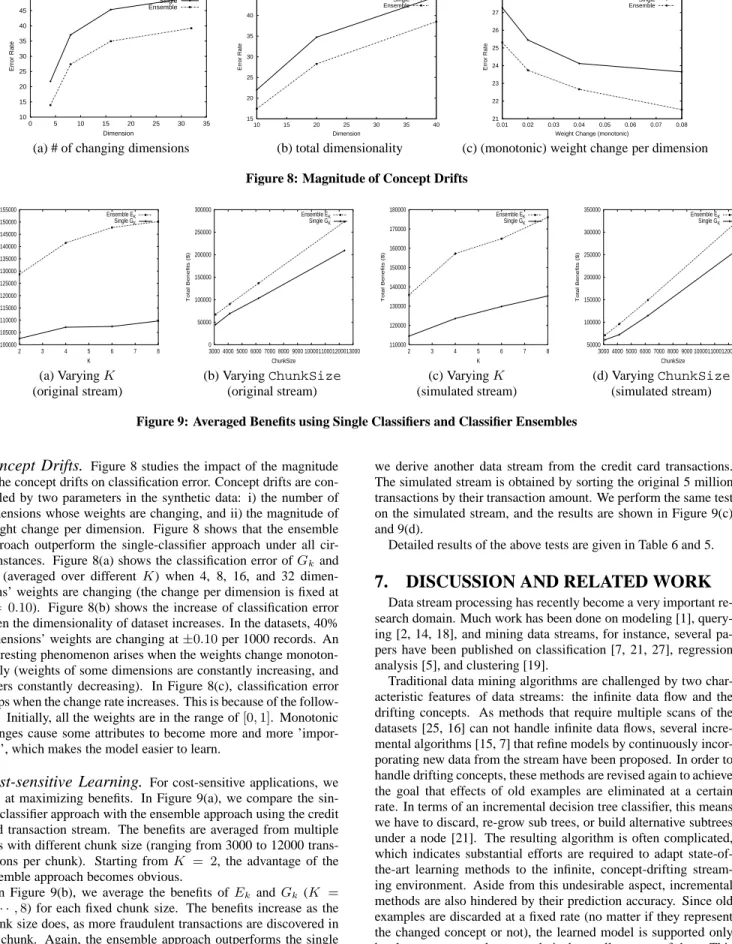
Figure 8 studies the impact of the magnitude of the concept drifts on classification error. Concept drifts are con-trolled by two parameters in the synthetic data: i) the number of dimensions whose weights are changing, and ii) the magnitude of weight change per dimension. Figure 8 shows that the ensemble approach outperform the single-classifier approach under all cir-cumstances. Figure 8(a) shows the classification error ofGkandEk (averaged over different K) when 4, 8, 16, and 32
dimen-sions’ weights are changing (the change per dimension is fixed at t = 0.10). Figure 8(b) shows the increase of classification error when the dimensionality of dataset increases. In the datasets, 40% dimensions’ weights are changing at±0.10per 1000 records. An interesting phenomenon arises when the weights change monoton-ically (weights of some dimensions are constantly increasing, and others constantly decreasing). In Figure 8(c), classification error drops when the change rate increases. This is because of the follow-ing. Initially, all the weights are in the range of[0,1]. Monotonic changes cause some attributes to become more and more ’impor-tant’, which makes the model easier to learn.
Cost-sensitive Learning.
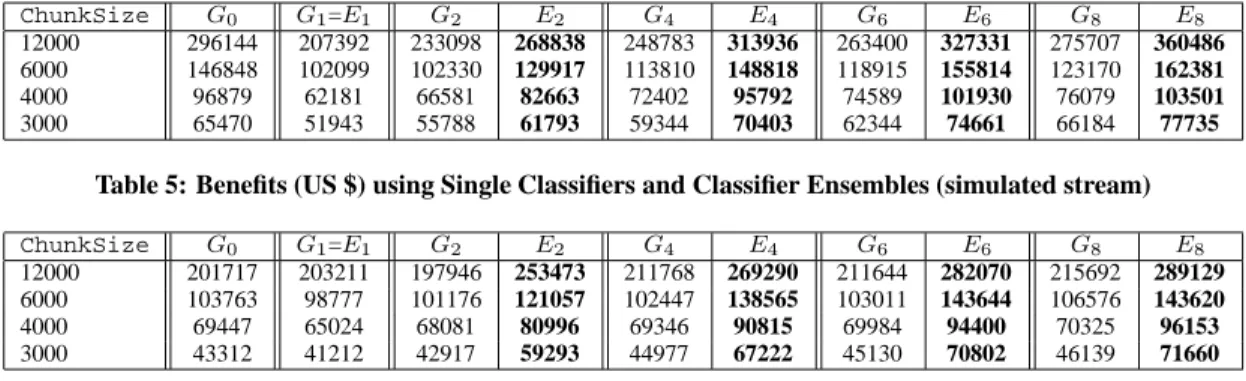
For cost-sensitive applications, we aim at maximizing benefits. In Figure 9(a), we compare the sin-gle classifier approach with the ensemble approach using the credit card transaction stream. The benefits are averaged from multiple runs with different chunk size (ranging from 3000 to 12000 trans-actions per chunk). Starting fromK = 2, the advantage of the ensemble approach becomes obvious.In Figure 9(b), we average the benefits ofEk andGk (K =
2,· · ·,8) for each fixed chunk size. The benefits increase as the chunk size does, as more fraudulent transactions are discovered in the chunk. Again, the ensemble approach outperforms the single classifier approach.
To study the impact of concept drifts of different magnitude,
we derive another data stream from the credit card transactions. The simulated stream is obtained by sorting the original 5 million transactions by their transaction amount. We perform the same test on the simulated stream, and the results are shown in Figure 9(c) and 9(d).
Detailed results of the above tests are given in Table 6 and 5.
7.
DISCUSSION AND RELATED WORK
Data stream processing has recently become a very important re-search domain. Much work has been done on modeling [1], query-ing [2, 14, 18], and minquery-ing data streams, for instance, several pa-pers have been published on classification [7, 21, 27], regression analysis [5], and clustering [19].
Traditional data mining algorithms are challenged by two char-acteristic features of data streams: the infinite data flow and the drifting concepts. As methods that require multiple scans of the datasets [25, 16] can not handle infinite data flows, several incre-mental algorithms [15, 7] that refine models by continuously incor-porating new data from the stream have been proposed. In order to handle drifting concepts, these methods are revised again to achieve the goal that effects of old examples are eliminated at a certain rate. In terms of an incremental decision tree classifier, this means we have to discard, re-grow sub trees, or build alternative subtrees under a node [21]. The resulting algorithm is often complicated, which indicates substantial efforts are required to adapt state-of-the-art learning methods to the infinite, concept-drifting stream-ing environment. Aside from this undesirable aspect, incremental methods are also hindered by their prediction accuracy. Since old examples are discarded at a fixed rate (no matter if they represent the changed concept or not), the learned model is supported only by the current snapshot – a relatively small amount of data. This usually results in larger prediction variances.
ChunkSize G0 G1=E1 G2 E2 G4 E4 G6 E6 G8 E8
12000 296144 207392 233098 268838 248783 313936 263400 327331 275707 360486
6000 146848 102099 102330 129917 113810 148818 118915 155814 123170 162381
4000 96879 62181 66581 82663 72402 95792 74589 101930 76079 103501
3000 65470 51943 55788 61793 59344 70403 62344 74661 66184 77735
Table 5: Benefits (US $) using Single Classifiers and Classifier Ensembles (simulated stream)
ChunkSize G0 G1=E1 G2 E2 G4 E4 G6 E6 G8 E8
12000 201717 203211 197946 253473 211768 269290 211644 282070 215692 289129
6000 103763 98777 101176 121057 102447 138565 103011 143644 106576 143620
4000 69447 65024 68081 80996 69346 90815 69984 94400 70325 96153
3000 43312 41212 42917 59293 44977 67222 45130 70802 46139 71660
Table 6: Benefits (US $) using Single Classifiers and Classifier Ensembles (original stream)
data mining community. The popular approaches to creating en-sembles include changing the instances used for training through techniques such as Bagging [3], Boosting [13], and pasting [4]. The classifier ensembles have several advantages over single model classifiers. First, classifier ensembles offer a significant improve-ment in prediction accuracy [13, 28]. Second, building a classi-fier ensemble is more efficient than building a single model, since most model construction algorithms have super-linear complexity. Third, the nature of classifier ensembles lend themselves to scalable parallelization [20] and on-line classification of large databases [4]. Previously, we used averaging ensemble for scalable learning over very-large datasets [12]. We show that a model’s performance can be estimated before it is completely learned [10, 11]. In this work, we use weighted ensemble classifiers on concept-drifting data streams. It combines multiple classifiers weighted by their expected prediction accuracy on the current test data. Compared with incremental models trained by data in the most recent win-dow, our approach combines talents of set of experts based on their credibility and adjusts much nicely to the underlying concept drifts. Also, we introduced the dynamic classification technique [9] to the concept-drifting streaming environment, and our results show that it enables us to dynamically select a subset of classifiers in the en-semble for prediction without loss in accuracy.
8.
REFERENCES
[1] B. Babcock, S. Babu, M. Datar, R. Motawani, and J. Widom. Models and issues in data stream systems. In PODS, 2002. [2] S. Babu and J. Widom. Continuous queries over data
streams. SIGMOD Record, 30:109–120, 2001.
[3] Eric Bauer and Ron Kohavi. An empirical comparison of voting classification algorithms: Bagging, boosting, and variants. Machine Learning, 36(1-2):105–139, 1999. [4] L. Breiman. Pasting bites together for prediction in large data
sets and on-line. Technical report, Statistics Dept., UC Berkeley, 1996.
[5] Y. Chen, G. Dong, J. Han, B. W. Wah, and J. Wang. Multi-dimensional regression analysis of time-series data streams. In VLDB, Hongkong, China, 2002.
[6] William Cohen. Fast effective rule induction. In ICML, pages 115–123, 1995.
[7] P. Domingos and G. Hulten. Mining high-speed data streams. In SIGKDD, pages 71–80, Boston, MA, 2000. ACM Press. [8] P. Domingos. A unified bias-variance decomposition and its
applications. In ICML, pages 231–238, 2000.
[9] Wei Fan, Fang Chu, Haixun Wang, and Philip S. Yu. Pruning and dynamic scheduling of cost-sensitive ensembles. In
Proceedings of the 18th National Conference on Artificial Intelligence (AAAI), 2002.
[10] W. Fan, H. Wang, P. Yu, S. Lo, and S. Stolfo. Progressive
modeling. In ICDM, 2002.
[11] W. Fan, H. Wang, P. Yu, S. Lo, and S. Stolfo. Inductive learning in less than one sequential scan. In IJCAI, 2003. [12] W. Fan, H. Wang, P. Yu, and S. Stolfo. A framework for
scalable cost-sensitive learning based on combining probabilities and benefits. In SIAM Data Mining, 2002. [13] Yoav Freund and Robert E. Schapire. Experiments with a
new boosting algorithm. In ICML, pages 148–156, 1996. [14] L. Gao and X. Wang. Continually evaluating similarity-based
pattern queries on a streaming time series. In SIGMOD, Madison, Wisconsin, June 2002.
[15] J. Gehrke, V. Ganti, R. Ramakrishnan, and W. Loh. BOAT– optimistic decision tree construction. In SIGMOD, 1999. [16] J. Gehrke, R. Ramakrishnan, and V. Ganti. RainForest: A
framework for fast decision tree construction of large datasets. In VLDB, 1998.
[17] S. Geman, E. Bienenstock, and R. Doursat. Neural networks and the bias/variance dilemma. Neural Computation, 4(1):1–58, 1992.
[18] M. Greenwald and S. Khanna. Space-efficient online computation of quantile summaries. In SIGMOD, pages 58–66, Santa Barbara, CA, May 2001.
[19] S. Guha, N. Milshra, R. Motwani, and L. O’Callaghan. Clustering data streams. In FOCS, pages 359–366, 2000. [20] L. Hall, K. Bowyer, W. Kegelmeyer, T. Moore, and C. Chao.
Distributed learning on very large data sets. In Workshop on
Distributed and Parallel Knowledge Discover, 2000.
[21] G. Hulten, L. Spencer, and P. Domingos. Mining
time-changing data streams. In SIGKDD, pages 97–106, San Francisco, CA, 2001. ACM Press.
[22] Ron Kohavi and David H. Wolpert. Bias plus variance decomposition for zero-one loss functions. In ICML, pages 275–283, 1996.
[23] Tom M. Mitchell. Machine Learning. McGraw Hill, 1997. [24] J. Ross Quinlan. C4.5: Programs for Machine Learning.
Morgan Kaufmann, 1993.
[25] C. Shafer, R. Agrawal, and M. Mehta. Sprint: A scalable parallel classifier for data mining. In VLDB, 1996. [26] S. Stolfo, W. Fan, W. Lee, A. Prodromidis, and P. Chan.
Credit card fraud detection using meta-learning: Issues and initial results. In AAAI-97 Workshop on Fraud Detection and
Risk Management, 1997.
[27] W. Nick Street and YongSeog Kim. A streaming ensemble algorithm (SEA) for large-scale classification. In SIGKDD, 2001.
[28] Kagan Tumer and Joydeep Ghosh. Error correlation and error reduction in ensemble classifiers. Connection Science, 8(3-4):385–403, 1996.
[29] P. E. Utgoff. Incremental induction of decision trees.