Integration of facilities provision and facilities support
services provision – A management process model
Danny Shiem-Shin Then
The Hong Kong Polytechnic University
Department of Building Services Engineering Hung Hom, Kowloon
Hong Kong SAR, CHINA [email protected]
Abstract:
The paper supports the view that research efforts aimed at improving management effectiveness of operational real estate assets should be channelled to provide frameworks or models that promote understanding to all parties involve in the process, from a knowledge base that can better explain the following:
1. Requirements of core business(es);
2. Key real estate and facilities services attributes, and 3. Options evaluation to meet dynamic changes.
In previous papers the author proposes a proactive management model for corporate real estate resource that calls for a constant two-way dialogue: from strategic management - the strategic intentions and direction of where the company is going; and from operational management - the best way of achieving the desired outcome in resource terms and their ongoing management. At the heart of the proactive management model are the interrelationship between the Strategic Facility Brief and the Service Levels Brief.
This paper extends on the above model with a management framework that supports the implementation of both the Strategic Facility Brief (SFB) and the Service Levels Brief (SLB) in an organisation setting. Within a business context, the SFB provides the context for placing the role of operational real estate assets that is aimed at continuously aligning the real estate resource to the strategic intent of business plans. Similarly, the SLB provides the basis for considering the role of facilities support services that is aimed at continuously aligning the service performance to the strategic intent of business plans.
Introduction
The primary focus of this paper is the physical resource base that supports any business - the operational corporate real estate assets. In order to achieve the much-needed alignment between business strategic direction, organizational structure, work processes and the enabling physical environment; the organization’s strategic intent must clearly reflect the facilities dimensions in its strategic business plans.
A comprehensive literature review by Then (1996) highlighted three emerging themes, which influenced the research direction:
• The need to link real estate/facilities decisions to corporate strategy.
• The need to proactively manage functional space as a business resource.
• The need to incorporate physical asset requirements in an integrated business resource management model.
The above themes, in turn, lead to at least three requirements in any attempt to develop an integrated resources management structure that binds facilities provision to facilities managementin any organizational setting:
(1) The requirement for an appropriate linking mechanism for considering facilities implications of business decisions by promoting meaningful dialogue between business corporate planners and real estate/facilities personnel.
(2) The requirement for management processes to monitor the strategic relevance of facilities requirements and monitoring their performance over time.
(3) The requirement of appropriate skills and competencies within the real estate/facilities function to monitor and continuously review procurement strategies to take advantage of advances in technological development and market offering on the supply side.
An earlier paper (Then, 1998b) reported on the justification and management implications of arising from research proposition (1) above. This paper reports on process models in respond to research proposition (2) above.
BACKGROUND
The role of real estate asset management (REAM) in the context of business management is to ensure the timely supply of appropriate, fully serviced functional space, as a supporting business resource to the fulfilment of business objectives. A qualitative approach has been adopted as the principal research method based on case study interviews, supplemented by questionnaire surveys of respondent organisations. An integrating resource management framework was developed to model the nature of interactions between strategic business planning and operational asset management within an organizational setting. The proposed framework is grounded on an understanding of the nature and demands of the core business requirements. Business operational requirements are the drivers of real estate demand and facilities services provisions. The proposed REAM model represents a dynamic integrated management process that optimizes the business resources (people, property, technology, knowledge and finance) towards the fulfilment of corporate objective and targets.
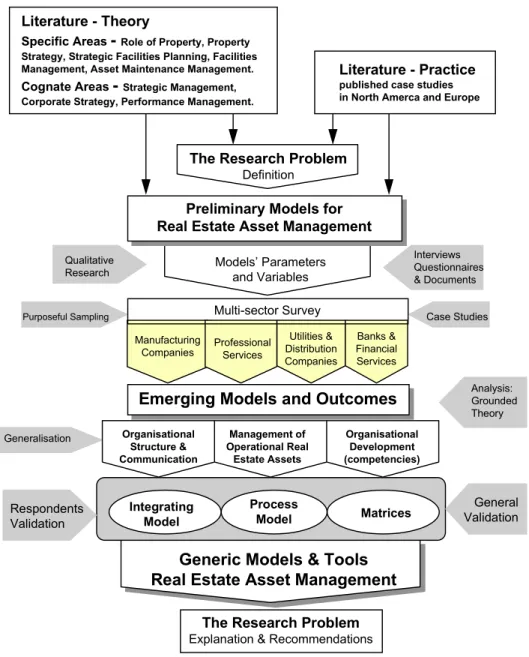
A three-part analysis was adopted to meet the separate requirements of data analysis for each of the above research propositions. The overall methodology framework of the research undertaken is summarised in Figure 1.
Generic Models & Tools Real Estate Asset Management
Literature - Theory
Specific Areas - Role of Property, Property Strategy, Strategic Facilities Planning, Facilities Management, Asset Maintenance Management.
Cognate Areas - Strategic Management, Corporate Strategy, Performance Management.
Literature - Practice published case studies in North Amerca and Europe
Preliminary Models for Real Estate Asset Management
The Research Problem Definition Models’ Parameters and Variables Purposeful Sampling Interviews Questionnaires & Documents Manufacturing Companies Banks & Financial Services
Emerging Models and Outcomes Management of Operational Real Estate Assets Organisational Structure & Communication Organisational Development (competencies) Integrating Model Matrices Analysis: Grounded Theory Generalisation General Validation Respondents Validation Professional Services Qualitative Research Case Studies Multi-sector Survey Utilities & Distribution Companies
The Research Problem Explanation & Recommendations
Process Model
Figure 1: Research Methodology Framework (Then, 1996)
Note: Real Estate Asset Management (REAM) embraces two principal areas of management of the corporate physical assets: facilities provision (that is, the definition of demand, design, acquisition and management of functional space to house the core business activities) and facilities management (that is, the definition of service levels, procurement and management of facilities-related support services required for the proper functioning of the working environment within the corporate real estate portfolio).
Justification for an Integrated Model for REAM
Requirements of an Integrated Proactive Management Framework
Proactive management of the corporate real estate resource demands well articulated strategic direction from senior management and well defined measurable deliverables from operational management. The relationship between business management and the supporting role of operational property is often not properly defined at the strategic level. This often results in operational policies that do not clearly reflect the contribution of property assets in terms of the organization’s overall performance measured in terms of improved profitability, productivity and customer
satisfaction. Two main categories of roles are discernible from the range of activities associated with REAM:
1. Activities related to the role of providing appropriate buildings (i.e. the corporate operational asset base measured in terms of functional space) required by the organization to carry out its core business activities, and
2. Activities related to the role of ongoing management and servicing of buildings in use (i.e. the workplace environment).
The first facet is essentially concerned with the role of “facilities provision”, while the second facet is concerned with the role of “facilities support services management” of property-related support services. Successful resources management should consider these two facets as one overall issue.
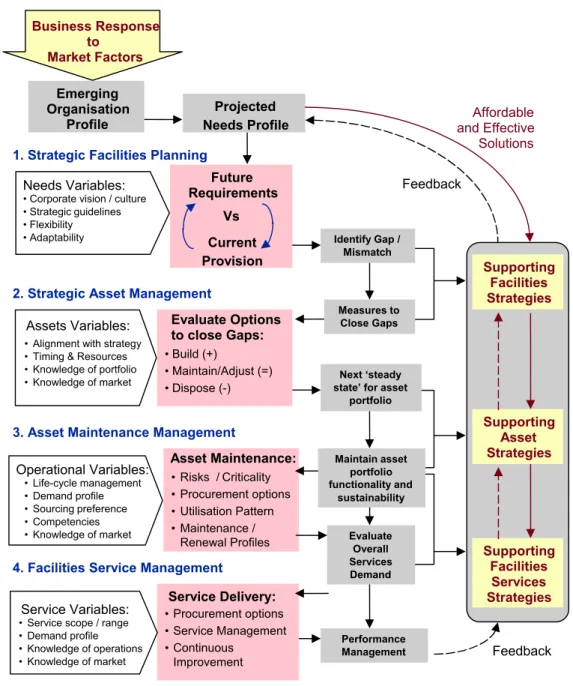
Figure 2: Real Estate Asset Management – An Integrated Resource Management Framework (Then, 1996, revised 1999)
•Procurement options •Service Management •Continuous Improvement • Risks / Criticality • Procurement options • Utilisation Pattern • Maintenance / Renewal Profiles • Life-cycle management • Demand profile • Sourcing preference • Competencies • Knowledge of market Future Requirements Vs Current Provision Emerging Organisation Profile Projected Needs Profile Measures to Close Gaps Business Response to Market Factors Identify Gap / Mismatch Supporting Facilities Strategies • Build (+) • Maintain/Adjust (=)
• Dispose (-) state’ for assetNext ‘steady portfolio
Supporting Asset Strategies Needs Variables:
• Corporate vision / culture • Strategic guidelines • Flexibility • Adaptability
• Alignment with strategy • Timing & Resources • Knowledge of portfolio • Knowledge of market Maintain asset portfolio functionality and sustainability Supporting Facilities Services Strategies Operational Variables: Evaluate Overall Services Demand Performance Management Service Variables:
1. Strategic Facilities Planning
2. Strategic Asset Management
3. Asset Maintenance Management
4. Facilities Service Management
Affordable and Effective Solutions Feedback Evaluate Options to close Gaps: Asset Maintenance: Assets Variables: Service Delivery:
•Service scope / range •Demand profile •Knowledge of operations •Knowledge of market
The need to improve the communication interfaces between strategic business planning and operational asset management resulted in a model proposition for REAM comprising of four related components of Strategic Facilities Planning (SFP),
Strategic Asset Management (SAM), Facilities Service Management (FSM), and
Asset Maintenance Management (AMM).The interrelationship and interactions of the
four principal components of REAM in continuously sustaining corporate strategic relevance is illustrated in Figure 2.
REAM as Managing the Enabling Working Environment
The external business environment impinges on both the core business performance as well as the facilities support services delivery strategy. The enabling workplace
environment within an organization is an outcome of the response to these two sets
of variables:
1. real estate variables, and
2. facilities services variables
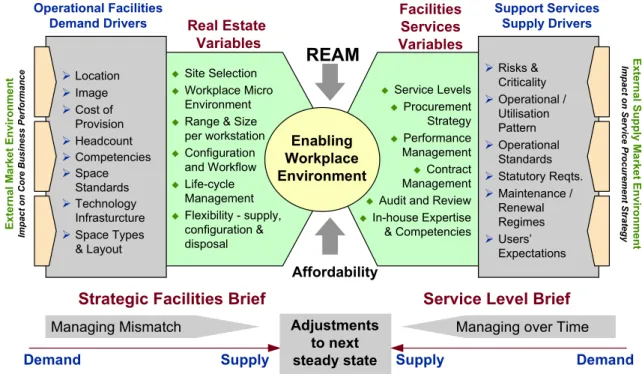
Figure 6 provides a framework for considering the various factors that impact on the output from the Strategic Facilities Brief (SFB) and Service Levels Brief (SLB). In deriving the variables that are ultimately reflected in the quality of the enabling working environment, evaluations are carried out at three cascading levels: (i) external market environment, (ii) organizational response, and (iii) key demand and supply factors. Enabling Workplace Environment Real Estate Variables Affordability REAM Operational Facilities Demand Drivers Demand Supply
Managing Mismatch Adjustments to next steady state Facilities Services Variables Support Services Supply Drivers
Strategic Facilities Brief Service Level Brief
Managing over Time
Demand Supply Ext ern al M a rk et Env ir o n m e n t Impa ct on C o re Bus ines s Perf orma nce Ext ern al Sup p ly Ma rke t En viro nment Impa ct on S e rv ice P ro c ureme n t Strategy Service Levels Procurement Strategy Performance Management Contract Management
Audit and Review In-house Expertise & Competencies ¾Risks & Criticality ¾Operational / Utilisation Pattern ¾Operational Standards ¾Statutory Reqts. ¾Maintenance / Renewal Regimes ¾Users’ Expectations Site Selection Workplace Micro Environment
Range & Size
per workstation Configuration and Workflow Life-cycle Management Flexibility - supply, configuration & disposal ¾Location ¾Image ¾Cost of Provision ¾Headcount ¾Competencies ¾Space Standards ¾Technology Infrasturcture ¾Space Types & Layout Then S.S. (1996)
Figure 3: REAM as Managing the Enabling Workplace Environment (Then, 1996) Figure 3 emphasizes that the common denominator is the need to constantly adjust to a next ‘steady state,’ in response to external factors. The outcome is to provide an enabling workplace environment that supports the achievement of the corporate goals, whatever the final product(s).
Within the SFB domain, strategic management concerns are with managing mismatch between demand and supply as a response to the dynamic market environment within which the organization operates. The primary concerns of REAM within SFB are with decisions relating to asset ownership and asset management. The strategies adopted in response to the market factors are then translated into
operational facilities demand drivers at the intermediate level, which will in turn
determine the appropriate real estate variables for the business it is supporting. The
real estate variables represent the output of the SFP domain. The variables listed
represent the strategic parameters that govern the facilities provision from demand initiation through to the supply of the appropriate functional space. At any point in time, the relative weightings given to the real estate variables identified will influence the emerging supporting facilities strategies.
Within the SLB domain, management concerns are with managing the existing property assets over time, with the emphasis on meeting operational and users’ requirements within agreed parameters of service and financial limits. The primary concerns of REAM within SLB are with decisions relating to minimizing risks of disruption and service management.
The strategies adopted in response to corporate strategic plans are translated into facilities support services supply drivers at the intermediate level, which will in turn determine the appropriate facilities services variables for the working environment within the existing operational real estate portfolio. The facilities service variables
represent the output of the SLB domain. The variables listed represent the tactical and operational parameters that govern the facilities service provision from demand initiation through to the supply of the appropriate levels of facilities services. At any point in time, the relative weightings given to the facilities services variables identified will influence the practice of the support services delivery process.
A central theme in the dialogue between SFB and SLB is the significance placed by senior management on the capability of options evaluation or having alternative ‘strategic scenarios’ against possible business outcomes. The dominant concept of REAM is to provide an informed interface between strategic business planning and operational asset management via SFB and SLB. REAM takes as its inputs - the business response to the changing market factors, the processes of evolving the most appropriate supporting facilities strategies in support of the new strategic direction, and as outputs - action plans for adjusting the existing asset base to a next ‘steady state.’
The emphasis on affordability as a central driver for the practice of REAM is important in that the concept of ‘living within one’s means’ accords with key stakeholders’ concerns within the overall business management process:
• senior management’s preoccupation with the costs associated of real estate asset provision and facilities occupancy costs;
• business units’ demand of value for money from service providers being meet by performance related service contracts based on mutually agreed service levels and performance measures;
• service providers, in-house or external, working within a strategic framework of provision guided by continuous constructive dialogue between SFB and SLB. The preceding discussions described the convergence of real estate variables and facilities services variables leading to the creation of appropriate enabling workplace environment as an outcome of REAM in an organization setting. The range of factors to be considered demonstrates the need for an integrated management process. The next section builds upon the preliminary models presented above and incorporates the empirical evidence from the case study organisations to propose a pair of conceptual process models to elaborate the management roles associated with Facilities Provision and Facilities Service Management.
Process Model for Facilities Provision
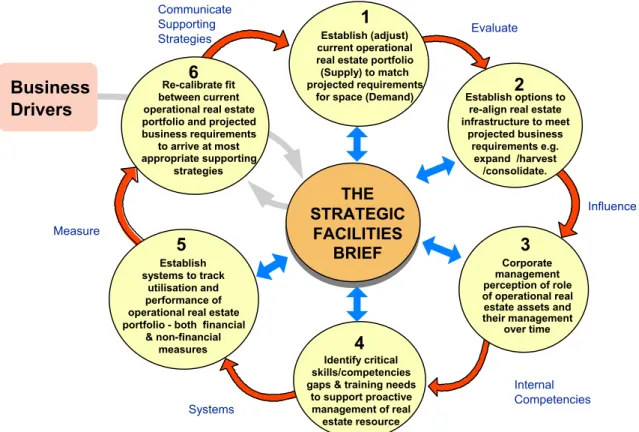
Figure 4 illustrates a conceptual process model of a management framework for placing the role of operational real estate assets (i.e. operational property) within the realm of business management. The model centres on the key role of the Strategic
Facilities Brief in defining the parameters for facilities provision. The model describes
a 6-stage process aimed at continuously aligning the real estate resource to the strategic intent of corporate business plans.
Figure 4: Management Framework for Facilities Provision. (Then, 1996)
The depiction of the model as a cyclical process is intended to reinforce the fact that the re-alignment process of operational assets to business plans is a continuous one
Establish (adjust) current operational real estate portfolio (Supply) to match projected requirements
for space (Demand) Establish options to re-align real estate infrastructure to meet projected business requirements e.g. expand /harvest /consolidate. Corporate management perception of role of operational real estate assets and their management
over time Identify critical
skills/competencies gaps & training needs
to support proactive management of real estate resource Establish systems to track utilisation and performance of operational real estate portfolio - both financial
& non-financial measures
Re-calibrate fit between current operational real estate portfolio and projected business requirements to arrive at most appropriate supporting strategies THE STRATEGIC FACILITIES BRIEF Business Drivers Influence Evaluate Internal Competencies Measure Systems Communicate Supporting Strategies 1 2 3 4 5 6
of adjusting to the ‘next steady state’ in response to external market forces. The 6-stage process has been derived from published literature and reinforced by evidence from empirical data from the case studies and interviews. It attempts to incorporate elements of best practices in a generalized model that focuses on the key stages and management emphasis between any two stages.
It is apparent from the six stages model that the management focus shifts as one move from one stage to the next. The emphasis progression from; evaluate -> influence -> competencies -> systems -> measurement -> communicate; gives an indication of the wide range of skills necessary within REAM.
The outcome of the facilities provision component of the process model is the appropriate supporting facilities strategies based on the organization’s capability to generate alternatives or scenarios to ensure that the existing corporate real estate assets maintain their strategic relevance in supporting the corporate business plans. Process Model for Facilities Service Management
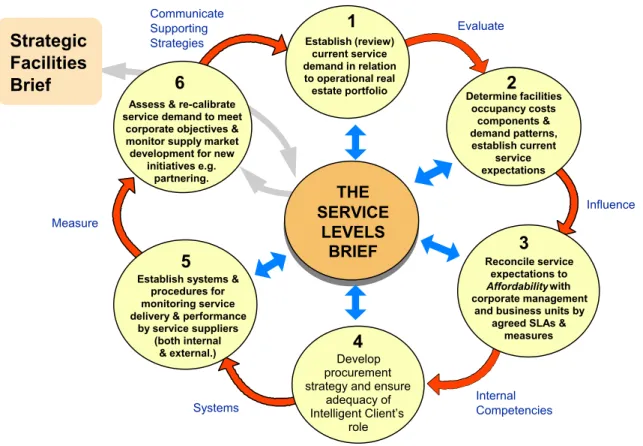
Figure 5 shows the companion model to Figure 4. It illustrates a process model of a management framework for placing the role of facilities support services in business. The model centres on the key role of the Service Levels Brief and proposes a similar 6-stage process that is aimed at continuously aligning service performance to operational real estate portfolio in line with the strategic intent of business plans. Similarly, the proposed model incorporates elements of best practices in a generalized model that focuses on the key stages and management emphasis between any two stages.
In the evaluation of services levels, it is important to balance the needs of the various business units against the relative contributions to the total corporate business by each individual business units. In practice, there may be several service levels even for an individual service as dictated by the relative importance of each business unit’s contribution to profitability.
The outcome of the facilities service management component of the process model is appropriate supporting facilities service strategies with emphasis on managing the operational assets over time and supporting the enabling working environment within the real estate portfolio.
Figure 5: Management Framework for Facilities Service Provision. Then (1996) It is emphasized that the cyclical processes represented in Figures 4 and 5 above are not necessarily sequential, but an iterative one emphasizing the advantages associated with organizational learning. Within an organizational setting, both models provide a management framework that supports two important interfaces:
1. Strategic interactions with senior management and business units; access to vital
business information, in order to sustain (by being proactive) and to continue to
maintain strategic relevance (by having the capacity to generate solutions), in terms of the operational asset base;
2. Operational interactions with business units, as purchasers of services; the provision of service performance information in order to ensure economical and consistent delivery of the appropriate service packages through effective procurement and performance monitoring.
Emerging Proactive Management Models
The emerging models are derived from three principal sources of data:
1. Established management and economic theories applied to a particular class of durable physical assets, real estate assets, in an organizational setting.
2. Published case studies and interviews from practitioners in the related fields of real estate (property) management, facilities management, maintenance management, etc.
Establish (review) current service demand in relation to operational real
estate portfolio Determine facilities occupancy costs components & demand patterns, establish current service expectations Reconcile service expectations to Affordability with corporate management
and business units by agreed SLAs &
measures
Develop procurement strategy and ensure
adequacy of Intelligent Client’s
role
Establish systems & procedures for monitoring service delivery & performance
by service suppliers (both internal
& external.) Assess & re-calibrate service demand to meet
corporate objectives & monitor supply market development for new
initiatives e.g. partnering. THE SERVICE LEVELS BRIEF Strategic Facilities Brief Influence Evaluate Internal Competencies Measure Systems 1 2 3 4 5 6 Communicate Supporting Strategies
3. Case studies and interviews conducted as part of this study.
The models are presented as concepts to explain context, causes and implications in practice.
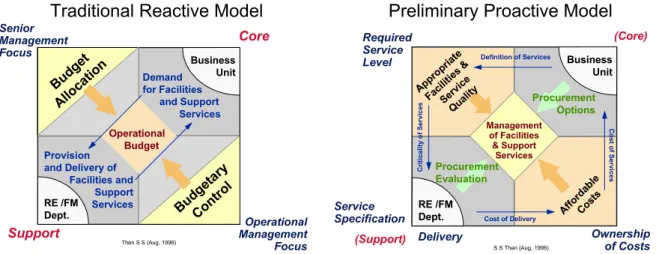
A traditional reactive management model for the practice of REAM is presented as the starting point of theory generation for an integrated proactive model. A preliminary proactive management model, encompassing both the facilities provision and facilities service management dimensions of REAM, is also proposed. These two models represent the extremes along a continuum rather than typical representation in reality.
Traditional Reactive Model Preliminary Proactive Model
Core Support Budg et Allo catio n Budg etary Contr ol Senior Management Focus Operational Management Focus Demand for Facilities and Support Services Provision and Delivery of Facilities and Support Services RE /FM Dept. Business Unit Operational Budget Then S S (Aug, 1996) (Core) (Support) Required Service Level Ownership of Costs RE /FM Dept. Business Unit Afforda ble Cost s Approp riate Faci lities & Servic e Quality Procurement Evaluation Procurement Options Delivery Service Specification Definition of Services Cost of Delivery Cost o f S e rvi ces Cr it ic a lit y of Se rv ic es Management of Facilities & Support Services S S Then (Aug, 1996)
Figure 6: Comparison of Reactive and Proactive Models (Then, 1996)
The traditional reactive model contrasted sharply with the preliminary proactive model in both management approach and focus, and in the nature of relationships between the business units and service providers (i.e. the in-house real estate/facilities department). The former being essentially a cost (budget)-driven approach while the latter relies on a process-driven approach guided by clear articulation of facilities and service demands through the SFB and SLB.
Following the analysis of feedback from a validation workshop, it was decided that in the case of the preliminary proactive model, the real estate variables from the domain of SFB and the facilities service variables from SLB are sufficiently unique to warrant separate considerations.
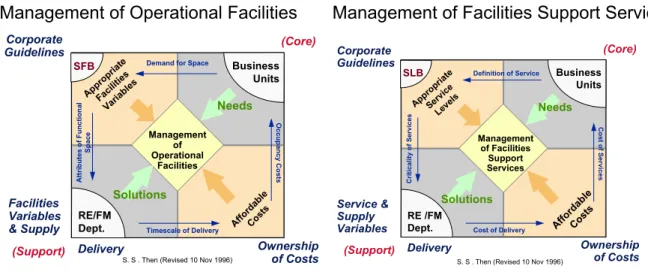
Figure 7 provides a revised emerging proactive model as two components; one focusing on the management of operational facilities (i.e. real estate assets), the other focusing on the management of facilities support services. The acknowledgment of a shift in emphasis, from fulfilling transactions on demand under the traditional reactive approach, to a process-driven management approach is fundamental in justifying and defining the emerging role and scope of REAM.
The context and role of the SFB in providing a corporate perspective of the real estate resource ensure that demand is defined and articulated as corporate facilities guidelines, and supply is effected with affordable cost criteria without lost of criticality and quality.
Within a corporate setting, the proactive model caters for the translation of business units needs by providing affordable solutions via a process cycle comprising of:
• demand for space,
• key attributes of functional space,
• time-scale of delivery, and
• recovery of facilities occupancy costs
In a similar manner, the business units’ demand for facilities services within the context of SLB can be meet via a process cycle comprising of:
• definition for service,
• criticality of service (which influences procurement options),
• cost of provision, and
• recovery of facilities service costs.
Management of Operational Facilities Management of Facilities Support Services
(Core) (Support) Corporate Guidelines Ownership of Costs RE/FM Dept. Business Units Management of Operational Facilities Afforda ble Cost s Appropria te Facilitie s Variabl es Solutions Needs Delivery Facilities Variables & Supply
Demand for Space
Timescale of Delivery Oc cu pa nc y C o st s Att ri b utes o f F unction al Sp ac e
S. S . Then (Revised 10 Nov 1996)
SFB (Core) (Support) Corporate Guidelines Ownership of Costs RE /FM Dept. Business Units Management of Facilities Support Services Affo rdab le Costs Approp riate Serv ice Lev els Solutions Needs Delivery Service & Supply Variables Definition of Service Cost of Delivery Cost o f S e rvi ces Cr it ica lit y o f S er vic es
S. S . Then (Revised 10 Nov 1996) SLB
Figure 7: Emerging Proactive Models (Then, 1996)
Effective matching of demand for, and supply of, functional accommodation and associated support services to meet operational requirements in a dynamic business environment demands the management of the real estate assets as a dynamic integrated management process. The realization of an integrated approach necessitates a formal planning framework that must cater for the cultural, procedural and existing knowledge base of the organization concerned. Ultimately, the practice of REAM is concerned with the delivery of the enabling workplace environment – the optimum functional space that supports the business processes and human resources.
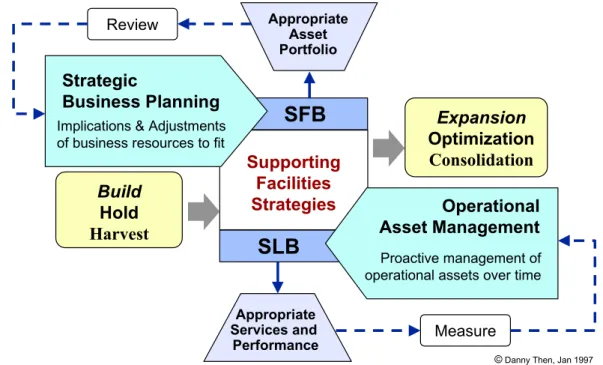
Figure 8 illustrates the dynamic capabilities of a model framework to review strategic relevance against the competitive realities of the business environment within which it operations, as well as, measuring operational management effectiveness and efficiency against external best practice. The business imperative from a resources management perspective is to align the appropriate supporting facilities strategies to the current strategic business plans.
Figure 8: An Integrated Resources Management Framework (Then, 1996)
The justification of REAM is to meet the business challenges that confront the organization it is supporting, as an enabler in the first instance. In the long term, a more sustainable role must be to build upon an aspiration to continuously add value by providing appropriate and innovative ‘facilities solutions’ to business challenges through the skilful manipulation of all business resources - the optimum balance between people, physical assets and technology.
Key features of a proactive integrated resources management framework illustrated in Figures 8 above are summarized as follows:
1. A growing awareness of the need to fully understand each business units cost structure has promoted a closer scrutiny of occupancy costs of operational facilities.
2. A shift in culture from being a ‘free goods’ absorbed as a ‘hidden’ corporate overhead expense, to full ownership of occupancy costs has had the impact of dramatically altering the approach, as well as, the focus on management of functional space provision and support services procurement.
3. The continuing restructuring of the supply market in facilities support services, has altered the traditional role of facilities service management side of REAM; shifting from management of directly employed staff to management of service
SFB
SLB
Appropriate Asset Portfolio Appropriate Services and Performance Strategic Business Planning Operational Asset ManagementImplications & Adjustments of business resources to fit
Proactive management of operational assets over time Supporting Facilities Strategies Expansion Optimization Consolidation Build Hold Harvest
© Danny Then, Jan 1997
Measure Review
providers and ensuring performance standards are met. On the facilities provision side of REAM, however, the real estate (property) supply market has remained relatively static, development innovations and opportunities largely constrained by inflexibility in funding arrangements.
4. Concerns of senior management are in defining the appropriate service requirements and quality in line with ensuring business continuity and success. In this respect, the onus has shifted to the business units to define their service requirements and criticality, tempered by the economics of affordability.
5. A service relationship between business units, as purchasers of functional space and related services, and in-house service provider, acting as an intelligent client interface, with the relevant competencies to provide effective and economical solutions to business units’ expressed needs with full awareness and ownership of the cost of provision.
Conclusions
The current emphasis on appropriateness and affordability in space demand and facilities support services calls for a management approach that is underpinned by an understanding of the drivers of business demands and the processes required to meet the business requirements. This underlying principle has seen a growing acknowledgement in both the property and facilities industry in recent years (O’Mara, M., 1999; Weatherhead, M., 2000; Capital Economics, 2002).
This study was initiated on the premise that the role of the corporate operational real estate assets represents an increasingly important component of business resources in the overall management of corporate success. A common theme that emerged from the literature survey through to the case studies and the validation exercise carried out, was the prevailing perception or attitude of the role of operational assets held by senior management and the profound impact it had on the practice of operational asset management in an organization. This perception is fundamental in that it is always the prerogative of senior management to allocate resources to the various functional divisions within the organization. However, it is equally important to acknowledge that almost all strategic business decisions have implications on real estate and/or facilities dimensions.
The crucial question is to what extent are such implications thoroughly evaluated, articulated and presented at senior management level where strategic business
decisions are made? Executives charged with responsibilities for the real estate and
facilities support roles must develop the competencies and capabilities to provide realistic options within the business propositions remit in the hope of influencing senior management decisions to arrive at appropriate optimal facilities solutions to
meet business needs. In this respect, raising the corporate strategic awareness to
the strategic role of the real estate resource is a fundamental pre-condition for an informed interface to materialize. It is hoped that the models presented in this paper go some way to explain, justify and promote the critical need for constructive dialogue between strategic business planning and operational asset management via an integrated resources management framework.
References
Then, S.S. (1996) A Study of Organisational Response to the Management of Operational Property Assets and Facilities Support Services as a Business Resource - Real Estate Asset Management. Unpublished Thesis. Heriot-Watt University, Edinburgh.
Then, S.S. (1998a) “Corporate Leadership in Real Estate and Facilities Management.” Proceedings of CIB W70 Singapore ‘98 Symposium on Management, Maintenance and Modernisation of Building Facilities – The Way Ahead into the Millennium – The Way Ahead into the Millennium, Ed. Quah Lee Kiang; 18-20 November 1998.
Then, S.S. (1998b) “Integrating Facilities Provision and Facilities Support Services Management.” Proceedings of CIB W70 Singapore ‘98 Symposium on Management, Maintenance and Modernisation of Building Facilities – The Way Ahead into the Millennium, Ed. Quah Lee Kiang; 18-20 November 1998. pp.95-102.
Danny Shiem-Shin Then, (1999). An integrated resource management view of facilities management. Facilities. Vol.12/13 1999 pp.462-469.
Danny Shiem-Shin Then, (2000). The role of real estate assets in supporting the fulfilment of corporate business plans: key organizational variables for an integrated resource management framework. Facilities. Vol.7/8 2000 pp.273-280.
O’Mara, M. (1999) A. Strategy and Place. The Free Press.
Weatherhead, M. (2000), Business tackling property issues. A Report for RICS Policy Unit. Capital Economics (2002), Property in business – a waste of space? A study for RICS.
Note 1: The sources of literature reviewed are listed below. The emerging trends and research directions are the results of an international literature review over the last two decades. The main focus of the review was the role of physical assets in supporting business objectives.
United Kingdom and Europe:
Arthur Anderson (1995) Wasted Assets? A survey of corporate real estate in Europe. Avis, M., Gibson, V. (1995). Real Estate Resource Management. GTI.
Avis, M., Gibson, V., & Watts, J. (1989). Managing Operational Property Assets. GTI.
Debenham Tewson Research. (1992) The Role of Property - managing cost and releasing value. Ernst & Young. (1993) The Property Cycle - The management issue.
Graham Bannock & Partners Ltd., (1994) Property in the Board Room - a new perspective. Commissioned by Hillier Parker
Gallup. (1996) Shaping the workplace for profit. Commissioned by Workplace Management. The Henley Centre. (1996) The Milliken Report: Space Futures. Commissioned by Milliken Carpet. Oxford Brooks University & University of Reading. (1993) Property Management Performance
Monitoring. GTI. North America:
Apgar,IV,M.(1995) “Managing Real Estate to Build Value”, Harvard Business Review, Nov-Dec. pp.162-179.
Arthur Anderson (1993), Real Estate in the Corporation: The bottom line from seniormanagement. (1993).
Becker, F. & Steel, F. (1995), Workplace by Design - mapping the high-performance workscape. Josey-Bass Publishers.
Brown, R. K., Lapies,P.D. & Rondeau,E.P. Managing Corporate Real Estate - forms and procedures. John Wiley & Sons, Inc.
Jorroff, M, et al., (1993), Strategic Management of the Fifth Resource: Corporate Real Estate. The Industrial Development Research Council, U.S.A.
Marshall,H.E. & Ruegg,R.T. (1990) Building Economics - theory and practice. Van Nostrand. Nourse, H.O. (1990), Corporate Real Estate Asset Management. Prentice-Hall Inc.
Veale, P.R. (1989), Managing Corporate Real Estate Assets: Current executive attitudes and prospects for an emergent management discipline. The Journal of Real Estate Research. Fall 1989.
Visher, J. C. (1996) Workspace Strategies. Chapman & Hall.
Wilson, R.C. (1991), Strategic Positioning and Facilities Planning: reviewing business plans and facilities strategies. Site Selection. Industrial Development Section. April 1991. pp.26-30. Zeckhauser, S. & Silverman, R. (1981) Corporate Real Estate Asset Management in the United