2016
Sparse Non-negative Matrix Factorization for Mesh Segmentation
Sparse Non-negative Matrix Factorization for Mesh Segmentation
Tim McGraw
Jisun Kang
Donald Herring
Follow this and additional works at: https://docs.lib.purdue.edu/cgtpubs
This document has been made available through Purdue e-Pubs, a service of the Purdue University Libraries. Please contact [email protected] for additional information.
c
World Scientific Publishing Company
Sparse Non-negative Matrix Factorization for Mesh Segmentation
Tim McGraw
Purdue University, Computer Graphics Technology Department, Knoy Hall West Lafayette, Indiana 47906, USA
Jisun Kang
Purdue University, Computer Graphics Technology Department, Knoy Hall West Lafayette, Indiana 47906, USA
Donald Herring
Purdue University, Computer Graphics Technology Department, Knoy Hall West Lafayette, Indiana 47906, USA
Received (Day Month Year) Revised (Day Month Year) Accepted (Day Month Year)
We present a method for 3D mesh segmentation based on sparse non-negative matrix factorization (NMF). Image analysis techniques based on NMF have been shown to decompose images into semantically meaningful local features. Since the features and coefficients are represented in terms of non-negative values, the features contribute to the resulting images in an intuitive, additive fashion. Like spectral mesh segmentation, our method relies on the construction of an affinity matrix which depends on the geometric properties of the mesh. We show that segmentation based on the NMF is simpler to implement, and can result in more meaningful segmentation results than spectral mesh segmentation.
Keywords: segmentation; clustering; mesh processing; sparse approximation; non-negative matrix factorization
1. Introduction
Mesh segmentation is the process of partitioning a mesh into smaller submeshes. Applications include object recognition by parts1, mesh parameterization and tex-ture mapping2, bounding volume computation3, skeleton extraction for rigging and animation4;5, shape matching6, morphing and mesh editing7;8. The ideal segmen-tation results for a given mesh depends on the problem being solved, but 2 main classes have been proposed in the literature: segmentation into surface patches and segmentation into semantically meaningful parts. Tasks such as parameterization
and texture mapping typically use segmentation into patches where the patches are constrained to be nearly planar, or some other shape that can be easily parameter-ized. Segmentation into parts is critical for animation and recognition tasks. The set of parts desired from an animated character are usually anatomically meaning-ful (e.g. arms, legs, torso). The segmentation results can help define the anatomical regions which are independently transformed when animating a character. In CAD applications, such as reverse engineering, the decomposition may be hierarchical so that an assembly can be broken into subassemblies, and subassemblies can be broken into individual components.
Spectral mesh clustering techniques are heavily influenced by research into graph partitioning and clustering problems. The observation that eigenvectors of graph adjacency matrices can give insights into the clusters formed by graph vertices9 has also led to the development of many new image segmentation10 and point clustering techniques. The eigenvalue decomposition of mesh affinity and Laplacian matrices can reveal useful topological mesh features, such as symmetry and number of connected components, as well as identifying clusters of similar faces. However, we will make use of a different matrix factorization for formulating a new mesh segmentation algorithm.
Non-negative matrix factorization is a process for finding a low-rank approxi-mation to a matrix,L=W H, such thatW, H, andL have no negative elements. If L is an m×n matrix then W is m×k and H is k×n, where the value of k
depends on the problem being solved, but is generally much less thanmorn. Ap-plications of NMF include unsupervised clustering11, dimensionality reduction12, machine learning of statistical models13, medical image analysis14 and computer vision15. In clustering and image analysis applications the NMF is often used to find basis functions which correspond to the “building blocks” which describe the data. We will show that this is also the case when applying the NMF to mesh segmentation.
1.1. Contributions of our method
The proposed method is a new application of NMF to the mesh segmentation problem. The contributions of the method are:
• Simplicity: Unlike the spectral segmentation approach, our method does not require eigenvector computation, sorting, normalization or k-means clustering steps. The NMF can be computed using non-negative least squares.
• Flexibility: Our method is based on construction of distance and affinity matrices. Similarity measures based on geometric features can be incorpo-rated into these matrices, permitting these features to influence the seg-mentation results. Hierarchical segseg-mentation results can be produced by changing the rank of the NMF.
the locality of the NMF basis functions, and the addition of a sparsity con-straint improves the distinctness of features and the consistency of results.
2. Related work
The problem of mesh segmentation has been solved using many approaches, starting with the region growing approach proposed by Faugeras and Hebert16. The input to a mesh segmentation algorithm is a set of vertices, V ={v1, v2, ...vn}, a set of edges , E ={eij} where vi and vj are adjacent vertices forming the edgeeij, and a set of faces, F, in the mesh. Depending on the specific algorithm the mesh may be constrained to be 2-manifold (each edge is shared by exactly 2 faces). The out-put of the segmentation is a set of disjoint submeshes. These submeshes represent groups of faces, vertices, or edges of the input mesh that are considered homoge-neous according to some criterion. Most often mesh faces are grouped together, but occasionally vertices and rarely edges.
General approaches to mesh segmentation include hierarchical clustering, iter-ative clustering, spectral methods and implicit methods. Our discussion will con-centrate on spectral methods, since they are most closely related to our technique. For an overview of the other approaches see the survey papers by Shamir17 and Theologou et al.18.
2.1. Spectral methods
The spectral clustering approach to mesh segmentation is a product of the active research areas of spectral mesh processing19 and spectral graph theory (especially clustering20). Spectral methods, in general, involve analysis of the eigenvalues and eigenvectors of appropriately defined matrices. In computer graphics spectral meth-ods have been found to have a wide variety of applications. Vallet and Levy21 presented a spectral method to convert a mesh into the frequency domain for the purposes of mesh smoothing. The eigenfunctions of the Laplace-Beltrami operator are used to define Fourier-like basis functions called manifold harmonics. Mesh pro-cessing can then proceed in a manner similar to signal propro-cessing. For example, high-frequency noise and other small details can be removed by low-pass filtering. Other computer graphics applications of spectral methods include mesh parame-terization, symmetry detection, surface reconstruction, remeshing, and mesh com-pression. See Zhang et al.19for a complete survey of spectral methods in computer graphics.
Spectral mesh segmentation can be seen as the use of spectral graph clustering on the graph formed by vertices and edges in a mesh, or the dual graph of faces and edges in a mesh. The algorithm requires the computation of an affinity matrix,
A, from which a mesh or graph Laplacian matrix, L, may (optionally) be com-puted. Various approaches have introduced different formulations for the affinity and Laplacian matrix, and the subsequent processing of the eigenvectors. Liu and Zhang22first applied spectral clustering to three dimensional meshes by computing
eigenvectors of a distance-based affinity matrix. To segment a mesh into k sub-meshes the eigenvectors corresponding to theklargest eigenvalues of a normalized affinity matrixAare computed. The final step is to cluster faces by their eigenvec-tor components, usually using an efficient k-means technique23. Later, Zhang and Liu24 described a mesh segmentation algorithm based on recursive spectral two-way cut and Nystrom approximation which only requires construction of a partial affinity matrix.
2.2. Affinity and Laplacian matrices
The elements,Aij, of the affinity matrix are measures of the likelihood that faces (or vertices) i and j are in the same region of the segmentation. An example of a simple affinity matrix used often in spectral graph analysis is the combinatorial affinity matrix which is equivalent to the mesh adjacency matrix. This affinity matrix, however only takes vertex connectivity into account, not mesh geometry. Mesh affinity matrices are based on distance metrics that do take geometry into into account. Affinity matrices can be computed from distance matrices by using the fact that affinity and distance have an inverse relation.
Many different geometric features can lead to definitions of distances on a mesh. One possible definition for distance dij is the Euclidean distance ||vi−vj|| when clustering vertices, or the geodesic distance between face centroids when clustering mesh faces. A distance based on thedihedral angle25;4;22is given by
dij=η(1−ni·nj) (1) whereniandnj are face (or vertex) unit normal vectors, andη is a free parameter. The relative sensitivity to ridges and creases can be controlled by changing the value ofη based on the degree of local concavity or convexity4. Another concavity based affinity matrix is given by Wang et al26.
Affinity matrices for mesh segmentation have been based on reciprocal dis-tance27, various kernels (including Gaussian10), and mesh curvature28. For the definitions given belowAi,j= 0 when there is no edge betweenvi and vj. In some applications a full affinity is required, which is defined in terms of the distances between all pairs of vertices. In these cases distance is defined as the length of the shortest path betweenvi and vj, and can be computed using Dijkstra’s or Floyd’s algorithm. Some implementations24 29require only a partial version of the full affin-ity matrix to be computed, since a sparser matrix provides computational benefits. The Nystrom30 approximation can then be used to approximate the eigenvectors of the full matrix.
Thereciprocal distance affinity matrixis given by
Aij = 1
dij
. (2)
matrix,
Aij =e
−d(vi,vj)2
2σ2 (3)
where σis a tunable parameter that influences the size of the clusters, anddmay be Euclidean distance or some other measure. Liu and Zhang22 use a function, d based on face centroid geodesic distance and face dihedral angle. They also suggest a method for automatically computingσ.
Early graph partitioning9and image segmentation10methods were based on the eigenvectors of the affinity matrix. Later methods operated instead on the Laplacian matrix, which is computed from the affinity matrix, but can be defined in many ways. The study of eigenvalues of the Laplacian matrix has connections to harmonic analysis where basis functions on various domains (e.g. DCT, Fourier basis, spher-ical harmonics) can be formulated as eigenfunctions of Laplacian operators defined on those domains. Other mesh segmentation techniques based on this eigenfunction concept include5;31;25;32. Methods based on eigenfunctions of the Laplace-Beltrami operator include diffusion distance and heat kernel signature18.
Most Laplacian formulations are defined in terms of the diagonal matrix D, where Dii = PjAij. In the case of the combinatorial affinity matrix D repre-sents the degree of each vertex. Variations on spectral clustering can be created by changing the definition of the affinity matrix and mesh Laplacian.
The symmetric Laplacian, (or graph Laplacian)
L=D−A (4)
was used for mesh segmentation by Liu and Zhang28 and for mesh segmentation by Zhang et al.25. The normalized Laplacian is given by
L=I−D−1
A, (5)
where Iis the identity matrix andD−1Ais the (row) normalized affinity matrix. If the eigenvalues of a normalized affinity matrix are λi then the eigenvalues of the corresponding Laplacian matrix are 1−λi and the eigenvectors are the same. The clustering information is contained in the eigenvectors corresponding to the largest eigenvalues of the affinity matrix, or the smallest eigenvalues of the Laplacian matrix. Since some popular iterative eigenvalue solvers (e.g. Arnoldi Iteration) produce the largest magnitude eigenvalues first it can be more efficient to work in terms of the affinity matrix. Von Luxburg33 gives a thorough overview of Laplacian matrices used in spectral mesh clustering, and their properties.
Once the desired matrix, M, (affinity matrix, normalized affinity matrix or Laplacian matrix) is computed, the next step of spectral segmentation is to compute the eigenvalue decomposition M = XΛX−1 where Λ is a diagonal matrix. The eigenvectorsxi are the columns ofX, and the eigenvaluesλi= Λii are assumed to sorted. Segmentation into k regions requires the k eigenvectors which correspond to thek smallest or largest eigenvalues. The eigenvectors are assembled into U = [x1, x2, ..., xk]. Finally k-means clustering on the rows of U is performed to find
the segmentation result. It is also possible to automatically estimate the number of regions from Λ by using the eigengap heuristic maxk =λk+1−λk. An overview of spectral mesh segmentation is given in Algorithm (1).
Like spectral methods, our segmentation algorithm also requires computation of an affinity matrix. In place of the eigenvalue decomposition we compute the sparse rank-k NMF. Since the Laplacian matrix can have negative values it cannot be decomposed by the NMF. Instead we compute the NMF of a normalized affinity matrix, M = D−1A. The segmentation results are directly extracted from the NMF,M =W H, by finding the column of H which has maximum value. Due to the clustering properties of NMF we don’t need to perform any additional clustering on the results.
Algorithm 1Spectral mesh segmentation
1: procedureSpectral mesh segmentation(V, F, k) 2: Compute the dual graphV′
, F′
. Use the dual graph in the following computa-tions where vertices correspond to faces of the original mesh.
3: Compute the distance matrixd
4: Estimateσfor the Gaussian kernel affinity matrix.
5: Compute an affinity matrix,Afrom the distance matrix,dandσ.
6: Compute the full affinity matrix for all vertex pairs (e.g. using Floyd-Warshall or Dijkstra)
7: FromAcompute a normalized affinity matrix.
8: Compute the eigenvalue decomposition S = VΛV−1 and sort the eigenvalues (diagonal elements of Λ) and the corresponding eigenvectors.
9: Extract the lastkcolumns ofV into ˆV. 10: Normalize the rows of ˆV, as done by20.
11: Compute k-means on the rows of ˆV. The clustering assignment of each vertex gives segmentation results
12: end procedure
Decomposition of a normalized affinity matrix has previously been used to per-form clustering in the context of stochastic processes. Meila and Shi34 perform clustering by analyzing the row normalized matrixM =D−1A. This matrix can be interpreted as a stochastic matrix whereMij is the probability of a random walk moving from vertexi to j in one step. Eigenanalysis of this matrix can reveal the regions that random walks remain in for large amounts of time.
3. Sparse non-negative matrix factorization
Non-negative matrix factorization is used by many unsupervised learning algo-rithms that yield a parts-based representation of data. The non-negativity of the resulting matrices means that the data can be expressed as a strictly additive
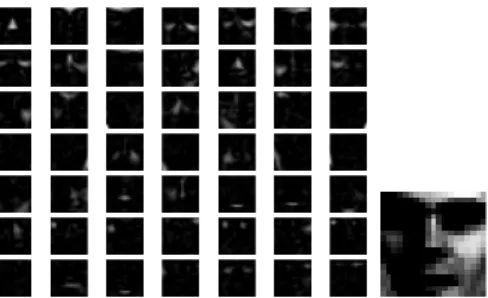
com-Fig. 1. Local basis functions computed from 1500 face images (left), sample 19×19 face image
bination of parts. As a result, NMF usually results in an intuitive decomposition of the data since additional terms cannot subtract already existing features in the data. For example, NMF is an integral part of algorithms for blind source separa-tion of audio signals, such as music. A musical score may be decomposed into the individual instrument tracks35. NMF analysis of stochastic matrices can be used to learn statistical models of random processes13.
The problem of finding the NMF can be written as the optimization problem min
W,H||L−W H|| 2
F s.t. W ≥0 and H ≥0 (6)
where || · ||F denotes the matrix Frobenius norm.
3.1. Parts-based decomposition and clustering with NMF
To demonstrate NMF with a sample image processing application, we replicated the experiments of Lee and Seung15by applying NMF to a facial image database36 of 1500 images. Each 19×19 pixel image was reformatted to 1D, and was set as a column ofL. The NMF (rank = 49) ofLwas computed, and the facial features were extracted from the columns ofW. Computing the NMF of the 361×1500 matrix took 0.25 seconds in Matlab. Unlike the eigenface approach, where the eigenvalue decomposition of a covariance matrix is computed, the NMF features are local. The 49 features shown in Figure (1) often correspond to recognizable features such as eyes, nose and lips. Since the coefficient matrix is positive, the features can be added together in an intuitive way to form the image of face.
The fact that symmetric NMF can be shown to be equivalent to kernel k-means clustering37 suggests the usefulness of NMF as a segmentation tool. The equiva-lence can be seen by using the fact that the kernel k-means objective function can be written in terms of matrix trace maximization38. The trace maximization prob-lem maxHtr(HTLH) can be shown to be equivalent to the minimization problem minH||L−HHT|| which defines the symmetric NMF problemL=HHT.
3.2. Sparsity
Many recently developed solutions to image processing problems are formulated by transforming the problem into a domain in which the data are sparse. Sparsity means that a signal can expressed as linear combination of basis functions using few terms. This has obvious implications for data compression39. Other image analysis applications are image reconstruction40, and denoising41. Though the NMF often results in sparse basis functions, by imposing a sparseness constraint the degree of sparseness can be controlled42.
Sparseness can be quantified using the l0 norm which counts the number of nonzero elements in a vector. Equation (7) shows the constrained optimization problem that solves the linear system x = Dy while imposing sparseness on the solutiony. min y 1 2||x−Dy|| 2 2+λ||y||0 (7)
However, solution of Equation 7 is NP-hard. In many cases43 the convex re-laxation of Equation 7 formed by replacing thel0 norm with thel1 norm induces sparsity iny and can be solved much more efficiently.
Imposing a sparseness constraint on either, or both of the the factorsW andH
has several benefits. In general the NMF does not have a unique solution, but by imposing some constraints it can be made unique. Sparsity, unfortunately, is not one of those constraints. But the computation of the sparse NMF does have a smaller solution space and has been shown to lead to better and more consistent clustering results44. Increasing sparsity has also been observed to improve the separation of features35 in the resulting basis vectors.
Incorporating sparseness on H into the NMF decomposition results in the op-timization problem min W,H 1 2||L−W H|| 2 F+ µ 2||W|| 2 F+ λ 2 X i ||hi||21 s.t. W ≥0 and H ≥0 wherehi are columns of H. The Frobenius norm term controlled by parameter µ adds another side constraint that keepsW from becoming too large which would in turn causeH to become very small.
The sparse NMF problem can be solved by initializingH to non-negative ran-dom values, then solving alternating non-negative least squares (NNLS) problems. When solving forH by NNLS,W is held constant
minH>0 W √ λe1×k H− L 01×n 2 F , (8)
wheree1×k is a row of zeros, and 01×n is a column of all zeros. Likewise,H is held constant when solving forW by
minW >0 HT √µI k WT − L 0k×m 2 F , (9)
where Ik is a k×k identity matrix, and 0k×m is a k×m matrix of all zeroes. Alternation continues until an iteration threshold has been passed or the fitting residual falls below some threshold. See Li and Ngom45for a full description of this and other NMF decomposition algorithms and source code.
4. Methods
Algorithm 2NMF segmentation
1: procedureNMF mesh segmentation(V, F, n, k) 2: Compute the dual graph of the mesh to obtainV′
, F′ .
3: Compute the same distance matrix,d, as Katz4and Liu and Zhang22 which is based on a combination of geodesic distance and dihedral angle (Equation (1)). 4: Compute the distance-based affinity matrix,A, fromdusing Equation(2). 5: FromA, computeT, the all pairs shortest path matrix22.
6: ComputeS =D−1T, the normalized affinity matrix, by normalizing the rows of T to sum to 1. S can be seen as a Markov transition matrix describing a random walk on the mesh. Each element, Ti,j, represents the probability of a random walk going from faceito facej.
7: Compute the rank-k sparse NMF of S to obtain W and H, where k is the number of desired regions.
8: NormalizeW andH.
9: Compute the label for each face,iby findingmaxjHi,j 10: end procedure
We solve the mesh segmentation problem using the steps described in Algo-rithm (2). In comparing this implementation to other clustering and segmentation approaches, note that
• We have found that the same parameter ranges used by Liu and Zhang22 in computing distances (δ∈[0.01,0.05] andη ∈[0.1,0.2]) perform well, so we use the same range.
• We decompose an asymmetric normalized affinity matrix rather than a symmetric normalized affinity or Laplacian matrix.
• We don’t need to estimate a variance for the kernel-based affinity (Equation 3).
• We don’t compute eigenvalues, so we don’t need to sort eigenvalues or row normalize eigenvectors
• We don’t need a separate k-means clustering step since the nature of NMF produces clusters in the matrix of basis functions,H.
To demonstrate the parts based decomposition found by the NMF we show the basis functions H:,j for several meshes in Figures (2, 4, and 5). The rank, k,
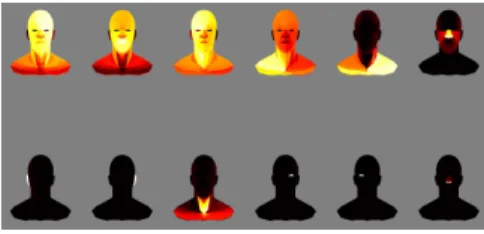
of the decomposition is set to the number of desired regions. Note that the basis functions computed for the head mesh, like the image decomposition results in Figure (1), highlight local anatomical features like the eyes, ears and nose. This is not the case for other basis functions, such as the diffusion wavelet basis46 or the eigenfunctions of the Laplace-Beltrami operator shown in Figure (3). The superior locality of the NMF basis is due to several factors: (1) the affinity matrix takes geodesic distance between faces into account resulting in surface clustering, (2) the NMF generates an additive decomposition of the mesh into local parts, and (3) the sparseness constraint drives low values in the NMF basis functions to zero, resulting in a sharper delineation of features.
Fig. 2. NMF basis functions (k= 12) for the head mesh plotted with a heat map color palette.
White denotes high values, and black denotes low values. Features such as eyes, ears and nose are clearly visible.
Fig. 3. Other comparable basis functions. Diffusion wavelet basis functions (top) and eigenfunctions of the Laplace-Beltrami operator (bottom) are not a local nor as feature specific as the NMF basis functions.
For segmentation, sparsity is enforced on the columns of H, which is the clus-ter indicator function. Sparsity on H encourages locality of the clusters. Figure 6
Fig. 4. NMF basis functions (k= 5) for the table mesh. The table top and each leg are isolated
in different functions.
Fig. 5. NMF basis functions (k= 6) for the hand mesh. Each finger is strongly associated with a
different function.
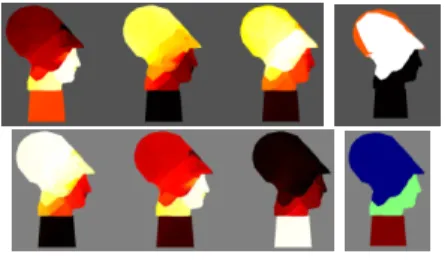
demonstrates the effect of sparsity on theHand the segmentation results. In the top row the basis functions without sparsity do not reflect a clear distinction between the three regions in the mesh. In the bottom row the sparse basis functions show a clear separation of regions which permits us to use a simple columnwise maximum operation to assign clusters to faces. The segmentation results are clearly improved with the sparsity constraint as the helmet, face and base are assigned to different regions.
Fig. 6. Basis functions (left) and segmentation results (right) computed without (top) and with (bottom) sparseness constraints (k = 3).
5. Results
In this section we present our experimental results and demonstrate the perfor-mance of our algorithm compared to spectral approaches. We tested the NMF segmentation approach on meshes from the Princeton Shape Benchmark, McGill 3D shape benchmark, and AIM@SHAPE-VISIONAIR repositories. For all results we have used parameter valuesδ∈[0.01,0.05],η ∈[0.1,0.2],n= 10. The value of
Fig. 7. Segmentation results on flamingo (k=4), dragon (k=6), armadillo (k=6), skeleton (k=7), pawn (k=4), hand (k=6), Lucy (k=10) and happy Buddha (k=6) and meshes.
Figure (7) shows successful results of our method on flamingo, skeleton, pawn and hand meshes. The flamingo was segmented into four regions which correspond to the body, two legs and the neck and head together in a single region. The NMF method combined with the choice of affinity matrix handles narrow extremities very well due to the inclusion of a dihedral distance term. The skeleton result is particularly impressive since there are many small bones and concave features that could have confounded the segmentation process. The pawn doesn’t have any long protrusions, like the other meshes, but small concave valleys between the parts lead to a good result.
One case in which our method performed better than spectral segmentation is the octopus mesh shown in Figure 8. Note that our method has placed all of the
Fig. 8. Segmentation results on octopus (k=9) using our method (left) and spectral mesh segmen-tation (right).
legs of the octopus into different regions while spectral segmentation produced a segmentation where two legs were in the same region (colored cyan), and a separate region appears near the base of the yellow leg.
Figure(9). On the horse and camel we are able to split the animals into leg, head and body regions. On the bunny mesh the head, ears, feet and tail are separate from the chest, back and thigh.
Fig. 9. Animal segmentation results. Camel (k=6), horse (k=6) and bunny (k=8).
Figure 10 shows a mesh for which NMF did not produce a good result. A semantic segmentation would have a region representing the hub at the center of the rocker arm and regions for the adjusting screw and nut at the top. Our method was able to segment the screw and nut, but not the hub. Spectral segmentation did a better job, but not ideal. That method was able to segment the hub and one end of the screw. These results are probably due to the relative flatness and smoothness of the mesh. Both methods would likely perform better by changing the affinity matrix to weight angular distance more or take some other geometric features into account.
Fig. 10. Segmentation of rocker arm (k=4) with NMF method (left) and spectral method (right). Both methods fail to produce a meaningful result.
Meshes that consist of multiple connected components (such as the handle, spout, lid and body of the teapot) and non-watertight meshes such as the teapot can be segmented. The hand mesh shown on the right side of Figure (11) demonstrates that NMF mesh segmentation can produce meaningful results in the presence of additive noise. In this experiment the input mesh had its vertices displaced in the normal direction by a random distance (zero-mean Gaussian with standard
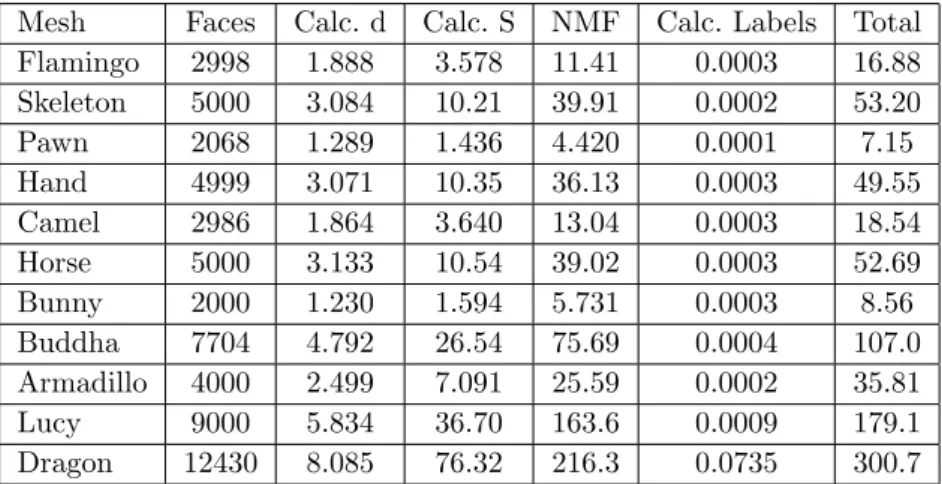
Mesh Faces Calc. d Calc. S NMF Calc. Labels Total Flamingo 2998 1.888 3.578 11.41 0.0003 16.88 Skeleton 5000 3.084 10.21 39.91 0.0002 53.20 Pawn 2068 1.289 1.436 4.420 0.0001 7.15 Hand 4999 3.071 10.35 36.13 0.0003 49.55 Camel 2986 1.864 3.640 13.04 0.0003 18.54 Horse 5000 3.133 10.54 39.02 0.0003 52.69 Bunny 2000 1.230 1.594 5.731 0.0003 8.56 Buddha 7704 4.792 26.54 75.69 0.0004 107.0 Armadillo 4000 2.499 7.091 25.59 0.0002 35.81 Lucy 9000 5.834 36.70 163.6 0.0009 179.1 Dragon 12430 8.085 76.32 216.3 0.0735 300.7
Table 1. Segmentation timing. All times are in seconds.
deviation = 0.02.) The results show separation of individual fingers into regions, and results are similar to the hand in Figure (7).
Fig. 11. The NMF segmentation method can handle meshes with multiple components and meshes that are not watertight, such as the teapot, k=4 (left) and noisy meshes, such as the hand, k=6 (right).
The sparse NMF segmentation algorithm was implemented in Matlab R2015a on a Dell Optiplex workstation with 3.4 GHz Intel Core i7-3770 CPU and 8GB RAM. Timings for the results in this section are presented in Table (1) and it is clear that computation time is dominated by the NMF calculation.
6. Conclusions and future work
We have presented a new mesh segmentation technique based on sparse non-negative matrix factorization. This method is simpler to implement than competing spectral segmentation approaches and can result in more meaningful segmentation results when the same distance metrics are used. The sparseness constraint results in improved localization of features and also improves consistency over multiple runs of the algorithm. This method can also handle meshes with non-manifold
edges that are not watertight and consist of multiple connected components.
6.1. Limitations
Mesh size and region count are limited by system memory. We have run out of memory on a 64-bit system with 8GB of RAM while segmenting a mesh with 50000 faces. This is because the matrix,S, assembled in algorithm 2 is a full matrix with size |F| × |F| where |F| is the number of faces in the mesh. Likewise, spectral mesh clustering22, requires construction of a dense pairwise face distance matrix. But the memory requirements of our implementation of the NMF are greater than the eigenvalue decomposition. We are investigating patch-based and multiresolution approaches to segmenting large meshes and more memory efficient implementations of NMF.
We have observed that NMF segmentation results depend on triangle quality. The same is noted for spectral segmentation. Using an area weighting when com-puting the affinity matrix, as is done in the conformal Laplacian, may help reduce the impact of triangle quality.
Sometimes computing segmentation labels with the max operation results in disconnected regions having the same label. This can be fixed by splitting discon-nected regions into multiple labels, resulting in a segmentation with more than k
regions.
6.2. Improvements
There are several areas of improvement to the proposed algorithm. The row maxi-mum operation for assigning clusters to faces is a simple and obvious approach, but replacing it with a more sophisticated process may improve the quality of clusters and result in smoother boundaries. Another approach to smoothing the segmenta-tion boundaries may be to directly filter the basis funcsegmenta-tions. To compare our results with spectral mesh clustering22we used the same distance matrix, but more exper-iments are needed to see if the NMF approach can be improved by using a different distance metric.
6.3. Applications
The parts-based local basis functions computed by the sparse NMF may be useful for other applications, such as automatically computed bone weights for skeletal animation. We will also explore the use of these basis functions for feature detection in applications such as shape matching and mesh retrieval.
Bibliography References
1. J. Shotton, T. Sharp, A. Kipman, A. Fitzgibbon, M. Finocchio, A. Blake, M. Cook, and R. Moore, “Real-time human pose recognition in parts from
sin-gle depth images,” Communications of the ACM, vol. 56, no. 1, pp. 116–124, 2013.
2. A. Sheffer, E. Praun, and K. Rose, “Mesh parameterization methods and their applications,” Foundations and Trends in Computer Graphics and Vi-sion, vol. 2, no. 2, pp. 105–171, 2006.
3. X. Li, T. W. Woon, T. S. Tan, and Z. Huang, “Decomposing polygon meshes for interactive applications,” inProceedings of the 2001 symposium on Interactive 3D graphics, pp. 35–42, ACM, 2001.
4. S. Katz and A. Tal,Hierarchical mesh decomposition using fuzzy clustering and cuts, vol. 22. ACM, 2003.
5. F. De Goes, S. Goldenstein, and L. Velho, “A hierarchical segmentation of articulated bodies,” inComputer Graphics Forum, vol. 27, pp. 1349–1356, 2008. 6. S. Biasotti, S. Marini, M. Mortara, G. Patane, M. Spagnuolo, and B. Falcidieno, “3d shape matching through topological structures,” inDiscrete Geometry for Computer Imagery, pp. 194–203, Springer, 2003.
7. T. Funkhouser, M. Kazhdan, P. Shilane, P. Min, W. Kiefer, A. Tal, S. Rusinkiewicz, and D. Dobkin, “Modeling by example,” in ACM Transac-tions on Graphics (TOG), vol. 23, pp. 652–663, ACM, 2004.
8. S. Shlafman, A. Tal, and S. Katz, “Metamorphosis of polyhedral surfaces using decomposition,” inComputer Graphics Forum, vol. 21, pp. 219–228, 2002. 9. W. E. Donath and A. J. Hoffman, “Lower bounds for the partitioning of
graphs,”IBM Journal of Research and Development, vol. 17, no. 5, pp. 420–425, 1973.
10. Y. Weiss, “Segmentation using eigenvectors: a unifying view,” inIEEE Inter-national Conference on Computer Vision, vol. 2, pp. 975–982, IEEE, 1999. 11. W. Xu, X. Liu, and Y. Gong, “Document clustering based on non-negative
ma-trix factorization,” inProceedings of the 26th annual international ACM SIGIR conference on Research and development in informaion retrieval, pp. 267–273, ACM, 2003.
12. Z. Li, J. Liu, and H. Lu, “Structure preserving non-negative matrix factoriza-tion for dimensionality reducfactoriza-tion,”Computer Vision and Image Understanding, vol. 117, no. 9, pp. 1175–1189, 2013.
13. G. Cybenko and V. Crespi, “Learning hidden Markov models using nonnega-tive matrix factorization,”Information Theory, IEEE Transactions on, vol. 57, no. 6, pp. 3963–3970, 2011.
14. Y. Xie, J. Ho, and B. C. Vemuri, “Nonnegative factorization of diffusion tensor images and its applications,” in Information Processing in Medical Imaging, pp. 550–561, Springer, 2011.
15. D. D. Lee and H. S. Seung, “Learning the parts of objects by non-negative matrix factorization,”Nature, vol. 401, no. 6755, pp. 788–791, 1999.
16. O. D. Faugeras and M. Hebert, “The representation, recognition, and locating of 3-d objects,” The International Journal of Robotics Research, vol. 5, no. 3, pp. 27–52, 1986.
17. A. Shamir, “A survey on mesh segmentation techniques,” inComputer Graphics Forum, vol. 27, pp. 1539–1556, 2008.
18. P. Theologou, I. Pratikakis, and T. Theoharis, “A comprehensive overview of methodologies and performance evaluation frameworks in 3d mesh segmenta-tion,”Computer Vision and Image Understanding, 2015.
19. H. Zhang, O. Van Kaick, and R. Dyer, “Spectral mesh processing,” inComputer Graphics Forum, vol. 29, pp. 1865–1894, 2010.
20. A. Y. Ng, M. I. Jordan, Y. Weiss, et al., “On spectral clustering: Analysis and an algorithm,”Advances in Neural Information Processing Systems, vol. 2, pp. 849–856, 2002.
21. B. Vallet and B. L´evy, “Spectral geometry processing with manifold harmon-ics,” inComputer Graphics Forum, vol. 27, pp. 251–260, 2008.
22. R. Liu and H. Zhang, “Segmentation of 3d meshes through spectral clustering,” inComputer Graphics and Applications, 2004. PG 2004. Proceedings. 12th Pa-cific Conference on, pp. 298–305, IEEE, 2004.
23. J. A. Hartigan and M. A. Wong, “Algorithm as 136: A k-means clustering algorithm,”Applied statistics, pp. 100–108, 1979.
24. H. Zhang and R. Liu, “Mesh segmentation via recursive and visually salient spectral cuts,” in Proc. of vision, modeling, and visualization, pp. 429–436, 2005.
25. J. Zhang, J. Zheng, C. Wu, and J. Cai, “Variational mesh decomposition,” ACM Transactions on Graphics (TOG), vol. 31, no. 3, p. 21, 2012.
26. H. Wang, T. Lu, O. K.-C. Au, and C.-L. Tai, “Spectral 3d mesh segmentation with a novel single segmentation field,”Graphical Models, vol. 76, no. 5, pp. 440– 456, 2014.
27. K. C. Das, “Maximum eigenvalue of the reciprocal distance matrix,” J Math Chem, vol. 47, pp. 21–28, 2010.
28. R. Liu and H. Zhang, “Mesh segmentation via spectral embedding and contour analysis,” inComputer Graphics Forum, vol. 26, pp. 385–394, 2007.
29. C. Fowlkes, S. Belongie, F. Chung, and J. Malik, “Spectral grouping using the nystrom method,”Pattern Analysis and Machine Intelligence, IEEE Transac-tions on, vol. 26, no. 2, pp. 214–225, 2004.
30. E. J. Nystr¨om, “ ¨Uber die praktische aufl¨osung von integralgleichungen mit an-wendungen auf randwertaufgaben,”Acta Mathematica, vol. 54, no. 1, pp. 185– 204, 1930.
31. Y. Fang, M. Sun, M. Kim, and K. Ramani, “Heat-mapping: A robust approach toward perceptually consistent mesh segmentation,” inComputer Vision and Pattern Recognition (CVPR), 2011 IEEE Conference on, pp. 2145–2152, IEEE, 2011.
32. M. Reuter, “Hierarchical shape segmentation and registration via topological features of Laplace-Beltrami eigenfunctions,” International Journal of Com-puter Vision, vol. 89, no. 2-3, pp. 287–308, 2010.
vol. 17, no. 4, pp. 395–416, 2007.
34. M. Meila and J. Shi, “A random walks view of spectral segmentation,” Inter-national Workshop on AI and Statistics, 2001.
35. T. Virtanen, “Monaural sound source separation by nonnegative matrix fac-torization with temporal continuity and sparseness criteria,” Audio, Speech, and Language Processing, IEEE Transactions on, vol. 15, no. 3, pp. 1066–1074, 2007.
36. K.-K. Sung, Learning and Example Selection for Object and Pattern Recog-nition. PhD thesis, MIT, Artificial Intelligence Laboratory and Center for Biological and Computational Learning, Cambridge, MA, 1996.
37. C. H. Ding, X. He, and H. D. Simon, “On the equivalence of nonnegative matrix factorization and spectral clustering.,” inSDM, vol. 5, pp. 606–610, SIAM, 2005. 38. I. S. Dhillon, Y. Guan, and B. Kulis, “Kernel k-means: spectral clustering and normalized cuts,” inProceedings of the tenth ACM SIGKDD international conference on Knowledge discovery and data mining, pp. 551–556, ACM, 2004. 39. S. G. Chang, B. Yu, and M. Vetterli, “Adaptive wavelet thresholding for image denoising and compression,” Image Processing, IEEE Transactions on, vol. 9, no. 9, pp. 1532–1546, 2000.
40. M. Lustig, D. Donoho, and J. M. Pauly, “Sparse MRI: The application of compressed sensing for rapid MR imaging,” Magnetic resonance in medicine, vol. 58, no. 6, pp. 1182–1195, 2007.
41. M. Elad and M. Aharon, “Image denoising via sparse and redundant represen-tations over learned dictionaries,” Image Processing, IEEE Transactions on, vol. 15, no. 12, pp. 3736–3745, 2006.
42. P. O. Hoyer, “Non-negative matrix factorization with sparseness constraints,” The Journal of Machine Learning Research, vol. 5, pp. 1457–1469, 2004. 43. D. L. Donoho, “For most large underdetermined systems of linear equations
the minimal 1-norm solution is also the sparsest solution,”Communications on pure and applied mathematics, vol. 59, no. 6, pp. 797–829, 2006.
44. J. Kim and H. Park, “Sparse nonnegative matrix factorization for clustering,” Technical Report, 2008.
45. Y. Li and A. Ngom, “The non-negative matrix factorization toolbox for biolog-ical data mining,”Source code for biology and medicine, vol. 8, no. 1, pp. 1–15, 2013.
46. R. R. Coifman and M. Maggioni, “Diffusion wavelets,”Applied and Computa-tional Harmonic Analysis, vol. 21, no. 1, pp. 53–94, 2006.
Photo and Biography
Tim McGrawreceived the Ph.D. degree in Computer and In-formation Science and Engineering from University of Florida, Gainesville, Florida, in 2005.
He has been an Assistant Professor of Computer Graphics Technology at Purdue University since 2013. His research in-terests are medical image analysis, scientific visualization and real-time graphics.
Jisun Kang is an MS student of Computer Graphics Tech-nology at Purdue University. Her research interests are medical image processing and visualization.
Donald Herringis an MS student of Computer Graphics Tech-nology at Purdue University. His research interests are real-time graphics, game development and non-photorealistic rendering.