This content has been downloaded from IOPscience. Please scroll down to see the full text.
Download details:
IP Address: 130.209.115.202
This content was downloaded on 06/02/2017 at 10:54 Please note that terms and conditions apply.
Participatory sensing as an enabler for self-organisation in future cellular networks
View the table of contents for this issue, or go to the journal homepage for more 2013 IOP Conf. Ser.: Mater. Sci. Eng. 51 012003
(http://iopscience.iop.org/1757-899X/51/1/012003)
You may also be interested in:
A Comparison of Generative and Discriminative Appliance Recognition Models for Load Monitoring Ahmed Zoha, Muhammad Ali Imran, Alexander Gluhak et al.
Scope for biological sensing technologies in meat production and export in northern Pakistan M S Qureshi and I H Qureshi
Exploring the potentials of volunteered geographic Information as a source for spatial data acquisition
Izyana Ariffin, Badariah Solemon, Rina Md Anwar et al.
Complex Product Architecture Analysis using an Integrated Approach Amad Uddin, Ioan Felician Campean and Mohammed Khurshid Khan
Evolution of the ATLAS distributed computing system during the LHC long shutdown S Campana and the Atlas Collaboration
Using game engine for 3D terrain visualisation of GIS data: A review
Ruzinoor Che Mat, Abdul Rashid Mohammed Shariff, Abdul Nasir Zulkifli et al. Analysis of the usage of polymer building materials in China
Hai-yang Ren and Su-fang Liu
Integration of Cloud resources in the LHCb Distributed Computing Mario Úbeda García, Víctor Méndez Muñoz, Federico Stagni et al. Brief Discussion on Green Building Materials
Participatory sensing as an enabler for self-organisation in
future cellular networks
Muhammad Ali Imran1,3, Ali Imran2 and Oluwakayode Onireti1
3
To who m any correspondence should be addressed.
1 Centre for Communication Systems Research (CCSR), University of Surrey, GU2 7XH, UK
2 Qatar Mobility Innovation Center, Doha, Qatar E-mail: [email protected]
Abstract. In this short review paper we summarise the emerging challenges in the field of participatory sensing for the self-organisation of the next generation of wireless cellular networks. We identify the potential of participatory sensing in enabling the self-organisation, deployment optimisation and radio resource management of wireless cellular networks. We also highlight how this approach can meet the future goals for the next generation of cellular system in terms of infrastructure sharing, management of multiple radio access techniques, flexible usage of spectrum and efficient management of very small data cells.
1. Introduction
Mobile cellular networks are traditionally designed to cater for the peak load/demand. This results in the wastage of valuable resources like energy, spectrum and space when the network is not fully loaded. This scenario is prevalent for a majority of the time when the network is active and hence the situation requires a more dynamic and intelligent design that will adopt the utilisation of the available resources according to the instantaneous load/demand of the system.
This challenge can only be met if we have a mechanism to monitor the system requirements and available resources in ‗time‘ and ‗space‘ domains in a live manner. On top of this we should have a mechanism to implement the on-the-run optimisation and configuration of network in an automated manner without the involvement of trained human resources to carry out the required tweaks and adjustments. The first requirement calls for a mechanism for collection of live data and the second requirement calls for the capability of self-organisation in the network.
Self organisation is a not a new area of research and development. The state of the art for this technique is discussed in detail in [1] where several defining features are also identified to classify a technique as self-organising. Some of the existing methodology towards self-organisation of cellular networks include: automatic neighbour relation function (ANR) for self-configuration of neighbour list in Long Term Evolution (LTE) system [2, 3]; self-configuration of propagation parameters such as antenna tilt and transmit power to improve coverage and capacity [4-6]; self-configuration of IP address [7, 8] and; load balancing through power and antenna adaption [9-11]. One of the key requirements of the self-organisation is to monitor and provide as an input all key parameters of the
system that affect the optimisation of configuration process. This can be achieved by enabling participatory sensing mechanism that can use the problem creators (the end user mobile devices and the applications running on them) to become part of a solution to the problem. Role of participatory sensing in a broad context is discussed in [12] and in the context of cellular/mobile devices is discussed in [13].
Participatory sensing offers several advantages over the conventional sensor networks which require the deployment of numerous static sensors, especially in urban areas. One main advantage of participatory sensing is that it leverages on the existing sensing provided by smart phones and communication provided by Wi-Fi and cellular architecture, thus, making the hardware deployment cost almost negligible. Also, participatory sensing inherits intrinsic economic scalability by exploiting existing phones as sensors. Furthermore, the open accessibility of application development toolkits for major mobile operating systems and convenient distribution channels in the form of App stores makes application development and deployment relatively easy. In addition, the inherent ubiquity and mobility of the phones yields spatiotemporal coverage at unprecedented scale which allows sensing and coverage of unpredictable events that might be missed by static sensor deployments [12]. The people-centred application of participatory sensing include: health and well-being where sensor enriched smart phones collect situ continuous data that improve the way wellness is reported and assessed as well as how treatment is delivered [14, 15]; monitoring sport experience; enhancing social media and price auditing [16-18]. Their environmental-centric applications include monitoring air quality, ambiance, noise, thermal column and road traffic condition [19-23].
In this short review paper we summarise the challenges that we anticipate in enabling this technique to be part of the future generation of cellular networks.
The rest of the paper is organised as follows. The next section presents the system model for participatory sensing. Section 3 summarised the challenges anticipated for making participatory sensing as a viable mechanism to gather data for enabling the self organisation of the network. Section 4 summarises the area of network management of optimisation that will benefit from the participa tory sensing approach. Section 5 identifies the desirable goals and objectives for the design and implementation of the next generation of cellular networks and how t hey relate with the participatory sensing framework. Finally we summarise the paper and provide an outlook for future research and development in this area.
2. Participatory Sensing System Model
PS System Model
Sensing, Tasking, Reporting, Storage, Processing and Presentation Participant
Privacy
User Participation and Data sharing ability
Overheads
Campaign Administrator
Data Quality
Data Credibility
Data Mining and Managment End User Legend: Stake Holders PS Application Components Challenges
Figure 1. Participatory sensing system model including stake holders and application components with identification of underlying challenges
A generic system model of participatory sensing is presented in Figure 1. The system model is made up of three distinct stakeholders which are: the campaign administrators, the participants and the end users. The campaign administrators are responsible for setting up the participatory sensing campaign. They design, implement, and deploy the system architecture and are responsible for the maintenance and the management of the infrastructures. The participants have the sensing application on them and contribute to the participatory sensing campaign by gathering the sensor reading they have obtained. The end users on the other hand access and consult the data gathered by the participant according to their interests or preferences. End users could include the contributing participants which consult on their own collected data, campaign administrator verifying the obtained results or specialized entities attempting to gain insights about the monitored phenomena. Irrespective of the entity that serves as the end user, the reliability of the data produced by participatory sensing is a major concern on its application. The underlying challenges of participatory sensing can be categorised into two. The first category of challenges which include: user participation and sharing ability, privacy concern and overheads affects the main participatory sensing stakeholder, i.e. the participant. The second category of challenges primarily affects the administrator of a PS campaign, though it indirectly affects the ‗end user‘ as well. This category includes challenges of controlling the spatiotemporal sampling to ensure quality of information, identifying and filtering out malicious or noisy inputs to ensure credibility of data gathered, and right context extraction without jeopardizing the participant. A detailed description of these challenges is presented in the next section.
3. Challenges in participatory sensing
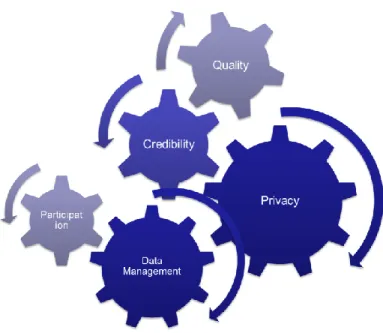
Participatory sensing is a promising techniques but it is mired by several intertwined challenges that need to be overcome before it can provide its promised benefits, as shown in Figure 2. In the sequel we identify some of these main challenges and briefly discuss their scope.
3.1.Data Quality
Quality of the data collected by the participatory sensing techniques is of paramount importance to decide where and to what extent we can use this data for mission critical purposes. It is important to filter the data and identify the outliers as well as to fill in the gaps by interpolating and extrapolating the data to cover the missing parts of the full picture. These extrapolations also require methods for inference and analysis of the data. Finally all participating sensors do not have equal weightage in terms of their contribution so mechanisms need to be developed to apply user-preference and reliability measures while integrating the data from several sources.
3.2.Data Credibility
Participatory sensing relies heavily on altruistic user contributions. However, this openness makes participatory sensing vulnerable to malicious inputs. Without trust in the data provided by participants, the resulting statistics can be of little use. Therefore, it is important to ensure that the collected data comes from a trusted and credible source. Mechanisms and techniques need to be developed to ensure that any user added to the group or participating sensors should be admitted after authenticating their credibility. Mechanisms should also be in place to ensure that their performance and activity is monitored to ensure that untrustworthy adversaries do not hijack them.
3.3.Participant’s Privacy
Participatory sensing enables availability of large amount of real time data shared by participants. This comes with an inherent challenge of maintaining watertight systems that can protect personal privacy. There is a need to develop a privacy-preserving framework that will enable users of participatory sensing applications to contribute data without having to worry about compromising their
privacy. The research on privacy preservation in this context has to focus on both spatial and temporal privacy of users, which are two universal attributes that are expected to be included in user reports for all participatory sensing applications in general and participatory applications to be to be exploited for enabling self-organisation in particular. Another important aspect is to ensure the privacy of the participants‘ data while collecting the data in a live manner and also for the historic data stored in the cloud or other centralised devices.
3.4.User participation and data share-ability
From viewpoint of user participation and share-ability, participatory sensing can be considered analogous to a peer-to-peer network where users contribute sensing data to be shared among them or with central server. An issue that is central to both types of network is that there must be an incentive for the users to share, otherwise, it is well known from the ―Tragedy of the Commons‖ that most users will tend to be free-riders rather than contributing resources to help system achieve its objectives. Therefore, one of the key challenges in participatory sensing is to convince and motivate the users to willingly participate in the data collection process. It is clear that this challenge is linked to the privacy challenge since ensuring the privacy of the end user's data can be a strong motivation for the users to be willing to participate in data sharing. Appropriate levels of abstraction and anonymisation should be implemented to convince users to share their personalised data (like user position, activity logs, trajectory and presence information in certain locations).
3.5.Data mining and management
The data collected by participatory sensing from a large scale of sensors and from a diverse group of participants is bound to scale very quickly into a large sized set – classified as a ―big data‖ problem. Management of such a data set and extraction of useful information in a timely manner is a big challenge and an active area of research.
Figure 2. Different challenges in the implementation of participatory sensing actually drive and affect each other due to their intertwined nature.
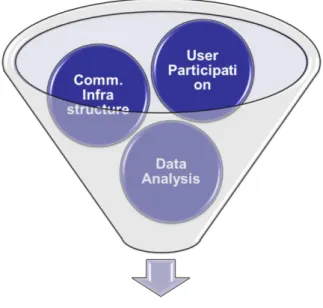
A working participatory sensing mechanism at its own is not sufficient to provide full benefits for the optimisation of a multi-objective cellular network. This should be augmented with the mechanisms
reliably communicating this information to a decision maker and providing means and mechanisms for data analysis and filtering. All these ingredients can ensure that we can optimise the system operation in light of multiple, and at times conflicting, objectives (like deployment optimisation, energy efficiency, spectrum efficiency and delay minimisation).
4. How participatory sensing will help?
Assuming that we have a working participatory sensing framework that collects the data from all users in a cellular system, we summarise different aspects of cellular network design and configuration that can benefit from this framework.
Figure 3. Design and implementation of the participatory sensing framework must have all the necessary ingredients to enable a ubiquitous multi-objective cellular network
4.1.Efficient Deployment
Data logged for user positioning and time stamps for data demand of different users at different times of the day can be utilised to identify the hotspots for service demand. In addition, signal levels along with the user positioning reported from the end user devices can also identify the gaps in coverage. All this information can benefit in optimising the deployment of infrastructure. This deployment can be a static deployment or can be changed in a more dynamic manner by switching ON/OFF certain nodes in the system depending on the demand and the time of the day as proposed in [24].
4.2.Efficient Self-organization
For a real-time, short time-scale optimisation and configuration of the network we require autonomous mechanisms for optimisation and configuration. This will also require real-time data acquisition from participatory sensing mechanisms. However, provided the data is reliable, credible and all users willingly participate, this can significantly improve the performance of the self-organising networks. An example of such self-organisation that can be based on participatory sensing data is autonomous antenna tilt optimisation while taking into account live user demography and activity profiles, as proposed in [25].
4.3.Efficient Radio Resource Management
Usually radio resources are managed on a long time-scale to adapt to average network and link statistics. However this may result in under-provisioning or over-provisioning of resources. However with a working participatory sensing mechanism in place, this can be drastically changed and the optimisation can track the variation in the opportunities very closely and hence reducing any associated wastage of the resources. Cell size or handover hysteresis optimisation for resource to load balancing based on live user experience is an example of possible applica tion of such participatory sensing enabled efficient radio resource management [26].
4.4.Enabler for Future Architectures
Some futuristic architectures like massive MIMO, coordinated multipoint, opportunistic relaying etc. will require real-time channel state information and other system parameters to be reported to a decision making central point. All of these futuristic ideas will significantly benefit from the participatory framework for their self-configuration and optimisation.
5. Goals for future generation network
Based on the participatory sensing mechanism that will act as an enabler for self-organisation in future cellular systems, we should aim for several top level desirable features in the next generation of the system. Some of these desirable features are discussed briefly and it is highlighted how these ambitions will benefit from participatory sensing.
5.1.Infrastructure sharing
With the advent of very dense cellular systems for meeting the future data demands, we need to keep the spiralling capital expenditure CAPEX for each operator under control. For economic and technical viability of future cellular systems, the trend has to shift from competition to coopetition, among rivals in the industry. A simple model is to enable infrastructure sharing. A main impediment for enabling this is the perception of loss of control on the assets and inability of fairly sharing the revenues from the system. Participatory sensing can help by ensuring data collection regarding trajectories, usage patterns etc. for each operator‘s users to allow building up the profit sharing models as well as to allow a federation of assets where assets can be shared or kept for exclusive use based on the demands and dynamics of end users.
5.2.Co-existence of multiple radio access technologies
The network is fast becoming a melting pot of plethora of different options to provide wireless service. Despite of co-existing in space and time, so far these different options are operating mainly as competitors. Even if they are used to complement each other in some instances, the cooperation witnessed so far is ad-hoc and not well designed due to lack of availability of user specific data and inherent unpredictability associated with wireless eco-system. However, all this can change by exploiting the rich data collected from participatory sensing. Multi-vendor, multi-RAT co-existence exploitation agents can be designed to optimise the use of several radio access technologies jointly while taking into account user specific application requirements, social-economic portfolio and predictions of spatio-temporal footprints.
5.3.Flexible spectrum usage
One of the key features in future networks is more efficient and flexible usage of the spectrum. Some researchers propose the use of spectrum sensing based techniques for the flexible spectrum allocation but this will lead to unnecessary complexity and wastage of resources at the sensing end. On the other hand, some researchers are proponents of data base based spectrum allocation in time and space. However, creation of such databases is only feasible if we allow participatory sensing to collect
and share the spectrum availability information that will again require spectrum sensing but this will only be needed during the stages when database is being populated. Once a database is stable, only few infrequent sensing operations will be required to keep the database up to date.
5.4.Management of individual data cells using control cells
An emerging architecture of dense cellular networks proposes the separation of data and control functionalities in the system. A large sized macro cell should control the coverage through control signalling and small, densely packed, access points should provide the data service. Such models are explained in details in [27, 28]. The working of this architecture can benefit from the participatory sensing by reporting the emerging demands and trends to optimise the hand-overs, data handling, switching ON/OFF certain data nodes and several other optimisation functionalities in future cellular networks.
6. Outlook and summary
Overall, we have identified that with emerging demands of very high efficiency in cellular networks the self organising mechanisms will become inevitable. One of the enabler for self organisation is timely availability of the optimisation/configuration parameters. In this regard we identify the potential role of participatory sensing techniques. We have discussed the intertwined challenges to enable participatory sensing framework and then identified the areas that can significantly benefit from such a mechanism. We have also identified some key features expected in next generation of cellular networks and discussed how participatory sensing can play a positive role in ensuring these features are implemented in next generation of the system.
7. References
[1] Aliu, O.G.; Imran, A.; Imran, M.A.; Evans, B., "A Survey of Self Organisation in Future Cellular Networks," Communications Surveys & Tutorials, IEEE , vol.15, no.1, pp.336-361, First Quarter 2013. doi: 10.1109/SURV.2012.021312.00116.
[2] Mueller C. M., Bakker H. and Ewe L., ―Evaluation of the automatic neighbour relation function in a dense urban scenario,‖ in Vehicular Technology Conference (VTC Spring), 2011 IEEE 73rd, 2011, 1-5.
[3] 3GPP TS 36.300, Evolved Universal Terrestrial Radio Access (E-UTRA) and Evolved Terrestrial Radio Access Network (E-UTRAN); overall description; Stage 2
[4] Wu J. S., Chung J. K. and Wen C. C., ―Hot-spot traffic relief with a tilted antenna in CDMA cellular networks,‖ IEEE Trans. Veh. Technol., vol. 47, no. 1, pp. 1 –9, Feb 1998.
[5] Temesvary A., ―Self-configuration of antenna tilt and power for plug & play deployed cellular networks,‖ in Proc. IEEE Wireless Communications and Networking Conf. WCNC 2009, 2009, pp. 1–6.
[6] Calcev G. and Dillon M., ―Antenna tilt control in CDMA networks,‖ in 2nd Annual International Wireless Internet Conference, 2006.
[7] Alcatel-Lucent, ―Automated installation of eNodeBs,‖ R3-071251, 3GPP TSG RAN3, vol. Sophia Antipolis, 2007.
[8] Hu H., Zhang J., Zheng X., Yang Y., and Wu P., ―Self-configuration and self-optimization for LTE networks,‖ IEEE Commun. Mag., vol. 48, no. 2, pp. 94–100, 2010.
[9] Wang A. and Krishnamurthy V., ―Mobility enhanced smart antenna adaptive sectoring for uplink capacity maximization in CDMA cellular network,‖ IEE Trans. Commun. , vol. 56, no. 5, pp. 743 –753, May 2008.
[10] Wu J., Bigham J., Jiang P., and Wang Y., ―Intelligent control of cellular network coverage using semi-smart antennas for load balancing,‖ International Conference on Signal Processing Communications and Networking, ICSCN ‘08, pp. 295 –301, 2008.
[11] Siomina I. and Yuan D., ―Optimization of pilot power for load balancing in WCDMA networks,‖ in IEEE Global Telecommunications Conference, 2004, (GLOBECOM ‘04), vol. 6, 2004, pp. 3872 – 3876.
[12] Burke J., Estrin D, Hansen M, Parker A, Ramanathan N, Reddy S, Srivastava M B, ―Participatory sensing‖. In ACM Sensys World Sensor Web Workshop, Boulder, CO, USA, Oct 2006.
[13] Reddy, Sasank and Samanta, Vidyut and Burke, Jeff and Estrin, Deborah and Hansen, Mark and Srivastava, Mani, ―MobiSense—mobile network services for coordinated Participatory Sensing‖, in International Symposium on Autonomous Decentralized Systems, 2009. ISADS'09. IEEE 2009.
[14] Blom J. and Hänninen R.. Air Pollution in Everyday Life: toward Design of Persuasive Urban Air Quality Services. 7th International Conference on Persuasive Technology (Persuasive), Linköping, Sweden. June 2012
[15] Consolvo S., McDonald D. W., Toscos T., Chen M., Froehlich J. E., Harrison B., Klasnja P., LaMarca A., LeGrand L., Libby R., Smith I. and Landay J. A., ―Activity Sensing in the Wild: A Field Trial of UbiFit Garden‖, in Proceedings of the 2008 Conference on Human Factors in Computing Systems (CHI 2008), Florence, Italy, April 2008.
[16] Eisenman S. and Campbell A., ―SkiScape Sensing‖, in Proceedings of the 4th International Conference on Embedded Networked Sensor Systems (ACM SenSys 2006), Boulder, Colorado, USA, November 2006.
[17] Gaonkar S., Li J., Choudhury R., Cox L. and Schmidt A., ―Micro-Blog: Sharing and Querying Content Through Mobile Phones and Social Participation‖, in Proceedings of the 6th ACM International Conference on Mobile Systems, Applications, and Services (ACM MobiSys), pp. 174–186, Breckenridge, Colorado, USA, June 2006.
[18] Deng L. and Cox L. P., ―LiveCompare: Grocery Bargain Hunting Through Participatory Sensing‖, in Proceedings of the 10th
Workshop on Mobile Computing Systems and Applications (HotMobile 2009), Santa Cruz, California, USA, February 2009.
[19] Carrapetta J., Youdale N., Chow A. and Sivaraman V., ―Haze Watch‖, online at http://www.pollution.ee.unsw.edu.au.
[20] Maisonneuve N., Stevens M., Niessen M. and Steels L., ―NoiseTube: Measuring and Mapping Noise Pollution with Mobile Phones‖, in Proceedings of the 4th
International Symposium on Information Technologies in Environmental Engineering (ITEE), Thessaloniki, Greece, pp. 215-228, May 2009.
[21] Bao X. and Choudhury R., ―MoVi: Mobile Phone Based Video Highlights via Collaborative Sensing‖, in Proceedings of the 8th
ACM International Conference on Mobile Systems, Applications and Services (ACM MobiSys 2010), Berkeley, California, USA, pp. 357-370, June 2010.
[22] Von Kaenel M., Sommer P., and Wattenhofer R., ―Ikarus: Large-Scale Participatory Sensing at High Altitudes,‖ in Proceedings of the 12th Workshop on Mobile Computing Systems and Applications (HotMobile), 2011, pp. 55–60
[23] Mohan P., Padmanabhan V., and Ramjee R., ―Nericell: Rich Monitoring of Road and Traffic Conditions using Mobile Smartphones,‖ in Proceedings of the 6th ACM Conference on Embedded Network Sensor Systems (SenSys), 2008, pp. 323–336.
[24] Capone, Antonio and Filippini, Ilario and Gloss, Bernd and Barth, Ulrich, ―Rethinking cellular system architecture for breaking current energy efficiency limits‖, in Sustainable Internet and ICT for Sustainability (SustainIT), 2012, IEEE.
[25] Chen, Yan and Blume, Oliver and Gati, Azeddine and Capone, Antonio and Wu, Chi-En and Barth, Ulrich and Marzetta, Tom and Zhang, Haibin and Xu, Shugong, ―Energy Saving: Scaling Network Energy Efficiency Faster than Traffic Growth‖ Wireless Communications and Networking Conference Workshops (WCNCW), 2013.
[26] Imran, A.; Imran, M.A.; Tafazolli, R; ―A novel Self Organizing framework for adaptive Frequency Reuse and Deployment in future cellular networks,‖ 21st Radio Communications (PIMRC), IEEE; vol., no., pp.2354-2359, 26-30 Sept. 2010
[27] Imran, A.; Imran, M.A.; , Atta-ul-Quddus; Tafazolli, R.; , ―Distributed spectral efficiency optimization at hotspots through self-organisation of BS tilts,‖ IEEE GLOBECOM, 2011, vol., no., pp.570-574, 5-9 Dec. 2011
[28] Imran, A.; Yaacoub, E.; Imran, M.A.; Tafazolli, R.; , ―Distributed Load Balancing through Self Organisation of cell size in cellular systems,‖ Personal Indoor and Mobile Radio Communications (PIMRC), 2012 IEEE 23rd International Symposium on , vol., no., pp.1114-1119, 9-12 Sept. 2012
Acknowledgments
This work was made possible by NPRP grant No. 5 - 1047 - 2 – 437 from the Qatar National Research Fund (a member of The Qatar Foundation). The statements made herein are solely the responsibility of the authors.