Architectural illumination aims to
reveal the existing form of a
building and create links between
it and the landscape, defining a
unique identity while respecting
the living environment of people.
Lighting objectives
Lighting can transform the night-time appearance of a building or
landscape. The aesthetics, usability and desirability of a structure
or place can be increased by good lighting design. To achieve this,
there must be a clear understanding between all parties on the
objectives of the night-time scene.
Architectural illumination has three main categories:
• Historical - buildings and structures of special historic interest
• Contemporary - modern and “industrial” premises
• Ambience - parks, precincts and water features
All three share the same three broad lighting design objectives:
appearance, performance and safety.
Most buildings and their surroundings have a purpose, whether it is
commercial or tourism, historical aesthetic or modern. The lighting
needs to enhance the brand image, to bring out the beauty of
the architecture and open the surrounds to confident exploration
and enjoyment. A well lit approach can provide an enhanced
appearance whilst satisfying the requirements for safety of those
using the space and those who own it.
When translating these objectives into lighting criteria there are
several considerations. Firstly, since the visual size of the details
to be seen are generally large low levels of lighting tend to be
sufficient. Secondly the lighting of vertical surfaces assumes more
importance outdoors.
Picture 1: Bridge of Avignon, FR Photo: © Christophe Canadell Noctabene Agency Picture 2: Torre Alemanna, IT.
Photo: © Fabio Baraldi Architect: Vincenzo Russo Picture 5: Pont Audemer, FR.
Architectural
Illumination
Architectural illumination is one of those subjects which needs
to be defined before it can be understood. It differs from other
forms of exterior lighting in a number of key aspects, some of
which can be lengthy to explain. So perhaps our starting point
should be to categorise the various applications
Functional illumination
is where light is used to enable
people to carry out a task in a particular area. Typically, the
area around a security access gate would require functional
lighting.
Promotional illumination
serves a different purpose, which
is to attract the attention of a viewer, and to encourage further
involvement – lighting an advertising billboard would fall into
this category.
Architectural illumination
is quite different from either of
the above. The requirement here is to reveal detail differently
from the daytime, to create links between architectural features
of buildings and landscapes defining a specific identity whilst
respecting the living environment of people. It is an area in
which the designer needs creativity, intuition and flair.
At Thorn we begin with the idea of light itself before progressing
to specific products. Creating aesthetic appeal, conveying
messages and meanings, facilitating orientation, maximising
safety, conserving energy and establishing how particular light
sources will interact with building surfaces are all important
considerations. Our aim is to bring art and science together, to
encourage creativity, not blandness, and to craft an imaginative
lighting solution that balances emotional impact with the
functional aspects of the project.
That’s why we offer ranges from which almost any architectural
lighting requirement may be met. By applying this brochure,
including eControl guidance on 15 ways to make energy
efficient lighting easy, economic prosperity and citizen well-being
can be improved and the impact on the environment reduced.
Contents
Illumination criteria 04
eControl 08
New product - Contrast 2 LED 10
Ways of lighting 26
Sensa DMX 50
Why Thorn Lighting?
As a trusted global supplier of professional outdoor and indoor lighting with integrated controls, we have years of experience in luminaire development.
Leveraging our research and development facilities, we actively work to raise lighting standards and are uniquely placed to combine the latest light source technology with our specialist expertise in optical and luminaire design.
When you’re lighting facades, structures or amenity spaces with our products you can achieve a solution where aesthetics, optical performance, energy consumption and maintenance are all in perfect balance.
Picture: Place des Epars à Chartres, FR. Reichen & Robert.
Architects: Paysagist Atelier Jacqueline Osty. Lighting Design: Roger Narboni,
Criteria
There are a number of variables that must be
taken into account when selecting architectural
illumination equipment. These can be grouped
into: ‘function factors’ and ‘emotion factors’.
Functional factors relate to the physical and
operational characteristics of the lighting system,
whereas emotional factors are those that affect
user’s evaluation and can be harder to ascertain.
Placement
To start an outdoor lighting design you need to know the principal viewing position or approach to the building or area being lit. Don’t confuse this with the general aiming orientation for the main lights. This direction should be different from the most common viewing direction for the building, otherwise no shadows will then be visible and the scene will appear flat. The direction of light can be used either to emphasise or flatten detail. Dazzle or “disability glare” can be avoided with careful positioning and aiming. The additional use of hoods, spill rings and louvres for screening lamps from sight at normal viewing angles are often used, but will reduce performance. Distraction or “discomfort glare” can be overcome by increasing the mounting height, aiming the peak intensity of these floodlights at angles below 70° to the downward vertical and, where possible, increasing background ambient light levels.
How much light?
Most exterior lighting guides give maintained illuminance values for specific applications but this is not what we actually see. Illuminance is a measure (lux) of the quantity of light that falls on a surface. It does not depend on the surface properties of what is being lit. A dark and light surface next to each other could be receiving the same amount of illuminance but the brightness would be quite different. The light surface would look brighter. Surface reflectance is influential in our perception of the brightness of surfaces. Brightness is subjective whereas Luminance, the light reflected from
a surface, can be measured (cd/m²), and can be considered to be objective. Consequently in determining quantities of light for outdoor applications there is a mixture of references to luminance, reflectance and illuminance. Architectural illumination is particularly subjective and will depend upon the relative brightness of the surroundings or character of the area, often known as district brightness. To avoid overlighting and obtrusive light the lighting industry has issued guidance notes, including specific recommended luminance levels which relate to average and maximum illuminance values for the lighting of a series of environmental zones, ranging from dark landscapes to bright inner city areas.
Fig. 3 The ratio between the average luminance and the maximum luminance will determine the degree of contrast in the subject. This is referred to as the luminance contrast ratio. In the case of a building facade lit to an average level of 10 cd/m², the highlighting of a small portion to a luminance of 30 cd/m² will only just be noticeable. Increase the luminance to 50 cd/ m² and the effect becomes more dramatic. Remember that these ratios relate to the amount of light reflected from the surfaces. If the building facade is red brick with a given reflectance factor of 0.3 and a feature is a white plaque with a reflectance of 0.9, and they are lit to the same illuminance, there will be a brightness ratio of 1:3. To make things easier suggested illuminances can be given for a range of typical materials for use in preliminary design based on the use of a ‘white’ light source. See Fig 1 and 2.
The ‘function’ factors
Fig 1 Illuminance onto a surface, luminance off the surface
The Effect of Luminance Contrast Ratio 1:1 Not Noticeable 1:3 Just Noticeable 1:5 Low Drama 1:10 High Drama
Fig 2 The smaller square of higher reflectance is brighter.
Fig 3
Illuminance Luminance
Reflection e.g. 0.4
Lamp types
The most common lamps used for architectural lighting are powerful high-intensity discharge (HID) sources, metal halide and high-pressure sodium, although dimming is not reliable and the latter’s quality does not distinguish colours clearly. The excellent colour rendition and brilliant light of mini tungsten halogen means that it continues to be used, but selectively due to poor efficacies and lamp life LED being the most common replacement. The linear fluorescent has high lumen efficacy and a wide choice of colour temperatures and colours, but this relatively large, diffused, light source does not lend itself to providing narrow beam distributions in long throw projectors and is therefore more suited to wall washing and guidance tasks. As performance improves and costs fall, LEDs have rapidly become the lamp of choice. Their unique qualities – instant start, high efficacy, compact size, long life, reliable performance in cold temperatures, good colour rendition and dimmability/colour control - are perfect for most applications. A further attribute of LEDs is that their light is emitted in a specific direction. Thus modern optical designs, materials and techniques can deliver more controlled light distributions and maximise performance.
Maintenance
Even when the most suitable lamp and luminaire combination has been selected, the energy costs can still be reduced by regular maintenance. Floodlights with a re-positioning lock system are helpful if the appearance is to be maintained over successive maintenance operations.
Lamp type Luminous Efficacy (lm/W) Lamp Life (h) CRI Re-strike times Tungsten Halogen 12 – 35 2000 – 4000 Very good Prompt
CFL 40 – 65 6000 – 12000 Good Prompt
Linear Fluorescent 50 – 100 10000 – 50000 Good Prompt Induction Lamp 60 – 80 60000 – 100000 Good Prompt
Metal Halide 50 – 100 6000 – 12000 Good 5 – 10 minutes Low Pressure
Sodium 100 - 200 6000 - 8000 Very poor 2 – 5 minutes High Pressure
Sodium 40 – 100 12000 – 16000 Fair to good 2 – 5 minutes LED 20 - 120 20000 – 100000 Fair to very good Prompt
Surfaces
How much light you direct on to a building is less important than how much is reflected back from it and how this is reflected. What you will see is dependent on roughness and reflectance factors of a given surface – darker, more textured surfaces need more light than pale, smooth surfaces. ‘Portland stone’ for instance reflects well, but ‘dirt coated dark brick’ would need a lot more light to look as bright. The same is true when colour is used, but is complicated by “colour absorption”. The fabric of a building has a colour, or in many cases a mixture of colours. Different types of lamp will give differing colour renditions. Light sources which are monochromatic, or strongly biased towards a small range of colours, will only reveal some of the colours resident in the structure. Using for instance a low pressure sodium lamp (monochromatic yellow) on a red surface would be pointless because the lamp has no red content and there would be almost no visible effect on the lit surface. At the same time, lighting a strongly coloured surface, for instance
trees with green foliage, with matching colour light will produce “colour saturation”, where the natural colour of the lit subject is reinforced. “White” sources (which contain a representation of the full spectral range) are therefore necessary for materials which are required to be seen close to their appearance in natural light. It is not only the lightness of the building surface which is important, but also the degree of specularity. Matt surfaces have the advantage of reflecting light in all directions so when buildings are lit from a low or ground level the apparent brightness when viewed at ground level can be relatively high. However, reflections from specular surfaces such as marble and stainless steel can present difficulties as when projectors are installed at ground level the reflected component is directed into the sky and away from the observer.
Effect of building surfaces on lighting
Colour appearance and colour rendering
Within “near white” light, as a general rule provided by fluorescent, tungsten halogen, metal halide and LED light sources, there is variation by colour temperature, this will change the appearance from warm to cold, the higher the temperature, the “cooler” the light. A safe and simple design approach is to use warm colour appearance light sources with warm coloured materials and use cool colour appearance light sources with cool coloured materials. For example, red brickwork would be sympathetically lit by high pressure sodium lamps (which have a yellow bias among a limited spectrum output) with a colour temperature of about 2000K, but could look rather dull with metal halide lamps with a colour temperature of over 5000K.
There is also a scale of colour rendering properties expressed as a “CRI” or “Ra” figure (0–100) - again the higher the number, the more accurate the colour rendering. A classification of a light source of Ra80 and above will indicate good colour rendering. Lamps of good colour rendering will make a scene look natural whereas lamps of poor colour rendering will distort some colours making the appearance of a scene unnatural.
Matt Building
Specular Building
Colours
Coloured lighting has a dramatic effect on the way people react to
the scene. Strong colours reinforce the nature of a busy area, while
softer colours induce a more relaxed response. Using different light
sources or colour mixing RGB LEDs can produce colour contrasts
and allows a distinction to be made between two parts of a building
or space. Both methods can also simulate shadow, moonlight and
sunrise/sunset.
District brightness
The degree to which an object is accentuated depends upon the
contrast between the object and its background. To achieve a
desired emphasis the luminance of the object has to be related to
the district brightness. The light levels used on a structure or natural
feature should be in harmony with the light levels of the surrounding
area. For example, a country church may need little more than
moonlight levels to make its presence felt whereas a building lit to
this level in the centre of a city would hardly be noticed.
Criteria
The ‘emotion’ factors
By direction
By intensity By colour Beam control
Floodlights have a light distribution which is related to the shape of the reflector. A round reflector will produce a conical beam, symmetrical between vertical and horizontal axes. This is known as a “circular” type and is useful for long-throw requirements, typically to pick out a single feature. A rectangular reflector, curved in one direction only, will produce a beam which is “asymmetrical” between its two axes – useful for lighting areas rather than small points. But it is rare that an “off the peg” floodlight will give the precision required. Constraints in mounting positions will often generate a need for a “modified” beam, and add-on accessories such as refractor glasses and holographic films which vary the beam shape, are vital in getting the right result. Manufactured from thin film substrates holographic films can be placed above LEDs to soften or dramatically re-shape the beam. Their high transmission efficiencies far exceed that of glass or plastic material. Used as “beam shapers” they can expand a circular beam or stretch it to a linear line of light.
Contrast
In an exterior scene it is the highlights and shadows that bring contrast and achieve modelling; these are created by the direction (a function of the geometry of the installation) and the intensity of the light. Spaces and structures that feature areas of light and shade are generally preferred by observers and considered more interesting. Light naturally attracts, so highlighting key features will help an observer relate to the structure. Care should be taken to only light those details that are required, as too many highlights will destroy the effect and either make the structure appear bland and uninteresting or disjoined and incoherent. Completeness is also important and care should be taken to avoid “floating” appearances where the upper part of a building is lit but the lower level is not, removing the connection with the ground.
The impressions of a lit area are subjective and cannot be measured. Designers mainly rely on experience, supplemented if necessary by daytime photographs, computer visual simulations, scale models and site experiments, to achieve the desired results.
Colour temperatures
The colour appearance of a light source can evoke a warm or cool atmosphere depending on the choice of colour temperature of the source. The spectral distributions of light emitted by typical ‘white’ lamps show quite notable differences from warm to cool, so that you can produce subtle contrasts in colour appearance.
By colour temperature 4200K (neutral) 3000K (Intermediate) 2700K (warm)
Intensive light beam Semi-extensive light beam created with intensive + refractor
Technology
Lamp efficacy
How efficiently a lamp converts electricity into light (lm/W)
Ballast classification
Controls the electricity supply to the lamp (Energy Efficiency Index EEI)
Luminaire distribution
Light is controlled and emitted from a luminaire using optics which bend and shape the light to the correct location
System efficacy
The combination of optical and thermal control within the luminaire (luminaire lm/W)
Control
Application
Environment
Presence/Absence
Presence: Lights automatically turn on and off with movement.
Absence: Lights automatically turn off and have to be manually switched on.
Daylight
Artificial lighting responds to the natural light conditions
Constant illuminance
A function designed to produce correct lighting levels for the duration of the maintenance period
Task/Scene setting
Allows the user to set scenes and adapt the lighting to different aesthetics and tasks
Timed off
Automatic cut-off can be installed to turn all lights off during unoccupied hours
Task lighting
Lighting the task areas with the correct amount of light
Zoning of lighting
Lighting is zoned according to area use
Maintenance schedule
Maintenance must be performed in response to product age, performance and environment
Waste light
Any light which does not hit the intended target is waste light
Reflectance
Light is reflected from the surface within the space
Visible smart metering
Results of actions can be quickly seen as increased or decreased energy use
To help you through the process of understanding, specifying, installing and
maintaining good quality, energy efficient lighting, we recommend you take
advantage of our eControl programme.
Originally conceived to promote electronic dimming and indoor control systems, eControl has now been expanded to cover all our outdoor energy focused initiatives products and services (including those above). If you are considering migrating to the latest energy efficient technologies, eControl advice is available on request. Within this philosophy we have developed 15 easy ways to save energy, for the full frame work see below 15 ways to make energy efficient lighting easy
When considering energy efficiency and lighting it is important that it is not considered in isolation. A lighting installation has a basic requirement to provide a sufficient amount of light to allow a task to be performed efficiently and safely. Requirements for this are given in standards such as EN 12464 (Lighting of workplaces), EN 13201
(road lighting), EN 1838 (emergency lighting), etc. In addition, as well as providing good task illumination the lighting installation should provide light of a good enough quality to provide a pleasant and fulfilling environment for the occupants of a space. The ideal is to provide these two aspects in as energy efficient way as possible. Energy efficiency is a complex set of interactions and relationships linked to technology, physical environment, social behaviour and work requirements. However we can consider energy efficiency may generally be split into four main areas:
National Museum of Sèvres Ceramic, Lighting concept: Roger Narboni, CONCEPTO agency. PFI and installation : Bouygues Energy & Services. Photo: © CONCEPTO.
Product Focus
Contrast 2 LED
High light output in a compact and discreet
design with a wide choice of light effects
created using different light distributions
and accessories
• Performance
• Compactness
Product Focus
Contrast 2 LED
Ways of lighting
Offset from surface Offset from ground recessed boxes
Pedestrian application with mast fixation or wall fixation
Wall washing Accentuation Illumination from a column
Contrast 2 LED can be installed on the ground, in recessed boxes, on walls or on dedicated columns
National Museum of Sèvres Ceramic, Lighting concept: Roger Narboni, CONCEPTO agency. PFI and installation : Bouygues Energy & Services. Photo: © CONCEPTO.
A compact architectural floodlight range
combining high output LEDs of predefined
beams offering complete flexibility
• Innovative, compact design with integral gear for the Medium and Large sizes (static or dynamic versions). Small versions use remote gear boxes
• Exceptional modularity with LED colours, light distributions, accessories and light outputs in three body sizes
• Manual dimming on monochromatic versions (Medium and Large) and DMX controls on RGB versions for a variety of lighting effects • All sizes are available with a remote gear box (on request) for
countries with temperatures reaching 50°C
Applications
• Illumination and façades
Lamp Information
• Small size: 4 LEDs, Medium size: 12 LEDs, Large size: 36 LEDs • 40,000 hours @ L70 Ta 25°C or 50°C depending on the version • From 9 to 18W for the small versions. Up to 62 Llm/W.
LED module efficacy: 92 lm/W for 4000K at 1A.
• From 27 to 46W for the medium versions. Up to 54 Llm/W. LED module efficacy: 92 lm/W for 4000K at 1A.
• From 95 to 126W for the large versions. Up to 61 Llm/W. LED module efficacy: 105 lm/W for 4000K at 700mA. • Colour temperature 3000K and 4000K for all sizes.
6000K only available for the Large version. Other colour temperatures on request
• CRI 80 minimum for the 3000 and 4000K. Typical CRI 70 for the 6000K.
• A choice of light shaping holographic films and accessories to create a range of static or dynamic lighting effects with minimal light loss and glare (see below)
• Holographic films available in 1x60°, 5x30° and 60x60°
• Standard Monochromatic Medium and Large size floodlights have an integral user-adjustable control to vary light output on site
• We recommend using holographic films with circular light beams. It is more effective to install a holographic on an intensive light beam. The wider the light beam the less efficient the flux value and light effect.
Light distributions
A choice of predefined light beams: circular, elliptical or asymmetrical.
Standard beam angles range from 8° to 50°x50° for the Medium and Large sizes.
The Small size has angles of 12°, 32° and 44x12°. Standard versions:
Small and Medium versions are available in whites (3000K and 4000K), colours (R, G and B) and RGB DMX. Amber, 2700K and 6000K on request.
Large version is available in white (3000K, 4000K and 6000K) and RGB DMX versions. Other colours: R, G, B, A and 2700K on request.
For all sizes, RGBW, RGBA or tunable white are available on request.
High ambient temperature versions: please contact your local sales representative.
Light distribution with holographic films
Small version 12° 12° + 5 x 30° holographic film 12° + 1 x 60° holographic film 12° + 60 x 60° holographic film
Medium version 8° 8° + 5 x 30° holographic film 8° + 1 x 60° holographic film 8° + 60 x 60° holographic film
Large version 8° 8° + 5 x 30° holographic film 8° + 1 x 60° holographic film 8° + 60 x 60° holographic film
Light distribution shape Beam angles
Small Medium/Large Circular 12° 8° 32° 24° - 36° Elliptical 44 x 12° 8 x 16° Asymmetrical - 30° deviation50 x 50°
Product Focus
Contrast 2 LED
Materials/Finish
Body: die-cast painted aluminium EN AC 47100 DF sanded, silver grey 150 Glass: tempered glass, 4mm thick
Gasket: EPDM Screws: stainless steel
Medium and Large high ambient temperature bodies are pre-wired with 1.5m cable.
Connection boxes for:
1 to 2 Small: die-cast painted aluminium EN AC 44100 KF sanded silver grey 150
Gasket: EPDM Screws: stainless steel
1 to 4 Small or 1 Small RGB: die-cast painted aluminium EN AB 47100 sanded silver grey 150
Gasket: rubber/neoprene Screws: stainless steel
Holographic films
Frame: die-cast painted aluminium EN AC 44100 KF sanded silver grey 150
Film: PC sheet (2mm) plus PC holographic film (0,27mm)
Installation/Mounting
Floodlight is fully adjustable on a stirrup. Stirrup fixed to mount by central bolt through Ø15mm hole and 2 x Ø8mm holes for the Medium and Large sizes.
Small versions fixed via central bolt hole Ø15mm and 1 x Ø8mm hole. Aiming simplified by indicator on stirrup, locked via central Ø6mm Allen screw for all sizes.
Easy installation of a maximum of 2 accessories: holographic films plus visor or holographic films plus glare shield for Medium and Large sizes. Holographic films plus visor for the Small. No glare shield for the Small version.
Medium and Large
Easy access to power supply on the product rear for monochromatic Medium and Large sizes and manual potentiometer adjustment. Entry via 3 Allen screws.
Easy access to power supply and DMX card on the product rear for RGB DMX Medium and Large sizes. Entry via 3 Allen screws.
Medium monochromatic: 2 cable glands for through wiring.
Medium RGB DMX: 3 cable glands. 2 for DMX IN/OUT and one for mains to enter.
Large monochromatic: 2 cable glands for through wiring. Large RGB DMX: 4 cable glands. 2 for DMX IN/OUT and 2 for mains IN/OUT.
Small
Remote gear box for the monochromatic and RGB DMX Small versions. Entry via 4 Allen screws on the gear box for up to 2 Small floodlights and via 6 screws on the gear box for up to 4 Small floodlights.
Small monochromatic: Pre-wired with H07RNF cable, 1.5m long. Small RGB DMX: Pre-wired with H07RNF cable, 1.5m long . Gear box for 2 Small monochromatic: 4 cable glands including through wiring.
Gear box for 4 Small monochromatic: 6 cable glands including through wiring.
Gear box for 1 Small RGB DMX: 5 cable glands for through wiring mains and DMX.
Cable glands for Ø8-13mm cable.
Attachments and ground recessed boxes available. No LED module replacement.
Specification
To specify state:
A range of compact floodlights in 3 sizes, offering high light outputs with a wide choice of light distributions, LED colours and accessories to cover all applications. Manual dimming on Medium and Large monochromatic versions adjustable on site. Dynamic RGB DMX versions for all sizes. As Thorn Contrast 2 LED.
Twilight temperature of use and locations 0 - 95% humidity
Maximum distance from the Contrast 2 body to connection box Standard White Colour RGB Small 1A Body: + 50°C Gear boxes 1-2: + 35°C Gear boxes 1-4: + 25°C Indoor/Outdoor 700mA Body: + 50°C Gear boxes 1-2: + 35°C Gear boxes 1-4: + 25°C Indoor/Outdoor 700mA Body: + 50°C Gear boxes: + 35°C Indoor/Outdoor Medium 1A+ 25°C Indoor/Outdoor 700mA + 25°C Indoor/Outdoor 700mA + 25°C Indoor/Outdoor Large 1A+ 25°C Outdoor 700mA + 25°C Indoor/Outdoor 700mA + 25°C Indoor/Outdoor
High ambient temperature country Remote gear box Indoor and Outdoor use
White Colour RGB Small 1A Body: + 50°C Gear boxes 1-2: + 35°C Gear boxes 1-4: + 25°C Indoor/Outdoor 700mA Body: + 50°C Gear boxes 1-2: + 35°C Gear boxes 1-4: + 25°C Indoor/Outdoor 700mA Body: + 50°C Gear boxes: + 35°C Indoor/Outdoor Medium 1A Body: + 50°C Gear boxes: + 35°C Indoor/Outdoor 700mA Body: + 50°C Gear boxes: + 35°C Indoor/Outdoor 700mA Body: + 50°C Gear boxes: + 35°C Indoor/Outdoor Large 700mA Body: + 50°C Gear boxes: + 35°C Indoor/Outdoor 700mA Body: + 50°C Gear boxes: + 35°C Indoor/Outdoor 700mA Body: + 50°C Gear boxes: + 25°C Indoor/Outdoor Standard Monochromatic DMX RGB Connection box for
up to 2 Small Connection box for up to 4 Small
Small
1 x Small 2 x Small 1 x Small 2 x Small 3 x Small 4 x Small 1 x Small
105m 10m 105m both at 105m 2 at 10m and 1 at
105m 4 at 10m 10m
High ambient temperature country Monochromatic
DMX RGB Connection box for
up to 2 Small Connection box for up to 4 Small
Small
1 x Small 2 x Small 1 x Small 2 x Small 3 x Small 4 x Small 1 x Small
105m 10m 105m both at 105m 2 at 10m and 1 at
105m 4 at 10m 10m
Medium 100m 12m
Large 100m 18m
Flux data
Size distributionLight
Static Dynamic
Simple dimming Scenario
Monochromatic Whites Tricolour
R G B 3000K 4000K 6000K RGB
Small Standard and High ambient temperature version
12° Total PowerLumens 2709W 12W478 12W156 14W799 14W859 -- 18W346
32° Lumens 235 417 136 696 748 - 302
Total Power 9W 12W 12W 14W 14W - 18W
44x12° Total PowerLumens 2569W 12W454 12W148 14W760 14W816 -- 18W330
Medium Standard and High ambient temperature version
8° Total PowerLumens 27W740 131035W 35W429 227146W 246746W 297846W 42W826
24° Total PowerLumens 27W682 120735W 35W395 206946W 225446W 272046W 42W761
36° Lumens 694 1227 402 2106 2290 2808 765
Total Power 27W 35W 35W 46W 46W 46W 42W
8x16° Total PowerLumens 27W726 128435W 35W420 221046W 240246W 289846W 42W810
50x50° Total PowerLumens -- -- -- 203246W 222246W 268246W -
-Large Standard
8° Total PowerLumens 208676W 369195W 120895W 126W6384 126W6978 126W8422 232895W
24° Lumens 1873 3314 1085 5555 6200 7263 2091
Total Power 76W 95W 95W 126W 126W 126W 95W
36° Total PowerLumens 191876W 339495W 111195W 126W5794 126W6333 126W7644 198395W
8x16° Total PowerLumens 201476W 356495W 116695W 126W5906 126W6456 126W7792 224895W
50x50° Total PowerLumens 193276W 341895W 111895W 126W5622 126W6144 126W7416 215695W
Large High ambient temperature versions
8° Total PowerLumens 208676W 369195W 120895W 472384W 508284W 613384W 232895W
24° Total PowerLumens 187376W 331495W 108595W 426084W 456384W 551784W 209195W
36° Total PowerLumens 191876W 339495W 111195W 434384W 467384W 564084W 198395W
8x16° Total PowerLumens 201476W 356495W 116695W 456084W 490684W 592284W 224895W
50x50° Lumens 1932 3418 1118 4374 4706 5680 2156
Product Focus
Contrast 2 LED
Ordering Guide - Standard versionsSmall
Delivered without gear box.
For monochromatic versions, two gear box options are provided: one for up to 2 small units and one for up to 4 small units.
The white versions are driven by 1A and the coloured monochromatic versions are driven by 0.7A. Please select the correct connection box version when ordering.
For RGB DMX versions, you need to order the power supply/DMX gear box SAP code 96261426.
Medium and Large
Delivered complete with power supply for monochromatic versions and power supply/DMX card for the RGB DMX versions. Other RGBW, RGBA and tunable white versions available on request. DALI versions on request. Other RAL on request. Other light distributions on request.
High ambient temperature versions:
Please contact your local sales representative
With this option, all products are with remote gear box. No manual dimming with potentiometer for high ambient temperature versions with remote gear. Can be used at 50°C with the remote gear box at 35°C. For the white versions, same flux output for the medium versions compared to standard versions and less flux output for the large versions. For the LED colours other than white, same flux for the standard and high ambient temperature versions.
Contrast 2 LED S Small version Contrast 2 LED M Medium version Contrast 2 LED L Large version
NG No Gear GL Glass FB In ground box BU Blue RD Red GN Green 840 CRI 80 and 4000K 830 CRI 80 and 3000K 860 CRI 80 and 6000K
RGB Colour changing versions driven with DMX R/S 8° Circular light beam 8°x8°
Small- Indoor and Outdoor use
Medium- Indoor and Outdoor use
Large- Indoor and Outdoor use for the RGB versions. Only outdoor use for the white versions.
S/S 8x16° Ellipsoidal light beam A/S Asymmetrical light beam 12L70 12 LEDs driven at 700mA
CBOX MONO Connection box for Small monochromatic LED colours except whites
CBOX WHITE Connection box for Small white versions
LV Louvre
LR Adjustable refractor holographic film
Total angle opening Description Wt (kg) SAP Code
Monochromatic Bodies 12° CONTRAST 2 LED S 4L105 R/S 12° 830 NG 1.1 96261327 CONTRAST 2 LED S 4L105 R/S 12° 840 NG 1.1 96263247 CONTRAST 2 LED S 4L70 R/S 12° RD NG 1.1 96263250 CONTRAST 2 LED S 4L70 R/S 12° GN NG 1.1 96263253 CONTRAST 2 LED S 4L70 R/S 12° BU NG 1.1 96263256 32° CONTRAST 2 LED S 4L105 R/S 32° 830 NG 1.1 96261329 CONTRAST 2 LED S 4L105 R/S 32° 840 NG 1.1 96263248 CONTRAST 2 LED S 4L70 R/S 32° RD NG 1.1 96263251 CONTRAST 2 LED S 4L70 R/S 32° GN NG 1.1 96263254 CONTRAST 2 LED S 4L70 R/S 32° BU NG 1.1 96263257 44X12° CONTRAST 2 LED S 4L105 S/S 44x12° 830 NG 1.1 96261330 CONTRAST 2 LED S 4L105 S/S 44x12° 840 NG 1.1 96263249 CONTRAST 2 LED S 4L70 S/S 44x12° RD NG 1.1 96263252 CONTRAST 2 LED S 4L70 S/S 44x12° GN NG 1.1 96263255 CONTRAST 2 LED S 4L70 S/S 44x12° BU NG 1.1 96263258 Connection boxes
CONTRAST 2 LED S 2X4L70 CBOX MONO 1.7 96261898 CONTRAST 2 LED S 4X4L70 CBOX MONO 1.2 96261899 CONTRAST 2 LED S 2X4L105 CBOX WHITE 1.7 96261425 CONTRAST 2 LED S 4X4L105 CBOX WHITE 1.2 96261427 RGB Bodies 12° CONTRAST 2 LED S 4L70 R/S 12° RGB NG 1.1 96261328 32° CONTRAST 2 LED S 4L70 R/S 32° RGB NG 1.1 96263259 44X12° CONTRAST 2 LED S 4L70 S/S 44X12° RGB NG 1.1 96263260 Connection boxes
CONTRAST 2 LED S CBOX RGB DMX 1.2 96261426 Accessories
CONTRAST 2 LED S VISOR 0.064 96261859 CONTRAST 2 LED S LR 60X60° 0.117 96261860 CONTRAST 2 LED S LR 1X60° 0.117 96261861 CONTRAST 2 LED S LR 5X30° 0.117 96261862
Total angle opening Description Wt (kg) SAP Code
Monochromatic Floodlights 8° CONTRAST 2 LED M 12L105 R/S 8° 830 4.3 96261331 CONTRAST 2 LED M 12L105 R/S 8° 840 4.3 96263223 CONTRAST 2 LED M 12L70 R/S 8° RD 4.3 96263228 CONTRAST 2 LED M 12L70 R/S 8° GN 4.3 96263233 CONTRAST 2 LED M 12L70 R/S 8° BU 4.3 96263238 24° CONTRAST 2 LED M 12L105 R/S 24° 830 4.3 96261333 CONTRAST 2 LED M 12L105 R/S 24° 840 4.3 96263224 CONTRAST 2 LED M 12L70 R/S 24° RD 4.3 96263229 CONTRAST 2 LED M 12L70 R/S 24° GN 4.3 96263234 CONTRAST 2 LED M 12L70 R/S 24° BU 4.3 96263239 36° CONTRAST 2 LED M 12L105 R/S 36° 830 4.3 96261334 CONTRAST 2 LED M 12L105 R/S 36° 840 4.3 96263225 CONTRAST 2 LED M 12L70 R/S 36° RD 4.3 96263230 CONTRAST 2 LED M 12L70 R/S 36° GN 4.3 96263235 CONTRAST 2 LED M 12L70 R/S 36° BU 4.3 96263240 8X16° CONTRAST 2 LED M 12L105 S/S 8X16° 830 4.3 96261335 CONTRAST 2 LED M 12L105 S/S 8X16° 840 4.3 96263226 CONTRAST 2 LED M 12L70 S/S 8X16° RD 4.3 96263231 CONTRAST 2 LED M 12L70 S/S 8X16° GN 4.3 96263236 CONTRAST 2 LED M 12L70 S/S 8X16° BU 4.3 96263241 50X50° deviation of 30°
CONTRAST 2 LED M 12L105 A/S 830 4.3 96261336 CONTRAST 2 LED M 12L105 A/S 840 4.3 96263227 CONTRAST 2 LED M 12L70 A/S RD 4.3 96263232 CONTRAST 2 LED M 12L70 A/S GN 4.3 96263237 CONTRAST 2 LED M 12L70 A/S BU 4.3 96263242 RGB Floodlights 8° CONTRAST 2 LED M 12L70 R/S 8° RGB DMX 4.5 96261332 24° CONTRAST 2 LED M 12L70 R/S 24° RGB DMX 4.5 96263243 36° CONTRAST 2 LED M 12L70 R/S 36° RGB DMX 4.5 96263244 8X16° CONTRAST 2 LED M 12L70 S/S 8X16° RGB DMX 4.5 96263245 50X50° deviation 30° CONTRAST 2 LED M 12L70 A/S RGB DMX 4.5 96263246 Accessories
CONTRAST 2 LED M VISOR 0.212 96261854 CONTRAST 2 LED M LV 0.078 96261855 CONTRAST 2 LED M LR 60X60° 0.26 96261856 CONTRAST 2 LED M LR 1X60° 0.26 96261857 CONTRAST 2 LED M LR 5X30° 0.26 96261858 Monochromatic Floodlights 8° CONTRAST 2 LED L 36L105 R/S 8° 830 7.5 96261337 CONTRAST 2 LED L 36L105 R/S 8° 860 7.5 96261919 CONTRAST 2 LED L 36L105 R/S 8° 840 7.5 96263207 24° CONTRAST 2 LED L 36L105 R/S 24° 830CONTRAST 2 LED L 36L105 R/S 24° 840 7.57.5 9626320396261339 CONTRAST 2 LED L 36L105 R/S 24° 860 7.5 96263208 36°
CONTRAST 2 LED L 36L105 R/S 36° 830 7.5 96261340 CONTRAST 2 LED L 36L105 R/S 36° 840 7.5 96263204 CONTRAST 2 LED L 36L105 R/S 36° 860 7.5 96263209 8X16° CONTRAST 2 LED L 36L105 S/S 8X16° 830CONTRAST 2 LED L 36L105 S/S 8X16° 840 7.57.5 9626320596261341 CONTRAST 2 LED L 36L105 S/S 8X16° 860 7.5 96263210 50X50° deviation
of 30°
CONTRAST 2 LED L 36L105 A/S 830 7.5 96261342 CONTRAST 2 LED L 36L105 A/S 840 7.5 96263206 CONTRAST 2 LED L 36L105 A/S 860 7.5 96263211 RGB Floodlights 8° CONTRAST 2 LED L 36L70 R/S 8° RGB DMX 7.3 96261338 24° CONTRAST 2 LED L 36L70 R/S 24° RGB DMX 7.3 96263212 36° CONTRAST 2 LED L 36L70 R/S 36° RGB DMX 7.3 96263213 8X16° CONTRAST 2 LED L 36L70 S/S 8X16° RGB DMX 7.3 96263214 50X50° deviation 30° CONTRAST 2 LED L 36L70 A/S RGB DMX 7.3 96263215 Accessories
CONTRAST 2 LED L VISOR 0.433 96261849 CONTRAST 2 LED L LV 0.167 96261850 CONTRAST 2 LED L LR 60X60° 0.49 96261851 CONTRAST 2 LED L LR 1X60° 0.49 96261852 CONTRAST 2 LED L LR 5X30° 0.49 96261853 Ground recessed boxes- For standard and high ambient temperature versions
Description Wt (kg) SAP Code
Ground recessed boxes
CONTRAST 2 L FB GL 672X550X500 40.0 96264512 CONTRAST 2 M FB GL 430X430X490 25.4 96264513 CONTRAST 2 S FB GL 330X330X330 13.2 96264514
Contrast 2 LED S Small version Contrast 2 LED M Medium version Contrast 2 LED L Large version
NG No Gear GL Glass FB In ground box BU Blue RD Red GN Green 840 CRI 80 and 4000K 830 CRI 80 and 3000K 860 CRI 80 and 6000K
RGB Colour changing versions driven with DMX R/S 8° Circular light beam 8° x8°
S/S 8x16° Ellipsoidal light beam A/S Asymmetrical light beam 12L70 2LEDs driven at 700mA
CBOX MONO Connection box for Small monochromatic LED colours except whites CBOX WHITE Connection box for Small white versions
LV Louvre
LR Adjustable refractor holographic film KIT High ambient temperature versions
Small
Delivered without gear box.
For monochromatic versions, two gear box options are provided: one for up to 2 small units and one for up to 4 small units.
The white versions are driven by 1A and the coloured monochromatic versions are driven by 0.7A. Please select the correct connection box version when ordering.
For RGB DMX versions, you need to order the power supply/DMX gear box SAP code 96261426.
Medium and large
Bodies delivered complete pre-wired with 1.5m cable. Small - Indoor and Outdoor use
Medium - Indoor and Outdoor use
Large - Indoor and Outdoor use
Total angle opening Description Wt (kg) SAP Code
Monochromatic Bodies 12° CONTRAST 2 LED S 4L105 R/S 12° 830 NG 1.1 96261327 CONTRAST 2 LED S 4L105 R/S 12° 840 NG 1.1 96263247 CONTRAST 2 LED S 4L70 R/S 12° RD NG 1.1 96263250 CONTRAST 2 LED S 4L70 R/S 12° GN NG 1.1 96263253 CONTRAST 2 LED S 4L70 R/S 12° BU NG 1.1 96263256 32° CONTRAST 2 LED S 4L105 R/S 32° 830 NG 1.1 96261329 CONTRAST 2 LED S 4L105 R/S 32° 840 NG 1.1 96263248 CONTRAST 2 LED S 4L70 R/S 32° RD NG 1.1 96263251 CONTRAST 2 LED S 4L70 R/S 32° GN NG 1.1 96263254 CONTRAST 2 LED S 4L70 R/S 32° BU NG 1.1 96263257 44X12° CONTRAST 2 LED S 4L105 S/S 44x12° 830 NG 1.1 96261330 CONTRAST 2 LED S 4L105 S/S 44x12° 840 NG 1.1 96263249 CONTRAST 2 LED S 4L70 S/S 44x12° RD NG 1.1 96263252 CONTRAST 2 LED S 4L70 S/S 44x12° GN NG 1.1 96263255 CONTRAST 2 LED S 4L70 S/S 44x12° BU NG 1.1 96263258 Connection boxes
CONTRAST 2 LED S 2X4L70 CBOX MONO 1.7 96261898 CONTRAST 2 LED S 4X4L70 CBOX MONO 1.2 96261899 CONTRAST 2 LED S 2X4L105 CBOX WHITE 1.7 96261425 CONTRAST 2 LED S 4X4L105 CBOX WHITE 1.2 96261427 RGB Bodies 12° CONTRAST 2 LED S 4L70 R/S 12° RGB NG 1.1 96261328 32° CONTRAST 2 LED S 4L70 R/S 32° RGB NG 1.1 96263259 44X12° CONTRAST 2 LED S 4L70 S/S 44X12° RGB NG 1.1 96263260 Connection boxes
CONTRAST 2 LED S CBOX RGB DMX 1.2 96261426 Accessories
CONTRAST 2 LED S VISOR 0.064 96261859 CONTRAST 2 LED S LR 60X60° 0.117 96261860 CONTRAST 2 LED S LR 1X60° 0.117 96261861 CONTRAST 2 LED S LR 5X30° 0.117 96261862
Total angle opening Description Wt (kg) SAP Code
Monochromatic
Floodlights
8° CONTRAST 2 LED M 12L105 R/S 8° 830 KIT 4.2 96261821 24° CONTRAST 2 LED M 12L105 R/S 24° 830 KIT 4.2 96261822 36° CONTRAST 2 LED M 12L105 R/S 36° 830 KIT 4.2 96261823 8X16° CONTRAST 2 LED M 12L105 8X16° 830 KIT 4.2 96261824 50X50° deviation 30° CONTRAST 2 LED M 12L105 A/S 830 KIT 4.2 96261825 RGB
Floodlights
8° CONTRAST 2 LED M 12L70 R/S 8° RGB KIT 4.2 96261864 24° CONTRAST 2 LED M 12L70 R/S 24° RGB KIT 4.2 96263219 36° CONTRAST 2 LED M 12L70 R/S 36° RGB KIT 4.2 96263220 8X16° CONTRAST 2 LED M 12L70 S/S 8X16° RGB KIT 4.2 96263221 50X50° deviation 30° CONTRAST 2 LED M 12L70 A/S RGB KIT 4.2 96263222 Accessories
CONTRAST 2 LED M VISOR 0.212 96261854 CONTRAST 2 LED M LV 0.078 96261855 CONTRAST 2 LED M LR 60X60° 0.26 96261856 CONTRAST 2 LED M LR 1X60° 0.26 96261857 CONTRAST 2 LED M LR 5X30° 0.26 96261858
Total angle opening Description Wt (kg) SAP Code
Monochromatic
Floodlights
8° CONTRAST 2 LED L 36L70 R/S 8° 830 KIT 5.8 96261826 24° CONTRAST 2 LED L 36L70 R/S 24° 830 KIT 5.8 96261827 36° CONTRAST 2 LED L 36L70 R/S 36° 830 KIT 5.8 96261828 8X16° CONTRAST 2 LED L 36L70 S/S 8X16° 830 KIT 5.8 96261829 50X50° deviation 30° CONTRAST 2 LED L 36L70 A/S 830 KIT 5.8 96261830 RGB
Floodlights
8° CONTRAST 2 LED L 36L70 R/S 8° RGB KIT 5.8 96261846 24° CONTRAST 2 LED L 36L70 R/S 24° RGB KIT 5.8 96263199 36° CONTRAST 2 LED L 36L70 R/S 36° RGB KIT 5.8 96263200 8X16° CONTRAST 2 LED L 36L70 S/S 8X16° RGB KIT 5.8 96263201 50X50° deviation 30° CONTRAST 2 LED L 36L70 A/S RGB KIT 5.8 96263202 Accessories
CONTRAST 2 LED L VISOR 0.433 96261849 CONTRAST 2 LED L LV 0.167 96261850 CONTRAST 2 LED L LR 60X60° 0.49 96261851 CONTRAST 2 LED L LR 1X60° 0.49 96261852 CONTRAST 2 LED L LR 5X30° 0.49 96261853 Ordering Guide - High ambient temperature versions
Ground recessed boxes- For standard and high ambient temperature versions
Description Wt (kg) SAP Code
Ground recessed boxes
CONTRAST 2 L FB GL 672X550X500 40.0 96264512 CONTRAST 2 M FB GL 430X430X490 25.4 96264513 CONTRAST 2 S FB GL 330X330X330 13.2 96264514
Product Focus
Contrast 2 LED
57 405 95 70 295 195 57 355 95 70 117 26 62 51 185 57 405 70 295 195 57 355 70 314 311 106 53 330 330 330 550 426452 500 672 602 576 672 20° 490 420 430 15° 60° 430Monochromatic for 1 to 2 Small
Monochromatic for 1 to 4 Small
293 186 57 276 186 147 98 118 57 252 186 147 98 118 57 252 186 147 98 118 57 252 276 186 147 98 118 57 252 276 186 147 98 118 57 252 Small versions
Standard and high ambient temperatures
RGB
Medium versions
Standard
High ambient temperature Power supply boxes
Power supply boxes
Monochromatic
RGB
Large versions
Standard
High ambient temperature
Power supply boxes
Monochromatic
RGB DMX
Large versions DISTANCE (m) DISTANCE (m) DISTANCE (m) DISTANCE (m) DISTANCE (m) DISTANCE (m) DISTANCE (m) DISTANCE (m) 2107 lx 177 lx 39 lx 22 lx 10 35 75 100 Ø 1.3 Ø 4.5 Ø 9.7Ø 12.9m 175 lx 44 lx 14 lx 7 lx 10 20 35 50 Ø 4.3 Ø 8.6 Ø 15.1 Ø 21.6m 105 lx 47 lx 26 lx 12 lx 10 15 20 30 Ø 6.5 Ø 9.7 Ø 13.0 Ø 19.5m 213 lx 53 lx 24 lx 17 lx 10 20 30 35 1.3 2.6 3.8 4.5m 11.8 23.7 35.5 41.4 50 lx 22 lx 13 lx 8 lx 10 15 20 25 4.4 6.7 8.9 11.1m 14.7 22.0 29.4 36.7 39 lx 17 lx 10 lx 6 lx 10 15 20 25 6.5 9.8 13.1 16.3m 15.6 23.4 31.3 39.1 10 20 35 50 1.4 2.7 4.8 6.8m 16.2 11.3 6.5 3.2 818 lx 205 lx 67 lx 33 lx 5 6.6 13.3 38.0 28.5 19.0 9.5 112 lx 28 lx 12 lx 133 lx 33 lx 15 lx 8 lx 5 10 15 20 Ø 5.1 Ø 10.2 Ø 15.3 Ø 20.4m 302 lx 76 lx 34 lx 19 lx 10 20 30 40 1.7 3.4 5.1 6.9m 5.8 11.6 17.4 23.2 83 lx 37 lx 21 lx 10 15 20 25 4.5 6.7 9.0 11.2m 6.3 9.5 12.6 15.8 13 lx 291 lx 105 lx 26 lx 12 lx 3 5 10 15 Ø 3.1 Ø 5.1 Ø 10.2 Ø 15.3m CONTRAST2 L 4K 24D + 60X60
Large versions with accessory
DISTANCE (m) DISTANCE (m) DISTANCE (m) DISTANCE (m) 10 15 20 19.9 26.5m 7 lx
Product Focus
Contrast 2 LED
Medium versions
Medium versions with accessory
121 lx 30 lx 13 lx 8 lx 3 6 9 12 Ø 3.1 Ø 6.1 Ø 9.2 Ø 12.2m 105 lx 26 lx 12 lx 7 lx 3 6 9 12 Ø 3.1 Ø 6.1 Ø 9.2 Ø 12.2m CONTRAST2 M 4K 24D + 60X60 109 lx 49 lx 27 lx 17 lx 10 15 20 25 1.7 2.6 3.4 4.3m 5.8 8.7 11.6 14.5 CONTRAST2 M 4K 8D + 1X60 77 lx 34 lx 19 lx 12 lx 10 15 20 25 1.3 1.9 2.6 3.2m 11.8 17.7 23.7 29.6 50 lx 22 lx 13 lx 8 lx 6 9 12 15 2.7 4.0 5.3 6.7m 8.8 13.2 17.6 22.0 334 lx 188 lx 84 lx 30 lx 15 20 30 50 Ø 1.9 Ø 2.6 Ø 3.9Ø 6.5m 252 lx 63 lx 28 lx 16 lx 5 10 15 20 Ø 2.1 Ø 4.3 Ø 6.4 Ø 8.6m 152 lx 38 lx 17 lx 10 lx 5 10 15 20 Ø 3.2 Ø 6.5 Ø 9.7 Ø 13.0m 10 20 35 50 1.3 2.7 4.6 6.6m 16.2 11.3 6.5 3.2 311 lx 78 lx 25 lx 12 lx 3 6 9 12 4.0 8.0 11.9 15.9m 22.8 17.1 11.4 5.7 113 lx 28 lx 13 lx 7 lx 158 lx 39 lx 18 lx 10 lx 3 6 9 12 2.0 3.9 5.9 7.8m 4.7 9.4 14.1 18.8 84 lx 37 lx 21 lx 13 lx 6 9 12 15 2.7 4.0 5.4 6.7m 3.8 5.7 7.6 9.5
This lx value indicates an approximate value of average illuminance for the Contrast Medium with 4000°K LED. For the 3000°K version this value could be reduced about 9%.
DISTANCE (m) DISTANCE (m) DISTANCE (m) DISTANCE (m) DISTANCE (m) DISTANCE (m) DISTANCE (m) DISTANCE (m) DISTANCE (m) DISTANCE (m) DISTANCE (m) DISTANCE (m)
274 lx 69 lx 30 lx 17 lx 6 12 18 24 Ø 1.2 Ø 2.4 Ø 3.5 Ø 4.7m 6 9 12 18 1.1 1.7 2.3 3.4m 15.2 10.1 7.6 5.1 80 lx 35 lx 20 lx 9 lx 173 lx 43 lx 19 lx 11 lx 3 6 9 12 0.6 1.2 1.8 2.5m 3.5 7.1 10.6 14.1 130 lx 33 lx 14 lx 8 lx 3 6 9 12 1.6 3.2 4.8 6.3m 1.7 3.3 5.0 6.6 149 lx 37 lx 17 lx 9 lx 3 6 9 12 Ø 1.7 Ø 3.4 Ø 5.1 Ø 6.8m 270 lx 68 lx 30 lx 17 lx 3 6 9 12 0.7 1.4 2.1 2.8m 1.8 3.6 5.4 7.2 116 lx 29 lx 13 lx 7 lx 2 4 6 8 Ø 2.1 Ø 4.2 Ø 6.4 Ø 8.5m 314 lx 79 lx 20 lx 9 lx 1 2 4 6 Ø 1.3 Ø 2.6 Ø 5.2 Ø 7.7m CONTRAST2 S 4K 32D + 60X60 90 lx 22 lx 10 lx 6 lx 3 6 9 12 1.3 2.6 3.9 5.1m 2.2 4.5 6.7 9.0 Small versions
Small versions with accessory
DISTANCE (m) DISTANCE (m) DISTANCE (m) DISTANCE (m) DISTANCE (m) DISTANCE (m) DISTANCE (m) DISTANCE (m) DISTANCE (m)
Product Focus
Contrast 2 LED
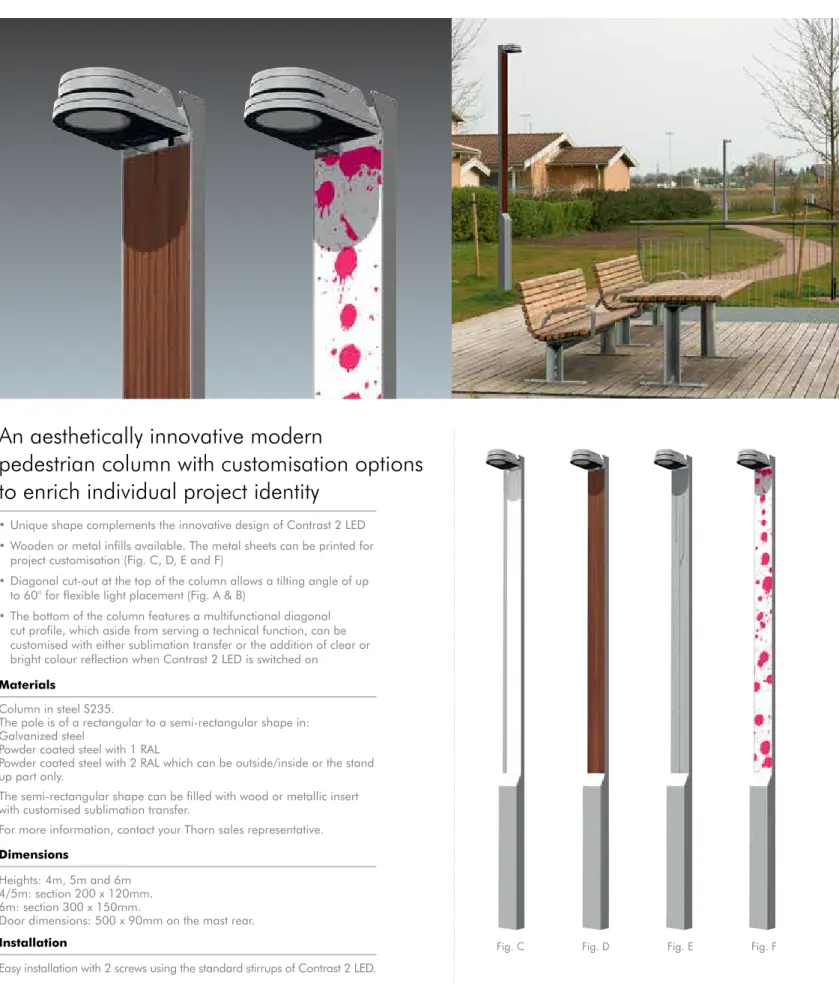
An aesthetically innovative modern
pedestrian column with customisation options
to enrich individual project identity
• Unique shape complements the innovative design of Contrast 2 LED • Wooden or metal infills available. The metal sheets can be printed for
project customisation (Fig. C, D, E and F)
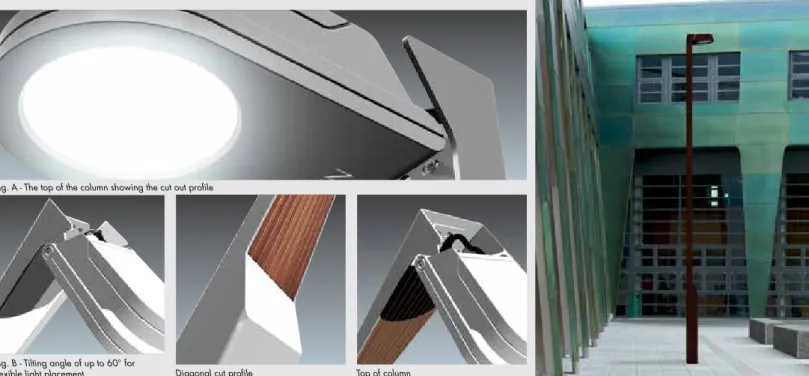
• Diagonal cut-out at the top of the column allows a tilting angle of up to 60° for flexible light placement (Fig. A & B)
• The bottom of the column features a multifunctional diagonal cut profile, which aside from serving a technical function, can be customised with either sublimation transfer or the addition of clear or bright colour reflection when Contrast 2 LED is switched on
Materials
Column in steel S235.
The pole is of a rectangular to a semi-rectangular shape in: Galvanized steel
Powder coated steel with 1 RAL
Powder coated steel with 2 RAL which can be outside/inside or the stand up part only.
The semi-rectangular shape can be filled with wood or metallic insert with customised sublimation transfer.
For more information, contact your Thorn sales representative.
Dimensions
Heights: 4m, 5m and 6m 4/5m: section 200 x 120mm. 6m: section 300 x 150mm.
Door dimensions: 500 x 90mm on the mast rear.
Installation
Easy installation with 2 screws using the standard stirrups of Contrast 2 LED.
Height: 4 m Luminaires: 1 Medium and 1 Small 4m 5m 6m Height: 5 m Luminaires: 1 Medium and 1 Small Height: 5 m
Luminaires: 2 Medium Luminaires: 1 Large Height: 6 m and 3 Small Height: 6 m Luminaires: 1 Large and 1 Medium Height: 6 m Luminaires: 2 Large
Fig. A - The top of the column showing the cut out profile
Diagonal cut profile Top of column
Fig. B - Tilting angle of up to 60° for flexible light placement
Product Focus
Contrast 2 LED
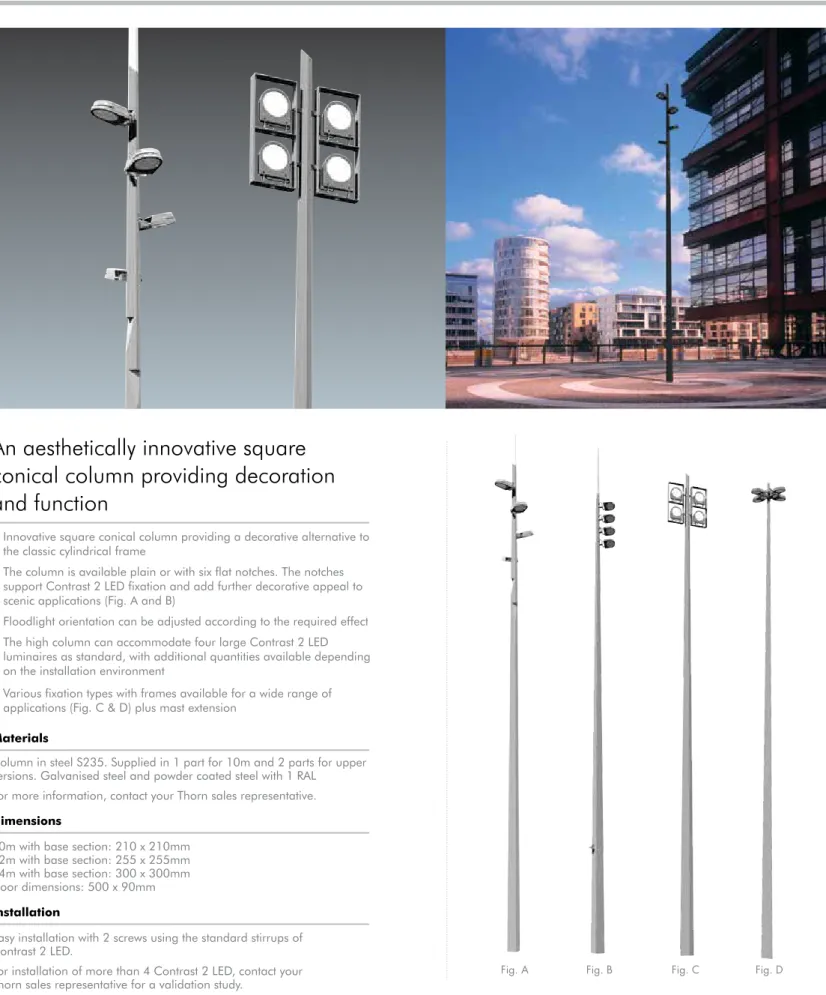
An aesthetically innovative square
conical column providing decoration
and function
• Innovative square conical column providing a decorative alternative to the classic cylindrical frame
• The column is available plain or with six flat notches. The notches support Contrast 2 LED fixation and add further decorative appeal to scenic applications (Fig. A and B)
• Floodlight orientation can be adjusted according to the required effect • The high column can accommodate four large Contrast 2 LED
luminaires as standard, with additional quantities available depending on the installation environment
• Various fixation types with frames available for a wide range of applications (Fig. C & D) plus mast extension
Materials
Column in steel S235. Supplied in 1 part for 10m and 2 parts for upper versions. Galvanised steel and powder coated steel with 1 RAL
For more information, contact your Thorn sales representative.
Dimensions
10m with base section: 210 x 210mm 12m with base section: 255 x 255mm 14m with base section: 300 x 300mm Door dimensions: 500 x 90mm
Installation
Easy installation with 2 screws using the standard stirrups of Contrast 2 LED.
For installation of more than 4 Contrast 2 LED, contact your Thorn sales representative for a validation study.
Fig. A Fig. B Fig. C Fig. D
Height: 10 m
Luminaires: 4 Large Luminaires: 4 LargeHeight: 10 m Luminaires: 4 LargeHeight: 12 m Luminaires: 4 LargeHeight: 14 m 10m
12m 14m
Fig. A and B - The notches support Contrast 2 LED
Fig. E
Ways of lighting
5
These sections are a guide to applications and suitable luminaires with brief comments where considered useful. Because of the wide range of applications it is necessary to analyse the visual requirements of each and choose the lamps and luminaires carefully in order to produce the best results.
The most common applications can be grouped into five general categories: Off-set Accentuation Wall washing Guidance Light effects
Thorn can offer several luminaire types to produce attractive and dramatic results economically. Broadly classified according to the way in which the light is distributed or controlled they include: floodlights, spotlights, linear wall grazers, wall washers, ground and wall recessed units (shielded, un-shielded and directional), colour changers and columns. The majority are offered with a wide selection of styles, finishes, sizes and attachments. Additionally, digital control units are offered to produce specific LED colours or create colour changing LED effects. Where rapid scene or dynamic colour change is required use DMX protocol controls and luminaires. For slower scene change or simple dimming DALI is an alternative.
1 2 3 4 5
4
3
1
3
2
Offset
1
In the case of a building facade where there is an opportunity to “off-set” equipment some distance away, lighting from the main direction of view will create a flat appearance to the building. Whereas setting the lighting to come onto the building at a glancing angle with respect to the main direction of view will produce strong shadows and marked highlights, consequently the building will be given the appearance of depth. Completeness of floodlighting is important in that the whole building and its setting should be revealed. This may include the return walls to the main facade, the roof and the full height of any projection from the roof such as chimneys or adjacent walls, trees or shrubbery. The main floodlights usually need supplementing to give completeness and avoid a ‘floating’ appearance. Buildings can appear to float if the base of the building is shadowed or under lit. Wherever possible, luminaires should be hidden from view by being installed behind existing structures or purpose-built features, or recessed in ground boxes. Great medieval and classic architecture is characterised by facades with predominantly vertical characteristics. The style can be emphasised by applying illumination from the left and right side of the facade using medium beam floodlights. Generally, due to fairly light coloured surface material, the shadows formed by sharply oblique lighting are too strong and create too distinct a contrast. In-fill lighting from the opposite direction using wide-beam floodlights will reduce the contrast and soften the appearance.
In contrast, many modern high rise office and hotel blocks have a markedly horizontal emphasis, often including elements that project slightly, like window ledges or continuous bands that run across the facade from one side of the building to the other. Floodlights placed close to the facade and aimed upward will produce bands of dark shadow above the projection. Supplementary lighting may be placed upon the ledge to soften or eliminate the shadow, or alternatively, the floodlights have to be moved away from a close-offset position so that a greater distance exists between the facade and the light source. With spec-built office blocks and factory units, facades that are basically flat are often encountered. The achievement of any shadow effects may only be possible by placing the luminaires at exceptionally close-offset positions as a certain unevenness in the brightness patterns across the facade could produce a degree of visual interest. Alternatively, luminaires may be able to be installed at the top of the building directing narrow beams of light downwards. Another possibility is to place low power luminaires at suitable positions at different levels of the building directed downwards or sideways. Beware of glass facades which reflect light directly into the sky and yet show little or no luminance themselves. Floodlights including the new Contrast 2 LED can also be used with accessories to create different types of light beams.
Ways of lighting
Lighting from a distance to highlight vertical structures
1
Sensa DMX
www.thornlighting.com/SEND
Contrast 2 LED (Medium)
www.thornlighting.com/CON2
Contrast 2 LED (Large)
www.thornlighting.com/CON2 Contrast C www.thornlighting.com/CONC Contrast R www.thornlighting.com/CONR OSQ www.thornlighting.com/OQSE
Product range For more information on your desired product please select from below:
Torre Alemanna, IT. © Fabio Baraldi, Architect: Vincenzo Russo | Corniche
Qba
www.thornlighting.com/QBAL
Please note: Accessories can be added to create different beam effects
1
Ways of lightingOffset
Project Examples
Contrast 3000K offset, 20m distance Contrast 4200K offsetTorre Alemanna, IT. © Fabio Baraldi | Contrast LED + accessory
Avignon Bridge, FR. © Christophe Canadell Noctabene | Satin, Qba LED and Contrast LED
Offset
Project Examples
Brionne, FR | Contrast, QBA, E/Fact and Band
2
Ways of lighting
Accentuation
When lighting statues or sculpture, modelling is usually important to reveal the form and details of the structure and make it stand out from its surroundings. The main differentiation between natural daylight and artificial floodlighting is that daylight always has a downward direction, while floodlighting can be aimed from almost any direction, but is more usually these days aimed upwards. This means that features on the surface of a structure will have shadows reversed from the daytime view, and a structure can take on a very different appearance at night as a result. Establishing a principle viewing position is an important first step. Once agreed then a typical treatment is to use a key light at about 45°, if that is possible, with a less intense softer fill in light from the other side. An even more three dimensional effect can be given by introducing back lighting, although care is needed not to cause glare to observers at the preferred viewing position. Just using a key light alone can look harsh and stark. In the situation where there is an object that people are expected to walk around then lighting from three directions could be appropriate given slightly stronger emphasis in one direction. (Fig.1)
Works in light coloured materials are normally revealed best when brighter than the background, but dark statues, like bronzes, are often better in silhouette.
The shadows of a lit object can in some circumstances be part of the overall effect. Where different coloured light sources are being used shadows from one light source can be lit
and coloured by another light source. Shadows can help to define the three-dimensional form of an object or building and create a contrast between highlights in the field of view. (Fig. 2) Light directed at a fairly shallow angle, close offset, can provide strong shadows to a three-dimensional structure. These strong shadows can be softened by lighting from the opposite direction to fill in the shadows. The illuminance only needs to be a tenth to a third of the key light. (Fig. 3). Experiment on site to get the best lighting effect. In amenity areas over use of shadows should be avoided as this reduces people’s sense of security within the space. A facade is often designed to incorporate features such as balconies or galleries that may project forward or be recessed into the facade. Normally, offset floodlights are employed to prevent excessively dark shadows being formed, but if lack of available space in front of the facade prevents their use, supplementary illumination will have to be placed inside the balcony space or incorporated within the building to create the shadow.
Constraints in mounting position or specific application requirements often require a modified beam distribution or intensity. Additional beam shaping optical components are useful in getting the correct result, as is the ability to set the maximum output of the floodlight to suit to the overall scheme using in built manual dimming like Contrast 2 LED Large and Medium with manual potentiometer in monochromatic versions.
Revealing form and structural detail
2
Fig. 1 Fig. 2 Fig. 3 Elevation ViewDirection Close Offset
Plan Elevation View Direction Soft Infill Plan
Sensa DMX D-CO LED Flood
Milo Qba
Contrast Pinspot
www.thornlighting.com/CONP
Contrast Mini Pinspot
www.thornlighting.com/CONM
Product range For more information on your desired product please select from below:
Catello Ceconi Pielungo, Vito d’Asio, IT. © Fabio Baraldi
Contrast 2 LED (Small)
www.thornlighting.com/CON2
Contrast 2 LED (Medium)
www.thornlighting.com/CON2
Contrast R
www.thornlighting.com/CONR
Please note: Accessories can be added to create different beam effects
3
Ways of lighting
Wall washing
Here is a simple test you can try for yourself. Take a torch outside at night, and shine it directly at brickwork - you will see the colour and the shape of the bricks! Now place the torch close to the building surface, and direct the light across the surface – you will see the texture also. This wall washing technique is known as “grazing”, and is effective in showing details of structures, not just the texture, but also accentuating shape and form as well as adding depth. It also simplifies the lighting of architectural detail. Grazing has the added advantage for occupied buildings, such as offices and hotels, that there is very little light penetration into the building to cause annoyance or discomfort to the occupants. More conventional wall washing aims to maintain coherence across the whole of the façade. By mounting luminaires at regular intervals – or continuously in the case of linear luminaires – the walls are gently “washed” with even illumination. This soft, glare-free ambient lighting can create visual interest and in many situations also provide general surround lighting to the area, due to reflection.
Luminaire spacings, especially where linear units meet, and selected beam shapes play a key role in determining whether a wall is evenly illuminated or not. Distinct cut-off lines can be used purposely to help visual communication and impact the visual rhythm of a space. Wall washing lighting usually requires a larger number of low powered luminaires than that used for greater offset distances. Wherever possible, luminaires should be recessed or hidden from view.
Floodlights like Contrast 2 LED can be used with an accessory to create an ellipsodial light beam particularly suitable for cornice wall washing.
Providing a wash of light across
surface-orientated structures
3
Elevation Plan Elevation PlanHaline2 www.thornlighting.com/HALN Corniche www.thornlighting.com/CRNC Satin www.thornlighting.com/SATN
D-CO LED Recessed
www.thornlighting.com/DCOR Band www.thornlighting.com/BAND E/Fact www.thornlighting.com/EFCT Band2 www.thornlighting.com/BAN2 Sensa DMX www.thornlighting.com/SEND Mica www.thornlighting.com/MICA Linear floodlights Recessed Floodlights
Product range For more information on your desired product please select from below:
Qba
www.thornlighting.com/QBAL
Contrast R
www.thornlighting.com/CONR Stairs, Paris, FR «On» Agency. © Vincent Thiesson | Satin
Please note: Accessories can be added to create different beam effects
Contrast 2 LED
Wall washing
Project Examples
3
Ways of lighting
Corniche 2700K
Torre Alemanna, IT. © Fabio Baraldi, Architect: Vincenzo Russo | Corniche
Wall washing
Project Examples
Ways of lighting
Wall washing
Project Examples
3
Wall washing
Project Examples
4
Ways of lighting
Guidance
Recessed luminaires can be used for defining pathways and routes for pedestrians. Where people are likely to follow a prescribed route a sequence of “beacons” can lead the eye and footsteps. For marking out routes, use minimum wattage lamps. Entrances, paths, intersections, steps and seating areas can all be marked, and precise directional control is possible to prevent light pollution. By night they guide and define routes, by day they continue to provide a visual waymark.
Recessed wall luminaires can be an attractive alternative to ground type units as well as more practical in marking changes of level. It needs to be established that a cavity can be made for the luminaires and that provision can be made for electrical connections. The shape of the luminaire, round, square or rectangular, can be selected to complement the architecture. Recessed luminaires are also less susceptible to vandalism than bollards that might be considered for pathway lighting.
A wide variety of recessed and surface mounted luminaires are now available, for ground and wall mounting. Various combinations of coloured light sources, and directional grilles can be attached allowing the creation of many different visual effects. Also, consider using directional ‘windows’ to direct the light output near to the horizontal.
Lighting equipment should be chosen which is in keeping with the public nature of the area. An impression of brightness, warmth and unity is desirable, particularly throughout the circulation spaces. Colour should be natural and people not inconvenienced by glare. An aspect to take into account is the surface temperature of the luminaire. Young children could be particularly vulnerable to injury if they touch some luminaires. There are low temperature luminaire options available to avoid this possibility.
Creating guidance with ground or wall recessed lighting
D-CO LED Recessed www.thornlighting.com/DCOR Mica www.thornlighting.com/MICA E/Fact www.thornlighting.com/EFCT Linn www.thornlighting.com/LINN
Product range For more information on your desired product please select from below:
Comune di Limatola, Frazione Giardoni, IT | D-CO LED
Jalon www.thornlighting.com/JALN Via www.thornlighting.com/VIAW Sensa DMX www.thornlighting.com/SEND
Guidance
Project Examples
4
Ways of lighting
Guidance
Project Examples
Torre Alemanna, IT. © Fabio Baraldi | Mica, Contrast and Corniche