ANALYSIS OF A PROCESS AND COMPUTER USER INTERFACE FOR DATA ANALYTICS RESULTS FOR PATIENT DISCHARGE DECISION MAKING
BY SANJANA JAIN
THESIS
Submitted in partial fulfillment of the requirements for the degree of Master of Science in Industrial Engineering
in the Graduate College of the
University of Illinois at Urbana-Champaign, 2017
Urbana, Illinois
Adviser:
ii ABSTRACT
Initially, computer aids simply automated the processes that humans had developed to complete various tasks. Their primary contribution was to increase efficiency by automating repetitive, tedious tasks, both physical and cognitive. Many years later, sophisticated computer aids employ a broad-scale availability of large amounts of information, coupled with the ability to analyze that information using statistical methods. Data analytics can provide more information than ever before to those using computer based systems. Computer aids for engineering design are typically used by engineers, who are data-savvy, and are generally capable of using the results of data analytics directly incorporated into engineering design tools in an efficient manner. However, data analytics results are becoming more widespread and available for users who are not data-savvy. These systems must be designed with this in mind. This paper presents an example of a computer aid for healthcare, a tool to aid in the patient discharge decision. The motivating problem is the large number of patients who are readmitted to hospitals within 30 days of discharge. The design problem addressed here includes identifying the decision process the users should employ, as well as the computer/user interface that best uses the data analytics results. This work was carried out through collaboration with a healthcare provider. A readmission risk tool was developed using data analytics to estimate the probability of readmission based on a historical data set of 50 patient-specific factors. Preliminary work indicated that the users did not fully accept or utilize the data analytics results, and also demonstrated their need to continue to rely in part on their own expert heuristic decision processes. This study presents a method for dealing with these issues. First, a normative decision based approach to determining a multiattribute utility function is formulated and assessed to
iii
compare alternative computer/user interface designs. Then, the same approach is taken to assess the healthcare worker‘s willingness to make tradeoffs under uncertainty when making the patient discharge decision. The resulting interactive computer interface design coupled with the normative healthcare decision process helps the user best exploit data analytics results while simultaneously facilitating the user‘s continued deployment of their own expertise.
Currently, the RRT is being utilized for flagging the readmission risk prone patients and not for making the main discharge decision regarding the patient. Its main use is to help the healthcare workers focus their attention on these medium-high risk patient profiles. Furthermore, the RRT result display needs to be made more actionable and relevant to the healthcare workers for the efficient use of the RRT model. We will discuss this in detail in our study.
iv
v
ACKNOWLEDGMENTS
This project would not have been possible without the support of many people. Many thanks to my adviser, Professor Deborah Thurston, who read my numerous revisions and helped make some sense of the confusion. Also thanks to the OSF and JUMP staff, Ann Willemsen-Dunlap, Hoa Cooper, Erin Bosch, Leslie Foti, Constance Kisner and Chris Frankovich, who offered guidance and support. I would like to thank Kuocheng Wang for his help and contribution as well. In addition, thanks to the Professor Thurston and University of Illinois Graduate College for awarding me research assistantship from the grant ―Jump ARCHES Endowment for Engineering and Health Care Innovation‖ and Holly Kizer and Dr. Sreenivas for giving me a teaching assistantship and providing me with the financial means to complete this project. And finally, thanks to my parents, brother and numerous friends who endured this long process with me while constantly offering me love and support.
vi
TABLE OF CONTENTS
CHAPTER 1: INTRODUCTION ...1
CHAPTER 2: LITERATURE REVIEW...7
CHAPTER 3: METHODOLOGY...13
CHAPTER 4: DISCUSSIONS ...51
CHAPTER 5: RESULTS ...56
CHAPTER 6: CONCLUSIONS AND RECOMMENDATIONS…...59
CHAPTER 7: LIMITATIONS AND FUTURE SCOPE OF WORK ...61
CHAPTER 8: REFERENCES ...63
1 CHAPTER 1 INTRODUCTION
The cost of readmission of patients within 30 days is now considered the responsibility of the Accountable Care Organizations (ACO) under the Affordable Care Act (ACA) of 2010. This makes up a cost of approximately $42 billion per year by roughly 20 to 25 percent of patients discharged from primary medical facilities and is payable to insurance providers [1]. This scenario arises due to different reasons in different cases. Sometimes, the patient is discharged earlier than needed, or provided unsuitable treatment. In other cases, the patient is unsuccessful in understanding or following the post discharge precautions/ instructions recommended by their healthcare worker or taking appropriate timely medications.
The main objective is to empower the healthcare workers with the right technology to make informed discharge decision for the betterment of the patient health outcome, readmission cost reduction and efficient utilization of hospital resources. The first step to achieve this goal is already underway because OSF has developed a new risk tool that estimates the probability of a patient‘s readmission based on his/ her attributes.
The second step, which is what this thesis elaborates on, is the designing of a training system for the healthcare workers on how to best utilize those results given from the risk tool and incorporate them into making improved discharge decisions. We have attempted to study the current steps taken by the healthcare workers while making discharge decisions and their reliability and trust in the results of the risk tool. We believe that the training of the healthcare workers in using the risk tool plays a major role in their dependency and understanding of the risk tool‘s results. This is done by analyzing the current training module of the healthcare
2
workers and thus creating a visual simulation tool that strategically integrates the risk tools results into the existing training module for better understanding.
Thus, the main aim is to develop a visual training simulation for the healthcare workers that aid them in developing a better understanding and hence efficiently using the risk tool‘s results to make improved patient discharge decisions.
This will be an interactive tool that will treat each individual patient case uniquely by analyzing the inputted patient information and important healthcare feedback. It will raise situation awareness and analyze strategies for the best discharge plan for the respective patient by gathering information, using multiattribute decision analysis and tradeoff decision making under uncertainty. Visual input and feedback to the trainee will include graphical, text and quantitative information.
The training system will simulate the patient discharge decision process. First, it will provide visual input to the trainee regarding patient characteristics and their possible effects on likelihood of readmission. The trainee will then react to that input by rejecting or accepting its results based on their personal interaction with the patient. Then, the system will provide a customized visual feedback to simulate the response to the trainee‘s decision. The two primary goals are to teach the trainee how to best integrate this new risk tool information into their pre-existing cognitive models, and to improve user acceptance of the tool.
Expected results are a reduction in the number unplanned readmissions and their cost, reduction in the extended use of the healthcare facilities resources (including human resources and machines) as well as improved overall health outcomes.
3
1. 30 Day Readmission Risk: Section 3025 of the Affordable Care Act added section 1886(q) to the Social Security Act establishing the Hospital Readmissions Reduction Program, which requires CMS to reduce payments to IPPS hospitals with excess readmissions, effective for discharges beginning on October 1, 2012. In the FY 2012 IPPS final rule, CMS finalized the following policies with regard to the readmission measures under the Hospital Readmissions Reduction Program. It defined readmission as an admission to a subsection (d) hospital within 30 days of a discharge from the same or another subsection (d) hospital [2].
2. OSF‘s Readmission Risk Tool (RRT): The risk readmission tool assessed for this project was developed at the Order of St. Francis (OSF) Medical Center, a 600 bed teaching hospital d in Peoria, IL. The readmission risk tool (RRT) provides an estimate of the probability of a patient needing to be readmitted to the hospital within 30 days of discharge. The results are obtained through a multivariate regression analysis of a large historical data set and are based on 50 patient-specific factors. [3] 3. Simulation: According to the Society for Simulation in Healthcare, simulation
training is ―the imitation or representation of one act or system by another‖ and serves as ―a bridge between classroom learning and real-life clinical experience.‖ [4].
4. Mutliattribute Decision Making: Multiple-criteria decision-making (MCDM) or multiple-criteria decision analysis (MCDA) is a sub-discipline of operations research that explicitly evaluates multiple conflicting criteria in decision making (both in daily life and in professional settings). [5]
4
b. Motivation: In an attempt to improve medical care while also reducing the overall costs by integrating quality care processes, the legislative changes directed by the Affordable Care Act (ACA) lead to the formation of the Accountable Care Organizations (ACO) [6]. As date, there exist 32 designated ACO medical facilities and only one is in a rural setting which is located in Peoria, IL [7]. According to the Agency for Healthcare Research and Quality (AHRQ) over 1.8 million readmissions at a cost of almost $42 billion were served by hospitals in 2014 [1].
Due to severity of the correct diagnosis and its effect on readmissions, copious research has been conducted in these areas [8], including other predictors of unplanned readmissions like patient attributes. Preliminary patient attributes, diagnoses, and surgical procedures have been integrated by some online risk tools such as one from the American College of Surgeons (ACS) into a risk score and therefore a recommended length of stay at the hospital [9]. Some works on the other hand, explored techniques such as medical staff follow up, technology support and communication plans for preventing readmissions [10]. Yet, for the problem of 30 day unplanned readmissions, no general system exists.
The opportunity to raise situational awareness by integrating pre-existing human expertise, predictive statistics and risk tools, is found in normative decision systems. Compared to the expert heuristic, rule-of-thumb model that is presently being used, visual simulation based training can aid in building an improved mental model in terms of accuracy and precision. Despite of being useful, efficient and necessary, these heuristics are sometimes limited or faulty. To add value, transparency, trust, reliability and hence
5
increased acceptance by the users, there is a need to define and develop a holistic system which includes decision systems and training.
c. Drivers: There are several drivers that might lead the healthcare facilities and their respective workers to start incorporating the RRT results in their patient discharge process. Generally, it‘s even a combination of these drivers:
1. Reduction in Readmission Cost: For the FY 2016, there were 2,620 facilities are being penalized. In FY 2015, the highest penalty for a single facility is over $3.6M wherein 49 hospitals are being penalized at least $1M. Along with the penalty percentage, the more important drivers are the total volume of Medicare patients and the case-mix index of the provider. [11] Following is the formula laid out by CMS [2]:
Excess readmission ratio = risk-adjusted predicted readmissions/risk-adjusted expected readmissions
2. Reduction in the Continued Care cost at the healthcare facility: In 2010, the aggregate cost for all hospital stays was $375.9 billion; the average cost per stay was $9,700. [12] This considerable amount per stay, if controlled can result in saving the healthcare facilities funds which can be put to use for other important purposes. 3. Improved patient health outcomes: Lesser amounts of readmissions would be a direct
result of improved patient health outcomes. These results could save the patients and hospitals a lot of time and money as well. Striving to achieve a better quality of
6
healthcare by making the right decisions is one of the main drivers of this research because it benefits both the healthcare giver and receiver.
7 CHAPTER 2 LITERATURE REVIEW
Electronic Health Records (EHR) is adopted by approximately 80% of the healthcare professionals. Out these, roughly half of them use the assistance of the EHR to make patient related decisions [13]. Yet, we have observed that the medical industry remains subjugated by the expert based heuristic decisions making despite the discovery of EHR systems and proprietary risk. Meaning, regarding complex systems and patients, the healthcare community‘s ‗culture‘ is by condition, deeply grounded in expert heuristic based decision making. Doctors mostly depend on their professional expertise to convey quality care. Further research by [14] found that reviewing and revising a clinical electronic health record system will cost 3 times more than developing the original system. Hence in transient environments, the heart of training tools, intelligent behavior and design of decision support systems is represented by development and the manipulation of models [15].
Prior to adopting these technologies, the healthcare industry should be aware and capable of navigating the total patient discharge system. This is directly affected by the both the design of the technologies and the training provided to the healthcare workers. User interface design has become an important factor that can affect computer user‘s acceptance of the information displayed. This will in turn effect the efficiency with which these models can be used and reduce the benefits they have to offer to the society. Among the software that is designed for the US government, 98% is reported to be ―unusable as delivered‖ [16]. [17] Provided a list of cultivated mindsets, specialized disciplinary skills and basic skills needed in human-centered design in general. Furthermore, [18] described five user interface issues that should be considered in
8
system design, including data entry by professionals, information presentation, user customizability, task-independent user interface principles and evaluation of the user interface. In order to train the healthcare workers to make full use of these technologies to assist them with patient decisions we need to develop robust training systems. Hence, [19] [20] acknowledged the fact that all systems must be based on their respective domain experts and professionals and their activities/ actions in actual real life work scenarios. Furthermore, they explained that this can be permissible by accounting for cognitive engineering processes which sustenance human performance in compound systems. There some other methods related to patient discharge which is not recognized in literature like the Cognitive Task Analysis [21]. Thus, there would be a requirement of acceptance of most of these cognitive engineering approaches presented in this research into the healthcare culture. Many engineering design researchers have begun to employ computer-based, normative engineering approaches in the healthcare industry. Just a few examples include motion capture experiments to identify differences between novice and experienced nurses in the task of moving patients [22], and activity modeling and cost indicators to measure the effectiveness of telemedicine IT technology for dermatology [23]. The problem of how to gather and use medical domain expertise to facilitate engineering design of innovative medical devices is addressed by [24]. They develop a method that gathers and links ontologies from medical and engineering realms.
There is a need to define the term ‗culture‘ as can take on a wide range of meanings. Hence for this study, the healthcare industry culture will be defined as the set of values that is shared by a group of interacting individuals [25]. There are a set of primary individuals who generally play a
9
role in making patient care and discharge decisions such as all the medical physicians involved in the case, registered and bedside nurses (palliative care), case managers, the patient and his/ her family, primary care provider (PCP), occupational and physical therapists, pharmaceutical team, and residential health helpers as required. Although, quite a few secondary helpers exist, but generally, they are not direct participants in the patient‘s intervention decision making.
Due to the unclear definition of the leading edge of cultural change, approaches which depict the presentation of the complete holistic system, recognize cognitive processes employed, and as a result notify us of whether or not technology and expert judgments work together, can aid in expanding the body of knowledge. The healthcare industry culture seems accepting of emerging technologies. This is a positive observation as we witness the development of new proprietary risk and decision tools in the market. [26] Suggested several distinct decision making models for system design. Others [27-29] focused more on the requirement priority selection for each system version release using strategic decision making. Other approaches employ surveys completed by the user [30-32]. In the area of healthcare, researchers are seeking better ways to design the healthcare system. While other papers focus on the user interface design, [33] argued that more fundamental structures need to go into human centered systems, such as users, functions and tasks. [32] Employed user-centered design together with the agile method to design software for organ transplant nursing. The author spent several days with the nurse, iteratively gaining feedback so the final design matched the user need. However, this took a significant amount of time. [16] Studied the redesign process and applied several steps on the redesign of family history software. The author revised the functions, usability, and user interface to improve user-friendliness.
10
Any kind of ‗one size fits all‘ or standardized models that introduce decision or risk technology to define a patient‘s attributes or process are in the danger of being viewed as flawed and incomplete by healthcare professionals. It can be identified as model that‘s unlikely to add any value to any patient care decisions [25] [34]. According to this author, the fact that these standardized models and decision tools give less importance to the impact of cultural beliefs including family structure such as social economic status and family structure, is one of the key explanations for the uncertain image of such standardized models [25][35]. These patient attributes details due to their social framework are generally captured by healthcare facilities by employing care management specialists with the likes of social workers (SW) and registered nurses (RN) or social workers (SW) in case of referrals influenced by higher risk patients. The main goal of coupling these care management specialists with discharge tools is to isolate this high risk
Patients and hence concentrate discharge resources. This common approach diminishes some of the uncertainty which might prevail in decision tools such as RED and BOOST. To explain what each of these decision tools is capable is that amongst the most advanced and cutting edge methodologies for care transition improvement, includes the Reengineered Hospital Discharge Program (RED) [36] [37]and Project BOOST - Better Outcomes for Older adults through Safe Transitions [38]. In evaluating a patient up for discharge, Project RED analyses 12 components as a pre-discharge procedure. It then suggests various methods for post-discharge follow up. Despite of being not prescriptive in nature, project RED utilizes process flow methods to guide the effort of the user and depicts an adaptable methodology. To capture the meticulousness of the discharge processes centered on patient care, this project presents a sequence of techniques and
11
logical measures. Project BOOST introduces the usage of intervention tools to locate and concentrate the services provided by healthcare professionals in more complicated patient scenarios and describes similar techniques to counter these situations. It presents procedures to diminish the risk of readmission by suggesting which specific patient attributes should be the concentrated on. Some setbacks to this project are that it does not possess any tools to explain how the decision making is done and it‘s level of quality. Hence, this thesis tackles this very same research gap of how technologies affect the quality of patient related discharge decisions. The goal is to better utilize medical expertise in the creation of functional engineering design models. The problem of developing models for healthcare that begin with a large set of historical data, and yet can be fine-tuned in response to patient-specific data is not a trivial one. Such a model was developed by [39] to aid in left heart disease repair and treatment, and by [40] to aid in diagnosis and pre-operative planning for aortic disease. The problem that experts can sometimes underestimate certain failure events due to their lack of historical precedent is addressed by [41]. By guiding exploration of a solution space and providing simulated feedback, they demonstrate that even non-expert humans can potentially achieve results that are superior to a normative stochastic algorithmic approach.
Technology support, improved communications plan and post discharge medical follow-up were some methods suggested by [42] proposes techniques for preventing readmissions,
To study technology support in the healthcare industry, [18] developed a 3-stage iterative web page design process for a health counseling system, including ―Conception‖, ―Realization‖ and ―Deployment‖ stages. These stages resolved the question of what functions the system should include, and how the user interface should appear. These stages were developed based on [43].
12
[44] Made a comparison between the aviation system and healthcare system, and suggested that the analogies discovered could help improve the healthcare system. [45] and [46] reviewed health information systems and described several challenges posed. [47] Designed an emergency medical information system using a participatory design process. The author presented 2 designs with the same information to medical staff and as a result iterated to a superior design.
To conclude, since the institution of the Affordable Care Act (ACA) we have witnessed a rise in the development of technologies and acceptance of models. Despite this positive change, we have yet to witness a balanced pairing of normative models and expert heuristics which continue to co-exist in a cultural competition. This thesis addresses these issues by presenting a method for designing a computer-user interface in an area of healthcare decision making, and for enabling the human expert user to simultaneously benefit from normative mathematical models while continuing to rely on their own judgment and experience with an individual patient.
13 CHAPTER 3 METHODOLOGY
As we already know, improvement and development of the healthcare workers ability and willingness to use the risk tools to assess discharge decisions for a patient depend on their understanding and trust on the risk technology which in turn depends on the training provided to these healthcare workers on the usage of the EMR and risk tools. The benefits that will arise from achieving this balance of technology and expert heuristics are increased accuracy in defining what patient attributes are responsible for risk of readmission for individual cases, increased confidence in proposing the most suitable interventions to mitigate readmission risk and reduced inconsistency in defining the features of these interventions such as number of days in the hospital, number of follow up calls, post discharge care suggestions, educating the patient on dos and don‘ts and so on.
Hence two major hypotheses will be tested. Firstly, providing apt training to healthcare workers should integrate the value that the normative decision making model brings. We anticipate that this step increase the acceptability if the decision making tools among the healthcare workers and will develop the predictive abilities of these healthcare workers in assessing patient risk.
There will be two primary hypotheses to be examined:
H1: Differently trained healthcare professionals tend to differently accepting new technologies aimed towards improving patient discharge decisions. Differently trained is defined by:
O Little or no training
O PowerPoint Presentation Training O Interactive Onboarding Process Training
14
H2: Improved user interface design of the risk technologies can be used to positively impact the use of expert heuristics by trained healthcare professionals in judgments used to assess patients for discharge.
O Design 1 O Design 2 O Design 3
The primary objective of testing the first hypothesis is focused at providing awareness to healthcare professionals about discharge design models and that can be facilitated by innovating simulation training techniques that can utilize the potential of the facilities available by the OSF Medical Group such as the JUMP Training Simulation Centre and the Education Centre which will in turn aid in mitigating the unplanned patient 30-day readmissions. There is an emphasis on the innovation of strategies and techniques that can check the way risk tools can improve understanding of patient attributes and there effect on the risk of readmission. In order to evade the stove piped system, we need to concentrate on training and techniques that aid in the innovation and involvement of new advanced technologies. Techniques that introduce a harmony of these normative risk approaches coupled with expert heuristics will be discussed and a study will be done to test the effect of different types of training given to healthcare workers and their corresponding levels of acceptance of these decision tools in the real life medical setting. Future work can lead to these technologies being widely used in the entire patient care spectrum and not just the discharge decision section. To help in the development of the medical industry, exploring the mutually beneficial relationship between risk technologies and normative approaches in the
15
presence of the dominating expert heuristic opinion will help us gain a better understanding of the advantages and disadvantages it presents.
The second hypothesis to test the effect of an improved user interface design to display the RRT results in such a way that it aids the healthcare workers in using the tool efficiently and to its most potential. Much has been written about the use of data analytics in computer aids used by engineers during the product design process, but less about designing the computer aids themselves for others so they can benefit the most from data analytics results. One example is a tool used by healthcare providers to make patient discharge decisions. The patient discharge decision, like many in healthcare, has traditionally been made by collaborative teams of human experts. Such teams typically include doctors, nurses, social workers and others who rely in their own expertise to estimate the risk of patient readmission. These estimates may differ among team members, who must acknowledge such differences while still working to develop a collaborative discharge plan. The use of a computer aid that incorporates data analytics to improve estimates of readmission risk is the topic of this paper.
Current Readmission Risk Tool:
The risk readmission tool assessed for this project was developed at the Order of St. Francis (OSF) Medical Center, a 600 bed teaching hospital d in Peoria, IL. The readmission risk tool (RRT) provides an estimate of the probability of a patient needing to be readmitted to the hospital within 30 days of discharge. The results are obtained through a multivariate regression analysis of a large historical data set and are based on 50 patient-specific factors. The tool results are embedded in a larger screen found in EPIC, the hospital‘s electronic medical record system. Figures 1 and 2 show the user information provided by the RRT and a typical Epic screen. In
16
Figure 1, the green color indicates to the user that the RRT estimates a low risk of readmission, red indicates a high risk and yellow indicates a medium risk. The primary users of the tool are registered nurses (RN). If the RN moves her or his mouse over the color, the system will display the estimated probability of readmission for that patient. However, there is no further information shown, and the RN is not able to interact with the risk tool. This results in a low level of trust by RN. Frequently the RN does not even consider the RRT results, and estimates the readmission probability on the basis of their own experience with this and previous similar patients.
Figure 1. RRT Results shown in Epic screen: Red, yellow and green indicate high, medium and low risk of readmission, respectively
17
Figure 2. Epic screenshot [27]
In order to encourage the nurses to use the RRT more often, three alternative computer-use interface designs were considered, shown in Figure 3. Design 1 displays the RRT results in the red-yellow-green (RYG) format as shown in Figure 1 in a small area of the upper left corner of the screen. Design 2 displays the RYG results along with a listing of the top 10 factors correlated with readmission risk for that patient in a larger portion of the screen. The nurse can than examine these top 10 explanatory reasons. Design 3 adds more information by displaying a graphical depiction of the confidence interval in addition to the RYG display and the top 10 factors. Adding graphical information derived from a mathematical model has been demonstrated to be useful [48]. If the patient-specific parameter under consideration is in a
18
region where the range on the confidence interval is very large, the nurse can take this into consideration in adjusting the estimate of the probability of readmission.
Figure 3. Three computer-user interface design options
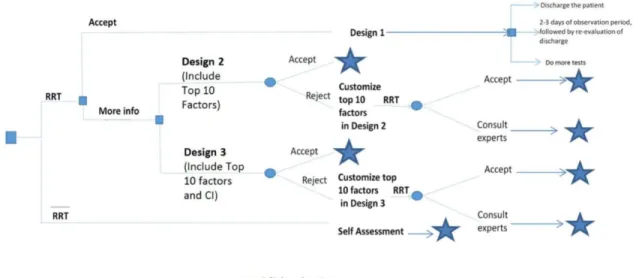
Normative decision based methods were employed to assess multiattribute utility functions for both design decisions regarding the use-interface screen and also for the decisions that the healthcare worker makes when using the results of the RRT. The decision maker was Ann Willemsen-Dunlap, PhD, who is a certified registered nurse anesthetist (CRNA). Dr. Dunlap has over 20 years of experience at OSF, and is a frequent user of the RRT. In this paper, we use her expressed preferences as representative of the computer-users preferences in general. Previous results indicated that the users were influenced by, but did not fully accept the RRT results [49]. Reasons for this include lack of trust and/or lack of understanding of how the tool came to its conclusions, as well as the user possessing first-hand knowledge of the individual patient that is not reflected in the tool results. A new computer-user interface and decision procedure was developed to facilitate better use of the tool. The decision tree shown in Figure 4 illustrates the series of decision and chance events that a user will encounter when using the tool. Several researchers have emphasized the need for the designs to be more human-centered in the
19
bioinformatics arena [33], [32]. The new system provides the user the opportunity to interact with the RRT seek more information than is displayed in the RYG display.
Figure 4. Decision tree for patient discharge procedure
The steps carried out in the decision tree shown in Figure 4 are as follows:
1. The user decides whether to consult the RRT or not. If not (taking the bottom-most branch) the user does a self-assessment of the patient, and then must make a decision (indicated by the star symbol) about whether the patient should be discharged, observed for 2-3 more days then re-evaluated, or kept in the hospital for more tests. If the user decides to consult the RRT, she or he
20
views the RRT results from Figure 1 embedded in the Epic screen as in Design 1 shown in Figure 3.
2. After viewing this screen, the user must decide whether to accept the RRT estimate or not. If the user accepts the estimate (taking the top-most branch), then the user must make the same discharge/observe and re-evaluate/keep in hospital decision as described earlier. It is important to note that for this system, even when users accept the RRT result, they still consider their own estimate of readmission on the basis or their expertise and interactions with that individual patient.
3. If the user rejects the RRT results and seeks more information about the RRT analysis, they can choose between Design 2 and Design 3, as shown in Figure 4. Design 2 includes the original RRT output plus a listing of the top 10 predictive factors, displayed in a larger portion of the screen. Design 3 includes the original RRT output, the top 10 factors and a graphical representation of the confidence intervals displayed in an even larger portion of the screen.
4. After viewing either Design 2 or Design 3, the user can again either accept or reject the RRT results. If they are accepted, the user is now ready to make the same discharge/observe and reevaluate/keep in hospital decision as described earlier. If the user rejects the RRT results, then they can request more information by customizing which predictive factors are displayed.
The three different designs enable the user to interact with the RRT and integrate its results with their own expertise and direct contact with the patient. This ability to incorporate and utilize their
21
experience with the patient by customizing the user interface screens inculcates more trust in on the RRT analysis by the healthcare workers.
Utility Functions:
Two separate multi-attribute utility functions were assessed, one for the design decision regarding user-interface screen design, and another for the decision regarding patient discharge. The standard lottery method described for engineering design in [50] was employed to assess the multiattibute utility functions (including definition of the design attributes and their negotiable ranges), tests for preferential and utility independence, single attribute utility functions for each attribute Ui(xi) and scaling constants ki.
When the design attributes are defined in such a way that both preferential and utility independence conditions are satisfied [50] and [51], then the multiplicative form shown in equation 1 is correct form of the multiattribute utility function.
22 User-Interface Screen Design Decision:
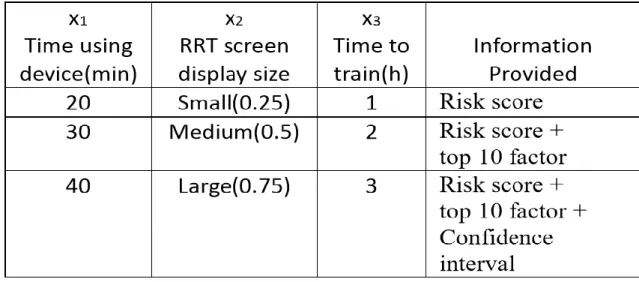
For the user-interface screen design decision, the three attributes and their ranges of negotiability are shown in Table 1, and include time required using device before giving feedback to the patient (in minutes) ( 𝑥1), screen size (𝑥2) and time to train the use (in hours) (𝑥3). The negotiable range of 𝑥1 is 15 to 60 min, the range of 𝑥2 is 1/4 to 3/4, and the range of 𝑥3 is 1 to 4 hours. When 𝑥2 equals 1/4, this refers that a design where the risk tool results are displayed in screen area that is 1/4 width and 1/4 height of the Epic tool screen.
These attributes reflect the unavoidable trade-offs faced by the designer. If the RRT screen size is smaller, then less information can be displayed, but the advantage is that both the time spent using the device and the training time required to learn how to interpret the results is lower. On the other hand, if the RRT screen display size is larger, then more information can be displayed, but the drawback is an increase in both time spent using the device and training time. The user must consider whether obtaining and interpreting more information is appropriate for each patient. Also, since RRT results are included in the Epic screen, some information in the Epic tool will be temporarily out of view.
23
Table 1. Three attributes of the screen design decision and ranges
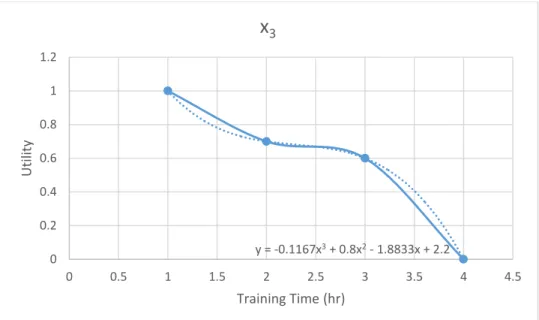
The user‘s responses to the assessment revealed that both preferential and utility independence conditions were satisfied. Then, several data points were assessed across each single attribute range. A third order function was employed to fit curves for each function, shown in equations 2-4. All three are monotonic functions. The single attribute utilities decrease as the feedback and training time increase, and increase as RRT screen display size increases.
24 Figure 5: Utility vs 𝑥 Figure 6: Utility vs 𝑥 y = -4E-05x3 + 0.0037x2 - 0.1294x + 2.2352 0 0.2 0.4 0.6 0.8 1 1.2 0 10 20 30 40 50 60 70 U tility
feedback time (min)
x
1 y = 32.801x3 - 53.229x2 + 28.558x - 4.3138 0 0.2 0.4 0.6 0.8 1 1.2 0 0.1 0.2 0.3 0.4 0.5 0.6 0.7 0.8 U tility scalex
225
Figure 7: Utility vs 𝑥
The scaling constants were assessed at k1 = 0.8, k2 = 0.8 and k3 = 0.8 After using RRT analysis, we calculated the utility functions for each designs as shown in the above equations.
Patient Discharge Decision
So to define the design attributes and their negotiable ranges:
Readmission cost (RC)
Continued Care (CC): Time, space and resources used in the hospital
Health Impact (HS): Health Adjusted Quality of Life (HAQOL) Survey which would be measured twice, once at some pre-determined point in the discharge planning process and again at 30 days following discharge from the hospitalization during which the first survey was done.
y = -0.1167x3 + 0.8x2 - 1.8833x + 2.2 0 0.2 0.4 0.6 0.8 1 1.2 0 0.5 1 1.5 2 2.5 3 3.5 4 4.5 U tility Training Time (hr)
x
326
Table 2. Three attributes of the patient discharge decision and their ranges
Conducting the Preferential Independence Tests for all three attributes:
X1 = Readmission Cost; X2 = Continued Care Cost; X3 = Health Score
a) Between X1 and X2
(High X1, High X2) ~ (Low X1, High X2) (High X1, Low X2) ~ (Low X1, Low X2)
Conclusion: In both the cases above, the decision maker chose the right hand side. This shows that the decision maker is preferential independent towards getting a low X1, which means obtaining a low readmission cost regardless of any changes in the other attributes.
b) Between X2 and X3
(High X2, High X3) ~ (Low X2, High X3) (High X2, Low X3) ~ (Low X2, Low X2)
27
Conclusion: In both the cases above, the decision maker chose the right hand side. This shows that the decision maker is preferential independent towards getting a low X2, which means obtaining a low continued care cost regardless of any changes in the other attributes.
c) Between X3 and X1
(High X3, High X1) ~ (Low X3, High X1) (High X3, High X1) ~ (Low X3, Low X1)
Conclusion: In both the cases above, the decision maker chose the left hand side. This shows that the decision maker is preferential independent towards getting a high X3, which means obtaining a high health score regardless of any changes in the other attributes.
Conducting the Utility Independence Tests for all three attributes:
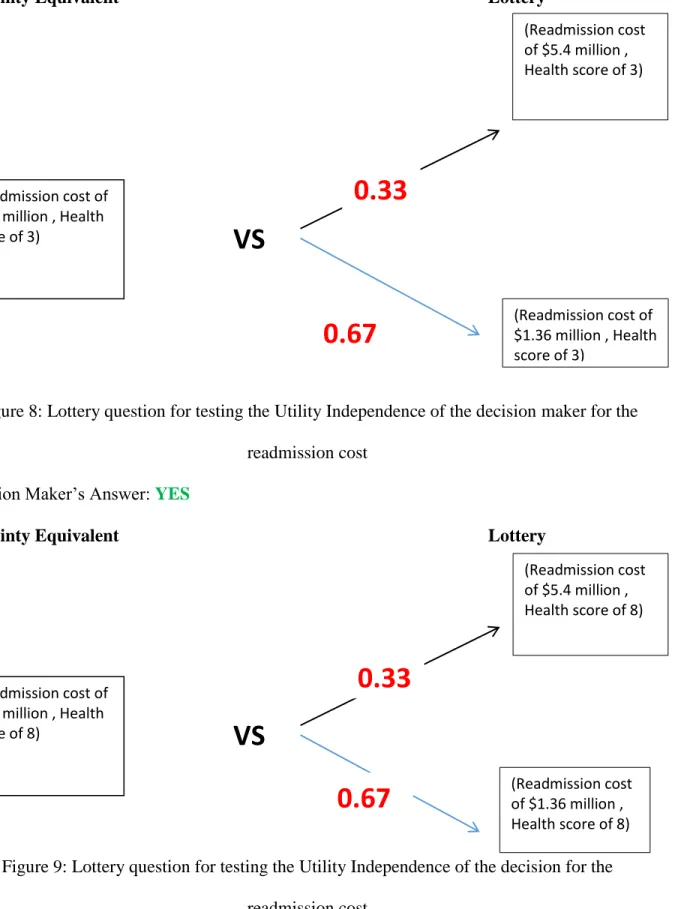
To check if the decision maker is indifferent between the certainty equivalent and lottery at the same value of ‗P‘ in both scenarios for each attribute:
28
Certainty Equivalent Lottery
Figure 8: Lottery question for testing the Utility Independence of the decision maker for the readmission cost
Decision Maker‘s Answer: YES
Certainty Equivalent Lottery
Figure 9: Lottery question for testing the Utility Independence of the decision for the readmission cost (Readmission cost of $2.7 million , Health score of 3)
VS
(Readmission cost of $5.4 million , Health score of 3) (Readmission cost of $1.36 million , Health score of 3)0.33
3.
0.67
777
(Readmission cost of $2.7 million , Health score of 8)VS
(Readmission cost of $5.4 million , Health score of 8) (Readmission cost of $1.36 million , Health score of 8)0.33
3.
0.67
777
29 Decision Maker‘s Answer: YES
Conclusion: For the decision maker, the readmission cost attribute is utility independent of the other attributes.
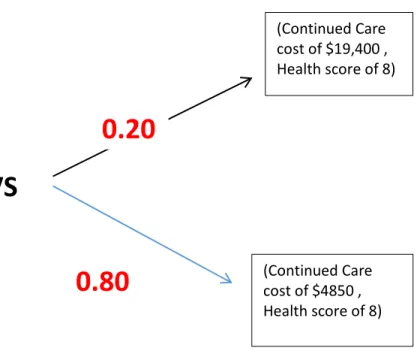
b) For the Continued Care Cost:
Certainty Equivalent Lottery
Figure 10: Lottery question for testing the Utility Independence of the decision maker for the continued care cost
Decision Maker‘s Answer: YES
(Continued Care cost of $9,700 , Health score of 3)
VS
(Continued Care cost of $19,400 , Health score of 3) (Continued Care cost of $4850, Health score of 3)0.20
0.80
30
Certainty Equivalent Lottery
Figure 11: Lottery question for testing the Utility Independence of the decision maker for the continued care cost
Decision Maker‘s Answer: YES
Conclusion: For the decision maker, continued care cost attribute is utility independent of the other attributes.
(Continued Care cost of $9,700 , Health score of 8)
VS
(Continued Care cost of $19,400 , Health score of 8) (Continued Care cost of $4850 , Health score of 8)0.20
0.80
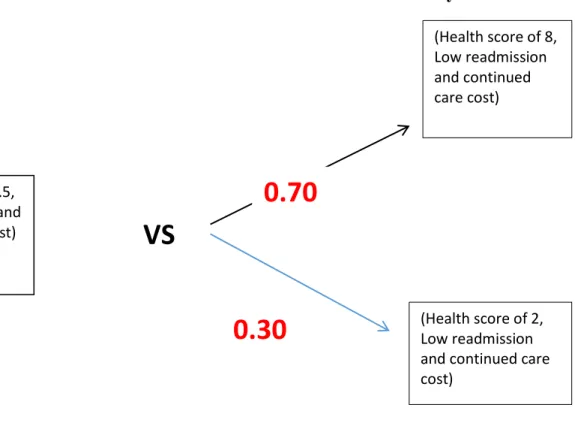
31 c) For the Health Score:
Certainty Equivalent Lottery
Figure 12: Lottery question for testing the Utility Independence of the decision maker for the health score
Decision Maker‘s Answer: YES
(Health score of 5.5, Low readmission and
continued care cost)
VS
(Health score of 8, Low readmission and continued care cost) (Health score of 2, Low readmission and continued care cost)
0.70
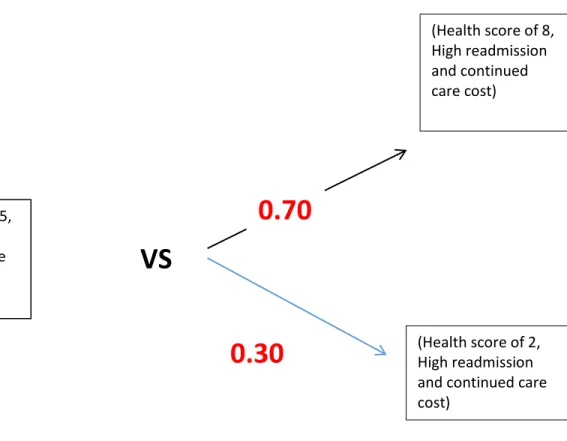
32
Certainty Equivalent Lottery
Figure 13: Lottery question for testing the Utility Independence of the decision maker for the health score
Decision Maker‘s Answer: YES
Conclusion: For the decision maker, the health score attribute is utility independent of the other attributes.
The next step is for the healthcare worker to use the RRT information in order to make an informed decision regarding the patient's discharge. For this task, a second multiattribute utility
(Health score of 5.5, High readmission and continued care
cost)
VS
(Health score of 8, High readmission and continued care cost) (Health score of 2, High readmission and continued care cost)0.70
33
function was formulated and assessed using the same methods described above. The attributes definitions and the assessed utility functions are described below.
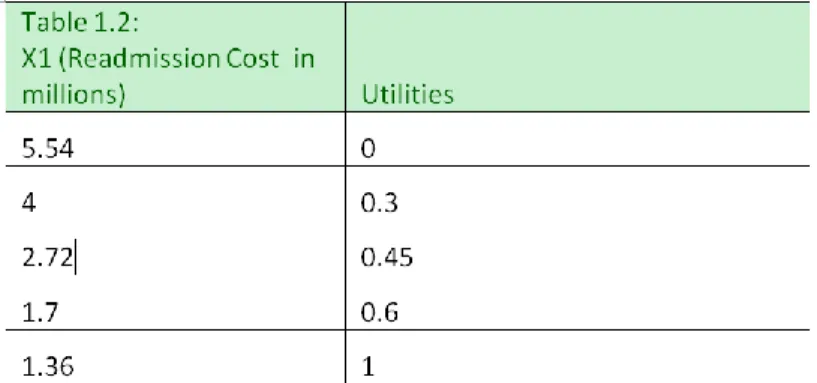
X1 - Readmission Cost (RC), which is estimated using the result from the RRT analysis as shown on each design. Figure 14 shows that the decision maker is slightly risk seeking over the range of negotiability.
Table 3: Tabular form of single attribute utility U1(x1) values for Readmission Cost
Figure 14: Graphical representation of single attribute utility U1(x1) for Readmission Cost
34
X2 - Continued Care Cost (CC) reflects the time, space and resources used in the hospital to provide continued care. Figure 15 shows that the decision maker is slightly risk seeking over the range of negotiability.
Table 4: Tabular form of single attribute utility U2(x2) values for Continued Care Cost
Figure 15: Graphical representation of single attribute utility U2(x2) for Continued Care Cost
X3 - Health Impact Score (HS) is measured by the Health Adjusted Quality of Life (HAQOL) survey, which would be measured twice, once at some pre-determined point in the discharge
35
planning process and again at 30 days following discharge from the hospital. Figure 16 shows that the decision maker is slightly risk averse over the range of negotiability.
Table 5: Tabular form of single attribute utility U3(x3) values for Health Score
Figure 16: Graphical representation of single attribute utility U3(x3) for Health Score
36
Determining scaling constant ‘k1, k2, k3 ’ of each attribute:
a) For Readmission Cost (RC):
Certainty Equivalent Lottery
Figure 17: Lottery question for determining the scaling constant for the readmission cost
Hence, the equation:
U (Certainty Equivalent) = P.U (Best in all attributes) + (1-P).U (Worst in all attributes) And, we know that U (Best in all attributes) = 1 so similarly U (Worst in all attributes) = 0 Thus, according to the decision maker:
U (Certainty Equivalent) = P = K1 = 0.65
(Low readmission cost, High Continued Care cost, low health
score)
VS
Best in all attributes: (Readmission Cost: $1.36 million, Continued Care Cost: $4850, Health Score: 8) Worst in all attributes: (Readmission Cost: $5.45 million, Continued Care Cost: $19,400, Health Score: 2)P
1-P
37 b) Continued Care Cost (RC):
Certainty Equivalent Lottery
Figure 18: Lottery question for determining the scaling constant for the continued care cost
Hence, the equation:
U (Certainty Equivalent) = P.U (Best in all attributes) + (1-P).U (Worst in all attributes) And, we know that U (Best in all attributes) = 1 so similarly U (Worst in all attributes) = 0 Thus, according to the decision maker:
U (Certainty Equivalent) = P = K2 = 0.65
(High readmission cost, low Continued Care cost, low health
score)
VS
Best in all attributes: (Readmission Cost: $1.36 million, Continued Care Cost: $4850, Health Score: 8) Worst in all attributes: (Readmission Cost: $5.45 million, Continued Care Cost: $19,400, Health Score: 2)P
1-P
38 c) Health Score (HS):
Certainty Equivalent Lottery
Figure 19: Lottery question for determining the scaling constant for the health score
Hence, the equation:
U (Certainty Equivalent) = P.U (Best in all attributes) + (1-P).U (Worst in all attributes) And, we know that U (Best in all attributes) = 1 so similarly U (Worst in all attributes) = 0 Thus, according to the decision maker:
U (Certainty Equivalent) = P = K3 = 0.3
(High readmission cost, high Continued Care cost, high
health score)
VS
Best in all attributes: (Readmission Cost: $1.36 million, Continued Care Cost: $4850, Health Score: 8)Worst in all attributes: (Readmission Cost: $5.45 million,
Continued Care Cost: $19,400, Health Score: 2)
P
39 Determining the Normalizing Parameter (K):
K = (Kk1 + 1) (Kk2 + 1) (Kk3 + 1) -1 (Kk1 + 1) (Kk2 + 1) (Kk3 + 1) – 1 – K = 0
(K(0.65) + 1) (K(0.65) + 1) (K(0.3) + 1) – 1 – K = 0 Solving the cubic equation to get the value of K :
40 Hence, we choose K = - 0.85.
The scaling constants were assessed at k1 = 0.65, k2 = 0.65 and k3 = 0.3. The three possible discharge decisions as shown in the ―star‖ section of figure 4 are:
Alternative 1: Discharge the patient. This decision minimizes continued care cost, but increases the risk of readmission cost and lower health scores.
Alternative 2: Two-three days of observation period, followed by re-evaluation of discharge. This compromise decision incurs continued care costs, but seeks to diminish the risk or readmission cost and improve health score results.
Alternative 3: Do more tests. This decision increases continued care costs, but decreases the risk of higher readmission costs and lower health score results.
41
Figure 21 shows the decision tree results of the utility assessment to determine whether it is better to use the RRT combined with expert self-assessment on the part of the healthcare worker, or to rely exclusively the worker‘s expert self-assessment. The
Probabilities of acceptance were estimated based on experience. The final result indicates that the utility of using the RRT is 0.94, whereas the utility of not using the RRT is 0.49. Hence, the health worker will choose to use the RRT.
Figure 21: Decision tree for using the RRT or not
After demonstrating that deciding to use the RRT is better than not, the discharge decision process followed by the healthcare worker for three hypothetical patient profiles are analyzed below.
42
Model Patient A: Patient A has had invasive abdominal surgery. Infectious complications are the main causes of postoperative morbidity in abdominal surgery. The healthcare workers used following steps to determine the best sequence of decisions, as shown in Figure 22: a. Choose to use the RRT (due to higher utility)
b. Decide to get more information on the RRT result by choosing Design 2 display (chosen based on severity of medical case)
c. View the RRT results in Design 2 format, but then chooses to customize the top 10 factors displayed based on their experience
d. Accept the new RRT results, then estimate values for the attributes for each of the three alternative discharge decisions, shown in Table 6:
Table 6. Estimates for each alternative for Patient A
e. Make the discharge decision that maximizes utility. At this point, the results from employing equation 1 indicate that:
43
Alternative 1: Discharge the patient: 𝑈1(𝑥1 , 𝑥2 , 𝑥3) = 0.65
Alternative 2: 2 to 3 days of observation period followed by reevaluation and discharge: 𝑈2(𝑥1 ,
𝑥2 , 𝑥3)= 0.8089
Alternative 3: More tests while continuing to stay in hospital 𝑈3(𝑥1 , 𝑥2 , 𝑥3)= 0.7574
For Patient A, the best alternative (with the highest utility) is to keep the patient for 2-3 days of observation period followed by re-evaluation of discharge.
Figure 22: Best decision path for patient A
Model Patient B: Patient B has had a recent fracture. A fracture normally consolidates within an expected timeframe. The actual time varies with the site and nature of the fracture, and with patient-specific factors such as age. The healing process takes time. The healthcare worker used the following steps to determine the best sequence of decisions, as shown in Figure 23: a. Choose to use the RRT tool (due to higher utility as shown above)
44
b. Accept the RRT results by choosing Design 1 display (design chosen based on minimal severity of medical case)
c. Estimate attribute values for each of the three alternative discharge decisions, shown in Table 7:
Table 7. Estimates for each alternative for Patient B
d. Make the discharge decision that maximizes utility. The results of employing equation 1 indicate that:
Alternative 1: Discharge the patient: 𝑈1(𝑥1 , 𝑥2 , 𝑥3) = 1.0
Alternative 2: 2 to 3 days of observation period followed by reevaluation and discharge: 𝑈2(𝑥1 ,
𝑥2 , 𝑥3)= 0.7838
Alternative 3: More tests while continuing to stay in hospital 𝑈3(𝑥1 , 𝑥2 , 𝑥3)= 0.0
45
Figure 23: Best decision path for patient B
Model Patient C: Patient C is an elderly male with congestive heart failure. Other health issues may also factor in because of age. The healthcare worker used following steps to determine the best decision as shown in Figure 24:
a. Choose to use the RRT tool (due to higher utility as shown above)
b. Decide to get more information on the RRT result by choosing the Design 3 display (chosen based on severity of medical case)
c. View the RRT results in Design 3 format, but then decide to customize the factors displayed based on their experience
46
d. Accept the RRT results and then estimate values for the attributes for each of the three alternative discharge decisions, shown in Table 8:
Table 8. Estimates for each alternative for Patient C
e. Make the discharge decision that maximizes utility. The results of employing equation 1 indicate that:
Alternative 1: Discharge the patient: 𝑈1(𝑥1 , 𝑥2 , 𝑥3) = 0.0
Alternative 2: 2 to 3 days of observation period followed by reevaluation and discharge: 𝑈2(𝑥1 ,
𝑥2 , 𝑥3)= 0.8616
Alternative 3: More tests while continuing to stay in hospital 𝑈3(𝑥1 , 𝑥2 , 𝑥3)= 0.9576 For patient
47
Figure 24: Best decision path for patient C
Sensitivity Analysis:
Sensitivity analysis is important in order to test the robustness of many types of analysis, healthcare in particular [52]. The results of sensitivity analysis on the scaling constant k1 (originally assessed as 0.65), performed for each patient are shown in Figures 25-27. Figure 25 shows that for patient A, when k1 is between 0 and 0.8 approximately, the best choice is Alternative 2, and when k1 is between 0.8 and 1, the best choice is Alternative 3. The assessed k1 value was 0.65, thus the recommended alternative is reasonably robust against small changes in k1.
48
Table 9: Patient A
Figure 25: Patient A's Sensitivity Analysis
Figure 26 shows that for patient B, the results are much more robust. Alternative 1 remains the best choice over the full range of k1, from 0 to 1. Figure 27 shows that for patient C, the results
49
are also robust. The value of k1 would have to fall from 0.65 to 0.275 before the best decision would change from Alternative 3 to Alternative 2.
Table 10: Patient B
Figure 26: Patient B's Sensitivity Analysis
50
Table 11: Patient C
51 CHAPTER 4 DISCUSSIONS
We met with Erin Bosch (Director of Central Region Care Management), Leslie Foti (Knowledge Expert – CM Center of Expertise), Constance Kissner (Clinical Education Specialist), Hoa Cooper (Vice-President, Care Management for OSF Ministry) and Ann. M. Willemsen-Dunlap (Director of Inter-professional Education, Jump Education and Simulation Center) in the OSF Healthcare facility in Peoria on the 27th of March, 2017 [7]. We started off the meeting by a detailed explanation of the 8 weeks of the onboarding process by Leslie. She went over their week to week schedule and covered all the activities that were a part of the training. We then went into a Q&A with Leslie, Erin and Constance on how the RRT tool was being utilized at the practitioner level currently. After that we were joined by Hoa Cooper who gave us an understanding of the RRT at the manager‘s level. We ended the day by going through our findings with Ann and getting her input on our suggestions.
Since the RRT has been employed in the OSF hospital, they have managed to avoid the predicted rate of readmissions and hence their actual rate of readmission is lesser [53]. Refer to Figure 28 below for the numbers. Hence, the OSF healthcare professionals consider that this tool, despite being in its initial stages, has benefited their healthcare facility.
52
Figure 28: Readmission Trend Monthly: Actual vs Predicted [53]
After reviewing our findings and suggestions, here are some insights that we received from them [7]:
1. The red dot from the RRT result only tells them to pay special attention to these high and medium-high risk patients. It does not, in any way, affect their initial decision of whether to discharge the patient or not.
2. The special attention given to such patients after identifying them as high risk is by actively following them;
a. Sign onto treatment team b. Daily chart review
53
c. Us the High/ Medium High Readmission Risk ―Bundle‖ of interventions. Here depending on the patient profile, they would recommend different types of healthcare programs for outpatients like Home Health, Mobile Integrated Health, Palliative Care, Family Meeting, Complex Care Manager and so on. Refer to the Figure 29 below for more details on this bundle [53][54].
Figure 29: High/ Medium High Risk Bundle [53]
3. Currently, the risk tool display consists of a dot (red, yellow or green) depending on the level of risk of readmission the patient is at. In case a red dot appears for any patient, this means that patient is at a medium-high risk of readmission and so it should trigger an immediate need to visit the patient in person to assess their situation best. This is an important step that must not be evaded because the need to assess these high risk patients is lacking in the younger staff as they rely more on technology.
54
4. Another feature of the RRT display is that it shows the exact percentage of up to 4 decimals if we hover the cursor on the dot.
5. Before, they would also receive the top 10 risk factors that affect that risk score percentage in emails. This wasn‘t too helpful because:
a. Firstly, the emails were difficult and time consuming to access as they were on separate platforms than the risk tool score.
b. The factors displayed were not phrased in a more relevant manner for example age, zip code and so on. By stating age as one of the risk factors it would be stressing on the frailty factor of the patient. This wouldn‘t always be accurate since there are elderly patients who are much in much healthier states than their peer. Similarly, by stating zip code as one of the risk factors, it would be indirectly referring to the socio-economic condition of the patient back home and how it could affect their condition if they were sent home. Hence, the usefulness of displaying these risk factors is negligible in terms their ambiguous co-relation to what actions should be taken next to prevent the patient from readmitting.
c. Hence, the three display designs we have introduced in our methodology would have little to no benefit in helping the healthcare workers make better informed decisions to reduce readmissions.
6. Also, we found out that the three alternatives (discharging the patient, observing the patient for 2-3 days and re-evaluating discharge or continuing to keep the patient in the hospital and conducting more tests) that we had evaluated using multiattribute utility analysis of the three attributes which were readmission cost, continued care cost and
55
health of the patient were actually primarily all dependent on the insurance policy of the patient more than these attributes. Since the insurance guidelines are based on reasonable expectations of length of hospital stay depending on the patient and treatment-specific factors. Thus, if the insurance company covered the expenses for extended stay at the hospital then the patient could stay and if not, then they had no option but to discharge the patient or have they pay out of their own pocket. Also, in some cases if a patient stays in the hospital setting for too long, the health outcomes are worse because of chances of infection [55]. Hence, these unaccountable factors and the insurance guidelines play a larger role in in the discharge decision than the estimates of readmission cost, continued care cost and health outcome of the patient.
7. Also, the suggested model in this study proposed allowing the healthcare worker to customize the factors using their experience with the patient and rerun the RRT to get a more accurate result. But the feedback we received on this attempt to combine the RRT risk score and expert heuristics was:
a. It was a time consuming feature that required a lot of screen time with the RRT which would be detrimental to spirit of actually going to visit the patient in person and doing a physical assessment.
b. For experienced case managers, the risk factors would be obvious and hence they would be able to utilize this feature whereas the new staff would not have that kind of knowledge and so they would not be trusted to operate this system in order to customize the score.
56
CHAPTER 5 RESULTS
So to address the feedback and issues we have listed in the discussions section [7]:
1. We realized that the currently the use of the RRT is to help identify and focus their attention on those patients with high risk of 30 day readmission. It does not help the healthcare professionals decide whether to discharge the patient or not. Instead, it helps them plan out an extensive program for their care (in and out of the hospital) using the ―bundle‖ after a thorough assessment of their physical and residential condition.
2. Displaying the top 10 factors that affect the risk percentage calculated by the RRT will only be useful if these factors seem actionable. So instead of displaying ‗age‘, it could say ‗frailty‘ and instead of ‗zip code‘, it could say ‗condition of residence‘. In this way, they could build their patient care regime around these risk factors because they can understand the direct impact they have on the patient.
3. Also, apart from these factors being phrased in a more actionable manner, they could be ranked from 1 to 10 (where 1 is the most risky factor and 10 the least) so that the healthcare managers know which areas of care they should give more priority.
4. Putting hyperlinks, or a list important actions that should be taken for each of these 10 risk factors, would help the healthcare workers organize their patient care plan. The first step that should be displayed as soon as we see the red dot should be ‗assess the patient in person‘. This is a must so that the staff doesn‘t completely fall into a habit of relying on
57
the technology and skip the most important step of visiting the patient in person. Refer to the Figure 30 below for the modified display that we have proposed:
Figure 30: Step by step procedure of maneuvering through the proposed RRT display The steps to maneuver through this display would be as follows:
1. Running the RRT to get the initial colored dot (red/amber/green).
2. In case it‘s red, hovering the cursor on the red dot to get a message that displays the readmission risk percentage such as: ALERT: 0.8765 RISK SCORE. ASSESS THE PATIENT IN PERSON IMMEDIATELY.
3. Then the next step would be to click on the red dot to get a list of the top 10 risk factors that will patient‘s health and put them in the risk of readmission. They will be ranked from 1 to 10 depending on their importance with 1 being the most dangerous.
58
4. Alongside these risk factors, there will be a display of actions that should be taken to curb the threats posed by each of these risk factors.
59 CHAPTER 6
CONCLUSIONS AND RECOMMENDATIONS
The readmission risk tool project aimed to reduce the number of patient readmissions, but its full potential has not yet been achieved. The first obstacle is the lack of understanding of the tool by the healthcare workers because of the limited information provided by the user interface. The second obstacle is that the healthcare workers are not able to combine their own expertise and valuable first-hand knowledge of the patient with the tool results, and hence are hesitant about its accuracy. Hence, they are not able to utilize the tool‘s analytic results to their fullest potential.
This study presented a normative, decision based design approach to these problems. Firstly, the computer-user interface system was redesigned to enable the users to obtain more information from the data analytics on a case-by-case basis at their discretion, with varying levels of information. The attributes that were under consideration included time to use the system, screen space consumed and time to train system users. This enables the user to control the amount of information revealed, depending the initial degree of their agreement with the tool results, their own expertise and their direct contact with the patient. Being able to access more information allows them to develop a deeper understanding of the result obtained with the tool. An example showed how to determine whether to use or not use the tool. Next, a method was developed to facilitate interaction between the user and the data analytics results to make the discharge decision. A normative decision tree coupled with multiattribute utility analysis helps identify the sequence of user decisions that best facilitates the user accessing data analytics results, deploying their own expertise, and ultimately making the patient discharge decision. For this step, attributes
60
included readmission cost, continued care cost and health impact score. Three hypothetical patient profiles served as examples to demonstrate the steps of the proposed process, and sensitivity analysis demonstrated how to test solution robustness. After our visit to Peoria, I would recommend we form a new multiattribute utility function using a different set of attributes that taken into account the limitations presented by the multiattribute utility function we have assessed in this study.
Hence, our findings were that the RRT is being utilized not for making the main discharge decision regarding the patient but to help the healthcare workers identify the readmission risk prone patients so that they can pay them special attention. We also found out that the RRT result display could be made more actionable and relevant to the healthcare workers by introducing ranked risk factors with a list of preventive actions that the healthcare professionals can take to prevent possible readmissions.
![Figure 2. Epic screenshot [27]](https://thumb-us.123doks.com/thumbv2/123dok_us/10196492.2922493/24.918.159.744.111.469/figure-epic-screenshot.webp)