https://doi.org/10.1007/s40747-020-00265-x O R I G I N A L A R T I C L E
A projection-based continuous-time algorithm for distributed
optimization over multi-agent systems
Xingnan Wen1·Sitian Qin1
Received: 30 September 2020 / Accepted: 18 December 2020 © The Author(s) 2021
Abstract
Multi-agent systems are widely studied due to its ability of solving complex tasks in many fields, especially in deep rein-forcement learning. Recently, distributed optimization problem over multi-agent systems has drawn much attention because of its extensive applications. This paper presents a projection-based continuous-time algorithm for solving convex distributed optimization problem with equality and inequality constraints over multi-agent systems. The distinguishing feature of such problem lies in the fact that each agent with private local cost function and constraints can only communicate with its neigh-bors. All agents aim to cooperatively optimize a sum of local cost functions. By the aid of penalty method, the states of the proposed algorithm will enter equality constraint set in fixed time and ultimately converge to an optimal solution to the objective problem. In contrast to some existed approaches, the continuous-time algorithm has fewer state variables and the testification of the consensus is also involved in the proof of convergence. Ultimately, two simulations are given to show the viability of the algorithm.
Keywords Deep reinforcement learning·Multi-agent systems· Distributed optimization problem·Penalty method· Convergence
Introduction
Reinforcement learning stems from an experiment on the behaviors of cats in 1898 by Thorndike [20]. With the devel-opment of science and application, the concept of deep reinforcement learning (DRL) is proposed. DRL is a interdis-cipline of reinforcement learning and deep learning to cope with environments with high dimensions [17]. In DRL field, multi-agent systems raise much attention, since they own the ability to deal with complex tasks by the cooperation of indi-vidual agents. Thus, the study among multi-agent systems is important.
Owing to the widespread application in resource alloca-tion [1], machine learning [21], and robot control [25], and so on, distributed optimization problem over multi-agent sys-tems has drawn much attention in recent years. In resolving
B
Sitian Qin[email protected]; [email protected] Xingnan Wen
1 Department of Mathematics, Harbin Institute of Technology,
Weihai 264209, People’s Republic of China
process, agents can only communicate with their neighbors and the optimal solutions of distributed optimization prob-lems are calculated based on their interaction. In past few decades, many research results have emerged for distributed optimization problems with sorts of constraints (see [3,14,18] and references therein). In [18], a topology network is intro-duced to solve a distributed optimization problem, where time delays are considered in the communication process among agents. By augmented Lagrange multiplier method, a nonsmooth distributed optimization problem with inequality constraints is studied in [29]. Moreover, a penalty method is utilized in [14] for distributed optimization to simplify con-straints on an undirected topology graph.
Neurodynamic approach is a powerful tool in distributed optimization problems as well as traditional optimizations. For solving optimizations, Xia et al. [24] proposed a neu-rodynamic approach with global convergence. In [22], a second-order distribution dynamics is introduced to solve an optimization without constraints. In application of neu-rodynamic approaches, time delays are often inevitable. To consider the influence of time delays, Zeng et al. presented a continuous-time algorithm with time-varying delays and studied their stabilities in [31,32]. To be suitable for
comput-ers, discrete-time recurrent algorithms are also considered in [30].
In recent years, for the purpose of realizing the goal of reducing the layers of related models, penalty method has attracted great attention among scholars. In [33], a discrete-time algorithm is proposed to solve distributed optimization problem without constraints. Authors in [33] discuss the con-vergence and error tolerance with the help of estimating a penalty parameter in advance. To solve distributed optimiza-tion problems with double local constraints, a neurodynamic approach is proposed in [16] by projection and regular-ization methods. It is worth noting that the computational burden may increase when applying neural network in [16] to solve distributed optimization problems with complex struc-tures. For the broader application, Jiang et al. [8] proposed a penalty-like continuous-time algorithm for distributed opti-mization problems with affine equality and convex inequality constraints without considering penalty method.
It can be seen that distributed optimization problems are detailed studied with sorts of constraints and topol-ogy graphs according to above research findings. And it is worth noting that the computational complexity varies among different models. To introduce a proper algorithm to simply the calculation and complexity, the penalty method utilized in [14] is also considered here. Besides, we construct a projection-based continuous-time algorithm to solve dis-tributed optimization problems with equality and inequality constraints over multi-agent systems in this paper. The main contributions of this paper are listed as follows:
1. In this paper, a continuous-time algorithm is proposed to resolve distributed optimization problem over multi-agent systems. Since the local cost functions and inequal-ity constraint functions are studied without smoothness assumption, the distributed optimization problem here is more general than the one in [15]. Moreover, algorithm is constructed as a differential inclusion system, which is more flexible than the general gradient systems such as [6,26].
2. By introducing penalty method, the distributed optimiza-tion problem with equality and inequality constraints is transformed into a new one. Thus, the distributed opti-mization problem can be solved by the algorithm which can be applied into the reformulated problem. Compared with conventional approach for distributed optimization problems in [12], penalty method has the advantage of reducing the dimension of models.
3. From any initial point, the states of the continuous-time algorithm are sure to enter equality constraint in a fixed time. This property guarantees the algorithm to possess the advantage of simplifying the distributed optimization problems by ignoring one of the constraints after a period time. Since fixed entering time is obtained without
calcu-lating(A AT)−1, the continuous-time algorithm is easier to be applied than algorithm in [11].
4. Different from conventional approaches which rely on introducing Laplace matrix to guarantee the consensus, the continuous-time algorithm realizes the consensus in the process of dealing with penalty terms. Compared with algorithm in [12], approach herein has fewer state vari-ables, which is more preferable in application fields.
The rest parts are organized as follows. In the section “Preliminaries and problem description”, some necessary preliminaries are first introduced. The targeted distributed optimization problem and the reformulated one are given in the section “Problem reformulation and neurodynamic approach”. In the section “Problem reformulation and neuro-dynamic approach”, we propose a continuous-time algorithm and discuss the convergence of its states. Double numerical examples are proposed in the section “Simulations” to verify the performance of the presented algorithm. In the section “Conclusions”, the conclusion of this paper and our future works are summarized.
Preliminaries and problem description
This section presents some basic concepts containing graph theory and nonsmooth analysis as well as some necessary lemmas. Then, our studied problem is introduced.
Graph theory and nonsmooth analysis
A graphG(N,E)is utilized in this paper to depict the infor-mation sharing among agents, where N = {1,2, . . . ,m}
means the set of agents and E ⊂ N ×N represents an edge set. An edgeei j exists between a pair of agents(i,j)if
they can communicate with each other. Denote thatNiis the
neighbor set of agenti, which isNi = {j ∈ N : ei j ∈ E}.
And a graph is called undirected if(i,j)∈Eimplies(j,i)∈
E. A path between agentsiandjin graphGis a sequence of edges(i,i1), (i1,i2), . . . , (ik,j), wherei1,i2, . . . ,ik ∈ N.
Undirected graphGis said to be connected if there is a path between any pair of agents.
Definition 1 [4]LetΨ :Rn→Rbe Li pschi t z conti nuous
near u0∈Rn.T he gener ali zed dir ecti onal der ivative o f
Ψ at u0i s de f i ned as:
Ψ0(u0;v)= lim sup u→u0,s↓0
Ψ (u+sv)−Ψ (u)
Also,i f Ψ0(u0;v)=Ψ(u0;v),Ψi s sai d t o be r egular at u0,wher e: Ψ(u0;v)=lim s↓0 Ψ (u0+sv)−Ψ (u0) t .
Proposition 1 [4] Suppose the function Ψ : Rn → R is
convex. Then, the subdifferential ofΨ at u0∈Rnis:
∂Ψ (u0)= {γ ∈Rn: γ,u−u0 ≤Ψ (u)−Ψ (u0), ∀u∈Rn}.
Proposition 2 [4]IfΨ : Rn → Ris Lipschitz continuous
near u0 ∈ Rn with Lipschitz constantα, then the following
items hold:
(1)∂Ψ (u0)is upper semicontinuous at u0;
(2)∂Ψ (u0)is a nonempty convex compact set;
(3)ξ ≤αfor anyξ ∈∂Ψ (u0).
Lemma 1 [4]IfΨ :Rn→Ris convex onΩ ⊆Rn, then for
any u1,u2∈Ω, the subdifferential ofΨ satisfies:
u1−u2, ξ1−ξ2 ≥0,
for anyξ1∈∂Ψ (u1)andξ2∈∂Ψ (u2).
Due to Proposition 2.3.6 in [4], a convex functionΨ :Rn→
Ris also regular.
Lemma 2 [4](Chain rule) Assume that x(t): R → Rn is
differentiable and Lipschitz, if function V : Rn → R is
regular at x(t), then we have:
˙
V(x(t))= ξ,x˙(t),∀ξ ∈∂V(x(t)), fora.e.t∈ [0,+∞).
Several necessary lemmas
Consider a system ˙ u(t)= −αu(t)2−ab −βu(t) a b u(0)=u0, (1)
whereu(t),u0∈Rn,α, βare positive constants anda,b>0
are odd integers satisfyinga <b.
Definition 2 F or any i ni ti al poi nt u(0) = u0 ∈ Rn,
i f t her e exi st s a T >0,such t hat:
(1) lim
t→Tu(t)−u ∗ =0; (2)u(t)−u∗ =0,t>T,
wher e u∗ i s an equili br i um poi nt o f syst em (1).
T hen,t he equili br i um poi nt o f syst em(1)i s sai d t o be
f i xed-ti me stable.
Lemma 3 [34]The original of system (1) is fixed-time stable and upper bound of the time can be calculated as:
T ≤ πb
2√αβ(b−a).
Lemma 4 [4]Suppose thatΩ1, Ω2⊆Rnare closed convex
sets satisfyingint(Ω1∩Ω2)= ∅, then for u0∈Ω1∩Ω2:
NΩ1∩Ω2(u0)=NΩ1(u0)+NΩ2(u0),
where NΩ(u0)is the normal cone toΩ ⊆Rnat u0, which
is defined as NΩ(u0)= {ξ ∈Rn|ξ,u0−u ≥0,∀u ∈Ω}.
Lemma 5 [34]Suppose thatΩ ⊆Rnis a nonempty closed
convex set. Then, for any u∈Rn, the projection operator:
ΠΩ(u)=arg min
v∈Ωv−u
has the following propositions:
(1)ΠΩ(u)−uis continuous at u;
(2)∇(ΠΩ(u)−u2)= −2(ΠΩ(u)−u).
Distributed optimization problem
In this paper, we consider a network consisted ofmagents over an undirected graphG to cooperatively solve the dis-tributed optimization problem as follows:
min m i=1 fi(x) s.t. gi(x)≤0, Aix=bi,i=1,2, . . . ,m, (2)
where x ∈ Rn, fi : Rn → Rare local cost functions and
gi(x) = (gi1(x),gi2(x), . . . ,gi pi(x))
T : Rn → Rpi may be nonsmooth, Ai ∈ Rq×n are row full rank matrixes and
bi ∈Rq. For convenience, we denote:
Si = {x∈Rn|gi(x)≤0}, Ωi = {x∈Rn|Aix=bi},
fori =1,2, . . . ,m. In this paper, we default there exists at least one minimum of distributed optimization problem (2). For solving distributed optimization problem (2), some useful assumptions are first introduced here.
Assumption 1 The graphGis undirected and connected. Assumption 2 The Slater condition of distributed optimiza-tion problem (2) holds, i.e., there exists a x˜ ∈ Rn, such that gi(x˜) < 0 as well as Aix˜ = bi fori = 1,2, . . . ,m.
Besides, the setsSiare bounded; that is∃Mi >0,such that
Assumption 3 The local cost functions fi(x)are all convex
and Lipschitz onRnwith the Lipschitz constantL.
Remark 1 The Assumptions 1–3 are widely adistributed optimization problems in solving distributed optimization problems, such as [12,15]. Assumption 1 guarantees agents can communicate with their neighbors. In addition, Assump-tions 2-3 imply that distributed optimization problem (2) is solvable.
Problem reformulation and neurodynamic
approach
In this section, based on penalty method, the distributed opti-mization problem (2) is equivalently converted to a new one. Besides, a neurodynamic approach is proposed to solve the obtained distributed optimization problem.
Problem reformulation
Consider the following distributed optimization problem:
min m i=1 fi(xi)+σ m i=1 Gi(xi)+λ m i=1 j∈Ni xi−xj s.t. xi ∈Ωi,i =1,2, . . . ,m, (3) where fi are from distributed optimization problem (2), Ωi = {x ∈ Rn|Aixi = bi}, the functions Gi(xi) =
pi
k=1
max{gi k(xi),0}, andσ, λ >0 are penalty parameters.
Proposition 3 Let Assumption 2 holds, and then, the
func-tions Gi(xi) in distributed optimization problem (3) are
coercive, that is:
lim xi→+∞
Gi(xi)= +∞, (4)
for i=1,2, . . . ,m.
Letg˜ = −max1≤i≤m,1≤k≤pi{gi k(x˜)}. Then, we have the following conclusion.
Theorem 1 Suppose that Assumptions 1–3 hold. If Ωi = Ωj,i,j ∈ {1,2, . . . ,m}, then there existσ0 = M Lmg˜ and
λ0=m(L+σ0), such that distributed optimization problem
(3) is equivalent to distributed optimization problem (2) with
σ > σ0andλ > λ0.
Proof Consider a distributed optimization problem as fol-lows: min m i=1 fi(x)+σ m i=1 Gi(x) s.t. x∈Ωi,i =1,2, . . . ,m; (5)
then, we will first prove distributed optimization problem (2) is equivalent to problem (5).
Suppose thatx∗is an optimal solution to distributed opti-mization problem (2), which yields:
0∈
m
i=1
∂fi(x∗)+NSΩ(x∗), (6)
where S = mi=1Si and Ω = mi=1Ωi. According to
Assumption2and Lemma4, int(S)∩Ω = ∅implies that:
NSΩ(x∗)=NS(x∗)+NΩ(x∗) = m i=1 NSi(x∗)+ m i=1 NΩi(x∗). (7) Similar to [28], we have: NSi(x∗)= μ≥0 μ∂Gi(x∗)= k∈Ii0(x∗) [0,+∞)∂gi k(x∗), (8) where Ii0(x∗)= {k∈ {1,2, . . . ,pi} :gi k(x∗)=0}. Thus,
combining (7) with (8), it can be obtained that:
NSΩ(x∗)= m i=1 k∈Ii0(x∗) [0,+∞)∂gi k(x∗)+ m i=1 NΩi(x∗). (9) By (6), there exists aξ∗ ∈ NSΩ(x∗), such that −ξ∗ ∈
m
i=1∂fi(x∗). Then, it is obvious thatξ∗ ≤ L, whereL
is the Lipschitz constant of fi(x)given in Assumption3.
Hence, there exist σi k ∈ [0,+∞), ςi k∗ ∈ ∂gi k(x∗)for
k∈ Ii0(x∗)as well asτi∗∈ NΩi(x∗), such that:
ξ∗= m i=1 k∈Ii0(x∗) σi kςi k∗ + m i=1 τi∗. (10)
Then, one has:
for anyk ∈ Ii0(x∗). If (11) does not hold, then there exists σi k0 > σ0,k0∈ Ii0(x∗). It follows that: ξ∗,x∗− ˜x = m i=1 k∈Ii0(x∗) σi kςi k∗ +τi∗,x∗− ˜x = m i=1 k∈Ii0(x∗) σi k ςi k∗,x∗− ˜x + m i=1 τi∗,x∗− ˜x , (12)
wherex˜ ∈ Ωint(S)is from Assumption2. Sinceςi k∗ ∈ ∂gi k(x∗), then by Definition1, one has:
gi k(x˜)−gi k(x∗)≥ ςi k∗,x˜−x∗, (13)
for any k ∈ Ii0(x∗),i ∈ {1,2, . . . ,m}. Besides, τi∗ ∈
NΩi(x∗)and Lemma4imply that:
τi∗,x˜−x∗ ≤0. (14)
for anyi ∈ {1,2, . . . ,m}. Substituting (13) and (14) into (12), it can be immediately obtained that:
ξ∗,x∗− ˜x ≥ − m i=1 k∈Ii0(x∗) σi kgi k(x˜) ≥ m i=1 k∈Ii0(x∗) σi kg˜≥mσi k0g˜, (15)
which together withσi k0 > σ0,k0∈ Ii0(x∗)andσ0= M Lmg˜
mean:
ξ∗,x∗− ˜x>M L.
It contradicts with the fact:
ξ∗,x∗− ˜x ≤ ξ∗ · x∗− ˜x ≤M L.
Thus, (11) holds and it delivers: ξ∗= m i=1 k∈Ii0(x∗) σi kςi k∗ + m i=1 τi∗ ∈ m i=1 k∈Ii0(x∗) σi k∂gi k(x∗)+ m i=1 NΩi(x∗) ⊆σ m i=1 k∈Ii0(x∗) [0,1]∂gi k(x∗)+NΩ(x∗) =σ m i=1 ∂Gi(x∗)+NΩ(x∗), (16)
for anyσ > σ0. Moreover,−ξ∗ ∈ mi=1∂fi(x∗)and (16)
show: 0∈ m i=1 ∂fi(x∗)+σ m i=1 ∂Gi(x∗)+NΩ(x∗),
which implies that x∗ is an optimal solution to distributed optimization problem (5). It is not difficult to prove that the minimum of distributed optimization problem (5) is also the optimal solution to problem (2). Hence, the equivalence of distributed optimization problem (2) and (5) has been testi-fied.
On the other hand, by the proof of Theorem 1 in [33], if λ > λ0 =m(L +σ0), the optimal solutions of distributed
optimization problem (5) also minimize the cost function in (3) and vice versa. Therefore, the distributed optimization problem (2) is equivalent to problem (3) withσ > σ0and
λ > λ0.
Remark 2 Penalty method is a widely adopted approach in solving optimization problems with sorts of constraints, such as [19,28] and so on. By introducing penalty parameters, one can reduce the dimension of related algorithms. In this paper, we introduce double penalty parameters to reformu-lated original distributed optimization problem into a new one. Compared with the conventional continuous-time algo-rithm in [12], the model herein has the advantages of owning lower state variables.
According to Theorem1, the equivalence of distributed optimization problem (2) and (3) are based on Ωi = Ωj,i,j ∈ {1,2, . . . ,m}. LetΩi =Ω, where:
Ω {x∈Rn|Axi =b},
andAi =A∈Rmnandbi =b∈Rmfori =1,2, . . . ,m. In
the following part of this paper, we will default this condition.
Projection-based continuous-time algorithm
To solve distributed optimization problem (3), a projection-based continuous-time algorithm is proposed as follows:
˙ xi(t)∈ |vi(t)|2− a bsign(vi(t))+ |vi(t)| a bsign(vi(t)) −ui(t)+ |ui(t)|sign(vi(t)), (17) where ui(t)=∂fi(xi(t))+σ∂Gi(xi(t))+2λ j∈Ni ∂xi(t)−xj(t) vi(t)=ΠΩ(xi(t))−xi(t);
a,bare positive odds and satisfya <b,∂fi(·), ∂Gi(·)and ∂ · are subdifferentials of corresponding functions,σ, λ >
0 are penalty parameters, andΠΩ represent the projection operator on the setsΩ = {x ∈ Rn|Axi = b}. It is worth
noticing|ui| = {|ξi| :ξi ∈ui}fori =1,2, . . . ,min (17). Remark 3 The continuous-time algorithm (17) is mainly composed of the following two parts:
(1): The terms|vi(t)|2−
a
bsign(vi(t))+|vi(t)|absign(vi(t)) and|ui(t)|sign(vi(t))are utilized to guarantee the states of
continuous-time algorithm (17) will enterΩ,i =1,2, . . . ,m
in fixed time.
(2): The terms −∂fi(xi(t)) − σ∂Gi(xi(t)) − 2λ
j∈Ni∂xi(t)−xj(t) are the subdifferentials of
objec-tive function in distributed optimization problem (3). They can be regarded as a gradient descent method and ensure the states of continuous-time algorithm (17) converge to an optimal solution of distributed optimization problem (3).
The projection-based continuous-time algorithm (17) can be also expressed by the following form:
˙
x(t)∈ |v(t)|2−absign(v(t))+ |v(t)|absign(v(t))
−u(t)+ |u(t)|sign(v(t)), (18)
wherex=col{x1,x2, . . . ,xm},v=col{v1, v2, . . . , vm}and u = col{u1,u2, . . . ,um}. The continuous-time algorithm
(17) is the distributed form of (18) and it can be seen that algorithm (17) is fully distributed.
Proposition 4 The equilibrium point of continuous-time
algo-rithm (18) is an optimal solution to distributed optimization
problem (3) and vice versa.
Convergence analysis
In this part, with the help of Lyapunov method and above preliminaries, we will study the convergence of continuous-time algorithm (17).
Theorem 2 Let Assumptions 1–3 hold. For any initial point
x(0) = x0 = col{x1(0),x2(0), . . . ,xm(0)} ∈ Rmn, the state
solutionx(t)of neural network (18) will converge to =
Ω1×Ω2× · · · ×Ωmand stays in it in fixed time.
Proof Suppose thatx(t) = col{x1(t),x2(t), . . . ,xm(t)} is
the solution with initial pointx(0) ∈ Rn. By the definition of subdifferential, there existηi(t) ∈ ∂fi(xi(t)), γi(t) ∈ ∂Gi(xi(t)), andθi(t)∈
j∈Ni∂xi(t)−xj(t), such that: ξi(t)=ηi(t)+σγi(t)+2λθi(t), (19)
for a.e.t≥0,whereξi(t)∈ui(t)is a vector.
Consider the Lyapunov function:
Vi(xi)=
1
2(ΠΩ(xi)−xi)
2.
According to Lemma5and (19), we can take the derivative ofVi(x)alongxi(t)as follows: d dtVi(xi(t)) = −ΠΩ(xi(t))−xi(t),x˙i(t) = −vi(t),−ξi(t)+ |ξi(t)|sign(vi(t)) − |vi(t)|3− a b − |vi(t)|1+ a b, (20) for a.e.t ≥0.
Since vi(t), ξi(t) − |ξi(t)||vi(t)| ≤ 0, then it follows
from (20) that: d dtVi(xi(t)) ≤ −|vi(t)|3− a b − |vi(t)|1+ a b = −(v2 i(t)) 3b−a 2b −(v2 i(t)) a+b 2b = −(2Vi(xi(t))) 3b−a 2b −(2Vi(xi(t))) a+b 2b . (21) Let ρi(xi) = √
2Vi(xi), and then, it can be immediately
obtained that: d dtρi(xi(t))≤ − ρi(xi(t)) 2−ab −ρi(xi(t)) a b. (22)
By Lemma3, we have lim
t→Tρi(xi(t))=0, which also implies
limt→T Vi(xi(t))=0 fori =1,2, ..,m. Thus, we have: ΠΩ(xi∗)=xi∗,
fori = 1,2, ..,m, which means for any initial pointx0 = col{x1(0),x2(0), . . . ,xm(0)} ∈ Rmn, x(t) will enter the set in
fixed time andT is bounded by:
T ≤ bπ
2(b−a).
Remark 4 It is worth noting that the property of entering one of the constraints or feasible region is possessed by many continuous-time algorithms for solving optimization problems, such as [8,11,19,34]. This proposition guarantees the continuous-time algorithm (17) which has the advan-tages of simplifying the distributed optimization problems by ignoring one of the constraints once the states enter this set. Compared with [11], the continuous-time algorithm (17) in constructed and fixed entering time is obtained without calculating(A AT)−1, which is easier to be applied in engi-neering fields.
Lemma 6 [2] (Opial)Suppose that x : [0,+∞)is a curve.
Then, x(t)will be convergent to a point in C⊆Rn(C= ∅)
(1) All accumulation points of x(·)are in C;
(2) For any x∗∈C,limt→+∞x(t)−x∗exists.
Theorem 3 Assume that Assumptions 1–3 hold, then for any initial pointx(0) = x0 =col{x1(0),x(20), . . . ,x(m0)} ∈ Rmn,
the state solutionx(t)of neural network (17) will converge
to its equilibrium point.
Proof Suppose x∗ = col{x1∗,x2∗, . . . ,x∗m} and C∗ are an equilibrium point and equilibrium point set of neural net-work (18). According to Theorem2, from initial pointx0= col{x1(0),x2(0), . . . ,xm(0)} ∈ Rmn, the state solution x(t)of
neural network (17) will enterin fixed time. And the fixed timeT ≤ 2(bb−πa).In other words, we can immediately get:
xi(t)=ΠΩ(xi(t)),
fort≥T. Hence, we havevi(t)=0,t ≥T.
Then, the neural network can be simplified as:
˙
xi(t)∈ −ui(t), (23)
fort ≥ T, whereui(t)is from (17). In the following part,
we will study the convergence of continuous-time algorithm (23).
Consider the Lyapunov function:
W(t)= 1 2 m i=1 xi(t)−xi∗2, (24)
on t ∈ [T,+∞). Taking the derivative of W(t), there existηi(t) ∈ ∂fi(xi(t)), γi(t) ∈ ∂Gi(xi(t)) andθi(t) ∈ j∈Ni∂xi(t)−xj(t), such that: d dtW(t)= m i=1 xi(t)−xi∗,x˙i(t) = − m i=1 xi(t)−xi∗, ηi(t) −σ m i=1 xi(t) −xi∗, γi(t) −2λ m i=1 j∈Ni xi(t)−x∗i, θi(t) (25) for a.e.t≥T.
Sincex∗is an equilibrium point of algorithm (18), it is also an equilibrium point of algorithm (23). Thus, there exist η∗ i ∈ ∂fi(xi∗),γi∗ ∈ ∂Gi(xi∗), andθi∗ ∈ j∈Ni ∂xi∗−x∗j, such that: 0=ηi∗+σγi∗+2λθi∗, (26)
fori =1,2, . . . ,m, which means that:
0=
m
i=1
xi(t)−xi∗, ηi∗+σγi∗+2λθi∗. (27)
Combining (25) and (27), we have: d dtW(t)= − m i=1 xi(t)−xi∗, ηi(t)−η∗i) −σ m i=1 xi(t)−xi∗, γi(t)−γi∗ −2λ m i=1 j∈Ni xi(t)−xi∗, θi(t)−θi∗. (28)
Due to the fact that fi(xi),Gi(xi), and
j∈Ni∂xi −xj
are convex functions, then by Lemma1, it follows:
xi(t)−xi∗, ηi(t)−ηi∗ ≥0, xi(t)−xi∗, γi(t)−γi∗ ≥0, j∈Ni xi(t)−xi∗, θi(t)−θi∗ ≥0, for a.e.t ≥T andi =1,2, . . . ,m.
Hence, it can be immediately obtained by (28) that: d
dtW(t)≤0,
for a.e.t ≥T. Because of the nonnegativeness ofim=1xi(t)−
xi∗2, we can declare that limt→+∞W(t)exists.
On the other hand, for the convenience of discussion, let:
K(x)= m i=1 fi(xi)+σGi(xi)+λ j∈Ni xi −xj , (29) wherex=col{x1,x2, . . . ,xm}and=Ω1×Ω2×· · ·×Ωm.
It is clear that lim inft→+∞K(x(t)) ≥ minx∈{K(x)}.If lim inft→+∞K(x(t)) > minx∈{K(x)},which means that, for anyε >0, there existsT˜ >T, such that:
K(x(t)) >min
x∈{K(x)} +ε. (30)
Sincex∗=col{x1∗,x2∗, . . . ,xm∗}is an equilibrium point of
continuous-time algorithm (18), by Proposition4,x∗is also an optimal solution to distributed optimization problem (3). It is obvious that:
K(x∗)=min
Table 1 Comparison of algorithms for solving distributed optimization problems
References Objective functions Constraint Penalty parameter
[15] Convex, differentiable Unconstrained Yes
[5] Convex, nonsmooth Unconstrained No
[13] Convex, nonsmooth Bounded constraint No
[12] Convex, nonsmooth Equality constraint inequality constraint No
Herein Convex, nonsmooth Equality constraint inequality constraint Yes
For the reason thatxi(t)∈ Ωfort ≥ T, thenx(t)∈for
t≥ ˜T >T. By (25) and (30), we have: d
dtW(t)≤minx∈{K(x)} −K(x(t))≤ −ε (31)
fort≥ ˜T. The first inequality holds by Definition1, which is utilized to demonstrate that:
xi−xi∗, ηi ≤ fi(xi∗)− fi(xi), xi−xi∗, γi ≤Gi(xi∗)−Gi(xi), 2 j∈Ni xi−xi∗, θi ≤ j∈Ni xi∗−x∗j − xi−xj , whereηi ∈ ∂fi(xi),γi ∈∂Gi(xi), andθi ∈j∈Ni ∂xi−
xj. By calculating integral of (31) fromT˜ to+∞, we have:
lim t→+∞ m i=1 xi(t)−xi∗2 = −∞, (32)
which leads to a contradiction. Hence, we obtain lim inft→+∞K(x(t))=minx∈{K(x)}.
Thus, there exists a time sequence{tn}, such that: lim
n→+∞K(x(tn))=minx∈{K(x)},
which delivers by (31) thatW(tn)→0 asn → +∞. Since
limt→+∞W(t)exists, we can get:
lim t→+∞W(t)=t→+∞lim 1 2 m i=1 xi(t)−xi∗2 =0.
Therefore,x∗∈C∗is an accumulation ofx(t). By Lemma6, it can be concluded thatx(t)of neural network (18) will
converge to its equilibrium point.
According to Proposition4, the equilibrium point of neu-ral neuneu-ral network (17) is an optimal solution to distributed optimization problem (2). Then, we have the following con-clusion:
Corollary 1 Assume that Assumptions 1–3 hold, then for any initial point x0 = col{x1(0),x2(0), . . . ,xm(0)} ∈ Rn and σ > σ0, λ > λ0, then the states x(t) of continuous-time
algorithm (18) will converge to an optimal solution to
dis-tributed optimization problem (2).
Remark 5 In [12], distributed optimization problem (2) has been studied under the similar assumptions in this paper. With the help of Laplacian matrix, authors in [12] proposed a differential inclusion system and proved the consensus and convergence of agents. Different from [12], the continuous-time algorithm (17) achieves convergence by a transformed distributed optimization problem. Compared with algorithm in [12], continuous-time algorithm (17) has fewer state vari-ables, which is more preferable in application fields. Here, we also introduce some algorithms to solve distributed opti-mization problems in Table1to make detailed comparisons.
Simulations
This section presents two numerical examples to show the viability of the conclusion above and the projection-based continuous-time algorithm. Details are given as follows:
Example 1 A three-agent-system communicating over an undirected connected graph is considered in this example and its interaction topology is presented in Fig.1. The distributed
Fig. 2 Trajectories (xi,1,xi,2,xi,3)of the states of continuous-time
algorithm (17)
optimization problem is depicted as:
min 3 i=1 fi(xi) s.t. xi,1−2xi,2+xi,3=1 xi2,1+xi2,2+xi2,3−8≤0, (33)
wherexi =(xi,1,xi,2,xi,3)T ∈ R3is the decision variable
of agenti. And the local cost function of distributed opti-mization problem (33) is defined as:
fi(xi)=MTxi+q, i=1,2,3, (34)
whereq =2 is a constant andM =(1,3,4)T. The equality constraint set isΩ = {xi ∈R3:xi,1−2xi,2+xi,3=1}to
be specific. It is obvious thatA = (1,−2,3)is a full-row-rank matrix andb=1. In addition, the inequality constraint functionsgi(xi)= xi2,1+xi2,2+xi2,3−8,i =1,2,3.The
sets Si = {xi : gi(xi) ≤ 0}are nonempty and satisfy that
int(Ω)Si = ∅. Also, as the gradient of fi(xi) can be
calculated as∇fi(xi)=M = [1,3,4]T,i =1,2,3,
appar-ently, it is bounded on the equality constraint set. Thus, all assumptions in this paper are satisfied.
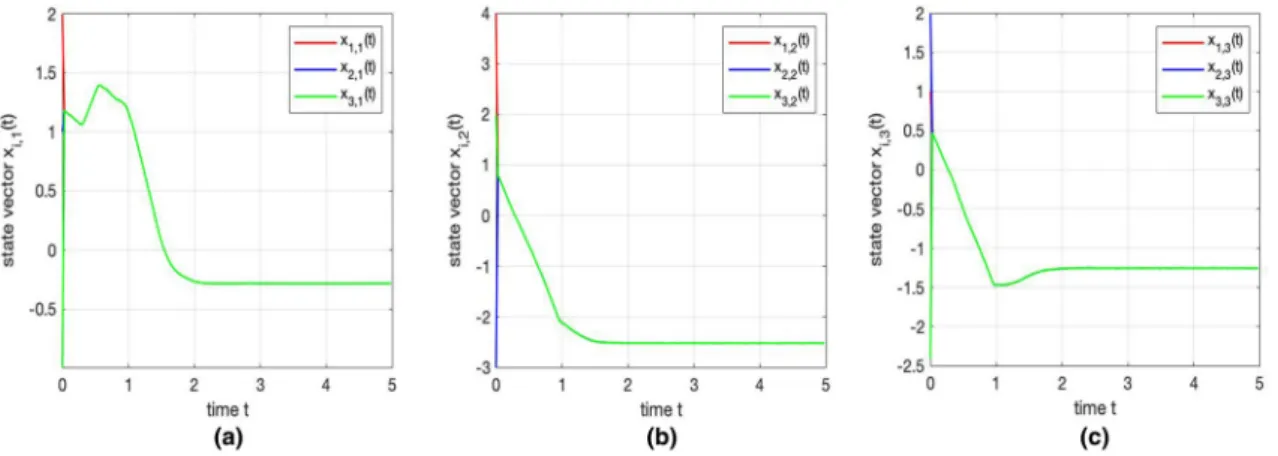
Simulation results are presented in Figs.2and3, which shows the trajectories of(xi,1,xi,2,xi,3)Tof states with
ran-dom initial values x1(0) = (2,1,−1)T,x2(0) = (4,−3,2)T andx3(0) =(1,2,−2.4)T. The colored area in Fig.2 is the feasible region of distributed optimization problem (33) and the above-mentioned initial points are marked as black ones. Besides, the star in red means an optimal solution of dis-tributed optimization problem (33). It is easy to find that the state solutions of continuous-time algorithm (17) enter the equality constraint in finite time and stay in it thereafter. After that, the trajectories of all the three agents converge to the equilibrium point(−0.3,−2.5,−1.233)T. The transient behaviors of the three agents’ solutions of continuous-time algorithm (17) are also presented in Fig.3.
Remark 6 In [9], Jia et al. proposed a generalized neural network for solving distributed optimization problems with inequality constraints only. Thus, the model cannot be imme-diately applied into distributed optimization problem (33) in Example 1. On the other hand, the continuous-time algorithm (17) is also suitable for distributed optimization problems in [9] under the condition that there is no equality constraint of distributed optimization problem (2) or the equality con-straints are satisfied after the fixed time given in Theorem2. Therefore, compared with neural network in [9], continuous-time algorithm (17) is more flexible when solving different distributed optimization problems.
Example 2 Consider a six-agent network with the commu-nication topology shown in Fig. 4. And the distributed optimization problem is given asfollows:
Fig. 4 Interaction topology of the six-agent system in Example2 min 6 i=1 fi(xi) s.t. xi,1+xi,2−2xi,3=3, xi2,1+xi2,2+i xi2,3−5≤0. (35)
The local cost functions of distributed optimization problem (35) are given as:
fi(xi)=MTixi+q, i =1,2,3,4,5,6, (36)
whereMi =(1,3,i)Tis relevant to each agent. Calculating
the gradient of fi(xi), one derives∇fi(xi)=Mi. Despite
the variability of the local cost functions, the boundedness of its gradient over the equality constraint set can still be guaranteed with a limited number of agents. It can be seen thatA=(1,1,−2)is a full-row-rank matrix and:
gi(xi)=xi2,1+x 2 i,2+i x
2 i,3−5.
Apparently, distributed optimization problem (35) meets the requirements of the conditions assumed in this paper, for instance, the boundedness of the inequality constraint set and the nonemptiness of the feasible region.
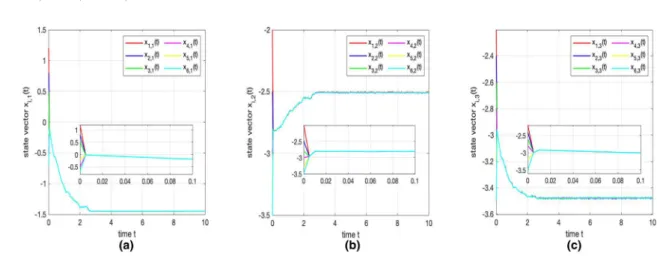
The transient behaviors of the states of continuous-time algorithm (17) are presented in detail in Fig. 5, in which xi,j(t) represents the trajectories of states.
Start-ing from initial points x1(0) = (1.2,−2,−2.2)T, x2(0) =
(0.8,−2.5,−2.4)T, x3(0) = (0.5,−2.8,−2.6)T, x4(0) =
(−0.5,−3,−2.8)T,x5(0)=(−0.2,−3.3,−3.2)T, andx6(0)=
(−0.7,−3.5,−3.5)T, the states of continuous-time algo-rithm (17) converge to an optimal solution
˜
x = (−1.447,−2.509,−3.478)T of (35). The detailed movements of the three components of the decision variables are also presented in subplots of Fig.5.
Conclusions
In this paper, a projection-based continuous-time algorithm is proposed to solve distributed optimization problems with equality and inequality constraints over multi-agent sys-tems. By exact penalty method, the distributed optimization problem is reformulated to a new one without inequality constraints and consensus constraints. It is proved that from any initial points, the states of continuous-time algorithm will enter the equality constraint set of the transformed dis-tributed optimization problem in fixed time. And states of continuous-time algorithm are proved to be convergent to an optimal solution of the original distributed optimization problem. Compared with existed models and approaches, the continuous-time algorithm has the advantages of owning fewer state variables. Besides, the states of continuous-time algorithm can find an optimal solution of distributed opti-mization problem under mild assumptions. Since the penalty method has the weakness of calculating penalty parameters, the application of continuous-time algorithm may be limited
in solving more complex distributed optimization problems. In our future work, we will consider to construct a algorithm independent of penalty method.
Acknowledgements This research was supported by National Natural Science Foundation of China (Grant 61773136) and National Natural Science Foundation of China (Grant 11471088).
Open Access This article is licensed under a Creative Commons Attribution 4.0 International License, which permits use, sharing, adap-tation, distribution and reproduction in any medium or format, as long as you give appropriate credit to the original author(s) and the source, provide a link to the Creative Commons licence, and indi-cate if changes were made. The images or other third party material in this article are included in the article’s Creative Commons licence, unless indicated otherwise in a credit line to the material. If material is not included in the article’s Creative Commons licence and your intended use is not permitted by statutory regulation or exceeds the permitted use, you will need to obtain permission directly from the copy-right holder. To view a copy of this licence, visithttp://creativecomm ons.org/licenses/by/4.0/.
References
1. Beck A, Nedic A, Ozdaglar A, Teboulle M (2014) Optimal distributed gradient methods for network resource allocation prob-lems. IEEE Trans Control Netw Syst 1(1):64–74
2. Bolte J (2003) Continuous gradient projection method in Hilbert spaces. J Optim Theory Appl 119(2):235–259
3. Cherukuri A, Cortés J (2016) Initialization-free distributed coor-dination for economic dispatch under varying loads and generator commitment. Automatica 74:183–193
4. Clarke FH (1990) Optimization and nonsmooth analysis. Siam 5 5. Gharesifard B, Cortes J (2014) Distributed continuous-time
con-vex optimization on weight-balanced digraphs. IEEE Trans Autom Control 59(3):781–786
6. Hu X, Wang J (2006) Solving pseudomonotone variational inequal-ities and pseudoconvex optimization problems using the projection neural network. IEEE Trans Neural Netw 17(6):1487–1499 7. Hopfield J (1985) Neural computation of decisions in optimization
computation of decisions in optimization problems. Biol Cybern 52
8. Jiang X, Qin S, Xue X (2019) A penalty-like neurodynamic approach to constrained nonsmooth distributed convex optimiza-tion. Neurocomputing
9. Jia W, Qin S, Xue X (2019) A generalized neural network for dis-tributed nonsmooth optimization with inequality constraint. Neural Netw
10. Kennedy M, Chua L (1988) Neural networks for nonlinear pro-gramming. IEEE Trans Circuits Syst 35(5):554–562
11. Liu N, Qin S (2018) A neurodynamic approach to nonlinear optimization problems with affine equality and convex inequality constraints. Neural Netw 109
12. Liu Q, Yang S, Wang J (2017) A collective neurodynamic approach to distributed constrained optimization. IEEE Trans Neural Netw Learn Syst 28(8):1747–1758
13. Liu Q, Wang J (2015) A second-order multi-agent network for boundconstrained distributed optimization. IEEE Trans Autom Control 60(12):3310–3315
14. Liang S, Zeng X, Hong Y (2018) Distributed nonsmooth optimiza-tion with coupled inequality constraints via modified Lagrangian function. IEEE Trans Autom Control 63(6):1753–1759
15. Lin P, Ren W, Farrell JA (2016) Distributed continuous-time opti-mization: Nonuniform gradient gains, finite-time convergence, and convex constraint set. IEEE Trans Autom Control
16. Ma L, Bian W (2019) A novel multiagent neurodynamic approach to constrained distributed convex optimization. IEEE Trans Cybern 1–12
17. Nguyen T, Nguyen N, Nahavandi S (2020) Deep reinforcement learning for multiagent systems: a review of challenges, solutions, and applications. IEEE Trans Cybern 99:1–14
18. Nedic A, Ozdaglar A (2009) Distributed subgradient methods for multi-agent optimization. IEEE Trans Autom Control 54(1):48–61 19. Qin S, Yang X, Xue X, Song J (2017) A one-layer recurrent neural network for pseudoconvex optimization problems with equality and inequality constraints. IEEE Trans Cybern 47(10):3063–3074 20. Thorndike E (1898) Animal intelligence: An experimental study of the associate processes in animals. Am Psychol 53(10):1125–1127 21. Wang X, Han M (2014) Online sequential extreme learning machine with kernels for nonstationary time series prediction. Neu-rocomputing 145:90–97
22. Wang J, Elia N (2011) Control approach to distributed optimization. Commun Control Comput
23. Wang J, Liu Q (2015) A second-order multi-agent network for bound-constrained distributed optimization. IEEE Trans Autom Control 60(12):1–1
24. Xia Y, Wang J (1998) A general methodology for designing glob-ally convergent optimization neural networks. IEEE Trans Neural Netw 9(6):1331–1343
25. Xia Y, Wang J (2001) A dual neural network for kinematic control of redundant robot manipulators. IEEE Trans Syst Man Cybern 31(1):147–154
26. Xia Y, Wang J (2004) A general projection neural network for solving monotone variational inequalities and related optimization problems. IEEE Trans Neural Netw 15(2):318–328
27. Xi C, Wu Q, Khan UA (2015) On the distributed optimization over directed networks. Mathematics,
28. Xue X, Wei B (2008) Subgradient-based neural networks for non-smooth convex optimization problems. IEEE Trans Circuits Syst I Regul Pap 55(8):2378–2391
29. Yi P, Hong Y, Liu F (2015) Distributed gradient algorithm for con-strained optimization with application to load sharing in power systems. Syst Control Lett 83:45–52
30. Zeng Z, Wang J (2008) Design and analysis of high-capacity asso-ciative memories based on a class of discrete-time recurrent neural networks. IEEE Trans Syst Man Cybern 38(6):1525–1536 31. Zeng Z, Wang J Liao (2003) Global exponential stability of a
gen-eral class of recurrent neural networks with time-varying delays. IEEE Trans Circuits Syst I Fund Theory Appl 50(10:1353–1358 32. Zeng Z, Wang J (2006) Improved conditions for global exponential
stability of recurrent neural networks with time-varying delays. IEEE Trans Neural Netw 17(3):623–635
33. Zhang J, Life YK (2019) Distributed discrete-time optimization in multi-agent networks using only sign of relative state. IEEE Trans Autom Control 6(64):2352–2367
34. Zuo Z, Lin T (2014) A new class of finite-time nonlinear consensus protocols for multi-agent systems. Int J Control 87(2):363–370
Publisher’s Note Springer Nature remains neutral with regard to juris-dictional claims in published maps and institutional affiliations.