An abridged version of this paper appears in the proceedings of the 37th International Cryptology Conference—CRYPTO 2017. This is the full version.
Non-Malleable Codes for Space-Bounded Tampering
Sebastian Faust∗,1, Kristina Hostáková∗,1, Pratyay Mukherjee†,2, and Daniele Venturi‡,3 1Ruhr-Universität Bochum, Bochum, Germany
2Visa Research, Palo Alto, USA 3Sapienza University of Rome, Rome, Italy
June 6, 2017
Abstract
Non-malleable codes—introduced by Dziembowski, Pietrzak and Wichs at ICS 2010— are key-less coding schemes in which mauling attempts to an encoding of a given message, w.r.t. some class of tampering adversaries, result in a decoded value that is either identical or unrelated to the original message. Such codes are very useful for protecting arbitrary crypto-graphic primitives against tampering attacks against the memory. Clearly, non-malleability is hopeless if the class of tampering adversaries includes the decoding and encoding algo-rithm. To circumvent this obstacle, the majority of past research focused on designing non-malleable codes for various tampering classes, albeit assuming that the adversary is unable to decode. Nonetheless, in many concrete settings, this assumption is not realistic.
In this paper, we explore one particular such scenario where the class of tampering adversaries naturally includes the decoding (but not the encoding) algorithm. In particular, we consider the class of adversaries that are restricted in terms of memory/space. Our main contributions can be summarized as follows:
• We initiate a general study of non-malleable codes resisting space-bounded tampering. In our model, the encoding procedure requires large space, but decoding can be done in small space, and thus can be also performed by the adversary. Unfortunately, in such a setting it is impossible to achieve non-malleability in the standard sense, and we need to aim for slightly weaker security guarantees. In a nutshell, our main notion (dubbed
leaky space-bounded non-malleability) ensures that this is the best the adversary can do, in that space-bounded tampering attacks can be simulated given a small amount of leakage on the encoded value.
• We provide a simple construction of a leaky space-bounded non-malleable code. Our scheme is based on any Proof of Space (PoS)—a concept recently put forward by Ateniese et al. (SCN 2014) and Dziembowski et al. (CRYPTO 2015)—satisfying a
∗
Funded by the Emmy Noether Program FA 1320/1-1 of the German Research Foundation (DFG).
†
Part of this work was done when the author was a Post-doctoral Employee at University of California, Berkeley, supported in part from DARPA/ARL SAFEWARE Award W911NF15C0210, AFOSR Award FA9550-15-1-0274, NSF CRII Award 1464397, AFOSR YIP Award and research grants by the Okawa Foundation and Visa Inc. The views expressed are those of the author and do not reflect the official policy or position of the funding agencies.
‡
Partially supported by the European Unions Horizon 2020 research and innovation programme, under grant agreement No. 644666, and by CINI Cybersecurity National Laboratory within the project FilieraSicura: Securing the Supply Chain of Domestic Critical Infrastructures from Cyber Attacks (www.filierasicura.it), funded by CISCO Systems Inc. and Leonardo SpA.
variant of soundness. As we show, our paradigm can be instantiated by extending the analysis of the PoS construction by Ren and Devadas (TCC 2016-A), based on so-called stacks of localized expander graphs.
• Finally, we show that our flavor of non-malleability yields a natural security guarantee against memory tampering attacks, where one can trade a small amount of leakage on the secret key for protection against space-bounded tampering attacks.
Contents
1 Introduction 1
1.1 Our Contribution . . . 2 1.2 Additional Related Work . . . 4
2 Preliminaries 4 2.1 Notation . . . 4 2.2 Coding Schemes . . . 5 3 Non-Malleability in Bounded Space 6 3.1 Space-Bounded Tampering . . . . 6 3.2 Achievable Parameters . . . 8 4 Building Blocks 10 4.1 Random Oracles . . . 10 4.2 Merkle Commitments . . . 11 4.3 Graph Pebbling and Labeling . . 12
5 Non-Interactive Proofs of Space 15 5.1 NIPoS Definition . . . 15 5.2 NIPoS Construction . . . 16 5.3 Security Analysis . . . 17
6 Our Coding Scheme 22
6.1 Code Construction . . . 22 6.2 Proof of Security . . . 22 6.3 Concrete Instantiation and
Pa-rameters . . . 26 7 Trading Leakage for Tamper-Proof
Security 26
7.1 Leaky Tamper Simulatability . . 26 7.2 Analysis . . . 28
1
Introduction
Non-malleable codes (NMC) [21] were originally proposed by Dziembowski, Pietrzak and Wichs [21] in 2010 and have since been studied intensively by the research community (see, e.g., [35, 25, 13, 26, 33, 1, 10] for some examples). Such codes are an extension of the concept of error cor-rection and detection and can guarantee the integrity of a message in the presence of tampering attacks when error correction/detection may not be possible. Informally, a non-malleable code
(Encode,Decode) guarantees that a codeword modified via an algorithmA, from some class A
of allowed tampering attacks,1 either encodes the original message, or a completely unrelated value. Notice that non-malleable codes do not need to correct or detect errors. This relaxation enables us to design codes that resist much broader tampering classesA than what is possible to achieve for error correcting/detecting codes. As an illustrative example, it is trivial to con-struct non-malleable codes for the class of constant tampering functions; that is, e.g., functions that replace the codeword by a different but valid codeword. Clearly, the output of a constant tampering function is independent of the original encoded message, and hence satisfies the non-malleability property. On the other hand, it is impossible to achieve error correction/detection against such tampering classes, as by definition valid codewords do not contain errors.
Applications of non-malleable codes. The fact that non-malleable codes can be built for broader tampering classes makes them particularly attractive as a mechanism for protecting the memory of physical devices from tampering attacks [8, 3]. To protect a cryptographic functionality F against tampering with respect to a class of attacks A applied to a secret key κ that is stored in memory, we can proceed as follows. Instead of storingκ directly in memory, we use a non-malleable code for A, and store the codeword c ← Encode(κ). Thus, each time when F wants to accessκ, we first decode ˜κ=Decode(c), and, only ifDecode(c)6=⊥, we run
F(˜κ,·)on any input of our choice. Intuitively, as long as the adversary can only apply tampering attacks from the class A, non-malleability of (Encode,Decode) guarantees that any tampering results into a key that is unrelated to the original key, and hence the output of F does not reveal information about the original secret key. For further discussion on the application of non-malleable codes to tamper resilience we refer the reader to [21].
The tampering classA. It is impossible to have codes that are non-malleable forall possible (efficient) tampering algorithms A. For instance, if A contains the composition of Encode and Decode, then given a codeword c the adversary can apply a tampering algorithm A that first decodes c to get the encoded value x; then, e.g., it flips the first bit of x to obtain x, and˜
re-encodes x. Clearly, such an attack results into˜ x˜ that is related to the original value x, and non-malleability is violated. A major research direction is hence to design non-malleable codes for broad classes of tampering attacks that exclude the above obvious attacks. Prominent examples are bit-wise tampering [21], where the adversary can modify each bit of the codeword individually, split-state tampering [2], where the codeword consists of two (possibly large) parts that can be tampered with individually, and tampering functions with bounded complexity [27]. All the above mentioned classes of attacks have in common that theDecodealgorithm is not part of A. Indeed, if we want to achieve non-malleability, then we must have that Decode∈ A/ , as otherwise the following attack becomes possible. LetAbe the tampering algorithm that first decodes the codewordcto get the encoded valuex, and then, depending on the first bitbofx, it overwritescwithcb, whereDecode(c0)6=Decode(c1). In this work, we aim at codes that achieve a weaker security guarantee than standard non-malleability, but for the first time can protect
1
the security of cryptographic functionalities F with respect to a class of tampering attacks A
withDecode∈ A.
On the importance of Decode∈ A. Besides being an obvious extension of the class of tam-pering attacks for which we can design non-malleable codes (albeit achieving a weaker security guarantee, which we will outline in Section 1.1), allowing that Decode∈ Ahas some important advantages for cryptographic applications, as emphasized by the following example. Consider a physical device storing an encoded keyEncode(κ)in memory, and implementing a cryptographic functionality F. If the device attempts to implement the cryptographic functionality F, then whenever it is executed, it has to run the Decode function to recover the original secret keyκ before running F(κ,·). Suppose that a malicious piece of software A, e.g., a virus, infects the device and attempts to learn information about the secret key κ. Clearly, once A infects the device, it may use the resources available on the device itself, which in particular have to be sufficient to run theDecodealgorithm. Hence, if we view the virusAas the tampering algorithm, to maintain the functionality of the device (which in particular requires to run Decode) and at the same time to allow the virus A to control the resources of attacked device, it is necessary thatDecode∈ A.2 Our main contribution is to design non-malleable codes that can guarantee meaningful security in the above described setting. We provide more details on our results in the next section.
1.1 Our Contribution
Leaky non-malleable codes. The standard non-malleability property guarantees that de-coding the tampered codeword reveals nothing about the original encoded messagex. Formally, this is modelled by a simulation-based argument, where we consider the following tampering experiment. First, the message x gets encoded to c← Encode(x) and the adversary can apply a tampering algorithm A∈ A resulting in a modified codewordc; the output of the tampering˜
experiment is then defined asDecode(˜c). Roughly speaking, non-malleability is guaranteed if we can construct an (efficient) simulatorSthat can produce a distribution that is (computationally) indistinguishable from the output of the tampering experiment, without having access tox; the simulator is typically allowed to return a special symbol same? to signal that (it believes) the adversarial tampering did not modify the encoded message.
As explained above, if Decode∈ A, then the above notion is trivially impossible to achieve, since the adversary can easily learn O(logk) bits, where k is the size of the message.3 In this work, we introduce a new notion that we callleaky non-malleability, which models the fact that, when A ∈ A, the adversary is allowed to learn some (bounded) amount of information about the message x. Formally, we give the simulator S additional access to a leakage oracle; more concretely, this means that in order to simulate the output of the tampering experiment,S can specify a leakage function L : {0,1}k → {0,1}` and receive L(x).4 Clearly, if ` =k, then the simulation is trivial, and hence our aim is to design codes where ` is as close as possible to the necessary bound of O(logk). Notice that, due to the allowed leakage, our notion of leaky non-malleability makes most sense when the message x is sampled from a distribution of high min-entropy. But, indeed, this is the case in the main application of NMC, where the goal is to
2In particular, when resources are measured by space as considered in this work, assuming that runningDecode
requires more space than what is available on the device would imply assuming a trusted part of memory that the virus cannot exploit, which seems unnatural.
3
For instance, the adversary may just guess the firstO(logk)bits of the message and replacecwithcu(where
u∈ {0,1}O(logk)
) depending on whether its guess was correct; this attack succeeds with non-negligible probability.
4
Although, later in the paper, we define leaky non-malleability only for the case of space-bounded tampering, we point out that this weaker security guarantee makes sense for arbitrary tampering classesA.
protect a secret key of a cryptographic scheme; and in fact, as we show at the end of the paper, leaky non-malleability still allows to guarantee protection against memory tampering in many interesting cases.
Modelling space-bounded tampering adversaries. In the above application with the virus, we allow the virus to use all resources of the device when it tampers with the codeword. Of course, this means that the virus is limited in the amount of space it can use. We exploit this observation by putting forward the notion of non-malleable codes that resist adversaries operating in bounded space. That is, in contrast to earlier works on NMC, we do not require any independence of the tampering (like, e.g., in the split-state model), nor the fact that tampering comes from a restricted complexity class. Instead, we allow arbitrary efficient tampering attacks that can globally modify the codeword, as long as the attacks operate in the space available on the device. Since the lower bounds in space complexity are notoriously hard, we follow earlier works [20, 19, 4, 18] that argue about space-bounded adversaries (albeit in a different setting), using the random oracle methodology and its connection to graph pebbling games.
Let us provide some more details on our model. Our setting follows the earlier work of Dziembowski, Kazana and Wichs [20, 19] and considers a “big adversary” B that has unlimited space (though runs in PPT) and creates “small adversaries” A(e.g., viruses) that it sends to the device. On the device, Acan use the available space to modify the codeword in some arbitrary way. We emphasize thatAhas no granular restrictions, and hence can read the entire codeword. Moreover, it can follow an arbitrary efficient (PPT) tampering strategy. The only restriction is thatAhas to operate in bounded space. Both adversariesAandBhave access to a random oracle
H. AfterAhas finished its tampering attack, we proceed as in the normal NMC experiment, i.e., we decode the modified codeword and output the result. We further strengthen our definition by allowing the adversary to repeat the above attack multiple times, which is sometimes referred to as continuous tampering [25, 33]. We note that, as in [33], we require an a-priori fixed upper bound on the number of viruses AthatBcan adaptively choose.
Technical overview of our construction. Our construction is based on Proofs of Space (a.k.a. PoS), introduced in [4, 18]. First, let us recall the notion of PoS briefly. In a PoS protocol, a prover P proves that “it has sufficient space” available to a space-bounded verifier V. Using the Fiat-Shamir [29] transformation, the entire proof can be presented by πid for
some identity id. The verifier can verify the pair (id, πid) within bounded space (say s). The
soundness guarantee is that a cheating prover, with overwhelming probability, can not produce a correct proof unless it uses a large amount of space. Our NMC construction encodes a value x ∈ {0,1}k by setting id := x and then computing the proof π
id. Hence, the codeword is
c= (x, πx). Decoding is done just by running the verification procedure of the PoS.
Now, if the codeword is stored in an s-bounded device, then decoding is possible within the available space whereas encoding is not – in particular, even if the adversary can obtain x, it can not re-encode to a related value, say (x+ 1, πx+1), as guaranteed by the soundness of the underlying PoS.5 We stress that our soundness requirement is slightly different than the existing PoS constructions, as we require some form of “extractability” from the PoS: Given an honestly generated pair (x, πx), if the space-bounded virus can compute a valid pair (x0, πx0)
wherex0 6=x, then one can efficiently extract x0 from the set of random oracle queries that the big adversary made before installing the virus. Our put differently, the only way to compute a valid proof is to overwrite(x, πx)with a valid pair(x0, πx0)“pre-computed” by the big adversary.
To formally prove the leaky non-malleability of our construction, we need to show that the
5
output of the tampering experiment can be simulated given only “limited” leakage on x. For simplicity, let us explain how this can be done for one tampering query. Intuitively this is possible because the big adversary can hard-code at most polynomially many (say q) correct pairs {xi, πxi}i∈[q] into the virus. Now, since any such xi 6= x can be efficiently “extracted” from the random oracle queries made by B prior to choosing the virus, log(q) bits of leakage are sufficient to compute the exactxi from the list{xi}i∈[q].6 For multiple adaptive tampering queries things get more complicated. Nonetheless, we are able to show that each such query can be simulated by logarithmic leakage.
We emphasize that our encoding scheme is deterministic for a fixed choice of the random oracle. In particular, the only randomness comes from the random oracle itself. Also, in the security proof, we do not require to program the random oracle in the on-line phase of the security reduction, in that the random oracle can just be fixed at the beginning of the security game.7. We concretely instantiate our construction by adapting the PoS protocol from Ren and Devadas [40], that uses so-called stacks of localized expander graphs.
Applications: Trading leakage for tamper resilience. One may ask if our notion of leaky non-malleability is useful for the original application of tamper protection. In Section 7 we show that cryptographic primitives which remain secure if the adversary obtains some bounded amount of leakage from the key, can naturally be protected against tampering attacks using our new notion of leaky non-malleability. Since there is a large body of work on bounded leakage-resilient cryptographic primitives, including signature schemes, symmetric and public key encryption [32, 16, 34, 38, 39, 22, 23], and many more, our transformation protects these primitives against any efficient space-bounded tampering attack.
1.2 Additional Related Work
Only very few works consider non-malleable codes for global tampering functions [5]. Very related to our attack model are in particular the works of Dziembowski, Kazana and Wichs [20, 19]. In these works, the authors also consider a setting where a so-called “big-adversary” infects a machine with a space-bounded “small adversary”. Using techniques from graph pebbling, the authors show how to construct one-time computable functions [20] and leakage resilient key evolution schemes [19] when the “small adversary” has to operate in bounded space.
The flavor of non-malleable codes in which there is an a-priory upper bound on the total number of tampering queries, without self-destruct, was originally considered in [9]. This concept has a natural application to the setting of bounded tamper resilience (see, e.g., [15, 14, 24]).
For other related works on non-malleable codes and its applications we refer to [37].
2
Preliminaries
2.1 Notation
For a stringx, we denote its length by|x|; ifX is a set,|X | represents the number of elements in X. When x is chosen randomly in X, we write x ← X. When A is an algorithm, we write y ← A(x) to denote a run of A on input x and output y; if A is probabilistic, then y is a random variable and A(x;r) denotes a run ofA on inputx and randomnessr. An algorithm A
6
In slightly more detail, the set {xi}i∈[q] can be extracted by the simulator outside the leakage oracle as it
does not depend onx, so the simulator can just ask for the index of the exactxito later reconstructxiin full.
7Since adaptive (i.e. on-line) programming is not required, for all practical purposes our construction can
be instantiated by standard hash functions like SHA-1. However, our proof crucially relies on the ability of the simulator to control the random oracle (albeit non adaptively), in order to make the “extraction” work.
is probabilistic polynomial-time (PPT) if A is probabilistic and for any input x, r ∈ {0,1}∗ the computation of A(x;r) terminates in at most a polynomial (in the input size) number of steps. We often consider algorithmsAO(·), with access to an oracleO(·).
We denote with λ ∈ N the security parameter. A function ν : N → [0,1] is negligible in
the security parameter (or simply negligible), denotedν(λ) ∈negl(λ), if it vanishes faster than the inverse of any polynomial in λ, i.e. ν(λ) =λ−ω(1). A function µ :N→ R is a polynomial
in the security parameter, written µ(λ) ∈poly(λ), if, for an arbitrary constant c > 0, we have µ(λ)∈O(λc).
2.2 Coding Schemes
We recall the standard notion of a coding scheme for binary messages.
Definition 1(Coding scheme). A(k, n)-codeΠ = (Init,Encode,Decode)is a triple of algorithms specified as follows: (i) The (randomized) generation algorithm Init takes as input λ ∈ N and returns public parametersω∈ {0,1}∗; (ii) The (randomized) encoding algorithmEncodetakes as input hard-wired public parametersω∈ {0,1}∗ and a valuex∈ {0,1}k, and returns a codeword c∈ {0,1}n; (iii) The (deterministic) decoding algorithmDecodetakes as input hard-wired public parametersω∈ {0,1}∗ and a codewordc∈ {0,1}n, and outputs a value in{0,1}k∪ {⊥}, where
⊥denotes an invalid codeword.
We say that Π satisfies correctness if for all ω ∈ {0,1}∗ output by Init(1λ) and for all x ∈ {0,1}k, Decode
ω(Encodeω(x)) = x with overwhelming probability over the randomness of the encoding algorithm.
In this paper we will be interested in modelling coding schemes where there is an explicit bound on the space complexity required to decode a given codeword.
Definition 2(Time/space-bounded algorithm). LetAbe an algorithm. For anys, t∈Nwe say
thatA iss-space bounded andt-time bounded (or simply(s, t)-bounded) if at any time during its execution the entire state of Acan be described by at most sbits and A runs for at most t time-steps.
For such algorithms we have sA ≤ s and tA ≤ t (with the obvious meaning). We often
omit the time parameter and simply say that A is s-bounded, which means that A is an s-bounded polynomial-time algorithm. Given an input x ∈ {0,1}n, and an initial configuration σ ∈ {0,1}s−n, we write (y,σ˜) :=A(x;σ) for the output y of A including its final configuration
˜
σ ∈ {0,1}s−n. The class of all s-space bounded deterministic polynomial-time algorithms is denoted byAs
space.
We stress that, similarly to previous works [20, 19], in caseAis modelled as a Turing machine, we count the length of the input tape and the position of all the tape heads within the space bound s. However we emphasize that, although A is space-bounded, we allow to hard-wire auxiliary information of arbitrary polynomial length in its description that is not accounted for in the space-bound. Intuitively, a coding scheme can be decoded in bounded space if the decoding algorithm is space bounded.
Definition 3 (Space-bounded decoding). Let Π = (Init,Encode,Decode) be a (k, n)-code, and d ∈ N. We call Π a (k, n)-code with d-bounded decoding, if for all ω output by Init(1λ) the decoding algorithmDecodeω(·) isd-bounded.
Notice that we do not count the length of the public parameters in the space bound; this is because the valueω is hard-coded into the description of the encoding and decoding algorithms.
3
Non-Malleability in Bounded Space
In this paper we consider non-malleable codes against the class of tampering attacks that are modelled as s-bounded efficient algorithms, for some parameter s ∈ N (cf. Definition 2). Our model is motivated by the fact that a tampering attempt against a codeword, stored in some memory-constrained device, cannot use more space than the total amount of space available on the device itself. We define our model formally in Section 3.1, whereas in Section 3.2 we state simple bounds on the achievable range for the parameters in our definition.
3.1 Space-Bounded Tampering
The standard way of formalizing the non-malleability property is to require that, for any “allowed adversary”8 A, tampering with an honestly computed target encoding of some valuex∈ {0,1}k, there exists an efficient simulatorSthat is able to emulate the outcome of the decoding algorithm on the tampered codeword, without knowing x. The simulator is allowed to return a special symbol same?, signalling that (it believes) the adversary did not modify the valuex contained in the original encoding.
Below, we formalize non-malleability in the case where the set of allowed adversaries consists of all efficients-bounded algorithms, for some parameters∈N(cf. Definition 2). However, since we are particularly interested in decoding algorithms that ared-bounded for some valued≤s, the standard notion of non-malleability is impossible to achieve, as in such a case the algorithm Acan simply decode the tampered codeword and leak some information on the encoded message via tampering (see also the discussion in Section 3.2). To overcome this obstacle, we will give the simulator Ssome extra-power, in thatS will additionally be allowed to obtain some limited amount of information on x in order to simulate the view of A. To capture this, we introduce an oracle O`,xleak that can be queried in order to retrieve up-to`bits of information aboutx. Definition 4 (Leakage oracle). A leakage oracle O`,xleak is a stateful oracle that maintains a counter ctr that is initially set to 0. The oracle is parametrized by a string x ∈ {0,1}k and a value ` ∈ N. When O`,xleak is invoked on a polynomial-time computable leakage function L, the value L(x) is computed, its length is added to ctr, and ifctr ≤`, then L(x) is returned; otherwise,⊥is returned.
Since our main construction is in the random oracle model (a.k.a. ROM), we will define space-bounded non-malleability explicitly for this setting. Recall that in the ROM a hash function
H(·) is modelled as an external oracle implementing a random function, which can be queried by all algorithms (including the adversary); in the simulation, the simulator S simulates the random oracle. We introduce the notion of a tampering oracle, which essentially corresponds to repeated (adaptive) tampering with a targetn-bit codeword, using at mostsbits of total space. Below, we consider that the total space of length sis split into two parts: (i) Persistent space of length p, that also stores the codeword of length n, and that is never erased by the oracle; and (ii) Transient (or non-persistent) space, of length s−p, that is erased by the oracle after every tampering. Looking ahead, in our tampering application (cf. Section 7), the persistent space corresponds to the user’s hard-drive (storing arbitrary data), while the transient space corresponds to the transient memory available on the device.
Definition 5 (Space-bounded tampering oracle). A space-bounded tampering oracle OcnmΠ,x,ω,s,p is a stateful oracle parameterized by a (k, n)-code Π = (InitH,EncodeH,DecodeH), a string
8
The adversary is often referred to as the “tampering function”; however, for our purposes, it is more convenient to think of the tampering function as an algorithm.
x ∈ {0,1}k, public parameters ω ∈ {0,1}∗, and values s, p ∈
N (with s ≥p ≥ n). The oracle
has an initial state st:= (c, σ), wherec ←EncodeHω(x), and σ:= σ0||σ1 := 0p−n||0s−p. Hence, upon input a deterministic algorithmA∈ As
space, the output of the oracle is defined as follows. OracleOcnmΠ,x,ω,s,p(A):
Parsest= (c, σ0, σ1)
Let(˜c,σ˜0,˜σ1) :=AH(c;σ0||σ1) Returnx˜:=DecodeHω(˜c)
Update st:= (˜c,σ˜0,0s−p).
Notice that in the definition above we put space restrictions only on the tampering algorithm A. The oracle itself is space unbounded. In particular, this means that even if the decoding algorithm requires more space than s, the oracle is well defined. Moreover, this allows us to assume that the auxiliary persistent spaceσ˜0 is never erased/overwritten by the oracle.
Furthermore, each algorithmAtakes as input a codeword˜cwhich is the result of the previous tampering attempt. In the literature, this setting is sometimes called persistent continuous tampering [33]. However, a closer look into our setting reveals that the model is actually quite different. Note that, the auxiliary persistent space σ0 (that is the persistent space left after storing the codeword) can be used to copy parts of the original encoding, that thus can be mauled multiple times. (In fact, as we show in Section 3.2, if p= 2n, the above oracle actually allows for non-persistent tampering as considered in [33, 25].)
In the definition of non-malleability we will require that the output of the above tampering oracle can be simulated given only `bits of leakage on the input x. We formalize this through a simulation oracle, which we define below.
Definition 6 (Simulation oracle). A simulation oracleOS2,`,x,s,ω
sim is an oracle parametrized by a stateful PPT algorithm S2, values `, s ∈ N, some string x ∈ {0,1}k, and public parameters
ω∈ {0,1}∗. Upon input a deterministic algorithmA∈ As
space, the output of the oracle is defined as follows. OracleOS2,`,x,s,ω sim (A): Letx˜←SO `,x leak(·) 2 (1λ, ω,A) Ifx˜=same?, setx˜=x Returnx.˜
We are now ready to define our main notion of continuous non-malleability under space-bounded tampering.
Definition 7(Space-bounded continuous non-malleability). LetHbe a hash function modelled as a random oracle, and let Π = (InitH,EncodeH,DecodeH) be a (k, n)-code. For parameters `, s, p, θ, d∈N, with s≥p≥n, we say that Πis an `-leaky (s, p)-space-boundedθ-continuously non-malleable code with d-bounded decoding ((`, s, p, θ, d)-SP-NMC for short) in the ROM, if it satisfies the following conditions.
• Space-bounded decoding: The decoding algorithm DecodeH isd-bounded.
• Non-malleability: For all PPT distinguishers D, there exists a PPT simulator S = (S1,S2) such that for all values x ∈ {0,1}k there is a negligible function ν : N → [0,1]
satisfying Pr h DH(·),OΠcnm,x,ω,s,p(·)(ω) = 1 : ω←InitH(1λ) i −PrhDS1(·),OSsim2,`,x,s,ω(·)(ω) = 1 : ω←InitS1(1λ)i ≤ν(λ),
whereD asks at most θ queries toOcnm. The probability is taken over the choice of the random oracle H, the sampling of the initial state for the oracle Ocnm, and the random coin tosses ofDand S= (S1,S2).
Intuitively, in the above definition algorithm S1 takes care of simulating random oracle queries, whereasS2 takes care of simulating the answer to tampering queries. Typically,S1 and S2 are allowed to share a state, but we do not explicitly write this for simplifying notation. For readers familiar with the notion of non-malleable codes in the common reference string model (see, e.g., [35, 25]), we note that the simulator is not required to program the public parameters (but is instead allowed to program the random oracle).9
Remark 1. Note that we consider the space-bounded adversaryAas deterministic; this is without loss of generality, as the distinguisherDcan always hard-wire the “best randomness” directly into
A. Also,A does not explicitly take the public parameters ω as input; this is also without loss of generality, as Dcan always hard-wire ω in the description ofA.
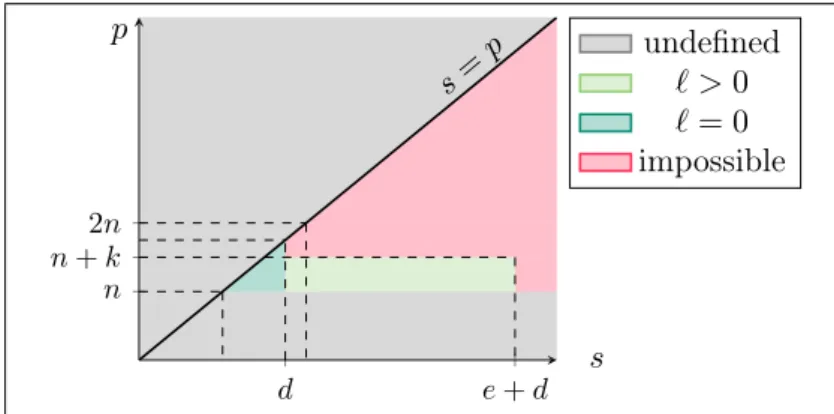
3.2 Achievable Parameters d e+d n n+k 2n s= p s p undefined ` >0 `= 0 impossible
Figure 1: Possible values for the parameters s, p ∈ N in the definition of leaky space-bounded non-malleability, for fixed values of k, n, d (assuming d < 2n); in the picture, “impossible” means forθ≥kand for non-trivial values of `, andeis the space bound for the encoding algorithm.
We now make a few remarks on our definition of space-bounded non-malleability, and further in-vestigate for which range of the parameters s (total space avail-able for tampering), p (persis-tent space available for tampering), θ (number of adaptive tampering queries), d (space required for de-coding), and ` (leakage bound), our notion is achievable. Let
Π = (InitH,EncodeH,DecodeH) be a (k, n)-code in the ROM.10 First, note that leaky space-bounded non-malleability is trivial to achieve whenever ` = k (or ` = k−ε, for ε ∈ O(logλ)); this is because, for such values of the leakage bound, the simulator can simply obtain the input message x ∈ {0,1}k, in which case the security guarantee becomes useless. Second, the larger the values of s and θ, the larger is the class of tampering attacks and the number of tampering attempts that the underlying code can tolerate. So, the challenge is to construct coding schemes tolerating a large space bound in the presence of “many” tampering attempts, using “small” leakage.
An important feature that will be useful for characterizing the range of achievable parameters in our definition is the so-called self-destruct capability, which determines the behavior of the decoding algorithm after an invalid codeword is ever processed. In particular, a code with the self-destruct capability is such that the decoding algorithm always outputs⊥after the first⊥is ever returned (i.e., after the first invalid codeword is ever decoded). Such a feature, which was already essential in previous works studying continuously non-malleable codes [25, 12, 11], can
9However, we stress that in the proof of our code construction (cf. Section 6), we do not need adaptive random
oracle programming.
10
be engineered by enabling the decoding function to overwrite the entire memory content with a fixed string, say the all-zero string if a codeword is decoded to⊥.
Depending on the self-destruct capability being available or not, we have the following natural observations:
• If Π is not allowed to self-destruct, it is impossible to achieve space-bounded non-malle-ability, for non-trivial values of `, whenever θ ≥ n (for any s ≥p ≥n, and any d∈ N). This can be seen by considering the deterministic algorithm Ai
auxi (for somei∈[n]) that overwrites the firsti−1bits of the input codeword with the valuesauxi := (c[1], . . . , c[i−1]), and additionally sets the i-th bit to0 (leaving the other bits unchanged). Using such an algorithm, a PPT distinguisherDcan guess the bitc[i]of the target codeword to be either
0(in case the tampering oracle returned the input messagex) or1(in case the tampering oracle returned a value different from x, namely ⊥). Hence, D returns 1 if and only if DecodeHω(c) =x.
The same attack was already formally analyzed in [12] (generalizing a previous attack by Gennaro et al.[31]); it suffices to note here that the above attack can be mounted using s = n bits of space (which are needed for processing the input encoding), and requires θ=ntampering attempts.
• Even ifΠis allowed to self-destruct, whenevers≥dandp≥n+θ−1, leaky space-bounded non-malleability requires`≥θ. This can be seen by considering the following attack. An s-bounded algorithm A1c0,c1, with hard-wired two valid encodings c0, c1 ∈ {0,1}n of two
distinct messages x0, x1 ∈ {0,1}k does the following: (i) Decodes c obtaining x (which requires d≤s bits of space); (ii) Stores the first θ−1 bits of x in the persistent storage
˜
σ0; (iii) If the θ-th bit ofx is one, it replacesc withc˜=c1, else it replacesc with˜c=c0. During the next tampering query, D can specify an algorithm A2c0,c1 that overwrites the target encoding with eitherc0 or c1 depending on the first11 bit of σ˜0 being zero or one, and so on until the firstθ−1 bits ofx are leaked. So in total, it is able to leak at least θ bits ofx (including the θ-th bit ofx leaked byA1).
• The previous attack clearly implies that it is impossible to achieve leaky space-bounded non-malleability, for non-trivial values of `, whenever s≥d,θ=k, andp≥n+k−ε, for ε ∈ O(logλ). A simple variant of the above attack, where essentially D aims at leaking the target encodingcinstead of the inputx, yields a similar impossibility result whenever s≥p,d∈N,θ=n, andp≥2n−ε, for ε∈O(logλ).
The above discussion is summarized in the following theorem (see also Fig. 1 for a pictorial representation).
Theorem 1. Let`, s, p, θ, d, k, n∈Nbe functions of the security parameterλ∈N. The following holds:
(i) No (k, n)-code Π without the self-destruct capability can be an (`, s, p, θ, d)-SP-NMC for
d∈N, s≥p≥nand `=n−µ, where µ∈ω(logλ).
(ii) For any 1≤θ < k, if Π is a (k, n)-code (with or without the self-destruct capability) that is an (`, s, p, θ, d)-SP-NMC ford∈N, s≥dand p≥n+θ−1, then `≥θ.
11
Recall that the tampering oracle of Definition 5 initializes the persistent space σ0 used by the current
(iii) No (k, n)-code Π (even with the self-destruct capability) can be an (`, s, p, θ, d)-SP-NMC for d∈N, `=n−µ, with µ∈ω(logλ), where, for ε∈O(logλ),
s≥d θ≥k p≥n+k−ε
or s≥p θ≥n p≥2n−ε.
Remark 2. We emphasize that our coding scheme (cf. Section 6) does not rely on any self-destruct mechanism, and achieves θ ≈k/logλ for non-trivial values of the leakage parameter. This leaves open the question to construct a code relying on the self-destruct capability, that achieves security for any θ∈poly(λ) and for non-trivial leakage, with parameters s, p, d consis-tent with the above theorem. We leave this as an interesting direction for future research.
4
Building Blocks
In this section we define the main cryptographic primitives on which we base our construction later. We start by putting forward a few conventions about random oracles, in Section 4.1, and by recalling the standard properties of Merkle trees, in Section 4.2. Then, in Section 4.3, we define a few concepts related to random-oracle labeling of directed acyclic graphs.
4.1 Random Oracles
All our results are in the random oracle model (ROM). Therefore we first discuss some basic con-ventions and definitions related to random oracles. First, recall that in the ROM, at setup, a hash functionHis sampled uniformly at random, and all algorithms, including the adversary, are given oracle access toH(unless stated otherwise). For instance, we letΠ = (InitH,EncodeH,DecodeH)
be a coding scheme in the ROM. Second, without loss of generality, we will always consider a random oracle Hwith a typeH:{0,1}∗ → {0,1}nH.
We emphasize that unlike many other proofs in the ROM, we will not need the full pro-grammability of random oracles. In fact, looking ahead, in the security proof of our code construction from Section 6, we can just assume that the random oracle isnon-adaptively pro-grammableas defined in [6].12 The basic idea is that the simulator/reduction samples a partially defined “random-looking function” at the beginning of the security game, and uses that function as the random oracleH. In particular, by fixing a function ahead of time, the reduction fixes all future responses to random oracle calls—this is in contrast to programmable random oracles, which allow the simulator to choose random values adaptively in the game, and also to program the output of the oracle in a convenient manner.
For any stringx, and any random oracleH, we use the notationHx to denote the specialized random oracle that accepts only inputs with prefix equal to x. We additionally make the following conventions:
• Query Tables. Random oracle queries are stored in query tables. Let QH be such a table. QH is initialized as QH :=∅. Hence, when His queried on a value u, a new tuple
(I(u), u,H(u))is appended to the tableQHwhereI :{0,1}∗ → {0,1}O(logλ)is an injective function that maps each input u to a unique identifier, represented in bits. Clearly, for any tuple(i, u,H(u))we have that I−1(i) =u.
• Input Field. Let QH = ((i1, u1, v1),· · · ,(iq, uq, vq)) be a query table. The input field
IPQH ofQH is defined as the tupleIPQH = (u1, . . . , uq).
12
4.2 Merkle Commitments
Merkle Commitment MGenH(1λ): Output ωcm:=∅.
MCommitHωcm(z0, . . . , zN−1): Output ψ:=RootH(N,(z0, . . . , zN−1)). MOpenHωcm((z0, . . . , zN−1), i):
• Ifi≡0 mod 2thenφ1 :=zi+1; else φ1 :=zi−1.
• Forj= 2 to log(N) do – i:=idiv 2
– Ifi≡0 mod 2 thenφj :=RootH(2j−1,(z(i+1)2j−1, . . . , z(i+2)2j−1−1));
elseφj :=RootH(2j−1,(z(i−1)2j−1, . . . , zi2j−1−1)). • Output (zi,(φ1, . . . , φlogN)).
MVerHωcm(i, ψ,(z,(φ1, . . . , φlogN))):
• Ifi≡0 mod 2thenψ0 :=H(z||φ1); else ψ0 :=H(φ1||z).
• Forj= 2 to log(N) do – i:=idiv 2
– Ifi≡0 mod 2 thenψ0 :=H(ψ0||φj); else ψ0 :=H(φj||ψ0).
• Ifψ=ψ0 then output 1, otherwise output 0.
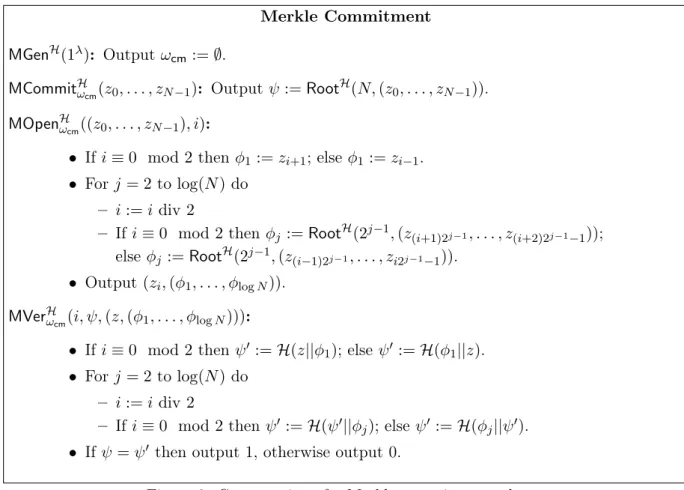
Figure 2: Construction of a Merkle commitment scheme
A Merkle commitment is a special type of commitment scheme13 exploiting so-called hash trees [36]. Intuitively, a Merkle commitment allows a sender to commit to a vector ofN elements z := (z1, . . . , zN) using N −1 invocations of a hash function. At a later point, the sender can open any of the valueszi, by providing a succinct certificate of size logarithmic inN.
Definition 8(Merkle commitment). A(k, ncm, N, nop, νmt)-Merkle commitment scheme (or MC
scheme) in the ROM is a tuple of algorithms(MGenH,MCommitH,MOpenH,MVerH) described as follows.
• MGenH(1λ): On input the security parameter, the randomized algorithm outputs public parametersωcm∈ {0,1}∗.
• MCommitHωcm(z): On input the public parameters and an N-tuplez= (z1, . . . , zN), where zi∈ {0,1}k, this algorithm outputs a commitment ψ∈ {0,1}ncm.
• MOpenHωcm(z, i): On input the public parameters, a vector z = (z1, . . . , zN) ∈ {0,1}kN, and i∈[N], this algorithm outputs an opening(zi, φ)∈ {0,1}nop.
• MVerHωcm(i, ψ,(z, φ)): On input the public parameters, an index i ∈ [N], and a commit-ment/opening pair(ψ,(z, φ)), this algorithm outputs a decision bit.
13Commitment schemes typically also have hiding, which ensures that the commitment does not reveal any
information about the committed string. Looking ahead, we will commit to a public string and hence hiding is not needed in our case.
We require the following properties to hold.
Correctness: For all z= (z1, . . . , zN)∈ {0,1}kN, and alli∈[N], we have that
Pr MVerHω cm(i, ψ,(zi, φ)) = 1 : ωcm←MGenH(1λ); ψ←MCommitHωcm(z) (zi, φ)←MOpenHωcm(z, i) = 1
Binding: For all z = (z1, . . . , zN) ∈ {0,1}kN, for all i ∈ [N], and all PPT adversaries A, we havePr[GbindA,z,i(λ) = 1]≤νmt, where the gameGbindA,z,i(λ) is defined as follows:
GameGbindA,z,i:
1. Sampleωcm←MGenH(1λ).
2. Let(ψ,(z0, φ0))←AHωcm(z, i). 3. Let(zi, φi) :=MOpenHωcm(z, i).
4. Output1 if and only if all of the following conditions are satisfied: (a) MVerHωcm(i, ψ,(z0, φ0)) = 1.
(b) MVerHωcm(i, ψ,(zi, φi)) = 1. (c) z06=zi.
Merkle commitments are a well known cryptographic primitive. For completeness, we recall how the construction works. Although such commitments can be based on standard collision-resistant hash functions, for consistency with the rest of the paper we describe the construction in the ROM.
Let T be a complete binary tree with N leafs (without lost of generality we assume that N is a power of two), and let H:{0,1}∗ → {0,1}k be a random oracle. We assign an index i∈ [0, N −1] to every leaf of the tree T. Informally, to commit to a stringz, one first parses
(z0, . . . , zN−1) :=z and defineszi to be the label of thei-th leaf of T. The commitment is then defined as the label of the root of the hash tree T. A more formal description is given in Fig. 2 (see also Fig. 3 for a pictorial representation). To simplify the notation in the figure, we define an auxiliary algorithm Root which, given the values of L leafs, recursively computes the value of the root of the binary hash tree. More formally:
AlgorithmRootH(L,(z0, . . . , zL−1)):
• IfL= 2, then output H(z0||z1);
• Else, outputHRootH(L2,(z0, . . . , zL
2−1))
||RootH(L2,(zL
2, . . . , zL−1))
. 4.3 Graph Pebbling and Labeling
Throughout this paper G = (V, E) is considered to be a directed acyclic graph (DAG), where V is the set of vertices andE is the set of edges of the graph G. Without loss of generality we assume that the vertices of G are ordered lexicographically and are represented by integers in
[N], where N =|V|. Vertices with no incoming edges are called input vertices or sources, and vertices with no outgoing edges are called output vertices or sinks. We denote Γ−(v), the set of all predecessors of the vertex v. Formally, Γ−(v) ={w∈V: (w, v)∈E}.
In this section we briefly explain the concept of graph labeling and its connection to the abstract game called graph pebbling which has been introduced in [17]. For more details we refer to previous literature in, e.g., [17, 40, 4, 18]. We follow conventions from [40] and will use results from the same. Sometimes for completeness we will use texts verbatim from the same paper.
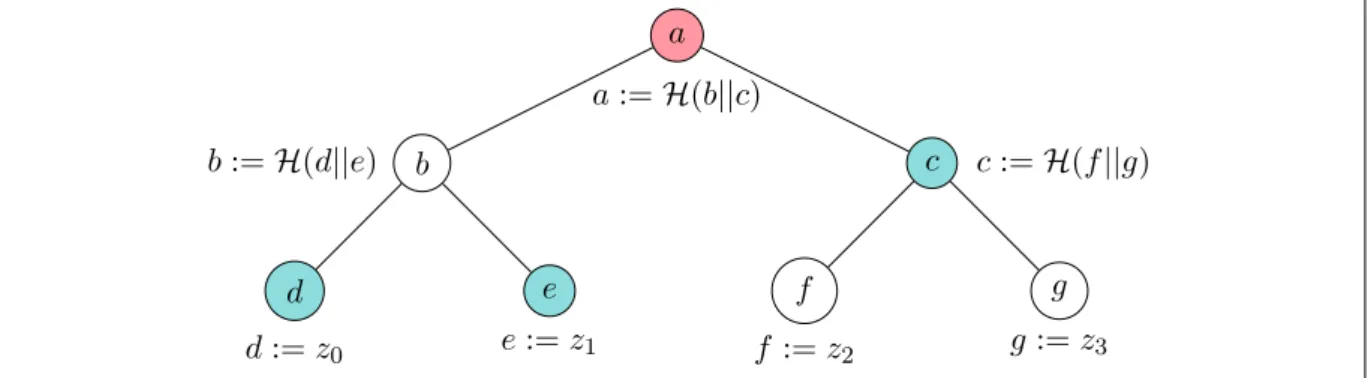
a b d e c f g a:=H(b||c) d:=z0 e:=z1 f :=z2 g:=z3 b:=H(d||e) c:=H(f||g)
Figure 3: Example of a Merkle commitment of a stringz= (z0, z1, z2, z3). HereMCommitH(z) = aand for example MOpenH(1,z) = (e,(d, c)). The verification algorithm, given(a,(e0,(d0, c0)))
and the index 1 computes b0 := H(d0||e0) and a0 := H(b0||c0) and outputs 1 if a = a0 and 0 otherwise.
Labeling of a graph. Let H:{0,1}∗ → {0,1}nH be a random oracle. The H-labeling of a
graph Gis a function which assigns a label to each vertex in the graph; more precisely, it is a function label:V → {0,1}nH which maps each vertex v ∈V to a bit stringlabel(v) := H(q
v), where we denote by v(1), . . . , v(d) = Γ−(v) and let qv := ( v if v is an input vertex,
v || label(v(1)) || . . . ||label(v(d)) otherwise.
An algorithm AH labels a subset of vertices W ⊆ V if it computes label(W). Specifically, AH labels the graph Gif it computes label(V).
Additionally, for m ≤ |V|, we define the H-labeling of the graph G with m faults14 as a function label:V → {0,1}nH such that, for some subset of vertices M ⊂V of sizem, it holds
label(v) =H(qv), for every v∈V \M, label(v)6=H(qv), for every v∈M.
Sometimes we refer to labeling with faults as partial labeling. The following lemma appeared in form of a discussion in [40]. It is based on an observation previously made in [18].
Lemma 1([40, Section 5.2]). LetAHbe an(s, t)-bounded algorithm which computes the labeling of a DAG Gwith m∈Nfaults. Then there exists an (s+m·nH, t)-bounded algorithmA˜H that computes the labeling ofGwithout faults but getsmcorrect labels to start with (they are initially stored in the memory of A˜H and sometimes called initial labels).
Intuitively the above lemma follows because the algorithm A˜H can overwrite the additional space it has, once the initial labels stored there are not needed.
Pebbling game. The pebbling of a DAGG= (V, E) is defined as a single-player game. The game is described by a sequence of pebbling configurations P= (P0, . . . , PT), wherePi ⊆V is the set of pebbled vertices after thei-th move. In our model, the initial configuration P0 does not need to be empty. The rules of the pebbling game are the following. During one move (translation from Pi to Pi+1), the player can place one pebble on a vertex v if v is an input vertex or if all predecessors ofv already have a pebble. After placing one pebble, the player can
14One can also define an analogy of faults in the pebbling game by adding a second kind of pebbles. These
remove pebbles from arbitrary many vertices.15 We say that the sequence P pebbles a set of vertices W ⊆V if W ⊆S
i∈[0,T]Pi.
The time complexity of the pebbling game Pis defined as the number of moves t(P) :=T. The space complexity ofPis defined as the maximal number of pebbles needed at any pebbling step; formally,s(P) := maxi∈[0,T]{|Pi|}.
Ex-post-facto pebbling. LetAH be an algorithm that computes the (partial)H-labeling of a DAGG. The ex-post-facto pebbling bases on the transcript of the graph labeling. It processes all oracle queries made by AH during the graph labeling (one at a time and in the order they were made). Informally, every oracle query of the form qv, for some v ∈ V, results in placing a pebble on the vertex v in the ex-post-facto pebbling game. This provides us a link between labeling and pebbling of the graph G. The formal definition follows.
Let H:{0,1}∗ → {0,1}nH be a random oracle and Q
H a table of all random oracle calls made byAH during the graph labeling. Then we define theex-post-facto pebblingPof the graph
Gas follows:
• The initial configurationP0 contains every vertexv ∈V such thatlabel(v) has been used for some oracle query (e.g. some query of the formH(· · · klabel(v)k · · ·)) at some point in the transcript but the query qv is not listed in the part of the transcript preceding such query.
• Assume that the current configuration isPi, for somei≥0. Then find the next unprocessed oracle query which is of the formqv, for some vertex v, and define Pi+1 as follows:
1. Place a pebble on the vertex v.
2. Remove all unnecessary pebbles. A pebble on a vertex v is called unnecessary if label(v) is not used for any future oracle query, or if the query qv is listed in the succeeding part of the transcript beforelabel(v)is used in an argument of some other query later. Intuitively, eitherlabel(v) is never used again, or AH anyway queriesqv before it is used again.
The lemma below appeared in several variations in the literature (see, for example, [17, 4, 40]), depending on the definition of graph pebbling.
Lemma 2(Labeling Lemma). LetGbe a DAG. Consider an(s, t)-bounded adversaryAHwhich computes the H-labeling of the graph G. Also assume thatAH does not guess any correct output of H without querying it. Then the ex-post facto pebbling strategy P described above pebbles the graph G, and the complexity of P is
s(P)≤ s
nH and t(P)≤t.
Proof. By definition of ex-post-facto pebbling, it is straightforward to observe that ifAH com-putes theH-labeling of the graphG, then the ex-post-facto pebblingPpebbles the graph. Since we assume that the adversary does not guess the correct label, the only way AH can learn the label of the vertexv is by querying the random oracle. The bound ont(P)is immediate. Again, by definition of the ex-post-facto pebbling, there is no unnecessary pebble at any time. Thus, the number of required pebbles is equal to the maximum number of labels that AH needs to store at once. Hence, the space bound follows directly from the fact that each label consists of nH bits and that the algorithm AH iss-space bounded.
15Similar to [40] in our model we assume that removing pebbles is for free as it does not involve any oracle
Localized expander graphs. A (µ, α, β)-bipartite expander, for0 < α < β <1, is a DAG withµsources andµsinks such that anyαµsinks are connected to at least βµsources. We can define a DAG G0µ,k
G,α,β by stacking kG (∈N) bipartite expanders. Informally, stacking means that sinks of the i-th bipartite expander are sources of the i+1-st bipartite expander. It is easy to see that such a graph has µ(kG+ 1) nodes which are partitioned into kG + 1 sets (which we call layers) of size µ. A Stack of Localized Expander Graphs (SoLEG) is a DAG Gµ,kG,α,β obtained by applying the transformation calledlocalization (see [7, 40] for a definition) on each layer of the graphG0µ,k
G,α,β.
We restate two lemmas about pebbling complexity of SoLEG from [40]. The latter appeared in [40] in form of a discussion.
Lemma 3 ([40, Theorem 4]). Let Gµ,kG,α,β be a SoLEG where γ := β−2α > 0. Let P =
(P0, . . . , Pt(P))be a pebbling strategy that pebbles at leastαµoutput vertices of the graphGµ,kG,α,β
which were not initially pebbled, where the initial pebbling configuration is such that |P0| ≤ γµ,
and the space complexity of Pis bounded by s(P)≤γµ. Then the time complexity ofP has the following lower bound:
t(P)≥2kGαµ.
Lemma 4([40, Section 5.2]). LetGµ,kG,α,β be a SoLEG andH:{0,1}
∗ → {0,1}nH be a random
oracle. There exists a polynomial time algorithm AH that computes the H-labeling of the graph
Gµ,kG,α,β in µnH-space.
5
Non-Interactive Proofs of Space
We start by defining non-interactive proofs of space, in Section 5.1. Then, in Section 5.2, we describe our construction based on Merkle commitments and pebbling of directed acyclic graphs. The security analysis is given in Section 5.3.
5.1 NIPoS Definition
A proof of space (PoS) [4, 18] is a (possibly interactive) protocol between a prover and a verifier, in which the prover attempts to convince the verifier that it used a considerable amount of memory or disk space in a way that can be easily checked by the verifier. Here, “easily” means with a small amount of space and computation; a PoS with these characteristics is sometimes called a proof of transient space [40]. A non-interactive PoS (NIPoS) is simply a PoS where the proof consists of a single message, sent by the prover to the verifier; to each proof, it is possible to associate an identity.
Intuitively, a NIPoS should meet two properties known as completeness and soundness. Completeness says that a prover using a sufficient amount of space will always be accepted by the verifier. Soundness, on the other hand, ensures that if the prover invests too little space, it has a hard time to convince the verifier. A formal definition follows below.
Definition 9 (Non-interactive proof of space). For parameters sP, sV, s, t, k, n∈N, with sV ≤
s < sP, andνpos∈(0,1), an(sP, sV, s, t, k, n, νpos)-non-interactive proof of space scheme (NIPoS
for short) in the ROM consists of a tuple of PPT algorithms(SetupH,PH,VH)with the following syntax.
• SetupH(1λ): This is a randomized polynomial-time (in λ) algorithm with no space re-striction. It takes as input the security parameter and it outputs public parameters ωpos ∈ {0,1}∗.
• PHωpos(id): This is a probabilistic polynomial-time (in λ) algorithm that is sP-bounded.
It takes as input an identity id ∈ {0,1}k and hard-wired public parameters ω
pos, and it
returns a proof of spaceπ ∈ {0,1}n.
• VHωpos(id, π): This algorithm issV-bounded and deterministic. It takes as input an identity
id, hard-wired public parametersωpos, and a candidate proof of space π, and it returns a
decision bit.
We require the following properties to hold. Completeness: For all id ∈ {0,1}k, we have that
PrhVHωpos(id, π) = 1 : ωpos←SetupH(1λ);π ←PHωpos(id) i
= 1,
where the probability is taken over the randomness of algorithms Setup and P, and over the choice of the random oracle.
Extractability: There exists a polynomial-time deterministic algorithm K (the knowledge ex-tractor) such that for any probabilistic polynomial-time algorithm B, and for any id ∈ {0,1}k, we have
Pr[GextB,id(λ) = 1]≤νpos,
where the experimentGextB,id(λ)is defined as follows: GameGextB,id(λ):
1. Sampleωpos←SetupH(1λ) and π←PHωpos(id).
2. LetA←BH(ωpos,id, π) and {idi}i∈[q]:=K(ωpos,QH(B)). 3. Let( ˜id,π˜) :=AH(id, π).
4. Output1 if and only ifVHωpos( ˜id,π˜) = 1and id˜ 6∈ {idi}i∈[q]∪ {id}
whereA is an (s, t)-bounded deterministic algorithm, q ∈poly(λ), the set QH(B) contains the sequence of queries ofBtoHand the corresponding answers, and where the probability is taken over the coin tosses ofSetup,B,P, and over the choice of the random oracle.
Roughly, the extractability property requires that no space-bounded adversary is able to modify an honestly computed proof π for identity id into an accepting proof π˜ for an identity
˜
id 6= id. Moreover, this holds true even if A is chosen adaptively (possibly depending on the public parameters, the identity id, and a corresponding valid proof π) by a PPT algorithm B with unbounded space. Since, however, B can compute offline an arbitrary polynomial number of valid proofs (idi, πi), what the definition requires is that no (B,A) is able to yield a valid pair ( ˜id,π˜) for an id˜ different than id that the knowledge extractor K cannot predict by just looking at B’s random oracle queries. It is easy to see that such an extractability requirement constitutes a stronger form of soundness, as defined, e.g., in [4, 40].
5.2 NIPoS Construction
We now give a NIPoS construction that is essentially a non-interactive variant of the PoS con-structions of [40] that is in turn based on [4]. In particular, we show that it satisfies the stronger form of soundness which we call extractability. In addition, we formalize the security analysis given in [40] with concrete parameters that may be of independent interest.
• A random oracleH:{0,1}∗→ {0,1}nH.
• A graphGµ,kG,α,β from the family of SoLEG (cf. Section 4.3), where α, β are constants in
(0,1)such that 2α < β. By definition of such a graph, the number of nodes is given by N =µ(kG+ 1). The in-degreeddepends on γ =β−2α, and it is hence constant.16 Without loss of generality we assume that the vertices ofGµ,kG,α,β are ordered lexicograph-ically and are represented by integers in [N]. For simplicity we also assume that N is a power of 2, and thatlog(N) divides nH.
• A(nH, ncm, N, nop, νmt)-Merkle commitment scheme(MGenH,MCommitH,MOpenH,MVerH)
(cf. Section 4.2).
Our construction is formally described in Fig. 4. Let us here just briefly explain the main ideas. The setup algorithm chooses a graph Gµ,kG,α,β from the family of SoLEG. Given an identity id, the prover first computes the Hid-labeling of the graph Gµ,kG,α,β and commits to the resulting string using the Merkle commitment scheme. Then τ vertices of the graph are randomly chosen. For each challenged vertex v, the prover computes and outputs the opening for this vertex as well as opening for all its predecessors. The verifier gets as input the identity, a commitment, andτ(d+ 1)openings, wheredis the degree of the graph. It firstly verifies the consistency of all the openings with respect to the commitment. Secondly, it checks the local correctness of the Hid-labeling.
The completeness of our scheme relies on the correctness of the underlying commitment scheme. The extractability will follow from the pebbling complexity of the graph Gµ,kG,α,β and the binding property of the commitment scheme. In particular, we prove the following statement: Theorem 2. Let H:{0,1}∗ → {0,1}nH be a random oracle, G
µ,kG,α,β be a SoLEG with N = µ(kG+ 1)nodes and din-degree, and (MGenH,MCommitH,MOpenH,MVerH) be a (nH, ncm, N,
nop, νmt)-Merkle commitment. Let s, t ∈ N be such that, for some δ ∈ [0, β−2α), we have
t < 2kGαµ and s ≤ δµnH. Then, the NIPoS scheme described in Fig. 4 is a (s
P, sV, s, t, k, n,
νpos)-NIPoS for any k∈N, as long as:
sP≥k+nH(µ+ log(N) + 1) +n s≥sV ≥k+n+nH n=ncm+nop(d+ 1)(nH/log(N)) νpos≤exp − nHµ(γ−δ) Nlog(N) +nH(d+ 1)νmt log(N) + |QH(A)| 2nH ,
where QH(A) are the random oracle queries asked by A andγ =β−2α.
5.3 Security Analysis
In this section we show that the construction suggested by [40] satisfies the stronger form of soundness which we call extractability. In addition, we formalize the security analysis given in [40] and provide concrete parameters. Let us first explain the intuition behind the proof of Theorem 2. The adversary wins the game only if all the checked vertices have a correct Hid˜ -label. By the binding property of the underlying Merkle commitment scheme this means that the adversary A has to compute a partialHid˜-labeling of the graph Gµ,kG,α,β. Since id˜ is not extractable from the query table of QH(B) of the adversary B and it is not equal to id, the adversary A does not get anyHid˜ label “for free” and hence, it has to compute the labeling on
16
NIPoS Construction
SetupH(1λ): On input the security parameter λ, generate the public parameters ωcm ←
MGenH(1λ) for the Merkle commitment. Consider the graph Gµ,kG,α,β; recall that the number of nodes of Gµ,kG,α,β is given by N =µ(kG+ 1) and the in-degree is d ∈ O(1). Output ωpos= (Gµ,kG,α,β, ωcm).
PHωpos(id): On input an identityid ∈ {0,1}k, and the public parametersω
pos = (Gµ,kG,α,β, ωcm), proceed as follows.
1. Generate a Hid-labeling ofGµ,kG,α,β. Denote the labeling byz= (z1, . . . , zN), where each zi ∈ {0,1}nH.
2. Generate a commitment ofz, i.e.ψ←MCommitHωcm(z) whereψ∈ {0,1}ncm.
3. Compute ρ := H(id, ψ). Using ρ as the randomness, pick τ vertices v = (v1, v2, . . . , vτ)by settingv:=ρ for τ =nH/log(N), where eachvi ∈[N].
4. For each vertex vi∈v:
(a) Compute the opening(zvi, φi) :=MOpen H ωcm(z, vi), for (zvi, φi)∈ {0,1} nop. (b) LetΓ−(vi) = (u(1)1 , . . . , u (i) d ) where each u (i)
j ∈[N]. Compute the opening corre-sponding to eachu(i)j ∈Γ−(vi), i.e.(zu(i)
j , φ(j)j ) :=MOpenHωcm(z, u(i)j ). (c) Define πi := (zvi, φi),(zu(i) 1 , φ(i)1 ),· · · ,(zu(i) d , φ(i)d ) ∈ {0,1}nop(d+1).
5. Output π:= (ψ,(π1, . . . , πτ))∈ {0,1}n as a proof of space for id.
VHωpos(id, π): On input the public parameters ωpos = (Gµ,kG,α,β, ωcm), an identity id ∈ {0,1}
k, and a candidate proof of space π ∈ {0,1}n, it first parses π as (ψ,(π
1,· · · , πτ)), and computes ρ := H(id, ψ). Using ρ as the randomness, pick τ vertices v = (v1, v2, . . . , vτ) by setting v := ρ for τ = nH/log(N), where each vi ∈ [N] (exactly as the prover did). Hence, it proceeds as follows for eachi∈[τ]:
1. Parseπi := ((wi, φi),(w1(i), φ (i) 1 ), . . . ,(w (i) d , φ (i) d ))and then: (a) Check thatwi =H(id, vi, w(i)1 , . . . w
(i) d ). (b) Check thatMVerHωcm(vi, ψ,(wi, φi)) = 1. (c) Let Γ−(vi) := (u(i)1 , . . . , u
(i)
d ); for each j ∈ [d] check that MVer H ωcm(u
(i) j , ψ,
(w(i)j , φ(i)j )) = 1.
2. If the above checks succeed for all i∈[τ], then output 1, else output 0. Figure 4: Our NIPoS construction.
its own. By Lemma 3, however, the labeling of the graphGµ,kG,α,β requires either a lot of space or a lot of time neither of which the (s, t)-bounded adversaryA has. Instead of computing all the labels correctly via random oracle calls, the adversary A can assign labels of some vertices to an arbitrary value which does not need to be computed and stored. However, if such partial labeling consists of too many faults, the probability that at least one of the faulty vertices will be checked is high. Consequently, a winning adversary can not save a lot of recourses by computing
only a partial labeling of the graph.
Proof of Theorem 2. First notice that, by our construction, it is straightforward to see the bounds onsP, sV andn. Here, we use Lemma 4 that there exists a poly-time algorithm that can
label the graphGµ,kG,α,βinµnH-bit space. Furthermore, sincesV ≤s < sPwe getk+n+nH≤s. Completeness is straightforward given these bounds and correctness of the Merkle commitment scheme. In the rest of the proof we will show the upper-bound on the soundness error νpos.
We start by constructing the knowledge extractor, taking as input the public parameters ωpos ∈ {0,1}∗ and the sequenceQH(B)ofB’s random oracle queries and corresponding answers.
K(ωpos,QH(B)):
• LetIPQH = (u1, . . . , uqB) be the input field of the query table.
• For each ui, such that |ui| ≥k, define id(ui) := (ui[1], . . . , ui[k]); let I be the set that contains all uniquek-bit stringsid(ui).
• Output the setI ={idi}i∈[q].
Adapting to our construction we can describe the security game GextB,id(λ) for any security parameter λ∈N as follows:
GameGextB,id(λ):
1. Sample ωpos←SetupH(1λ) andπ ←PHωpos(id).
2. LetA←BH(ωpos,id, π) and{idi}i∈[q]:=K(ωpos,QH(B)). 3. Let( ˜id,π˜) :=AH(id, π).
4. Parse(ψ,(π1,· · · , πτ)) := ˜π and compute (v1, . . . , vτ) :=H( ˜id, ψ).
5. Output 1 if and only if, for every i ∈[τ], the following holds. Assuming that
((wi, φi),(w1(i), φ (i) 1 ), . . . ,(w (i) d , φ (i) d )) :=πiand(u (i) 1 , . . . , u (i) d ) := Γ −(v i)all three conditions below are satisfied:
(a) wi =H( ˜id, vi, w(i)1 , . . . w (i) d ); (b) MVerHωcm(vi, ψ,(wi, φi)) = 1;
(c) For each j∈[d]: MVerHωcm(u(i)j , ψ,(w(i)j , φ(i)j )) = 1. Let us now fix an id ∈ {0,1}k and define the event
Unbind in the game GextB,id(λ) adapted
to our NIPoS construction (Fig. 4).
Event Unbind: There exists a z := (z1, . . . , zN)∈ {0,1}nHN for which at least one of the following conditions is true:
1. ∃i∈[τ]such thatwi 6=zvi,MVer H ωcm(vi, ψ,(zvi, ϕi)) = 1andMVer H ωcm(vi, ψ,(wi, φi)) = 1where(zvi, ϕi) :=MOpen H ωcm(z, vi).
2. ∃i ∈ [τ], j ∈ [d] such that wj(i) 6= zu(i)
j
, MVerHωcm(u(i)j , ψ,(zu(i)
j
, ϕ(i)j )) = 1 and MVerHωcm(u(i)j , ψ,(wj(i), φ(i)j )) = 1where(zu(i)
j
, ϕ(i)j ) :=MOpenHωcm(z, u(i)j ).
Assume that Unbind happens for some adversaryB. Then at least one of the two of above conditions must be true. For simplicity, we assume that the first condition is true; the proof for the case when the second condition holds follows similarly. We construct an algorithmCH,i for each i ∈[τ]which, hard-coded with polynomial-time algorithm A, wins the game GbindC,z,j(λ) of the Merkle commitment scheme, wherej=vi, as follows:
AdversaryCHB,,iz:
• Runωpos←SetupH(1λ) and π←PHωpos(id) for the fixedid.
• Run BH(ωpos,id, π). Answer RO queries made by B by querying the random
oracleH, and forwarding the answers toB.
• On receivingAfromB, run( ˜id,π˜) :=AH(id, π)and parse(ψ,(π1,· · · , πτ)) := ˜π and πi:= ((wi, φi),(w(i)1 , φ (i) 1 ), . . . ,(w (i) d , φ (i) d )).
• Finally, return(ψ,(wi, φi))as answer.
It is straightforward to observe thatC perfectly simulates the view ofB if the first condition is true fori. Therefore, using a simple union bound, we have that
Pr[Unbind]≤ X
j
Pr[GbindC,z,j(λ) = 1]≤τ(d+ 1)νmt.
Hence,
Pr[GextB,id(λ) = 1]≤Pr[GextB,id(λ) = 1 | ¬Unbind] + Pr[Unbind]
≤Pr[GextB,id(λ) = 1 | ¬Unbind
| {z }
:=E
] +τ(d+ 1)νmt (1)
Now, it is clear that the adversary can only win the game if it commits to a partial Hid˜ -labeling of the graphGµ,kG,α,β where all checked vertices have the correct label. Hence, unlessA successfully guesses the list of vertices ahead of time (which in turn requires predicting outputs of random oracle H), it has to compute the partial labeling within its space-bound s. Let us now define the following event.
Event Guess: A guesses the output of at least one random oracle query correctly (i.e., without querying the random oracle).
IfAmakes|QH(A)|queries to the random oracle in total, then clearly we have: Pr[Guess]≤
|QH(A)|/2nH. Hence:
Pr[E]≤Pr[E| ¬Guess
| {z }
:=E0
] + Pr[Guess]≤Pr[E | ¬Guess] +|QH(A)|/2nH. (2)
We have to bound the probability of E0. First, note that since we condition on both ¬Guess
and ¬Unbindwe have the following observations about E0:
1. ¬Unbindimplies that if the adversary Asuccessfully opens some commitmentψ˜to some valuezwith respect to some indexi(i.e.,MVerH succeeds), then it must have committed to a string z= (z1, . . . , zτ)such thatzi =z.
2. However, instead of labeling every node of Gµ,kG,α,β via random oracle queries, A can also put some faults (some arbitrary value that requires no space/time) to some node and “hope” that it is not challenged on those nodes. Since we assume¬Guess,Acan only win whenever no vi in (v1, . . . , vτ) is labeled with faults, because vi’s are decided randomly where the randomness comes from the output ofH.