2309
©IJRASET (UGC Approved Journal): All Rights are Reserved
Cost-Function-Based Network Selection Strategy in
Heterogeneous Integrated Wireless
Mahesh Mudafare
M.E. (W.C.C)
Abstract:Enabling users to connect to the best available network, dynamic network selection scheme is important for satisfying various quality of service requirements, achieving seamless mobility and load balancing in heterogeneous wireless networks. In this paper, we formulate the network selection problem in heterogeneous wireless networks with incomplete information as a Bayesian game. In general, the preference of a mobile user is private information. Therefore, each user has to make the decision of network selection optimally given only the partial information of the preferences of other users. To study the dynamics of such network selection, the Bayesian best response dynamics and aggregate best response dynamics are applied. Bayesian Nash equilibrium is considered to be the solution of this game, and there is a one-to-one mapping between the Bayesian Nash equilibrium and the equilibrium distribution of the aggregate dynamics. The numerical results show the global convergence of the aggregate best response dynamics for this Bayesian network selection game. This ensures that even with incomplete information, the equilibrium of network selection decisions of mobile users can be reached.
Keywords: Aggregate, response dynamic, Bayesian, Network selection, heterogeneous.
I. INTRODUCTION
2310
©IJRASET (UGC Approved Journal): All Rights are Reserved
decisions over the users, as the device is the only entity aware of actual connectivity conditions and real-time conditions in the device.
II. BRIEF LITERATURE SURVEY
Majed Haddad, member, IEEE, Piotr Wi˛ecek, member, IEEE “An Automated Dynamic Offset for Network Selection in
Heterogeneous Networks,” 1536-1233 (c) 2015 IEEE IEEE Transactions on Mobile Computing.In order to provide optimal use of RAN resources and best end user experience, 3GPP is also working on the integration of SC to include radio access technology (RAT) selection, addressed through per user and real time based decisions (e.g., network load and users’ radio conditions). For example, when the cellular network is somewhat congested, the operator who controls both the MC and the SC networks may want to steer mobile users that experience bad radio conditions on the cellular network (e.g., poor Received Signal Reference Power (RSRP) for LTE) from the MC to the SC (assuming SCs are available). Most existing work so far have assumed that each BS or mobile user has all others’ dynamics information whenever making its resource allocation decisions. Nevertheless, this might not be realistic in HetNets due to the limited capacity of the backhaul links and varied ownership. J. G. Andrews, H. Claussen, M. Dohler, S. Rangan, and M. C. Reed, “Femtocells: Past, Present, and Future,” IEEE Journal on Selected areas in Communications, vol. 30, no. 3, pp. 497–508, Apr. 2014. This paper considers load-aware network selection solutions, in which partial asymmetric information is available. Partial because the information available in making optimal network selection decisions is incomplete, and asymmetric because the information at the MC depends on the load, whereas the information available at the SC depends on the radio conditions. This contributes to the design of automated dynamic offset which optimizes network’s global utility while intelligence is split between the MC and mobile users. A. Damnjanovic, J. Montojo, Y. Wei, T. Ji, T. Luo, M. Vajapeyam, T. Yoo, O. Song, and D. Malladi, “A survey on 3gpp heterogeneous networks,” Wireless Communications, IEEE, vol. 18, no. 3, pp. 2011. Scenarios where such a situation is met, notably situations with priority among users. For example, when resource allocation rules correspond to those of primary users in cognitive radio or spectrum pooling networks, in which each user enjoys only a limited access to the spectrum. The rationale behind this stems from the fact that primary users maximizing their own spectral efficiency
independently of the others can result in suboptimal usage of the spectrum.
III. RESEARCH METHODOLOGY
To reach the equilibrium distribution, many iterations of network selection need to be performed to construct the convergence trajectory. Within an epoch, describes the path from the initial distribution state to its best response distribution. And at next selection epoch, this best response distribution is considered as the initial state. Therefore, the network selection distribution at network selection epoch m can be obtained from The impact of system parameters on the equilibrium distributions will be analyzed analytically in next section.
IV.PROPOSED SYSTEM
The A heterogeneous wireless environment consisting of multiple access networks with the. Without loss of generality, we consider service area a with three access networks
2311
©IJRASET (UGC Approved Journal): All Rights are Reserved
[image:4.612.133.466.282.510.2]ZigBee link with single RF-chain transmitter and receiver, It can scale link capacity with Nt at a even faster rate than SSK, which translates into enormous energy saving. It achieves this goal by uncovering the hidden potential of antenna hopping in real communications systems like ZigBee. It employs an antenna index coding framework that enables a fine-grained antenna hopping. The key observation is that real wireless devices need to compound symbol-level modulation with wide-band channel spreading . Consequently, It can embed multiple bits of antenna-index information in each original data symbol, by using sub-symbol level antenna hopping. Further, to obviate the need for multiple RF chains at the receiver side, It judiciously plants redundancy in the antenna hopping patterns, such that decoding error can be minimized without incurring too much overhead. ZigBee Transceiver. We port an opensource C# implementation of ZigBee PHY layer to the driver. This implementation is validated by running it on and allowing direct communication with a ZigBee transceiver . On top of it, we develop the single-carrier AIC and its decoding mechanisms following, along with the for WiFi Transceiver. To verify for multi-carrier systems, we first implemented an 802.11n-compliant. Our implementation reuses the 802.11n preamble mechanism, that allows transmit antennas to send LTF preambles sequentially, from which the receive antenna can extract their channel pattern. As a benchmark comparison, we have also implemented the 802.11n scheme that exploits diversity gain between a multi-RF-chain transmitter and single RF-chain receiver.
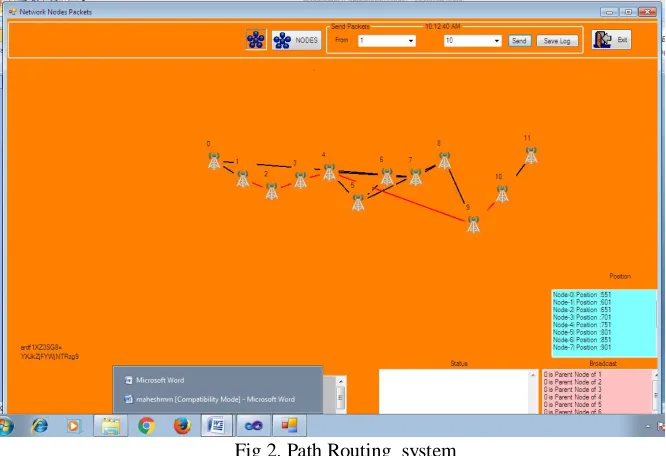
Fig 2. Path Routing system
Simulation scenario depicts the failure nodes and applies the recovery scheme for failure nodes. So the data transmit from another path to the destination, without dropping of the data transfer to the destination. To repair the failure nodes, so they are in active state. The combinational methodology detects the multiple failure Nodes at a time and apply the recovery scheme so that without failure of delivery of message packet data send to the destination and repair the failure nodes. The failure nodes have a time for regain the failure nodes. The data send from the previous routing path. So that the data deliver fastest which maximize the life time of network. The nodes are fail due to low battery of the nodes or the energy level of the node is low and apply the recovery scheme. The failure nodes are repair because it have time for regain the failure nodes.
V. CONCLUSIONS
2312
©IJRASET (UGC Approved Journal): All Rights are Reserved REFERENCES
[1] Majed Haddad, member, IEEE, Piotr Wi˛ecek, member, IEEE “An Automated Dynamic Offset for Network Selection in Heterogeneous Networks ” 1536-1233 (c) 2015 IEEE IEEE Transactions on Mobile Computing
[2] J. G. Andrews, H. Claussen, M. Dohler, S. Rangan, and M. C. Reed, “Femtocells: Past, Present, and Future,” IEEE Journal on SelectedAreas in Communications, vol. 30, no. 3, pp. 497–508, Apr. 2012.
[3] A. Damnjanovic, J. Montojo, Y. Wei, T. Ji, T. Luo, M. Vajapeyam, T. Yoo, O. Song, and D. Malladi, “A survey on 3gpp heterogeneous networks,” Wireless Communications, IEEE, vol. 18, no. 3, pp. 10– 21, 2011.
[4] Ericsson, “LTE Release 12 - taking another step toward the Networked Society,” White paper, Jan. 2013. [Online]. Available:http://goo.gl/BFMF
[5] L. Wang and G.-S. Kuo, “Mathematical modeling for network selection in heterogeneous wireless networks: A tutorial,” Communications Surveys Tutorials, IEEE, vol. 15, no. 1, pp. 271–292, 2013.
[6] S. Deb, P. Monogioudis, J. Miernik, and J. P. Seymour, “Algorithms for enhanced inter cell interference coordination (eicic) in lte hetnets,” in IEEE/ACM Transactions on Networking, 2013.
[7] R. Mahindra, H. Viswanathan, K. Sundaresan, M. Y. Arslan, and S. Rangarajan, “A practical traffic management system for integrated lte-wifi networks,” in ACM MobiCom, 2014
[8] A. Ting, D. Chieng, K. H. Kwong, I. Andonovic, and K. Wong, “Dynamic backhaul sensitive network selection scheme in lte-wifi wireless hetnet,” in IEEE PIMRC, Sept 2013.
[9] M. Haddad, S. E. Elayoubi, E. Altman, and Z. Altman, “A hybrid approach for radio resource management in heterogeneous cognitive networks,” IEEE Journal on Selected Areas in Communications Advances in Cognitive Radio Networking and Communications, vol. 2, no. 6, pp. 733–741, April 2010
[10] E. Aryafar, A. Keshavarz-Haddad, M. Wang, and M. Chiang, “Rat selection games in hetnets,” in IEEE INFOCOM, 2013.
[11] J. G. Andrews, S. Singh, Q. Ye, X. Lin, and H. S. Dhillon, “An overview of load balancing in hetnets: Old myths and open problems,” Wireless Communications, IEEE, vol. 21, no. 2, pp. 18–25, Apr. 2014.