Technology (IJRASET)
Performance Analysis of TCSC placement
problem solving
Preeti Sahu1, Ritesh Diwan2
Electronics and Telecommunication Department, Raipur Institute of Technology, Raipur, India
Abstract— In recent years, power demand has accrued day by day whereas the growth of power generation and transmission has been restricted because of restricted resources and environmental restrictions. Flexible AC Transmission Systems (FACTS) devices play a very important role in up the facility system performance. Flexible AC transmission systems devices have been chiefly used for finding numerous steady states, dynamic and transient management issues of grid. TCSC is an important member of FACTS family in an exceedingly grid, it has high potential in applications as a result of it is going to improve power system performance together with power flow management, transfer capability, transient stability and sub-synchronous resonance (SSR). As different FACTS devices, TCSC is additionally an expensive device, so this is often atmost essential to search out its optimum size and location in an exceedingly facility to realize most advantage of this device. This difficulty downside has been solved by researchers in several ways by considering totally different objectives. Many different mathematical techniques are employed within the past for optimal power flow resolution. In recent years, intelligent techniques impressed naturally, like genetic algorithm (GA), differential evolution (DE), particle swarm optimization (PSO), hybridisation of differential evolution and biography based optimization (BBO), non dominated sorting genetic algorithm (NSGA) etc. However there is no clear indication that one algorithm outperforms all others. In this , comperative study of improvement problem consists to reduce the TCSCs installation price and to decrease the total real power losses. To demonstrate the effectiveness of the proposed approach, 5 bus system and IEEE 24-bus system has been studied.
Index Terms—Optimal placement, Severity index, stressed power system, System loadability, TCSC, Hybrid DE/ABC.
I. INTRODUCTION
Flexible alternating current Transmission Systems (FACTS) controllers are unit solid state converters that have the capability of management of assorted electrical parameters in transmission circuits. Normaly used FACTS device Thyristor controlled series compensator (TCSC). It is a costly device therefore it is necessary to find optimal size and location in the busbar system. The downside of finding best location and size of Thyristor Controlled Series Compensator has been resolved as single objective as well as multi objective improvement downside. The subsequent section presents a short review of the work allotted by researchers to find the best location and size of TCSC.
FACTS devices have been used for solving various power system issues like voltage stability, power flow control, and transfer capability etc. The FACTS concept was initialy outlined by N.G. Hingorani, in 1988. According to IEEE definition, it is Alternating current transmission system incorporating power electronic based and other static controllers to enhance controllability and increase power transfer capability [1].
The conventional formulation of the optimal-power-flow (OPF) drawback determines the best settings of management
Variable like real power generations, generator terminal voltages, electrical device settings and phase-shifter angle. In resolution the OPF drawback for security-control applications, two type of variable is used to be determined by the optimization algorithm: generator active-power generation
and generator terminal voltages that area unit continuous variables, and also the point of the phase-shifting transformer [2]. A novel heuristic approach is offered based totally on Differential Evolution algorithm (DEA) to find foremost location of device to increase power system security protection and decrease system losses taking investment cost of these devices. TCSC has been decided on to area in the suitable region to enhance security margins of power structures [3].
The most advantageous reactive power dispatch (RPD) is to optimize the consistent and solve it by using non dominated sorting genetic algorithm. The optimum RPD downside is to optimize the steady state performance of an influence system in terms of one or a lot of objective functions whereas satisfying many equality and inequality constraints [4].
Technology (IJRASET)
consistent parameters. As this problem is very complicated (e.g., due to huge quantity of integer and real variables, and so forth.), Genetic algorithm (GA) strategies are used. The TCSC controllable the series reactance of a transmission line, for this reason being very flexible in controlling line currents and also can successfully damp inter area modes [5] .
The TCSC stability model was tested on conductor system. This system includes many interconnected areas, and thus, many interarea modes of oscillation. A TCSC was set during a circuit between two of the areas that expertise multiple swing modes sure as shooting system disturbances. The TCSC for this system contains a rms line-to-line voltage and rms line to line current with no fixed rating of compensation [6].
To verify the validity of the proposed changed ABC algorithmic program, the matter of crucial the optimum size, location and power issue for a distributed generation (DG). To reduce total system real power loss is considered application of DG-units has been used in some electric power networks. Power loss reduction, environmental friendliness, voltage improvement, system upgrading and improved dependableness applying a DG-unit. Utilization of the DG-unit, however, proves troublesome. The DG-unit application could be a mixed number nonlinear optimization drawback, which incorporates maximizing system voltages or minimizing power loss and value. As more objectives and constraints are thought of additional knowledge is required, that tends to feature issue to implementation [7].
II. PROBLEMIDENTIFICATION
A.TCSC
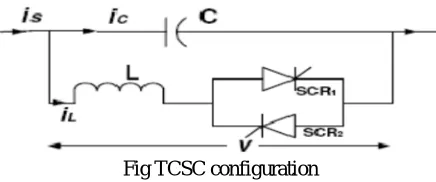
[image:3.612.196.414.332.423.2]A TCSC can be defined as a capacitive reactance compensator which consists of a series capacitor shunted by a thyristor controlled reactor in order to provide a smoothly variable series capacitive reactance.
Fig TCSC configuration
B. Placement problem
There is a troublesome task to perform optimum placement of TCSC because of high price of TCSC but it is necessary to find out the precise location of device. There is no, to the simplest of author’s data, paper that suggest a straight forward and reliable technique for determinative the suitable location of FACTS devices with static issues. Several factors depend on the situation of the device. optimum Power Flow (OPF) for reactive power planning could be a static nonlinear programming downside aimed at programming the controls of the facility of system in an exceedingly manner that optimizes an explicit objective perform whereas satisfying a collection of physical and operational constraints imposed by instrumentation limitations and security needs.
III. BRIEFDESCRIPTIONABOUTTHEPROBLEM
Various strategies are already done in this field to verify the best location of FACTS devices to boost loadability in transmission system at intervals steady state security. Some of them are illustrated:
A. Differential evolution (DE)
Due to their comparatively high value of investment, the method of installation project is significantly necessary, particularly within the determination of kind, location and rating of the instrumentality. Therefore, analysis space within the best location and filler of the FACTS device is wide developing. The best sort of the device determination is typically enclosed within the best FACTS drawback however is generally planned by mistreatment the knowledge base of the system operator on the thought-about network. during this paper, the best location and filler of the device area unit taken into consideration and therefore the sort of the FACTS device is assumed to be pre-assigned [8].
B. Nondominated sorting genetic Algorithm(NSGA)
Technology (IJRASET)
contingencies. Then, optimization technique is applied to seek out the simplest locations and parameter setting of TCSCs, so as to minimize the TCSCs installation price and also the total real power losses. Evolutionary algorithms are will not to solve this nonlinear optimization drawback, such as, the second version of nondominated sorting genetic algorithmic rule (NSGA-II). To demonstrate the effectiveness of the projected approaches, IEEE 30-bus check system has been used [9].
C. Particle swarm optimization (PSO)
Transmission loss may be reduced by installing reactive power compensation parts. Installing the thyristor controlled series compensator (TCSC) in installation has been noted to extend the voltage level within the system and hence reduce the system losses. This describes placement and sizing of FACTS devices supported Particle Swarm improvement for minimization of transmission loss considering voltage profile and price perform The TCSC is chosen because the device for compensation and behaviour as a reactive supply to the system. The PSO and EP (evolutionary programming) techniques performed on the IEEE 30-bus system have indicated that the planned ways are price in loss minimization scheme [10].
D. Hybrid DE/BBO algorithm
This is the new approach to hybridization of differential evolution with BBO (DE/BBO) technique is planned to solve best power flow downside with presence of FACTS devices. This planned technique is employed to fine-tune the simplest optimal values of the management variables to attain best performance of the ability system associate IEEE thirty bus system. TCSC is taken into account and resolved exploitation the planned algorithm together with DE and BBO. The simulation result shows that the planned cross of DE with BBO algorithm has higher performance than that of the DE and BBO in terms of improvement accuracy and tracking ability [11].
IV. MATHEMATICALFORMULATION
According to the variation of the thyristor firing angle or Conduction angle, this process can be modeled as a fast switch between corresponding reactance offered to the power system. When the thyristors are fired, the TCSC can be mathematically described as follows
The TCSC has two operating ranges around its internal circuit resonance
1. α ≤ α ≤ Π / 2 range, where ( )is capacitive.
2. 0 ≤ α ≤ Αl α range, where ( ) is inductive.
The above two relations are shown separately in the below fig
= – ( ɸ + ɸ )
= − ( ɸ − ɸ )
( )
( )
V. RESULT
A. Case 1. Analysis regarding PSO
According to siti amely jumaat, a approach for transmission loss decrease by TCSC installation via PSO and EP because the improvement technique has been best in this. Code for PSO and EP improvement techniques were developed to determine the optimum location and size of TCSC so as to minimize the transmission loss within the system. Besides that, the voltage profiles and installation cost of TCSC resulted from the study might be taken as a references of power grid operator.
B. Case 2. Performance using NSGA
Technology (IJRASET)
C. Case 3. Performance using DE/BBO
According to Susanta Dutta, in order to envision the practicability of the planned methodology for complicated network, it is applied to unravel OPF with TCSC of the same take a look at system. The optimum values of active power generation value, optimum location of TCSC, and power loss obtained by the algorithms. Below graph shows the optimal fuel cost of different algorithm.
DE/BBO BBO DE
FuelCost ($/hr)
1621.3510 1624.1507 1625.7795
Chart1. Comparison of fuel cost
D. Case 4. Performance analysis using DE
According to Bongkoj SookanantaThe best placement of the TCSC on the IEEE 24-bus RTS obtained from the DE and GA is branch 23 connecting bus 16 to 14 bus. With different sizing, the cost of generation obtained from the GA is that the lowest and lower than that obtained from the DE $0.01. During this case, the GA has 1.12 times longer process time compared to the DE. For this case, parallel branch 25 and branch 26 have the most negative index. By putting one TCSC, the parallel branches are unbalance. Therefore, branch 24 with the second most negative sensitivity index is chose. It is found that with the TCSC on this branch, the price of generation is $33443.47 that is beyond that on branch 23. Among all techniques, the employment of sensitivity index has the shortest computational time that, however, does not compute time for determination of the best sizing. Once again, the DE is that the most interesting application among designated ways on the FACTS placement determination.
Technique Generation cost ($)
Computational time (seconds)
DE 33417.27 142.4
GA 33417.26 162.8
Sensitivity index 33443.47 12.4
1619 1620 1621 1622 1623 1624 1625 1626 1627
DE/BBO BBO DE
Fu
el
C
o
st
Algorithms
Technology (IJRASET)
Chart2. Comparison of computational time
VI. CONCLUSION
The effectiveness of the best installation of FACTS for minimizing the active power generation price in power system is investigated. TCSC is reactance control FACTS device which may manage power flow between the lines. To indicate the effectiveness of the projected methodology standard take system (IEEE 24 bus) is employed for simulation study. Simulation results reveal that the projected algorithmic rule works satisfactorily for the system at rated load. Moreover, it will be inferred from the simulation results that installation of TCSC will scale the transmission loss and improvethe ability flow through the transmission line at reduced generation price for all the techniques mentioned.
REFERENCES
[1] N. G. Hingorani, and L. Gyugyi, "Understanding FACTS: Concepts and Technology of Flexible AC Transmission Systems", IEEE Press, New York, 2001
[2] N. B. Muthuselvan, P. Somasundaram and S. S. Dash, "Notice of Violation of IEEE Publication Principles
Security Enhancement of Optimal Power Flow using Genetic Algorithm," Power Electronics, Drives and Energy Systems, 2006. PEDES '06. International Conference on, New Delhi, 2006, pp. 1-4.
[3] H. R. Baghaee, B. Vahidi, S. Jazebi, G. B. Gharehpetian and A. Kashefi, "Power System Security Improvement by Using Differential Evolution Algorithm Based FACTS Allocation," Power System Technology and IEEE Power India Conference, 2008. POWERCON 2008. Joint International Conference on, New Delhi, 2008, pp. 1-6.
[4] S. Ramesh, S. Kannan and S. Baskar, "Multi-objective evolutionary algorithm based Reactive Power Dispatch with thyristor controlled series compensator,"
Power Electronics, Drives and Energy Systems (PEDES) & 2010 Power India, 2010 Joint International Conference on, New Delhi, 2010, pp. 1-7.
[5] A. Berizzi, C. Bovo and V. Ilea, "Optimal placement of FACTS to mitigate congestions and inter-area oscillations," PowerTech, 2011 IEEE Trondheim, Trondheim, 2011, pp. 1-8.
[6] J. J. Paserba, N. W. Miller, E. V. Larsen and R. J. Piwko, "A thyristor controlled series compensation model for power system stability analysis," in IEEE Transactions on Power Delivery, vol. 10, no. 3, pp. 1471-1478, Jul 1995
[7] F. S. Abu-Mouti and M. E. El-Hawary, "Modified artificial bee colony algorithm for optimal distributed generation sizing and allocation in distribution systems," Electrical Power & Energy Conference (EPEC), 2009 IEEE, Montreal, QC, 2009, pp. 1-9.
[8] B. Sookananta, "Determination of FACTS placement using differential evolution technique," Electrical Engineering and Informatics, 2009. ICEEI '09. International Conference on, Selangor, 2009, pp. 672-675.
[9] K. Tlijani, T. Guesmi and H. Hadj Abdallah, "Optimal number, location and parameter setting of multiple TCSCs for security and system loadability enhancement," Systems, Signals & Devices (SSD), 2013 10th International Multi-Conference on, Hammamet, 2013, pp. 1-6.
[10] S. A. Jumaat, I. Musirin, M. M. Othman and H. Mokhlis, "Placement and sizing of thyristor controlled series compensator using PSO based technique for loss minimization," Power Engineering and Optimization Conference (PEDCO) Melaka, Malaysia, 2012 Ieee International, Melaka, 2012, pp. 285-290.
[11] S. Dutta and P. K. Roy, "Optimal location of TCSC using hybrid DE/BBO algorithm," Non Conventional Energy (ICONCE), 2014 1st International Conference on, Kalyani, 2014, pp. 237-242.
0 20 40 60 80 100 120 140 160 180
DE GA Sensitivity