5
XI
November 2017
Multi Response Optimization of Laser Micro-
Machining Process Using Fuzzy Based Taguchi
Approach
V. Chengal Reddy1, Dr. G. Harinath Gowd2, Dr. M.L.S. Deva Kumar3
1
Research Scholar, 2Professor, Department of Mechanical Engineering, MITS, Madanapalle. Andhra Pradesh., INDIA. Professor3, Department of Mechanical Engineering, JNTUA College of Engineering, Ananthapuramu, A.P, INDIA
Abstract: Laser Beam Machining has turned to be the most successful one because of the following advantages i.e non contact process, none wearing tool, minimal distortion, reduced tendency to cracking and no tool wear. Also the process can be controlled easily and high material removal rates are possible with this process. Also it provides highly localized input to the work piece and creates less heat affected zone. Hence the LBM process is widely using in many industrial applications.
In the present work, Taguchi coupled Fuzzy Logic (TFL) has been used for multi-response optimization of Laser Micro-Machining process. In fuzzy logic multiple performance characteristic indexes (MPCI) was evaluated to solve the multi-response problem. In the present work, Milling Depth (D) and Surface Roughness (Ra) was considered as multiple responses and input parameters were taken as scanning speed, pulse power and pulse frequency. L9 orthogonal array is used to plan the experimentation. From the result it was found that TFL method optimized are at Scanning speed = 70mm/sec, Pulse power = 40W and Pulse frequency = 30 KHz. From the confirmation results, it was pragmatic that Laser Micro-Machining process significantly improved at TFA predicted optimum conditions while machining of Hastelloy C276.
Keywords: LaserMicro-Machining; Optimization; Fuzzy Logic; Taguchi Method, Hastelloy C276.
I. INTRODUCTION
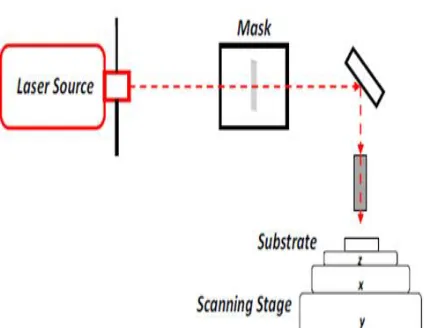
[image:2.612.212.424.550.714.2]High-precision miniaturized segments are progressively in demand for different enterprises, for example, aerospace, biomedical, electronics, environmental, communications, and automotive [1]. The laser frameworks are chiefly utilized for micromachining, micro-drilling, micro-cutting, precision machining, micro-fabrication, and milling applications. Laser micro-milling is being utilized to engrave metal surface and furthermore expels material deeper and quicker than other traditional milling strategies. This strategy can be effectively used to produce segments in micro-feature and parts with intricate geometry. The laser micro-milling process is controlled by many process parameters which influences the process execution. Accordingly, issues identifying with execution and contributions of process must be distinguished accurately.
Laser milling is generally new machining process that evacuates material in a layer-by-layer form. It is an removal framework that causes the vaporization of material, as requirements be facilitated between a laser beam and the work-piece being machined [2]. Be that as it may, it is basic to recognize the laser collaboration effort with metals and with polymers. At whatever point metals are utilized, the laser beam heats, liquefies and vaporizes the metal sublimation, while in polymers the process relies upon the burst of atomic chains (laser removal). The evacuation of material during laser processing is influenced by the qualities of the laser beam and the work-piece, however mostly dictated by the way that both associate. Scanning speed, laser power, and pulse frequency are the main considerations that influence laser processing and can once in a while be adjusted without changing the laser sort with a couple of special cases.
While machining, nano and picoseconds lasers micro milling is a suitable method to the conventional process for producing ultra high precision products from difficult to cut materials [3]. The value of the depth of evacuated material decides the exactness of parts created through a layer manufacturing technology.
In metal cutting industries manufacturing cost as well as productivity is mainly dependent on determination of optimum process parameters for any process. Very few have been done with optimization of process parameters in the field of laser manufacturing [4,5,6,7].
Hastelloy C276 has many applications particularly in the chemical field petrifaction field. This work material especially suit for high temperature environments. Hence more attention has to pay towards productivity improvement. One of the way to improve the productivity is to determine the optimum process conditions. From the literature, it was reveal that no attempt has been performed on determination of optimum process parameters while machining the Hastelloy C276. Hence TFL optimization methodology was employed to optimize input process parameters in Laser Micro-Machining while machining Hastelloy C276 considering the input process parameters like scanning speed, the laser power, and pulse frequency.
II. EXPERIMENTAL WORK
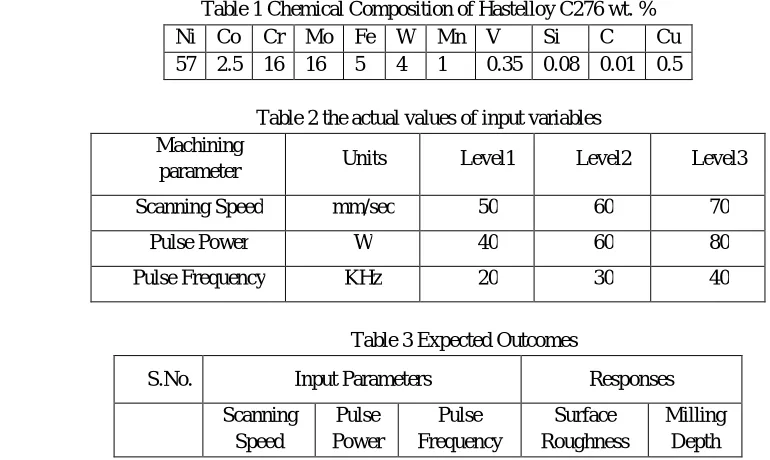
Laser micro milling process was performed by using DMG LaserTec 40 machine on Hastelloy C276. The chemical composition of Hastelloy C276 was given in Table 1. Levels of process parameters selected for the present study as shown in Table 2. Initially trail experiments were conducted for the present study to fix the levels of process parameters. The machine produces an average of laser power of 100W, 190mm focal length and 0.03mm beam spot diameter respectively. Experiments were performed by using L9 orthogonal array. The reason for selecting the orthogonal array is to reduce the time and machining cost.
[image:3.612.92.477.499.729.2]In the present study measured responses are milling depth and surface roughness respectively. Milling depth was measured at three different machined places and average value was recorded as actual depth by using inverted metallurgical microscope with computerized imaging kit. Surface roughness (Ra) was measured at three different machined places and average value was recorded as actual surface roughness by using surface roughness tester (SJ-310). The experimental results were shown in Table 3.
Table 1 Chemical Composition of Hastelloy C276 wt. % Ni Co Cr Mo Fe W Mn V Si C Cu 57 2.5 16 16 5 4 1 0.35 0.08 0.01 0.5
Table 2 the actual values of input variables Machining
parameter Units Level1 Level2 Level3 Scanning Speed mm/sec 50 60 70
Pulse Power W 40 60 80 Pulse Frequency KHz 20 30 40
Table 3 Expected Outcomes
(mm/sec) (W) (KHz) (µm) (µm) 1 50 40 20 3.904 105.08 2 50 60 30 50646 73.76 3 50 80 40 2.885 89.91 4 60 40 30 1.505 58.51 5 60 60 40 2.099 58.76 6 60 80 20 4.503 62.54 7 70 40 40 1.858 54.52 8 70 60 20 3.202 35.76 9 70 80 30 2.766 58.79
III. METHODOLOGY
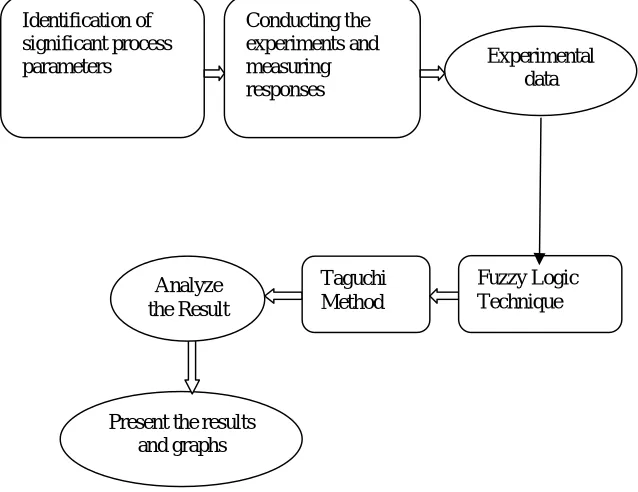
To satisfy the goal of the present work different theories, methods and techniques like Taguchi, Fuzzy logic systems have been used in this analysis. The methodology adopted for this work as shown in Figure 2.
[image:4.612.117.436.290.536.2]
Figure 2 Overall schematic of the proposed methodology
[image:4.612.177.412.600.713.2]Here Fuzzy Interface System is used which consists of Fuzzifier, Knowledge Base, Inference Engine, and Defuzzifier. Here multiple responses were converted to single response in the form of MPCI. Fuzzy Logic system is shown in Figure 3.
Figure 3 A block diagram of Fuzzy Logic System Conducting the experiments and measuring responses Identification of significant process
parameters Experimental data
Present the results and graphs Analyze the Result Taguchi Method Fuzzy Logic Technique
INPUT FUZZIFIER OUTPUT
INFERENCE ENGINE
DEFUZZIFIER FUZZY KNOWLEDGE BASED
MEMBERSHIP FUNCTIONS
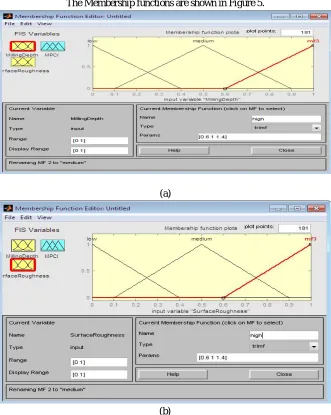
For the present study triangular waveform membership function was chosen
IV. RESULTS AND DISCUSSION
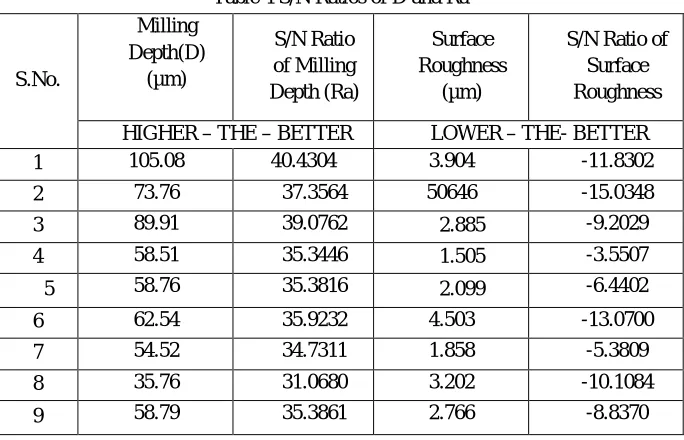
In the present study the objective is to get high milling depth and best surface finish. S/N ratio of milling depth and surface roughness values are calculated by using following equations.
S/N Ratio for Milling Depth = 20 log(y) (1) --- for larger is better S/N Ratio for Surface Roughness = -20 log(y) (2) --- for smaller is better S/N ratio values for milling depth and surface roughness are shown in Table 4.
Table 4 S/N Ratios of D and Ra
Normalization was done for obtained outputs as shown in Table 5. Equations (3) and (4) have been used to calculate the normalized values for surface roughness and milling depth respectively. In the present study surface roughness is lower the better requirement and milling depth is higher the better requirement.
(3) (4) Where i = number of attributes (1, 2, 3)
k= number of experimental runs (1, 2, 3, 9)
(k) = original sequence
= sequence after the data pre-processing
(k) = maximum value of (k)
Min (k) = minimum value of (k)
= desired value.
Fuzzy Tool which was available in matlab lab (2014a) software was used to get MPCI. Here, experimental responses have been selected as input parameters. Afterwards different sets of fuzzy rules were applied randomly and MPCI was obtained as shown in figure 6. Again obtained MPCI was considered as single response and Taguchi analysis was carried out for MPCI using Minitab Tool. S.No. Milling Depth(D) (µm) S/N Ratio of Milling Depth (Ra) Surface Roughness (µm)
[image:5.612.136.478.201.421.2] [image:5.612.132.480.201.426.2]Figure 4 Fuzzy logic system inputs and outputs The Membership functions are shown in Figure 5.
(a)
(b)
[image:6.612.141.472.300.715.2]Figure 6 Fuzzy logic reasoning Table 5 Results for the MPCI S.No Normalized
Milling Depth
Normalized Surface Roughness
MPCI 1 1 0.7210 0.436 2 0.6717 1 0.148 3 0.8554 0.4922 0.5 4 0.4568 0 0.868 5 0.4607 0.2516 0.131 6 0.5186 0.8289 0.31 7 0.3913 0.1594 0.704 8 0 0.5710 0.134 9 0.4612 0.4603 0.5
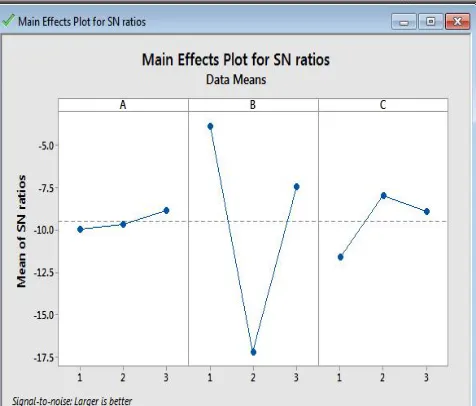
In taguchi signal to noise ratio was calculated for obtained MPCI values. In the present study MPCI was considered as higher the better characteristics. Obtained means of S/N ratios for MPCI was represented in figure 7. From figure 7 it was observed that scanning speed at 70mm/sec, pulse power at 40W and pulse frequency at 30KHz were determined as predicted optimum results (A3 B1 C2).
[image:7.612.206.444.506.709.2]Confirmation test results were compared with initial parameter settings (A2 B2 C2). Confirmation test results at optimal setting and initial parameter setting results are shown in table 6.
Table 6 Confirmation Test Result
Initial Parameter setting Optimal parameter setting Level A2B2C2 A3B1C2
Surface roughness 2.052 1.401 Milling depth 56.57 60.69
V. CONCLUSIONS
The present work deals with the investigations on machinability aspects such as surface roughness and milling depth in laser micro-machining of Hastelloy C276. Optimization of process parameters has been carried out and have been recognized as to yield the best combination of process variables like Scanning speed = 70mm/sec, Pulse power = 40W and Pulse frequency = 30 KHz. The performance characteristics such as Milling Depth and Surface Roughness were improved by using the current analysis. In outline, the proposed work enables the manufacturing engineers to select the optimal values depending on the production requirements and as a consequence, automation of the process could be done based on the optimal values.
REFERENCES
[1] Chae J, Park SS, Freiheit T Investigation of micro-cutting operations International Journal of Machine Tools and Manufacture 2006. 46:313-332. [2] DubeyAK,YadavaV. Laser beam machining— a review. International Journal of Machine Tools and Manufacture2008;5;48(6):609–628.
[3] Karnakis D, Rutterford G, Knowles M, Dobrev T, Petkov P, Dimov S High quality laser milling of ceramics, dielectrics and metals using nanosecond and picosecond lasers. SPIE Photonics West LASE 2006, San Jose CA, USA, 6106.
[4] Kaldos A, Pieper HJ, Wolfb E, Krause M Laser machining in die making—a modern rapid tooling process. J Mater Process Technol 155(156):1815–1820. [5] Campanelli SL, Ludovico AD, Bonserio C, Cavalluzzi P, Cinquepalmi M Experimental analysis of the laser milling process parameters. J Mater Process
Technol 2007. 191:220–223.
[6] Campanelli SL, Ludovico AD, Deramo C Dimensional accuracy optimization of the laser milling process. Proceedings of the 26 International Congress on Applications of Lasers and Electro–Optics (ICALEO), Orlando, Florida 2007.
[7] Mannio P, Magee J, Coyne E, O’Connor GM Ablation thresholds in ultrafast laser micro-machining of common metals in air. Proc SPIE 2003. 4876:470–478. [8] Bandhopadhayay S, Sarin Sundar JK, Sunderajan G, Joshi SV.Geometrical features and metallurgical characteristics of Nd:YAG laser drilled holes in thick
IN718 and Ti-6Al-4Vsheets. J Mater Process Technol 2002;127:83–95
[9] Ganesan T, Vasant P, Irraivan E Solving engineering optimization problems with KKT Hopfield neural networks. Int Rev Mech Eng 2011.7(7):1333–1339. [10] Cical˘a E, Soveja A, Sallamand P, Grevey D, Jouvard JM. The application of the random balance method in laser machining of metals. Journal of Materials
Processing Technology 2008;196(1–3):393–401.
[11] Bahaa E. A. Saleh, Malvin Carl, “Fundamentals of Photonics”John Wiley &Sons, 1991.