ISSN: 1992-8645 www.jatit.org E-ISSN: 1817-3195
ADAPTIVE NEURAL NETWORK DECENTRALIZED
CONTROL FOR LARGE SCALE SYSTEM WITH INPUT
SATURATION
YUQING MAO
Quzhou College of Technology, College of Information Engineering, Quzhou, Zhejiang, China, 324000
ABSTRACT
A new method of adaptive neural network decentralized control is designed for a relevant large scale system with input saturation, it is not necessary for this method to assume that relevant items satisfy the function upper bound of high order or low order, cancel the constraint condition for known upper bound of the unknown continuous function and controlled gain of the system. It is not necessary to handle controlled gain with unknown directions by virtue of Nussbum function, only using a neural network can simultaneously approximate unknown function, unknown gains, and unknown relevant items. It can be known by using the Lyapunov theoretical analysis that the designed method can guarantee the control system to obtain overall situation stability, simulation results display that the control method is valid and feasible.
Keywords: Neural Network; Input Saturation; Decentralized Control; Global Stability; Large Scale
System
1. INTRODUCTION
In recent 20 years, relevant research achievements on designing fuzzy decentralized controller [1],[6] and neural network decentraliz- ed controller[2],[3],[4] for large scale system have been emerging. According to order difference of the upper bound qualified function in relevant items, current research achievements can be briefly classified into two categories, one is to assume that the upper bound of relevant item is first order polynomial function [1][5], another two are to assume that the upper bound of relevant item is high order polynomial function [7], thereby, the current research achievements on decentralized control are not applicable to large scale system that relevant
items do not satisfy one order or high order constraint. In addition, current achievement normally assume qualified function is solely influenced by subsystem status or tracking error of subsystem when processing independent variables of qualified function for relevant items [1],[7], or assume that independent variables of qualified function for relevant items are directly determined by system output[2][5], for the large scale system of relevant items formed by all system variables, these research achievements are not applicable as well. Simultaneously, majority of the current achievements focus upon researches on the large scale system with linear input [1],[2],[3],[4],[5],
rather necessary to research decentralized control of large scale system with the non-linear input. Furthermore, current research achievements generally assume unknown function and controlled gain of large scale system has known upper and lower bound [2][3], and controlled gain symbol is already known [2], under many circumstances, it is very difficult to confirm the bound of unknown function and controlled gain, and the symbol of controlled gain. Focusing on the system with unknown symbol of controlled gain, the design of traditional adaptive fuzzy/neural network controller is normally processed by virtue of Nussbum function [10].
This article designs a new adaptive neural network decentralized control method by the concentration on saturation input large scale system, on the basis of above research achievements. This method has following advantages compared with current achievements: 1. it is not necessary to assume that relevant items satisfy the upper bound of high or low order function. 2. Cancel the constraint condition for upper bound of the unknown continuous function and controlled gain of the system. 3. Cancel assumptions that controlled gain has bound and known direction, and there is no need to use Nussbum function can realize the design of control system with unknown control gain direction. 4. The upper bound of saturation input is unknown. 5. Use one neural network to simultaneously approximate unknown function, unknown gain and unknown relevant item, significantly reducing the design difficulty. It can be learned from theoretical analysis that the design method can guarantee overall global stability of the control system, while simulation results verify the validity and feasibility of the control method.
2. DESCRIPTION OF RESEARCH OBJECT
The number i subsystem of large scale system is as follows:
,1 ,2
, 1
,1
( )
( )
( ,
,
)
ii i
i n i i i i i i N
i i
x
x
x
f
g p u
d
y
x
=
=
+
+
=
x
x
x
(1)Among,
(
,1,
,)
( , ,
(i 1))
i in n
T T
i
x
ix
i ny
iy
iR
−
=
=
∈
x
(1
≤ ≤
i
N
)
,u
i,
y
i is separately the status,input and output of subsystem,
p
i is saturationfunction by independent variable
u
i,d x
i( ,
1
,
x
N)
means the mutual relevance among thesubsystems,
f x
i(
i)
,g
i>
0
is separately unknown continuous function and unknown controlled gain of subsystem.p u
i( )
i is defined by the following expression:( )
,
( )
,
( )
( )
i iH i iH i i
i i iH
i i i i
sign u u
u
u
p u
u
u
u
q u
τ
u
≥
=
<
=
+
(2)
Among,
u
iH>
0
is unknown upper bound ofi
u
,( )
tanh(
i)
i i iH
ih
u
q u
u
u
=
,τ
i( )
u
i=
p u
i( )
i−
( )
i i
q u
, that isq u
i( )
i≤
u
iH,τ
i( )
u
i≤
u
iH−
tanh(1)
iH i
u
τ
∆
=
.ISSN: 1992-8645 www.jatit.org E-ISSN: 1817-3195
( 1)
,
ni)
Tdi
y
−
is continuously bounded, and{
di i}
di
di
∈
Ω
=
Y
≤
Y
Y
.Hypothesis 2: 1
1
(
,
,
)
(
)
N
i N ij j
j
d
D
=
≤
∑
x
x
x
,among,
X
=
(
x
1,
,
x
N) ,
TD
i(
x
i)
is unkn-own continuous function.
Note
e
i,1( )
t
=
x
i,1−
y
di,e
i( )
t
=
(
e
i,1,
e
i,2,
,
,
)
i
T i n
e
, ( )ni ,1 ,2( )
i di i i
v
= −
y
+
k e
t
+ +
,i 1 ,i i n i n
k
−e
,make1 1
,1 , , ,
1
( )
i i
i
n n
i i i i j i j i n
j
d
s t
e
k e
e
dt
λ
− −
=
=
+
=
+
∑
(3)
Among, , 11 i
(
0,1,
1)
i n j j
i j n i i
k
=
C
−−λ
−j
=
n
−
,
λ
i>
0
is design parameter, that is1 2
( )
(
)
(
)
( )
(
,
,
,
, )
i i i i i i i i
i N
s t
v
f
g
p u
d
t
= +
x
+
x
+
x x
x
(4)Lemma 1: if
s
i is satisfies expression (3), following conclusions can be established:1) when
s
i=
0
,e
i,1→
0
;2) when
s
i≤
s
, (0)
e
i∈ Ω
s,e
i( )
t
∈Ω
s,
∀
t
>
0
;3) when
s
i≤
s
, (0)
e
i∈ Ω
s,i i
n
T
λ
1
−
=
∃
,make( )
,
i
t
∈ Ω ∀ ≥
st
T
e
,among,{
1}
,
( )
2
j j ni,
1, 2,
,
s i
t e
i jλ
is j
n
i− −
Ω =
e
≤
=
.The following will use radial basis function neural network (RBF) to approach unknown continuous non-linear function of the system:
( )
T( )
( )
f
Y
=
W
S
Y
+
δ
Y
, among,Y
∈ Ω
Ym
R
⊂
is input variable,l
is the number of node,W
=
(
w
1,
,
w
l)
T∈
R
l is unknown ideal adjustable weight vector,S
( ) ( ( ), ,
Y
=
s
1Y
( ))
T ll
s
Y
∈
R
is radial basis function, where2
( ) ( )
( ) exp( )
T i i i
i
j j
s
c
− − −
= Y Y
Y ,
i
=
1, 2,
,
l
1 1
( )
(
( ),
( ),
,
( ))
Ti i i im
j
Z
=
j
Z
j
Z
j
Z
.Forgiven constant
δ >
0
, whenl
is large enough,( )
δ
Y
≤
δ
establishes.3. CONTROLLER DESIGN AND ANALYSIS OF SYSTEM STABILITY
Theorem 1: controlled large scale system (1)
satisfied above assumption conditions 1, 2, the controller and the parameter adaptive laws of on-line adjustment are designed as the following expression (5-7), then it can guarantee closed-loop large scale system (1) globally uniformly and ultimately bounded, and the tracking error converged to zero.
ˆ
ˆ
[ ( ) 1]
T( )
( )
i i i i i i i i i
u
= −
h x
+
s
−
W
S
x
−
δ
x
(5)2
ˆ ˆ
( ) , ,
ˆ , ˆ ( ) 0
ˆ ˆ ˆ
( ) ( ) ,
ˆ
ˆ , ˆ ( ) 0
i i
i
i i i i i W T i W i i i i
T
i i i
i i i i i i i i i
T i W i i i i
r S s M
M S s
r S s r S s
M S s
<
= ≤
= −
= >
x W
W W x
W W W
x x
W
W W x
或
ˆ ˆ
ˆ
ˆ ˆ ˆ
, 0
ˆ
ˆ ˆ
0, , 0
i i
i
i i i i i i
i
i i i
s M M s
M s
δ δ
δ
η
δ
δ
δ
δ
δ
δ
< = ≤
=
= >
或 , (7)
Among,
2
2 2
1
(
)
1
(
)
i i
i i W i i
h
M
S
M
δε
=
+
+
x
x
,ε
>
1
,
,
0
i i i
W G
M
M
δM
>
is designable knownparameter,
W
ˆ ,
iδ
ˆ
i is estimate value of,
i
δ
i∗
W
,andδ
i=
δ δ
i−
ˆ
i,W
i=
W
i∗−
W
ˆ
i,,
0
i i
r
η >
are adaptive rates of parameter.Demonstration: Suppose the closed-loop system
is unstable, that is for
∀ >
ε
1
,s
j≥ >
ε
1,
j
=
1
N
.Make 1 2
1 N i i
V
s
==
∑
, that is1 1 1 2 1 1
(
( )
(
(
)
(
,
,
,
) )
{
[
( ( )
( ))
]
(
)
(
) }
Ni i i i i i i i
i N i
N
i i i i i i i i i
i
N
i i i i i ij j i
j
V
g p u s
v
f
d
s
u s
g q u
u
u s
v s
f
s
D
s
τ
= = ==
+
+
+
≤
+
+
−
+
+
+
∑
∑
∑
x
x x
x
x
x
1 1 2 1 2 max 2 1 2 1 2 max { ( ) [ ] ( ) } { ( ) ( ) 2 [ ( )] } 2 { [ ( ) ( ) 2 Ni i i i i i i i iH
i
N
i i i i ij j i
j
N
i i i i i i i i
i
i iH i i i
i
N
ij j j
j
N
i i i i i i
i
i iH i i i
u s v s f s g u
u g s D s
u s v s f s s
g u u g
s
N
D s
u s s v f
g u u g
τ
τ
τ
= = = = = ≤ + + + + + + ≤ + + + + + + + ≤ + + + + + + +∑
∑
∑
∑
∑
x x x x x 2 1 ( )] } 2 Nji i i
j
N
D s
=
∑
x (8)As 2 max
(
)
(
)
2
i iH i i i
i i i
g u
u
g
F
=
f
x
+
+
+
τ
+
2 1
(
)
2
N
i ji i
j
N
v
D
=
+
∑
x
is continuous function,where
u
imax>
0
will be gave in the follow-updesign, therefore, it can use RBF neural network
to approximate,that is T ( ) ( )
i i i i i
i
F =W∗ S x +
δ
x ,(
,
ni, )
i
y
di i=
i
x
x
e
, T i∗
ISSN: 1992-8645 www.jatit.org E-ISSN: 1817-3195 2 1 1 2 1 2 2 2 2 1 2 2 2 1 2 1
( )
( )
{
[
( )
{ ( )(
}
( )
2
( )
2
1
{(
}
1
1
( )
1
(
2
)
] }
2
1
(
2
)
i i
i i
N
i i i i
i
T N
i i i i i i
i i i
i i i
N
W i i i i
i i
W i i N
T
i
i
i
i i i
i i
S
V
u s
s
s
S
s
s
h
s
h
M
S
s
M
s
s
M
S
M
s
s
V
N
δ δδ
ε
ε
ε
ε
ε
δ
ε
= = = = ∗≤
+ +
+
≤ −
−
+
≤ −
−
+
+
≤ −
−
−
≤ −
+
−
∑
∑
∑
∑
W
x
x
x
x
x
W
x
x
(9) From expression (9), when2 2
1
1 2 2 2
(0) 4
max(0, ln )
4 4 N i i s N t T N N
ε
ε
ε
ε
= + ≥ = −∑
(
ε
>
1)
,2 2 1 2
4
)
(
t
N
ε
s
N i i≤
∑
=that is
s
i(
t
)
≤
2
N
ε
.According to the lemma 1, when
i i
n
T
t
λ
1
1−
+
≥
, ,2
j j nii j i
e
≤
N
λ ε
−(
j
=
1,
)
i
n
, i{
x
ij jN
ij niY
i}
i
=
≤
+
Ω
∈
λ
−ε
2
, xx
, max{
}
ii u i i
u
∈ Ω =
u
≤
u
, whereu
imax=
2 2
ˆ
ˆ ˆ
1 4
4
2
(
i i1)
}
i i
W
M
M
N
ε
θ εM
M
δε
+
+
+ +
+
.Thus the closed-loop system has global stability.
Use 1 2
1
1
1
(
)
N
T
i i i
i i i
V
V
δ
γ
η
=
=
+
∑
W W
+
then2 1
(
)
0
N
i i i i
V
h
s
=
= −
∑
x
≤
According to the lemma of
barbalat,
s
i→
0
, integrating lemma 1 canreach:
e
i,1( )
t
→
0
,the demonstration is complete.4. CONTROL EFFECTS SIMULATION
Large scale system with relevance of input saturation is as the following expression (10)
1,1 1,2 3
1 1,2 1,1 1,2 1,1
1 1 1
(1 0.5sin
)
( )
(
, )
x
x
P
x
x
x
x
p u
d
t
=
= −
−
+ +
×
+
X
:
2,1 2,1 2,2 2 2 2,2 2,1 2,12 2 2
(1
)
(
)
(
, )
x
x
x
P
x
x
x
e
p u
d
t
−
=
=
−
+ +
×
+
X
:
(10) Among,1( , ) 0.012 cos 2 2,1sin(3 )
d X t = t+ x t +
2,2
cos(10 )
0.5
1,2sin(0.5 )
x
t
+
x
t
,2
( , )
d
X
t
=
1,1 2,1 2,2
0.01sin(5 )
t
+
2
x
sin(
x
)
+
x
cos(0.2 )
t
.Control objective: status
x
i=
(
x
i,1,
x
i,2)
T trace Tdi
=
(
0
.
05
sin
t
,
0
.
05
cos
t
)
Y
,i
=
1
,
2
.Use T ) 5 . 2 , 5 . 2 ( 1 =
x , T
) 5 . 2 , 5 . 2 ( 2 =
x ,
ε
=
2
,1 2 0.05
δ
=δ
= ,k
1,1=
k
2,1=
2
,r1=r2=0.8,9
.
0
2 1
=
η
=
η
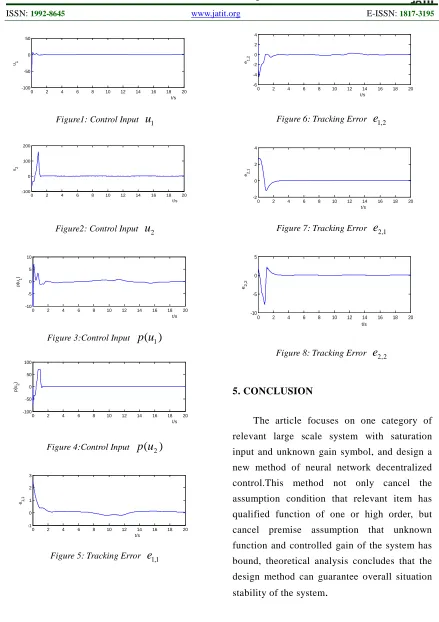
. Use sampling time of 0.020 2 4 6 8 10 12 14 16 18 20 -100
-50 0 50
u1
t/s
Figure1: Control Input
u
1
0 2 4 6 8 10 12 14 16 18 20 -100
0 100 200
u2
t/s
Figure2: Control Input
u
20 2 4 6 8 10 12 14 16 18 20 -10
-5 0 5 10
p
(u1
)
t/s
Figure 3:Control Input
p u
( )
1
0 2 4 6 8 10 12 14 16 18 20 -100
-50 0 50 100
p
(u2
)
t/s
Figure 4:Control Input
p u
(
2)
0 2 4 6 8 10 12 14 16 18 20 -1
0 1 2 3
e1,
1
t/s
Figure 5: Tracking Error
e
1,1
0 2 4 6 8 10 12 14 16 18 20 -6
-4 -2 0 2 4
e1,
2
t/s
Figure 6: Tracking Error
e
1,20 2 4 6 8 10 12 14 16 18 20 -2
0 2 4
e2,
1
t/s
Figure 7: Tracking Error
e
2,1
0 2 4 6 8 10 12 14 16 18 20
-10 -5 0 5
e2,
2
[image:6.612.84.523.68.690.2]t/s
Figure 8: Tracking Error
e
2,25. CONCLUSION
ISSN: 1992-8645 www.jatit.org E-ISSN: 1817-3195
REFERENCES:
[1] Yi-Shao Huang, MinWu, Yong He, Ling-Li Yu, Qi-Xin Zhu, “Decentralized Adaptive Fuzzy Control of Large-scale Nonaffine Nonlinear Systems by State and Output Feedback”, Nonlinear Dynamics, Vol. 69, No. 4, 2012, pp. 1665-1677.
[2] Tieshan Li, Ronghui Li, Junfang Li , “Decentralized Adaptive Neural Control of Nonlinear Systems with Unknown Time Delays”,Nonlinear Dynamics, Vol. 67, No. 3, 2012, pp. 2017-2026.
[3] Weisheng Chen, L. C. Jiao, Jianshe Wu. “Decentralized Backstepping Output feedback Control for Stochastic Interconnected Systems with Time-varying Delays using Neural Networks”, Neural Computing and Applications,Vol. 21, No.6, 2012, pp. 1375-1390.
[4] Shuai Li, Hongzhu Cui,Yangming Li, Bo Liu,Yuesheng Lou, “Decentralized Control of Collaborative Redundant Manipulators with Partial Command Coverage via Locally Connected Recurrent Neural Networks”, Neural Computing and Applications, 2012 (Published Online). [5] RuiWang, Yanjun Liu, Shaocheng Tong,
“Decentralized Control of Uncertain Nonlinear Stochastic Systems Based on DSC”, Nonlinear Dynamics, Vol. 64, No. 4, 2011, pp. 305-314.
[6] Mohammad Mehdi Fateh,Sara Fateh, “Dec- entralized Direct Adaptive Fuzzy Control of Robots using Vvoltage Control Strategy”,Nonlinear Dynamics. Vol. 70, No. 3, 2012, pp. 1919-1930.
[7] Cong Ming, Sunan Huang, “ Neural Netw- ork Control Design for Large-Scale Systems
with Higher-Order Interconnectio-
ns”, Advances in Neural Networks, Vol.
3972, 2006, pp. 1007-1012.
[8] Ning Zhou,Yanjun Liu,Shaocheng Tong, “Adaptive Fuzzy Output Feedback Control of Uncertain Nonlinear Systems with Nonsymmetric Dead-zone Input,”Nonlinear Dynamics, Vol.63, 2011,pp. 771–778.
[9] Yongming Li, Tieshan Li, Shaocheng Tong,“Adaptive Fuzzy Modular Backstepping Output Feedback Control of Uncertain Nonlinear Systems in the Presence of Input Saturation”, International Journal of Machine Learning and Cybernetics , 2012(Published online). [10] Yongming Li ,Shaocheng Tong , Tieshan