FIBER GRATING ATMOSPHERIC PRESSURE SENSOR
BASED ON MICRO-BENDING CHARACTERISTIC
LUO YINGXIANG
School of Electronics and Information Engineering, Chongqing Three Gorges University, Chongqing,
China
ABSTRACT
This paper proposed a new pressure sensor based on long period fiber grating resonant peak modulation through the LPFG microbending sensitivity characteristics and membrane structure with box. Research
results show that: the sensor measurement is in the range of 0~0.25 MPa, the detection resolution is
0.24469 hPa/dB, LPFG resonance spectroscopy changing law and the theoretical derivation, numerical analysis results are in good agreement with ANSYS. By appropriate selection of the diaphragm material, packaging structure parameters, which can obtain good corresponding relation and the measurement range, further improving the detection precision, can satisfy the weather and aircraft height measurement of pressure sensor requirements.
Key words: Long-Period Fiber Grating; Atmospheric Pressure Sensor; Bending; Resonance Peaking
Amplitude
1. INTRODUCTION
Atmospheric pressure measurement is not only an important parameter in the meteorological telemetering system, but also a modern aircraft to realize height measurement, which is one of the important ways. At present, the practical application is often employed in the resonant tube type, capacitance or resistance box film pressure sensor measuring atmospheric pressure [1]. Resonant cylinder pressure transducer has a stable work, small error, high resolution, but with small pressure range, complex structure, high cost, limited application field. In addition, the sensor will stop secretly phenomenon, cause observed failures, and easily affected by environmental factors that occur with aging [2]. Capacitive pressure sensor with high sensitivity, small zero drift, low power consumption advantages, but its high output impedance, load capacity of poor, parasitic capacitance and capacitance on the sensitivity and accuracy of the impact is bigger, the external environment (i.e., temperature, humidity, electrostatic, pollution etc) and output nonlinear will effect. The resistance strain gauge is used for detection of air pressure, and the air pressure sensor performance can be improved, but the effect of temperature and additional stress can be caused by large measurement error.
In order to avoid the above shortcomings, this long period fiber grating technology is introduced into the pressure sensor field, using LPFG on the bending sensitive characteristics, a long period fiber grating (LPFG) and the circular box film structure of the combination. Then constitute a special LPFG- film box package, so it has the anti interference and high sensitivity to ambient pressure changes in the environment, which can be better applied to atmospheric pressure measuring and vehicle height determination. So it has good application prospects.
2. SENSING PRINCIPLE
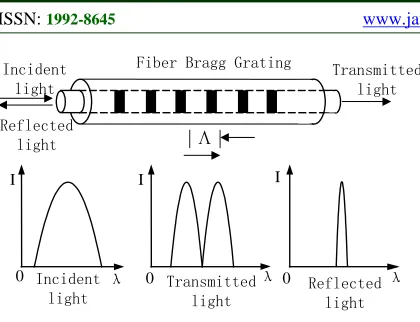
Fiber Bragg Grating Incident
light
Reflected light
Transmitted light
| Λ |
I
0
I
0
I
λ 0
λ
λ Transmitted
light
Reflected light Incident
[image:2.612.92.302.72.233.2]light
Fig.1 Fiber grating reflection spectrum and transmission spectrum
3. LPFG PRESSURE SENSOR PRINCIPLE
AND NUMERICAL ANALYSIS
3.1 LPFG bending properties
When the long period fiber grating (LPFG) is bent, bent on the impact of LPFG occurs mainly in 2 aspects: one is that [3] fiber has curved waveguide; on the other hand is to make LPFG per a modulated refractive index section tilts (relative to the first cycle was modulated refraction in terms of rate of cross section).
Let Λ be not bent LPFG period, R LPFG radius
of curvature, the second cycle by modulation of the refractive indices of the cross-section of the tilt
angle θ Λ= R, then the i cycle by modulation of
the refractive indices of the cross-section of the tilt
angle of θi=Λ(i−1) R . Equivalent grating in the
fiber core refractive index distribution can be
expressed as [3]
co eff( )
n z
:
co co co
eff eff eff
2
( ) ( ') 1 cos ' ( ')
'
i
n z n δn z ν z φ z
Λ
π
= + + +
(1)
Type: z'=xsinθi+zcosθi≈zcosθi ;
co eff
n is the
core of the fiber DC effective refractive index. Grating inclined main effect is to grating fringe
visibility and the decrease of ν so that each grating
period core average effective refractive index
modulation co
eff
n
δ is reduced, so that the cross
coupling coefficient kkj( , )zθ decreased, the
expression for the [3]
( )
( , ) ( )
2
kj kj
k zθ =ν θ σ z
(2)
Type : σ( )z self coupling coefficient, by long
period fiber grating coupling rate expressions can be seen, the grating bending will make the equivalent straight LPFG tilt angle increases, the core and cladding mode coupling between the coefficient is reduced, so that the resonant peak amplitude decreased.
Core schemas and in-phase transmission loss peaks normalized bandwidth can be approximated as:
1 2 4 1 k Lkj
nL
λ λ
λ
∆ ≅ +
∆ π
(3)
Type : λ for approximate resonant wavelength,
co cl eff eff
n n n
∆ = −
as the core and the cladding mode of the effective refractive index difference. For each of a defined wavelength, long period fiber grating
transmission Tλcan be expressed as:
co co
( / 2) ( / 2)
A L
T
A L
λ= −
(4)
[image:2.612.321.525.450.607.2]Use of type (4) calculation of curvature on LPFG resonant transmission spectrum influence curve is shown in Figure 2 [7-9], LPFG in the drawing bending respectively is 0 mm,0.75 mm,1.5 mm,2.25 mm,3.0 mm and 3.75 mm.
Fig.2 The relationship between LPFG transmission spectrum and bending curvature
Figure 2 shows, with the LPFG bending
(curvature) increases, LPFG Tλ enhanced LPFG
transmission, the transmission spectrum of the resonant peak amplitude decreased gradually, resonant peak wavelength red shift occurs.
The edges of the clamping, subjected to uniform
pressure p round diaphragm, the low pressure
surface at an arbitrary point has a radial stress
r
s
and a tangential stress st [4-5]:
2 2
2
3 1 3
1 1 8 r pR r s t R µ µ µ = + − +
(5)
2 2
2
3 1 1
1 3 8 t pR r s t R µ µ µ = + − +
(6)
Any point offset (i.e. deflection) is given by:
(
2)(
2 2)
2 33 1
16
p R r
y Et µ − − = 0 2 R r ≤ ≤
(7)
The type (7) an order and two order differential get:
(
2)(
3 2)
'3
3 1
4
p r R r
y Et µ − − = (8)
(
2)
2 " 3 3 1 4 p R y Et µ − = (9)By the formula (7) shows: when r=0, that is at
the center, the largest circular diaphragm deflection,
and the maximum deflection H:
(
2)
4 3 0 3 1 16 r p R H y Et µ = − = = (10)By type (10) deformation of the pressure and the
relationship between H to p:
(
)
3 2 4 16 3 1 Et H p R µ = − (11)According to the curvature equation, and into the type (8), (9) and (11), a circular diaphragm center
of curvature C:
(
)
(
)
" 2 2
3 3 2
0 '2
2
3 1 4
4 1
r
y p R H
C Et R y µ = − = = = + (12)
Type: H is at the center of the circular
diaphragm deflection, i.e. the center deflection (long period fiber grating curvature, unit: m).
Based on the formula the curvature and
deflection at the center, C H linearly, coefficient
of 4 /R2. At the same time, the curvatureC as long
period fiber grating curvature (m-1) and LPFG output spectrum characteristics are associated.
Combined type (1), (2), (3) and (4) available, LPFG resonant transmission spectrum of resonant
peak amplitude of A and pressurep relationship:
2 2 3 3(1 ) [ ( )] [ ] 4 pR
A f C p f
Et
µ
−
= =
(13)
By type (13) that: along with the pressure
increasing p , circular diaphragm deflection
increases, the center of curvature change, so that the LPFG curvature increases, LPFG resonant wavelength transmission enhancement, the transmission spectrum of the LPFG resonant peak amplitude decreased, resonant wavelength, and the
resonant peak amplitude and pressure p linear A
relationship.
In addition, the circular diaphragm in the large displacement exhibit nonlinear, stretching function added to the basic bending, thereby creating a stiffening effect. The stress of nonlinear followed
the center offset yc nonlinear, which follows the
relationship [5]: 3 4 4 2 16 0.488
3 (1 )
c c
Et y y
p
R µ t t
= − +
(14)
Type: p membrane surface pressure differential,
E as the modulus of elasticity for diaphragm
thickness, t , µ as Poisson's ratio, as to the
clamping edge radius of the diaphragm.
By formula (14) shows, the yc/t design was full of small, which can achieve the desired nonlinear. It is important to note, small yc/t will also bring a small strain.
The above derivation shows, when the circular diaphragm materials, dimensions is given, along with the pressure increasing, at the center of the deflection and curvature change will gradually change from nonlinear to linear.
3.3 Numerical analysis
Using ANSYS 10 software for numerical analysis, selection of circular diaphragm size and material characteristics are as follows: determine the plate radius is RRRR=27.934 mm, a film thickness of t=0.12 mm, stainless steel material, the
modulus of elasticity is E =190 GPa, Poisson's
ratio is µ=0.305, edge clamped, membrane surface
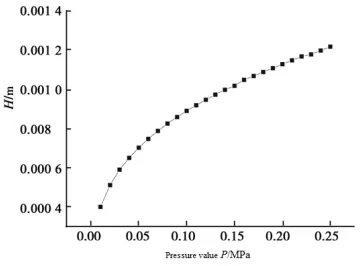
0.25 MPa. Simulation of circular diaphragm at the center of the deflection change with pressure curve as shown in figure 3.
Fig.3 Central deflection of the disk-shape diaphragm
[image:4.612.319.522.495.644.2]In different atmospheric pressures, according to figure 3 YYY simulation curves, grating curvature with air pressure changes gradually from nonlinear to linear. Due to bending and deflection, resonant peak amplitude and a linear relationship, resonant peak amplitude varies with the gas pressure relationships should also follow the trend. Therefore, using LPFG on the diaphragm microbending sensitivity, by Xie Zhenfeng amplitude change measurement environment pressure value.
4. LPFG PRESSURE SENSOR TEST
4.1 The test system structure
Based on long period fiber grating pressure sensor structure, as shown in figure 4. Test system components include: box film encapsulation structure, LPFG sensing probe and a pressure gauge. Among them, the diaphragm is the pressure sensitive element. Pressure changes when the two sides of the diaphragm, the surface pressure difference, the diaphragm will cause distortion. LPFG sensing probe is stuck on the lower surface of the diaphragm, the diaphragm deformation makes with LPFG resonance peak amplitude change, thus the pressure variation into LPFG resonant peak amplitude variation.
3 dB FBG
ASE
TC
Demodulation System
Fig.4 The scheme of the LPFG atmospheric pressure sensor
Based on the strain distribution along the diameter direction, LPFG paste in circular diaphragm near the center. Diaphragm material is stainless steel (0Cr17Ni12Mo2) for 190 GPa, elastic modulus, Poisson's ratio is 0.305, the thickness of 0.12 mm, 55.868 mm in diameter, the experimental device as shown in figure 4. System based on LPFG center wavelength at 1530.153 nm, the length of the grating was 3.75 cm; use a broadband light source (Agilent 83437A) as input, through the AQ6317C spectrum acquisition of long period fiber grating transmission spectrum changes. During the experiment, through the pressure pump (2J-TM-50/40) to the pressure sensor pressure, start with 0.02 MPa, each with 0.01 MPa to do a survey, to 0.25 the end of MPa. For detecting and sensing system repeatability, targeting the same measurement range, repeated compression /decompression measurement [7-11].
4.2 The result of testing and analysis
Figure 5 gives the harmonic amplitude value with the diaphragm by pressure changes in experimental curve, numerical analysis and ANSYS above the trend line. Figure 5 shows along with the change in air pressure, long period fiber grating harmonic amplitude value decreased from 16.712 dB to 6.495 dB, and the change is having good regularity, its response to dB/hPa. Resonance peak wavelength change also has very good regularity. In the pressure range, wavelength of 1.54 nm. Experiments show that, in the repeated /buck process, the pressure sensor can maintain a good repeatability and sensitivity.
Fig.5 The relationship between LPFG resonance peaking amplitude and atmospheric pressure
LPFG pressure sensor pressure in initial stage is
(0.02~0.07 MPa), because the stiffening effect
[image:4.612.93.300.625.691.2]linear relationship, the linear fitting equation is: A=28.917 34 P – 13.54475, a correlation coefficient of 0.99818, fitting the standard deviation is 0.09988, as shown in figure 5.
The diaphragm material for copper (Cu) for 119 GPa, elastic modulus, Poisson's ratio is 0.326, the thickness of 0.96 mm, 55.868 mm in diameter, according to the above method is tested by curve, as shown in figure 6. Compared with stainless steel
sheet, its higher sensitivity, in 0.12~0.30 MPa
within is better, but the initial stage of compression yield stress is affected [12-14].
Fig.6 The response curve of a copper membrane
The experiment was found in the grating axial stress influence mainly manifests for the resonant peak wavelength shift amount decreases, that is to say, in the compression process, due to the axial stress increases ceaselessly, resonant peak offset to less than no axial stress condition of offset. Properly reduce the adhesive on the LPFG axial tension, can be made in the free state of LPFG curvature as possible with the diaphragm deflection be consistent.
In addition, the pressure sensor measurement range is determined by the diaphragm thickness and material. If use the elastic modulus and thickness of the film, it will be at the early stage of loading (0.05 MPa) stress yield phase,and the range can be reduced, copper (thickness of 0.96 mm) response curve is shown in figure 6.
5. CONCLUSIONS
Long-period fiber grating (LPFG) has a sensitive characteristic that its resonance spectrum changes with bending curvature. By designing an LPFG-bellows seal structure; we developed a LPFG atmospheric pressure sensor based on bending
curvature characteristic resonance peaking
modulation. ANSYS numerical analysis and experimental results indicate that when the atmospheric pressure changes from 0.02 MPa to 0.25 MPa, the resonance peaking amplitude falls from 16.712 dB to 6.495 dB and the resonance peaking wavelength is red-shifted about1.54 nm. The resolution is 4.086 8×10⁵ dB/hPa. In the range
of atmospheric pressure measured in the
experiment, the sensor system has good sensitivity and repeatability, which can satisfy the need of meteorology and flight vehicle monitoring highly.
REFERENCES
[1] WANG L, DU Y, SONG Y Q, et al.
Development for gas pressure sensitive materials[J]. Optical Instruments, 2004, 26(2):211-217.
[2] XIAO S R, ZHU P, BEN F L. Analysis on
characteristics of optical fiber sensor for atmospheric pressure[J]. Optics and Precision Engineering, 2008,16(6):1042-1047.
[3] RAO Y J, WANG Y P, RAN Z L, et al.
Characteristics of novel long-period fiber gratings written by focused high-frequency CO2 laser pulses[J]. Asia-Pacific Optical and Wireless Communications 2001, Proc. SPIE, 2001, 4581:327-333.
[4] ZHAO H X, BAO J L, CHEN Y. Effect of
bending curvature on transmission spectra of long period fiber gratings[J]. Chinese Journal of Lasers, 2008,35(5):722- 725.
[5] DOEBELIN E O. Measurement systems
application and design[M]. Beijing: Publishing House of Electronics Industry, 2007.
[6] LIU H W. Material mechanics[M]. Beijing:
Publishing House of Higher Education,2002.
[7] WANG Y P, RAO Y J, ZENG X K. Bending
characteristics analysis of long-period fiber gratings using coupled mode theory[J]. Acta Photonica Sinica, 2002,31(10):1205- 1208.
[8] YANG L, LI G M, KANG L, et al. Signal
acquisition for atmospheric pressure transducer based on multi-period measurement[J]. Chinese Journal of Scientific Instrument, 2007,28(4):687-691.
[9] WANG Y, LIANG D K, ZHOU B. Vibration
monitoring of smart structure using micro-bending characteristic of long-period fiber grating[J]. Chinese Journal of Scientific Instrument, 2008,29(6):1154-1158.
[10] XIAO SH R, CHANG J H, BEN F L.
[11] Zhou Zhi, Wu Zhanjun, Tian Shizhu, et al, “Studies on properties of temperature sensing for optical fiber FBGs,” Piezoelectric & Acousto-optic, 24(6), 2002, pp.430-433.
[12] Zhang Song and Zhang Jin-ping, “Study on
FBG demodulator based on single-chip
microcontroller system,” China
Measurement&Test ,Vol.35 No.6, November ,2009, pp.220-350.
[13] Y. Zhao and Y. Liao, “Discrimination methods
and demodulation techniques for fiber Bragg grating sensors,” Optics and Lasers in Engineering,Vol.41. 1-18, 2004.
[14] Zhang Guoping, “Design of Portable Vibration
Monitoring System Based on Wavelet Theory,”
Modern Machinery, March,2010, Vol.20,