INTELLIGENT USER INTERACTIVE MODEL FOR REAL
TIME TEXT-GRAPHIC GENERATION
S.DEEPA, Dr.P.KUMAR
1Associate Professor of Electronics and Communication Engineering, 1Sona College of Technology, Salem, Tamil Nadu, India.
2Professor of Electronics and Communication Engineering 2KSR College of Technology, Erode, Tamil Nadu, India.
E-mail: [email protected], [email protected]
Tel: +919750038774
ABSTRACT
Real-time graphic generation from text inputs has visited by various researchers and many methods have been proposed earlier in this decade to simplify the task of graphic generation. But still the problem of providing sophisticated and accurate has not been met with any of the solution provided. We propose an intelligent interactive framework to generate graphics by processing the text input and the text processor interactively acquires the necessary parameters of the object to be generated on graphics which supports the user on generating quality graphics. The presented model has three components namely interactive text processor, Hybrid Property Manager and Graphics Generator. The hybrid property manager maintains multi object properties in hybrid nature using which the text processor acquires the necessary values for the properties of any object mentioned. Upon receiving a text input the interactive text processor identifies the set of objects mentioned in the input, and for each object provided it requests the level by level property value acquisition using hybrid property manager. The acquired values of object properties will be given for the graphic generator, which generates graphics based on object properties. The proposed model has produced higher accurate results and supported user, to make graphics easier.
Keywords: Text to Scene, Story Visualization, Graphic representation, Hybrid Object Properties
1. INTRODUCTION
Artificial intelligence becomes more sophisticated now a days and more automatic knowledge transferring machines has become more popular due to the technology developments. The crime investigating departments are more dependent to these ideas like text to images where the words of witness have to be formed in such a way to represent the accused who involved in the crime.
The popular words eye has been designed to fix the requirement of text to image conversion and to provide a blank slate where the user can literally paint a picture with words, where the description may consist not only of spatial relations, but also actions performed by objects in the scene. The text can include a wide range of input. We have also deliberately chosen to address the generation of static scenes rather than the control or generation of animation. This affords us the opportunity to focus on the key issues of semantics and graphical representation without having to address all the problems inherent in automatically generating convincing animation. The expressive power of natural
language enables quite complex scenes to be generated with a level of spontaneity and fun unachievable by other methods. There is a certain magic in seeing one’s words turned into pictures.
Text-to-scene conversion systems (TTSCS) aim to give imaginations to computers. When given a text description, a TTSCS will convert that description to a static scene or an animation. TTSCS have many applications. Novice users who are unfamiliar with state-of-the-art animation tools can convert imagined movies into real ones.
Story visualization is a technique of converting textual story into pictorial representation. For example a story of forest can be converted into cartoons and graphical video using this story visualization technique. There are various researches are ongoing for the development of text to scene technology using which any verbal information can be transferred into graphical representations.
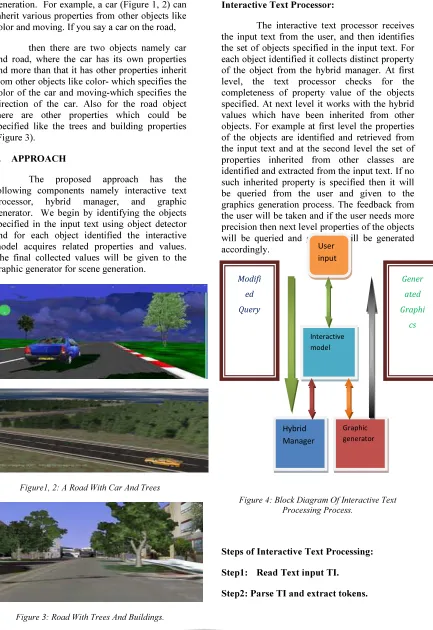
generation. For example, a car (Figure 1, 2) can inherit various properties from other objects like color and moving. If you say a car on the road,
[image:2.595.94.527.128.758.2]then there are two objects namely car and road, where the car has its own properties and more than that it has other properties inherit from other objects like color- which specifies the color of the car and moving-which specifies the direction of the car. Also for the road object there are other properties which could be specified like the trees and building properties (Figure 3).
2. APPROACH
The proposed approach has the following components namely interactive text processor, hybrid manager, and graphic generator. We begin by identifying the objects specified in the input text using object detector and for each object identified the interactive model acquires related properties and values. The final collected values will be given to the graphic generator for scene generation.
Figure1, 2: A Road With Car And Trees
Figure 3: Road With Trees And Buildings.
Interactive Text Processor:
The interactive text processor receives the input text from the user, and then identifies the set of objects specified in the input text. For each object identified it collects distinct property of the object from the hybrid manager. At first level, the text processor checks for the completeness of property value of the objects specified. At next level it works with the hybrid values which have been inherited from other objects. For example at first level the properties of the objects are identified and retrieved from the input text and at the second level the set of properties inherited from other classes are identified and extracted from the input text. If no such inherited property is specified then it will be queried from the user and given to the graphics generation process. The feedback from the user will be taken and if the user needs more precision then next level properties of the objects will be queried and graphics will be generated accordingly.
Figure 4: Block Diagram Of Interactive Text Processing Process.
Steps of Interactive Text Processing:
Step1: Read Text input TI.
Step2: Parse TI and extract tokens.
User input
Interactive
model
Hybrid Manager
Graphic
generator
Gener
ated
Graphi
cs Modifi
ed
Step3: Identify object names O specified in TI.
Step4: for each object Oi from O
Query Hybrid manager and collect object properties Pi.
For each property Pi(j)
Check for the value presented.
If true
O(Pi) = extract
the value presented.
Else
Ask the user to provide value for that.
End
End.
End
Step5: hand over O to graphics generator.
Step6: return result to the user.
Receive feedback from user.
Acquire additional property from Hybrid manager.
Receive additional property values from user.
Get graphics according to new property set.
End.
Step7: stop.
Hybrid Manager:
The objects and their properties are maintained by the hybrid manager. It maintains a object property set which has set of properties for each objects. If an object has inherited property, also that will be mentioned accordingly. Whenever the intelligent text processor asks for the improved property it looks for the inherited properties and gives to the text
processor. The hybrid manager provides the level of inherited property according to the level of interest on objects. If the user is more interested in the properties and if he goes deeply then the framework will provide more property and values to generate graphics accordingly.
Steps of Hybrid Processing:
Receive query as object Name
Fetch properties Op of objects O.
Return Op.
Wait for improved property query.
Fetch next level object property i.e. inherited.
Return inherited property.
End.
End.
Graphics Generation:
3. RESULTS
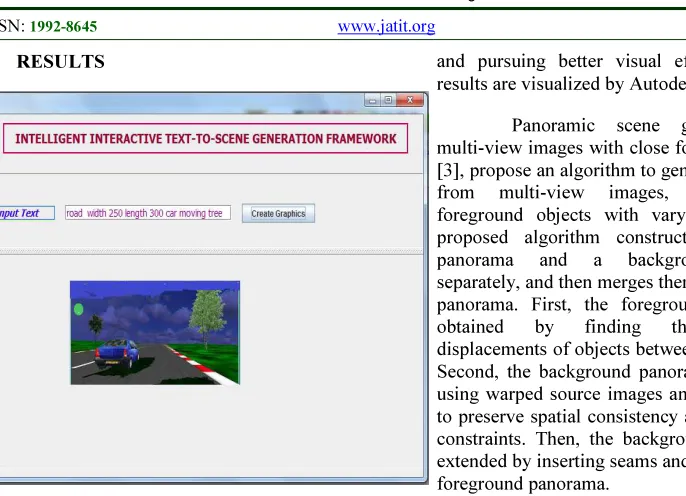
Figure 6: Result Of The Proposed System For Submitted Input Text.
The Figure 6 shows the result produced by the proposed method for a specified input text. It shows that the proposed system produces the graphics in specific object properties and in efficient manner.
4. BACKGROUND
Automatic 3D scene generation based on Maya [1], present a new system for automatically generating 3D scenes from text descriptions based on Autodesk Maya. We combine the advantages of both automatic 3D scene generation and excellent graphics tools in Maya, to achieve fast and efficient generation of 3D scene and good visual effects as well as convenience for the subsequent operations.
A new framework for automatic 3D scene construction from text description [2], propose a new framework capable of constructing 3D scene from text description directly, in which knowledge-based technology is adopted to represent the common sense of the real world. The framework extracts spatial relationships of objects described by texts and translates them into XML file with predefined grammar. A spatial reasoning algorithm is engaged next to decide the object layout in the scene. Several critical issues are taken into consideration in the spatial reasoning process for the purpose of dealing with more complex scenes
and pursuing better visual effects. The final results are visualized by Autodesk Maya.
Panoramic scene generation from multi-view images with close foreground objects [3], propose an algorithm to generate a panorama from multi-view images, which contain foreground objects with varying depths. The proposed algorithm constructs a foreground panorama and a background panorama separately, and then merges them into a complete panorama. First, the foreground panorama is obtained by finding the translational displacements of objects between source images. Second, the background panorama is initialized using warped source images and then optimized to preserve spatial consistency and satisfy visual constraints. Then, the background panorama is extended by inserting seams and merged with the foreground panorama.
A Constraint-based Text-to-Scene Conversion System [4], describes a system called Text2Scene for automatically converting text into 3D scenes. Text2Scene relies on a large database of 3D models to depict entities and actions. Every 3D module can have associated information, such as spatial tags, color and functional properties for depiction process. Text2Scene takes the implicit and conflicting constraints into account to generate reasonable scenes.
The Development of Text to Scene Tool for Aiding Children's Spatial Knowledge Understanding and Language Learning [5], present an approach to generate 3D scene based on text description. It then reports the evaluation for one of its application, and finally discusses the results obtained from experiments made using the system, and to investigate the potential that could be evolved as a tool for children to enhance their spatial knowledge and improve their interesting of learning language.
tuples extracted from the sentences. We generate novel scenes depicting the sentences, visual meaning by sampling from the CRF. The CRF is also used to score a set of scenes for a text-based image retrieval task.
Constraint-based conversion of action text to a time-based graphical representation [7], presents a method for converting unrestricted fiction text into a time-based graphical form. Three types of entities are extracted from fiction books to describe the scene namely Avatars, Areas and Objects. We present a novel method for modeling the temporal aspect of a fiction story using multiple time-line representations after which the information extracted regarding entities and time-lines is used to formulate constraints. A constraint solving technique based on interval arithmetic is used to ensure that the behaviour of the entities satisfies the constraints over multiple universally quantified time intervals. This approach is demonstrated by finding solutions to multiple time-based constraints, and represents a new contribution to the field of Text-to-Scene conversion.
5. CONCLUSION
We proposed a new intelligent system for graphic generation which works interactively with the users. It receives the input query text from the user and identifies the set of objects specified in the query and with the help of hybrid manager it acquires the respective properties for which the values are obtained interactively if not specified in the query. The user will be asked for feedback so that the user can update the generated graphics to any level of inherited property of object. The proposed method has produced efficient results in graphics generation.
6. REFERENCES
[1] Canlin Li, Automatic 3D scene generation based on Maya, IEEE international conference on Computer-Aided Industrial Design & Conceptual Design, pp: 981-985, 2009.
[2] Jiajie Lu, A new framework for automatic 3D scene construction from text description, IEEE , Progress in informatics and computing, vol:2, pp:964-968,2010. [3] Soon-young lee, Panoramic scene
generation from multi-view images with close foreground objects, Picture Coding Symposium, pp:486-489, 2010.
[4] Liuzhou wu, A Constraint-based Text-to-Scene Conversion System, IEEE international Conference on Computational Intelligence and Software Engineering, pp:1-9, 2009.
[5] Zeng X, The Development of Text to Scene Tool for Aiding Children's Spatial Knowledge Understanding and Language Learning, International technology and applications, pp:1-4, 2010.
[6] Lawrence Zitnick. C, Learning the Visual Interpretation of Sentences, IEEE transaction on computer vision and pattern recognition, 2013.
[7] Kevin Glass and Shaun Bangay. Constraint-based conversion of action text to a time-based graphical representation. ACM pages 19-28,2007.
[8] Kevin Glass, Shaun Bangay, and Bruce Alcock. Mechanisms for multimodality:taking action to another dimension. In AFRIGRAPH '07: Proceedings of the 5th international conference on Computer graphics, virtual reality, visualization and interaction in Africa, pages 135{144, New York, NY, USA, 2007. ACM.
[9] Alla Safonova and Jessica K. Hodgins. Construction and optimal search of interpolated motion graphs. ACM Trans. Graph., 26(3):106, 2007.
[10]Dan Tappan, Knowledge-Based Spatial Reasoning for Scene Generation from Text Descriptions, Proceedings of the Twenty-Third AAAI Conference on Artificial Intelligence (2008)
[11] Masoud Rouhizadeh Collecting Spatial Information for Locations in a Text-to-Scene Conversion System, in Computational Models of Spatial Language Interpretation and Generation Workshop 2011.
[12] Bob Coyne, Evaluating a Text-to-Scene Generation System as an Aid to Literacy in Workshop on Speech and Language Technology in Education (SlaTE) 2011 [13] Richard Sproat, Collecting Semantic
Information for Locations in the Scenario-Based Lexical Knowledge Resource of a Text-to-Scene Conversion System in KES 2011