Risk Measures and Nonlinear Expectations
*
Zengjing Chen1,2, Kun He3, Reg Kulperger4
1School of Mathematics, Shandong University, Jinan, China 2Department of Financial Engineering, Ajou University, Suwon, Korea
3Department of Mathematics, Donghua University, Shanghai, China
4Department of Statistical and Actuarial Science, The University of Western Ontario London, Ontario, Canada
Email: [email protected]
Received November 20, 2012; revised May 22, 2013; accepted June 16, 2013
Copyright © 2013 Zengjing Chen et al. This is an open access article distributed under the Creative Commons Attribution License, which permits unrestricted use, distribution, and reproduction in any medium, provided the original work is properly cited.
ABSTRACT
Coherent and convex risk measures, Choquet expectation and Peng’s g-expectation are all generalizations of mathe-
matical expectation. All have been widely used to assess financial riskiness under uncertainty. In this paper, we investi- gate differences amongst these risk measures and expectations. For this purpose, we constrain our attention of coherent and convex risk measures, and Choquet expectation to the domain of g-expectation. Some differences among coherent
and convex risk measures and Choquet expectations are accounted for in the framework of g-expectations. We show
that in the family of convex risk measures, only coherent risk measures satisfy Jensen’s inequality. In mathematical finance, risk measures and Choquet expectations are typically used in the pricing of contingent claims over families of measures. The different risk measures will typically yield different pricing. In this paper, we show that the coherent pricing is always less than the corresponding Choquet pricing. This property and inequality fails in general when one uses pricing by convex risk measures. We also discuss the relation between static risk measure and dynamic risk meas-ure in the framework of g-expectations. We show that if g-expectations yield coherent (convex) risk measures then the
corresponding conditional g-expectations or equivalently the dynamic risk measure is also coherent (convex). To prove
these results, we establish a new converse of the comparison theorem of g-expectations.
Keywords: Risk Measure; Coherent Risk; Convex Risk; Choquet Expectation; g-Expectation; Backward Stochastic
Differential Equation; Converse Comparison Theorem; BSDE; Jensen’s Inequality
1. Introduction
The choice of financial risk measures is very important in the assessment of the riskiness of financial positions. For this reason, several classes of financial risk measures have been proposed in the literature. Among these are coherent and convex risk measures, Choquet expecta- tions and Peng’s g-expectations. Coherent risk measures
were first introduced by Artzner, Delbaen, Eber and Heath [1] and Delbaen [2]. As an extension of coherent risk measures, convex risk measures in general probabil- ity spaces were introduced by Föllmer & Schied [3] and Frittelli & Rosazza Gianin [4]. g-expectations were in-
troduced by Peng [5] via a class of nonlinear backward stochastic differential equations (BSDEs), this class of
nonlinear BSDEs being introduced earlier by Pardoux and Peng [6]. Choquet [7] extended probability measures to nonadditive probability measures (capacity), and in- troduced the so called Choquet expectation.
Our interest in this paper is to explore the relations among risk measures and expectations. To do so, we re- strict our attention of coherent and convex risk measures and Choquet expectations to the domain of g-expecta-
tions. The distinctions between coherent risk measure and convex risk measure are accounted for intuitively in the framework of g-expectations. We show that 1) in the
family of convex risk measures, only coherent risk measures satisfy Jensen’s inequality; 2) coherent risk measures are always bounded by the corresponding Choquet expectation, but such an inequality in general fails for convex risk measures. In finance, coherent and convex risk measures and Choquet expectations are often used in the pricing of a contingent claim. Result 2) im- plies coherent pricing is always less than Choquet pricing, but the pricing by a convex risk measure no longer has *This work is supported partly by the National Natural Science
Founda-tion of China (11231005; 11171062) and WCU(World Class University program of the Korea Science and Engineering Foundation (R31-20007 and the NSERC grant of RK.
this property. We also study the relation between static and dynamic risk measures. We establish that if g-ex-
pectations are coherent (convex) risk measures, then the same is true for the corresponding conditional g-expecta-
tions or dynamic risk. In order to prove these results, we establish in Section 3, Theorem 1, a new converse com- parison theorem of g-expectations. Jiang [8] studies
g-expectation and shows that some cases give rise to risk measures. Here we are able to show, in the case of
g-expectations, that coherent risk measures are bounded by Choquet expectation but this relation fails for convex risk measures; see Theorem 4. Also we show that convex risk measures obey Jensen’s inequality; see Theorem 3.
The paper is organized as follows. Section 2 reviews and gives the various definitions needed here. Section 3 gives the main results and proofs. Section 4 gives a summary of the results, putting them into a Table form
for convenience of the various relations.
2. Expectations and Risk Measures
In this section, we briefly recall the definitions of g-ex-
pectation, Choquet expectation, coherent and convex risk measures.
2.1. g-Expectation
Peng [5] introduced g-expectation via a class of back-
ward stochastic differential equations (BSDE). Some of the relevant definition and notation are given here.
Fix T
0,
and let t 0t T
be a -dimen-
sional standard Brownian motion defined on a completed probability space
W d
, , P
. Suppose
t T0
t is the
natural filtration generated by
, that is 0 t T t
W
;
t W ss t .
We also assume T . Denote
2
2 , , : is measurable random variables with < , 0, ;
t t
L P — E t T
2
2
0
0, , d : is d valued, adapted processes with T d <
t s
L T X X — — E
X s Let g: d
0,T , d,
y z
satisfy
(H1) For any
0t is a continuous progressively measurable process with
, ,
g y z t
20 , , d <
T
E g y z s s
.(H2) There exists a constant K0 such that for any
y z1, 1
, y z2, 2
d
1 1 2 2
1 2 1 2
, , , ,
, 0, .
g y z t g y z t
K y y z z t T
(H3) g y
, 0,t
0, ,
y t
0,T .In Section 3, Corollary 3 we will consider a special case of d with 1.
d
Under the assumptions of (H1) and (H2), Pardoux and Peng [6] showed that for any , the
BSDE
2 , ,
L
P
T
, , d
d , 0T T
t t s s t s s
y
g y z s s
z W t (1)has a unique pair solution
2
2
0
, 0, , 0, , d
t t t
y z L T L T .
Using the solution t of BSDE (1), which depends on
y
, Peng [5] introduced the notion of g-expectations.
Definition 1 Assume that (H1), (H2) and (H3) hold on g and L2
, , P
. Let
y zs, s
be the solution of BSDE (1).
g
defined by g
: y0 is called the g-ex-pectation of the random variable .
g t
defined by g t : t is called the conditional g-expectation of the random variable
y
. Peng [5] also showed that g-expectation g
andconditional g-expectation g t preserve most of basic properties of mathematical expectation, except for linearity. The basic properties are summarized in the next Lemma.
Lemma 1 (Peng) Suppose that
2 1 2
, , L , ,P
.
1) Preservation of constants: For any constant c,
g c c
.
2) Monotonicity: If 12, then g
1 g
2 .3) Strict monotonicity: If 12, and ,
then
1 2
> >
P 0
1 >
2g g
.
4) Consistency: For any t
0,T ,
g g t g .5) If g does not depend on , and y is -
measurable, then t
. g t g t
In particular, gg t t0.
6) Continuity: If n as n in
2 , ,
L P ,
then limng
n g
.The following lemma is from Briand et al. [9, Theo-
Lemma 2 (Briand et al. ) Suppose that
Xt is of the form0 d ,
t
t s s
X x
W 0 t T, where
t is a continuous bounded process. Then
, , , 0,
lims t g s t s t t t
X E X
g X t t
s t
where the limit is in the sense of L2
, , P
.2.2. Choquet Expectation
Choquet [7] extended the notion of a probability measure to nonadditive probability (called capacity) and defined a kind of nonlinear expectation, which is now called Cho- quet expectation.
Definition 2
1) A real valued set function V:
0,1 is called a capacity ifa) V
0,V
1;b) V A
V B
, whenever A B, and AB
, ,L
. 2) Let V be a capacity. For any ,
the Choquet expectation
P 2
V
is defined by
0
0
: 1 d
V
V t t
V t dt
Remark 1 A property of Choquet expectation is posi- tive homogeneity, i.e. for any constant a0,
.V a a V
2.3. Risk Measures
A risk measure is a map :, where is in- terpreted as the “habitat” of the financial positions whose riskiness has to be quantified. In this paper, we shall con- sider 2
, ,
.L P
The following modifications of coherent risk measures (Artzner et al.[1]) is from Roorda et. al. [10].
Definition 3 A risk measure is said to be coherent if it satisfies
1) Subadditivity:
X1X2
X1
X2
,, ;
1 2
2) Positive homogeneity: ,
X X
X X
for all real number 0;
3) Monotonicity:
X
Y , whenever X Y;4) Translation invariance:
X
X forall real number .
As an extension of coherent risk measures, Föllmer and Schied [3] introduced the axiomatic setting for con- vex risk measures. The following modifications of con- vex risk measures of Föllmer and Schied [3] is from Frittelli and Rosazza Gianin [4].
Definition 4 A risk measure is said to be convex if it satisfies
1) Convexity:
X1 1 X2
X1 1
2 X ,
0,1 ,
X X1, 2;
2) Normality:
0 0;3) Properties (3) and (4) in Definition 3.
A functional
in Definitions 3 and 4 is usually called a static risk measure. Obviously, a coherent risk measure is a convex risk measure.As an extension of such a functional Artzner et al. [11,12], Frittelli and Rosazza Gianin [13] introduced
the notion of dynamic risk measure which is random and depends on a time parameter .
,
,t
t
Definition 5 A dynamic risk measure
: 2
, ,
2
, ,
t L P L t
P
is a random functional which depends on t, such that
for each it is a risk measure. If satisfies for
each
t t
0,t T the conditions in Definition 3, we say
t
is a dynamic coherent risk measure. Similarly if
t
satisfies for each t
0,T the conditions in De- finition 4, we say t
is a dynamic convex risk meas- ure.3. Main Results
In order to prove our main results, we establish a general converse comparison theorem of g-expectation. This
theorem plays an important role in this paper.
Theorem 1 Suppose that g g, 1 and g2 satisfy (H1),
(H2) and (H3). Then the following conclusions are equivalent.
1) For any , 2
, ,
L P
,
1
2
. g g g
2) For any
y z t1, , ,1
y z t2, ,2
d
0,T ,
1 2 1 2
1 1 1 2 2 2
, ,
, , , , .
g y y z z t
g y z t g y z t
(2)
Proof: We first show that inequality (2) implies ine-
quality 3). Let
1, 1
,t t
y z
y zt2, t2
and
be the solutions of the following BSDE corresponding to the terminal value
,t t Y Z
,
X and , and the generator gg g1, 2
and g, respectively
, , d
d . Tt t s s t
y X
g y z s s
Tz Ws s (3)Then 1
1 0,g y
2
2 0,g y
g
Y0.For fixed
1, 1
y zt t , consider the BSDE
1 1
1 12 , , 1 , ,
d .
t T
s s s s s s
t T
s s
t
y
dg y y z z s g y z s s
z W
It is easy to check that is the solu- tion of the BSDE (4).
1 2, 1 2
t t t t
y y z z
Comparing BSDEs (4) and (3) with X and gg, assumption (2), (2) then yields
1 2 1 2 1 1
1 2 2
2
, , , ,
, , , 0.
t t t t t t
t t
g y y z z t g y z t
g y z t t
Applying the comparison theorem of BSDE in Peng [5], we have Taking , thus by the definition of
1 2, 0.
t t t
Y y y t t0
g-expectation, the proof of this part is
complete.
We now prove that inequality (1) implies (2). We dis- tinguish two cases: the former where g does not de-
pend on y, the latter where g may depend on . y
Case 1, g does not depend on . The proof of this
case 1 is done in two steps.
y
Case 1, Step 1: We now show that for any t
0,T ,we have
1 2
2
,
, , , .
g t g t g t
L P
Indeed, for t
0,T , set
: > 1 2
t g t g t g t
A .
If for all t
0,T , we have then we ob-tain our result.
t 0,P A
If not, then there exists t
0,T such that P A
t > 0.We will now obtain a contradiction. For this , t
1 2>
t t
A g t A g t g t
I I
.That is
1 | 2
>At g t g t g t
I 0.
Taking g-expectation on both sides of the above
inequality, and apply the strict monotonicity of g-ex-
pectation in Lemma 1 (3), it follows
1 2 > 0.
t
gIA g t g t g t
But by Lemma 1 (4) and (5),
1 2
1 2 .
t
t t t
g A g t g t g t
g A g A t g A t
I
I I I
Note that by Lemma 1(v)
0, 1, 2.
i t i t
g IA g IA t i
Thus
1 21 2
1 1
2 2
0 <
0
t t t
t t t t
t t
t t
g A g A t g A t
g A g A t A g A t
g A g A t
g A g A t
I I I
I I I I
I I
I I
This induces a contradiction, thus concluding the proof of this Step 1.
Case 1, Step 2: For any ,t
0,T with t1,
i
and , let us choose
d i
z Xi z Wi
Wt
, 2 .Obviously, i 2
, ,
.XL P
By Step 1,
12
1 2 1
2 , 0, .
g t g t
g t
X X X
X t T
Thus
1 2 1 2
1 1
1
2 2
2 .
g t t
g t t
g t t
X X E X X
t
X E X
t
X E X
t
Let t, ,
y
applying Lemma 2, since g does not de-
pend on we rewrite g y z t
, ,
simply as g z t
, ,thus g z
1z2,t
g1
z1,t g2
z2, , t
t0. The proofof Case 1 is complete.
Case 2, g depends on y. The proof is similar to the
proof of Theorem 2.1 in Coquet et al. [14]. For each > 0
and
y z1, 1
, y z2, 2
d, define the stopping time
1 1 2 2
1 1 1 2 2 2 1 2 1 2
, ; ,
inf 0; , , , ,
, , .
y z y z
t g y z t g y z t
g y y z z t T
,
Obviously, if for each
1, 1
, 2, 2
dy z y z
1, ; ,1 2 2 <
0P y z y z T , for all , then the proof
is done. If it is not the case, then there exist > 0 and
1, 1
, 2, 2
d
y z y z ,
such that
1, ; ,1 2 2 <
> 0P y z y z T .
Fix , , ,y zi i
i1, 2 ,
and consider the following(forward) SDEs defined on the interval
,T
d , , d
, , 1, 2
i i
i i i
i
i
Y t g Y t z t t z W
Y y t i
and
3 3
1 2 1 2
3
1 2
d , , d
, .
t
Y t g Y t z z t t z z W
Y y y t
d ,
Obviously, the above equations admit a unique solu- tion Yi which is progressively measurable with
20 < .
sup i
t T
E Y t
Define the following stopping time
1 2
1 1 2 2
3
1 2
: inf ; , , , ,
, , .
2
t g Y t z t g Y t z t
g Y t z z t T
It is clear that T and note that T
whenever T, < > 0
thus, Hence
.
< T
<
.
P
Moreover, we can prove
1 2 > 3 , on <
Y Y Y
.In fact, setting
3
1
2
ˆ
Y t Y t Y t Y t ,
then
3
1 2
1 2
1 1 2 2
ˆ
d , ,
, , , , d .
Y t g Y t z z t
g Y t z t g Y t z t t
Thus dˆ
,
,
, ˆ 0.d 2
Y t
t Y
t
It follows that on
,
, ˆ
< 0. 2Y
This implies
3 < 1 2
<
P Y Y Y P > 0
a
are. (5)
By the definition of and , the pair pro-
cesses nd
31 2
Y
the solutions of the following BSDEs with terminal values
1, 2 Y Y
1 t ,z2
3
Y
1 ,
, 2Y t z Y
t ,z z
1 ,
Y T Y2
T and Y3
T ,
, , d
d , 1, 2 it t i s i t i s
y Y T
Tg y z s s
Tz W iand
3
1 2 1 2
, , d d
T T
t t s t
y Y T
g y z z s s
z z Ws.Hence,
1 1
1 1
1,
g Y g Y T
y
2 2
2 2
2
g Y g Y T
y
and
3 3
1 2.
gY gY T
y y
Applying the strict comparison theorem of BSDE and inequality (5), by the assumptions of this Theorem, we have
1 2
3 1 2
1 2
1 2
1 2
<
.
g g
g g
y y Y Y Y
Y Y y
y
This induces a contradiction. The proof is complete.
Lemma 3 Suppose that g satisfies (H1),(H2) and (H3). For any constant c= 0 , let
, ,
1 ,1 ,g y z t cg y z t
c c
.
Then for any L2
, , P
, g
c cg
.Proof: Letting yt gc t, then yt is the solu- tion of BSDE
, , d
d .T T
t t s s t
y c
g y z s s
z Ws sSince
, ,
1 ,1 ,g y z t cg y z t
c c
,
the above BSDE can be rewritten as
1 1
, , d d
T T
t t s s t
y c cg y z s s z W
c c
s s. (6)Let ytg t, then cyt satisfies
, , d
d .T T
t t s s t
cy c
cg y z s s
cz Ws s (7)Comparing with BSDE (6) and BSDE (7), by the uniqueness of the solution of BSDE, we have
cy czt, t
y zt, t
.Let t0, then cy0y0 . The conclusion of the
Lemma now follows by the definition of g-expectation.
This concludes the proof.
Applying Theorem 1 and Lemma 3, immediately, we obtain several relations between g-expectation g
and g. These are given in the following Corollaries.
Corollary 1 The g-expectation g
is the classical mathematical expectation if and only if g does not de- pend on y and is linear in z.Proof: Applying Theorem 1, g
is linear if andonly if g y z t
, ,
is linear in
y z, . By assumption(H3), that is g y
,0,t
0 for all
y t, . Thus g doesnot depend on y. The proof is complete.
Corollary 2 The g-expectation g
is a convex risk measure if and only if g does not depend on and is convex in .y z
Proof: Obviously, g -expectation g
0,1
2
1 1
, , , .
g g
L P
, g
(8)
For a fixed
0,1 , let
1
2
1 1
, , , , ,
1 1
, , 1 , , .
1 1
g y z t g y z t
g y z t g y z t
Applying Lemma 3,
1 , 12 1 .
g g g g
Inequality (8) becomes
1 2
2
1
, , , .
g g g
L P
1 ,
Applying Theorem 1, for any
, ,
d
0, , 1, 2,i i
y z t T i
1 2 1 2
1 1 1 2 2 2
1 1 2 2
1 , 1 ,
, , 1 1 ,
, , 1 , ,
g y y z z t
g y z t g y z t
g y z t g y z t
which then implies that g is convex. By the explanation
of Remark for Lemma 4.5 in Briand et al. [9], the
convexity of g and the assumption (H3) imply that g
does not depend on y. The proof is complete.
The function g is positively homogeneous in if
for any ,
z
0
a g
, ,az
ag
, ,z
.Corollary 3 The g-expectation g
is a coherent risk measure if and only if g does not depend on and it is convex and positively homogenous in . In particular, if ,y z
1
d g is of the form
, t tg z t a z b z with a0.
Proof: By Corollary 2, the g-expectation g
is aconvex risk measure if and only if g does not depend
on and is convex in . Applying Theorem 1 and Lemma 3 again, it is easy to check that
y z
g-expectation
g is positively homogeneous if and only if
g is
positively homogeneous (that is for all a> 0 and ,
g a ag
,
, ,
if and only if for any a0 ,
,
g az ag z d
.
In particular, if 1, notice the fact that g is con-
vex and positively homogeneous on , and that g
does not depend on y. We write it as g z t
,
then
0 0
0
, , ,
1, 1, .
z z
z
g z t g z t I g z t I
g t zI g t z I
z0 (9)
Note that zIz0z,
z Iz0 z, but, .
2 2
z z z z
z z
Thus from (9)
,
1,
1,
1,
1,
.2 2
g t g t g t g t
g z t z z
Defining
1,
1,
:2 t
g t g t
a , :
1,
1,
2 t
g t g t
b .
Obviously a0, since the convexity of g yields
1,
1,
0, 0. 2g t g t
g t
The proof is complete.
Remark 2 Corollaries 2 and 3 give us an intuitive explanation for the distinction between coherent and convex risk measures. In the framework of g-expectations, convex risk measures are generated by convex functions, while coherent measures are generated only by convex and positively homogenous functions. In particular, if d =
1, it is generated only by the family g z t
, a zt b zt with . Thus the family of coherent risk measures is much smaller than the family of convex risk measures.0
a
Jensen’s inequality for mathematical inequality is im- portant in probability theory. Chen et al. [15] studied
Jensen’s inequality for g-expectation.
We say that g -expectation satisfies Jensen’s
inequality if for any convex function :, then
2
,whenever , , , .
g g
L P
(10)
Lemma 4 [Chen et al. [15] Theorem 3.1] Let g be a convex function and satisfy
H1 ,
H2 and
H3 . Then1) Jensen’s inequality (10) holds for g-expectations
if and only if g does not depend on and is posi-
tively homogeneous in
y z;
2) If d1, the necessary and sufficient condition for
Jensen’s inequality (10) to hold is that there exist two adapted processes a0 and such that b
, t t g z t a z b z.Now we can easily obtain our main results. Theorem 2 below shows the relation between static risk measures and dynamic risk measures.
Theorem 2 If g -expectation g
static convex(coherent) risk measure, then the corresponding condi- tional g-expectation
is a
g t
. T namic convex (co-
herent) risk measure for each t
is dy0,
Proof: This follows directly direct from Theorem 1.
sen’s inequality.
Theorem 3 Suppose that g
is a convex risk measure. Then g
is a coherent risk measure if and only if g
satisfies Jensen’s inequality.Proof: If g
is a convex risk measure, then byCorollary 2, g is convex. Applying Lemma 4, g
satisfies Jensen’s inequality if and only if g is posi-
tively homogenous. By Corollary 2, the corresponding
g
is coherent risk measure. The proof is complete. Theorem 4 and Counterexample 1 below give the rela- tion between risk measures and Choquet expectation.
Theorem 4 If g
is a coherent risk measure, then
g
is bounded by the corresponding Choquet expec-
tation, that is g
V
, , ,L2
P
where
g
IAV A . If g
is a convex risk measure theninequality above fails in general. By construction there exists a convex risk measure and random variables 1 and 2 such that
1
1 and
2 >
g V g V 2
The prove this theorem uses the following lemma.
Lemma 5 Suppose that g does not depend on . Suppose that the
y g -expectation g
satisfies (1)
IB , ,g IAIB g
a A
I
< 1 g
(2) For any positive constant ,
A B
, , ,2
.g a a g L P
Then for any 2
, ,
theL
P g-expectation
g
is bounded by the corresponding Choquet expec- tation, that is
0
0
1 d d .
g g I x x g I x
x (11)
Proof: The proof is done in three steps.
Step 1. We show that if 0 is bounded by ,
then inequality (11) holds.
> 0
N
In fact, for the fixed N, denote n by
2 1 1 0 2 2 : . 2 n n n n i N n i iN iN I
Then n , in
n
n
2
, ,
.L P
Moreover, can be rewritten as
2 1 2 . 2 n n n n iN i N I
But by the assumptions (1) and (2) in this lemma, we have
2
1 2 2 1 2 2 . 2 n n n n n
g g n iN
i g n iN i N I N I
Note that 2 1 0 2d , . 2
n
n
g g x
n iN
i
N
I I x
n and n
, .g g n
Thus, taking limits on both sides of inequality (12), it follows that
0 d .
g g Ix x
The proof of Step
1 is complete.
Step 2. We show that if is bounded by ,
that is
> 0
N N
, then inequality (11) holds.
Let then Applying Step
1,
,
N N
0N 2N.
x
0 d .g N g I N x
(13)
But by Lemma 1(v), g
N
g
N. On theother hand, 2 0 0 0 0 d d d d d . N
g N x g x N
N g x N g x N N g x
I x I x
I x I x I x
. xThus by (13)
0
0
d N d
g N
N gIx x
gIx
Therefore
0
0
1 d N d .
g
N g Ix x
gIx x
Step 3. For any L2
, , P
. let N ,N
I
then N N. By Step 2,
0
0
1 d N d .
N
g
N g Ix x
gIx x
Letting N , it follows that
0
0
1 d d .
g g I x x g I x
x
The proof is complete.
Proof of Theorem 4: If the g-expectation g
isa coherent risk measure, then it is easy to check that the
g-expectation g
satisfies the conditions of Lemma5.
Let V A
g
IA A . By Lemma 5 and the de-finition of Choquet expectation, we have g
V
.The first part of this theorem is complete.
Counterexample 1 shows that this property of coherent risk measures fails in general for more general convex risk measures. This completes the proof of Theorem 4.
(12)
Counterexample 1 Suppose that
is 1-dimen- sional Brownian motion (i.e. d = 1). Let
t
W
1
g z z
measure. Let 1 1
1 2IWT
and 22IWT1. Then
1 V
1g
However g
2 >V
2 .
V
Here the
capacity in the Choquet expectation is given
by
V
g
I .V A A
Proof of the Inequality in Counterexample 1: The
convex function satisfies (H1), (H2) and(H3). Thus, by Corollary 2,
1
g z z
g-expectation g
is a convex risk measure. This together with the property of Choquet expectation in Remark 1 implies
1 1 1
1
1 1
1 1
2 2
1 1 .
2 2
T T
T T
g g W g W
V W V W V
I I
I I
Moreover, since d1 by Corollary 3, g
is a convex risk measure rather than a coherent risk measure. We now prove that g
2 >V
2 In fact, since
2 T 1
2
T 1
2 V IW V IW gIW
1 ,
T
.
we only need to show
1 1
2 > 2
T T
g IW gIW
Let
y z, be the solution of the BSDE 1
2 1 d
T
T T
t W t s t
y I
z s
z Wsd s.
0, (14)First we prove that
L P
t,
0,T
:zt
> 1 > (15) where L is Lebesgue measure on
0,T .
If it is not true, then zt1 a.e. t 0,T
and BSDE (14) becomes 1
2 d
T
T
t W t s
y I
z Ws.Thus
1 1
2 2
T T t t
t W t W W W
y E I E I t.
By the Markov property,
2 1
t T t t t
y P W W W W .
Recall that and are independent and . Thus
T t
W W
0,T t Wt
T t
W W N
1
2 d
t
t x x W
y
y y ,where
x is the density function of the normaldistribution N
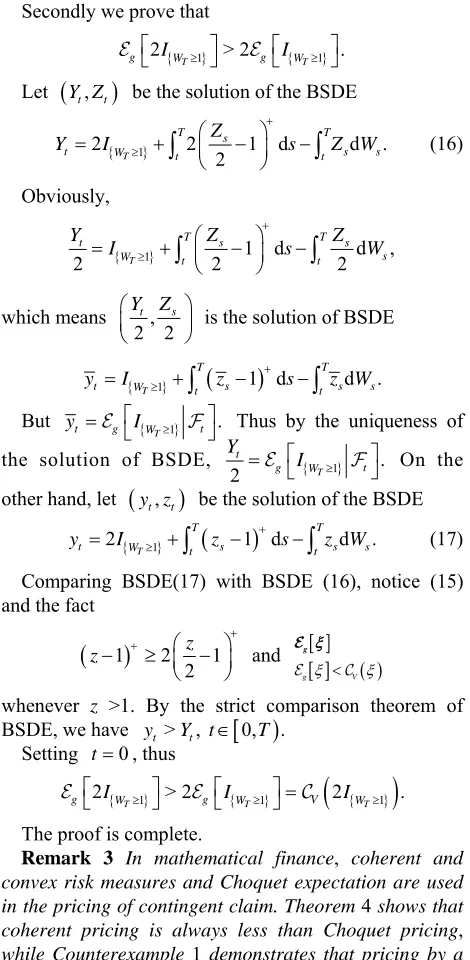
0,Tt . ThusSecondly we prove that
1 1
2 > 2
T T
g IW gIW .
Let
Y Zt, t
be the solution of the BSDE 1
2 2 1 d d
2
T
T s T
t W t t s s
Z
Y I s Z W
. (16)Obviously,
1 1 d d ,
2 T 2
T T
t s
2
s s
W t t
Y Z Z
I s W
which means , 2 2
t s
Y Z
is the solution of BSDE
T 1
1 d
d .T T
t W t s t
y I
z s
z Ws sBut 1 .
T
t g W t
y I Thus by the uniqueness of
the solution of BSDE, 1 .
2 T
t
g W
Y
I
t On the
other hand, let
y zt, t
be the solution of the BSDE 1
2 1 d
T
T T
t W t s t
y I
z s
z Wsd s. (17)Comparing BSDE(17) with BSDE (16), notice (15) and the fact
1
2 1 2z z
and
g V
g
whenever z >1. By the strict comparison theorem of
BSDE, we have yt > , Yt t
0,T
.Setting t0, thus
1 1
2 > 2 2
T T
g IW gIW V I
1
T
W . The proof is complete.
Remark 3 In mathematical finance, coherent and convex risk measures and Choquet expectation are used in the pricing of contingent claim. Theorem 4 shows that coherent pricing is always less than Choquet pricing, while Counterexample 1 demonstrates that pricing by a convex risk measure no longer has this property. In fact the convex risk price may be greater than or less than the Choquet expectation.
4. Summary
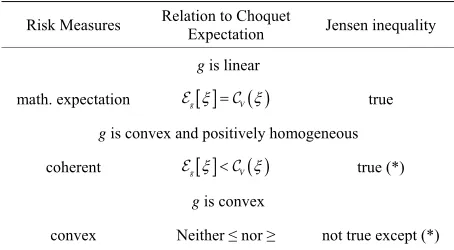
Coherent risk measures are a generalization of mathe- matical expectations, while convex risk measures are a generalization of coherent risk measures. In the frame- work of g-expectation, the summary of our results is
given in Table 1. In that Table, the Choquet expectation
is
:
zt D yt t 2 1
Wt
,t
z
t
W
where is the Malliavin derivative. Thus can be greater than 1 whenever is near 0 and is near 0. Thus (15) holds, which contradicts the assumption
a.e. t
D
t
1
t
z t
0,T .g A
Counterexample 1 shows that convex risk may be or
V A I .
[image:8.595.307.542.86.566.2]Table 1. Relations among coherent and convex risk mea- sures g
, choquet expectation and Jensen’s inequality.Risk Measures Relation to Choquet Expectation Jensen inequality
g is linear
math. expectation g V true
g is convex and positively homogeneous coherent g V true (*)
g is convex
convex Neither ≤ nor ≥ not true except (*)
risk there is an inequality relation with Choquet expec- tation.
REFERENCES
[1] P. Artzner, F. Delbaen, J. M. Eber and D. Heath, “Co- herent Measures of Risk,” Mathematical Finance, Vol. 9, No. 3, 1999, pp. 203-228. doi:10.1111/1467-9965.00068 [2] F. Delbaen, “Coherent Risk Measures on General Prob-
ability,” In: K. Sandmann and P. Schonbucher, Eds., Ad- vances in Finance and Stochastics, Springer-Verlag, Ber- lin, 2002, pp. 1-37. doi:10.1007/978-3-662-04790-3_1 [3] H. Föllmer and A. Schied, “Convex Measures of Risk and
Trading Constraints,” Finance and Stochastics, Vol. 6, No. 4, 2002, pp. 429-447. doi:10.1007/s007800200072 [4] M. Frittelli and E. R. Gianin, “Putting Order in Risk Mea-
sures,” Journal of Banking Finance, Vol. 26, No. 7, 2002, pp. 1474-1486. doi:10.1016/S0378-4266(02)00270-4 [5] S. G. Peng, “BSDE and Related g-Expectation,” Pitman
Research Notes in Mathematics Series, Vol. 364, 1997, pp. 141-159.
[6] E. Pardoux and S. G. Peng, “Adapted Solution of a Back-
ward Stochastic Differential Equation,” Systems and Con- trol Letters, Vol. 14, No. 1, 1990, pp. 55-61.
doi:10.1016/0167-6911(90)90082-6
[7] G. Choquet, “Theory of Capacities,” Annales de l'institut Fourier (Grenoble), Vol. 5, 1953, pp. 131-195.
doi:10.5802/aif.53
[8] L. Jiang, “Convexity, Translation Invariance and Subad- ditivity for g-Expectations and Related Risk Measures,” Annals of Applied Probability, Vol. 18, No. 1, 2008, pp. 245-258. doi:10.1214/105051607000000294
[9] P. Briand, F. Coquet, Y. Hu, J. Mémin and S. G. Peng, “A Converse Comparison Theorem for BSDEs and Re- lated Problems of g-Expectation,” Electronic Communi- cations in Probability, Vol. 5, 2000, pp. 101-117. doi:10.1214/ECP.v5-1025
[10] B. Roorda, J. M. Schumacher and J. Engwerda, “Coherent Acceptability Measures in Multi-Period Models,” Mathe- matical Finance, Vol. 15, No. 4, 2005, pp. 589-612. doi:10.1111/j.1467-9965.2005.00252.x
[11] P. Artzner, F. Delbaen, J. M. Eber, D. Heath and H. Ku, “Multiperiod Risk and Coherent Multiperiod Risk Meas- urement,” E.T.H.Zürich, Preprint, 2002.
[12] P. Artzner, F. Delbaen, J. M. Eber, D. Heath and H. Ku, “Coherent Multiperiod Risk Adjusted Values and Bell- man’s Principle,” Annals of Operations Research, Vol. 152, No. 1, 2007, pp. 5-22.
doi:10.1007/s10479-006-0132-6
[13] M. Frittelli and E. R. Gianin, “Dynamic Convex Risk Measures,” In:G. Szegö, Ed., Risk Measures for the 21st Century, John Wiley, Hoboken, 2004, pp. 227-248. [14] F. Coquet, Y. Hu, J. Mémin and S. G. Peng, “A General
Converse Comparison Theorem for Backward Stochastic Differential Equations,” Comptes Rendus de l’Académie des Sciences Paris, Series I, Vol. 333, 2001, pp. 577-581. [15] Z. J. Chen, R. Kulperger and L. Jiang, “Jensen’s Inequal-