N A N O E X P R E S S
Open Access
Enhanced electrochemical performance of
Lithium-ion batteries by conformal coating of
polymer electrolyte
Nareerat Plylahan
1,2, Sébastien Maria
3, Trang NT Phan
3, Manon Letiche
1, Hervé Martinez
4, Cécile Courrèges
4,
Philippe Knauth
2and Thierry Djenizian
1,2*Abstract
This work reports the conformal coating of poly(poly(ethylene glycol) methyl ether methacrylate) (P(MePEGMA)) polymer electrolyte on highly organized titania nanotubes (TiO2nts) fabricated by electrochemical anodization of Ti foil. The conformal coating was achieved by electropolymerization using cyclic voltammetry technique. The characterization of the polymer electrolyte by proton nuclear magnetic resonance (1H NMR) and size-exclusion chromatography (SEC) shows the formation of short polymer chains, mainly trimers. X-ray photoelectron spectroscopy (XPS) results confirm the presence of the polymer and LiTFSI salt. The galvanostatic tests at 1C show that the performance of the half cell against metallic Li foil is improved by 33% when TiO2nts are conformally coated with the polymer electrolyte.
Keywords:Titania nanotubes; Polymer electrolyte; Electropolymerization; Lithium-ion batteries
Background
The miniaturization of Lithium-ion batteries (LIBs) as a power source to drive small devices has been conti-nuously developed to meet the market requirements of nomadic applications. The challenge of the minia-turization of LIBs is to minimize the size and, at the same time, maximize the energy and power densities of the battery. In this context, 3D Li-ion microbatteries have been developed to overcome this challenge. Particularly, nanoarchitectured electrodes such as self-organized titania nanotubes (TiO2nts) are a potential candidate as a negative electrode in 3D Li-ion microbat-teries [1-9]. TiO2nts show a better electrochemical performance compared to the planar TiO2 counterpart [6] due to i) their high active surface area, ii) the direct contact between the active material and the substrate, iii) fast diffusion of charges, and iv) high stability upon cycling owing to spaces between nanotubes, which allow the volume variation caused by Li+ insertion/extraction.
To achieve the fabrication of the full 3D Li-ion micro-batteries, the use of conventional organic liquid electro-lytes must be avoided due to the safety concerns and its incompatibility to the integrated circuit technology. Poly (ethylene oxide) or poly(ethylene glycol) (PEG) is the most common polymer electrolyte used in LIBs due to its compatibility to the all-solid-state Li-ion microbat-teries [10], promising ionic conductivity [11,12], and thermal stability [13]. However, it is necessary to main-tain the 3D nanotubular structure of TiO2nts after the deposition of the polymer electrolyte in order to sub-sequently fabricate the full 3D Li-ion microbatteries by filling the polymer-coated TiO2nts with a cathode mate-rial. Recently, we have reported the electropolymerization by cyclic voltammetry (CV) to conformally electrodeposit the PEG-based polymer electrolyte with bis(trifluoro-methanesulfone)imide or LiTFSI salt on the TiO2nts with-out closing the tube opening [14-16]. The conformal electrodeposition of polymer is a convenient approach to preserve the 3D morphology of the substrate as it has been reported for other materials [17]. The main advan-tage of the conformal coating is that all the active surface area of TiO2nts is in contact with the polymer electrolytes, which will improve the charge transport and thereby * Correspondence:[email protected]
1
Aix-Marseille Université, CNRS, LP3 UMR 7341, F-13288, Marseille Cedex 9, France
2
Aix-Marseille Université, CNRS, MADIREL UMR 7246, F-13397, Marseille Cedex 20, France
Full list of author information is available at the end of the article
improving the performance of the microbatteries. It can be noted that the electrochemical-assisted polymerization process is a convenient and versatile approach. Indeed, the polymer formation can be achieved by different me-chanisms involving the formation of free-radical interme-diates, the activation by light, the use of initiator, and the direct oxidation or reduction of monomer as it has been reported for poly(para-phenylene)vinylene (PPV) [18], polypyrrole (PPy) [19], poly(2-methacryloyloxy (ethyl) acetoacetate) [20], and poly(sulfonated phenol) [21], respectively.
In this work, we report the fabrication of highly ordered and smooth TiO2nts and the conformal coating of the polymer electrolyte: comb-shaped poly(poly(ethylene glycol) methyl ether methacrylate) or P(MePEGMA) on TiO2nts by an electropolymerization technique. The mor-phology of the materials was characterized by scanning electron microscopy (SEM) and transmission electron microscopy (TEM). The chemical structure of the obtained P(MePEGMA) polymer was analyzed by proton nuclear magnetic resonance (1H NMR) and its molar mass was measured by size-exclusion chromatography (SEC). The polymer electrolyte was studied in depth by X-ray pho-toelectron spectroscopy (XPS). The electrochemical tests were carried out in the half cell to investigate the improved performance of the solid-state batteries caused by the conformal coating of TiO2nts with the polymer electrolyte.
Methods
TiO2nts were synthesized by electrochemical anodization [22] of Ti foil in an electrolyte containing 96.7 wt% glycerol, 1.3 wt% NH4F, and 2 wt% water. A constant volt-age of 60 V was applied to the cell (Ti foil as a working electrode and Pt foil as a counter electrode) for 3 h. After the anodization, the sample was rinsed with deionized water without removing it from the cell.
The electropolymerization on as-formed TiO2nts was carried out by CV [14-16] in an aqueous electrolyte containing 0.5 M LiTFSI and 0.2 M poly(ethylene glycol) methyl ether methacrylate or MePEGMA in a three-electrode system: TiO2nts as a working electrode, Pt foil as a counter electrode, and Ag/AgCl, 3 M KCl as a refe-rence electrode. MePEGMA is used as a starting mono-mer with an average molecular weight of 300 g mol−1and an average repeating ethylene oxide unit of 5. Prior to the electropolymerization, the electrolyte was purged with N2 for 10 min to remove dissolved oxygen. The CV was done for five cycles in the three-electrode configuration at the scan rate of 10 mV/s, potential window of−0.35 to−1 V vs Ag/AgCl, 3 M KCl. After the electropolymerization, the sample was dried without rinsing under vacuum at 60°C overnight.
The morphology of TiO2nts and polymer-coated TiO2nts were examined by electron microscopy techniques using a
JEOL 6320 F SEM and a JEOL 2010 F TEM (JEOL Ltd., Akishima, Tokyo, Japan).
1
H NMR spectra in CDCl3were recorded on a Bruker Advance 400 spectrometer (Bruker AXS, Inc., Madison, WI, USA). A chemical shift was given in parts per million relative to tetramethylsilane. In order to cha-racterize the polymer by NMR, the sample was im-mersed during approximately 1 h in CDCl3. Then the solution was recovered and concentrated to reach the minimum volume for an NMR analysis (≈0.5 mL).
Polymer molecular weights and dispersities were determined by SEC. The used system was an EcoSEC (Tosoh, Tokyo, Japan) equipped with a PL Resipore Pre-column (4.6 × 50 mm, Agilent Technologies, Inc., Santa Clara, CA, USA) and two linear M columns (4.6 × 250 mm, Agilent) with a gel particle diameter of 3μm. These columns were thermostated at 40°C. Detec-tion was made by an UV/visible detector operated at
λ= 254 nm, a dual flow differential refractive index detector, both from Tosoh, and a viscometer ETA2010 from PSS (Polymer Standards Service Inc., Amherst, MA, USA). Measurements were performed in THF at a flow rate of 0.3 mL min−1. Calibration was based on polystyrene standards from Polymer Laboratories (ranging from 370 to 371,100 g mol−1).
The electrochemical tests of bare TiO2nts and polymer-coated TiO2nts were carried out using galvanostatic measurements. TiO2nt electrodes were assembled against a metallic Li foil using Swagelok cells in an Ar-filled glove box. Two sheets of Whatman paper soaked with MePEGMA + LiTFSI electrolyte were used as a separator. The separators were prepared by soaking the circular disk (diameter of 10 mm) with an aqueous solution of 0.5 M LiTFSI + 0.8 M MePEGMA, then dried at 60°C in a vacuum dryer overnight. The cells were cycled at 1C in the potential window of 1.4 to 3 V vs Li/Li+using VMP3 (Biologic instrument).
Results and discussion
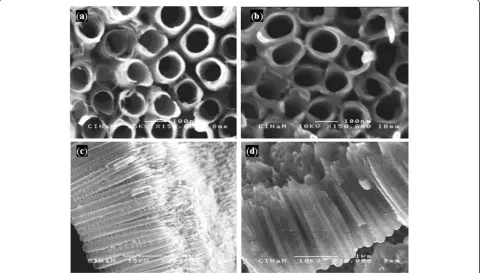
The morphology of as-formed TiO2nts and polymer-coated TiO2nts is shown in Figure 1. In Figure 1a,c, it can be seen that highly organized TiO2nts are obtained after the anodization for 3 h. The top view (Figure 1a) shows the rounded shape of the tube opening with the diameter of approximately 100 nm and the wall thick-ness of 10 nm. The side view (Figure 1c) shows length of the tubes of approximately 1.5 μm. Figure 1b,d shows the TiO2nts after the electropolymerization. The con-formal electrodeposition of the polymer electrolyte is supposed to occur according to a mechanism involving the formation of hydrogen free radicals as it is described elsewhere [15,25]. The top view (Figure 1b) shows the
thicker tube wall of approximately 20 nm which results from the deposition of the polymer. The side view (Figure 1d) shows that the spaces between tubes are filled with the polymer.
Figure 2 shows the TEM images of a single tube from the polymer-coated TiO2nts sample. In Figure 2a, a thin layer of polymer is clearly observed on the outer wall, from the top to the bottom of the tube. The enlarged view at the open end of the tube given in Figure 2b shows that the thickness of the conformal polymer layer is around 10 nm.
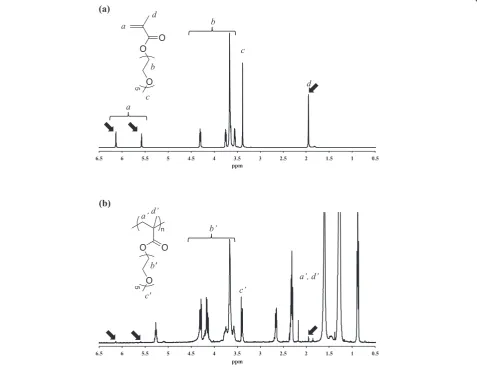
[image:3.595.58.539.431.704.2]After the conformal deposition of electrolyte on TiO2nts has been achieved, the polymer electrolyte was recovered and characterized by 1H NMR to verify if the polymer is formed and by SEC to estimate chain length of the polymer. The1H NMR spectra of the MePEGMA monomer and the P(MePEGMA) polymer are shown in Figure 3a,b, respectively. First, the polymer was success-fully extracted since the peak at 3.65 ppm corresponding to the methylene protons of the PEG chains together with the peak at 3.40 ppm of the methyl ether end-chain are still present in the polymer spectrum. Moreover the electropolymerization occurred since the peaks at 6.11 and 5.58 ppm corresponding to the vinylic protons and the singlet at 1.95 ppm of the methyl of the unsaturated methacrylic units in the monomer spectrum almost dis-appeared in the spectrum of the polymer (see arrows in
Figure 1Morphology of as-formed TiO2nts and polymer-coated TiO2nts.SEM images of(a)top view of as-formed TiO2nts,(b)top view of
Figure 3). Additionally new peaks appeared in the poly-mer spectrum between 2.8 and 0.8 ppm, which are un-fortunately not easy to assign. This area of the spectrum should contain peaks corresponding to the methylene and methyl groups of the methacrylate backbone but also some impurities. Indeed, considering the small vo-lume taken by the nanostructured polymer layer in the sample, the overall quantity of polymer available is very low and it was difficult to avoid pollution of the
extracted material. For example, peaks at 0.88 and 1.27 ppm could indicate the presence of linear alkanes and singlet at 1.6 ppm is due to water.
The SEC chromatograms of P(MePEGMA) polymer and MePEGMA monomer are shown in Figure 4. There are three evident peaks at the elution volume of 6.15, 6.5, and 7 mL. It is noted that the average molecular weight of the monomer used in this work is approxi-mately 300 g mol−1. Hence, the peak at 6.5 mL is nearly
(a) (b)
Polymer
TiO2
Polymer Polymer
[image:4.595.57.538.89.189.2]TiO2
Figure 2TEM images of a single tube from the polymer-coated TiO2nts sample.TEM images of(a)a single tube with conformal polymer
[image:4.595.60.538.350.717.2]coating and(b)enlarged view at the open end of the polymer-coated tube.
superimposed to the peak corresponding to the mono-mer; this means that our electrolyte contains probably the residual monomer, with modified end-chains con-sidering the NMR results. The peak at 6.15 mL shows the highest intensity (800 g mol−1), which is three times the molecular weight of the monomer peak at 6.5 mL. Therefore, this peak can be assigned to trimers. The peak at 7 mL with the molecular weight of 154 g mol−1 is lower than the weight of the monomer. This peak may correspond to the broken side chain from the monomer or trimers. We also observe a very large shoulder bet-ween 5 and 6 mL indicating the formation of larger
polymer species, but the signal intensity is too low to get molar mass integration.
XPS measurements were performed on self-organized TiO2nts coated with P(MePEGMA) and TiO2nts coated with P(MePEGMA) + LiTFSI. All the quantitative data, in-cluding binding energies of the different species detected, full width at maximum height (FWMH) and atomic per-centages (At.%) are given in Table 1. For TiO2nts + P(MePEGMA) sample, O 1 s and C 1 s peaks are detected. These peaks mainly result from the oxygen and carbon atoms in the polymer. The F 1 s peak is attributed to the residual fluoride ions from the anodization process since
4,0 4,5 5,0 5,5 6,0 6,5 7,0 7,5
0,000 0,003 0,006 0,009 0,012 0,015
RI response
Elution volume (mL) P(MePEGMA)
[image:5.595.60.539.88.306.2]MePEGMA
Figure 4SEC chromatograms of P(MePEGMA) and MePEGMA.
Table 1 Binding energies (BE, eV), full width at a half maximum (FWHM, %), and atomic percentages (At.%) of the main components of TiO2nts coated with P(MePEGMA) and TiO2nts coated with P(MePEGMA) + LiTFSI
TiO2nts + P(MePEGMA) TiO2nts + P(MePEGMA) + LiTFSI
BE (eV) FWHM (%) At.% BE (eV) FWHM (%) At.%
C 1 s 285 1.2 11.3 C 1 s 285 1.5 10
286.5 1.3 44.7 286.5 1.5 17.2
288 1.1 2.6 288 1.5 2.8
289.1 1.1 5.2 289.3 1.5 1.9
292.9 1.2 1.8
O 1 s 531 1.1 0.5 O 1 s 531.4 1.5 2.2
532.8 1.4 31 532.7 1.6 13.1
534 1.4 4.1 533.7 1.6 2.2
F 1 s 687.9 2.5 0.6 F 1 s 684.7 1.7 22.6
688.3 2.3 7
Li 1 s 55.9 1.4 15.1
N 1 s 399.6 2.1 1.7
S 2p 168.9 1.6 2.6
[image:5.595.65.539.509.732.2]the anodization and the electropolymerization were car-ried out in the same electrochemical cell. For TiO2nts + P(MePEGMA) + LiTFSI sample, N 1 s, F 1 s, Li 1 s, and S 2p peaks are detected in addition to O 1 s and C 1 s peaks, which results from the presence of LiTFSI salt [LiN (SO2CF3)2]. It can be noticed that no Ti and O atoms from TiO2nts have been observed in both samples, which indicates that the corresponding nanotubes are completely coated by the polymer electrolyte with a layer thickness over 5 nm (≈depth analysis of XPS experiments), which is in agreement with the thickness determined by TEM analysis.
The XPS spectra of C 1 s core peak for both samples are presented in Figure 5 (for a non-exhaustive presentation, the other XPS spectra are not displayed). The C 1 s core peak of TiO2nts + P(MePEGMA) (Figure 5a) presents four main components, which can be assigned to C-C and C-H at 285 eV, C-O at 286.5 eV, O-C-O at 288 eV, and O-C = O at 289.1 eV. The total concentration of C 1 s is 63.9 At.%. The main component located at 286.5 eV (44.7 At.%) corresponds to C-O bond in oligomer species of PEG (−CH2-CH2-O-)n [26]. For C 1 s core peak of TiO2nts + P(MePEGMA) + LiTFSI (Figure 5b), the four similar components are observed, plus an additional component at 292.9 eV (1.8 At.%), which can be assigned to CF3-like carbon atoms in LiTFSI (LiN(SO2CF3)2), as previously observed by Leroy et al. [27]. The total con-centration of C 1 s is 33.6 At.%. The O 1 s core peak of TiO2nts + P(MePEGMA) sample is composed of two main peaks at 532.8 eV (31 At.%) and 534 eV (4.1 At.%), which correspond to oxygen in PEG oligomer species. The total concentration of O 1 s is 35.5 At.%. The small component at 531 eV (0.5 At.%) can be attributed to residual OH species on the surface. For TiO2nts + P(MePEGMA) + LiTFSI, three components can be assigned for O 1 s peak
at 531.2 eV (O-H, 2.2 At.%), 532.3 eV (13.1 At.%), and 533.4 eV (2.2 At.%) (oxygen in PEG and LiTFSI). The O-H bond observed in this sample may result from the adsorbed water by LiTFSI salt on the surface of the sample. The total concentration of O 1 s is 17.7 At.%. It can be noticed that the percentages of C 1 s (286.5 eV) and O 1 s (532.8 and 534 eV) components, relative to C-O (PEG), decrease from TiO2nts + P(MePEGMA) to TiO2nts + P(MePEGMA) + LiTFSI, which proves the pre-sence of the lithium salt at the surface of TiO2nts + P(MePEGMA). The presence of LiTFSI in TiO2nts + P (MePEGMA) + LiTFSI sample is confirmed by the XPS spectra of F 1 s (29.3% total atomic percentage), S 2p (2.6% total atomic percentage), Li 1 s (15.1% total atomic percentage), and N 1 s (1.7% total atomic percentage). For F 1 s spectrum, two components can be observed at 684.7 eV (22.6 At.%), which may be assigned to LiF, and 688.3 eV (7 At.%), which corresponds to F-C in LiTFSI. The component of LiF may result from the residual F¯ from the anodization and Li+from LiTFSI salt. It has to be noticed that the proportion between the C 1 s signal rela-tive to C-F (1.8 At.%) and the F 1 s signal of F-C (7 At.%) is in agreement with C-F3ratio in LiTFSI. The peaks of Li 1 s and N 1 s are located at 55.9 eV and 399.6 eV, respectively, and the S 2p signal is composed of S 2p1/2at 168.9 eV and S 2p3/2 at 170.1 eV. These results are in agreement with previous XPS core peak characterization of LiTFSI done by Leroy et al. [27] and Plylahan et al. [14].
To summarize, our results show that self-organized TiO2nts are successfully coated with the polymer electro-lyte, and the presence of PEG and LiTFSI is confirmed.
The positive effect of the conformal coating of the polymer electrolyte on the electrochemical performance of the nanotubes was investigated by galvanostatic tests. Bare TiO2nts and polymer-coated TiO2nts were tested in a half cell against a metallic Li foil using separator
294 292 290 288 286 284 282
Binding Energy (eV)
b) TiO
2nts+P(MePEGMA)+LiTFSI a) TiO
[image:6.595.57.290.524.704.2]2nts+ P(MePEGMA)
Figure 5C 1 s XPS spectra of TiO2nts coated with (a) P(MePEGMA) and (b) P(MePEGMA) + LiTFSI by electropolymerization.
0 10 20 30 40
0 25 50 75 100 125 150 175
Specific capacity (mA h g
-1 )
Cycle number
Bare TiO2tns
[image:6.595.305.539.533.704.2]Polymer-coated TiO2nts
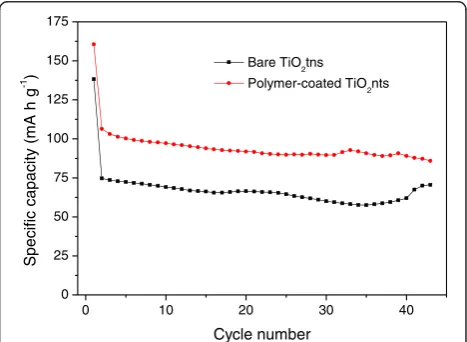
soaked with 0.5 M LiTFSI + 0.8 M MePEGMA. The cyc-ling performance at 1C in the potential window between 1.4 and 3 V vs Li/Li+is shown in Figure 6. The polymer-coated TiO2nts deliver an average reversible capacity of 100 mA h g−1which is improved by 33% as compared to bare TiO2nts (approximately 75 mA h g−1). The better performance is attributed to the conformal coating of the polymer electrolyte that increases the contact area between electrode and electrolyte. This increased con-tact leads to a better Li+ transport and thereby impro-ving the performance of the battery. The irreversible capacity at the first cycle is a normal behavior observed for anatase and amorphous TiO2nts [6,9,10,16]. This irreversible capacity is caused by the side reaction of lithium ions and residual water in the polymer and adsorbed surface water on TiO2nts. Also, some lithium ions are trapped inside the lattice after the first insertion (first discharge). The capacity fading is fairly low as a result of the 3D nanotubular structure that allows the volume variation during cycling.
Conclusions
The highly conformal electrodeposition of P(MePEGMA) polymer electrolyte on highly organized TiO2nts has been achieved using the cyclic voltammetry technique. The characterization of the polymer electrolyte by 1H NMR and SEC shows the formation of short polymer chains, mainly trimers and some traces of high molar mass poly-mer species as well as MePEGMA monopoly-mers. The in depth studies of polymer-coated TiO2nts by XPS confirm the presence of polymer and LiTFSI salt. The electro-chemical tests of TiO2nts in the half cell against metallic Li foil show the improved performance of the LIBs by 33% at 1C when TiO2nts are conformally coated with the poly-mer electrolyte.
Competing interests
The authors declare that they have no competing interests.
Authors’contributions
NP and ML prepared the samples. NP conducted the electrochemical tests and prepared the manuscript. SM and TP conducted1H NMR and SEC
experiments and prepared the manuscript. HM and CC conducted the XPS measurements and prepared the manuscript. PK and TD supervised the study. All the authors read and approved the final manuscript.
Acknowledgements
We acknowledge the Région PACA and ANR JCJC no. 2010 910 01 for financial supports.
Author details
1Aix-Marseille Université, CNRS, LP3 UMR 7341, F-13288, Marseille Cedex 9,
France.2Aix-Marseille Université, CNRS, MADIREL UMR 7246, F-13397, Marseille Cedex 20, France.3Aix-Marseille Université, CNRS, ICR UMR 7273, F-13397, Marseille Cedex 20, France.4IPREM-ECP-UMR 5254, Université de Pau et des Pays de l’Adour, Hélioparc Pau-Pyrénées, 2 Av du Président Angot, 64053, Pau Cedex 9, France.
Received: 16 May 2014 Accepted: 16 September 2014 Published: 2 October 2014
References
1. Ellis BL, Knauth P, Djenizian T:Three-dimensional self-supported metal oxides for advanced energy storage.Adv Mater2014,26:3368–3397. 2. Fang D, Huang K, Liu S, Li Z:Electrochemical properties of ordered TiO2
nanotube loaded with Ag nano-particles for lithium anode material.
J Alloys Compd2008,464:L5–L9.
3. Kyeremateng NA, Lebouin C, Knauth P, Djenizian T:The electrochemical behaviour of TiO2 nanotubes with Co3O4 or NiO submicron particles: composite anode materials for Li-ion micro batteries.Electrochim Acta 2012,88:814–820.
4. Wei W, Oltean G, Tai C-W, Edström K, Björefors F, Nyholm L:High energy and power density TiO2 nanotube electrodes for 3D Li-ion microbatteries.J Mater Chem A2013,1:8160.
5. Djenizian T, Hanzu I, Knauth P:Nanostructured negative electrodes based on titania for Li-ion microbatteries.J Mater Chem2011,21:9925. 6. Ortiz GF, Hanzu I, Djenizian T, Lavela P, Tirado L, Knauth P:Alternative
Li-ion battery electrode based on self-organized titania nanotubes.
Chem Mater2009,21:63–67.
7. Kyeremateng NA, Plylahan N, dos Santos ACS, Taveira LV, Dick LFP, Djenizian T:Sulfidated TiO2 nanotubes: a potential 3D cathode material for Li-ion micro batteries.Chem Commun2013,49:4205–4207. 8. Kyeremateng NA, Vacandio F, Sougrati M-T, Martinez H, Jumas J-C, Knauth
P, Djenizian T:Effect of Sn-doping on the electrochemical behaviour of TiO2 nanotubes as potential negative electrode materials for 3D Li-ion micro batteries.J Power Sources2013,224:269–277.
9. Ortiz GF, Hanzu I, Knauth P, Lavela P, Tirado JL, Djenizian T:TiO2 nanotubes manufactured by anodization of Ti thin films for on-chip Li-ion 2D microbatteries.Electrochim Acta2009,54:4262–4268.
10. Plylahan N, Letiche M, Barr MKS, Djenizian T:All-solid-state lithium-ion batteries based on self-supported titania nanotubes.Electrochem Commun2014,43:121–124.
11. Agrawal RC, Pandey GP:Solid polymer electrolytes: materials designing and all-solid-state battery applications: an overview.J Phys D Appl Phys 2008,41:223001.
12. Song JY, Wang YY, Wan CC:Review of gel-type polymer electrolytes for lithium-ion batteries.J Power Sources1999,77:183–197.
13. Bernhard R, Latini A, Panero S, Scrosati B, Hassoun J:Poly(ethylenglycol) dimethylether–lithium bis(trifluoromethanesulfonyl)imide, PEG500DME– LiTFSI, as high viscosity electrolyte for lithium ion batteries.J Power Sources2013,226:329–333.
14. Plylahan N, Kyeremateng NA, Eyraud M, Dumur F, Martinez H, Santinacci L, Knauth P, Djenizian T:Highly conformal electrodeposition of copolymer electrolytes into titania nanotubes for 3D Li-ion batteries.Nanoscale Res Lett2012,7:349.
15. Kyeremateng NA, Dumur F, Knauth P, Pecquenard B, Djenizian T:
Electrodeposited copolymer electrolyte into nanostructured titania electrodes for 3D Li-ion microbatteries.C R Chim2013,16:80–88. 16. Kyeremateng NA, Dumur F, Knauth P, Pecquenard B, Djenizian T:
Electropolymerization of copolymer electrolyte into titania nanotube electrodes for high-performance 3D microbatteries.Electrochem Commun 2011,13:894–897.
17. Mazzotta E, Surdo S, Malitesta C, Barillaro G:High-aspect-ratio conducting polymer microtube synthesis by light-activated electropolymerization on microstructured silicon.Electrochem Commun2013,35:12.
18. Djenizian T, Gelloz B, Dumur F, Chassigneux C, Jin L, Koshida N:Direct electropolymerization of poly(para-phenylene)vinylene films on Si and porous Si.J Electrochem Soc2010,157:H534–H539.
19. Surdo S, Strambini LM, Malitesta C, Mazzotta E, Barillaro G:Highly conformal growth of microstructured polypyrrole films by electrosynthesis on micromachined silicon substrates.Electrochem Commun2012,14:1–4. 20. Agarwal R, Bell J:Electropolymerization of 2-methacryloyloxy(ethyl)
acetoacetate on aluminum using a novel initiation method.J Appl Polym Sci1999,71:1665–1675.
21. Hou H, Vacandio F, Vona ML, Di Knauth P:Electropolymerization of sulfonated phenol by cyclic voltammetry.J Appl Polym Sci2013,
129:1151–1156.
22. Kowalski D, Kim D, Schmuki P:TiO2 nanotubes, nanochannels and mesosponge: self-organized formation and applications.Nano Today 2013,8:235–264.
24. Scofield JH:Hartree-slater subshell photoionization cross-sections at 1254 and 1487 eV.Electron Spectrosc Relat Phenom1976,8:129–137.
25. Cram S, Spinks G, Wallace G, Brown H:Mechanism of
electropolymerisation of methyl methacrylate and glycidyl acrylate on stainless steel.Electrochim Acta2002,47:1935–1948.
26. Leroy S, Blanchard F, Dedryère R, Martinez H, Carre B, Lemordant D, Gonbeau D:Surface film formation on a graphite electrode in Li-ion batteries: AFM and XPS study.Surf Interface Anal2005,37:773–781. 27. Leroy S, Martinez H, Dedryvère R, Lemordant D, Gonbeau D:Influence of
the lithium salt nature over the surface film formation on a graphite electrode in Li-ion batteries: an XPS study.Appl Surf Sci2007,
253:4895–4905.
doi:10.1186/1556-276X-9-544
Cite this article as:Plylahanet al.:Enhanced electrochemical performance of Lithium-ion batteries by conformal coating of polymer electrolyte.Nanoscale Research Letters20149:544.
Submit your manuscript to a
journal and benefi t from:
7Convenient online submission
7Rigorous peer review
7Immediate publication on acceptance
7Open access: articles freely available online
7High visibility within the fi eld
7Retaining the copyright to your article