flip the business school model. International Journal of Management Education, 15 (3). pp. 481-489. ISSN 1472-8117 DOI: https://doi.org/10.1016/j.ijme.2017.08.002
Link to Leeds Beckett Repository record: http://eprints.leedsbeckett.ac.uk/4371/
Document Version: Article
The aim of the Leeds Beckett Repository is to provide open access to our research, as required by funder policies and permitted by publishers and copyright law.
The Leeds Beckett repository holds a wide range of publications, each of which has been checked for copyright and the relevant embargo period has been applied by the Research Services team.
We operate on a standard take-down policy. If you are the author or publisher of an output and you would like it removed from the repository, please contact us and we will investigate on a case-by-case basis.
Developing Imaginators not Managers – How to Flip the Business School Model
Abstract
This experiential paper is written to provoke debate amongst deanly colleagues around the world-our location is the 130 business schools in the UK (and the 3500 plus in the world!) about how to ‘flip’ the academic model of their business schools. We make a case for this flipping by revisiting Henry Mintzberg’s thesis presented in ‘Managers not MBA’s in its tenth anniversary year. Ten years on we argue the case for the ‘flip’ is stronger than ever yet our progress toward it disappointing. The criticism of business schools is ever persistent and the argument for their irrelevancy seems to be strengthening. Our paper seeks to argue that much of business school practice and pedagogy is still rooted in content rather than context, where priority is given to academic knowledge in favour of practice intelligence. The ‘flip’ as we define it shifts the emphasis to the latter and helps restore business schools to the status of being relevant to business. Within this context, we provide key features of the flipped
business school model for curriculum design and delivery and introduce key enablers of the flip, and we argue that deans are well placed to take this agenda forward.
Keywords
Setting the Scene
We are celebrating the thirteen-year anniversary of the publication of Henry Mintzberg’s Managers Not MBAs. In 2004 Mintzberg presented what is still arguably the clearest articulation of what needed to be done to flip the management education model of the 21st century business school and why (Mintzberg, 2004). Mintzberg’s arguments resonated with a broad theme of the last 20 years of critiquing business school programmes and research for their lack of relevance to real world management practice. Mintzberg specifically expressed the flipping agenda in relation to the MBA course arguing that the dominant model of the MBA is too focused upon presenting ‘limited’ experience managers with scientific knowledge (academic theory) in relation to management. Flipping the model, Mintzberg argued involves shifting the focus onto the practice of management and bringing experienced practising managers into the classroom. For those concerned with the practical relevance of management education Mintzberg’s ideas made a great deal of sense and his book presented insights into what and how it could be done with a detailed example of an International Masters in Practicing Management programme.
Despite the clarity of Mintzberg’s thesis, there have been many articles in management journals and the quality business press over the last decade that go beyond the dominant model of the MBA and continue to re-state the business school problem – the irrelevance of business school courses and research to shaping management practice in organisations (see Beck, 2013; Bennis and O’Toole, 2005; Pfeffer and Fong, 2002). Warren Bennis in writing for Bloomberg Business, reflected upon this in ‘How Business Schools Lost Their Way’ and argued that “the orthodoxy hasn’t changed very much since the ’05 article, except perhaps to have gotten worse” (Bennis, 2012). Indeed, long standing critics of business schools will perhaps not be surprised by the persistence of the irrelevance point of management education and research. They point to deep-rooted cultural issues and the history of business schools, the importance of ivory tower research in the business school model, a faculty model built around traditional career academics, a narrow focus for competition amongst top grade business schools and the reality of on-going success of business school recruitment.
Whatever the reasons – and they are many and varied – it doesn’t appear by any reasonable assessment that much flipping of the business school model has taken place since 2004. In a Financial Times commentary Beck (2013) goes even further by arguing “I don’t believe there is a really good business school anywhere on earth. But I am holding onto the hope that there could be – someday”. Beck goes onto argue that the model for management education needs a real world mindset that offers programmes that prepare students to make improvements in practice.
evolve through the prism of interdisciplinarity in order to respond to recent calls for developing a cadre of global calibre in the age of uncertainty and rapid globalisation of markets and organisations. This resonates with what Roos (2014) debates in a Harvard Business Review, where he contends that business school leadership is also called upon the need to embed “cross-disciplinary thinking” in line with embracing a more practice-led and perhaps, experiential approach to delivering management education.
This experiential paper re-presents the case for mainstreaming the flipping of the broader management education model for business schools and not just the model for the MBA. Our flipping narrative is focused upon the interplay between ‘Practice Intelligence and Academic Theory’ – two opposing paradigms, yet encompassing both sides of the same coin called management education. Practice Intelligence is a new term and relates to management practice and the effectiveness of management practice in context. Practice Intelligence was first introduced by Sternberg and Wagner (1991) in their discussion on developing a framework for promoting individual and organisational productivity through Practice Intelligence. The term was then cited in Rethinking Business Schools - a management education contribution by Sulej (2015). Yet, both contributions have not attempted to define more widely what Practice Intelligence might mean in relation to management education. We define it as the outcome, yet an on-going process of blending professional practice,
knowledge and business organisation context as a response to the perceived irrelevancy of traditional management education models of business schools to business contexts. The essence of Practice Intelligence is the capability of managers to analyse, make sense of, reflect upon and shape a response to complex problem contexts. Core to this capability is the role of problem-based learning (Coombs and Elden, 2004; Sherwood, 2004) and the
importance of creativity and imagination in defining action and reflecting upon action (Chia and Holt, 2008; Gundry and Kickul, 1996).
Our headline is the need to give greater emphasis to Practice Intelligence rather than academic theory in the management education model. The exact blend of Practice
Intelligence and academic theory can clearly vary within any course design but the key point is making explicit the nature of the Practice Intelligence to be integrated into the course design. To convey the strength of this shift in the business school mindset we refer to it as a call to develop ‘Imaginators not Managers’. What do we mean by ‘imaginators’? We use the term to describe leaders and practitioners who not only manage the present, but imagine and shape futures - individual and organisational. Imaginators make sense of, help shape and make happen future contexts. At the heart of this point is the view that leadership and
management practice is continually challenged by rapidly changing contexts and an effective leader and manager needs to be regularly focused on changing their mindset and also that of their team and employees to bring about required change in behaviour (e.g. see Bennis and O’Toole, 2005; Muff et al., 2013).
One such example of a challenging context is the rise and adoption of Artificial Intelligence (AI), robotics and big data in the corporate world and on strategic decision-making level (Mirza, 2017; Parry et al., 2016). This provides one example of how technological disruptions are poised to reshape organisations and organisational thinking.
managers need to keep abreast of these developments but also be able to ‘imagine’ future organisational contexts.
We see this shift as game changing because so few university business schools make explicit their integration of Practice Intelligence into programmes and as a focus and outcome of their research. In his book Rethinking Business Schools, Sulej (2015) calls upon the need to
embrace and further develop such Practice Intelligence as an integral part of existing business school models. There are tacit threads of what we argue in business school practice but simply adopting a practice based narrative and intellectually engaging in the irrelevance debate while maintaining an ivory tower perspective on the role and value of academic theory does not cut it in terms of inculcating the change in mindset that is required to bring about the necessary change. Practice Intelligence needs to be the primary focus of management
education and research in business schools – management education in its broadest sense, which goes beyond the dominant model of the MBA. Business school programmes need to be designed with the emphasis upon Practice Intelligence and research needs to focus upon studying Practice Intelligence and the emergence of new Practice Intelligence.
The Current Business School Model through the Lens of the Literature
Following the 2008 economic downturn, business schools were under increased scrutiny for providing a generation of leaders and managers who may have not been adequately prepared for the rapidly-shifting business context (Jackson, 2009; James, 2009). The core purpose of business schools has long been defined as training for “the practice of management” (Simon, 1957, p.1), but the extent to which these institutions produce graduates able to effectively provide a response to a range of global challenges to sustain positive organisational and societal change has been questioned (Cunliffe et al., 2002; Currie et al., 2016; Kurucz et al., 2014; Roos, 2016). Others have argued that business schools may be failing to equip
managers to deal with complexity and uncertainty and thus organisations have become less effective than they might be otherwise (Caprioni and Arias, 1997; Dehler et al., 2001; Grey, 2004).
The reasons why business schools are failing to produce a generation of globally-responsible and well-equipped leaders and managers are believed to be many and varied. Prominent themes in the literature include the widening gap between management education and business practice (see Anderson et al., 2011; Sheppard et al., 2015); lack of business context awareness in business school faculty (see Hawawini, 2005); ineffective MBA programmes (Mintzberg and Lampel, 2001); and lack of innovation in business schools (Hall et al., 2012) to name a few. We discuss these below.
The mismatch between management education (ME) and business practice has been
highlighted as one of the key reasons behind recent business school criticisms of their efforts to develop graduates that are fit for the corporate world (James, 2009; Sheppard et al., 2015). This mismatch points to the content of ME, which may be failing to adequately address the change of pace in the business environment (Hall et al., 2012 and Maxwell et al., 2010) and in turn prepare business school graduates to deliver in this rapidly-changing environment (James, 2009).
Another theme in the literature is the focus on business school faculty composition
entrepreneurs in residence (Kuratko, 2005) and professors of management practice
(Etzkowitz and Dzisah, 2015) have been contended, the critique holds by and large as these efforts have not been addressed. From a business school perspective, the composition of the faculty plays a key role and if faculty members have not been exposed to industry or not so for a long time, they can only theorise it rather than reflect or connect with it in a typical classroom (Hawawini, 2005; Ivory et al., 2006; Pfeffer and Fong, 2002).
Ineffective MBA programmes have also been regarded as a key contributor to the inability of business schools to equip future leaders and managers with relevant business context
knowledge and skills (Mintzberg and Lampel, 2001; Mondalek and Rogers, 2013). This so-called ‘flagship course’ in management education has been criticised for creatingdisparity between the pedagogic and curricular focus of MBAs and business and corporate needs (David et al., 2011; Sheppard et al., 2015). This suggests that the business sector may simply
demand more diversity and depth than an MBA can offer (Mondalek and Rogers, 2013).
Furthermore, business schools have been consistently criticised for the lack of innovation (Hall et al., 2012), which may be attributed to missing an opportunity to ‘lower their walls’ (Currie et al., 2016). Bennis and O’Toole (2005) contended that business schools have only
recently begun to scratch the surface of opportunities to innovate management and business
curriculum. Bennis and O’Toole go on to suggest that business schools have not significantly
innovated since the launch of the MBA. Despite recent attempts to respond to the need to introduce innovation to management education, e.g. see LeClair et al. (2010) who developed a framework to drive innovation in business schools, there is clearly a need for more evidence in this direction (Davies and Hilton, 2014).
While a number of business and management scholars have provided critiques on the relevancy of management education to the world of practice over the years (see Beck, 2013; Pfeffer & Fong, 2002; Pfeffer & Fong 2004; Starkey et al., 2004), it does not appear that business schools have gained a foothold to start to address underlying issues that might lead to a greater change in the way they fulfil their core mission. Amongst these issues is the need to prepare a generation of leaders and managers who can confidently navigate through and deliver in the rapidly-shifting business context.
Amidst prominent themes in the literature of ME, the current narrative suggests that a change in the business school model may be long overdue. A flip of the business school model is provided in responding to this claim.
Making our Case for the Flip
of HE. Private sector organisations like Pearson in the UK and Apollo in the US have aligned their business and educational models to deliver practice-based education that shapes Practice Intelligence far more effectively than traditional universities. The notion of Practice
Intelligence would appear to have wider application than just the business school market place, see for example Sternberg & Wagner (1991) contribution on promoting individual and organisational effectiveness through Practice Intelligence.
The point above coupled with critique of the current business school model provide a more general context for why we are arguing the case for ‘flipping’ of the business school model in terms of emphasising Practice Intelligence. Jarche (2012) has recently argued that educational and training models need to change to reflect a perspective that he describes as ‘work is learning and learning is the work’. This brings out the contrast of the traditional business school model with the emphasis on disseminating explicit academic knowledge and its application to abstract problem contexts with the real world management practice context of messy and complex scenarios that call for the emergence of effective practice i.e. Practice Intelligence. It is the changing nature of work, organisations and the dynamics of global markets and economies that is helping shape and define the talent needs of organisations in terms of Practice Intelligence rather than traditional academic knowledge. In the UK we are now, with a degree of regularity, hearing major graduate recruiters saying that a first class or 2:1 honours degree is not enough to secure a graduate job (see Pollard, 2015; Williams et al., 2015). They seek people who also have work experience and can evidence achievement in real world contexts (Ehiyazaryan and Barraclough, 2009). By experience, we suggest they mean graduates need to demonstrate Practice Intelligence.
A challenge in flipping the business model is that Practice Intelligence is often tacit and implicit knowledge that is dynamic and is continually being shaped by rapidly changing practice contexts. Practice Intelligence is difficult to capture and codify and it does not easily fit the traditional classroom delivery model. An example of some business schools
responding to this challenge is the increasingly popular model of appointing ‘Professors of Management Practice’ (see Etzkowitz and Dzisah, 2015; Lerner and Malmendier, 2013). One rather obvious implication of the ‘work is learning and learning is the work’ theme is to increase the opportunity for learning in real world learning contexts. The ideal here would be more learning in the workplace e.g. placements, internships and also in-company degrees. In practice, this may involve business schools increasingly creating opportunities on campus to help students develop and evidence their Practice Intelligence.
What Does the Flip of the Business School Model Mean?
the classroom with the world of practice. We refer to this broader strategic flipping as the practice based model of management education, a definition that maintains its integrity with Mintzberg’s arguments in his 2004 publication (Mintzberg, 2004). In contrast to the
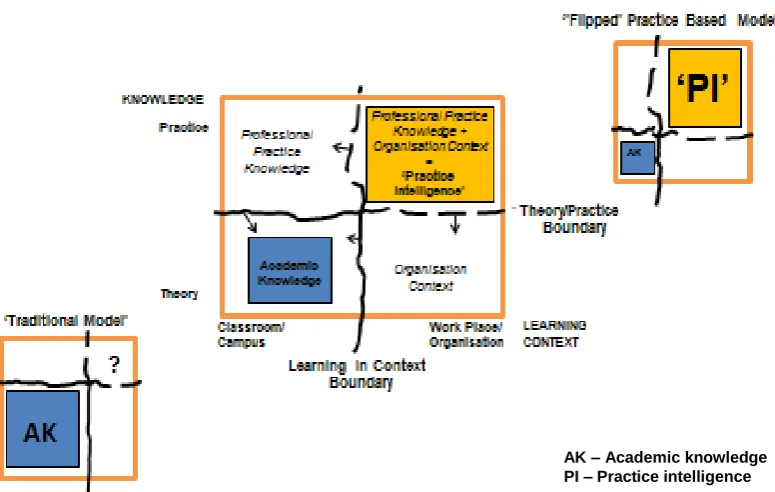
traditional model of management education our flipping dynamic is driven by the emphasis on management practice context rather than academic theory content. We illustrate this below:
(INSERT ILLUSTRATION 1 HERE)
Figure 1 illustrates the notion of the ‘flipped’ business school model we have been
developing in this experiential paper. We can use this to express how change in curriculum and course design would take place within a ‘flipped’ context. The traditional business school model designs and delivers programmes that major their emphasis upon academic
knowledge. The classroom/campus context lends itself to placing emphasis on the
dissemination of academic theory and practising its application in artificial problem contexts e.g. case studies. We recognise that within the traditional model it is common for there to be some reference to professional practice and real organisation contexts. The point is about the degree of emphasis and what dominates in anchoring both the course design and delivery, i.e. academic knowledge.
Our notion of ‘flipping’ relates to changing the anchoring point from academic knowledge to Practice Intelligence. As we highlighted at the outset of this paper, Practice Intelligence is a notion that relates management practice knowledge to real organisational contexts. To be sure some of that management practice knowledge may have strong association with academic theory and indeed in some instances may be based on academic theory. However, there is also a significant body of ‘revealed’ practice knowledge that reflects actual management practice. There is a difficulty at finding out this practice knowledge; managers have little reason to reflect on their practice while practising in practice despite the fact that taking a reflective approach to learning from practice is key (Cunliffe, 2002; Cunliffe, 2009; Jurucz et al, 2014). In that sense much of management practice knowledge is tacit. Moreover, there is another dimension that makes management practice knowledge a rich concept; that is its association with the specific context of its application. This contrasts with much of academic theory, which might be referred to, perhaps a little provocatively, as contextless.
‘Flipping’ the business model is not an easy trajectory in the terms expressed in the Figure. Courses designed first and foremost through a Practice Intelligence lens look and feel different from those designed through an academic theory lens. It impacts the type of knowledge that is the focus of a course. It impacts what and how students learn. It impacts the nature of the faculty that are needed in terms of their experience. It impacts where ideally the real learning takes place. There is a multi-dimensional flip dynamic at work here. A flipped business school would be one that engages with this kind of change across a large part of its course and research portfolio. It also implies other changes to the faculty model and rather obviously a business engagement strategy that would typically go way beyond what many business schools are able to practice.
Equally, as engagement is key to promoting and embedding PI, employer advisory boards, professional bodies, entrepreneurs in residence and professors in management practice may well contribute to shaping a ‘composite picture’ of PI and inform key parameters of the PI framework, which we believe will be fluid to an extent across different business schools. This is due to diverse business school cultures, visions and missions, but in it’s essence, PI
promotes a ‘flip’ where the flipping dynamic is driven by the emphasis on management practice context rather than academic theory content as shown on Figure 1.
Examples of business school success in flipping the dominant business school model are not as widely spread as the sector is concerned but a few notable ones provide a perspective into how the imbalance between management theory and practice has been addressed. ESCP Europe, the World's First Business School established in 1819, provides an innovative apprenticeship track as part of its management degrees, which combine in-company work experience with academic coursework (ESCP Europe, 2017). Likewise, degree
apprenticeships gain traction in the UK, which place student immersion in practice context and the opportunity to gain hands-on practical experience at the heart of this agenda (e.g. see Department for Business, Innovation and Skills, 2015). Another example includes Asia School of Business’ Innovation and Entrepreneurship Center based in Malaysia and nurturing action learning and learning by doing through a range of programmes including ASB 48-hour Maker Fest, Boot Camps and competitions (Asia School of Business, 2017).
The ‘Flipped’ Business School - the What
Drawing upon the arguments above we highlight the key features of the flipped business school model for curriculum and course design and delivery:
(i) Focusing on Context-based learning: fundamentally the flip involves shifting the
emphasis from learning academic knowledge (content) to problem based learning (context). In practice, this typically means that courses and modules will often lead with studying a problem context prior to engaging with academic content (the flip). Sense making of problem contexts is a challenging flip for academics and their students. It gives a different meaning to the notion of the application of theory. Importantly, the idea that a ‘one size’ academic theory can fit many circumstances is challenged and places less emphasis on studying a small
number of theories and models towards making sense of problem contexts and how to adapt the application and use of a theory (often outside conventional discipline boundaries) to messy and complex problem contexts.
equivalence rather than the traditional classroom. This again is not an easy shift. Many universities will struggle to move from their emphasis on classroom learning; they have a significant investment in classrooms. Of course some professional areas such as law and medicine have made great strides in this direction. In practice, business schools will need to introduce a range of new learning contexts on campus in addition to work based learning opportunities off campus and in workplace settings. However, there are considerable challenges associated with enabling reflective learning in work place environments and behind the success of this model is a major improvement in the extent and nature of business engagement between business schools and business organisations.
(iii) Growing the Practice Intelligence Knowledge in Business Schools: an obvious feature of flipping the business school model will be the increased use of practitioner faculty and visiting associate faculty. The dominant faculty model in the vast majority of business schools comprises career academics with limited management practitioner experience. In the last few years some business schools have started appointing Professors of Management Practice (see Etzkowitz and Dzisah, 2015; Lerner and Malmendier, 2013) to address the challenge of growing the business school’s Practice Intelligence knowledge. We would expect to see this kind of development extended together with other initiatives that address the weakness of the traditional model on the dominant role of career academics.
(iv) Developing Mindset Capabilities for the Workplace: implicit and explicit in the flipped model for business schools are programmes that specifically prepare students for the workplace challenge of changing mindsets in self and in others as a manager and leader. Students will be confronted with the reality that the classroom notions of the workplace are typically at odds with realities of organisations. This involves an increased emphasis on personal development and career management and requires business schools to go way beyond developing technical/functional management capabilities. Many business schools claim to offer opportunities on this front though in many instances it is ‘wrapped into the degree’ with the result that many graduate employers are unconvinced as to the reality of graduate capabilities in this area. In the UK there is a new initiative to record achievement through what is known as the HEAR (HE Achievement Record) report for each graduate but this is something that has received mixed response from employers. In essence, the flipped model will require students to be able to evidence they have ‘more than a degree’ given dominant employer perceptions as to the nature of university degrees.
These four key threads of argument behind the notion of flipping the business school model have lead us to provoke debate by suggesting that business schools need to be capable of developing ‘imaginators’ not managers. Managers may not always be able to respond imaginatively to Sir Michael Barber’s call and harness the breadth of opportunities beyond recently introduced responses by business schools, such as field methods which complement case methods (e.g. see Harvard Business School, 2017). Typically, the discipline and practice of management has focused on the present. This not to say managers don’t look beyond current developments in the business environment. Our argument however is that Imaginators are more likely to be focused on the future and so is the business environment.
The ‘Flipped’ Business School - the How
The journey towards flipping requires the following features to be taken into consideration by the wider senior management of the business school/university. We offer the below, not necessarily as steps, but as factors that would enable/inhibit the shaping of a practice based, flipped school.
a) Context of the School - A deep understanding of the context of the business school- its current and target students, the nature of the wider institution and its location. This
entrenched context is crucial to the shaping of the flip. For example, a largely teaching based widening participation institution, located in a community context wouldn’t necessarily be flipped to become a blue-chip/corporate oriented practice institution. Its flip would be geared toward the SME-led practice in its region appealing to the employers from that base. Of course, an understanding of the future market forces is important too, so that the flip is suited to the future despite its connection to the past. Demographic, socio-economic, locational context is crucial therefore in shaping the nature and degree of the flip.
b) Faculty - current and intended is a key determinant too-a flipped classroom that nurtures Practice Intelligence in particular, cannot be shaped without the faculty, appreciating the pedagogic and power shift entailed in a flip of the orthodox business school model. For example-a faculty largely comprising of early career staff with no industry experience would struggle to shape a classroom that nurtures Practice Intelligence and the latter might struggle to lend academic rigour to their practice without the underpinning research. An academic-practitioner debate is at the heart of the flipped business school model.
c) Employer engagement is key to achieving a practice-based school and thus flipping the traditional business school model. This engagement is crucial to the design, development and delivery of courses and research, for staff development and graduate development
programmes like internships and placements. To achieve this, a proactive employer-facing system and architecture is necessary and may require investment in people and systems.
d) Institutional culture, leadership and vision-This is the cornerstone for all of the above. Unless institutional leadership at the very top is committed to the flip, the flip becomes mission impossible. A shift in processes, systems and infrastructure is necessary to make the flip a sustainable one and this isn’t possible without the patience and commitment of the top leaders of the organisation. Instinctively, there is appeal to the headline of being a practice based business school and to be seen to be overtly squaring up to the problem of business school courses and research that is relevant to the real business world. That said, it is not an uncommon viewpoint held by many business school deans and their faculty that they have been practice based for decades and there is nothing dramatically that needs to change. There is seen to be no conflict to being traditional and practice based. This paper argues otherwise. There are significant contradictions of delivering performance improvements and innovation from the perspective of the practice based model versus that of the traditional model in business schools as illustrated in Figure 1 above.
interest. It helps business school deans and their faculty understand what they would need to do differently to flip their business school model on a journey to shaping a confident Practice Intelligence provision.
Where from here?
This paper is both management education-informed and an experience-based call to deans and senior academic managers to respond imaginatively to the ‘avalanche’ because a ‘steady as you go’ approach could cost our universities their long established cash cow – the business school. Both academia and practice suggest that a change in the business school model may be long overdue, particularly in the light of current evidence that ME is accountable for providing a generation of leaders and managers who may not be adequately prepared for the rapidly-shifting business context surrounded by uncertainty and disruptions – both from within the sector, e.g. raising ME competition and also more-widely, e.g. technological disruptions such as AI, Robotics and Big Data (Parry et al., 2016).
One example is the latter context, which provides scope and space for innovators alongside managers. Not only do individuals need to keep abreast of these developments but also be able to take advantage of and imagine future organisational scenarios. Imaginators will be well placed to envision, develop and execute future approaches to embracing organisational uncertainty fuelled by technological disruptions. Against this context we have positioned our case for ‘flipping’ the business school model – one which emphasises Practice Intelligence over academic theory in the interplay between both concepts.
This is also a call out to the past students of business schools to come forward as recruiters and employers to help their alma maters re-connect with the employability challenge and address the gap that is widening for current and future students of business schools.
This is a call out to our business schools to be bolder in their design of the management education paradigm and to be comfortable with the ‘shift of power’ represented in the co design and co development of courses with employers and students alike.
Most importantly it is a call out to our vice chancellors to embrace ‘disruption’ to give way to innovation in our business schools. Not until then will we be able to develop imaginators - shapers of confident, imaginative futures.
In a world where, the primary focus of deans and other senior leadership at business schools has been on KPIs and accreditations, the drivers of PI can be mobilised through encouraging further experimental PI practice and embedding pilot PI projects and programmes, which are focused on promoting the shaping and embedding of PI in business schools. Hence more examples of how PI is adopted in practice are required. Setting the parameters of PI, which should be aligned with business school vision and mission, is another key avenue for future research that will help refine the framework on Figure 1 and provide diverse perspectives into business school approaches to executing the flip.
We know that we could dive further into this and strengthen this call for future research and practice, but first, it is important to give way to new actions and responses as the basis for future practice.
References
Anderson, N., Herriot, P., and Hodgkinson, G. P. (2001). The practitioner‐ researcher divide in Industrial, Work and Organizational (IWO) psychology: Where are we now, and where do we go from here? Journal of Occupational and Organizational Psychology, 74(4), 391-411.
Arthur, J., and Bohlin, K. (Eds.). (2005). Citizenship and higher education: the role of
universities in communities and society. London: Routledge.
Asia School of Business (2017). Innovation and Entrepreneurship Center. http://asb.edu.my/innovation-entrepreneurship-center/ Accessed: 02.04.17.
Barber, M., Donnelly, K. and Rizvi, S. (2013). An Avalanche is coming: Higher Education
and the revolution Ahead, London: Institute for Public Policy Research
Beck, J. (2013). Management education needs a real world mindset.
https://www.ft.com/content/3e59496c-b40b-11e2-ace9-00144feabdc0?mhq5j=e2 Accessed: 13.07.17
Bennis, W. (2012). Have Business Schools Found Their Way?
https://www.bloomberg.com/news/articles/2012-07-09/have-business-schools-found-their-wayAccessed: 13.07.17
Bennis, W. G., and O’Toole, J. (2005). How business schools lost their way. Harvard
Business Review 83(5): 96-104.
Caproni, P. J. and Arias, M. E. (1997). Managerial skills training from a critical perspective.
Journal of Management Education 21(3): 292-308.
Chia, R., and Holt, R. (2008). The nature of knowledge in business schools. Academy of
Management Learning & Education, 7(4), 471-486.
Coombs, G., and Elden, M. (2004). Introduction to the special issue: Problem-based learning as social inquiry-PBL and management education. Journal of Management Education, 28(5), 523-535.
Cunliffe, A. L. (2002). Reflexive dialogical practice in management learning. Management
Learning. 33(1): 35–61.
Cunliffe, A. L. (2009). The philosopher leader: On relationalism, ethics and reflexivity – A critical perspective to teaching Leadership. Management Learning. 40 (1): 87-101.
Cunliffe A. L, Forray J. M, and Knights D. (2002). Considering management education: Insights from critical management studies. Journal of Management Education 26(5): 489-495.
David, F. R., David, M. E. and David, F. R. (2011) What Are Business schools Doing for
Business Today?Business Horizons, 54 (1), pp.51-62.
Davies, J., and Hilton, T. (2014). Building better business schools. Global Focus, 8(1), 52-55.
Dehler G. E, Welsh M. A., Murray M. W. (2001). Critical pedagogy in the 'new paradigm'.
Management Learning 32(4): 493-511.
Department for Business, Innovation and Skills (2015). Government rolls-out flagship Degree Apprenticeships. https://www.gov.uk/government/news/government-rolls-out-flagship-degree-apprenticeships Accessed: 01.04.17.
Ehiyazaryan, E., and Barraclough, N. (2009). Enhancing employability: integrating real world experience in the curriculum. Education+ Training, 51(4), 292-308.
ESCP Europe (2017). Master in Management: Apprenticeship Track.
http://www.escpeurope.eu/escp-europe-programmes/master-in-management/overview- master-in-management-escp-europe-business-school/master-in-management-mim-escp- europe-business-school/professional-experience-master-in-management-escp-europe-business-school/apprenticeship-track-master-in-management-escp-europe-business-school/ Accessed: 01.04.17.
Etzkowitz, H., and Dzisah, J. (2015). Professors of practice and the entrepreneurial university. International Higher Education, (49).
Graduate Management Admission Council (2014). Application Trends Survey 2014. Virginia: Graduate Management Admission Council.
Grey, C. (2004). Reinventing business schools: The contribution of critical management education. Academy of Management Education and Learning 3(2): 178-186.
Gunasekara, C. (2006). Reframing the role of universities in the development of regional innovation systems. The Journal of Technology Transfer, 31(1), 101-113.
Gundry, L. K., and Kickul, J. R. (1996). Flights of imagination: Fostering creativity through experiential learning. Simulation & Gaming, 27(3), 334-349.
Hall, R., Agarwal, R. and Green R., (2012). The Future of Management Education Scoping
Paper. Canbera: ABDC.
Harvard Business School (2017). The Field Method. http://www.hbs.edu/mba/academic-experience/Pages/the-field-method.aspx Accessed: 01.04.17.
Hawawini, G. (2005). The future of business schools. Journal of Management Development,
24(9), 770-782.
Ivory, C., Miskell, P., Shipton, H., White, A., Moeslein, K. and Neely, A. (2006). The Future
of Business schools in the UK: Finding a Path to Success, London: Advanced Institute of
Jackson, D. (2010). An international profile of industry-relevant competencies and skill gaps in modern graduates. International Journal of Management Education, 8(3), 29-58.
James, A. (2009). Academies of the apocalypse. The Guardian (7 April 2009).
http://www.theguardian.com/education/2009/apr/07/mba-business-schools-credit-crunch Accessed: 28.08.16.
Jarche, H. (2012). Work is Learning and Learning is the Work. www.jarche.comAccessed: 13.07.17.
Kuratko, D. F. (2005). The emergence of entrepreneurship education: Development, trends, and challenges. Entrepreneurship theory and practice, 29(5), 577-598.
Kurucz, E. Colbert, B. and J. Marcus. (2014). Sustainability as a provocation to rethink management education: Building a progressive educative practice. Management Learning. 45 (4), 437-457.
LeClair, D., Iannarelli, J. and Nelson, C. (2010). Business schools on an Innovation Mission:
Report of the AACSB International Task Force on Business schools and Innovation, Tampa,
FL: AACSB International.
Lerner, J., and Malmendier, U. (2013). With a little help from my (random) friends: Success and failure in post-business school entrepreneurship. Review of Financial Studies, 26(10), 2411-2452.
Mintzberg, H. (2004). Managers Not MBAs: A Hard Look at the Soft Practice of Managing
and Management Development. San Francisco: Berrett-Hoehler Publishers.
Mintzberg, H., and Lampel, J. (2001). Matter of degrees: Do MBAs make better CEOs?
Fortune, (February), 244.
Mirza, M. S. (2017). Manage disruptive organisational change. HR Future, 2017(Feb 2017), 18-21.
Mondalek, A. and Rogers, A. (2013) Here’s What Recruiters and CEOs Really Think about the Value of an MBA, Business Insider, Available at: http://www.businessinsider.com/is-the-cost-of-an-mba-worth-it-2013-7?op=1 Accessed: 28.01.14.
Muff, K., Dyllick, T., Drewell, M., North, J., Shrivastava, P., and Haertle, J. (2013).
Management education for the world: A vision for business schools serving people and the
planet. Edward Elgar Publishing.
Parry, K., Cohen, M., and Bhattacharya, S. (2016). Rise of the Machines: A Critical Consideration of Automated Leadership Decision Making in Organizations. Group &
Organization Management, 41(5), 571-594.
Pfeffer, J. and Fong, C. (2004). The business school ‘business’: Some lessons from the US experience. Journal of Management Studies. 41(8): 1501-1520.
Pollard, E. (2015). Understanding employers’ graduate recruitment and selection practices. London: Department for Business, Innovation and Skills.
Roos, J. (2014). The Renaissance We Need in Business Education. Harvard Business Review. https://hbr.org/2014/07/the-renaissance-we-need-in-business-education Accessed: 13.07.17. Roos, J. (2016). Practical wisdom: Making and teaching the governance case for
sustainability. Journal of Cleaner Production. 140, 117-124.
Sherwood, A. L. (2004). Problem-based learning in management education: A framework for designing context. Journal of Management Education, 28(5), 536-557.
Simon, H. A. (1967). The business school a problem in organizational design. Journal of
Management Studies, 4(1), 1-16.
Starkey, K., Hatchuel, A. and Tempest, S. (2004). Rethinking the business school. Journal of
Management Studies. 41(8): 1521-1531.
Steed, A. (2012). The flipped classroom. Teaching Business & Economics, 16(3), 9.
Sternberg, R. J., and Wagner, R. K. (1991). Promoting Individual and Organizational Productivity Through Practical Intelligence: The Role of Tacit Knowledge in Personal and
Organizational Effectiveness (Final Report ARI Research Note 91-52). Alexandria, VA:
U S. Army Research Institute for the Behavioral and Social Sciences.
Sulej, J. (2015). Rethinking Business Schools. London: Palgrave Macmillan.
Tucker, B. (2012). The flipped classroom. Education next, 12(1).
Williams, M., Tassinari, A. and Ball, C. (2015) Understanding employers’ graduate
recruitment and selection practices: Evidence report. London: Department for Business,