AN IMPROVED HIERARCHICAL CLUSTERING
COMBINATION APPROACH FOR SOFTWARE
MODULARIZATION
RASHID NASEEM
AN IMPROVED HIERARCHICAL CLUSTERING COMBINATION APPROACH FOR SOFTWARE MODULARIZATION
RASHID NASEEM
A thesis submitted in
fulfillment of the requirement for the award of the Doctor of Philosophy in Information Technology
Faculty of Computer Science and Information Technology Universiti Tun Hussein Onn Malaysia
iii
iv
ACKNOWLEDGEMENT
First, I want to thank ALLAH Almighty for giving me the strength and courage to accomplish my goal. HE has been the biggest source of strength for me.
I would like to express my deepest gratitude to my supervisor Prof. Dr. Mustafa Mat Deris. It has been an honor to be his PhD student. I am grateful for all his contributions of time, ideas, and knowledge to make my research experience productive and exciting.
I benefited from the expertise and support of Dr. Onaiza Mabool of Quaid-I-Azam University, Pakistan, in all aspects of my research work. Her guidance and instructions were particularly valuable during preparing research papers and the thesis. I would like to thank University Tun Hussein Onn Malaysia (UTHM) for supporting this research under Graduate Researcher Incentive Grant (GIPS) Vote No. U063.
I am grateful to Siraj Muhammad and Abdul Qadoos Abbasi who shared my interests and helped me a lot to clarify my views through conversations and implementation concerning my research and provide me the test systems for my research.
I would like to show my appreciation and pleasure to all my friends from Nigeria, Somalia, Iraq, Yemen, Malaysia, and Pakistan, especially the friends of Parit Raja (our house on rent in Batu Pahat, Malaysia). The loving and caring friends of Parit Raja: Zinda Abad.
Lastly, I would like to thank my family for all their pray, love and encouragement. The moral support of all my family member was the main stream to complete my PhD.
Thanks Malaysia.
v
ABSTRACT
vi
ABSTRAK
vii
CONTENTS
DECLARATION ii
DEDICATION iii
ACKNOWLEDGEMENT iv
ABSTRACT v
ABSTRAK vi
CONTENTS vii
LIST OF TABLES xi
LIST OF FIGURES xiv
LIST OF ALGORITHMS xvi
LIST OF APPENDICES xvii
LIST OF SYMBOLS AND ABBREVIATIONS xviii
LIST OF PUBLICATIONS xx
1.1 Overview 1
1.2 Problem Statement 5
1.3 Objectives 6
1.4 Scope 7
1.5 Dissertation Outline 7
2.1 Introduction 9
2.2 Software Maintenance 9
2.3 Aspects of Software Modularization using Clustering 11 2.4 Application of IAHC for Software Modularization 14 2.4.1 Selection of Entities and Features 14 2.4.2 Selection of Similarity Measure 16
CHAPTER 2 LITERATURE REVIEW 9
viii
2.4.3 Selection of the Linkage Method 18
2.5 Software Modularization using IAHCs 20
2.6 Software Modularization using Non-IAHCs 34 2.6.1 Search based Software Modularization 34
2.6.2 Graph based Approaches 37
2.6.3 Lexical Information based Approach 39
2.6.4 Other Approaches 40
2.7 Comparative Analysis 41
2.8 Hierarchical Clustering Combinations (HCC) 43 2.9 Works Related to Evaluation Criteria 46
2.10 Overall Scenario 50
2.11 Chapter Summary 51
3.1 Introduction 52
3.2 Phase 1 52
3.2.1 Study the Performance of Existing
Similar-ity Measures 54
3.2.2 Combined Binary Similarity Measures 54 3.2.3 Comparison of Combined Binary
Similar-ity Measures 54
3.2.3.1 Test Systems 54
3.2.3.2 Entities and Features 56 3.2.4 Strategies for Comparing Combined
Mea-sures 57
3.2.5 Selected Assessment Criteria for Phase 1 59
3.2.5.1 External Assessment 60
3.2.5.2 Expert Decompositions 60
3.2.5.3 Internal Assessment 61
3.2.6 Research Questions 62
3.3 Phase 2 62
3.3.1 Study the Performance of the Existing
HCCs 62
3.3.2 4+N Dimensions in Euclidean Space Based
HCC 63
3.3.3 Selection of the Best Parameters 63
3.3.4 Comparison of HCC 63
3.3.5 Selected Evaluation Criteria for HCC 65
3.4 Chapter Summary 67
ix
4.1 Introduction 68
4.2 Analysis of the JC, JNM, and RR Measures 68 4.2.1 JC with CL Clustering Process 69 4.2.2 JNM with CL Clustering Process 70 4.2.3 RR with CL Clustering Process 70 4.2.4 Discussion on the Results of JC, JNM and
RR Measures 72
4.3 Design of the Combined Binary Similarity Measures 76 4.3.1 Combination of the JC and JNM Measures:
“CJCJNM” Similarity Measure 76
4.3.2 Analysis of CJCJNM Measure 77
4.3.3 Combination of the JC and RR Measures:
“CJCRR” Similarity Measure 83
4.3.4 Combination of the JNM and RR
Mea-sures: “CJNMRR” Similarity Measure 83 4.3.5 Addition of the JC and JNM and RR
Mea-sures: “CJCJNMRR” Similarity Measure 84
4.4 Chapter Summary 85
5.1 Introduction 86
5.2 4+NDES-HCC Algorithm 87
5.2.1 Step 1, Initialization of the Variables 87
5.2.2 Step 2, Repeat 88
5.2.3 Step 3, Applying Base Clusterer (IAHC) 88 5.2.4 Step 4, Dendrogram Descriptor 88
5.2.4.1 (4+N) dimensions in a Euclidean
Space Based Descriptor: 89
5.2.4.2 BE Features 90
5.2.4.3 ES Features 91
5.2.5 Step 5, Loop Termination 92
5.2.6 Step 6, Vectors Addition 92
5.2.7 Step 7, Euclidean Distance 93
5.2.8 Step 8, Recovery Technique 94
5.3 Illustration of (4+NDES-HCC) Algorithm 94
5.4 Complexity Analysis 94
5.5 Chapter Summary 96
CHAPTER 5 EUCLIDEAN SPACE BASED HIERARCHICAL
TERING COMBINATION 86
x
6.1 Introduction 97
6.2 Assessment of the Combined Similarity Measures 97
6.2.1 Arbitrary Decisions 97
6.2.2 Number of Clusters 106
6.2.3 Authoritativeness 115
6.2.4 Overview of Results 119
6.2.5 Comparison with COUSM 121
6.2.6 Significance of the Authoritativeness 122
6.3 Assessment of the 4+NDES-HCC 123
6.3.1 Number of Clusters 123
6.3.2 Cluster-to-Cluster (c2c) Comparison 126
6.3.3 Authoritativeness 128
6.3.4 Significance of the Results 131
6.4 Overview of the Results for NDES 132
6.5 Chapter Summary 134
7.1 Introduction 135
7.2 Objectives Accomplished 136
7.3 Contributions 139
7.4 Directions for Future Work 140
7.4.1 Integration of More Similarity Measures 140 7.4.2 Integration of Partitioning Algorithms with
Hierarchical Algorithms 141
7.4.3 Application of Consensus Based
Tech-niques 141
7.4.4 Feature Extraction 141
7.4.5 Description of Dendrogram 141
7.4.6 Experiments on Other Test Systems 142 7.4.7 Use of Other Assessment Criteria 142
7.4.8 Big Data 142
APPENDIXA 160
VITAE 169
REFERENCES 143
CHAPTER 7 CONCLUSIONS AND FUTURE WORKS 135
xi
LIST OF TABLES
2.1 An Example Feature Matrix 15
2.2 Similarity Matrix of Table 2.1 using the JC Measure 18 2.3 Iteration 1: Updated Similarity Matrix from Table 2.2 using
the CL Method 18
2.4 Details of the Literatures 29
3.1 Details of the Test Software Systems 55
3.2 Relationships Between Classes that were used for
Experi-ments 57
3.3 Statistics for the Indirect Features of Classes in Industrial Test
Software Systems that were Used for Experiments 57
3.4 Clustering Stratagems for IAHCs 59
3.5 Personnel Statistics 61
3.6 Clusterers Stratagems for HCC 66
4.1 Iteration 2: Updated Similarity Matrix from Table 2.3 69 4.2 Iteration 3: Updated Similarity Matrix from Table 4.1 69 4.3 Iteration 4: Updated Similarity Matrix from Table 4.2 69 4.4 Iteration 5: Updated Similarity Matrix from Table 4.3 70 4.5 Iteration 6: Updated Similarity Matrix from Table 4.4 70 4.6 Iteration 7: Updated Similarity Matrix from Table 4.5 70 4.7 Similarity Matrix of Feature Matrix in Table 2.1 Using the
JNM Measure 71
4.8 Iteration 1: Updated Similarity Matrix from Table 4.7 Using
the CL Method 71
4.9 Iteration 2: Updated Similarity Matrix from Table 4.8 71 4.10 Iteration 3: Updated Similarity Matrix from Table 4.9 71 4.11 Iteration 4: Updated Similarity Matrix from Table 4.10 72 4.12 Iteration 5: Updated Similarity Matrix from Table 4.11 72 4.13 Iteration 6: Updated Similarity Matrix from Table 4.12 72 4.14 Iteration 7: Updated Similarity Matrix from Table 4.13 72 4.15 Similarity Matrix of Feature Matrix in Table 2.1 Using the
RR Measure 73
4.16 Iteration 1: Updated Similarity Matrix from Table 4.15 Using
xii
4.17 Iteration 2: Updated Similarity Matrix from Table 4.16 73 4.18 Iteration 3: Updated Similarity Matrix from Table 4.17 73 4.19 Iteration 4: Updated Similarity Matrix from Table 4.18 74 4.20 Iteration 5: Updated Similarity Matrix from Table 4.19 74 4.21 Iteration 6: Updated Similarity Matrix from Table 4.20 74 4.22 Iteration 7: Updated Similarity Matrix from Table 4.21 74 4.23 Similarity Matrix of Feature Matrix in Table 2.1 using the
CJCJNM Measure 79
4.24 Iteration 1: Updated Similarity Matrix from Table 4.23 using
the CL Method 79
4.25 Iteration 2: Updated Similarity Matrix from Table 4.24 79 4.26 Iteration 3: Updated Similarity Matrix from Table 4.25 79 4.27 Iteration 4: Updated Similarity Matrix from Table 4.26 80 4.28 Iteration 5: Updated Similarity Matrix from Table 4.27 80 4.29 Iteration 6: Updated Similarity Matrix from Table 4.28 80 4.30 Iteration 7: Updated Similarity Matrix from Table 4.29 80 6.1 Experimental Results using Arbitrary Decisions for all
Similarity Measures 104
6.2 Average Number of Arbitrary Decisions for all Similarity
Measures 106
6.3 Experimental Results using Number of Clusters for all
Similarity Measures 111
6.4 Afvcfor PLC Test System 114
6.5 Average Number of Clusters for All Similarity Measures 115
6.6 MoJoFM Results for all Similarity Measures 116
6.7 Correlations of MoJoFM with Arbitrary Decisions (AD) and
Number of Clusters (NoC) 117
6.8 Average MoJoFM Results for all Similarity Measures 119 6.9 Experimental Results using MoJoFM for COUSM (J-JNM)
and Combined Measures 121
6.10 Statistics off cv1,f vc2 andf vc3 122
6.11 The T-test Values between the MoJoFM Results of the
Combibed and Existing Measures using CL and SL Method 122 6.12 Descriptive Statistics of Results Achieved for Number of
Clusters 125
6.13 Percentage Improvement of Number of Clusters for NDES
over CD and IAHCs 126
6.14 Descriptive Statistics of Results Achieved for c2c 127 6.15 Percentage Improvement of c2c Values for NDES over CD
xiii
6.16 Descriptive Statistics of Results Achieved for MoJoFM 128 6.17 Percentage Improvement of MoJoFM Values for NDES over
CD and IAHCs 130
6.18 The T-test Values between the MoJoFM Results of the NDES
xiv
LIST OF FIGURES
1.1 Hierarchical clustering approaches and dendrogram 3
1.2 General framework of the HCC 4
2.1 Direct and indirect relationships in a C++ input/output
libraries1 13
2.2 IAHC Approach 16
2.3 Dendrogram 20
2.4 General HCC approach 44
3.1 Proposed research framework 53
3.2 Improved IAHC 58
3.3 IAHCs with combined similarity measures and linkage
methods 58
3.4 Poposed 4+NDES-HCC approach 64
4.1 Number of clusters and arbitrary decisions created by JC and
JNM 75
5.1 The 4+N dimensions in euclidean space based HCC model 88 5.2 Different steps of the 4+NDES-HCC algorithms. Two
dendrograms (D1 andD2) are described using 4+NDES and then V-Matrices are aggregated into AV-Matrix. Lastly a
recovery tool is used to get the final hierarchyF H 95 6.1 Experimental results of arbitrary decisions for all binary
measures using IAHCs 99
6.1 Experimental results of arbitrary decisions for all binary
measures using IAHCs (Continued) 100
6.1 Experimental results of arbitrary decisions for all binary
measures using IAHCs (Continued) 101
6.2 Arbitrary decisions taken during clustering process by all binary similarity measures using CL and SL methods for
different test software systems. 105
xv
6.4 Number of clusters created by all binary similarity measures during clustering process using CL and SL methods for
different test software systems. 113
6.5 Size of the clusters created using DDA test system and CL
method 118
6.6 Results for number of clusters created by different stratagems 124 6.7 Number of clusters created by different stratagems in each
iteration 125
6.8 Results for c2c created by different stratagems 127 6.9 c2c results for each iteration created by different stratagems 129 6.10 Results for authoritativeness created by different stratagems 129 6.11 Authoritativeness results for each iteration created by
different stratagems 131
6.12 Percentage improvement of NDES with respect to existing
xvi
LIST OF ALGORITHMS
1 Individual Agglomerative Hierarchical Clustering (IAHC)
Algorithm 15
2 Complete Linkage (CL) Method 19
3 Single Linkage (SL) Method 19
4 Weighted Average Linkage (WL) Method 19
xvii
LIST OF APPENDICES
xviii
LIST OF SYMBOLS AND ABBREVIATIONS
AHC – Agglomerative Hierarchical Clustering
ACDC – Algorithm for Comprehension Driven Clustering c2c – Cluster to Cluster
CLH – Cannot Link Hard
CH – Cluster Cohesion
CC/G – Graph-based Clustering Approach CPCC – Co-Phenetic Correlation Co-efficiency
CL – Complete Linkage
COUSM – Cooperative Only Update Similarity Matrix DDA – Document Designer Application
DSM – Dependency Structure Matrix dsm – design structure matrix clustering EdgeSim – Edge Similarity
eb – edge betweeness clusterin ECA – equal size cluster approach FCA – Formal Concept Analysis FES – Fact Extractor System FACA – Fast Community Algorithm
GA – Genetic Algorithm
HCC – Hierarchical Clusterers Combinations
IAHC – Individual Agglomerative Hierarchical Clustering IEEE – The Institute of Electrical and Electronics Engineers
IL – Information Loss
J-JNM – Jaccard and JaccardNM
JC – Jaccard
JNM – JaccardNM
LIMBO – Scalable Information Bottleneck LSI – Latent Semantic Indexing
Max – Maximum
MQ/mq – Modularization Quality
MLH – Must Link Hard
xix
MST – Minimum Spanning Tree
MMST – Modified Minimum Spanning Tree MoJoFM – Move and Join Effectiveness Measure
MoJo – Move and Join
MED – Maximum Edge Distance
MeCl – Merge Clusters
MATCH – Min-transitive Combination of Hierarchical Clusterings NAHC – Nearest hill-climbing
NoC – Number of Clusters
NDES – N Dimensional Euclidean Space OAM – Optimal Algorithm for MoJo PEDS – Power Economic Dispatch System PLC – Printer Language Converter PLP – Print Language Parser
RR – Russal&Rao
SAVT – Statistical Analysis Visualization Tool SBSE – Search Based Software Engineering SBSC – Search Based Software Clustering
SL – Single Linkage
SAHC – Steepest-Ascend Hill-Climbing
SD – Sorenson-Dice
std.dev. – Standard Deviation
sig. – Significance
TF.IDF – Term Frequency Inverse Document Frequency WCA – Weighted Combined Algorithm
xx
LIST OF PUBLICATIONS
• Rashid Naseem, Mustafa Mat Deris, Onaiza Maqbool, Jing-peng Li, Sara Shahzad, and Habib Shah (2016), Improved binary similarity measures for software modularization, Frontiers of Information Technology & Electronic Engineering (FITEE), In press (ISI and Scopus Indexed, Springer Journal)
• Rashid Naseem, Mustafa Mat Deris and Onaiza Maqbool (2014), Software Modularization Using Combination of Multiple Clustering, IEEE 17th International Multi-Topic Conference (INMIC), pp. 277 - 281, IEEE Conference
CHAPTER 1
INTRODUCTION
1.1 Overview
The software development life cycle comprises of many phases, perhaps the most important phase being maintenance, because it increases the operational life of a software after it has been deployed. Software maintenance is considered to be a difficult phase since it dominates other phases in terms of cost and efforts required (Garciaet al., 2011). Bavotaet al.(2013) stated that a typical system’s maintenance costs up to 90% of the total project expenses. In addition to that, Kumariet al.(2013) reported that maintenance phase requires 50% of the human and computer resources. According to Antonellis et al. (2009), United States spends $60 billion per year of its economy on the maintenance of software systems. Keeping in view the above, software maintenance may be considered a competitive research area to reduce the efforts required for maintenance.
In the software maintenance phase, “understanding the architecture” of software systems is an important and challenging activity to start adding new requirements or to start reverse engineering (Muhammad et al., 2012). However, when new requirements are incorporated in software systems, the systems’ size and complexity increases (Shtern & Tzerpos, 2014), while architecture may deteriorate and diverge from the original documentation (Shtern & Tzerpos, 2014; Chardigny
2
Therefore, it becomes difficult to understand the systems and introduce changes to them. Corazza et al. (2011), Cornelissen et al. (2009) and Kuhn et al.
(2007) reported that “understanding” the systems costs up to 60% of the whole maintenance cost. Hence, researchers have explored the problem and are working to solve it using automated techniques for the last two decades. These techniques support the software maintenance team in terms of gathering and presenting the basic architectural information for better understanding and improvement of the software systems. Architectural information comprises of a software architecture (structures of the systems, e.g., module architecture), which plays a vital role to understand the software systems (Ducasse & Pollet, 2009). Therefore, a number of approaches have been developed and proposed in the literature to recover the architecture of software systems mainly from their source code in order to improve the authoritativeness. Authoritativeness determines how much the automatically obtained decomposition is similar to manual decomposition prepared by human expert (Wu
et al., 2005). Besides hierarchical clustering (Maqbool & Babri, 2007b; Cui & Chae, 2011; Andritsos & Tzerpos, 2005), these approaches include, supervised clustering (Hall et al., 2012), optimization techniques (Praditwong et al., 2011), role based recovery (Dugerdil & Jossi, 2009), graph based techniques (Bittencourt & Guerrero, 2009), association based approaches (Vasconcelos & Werner, 2007), spectral method (Xanthos & Goodwin, 2006), rough set theory (Jahnke, 2004), concept analysis (Tonella, 2001), and visualization tools (Synytskyyet al., 2005).
3
(Camposet al., 2014) and for general data mining (Liaoet al., 2012). Each clustering algorithm produces results according to some criteria and bias of the technique (Faceli
et al., 2007). For example, Complete linkage clustering algorithm creates small size of clusters because this algorithm considers maximum distance between clusters while Single linkage algorithm considers minimum distance between the clusters and therefore makes large size clusters.
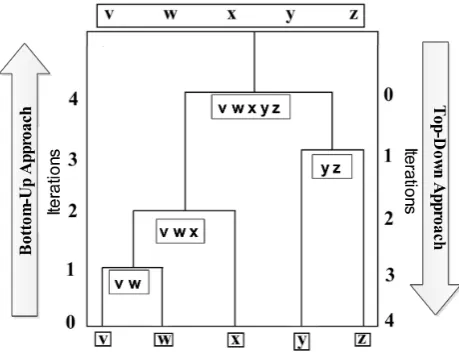
[image:23.595.203.433.434.611.2]Clustering techniques can be mainly divided into two categories: 1) partitional and 2) hierarchical. Partitional clustering makes flat partitions (or clusters) in the input data, while hierarchical clustering results in a tree like nested structure of clusters called “dendrogram”. The two main types of hierarchical clustering are divisive and agglomerative. The divisive approach starts by considering the whole data as one big cluster and then iteratively splits the clusters into two nested clusters in a top-down manner. Agglomerative hierarchical clustering (AHC) starts with singleton clusters and merges two most similar clusters at every step in a bottom-up manner as shown in Figure 1.1.
Figure 1.1: Hierarchical clustering approaches and dendrogram
Due to the ill-posed problem of clustering (Kashef & Kamel, 2010; Ghaemi
4
of algorithm), it may produce less authoritative results and vice versa. To improve clustering results many of the existing methods have been modified and improved (Chenet al., 2014; Wang & Su, 2011; Forestieret al., 2010; Kashef & Kamel, 2010). Some efforts have been made to improve the results by using prior information, e.g., user input and number of clusters, but this information is very difficult to obtain in advance (Ghaemiet al., 2009).
[image:24.595.112.529.458.532.2]Recently, combining the individual AHC (IAHC) algorithms in an ensemble fashion has gained the attention of the researchers to boost the clustering accuracy, known as Hierarchical Clustering Combination (HCC). This ensemble clustering is achieved by combining the dendrograms created by different IAHCs, to obtain a consensus result (Rashediet al., 2015; Zhenget al., 2014). Generally this combination has four phases as shown in Figure 1.2. In the first phase the IAHCs are applied to the input data to create dendrograms. Then the dendrograms are translated into an intermediate format (mostly in a matrix format calledDescription Matrix), so that they can be aggregated into a single intermediate format. Lastly a recovery tool is applied to recover a single consensus integrated dendrogram for the input data.
Figure 1.2: General framework of the HCC
5
a single feature and considering that feature as a distance value to make the clusters for final dendrogram. Therefore, in this research, a new improved HCC approach is proposed which is based on Euclidean space theory and is named as 4+NDES-HCC. This approach translate the dendrogram using four new features as vector dimensions in Euclidean space. The entity points in dendrograms are represented as vectors. Then, the corresponding vectors of two dendrograms are added using vector addition property to get the aggregated vector matrix. Then, Euclidean distance measure is applied to get the distance matrix. At the end a recovery tool is used such as IAHC to get the final consensus dendrogram which provides high authoritativeness.
1.2 Problem Statement
HCC has gain the attention of the researcher due to its promising results (Rashedi
6
Besides the aforementioned problem, this research also investigates the existing HCC approaches. As stated that HCC combines the dendrograms to create a single consensus dendrogram. Therefore, the dendrograms are translated into an intermediate format (mostly in a matrix format called Description Matrix), so that they can be aggregated into a single intermediate format for the recovery of final dendrogram. This research is also inspired by the problem that “descriptor matrices described by previous researchers (Rashedi et al., 2015; Mirzaei et al., 2008), allows to extract and utilize only the distances between two entities on the bases of a single type of relationship present between any two entity points in the dendrogram”. For example, CD descriptor (Mirzaei et al., 2008) uses the height level in a dendrogram as a distance (value) between two entity points. Hence this research came up with the idea to explore and extract features (dimensions) from the dendrograms to improve the clustering quality and introduce new HCC approach based on these features, namely 4+NDES-HCC.
1.3 Objectives
Based on the problem statement, following objectives are formulated:
1. To propose combined binary similarity measures that integrate the strengths of existing binary similarity measures thus reducing arbitrary decisions and increase the number of clusters which lead the IAHCs to improve the clustering quality in terms of authoritativeness, for software modularization;
2. To propose an improved hierarchical clustering combination approach based on Euclidean space and distance measure, namely 4+NDES-HHC 4 presents extracted number of features (dimensions) which can be extended to any number (N) usingEuclideanspace;
7
1.4 Scope
This research only focuses on software modularization through agglomerative hierarchical clustering approaches. This research analyzes the proposed and existing clustering approaches using open source (Weka, Mozilla, Junit, and iText) and proprietary industrial (DDA, FES, PEDS, PLC, PLP, and SAVT) software systems. To evaluate experimental results, MoJoFM (Wen & Tzerpos, 2004a) for authoritativeness and cluster to cluster are used as the external assessment criteria and for internal assessment, arbitrary decisions and number of clusters created by the clustering approach are used.
1.5 Dissertation Outline
This chapter gives the overview with motivation for software modularization using clustering techniques, problem statement and research objectives with the scope of this research. The remaining chapters are organized as follows:
• Chapter 2 provides an overview of clustering approach for software
modularization and a survey of literature. This chapter discusses the individual clustering algorithms used for software modularization and hierarchical clusterers combinations techniques. The review of comparative published literature and evaluation criteria is also discussed in this chapter.
• Chapter 3 presents the research methodology. In this chapter, a research
framework is proposed which shows how the research has been conducted. The proposed framework comprised of two phase. First phase presents the steps for analysis of existing binary similarity measures and introducing the new combined similarity measures. Second phase proposes the new HCC based approach, i.e., 4+NDES-HCC. Moreover, this chapter also explains the experimental setup.
• Chapter 4 analyzes the existing well known binary similarity measures for
8
Based on these strengths, this chapter proposes the combined binary similarity measures and discusses a small case study where the proposed measures perform better than the existing measures.
• Chapter 5presents the Euclidean space based HCC approach, named
4+NDES-HCC. To overcome the limitation of existing HCC approach, 4+NEDS-HCC extracts different features using Euclidean space from the dendrogram created by IAHCs/clusterers and then combine the features using vector addition property of Euclidean space. The distance between entities is calculated using Euclidean distance measure. To produce final consensus dendrogram an IAHC is used. • Chapter 6 presents and discusses the experimental results of combined and
existing binary similarity measures, and also presents the results for 4+NDES-HCC approach. The results for similarity measures are analyzed by formulating 19 research questions (as given in Chapter 3). Moreover, the results for 4+NDES-HCC are compared with CD-HCC and IAHC using evaluation criteria, e.g., number of clusters, cluster to cluster, and authoritativeness. To get insight of the results, this chapter gives the t-test to find the significance of the results of the proposed combined similarity measures and 4+NDES-HCC clustering approach. • Chapter 7concludes this dissertation with achieved objectives and contributions.
CHAPTER 2
LITERATURE REVIEW
2.1 Introduction
As discussed in the previous chapter, clustering techniques are widely used for the software modularization. Likewise, this chapter reviews the related works to the software modularization, clustering, HCC, and evaluation criteria used for analysis of the modularization results.
This chapter is organized as follows. Section 2.2 provides an overview of the software maintenance. Section 2.3 gives an overview of commonly used aspects of the software modularization using IAHCs. The overview of software modularization using IAHC is given in Section 2.4. Section 2.5 surveys the related literature of software modularization using IAHCs while Section 2.6 presents the survey of Non-IAHCs’ literature. Researchers have compared different techniques for software modularization, summary of these comparative literature is given in Section 2.7. Section 2.8 outlines the survey of existing HCC works. Works related to the evaluation of the software modularization results are presented in Section 2.9. The overall scenario which leads to over proposed research methodology is discussed in Section 2.10. Finally, this chapter is concluded by Section 2.11.
2.2 Software Maintenance
10
other attributes, or to adapt the product to a changed environment”. Knowledge of application domain, system’s architecture, algorithms used, past and new requirements, and experience on the execution of a particular software process is required for maintenance of the software systems (Chikofsky & Cross, 1990).
According to Huselius (2007), industries are facing major challenges of improving and maintaining the software systems due to the high expensive cost. It is estimated that 70% of the cost is spent on maintenance after softwares first release (Belle, 2004). Major changes are made in response to user requirements, data formats and hardware. According to Waters (2004), most researchers agree that 40 to 80 percent of software activities are focused on maintenance and evolution. However a recent study reported that a typical system’s maintenance costs up to 90% of the total project expenses (Bavotaet al., 2013). Due to the high cost of maintenance, researchers devoted their efforts to reduce the maintenance’s cost by introducing automated techniques. These techniques support the software maintenance regarding assembling and introducing the essential architectural information for better understanding, change and improvement of the software systems. Architectural information comprises of a software architecture (structures of the systems, e.g. module architecture), which plays a fundamental part to comprehend the software systems (Ducasse & Pollet, 2009).
11
software clustering can also be utilized for the accompanying purposes: 1) to improve the structure of software; 2) to present the higher level of abstraction of the software system; 3) to facilitate in presenting the different level of architectural views and 4) to arrange, outline and execute the changes in the source code furthermore predicts the effects of these predicts in the source code.
2.3 Aspects of Software Modularization using Clustering
Software clustering has three major aspects (Shtern & Tzerpos, 2012). First aspect is the software entities to cluster. These software entities can be variables, subprograms and files in case of structured systems (Koschke & Eisenbarth, 2000), while in case of object oriented systems classes can be considered as entities to cluster (Scanniello
et al., 2010a; Cai et al., 2009; Sindhgatta & Pooloth, 2007). In recent days the popularity of components based software development has introduced components or subsystems as entities because these subsystems are clustered into larger subsystems (Mitchell et al., 2002). Clustering entities also decide the level of clustering. If clustering entities are variables and subprograms, these can be combined into small clusters equivalent to classes and objects (Koschke & Eisenbarth, 2000). However, if clustering entities are classes and files then outcome of clustering process will be subsystems.
12
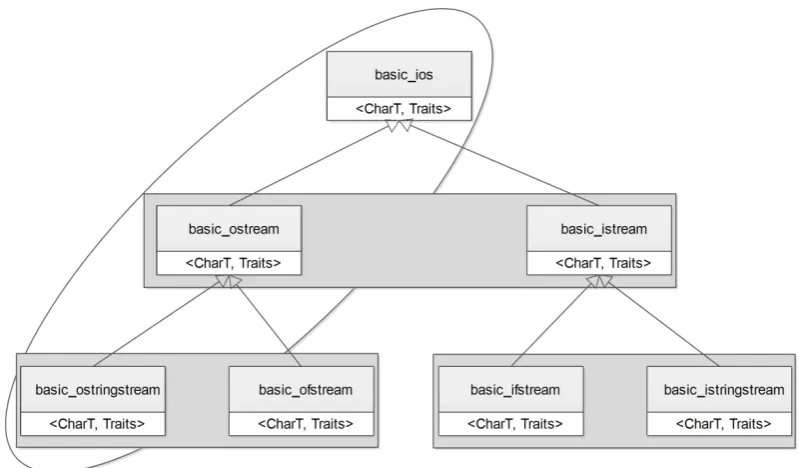
features are mostly function call, data accesses and code distribution in files (Koschke & Eisenbarth, 2000). A very good list of these relationships for object oriented systems is compiled by Bauer & Trifu (2004). This list includes inheritance coupling, aggregation coupling, association coupling, access coupling and indirect coupling. This list is extended by Muhammad et al.(2012) and extracted 26 features. Authors considered sixteen features as direct features and ten indirect features. A direct relationship between two entities (in this case classes) is known as a direct feature, for example, inheritance. Indirect is the common relationship that exists between two entities, for example, two classes accessing a library. To illustrate the direct and indirect relationship, consider the case in Figure 2.1 which demonstrates an example software system with various relations between classes. This example has taken from the online1 C++ reference documentation. All the classes available in the figure have inheritance relationships. Circle presents that all the entities have direct inheritance relationship while rectangles comprising entities show that these entities share/accessing a common entity. If direct inheritance relationships were to be considered, basic ios, basic ostream and basic ostringstream could be placed in one group. Despite the fact that this is a valuable view, another possibility is, basic ostringstream and basic ofstream have a common indirect relationship, i.e., accessing basic ostream, therefore could be placed in one group which presents an alternate however significant view of the system. Muhammad et al. (2012) reported that for software modularization indirect features produce better results.
Features may be in the binary or non-binary form. A binary feature represents the presence or absence of a relationship between two entities, while non-binary features are weighted features using different weighting schemes, for example, absolute and relative (Cui & Chae, 2011), to demonstrate the strength of the relationship between entities. Binary features are widely used in software modularization (Muhammadet al., 2012; Cui & Chae, 2011; Mitchell & Mancoridis, 2006; Wiggerts, 1997).
13
Figure 2.1: Direct and indirect relationships in a C++ input/output libraries1
clustering process. These techniques are in the form of algorithms and have various forms. Clustering techniques can be categorized as hierarchical clustering, optimization clustering, graph theoretical, and partitional clustering. Hierarchical clustering can take one of the two forms, divisive or agglomerative (Maqbool, 2006). In case of divisive algorithms, all entities are placed in one cluster initially and then partition process is performed until desired number of clusters is obtained. However, agglomerative clustering (i.e. IAHC) takes reverse approach and places all entities in their own clusters. So initially the number of entities is equal to the number of clusters. Then clusters are combined on the bases of similarity measures until the desired number of clusters is obtained. Optimization clustering algorithms use optimization techniques to maximize intra clustering similarity and minimize the inter cluster similarity. In case of graph theoretical algorithms, entities and their relationships are represented as graphs with nodes representing entities and edges as relationships.
14
however there are some advantages of using IAHC. For example, IAHC does not require prior information about the number of clusters. Moreover, Wiggerts (1997) stated that the process of IAHC is very similar to the approach of reverse engineering where architecture of a software system is recovered in a bottom-up fashion. IAHC provides different levels of abstraction and can be useful for the end user to select the desired number of clusters when the modularization results are meaningful to him (Lutellieret al., 2015). Since a maintainer may not have knowledge of the number of clusters in advance, therefore viewing the architecture at different abstraction levels facilitates understanding. Techniques have also been proposed to select an appropriate abstraction level, e.g., Chong et al. (2013) proposed a dendrogram cutting approach for this purpose.
2.4 Application of IAHC for Software Modularization
When IAHC is utilized for software modularization, the first step that occurs is the selection of entities to be clustered where each entity is described by different features. The steps are presented in more detail in the following subsections.
2.4.1 Selection of Entities and Features
Selecting the entities and features associated with entities depends on the type of software system and the desired architecture (e.g., layered/module architectures) to be recovered. For software modularization, researchers have used different types of entities, e.g. methods (Saeed et al., 2003), classes (Bauer & Trifu, 2004), and files (Andritsos & Tzerpos, 2005). Researchers have also used different types of features to describe the entities such as global variables used by an entity (Muhammad
15
as compared to other types (Naseem et al., 2013; Cui & Chae, 2011; Mitchell & Mancoridis, 2006).
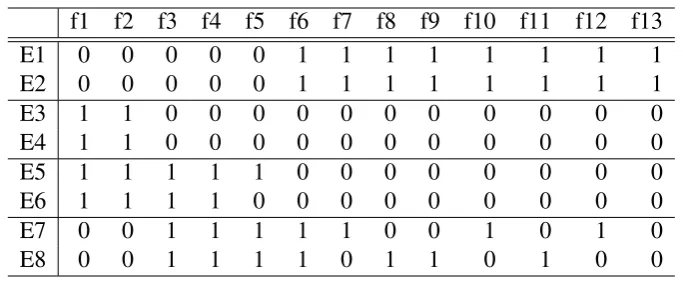
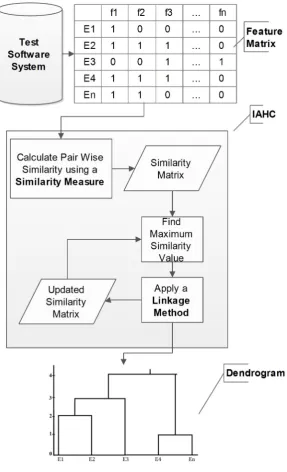
[image:35.595.148.490.379.521.2]To apply IAHC, a software system must be parsed to extract the selected entities and features associated with entities. This process results in a feature matrix of sizeN x P, whereNis the total number of entities andPis the total number of features. Each entity in the feature matrix has a feature vector fi = {f1, f2, f3, ..., fP}. More generally,Fpresents a general feature matrix which takes values from{0,1}p, in other words F = {0,1}p, where ‘1’ means presence of a feature and ‘0’ otherwise. IAHC takesFas input, as shown in Algorithm 1 (Figure 2.2 shows the process model). Table 2.1 shows an example 0-1 feature matrixF of a very small example software system, which contains 8 entities (E1 - E8) and 13 features (f1 - f13).
Table 2.1: An Example Feature Matrix
f1 f2 f3 f4 f5 f6 f7 f8 f9 f10 f11 f12 f13
E1 0 0 0 0 0 1 1 1 1 1 1 1 1
E2 0 0 0 0 0 1 1 1 1 1 1 1 1
E3 1 1 0 0 0 0 0 0 0 0 0 0 0
E4 1 1 0 0 0 0 0 0 0 0 0 0 0
E5 1 1 1 1 1 0 0 0 0 0 0 0 0
E6 1 1 1 1 0 0 0 0 0 0 0 0 0
E7 0 0 1 1 1 1 1 0 0 1 0 1 0
E8 0 0 1 1 1 1 0 1 1 0 1 0 0
Algorithm 1- Individual Agglomerative Hierarchical Clustering (IAHC) Algorithm
Input: Feature (F) matrix
Output: Hierarchy of Clusters (Dendrogram)
1: Create a similarity matrix by calculating similarity using aSimilarity Measurebetween each pair of entities
2: repeat
3: Group the most similar (singleton) clusters into one cluster (using maximum value of similarity in similarity matrix)
4: Update the similarity matrix by recalculating similarity using aLinkage Methodbetween newly formed cluster and existing (singleton) clusters
16
Figure 2.2: IAHC Approach
2.4.2 Selection of Similarity Measure
The first step of the IAHC process is to calculate the similarity between each pair of entities to obtain a similarity matrix by using a similarity measure, as shown in Step 1 of Algorithm 1. The well known binary similarity measures for software modularization (Cui & Chae, 2011; Naseem et al., 2013), are based on the following Definition 1:
17
∈F (F represents feature matrix, see Section 2.4.1). Let a be the number of features
common to both entities or pair of entities, b be the number of features present in Ei,
but not in Ej, c be the number of features present in Ej, but not in Ei, d be the number
of features absent in both entities (Lesot & Rifqi, 2009).
It is important to note thata+b+c+dis a constant value and is equal to the total number of features P. a + b = 0 only occurs when Ei has the feature vector fi = (0, ...,0). Likewise, a+c=0 shows that Ej has feature vector fj = (0, ...,0).
The binary similarity measures based on Definition 1, are as follows:
J accard(JC) = a
a+b+c (2.1)
J accardN M(JNM) = a
2(a+b+c) +d (2.2)
Russell&Rao(RR) = a
a+b+c+d (2.3)
where JC considers onlya, b,andcbetween entities. JNM considers all four quantities associated with the pair of entities (i.e.,a, b, c, andd) with double value ofa, b,andc
in denominator. While RR dividesaby total number of features.
Definition 2. A binary similarity measure, say SM, is a function whose domain is
{0,1}p, and whose range is
R+, i.e. SM :{0,1}p →R+ (Veal, 2011),
with the following properties:
• Positivity: SM(Ei,Ej)≥0,∀Ei, Ej∈F
• Symmetry: SM(Ei,Ej)=SM(Ej,Ei),∀Ei, Ej∈F
• Maximality: SM(Ei,Ei)≥SM(Ei,Ej),∀Ei, Ej∈F
18
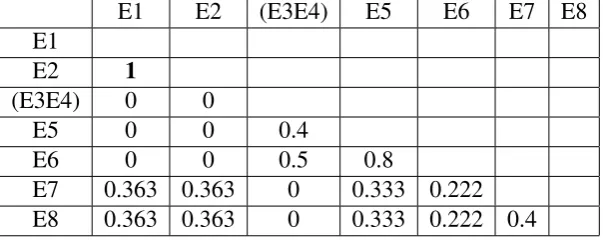
[image:38.595.174.465.261.398.2]In the first iteration of IAHC, Step 2 of Algorithm 1 searches for a maximum similarity value in Table 2.2 but it finds maximum similarity value ‘1’ which appears two times. Hence, there are two arbitrary decisions as (E1E2) has similarity value equal to 1, meanwhile (E3E4) also has the same similarity value. At this stage, IAHC may select either, but IAHC is explicitly forced to select the last value, i.e., similarity value of (E3E4), so (E3E4) cluster is made (see Table 2.3).
Table 2.2: Similarity Matrix of Table 2.1 using the JC Measure
E1 E2 E3 E4 E5 E6 E7 E8
E1
E2 1
E3 0 0
E4 0 0 1
E5 0 0 0.4 0.4
E6 0 0 0.5 0.5 0.8
E7 0.363 0.363 0 0 0.333 0.222 E8 0.363 0.363 0 0 0.333 0.222 0.4
Table 2.3: Iteration 1: Updated Similarity Matrix from Table 2.2 using the CL Method
E1 E2 (E3E4) E5 E6 E7 E8
E1
E2 1
(E3E4) 0 0
E5 0 0 0.4
E6 0 0 0.5 0.8
E7 0.363 0.363 0 0.333 0.222 E8 0.363 0.363 0 0.333 0.222 0.4
2.4.3 Selection of the Linkage Method
[image:38.595.169.471.486.607.2]19
Algorithm 2- Complete Linkage (CL) Method
Input: Similarity Matrix
Output: Updated Similarity Matrix
1: Update similarity matrix by calculating similarity between newly formed cluster and the existing entities or clusters. Let suppose three entities Ei, Ej and Ek and the newly formed cluster is EiEj. Now similarity between Ek and newly formed cluster Eij is calculated as:
CL(EiEj, Ek)= min(SM(Ei, Ek), SM(Ej, Ek))
Algorithm 3- Single Linkage (SL) Method
Input: Similarity Matrix
Output: Updated Similarity Matrix
1: Update similarity matrix by calculating similarity between newly formed cluster and the existing entities or clusters. Let suppose three entities Ei, Ej and Ek and the newly formed cluster is Eij. Now similarity between Ek and newly formed cluster EiEj is calculated as: SL(EiEj, Ek)= max(SM(Ei, Ek), SM(Ej, Ek))
In the illustrative example, the similarity values are updated between a new cluster (E3E4) and existing singleton clusters using CL method as shown in Table 2.3. For example, the CL method returns the minimum value between the similarity value of E3 and E1 (0) and the similarity value of E4 and E1 (0). Both of the returned values are the same (if there was a minimum, that would be selected), therefore, IAHC selects this similarity value as the new similarity between (E3E4) and E1. Similarly, all similarity values are updated between (E3E4) and the remaining entities.
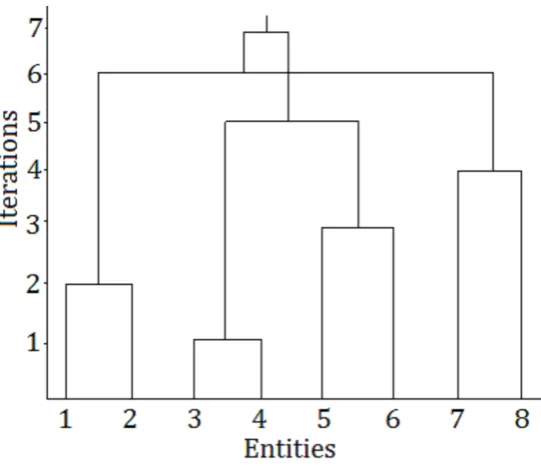
IAHC repeats Steps 2 and 3 until all entities are merged in one large cluster, or the desired number of clusters is obtained. At the end IAHC results in a hierarchy of clusters, also known as dendrogram, which is shown for the current example in Figure 2.3. The obtained hierarchy is then evaluated to assess the quality of the automatically formed clusters, and the performance of IAHCs.
This section illustrated how IAHC is used for software modularization. While, next section gives the literature review of IAHC approaches used for software modularization.
Algorithm 4- Weighted Average Linkage (WL) Method
Input: Similarity Matrix
Output: Updated Similarity Matrix
20
Figure 2.3: Dendrogram
2.5 Software Modularization using IAHCs
In order to better understand and to get more insight of the included literatures, this section lists the literature according to chronological order. A summary of all the literatures is presented in a tabular form in Table 2.4.
Davey & Burd (2000) evaluated the IAHCs for software modularization. Authors assessed four IAHCs, i.e., Complete linkage (CL), Single Linkage (SL), Weighted Average Linkage (WL), and Unweighted Average Linkage (UWL), and four similarity measures, i.e., Jaccard (JC), Sorensen Dice (SD), Canberra and Correlation coefficient. Procedures were selected as entities and three features were used: global, user defined types, calls, and combination of all the three. Experiments on three proprietary systems revealed that the CL with JC and SD measures create high quality results in terms of precision and recall with large number of small size clusters. All features produce better results as compared to individual category of features.
21
point 75 (SL75) performed better while CL with cut point 90 (CL90) performed worst. Increasing the cut point height resulted in decreasing the stability, while in case of SL increasing cut point resulted in increasing stability.
Clustering the software entities in a module may increase or decrease the collective information of the module. Based on the given assumption, Andritsos & Tzerpos (2003) proposed a new measure, called Information Loss (IL). IL tries to minimize the loss of information between any two entities while making a new cluster. Agglomerative Information Bottleneck (AIB) (Slonim & Tishby, 2000) has been improved to reduce the time complexity and scaLable InforMation BOttleneck (LIMBO) algorithm was introduced for clustering. To evaluate the applicability of LIMBO using IL, the algorithm was applied to two large size test systems i.e. TOBEY and Linux. LIMBO was compared to ACDC (Tzerpos & Holt, 2000a), Bunch (Mancoridiset al., 1999) and IAHCs algorithms (i.e., CL, SL, WL, and UWL). LIMBO performed better using MoJo as assessment criterion. However, LIMBO based on the non-binary features.
22
CL performs better in terms of cohesion while SL performs poorly.
Combined algorithm, a new software clustering algorithm was proposed in (Saeed et al., 2003). This algorithm updates the binary feature vector of a newly formed cluster by taking OR between the two feature vectors of entities making that new cluster. JC similarity measure was used to calculate the similarity between two entities. Authors conducted experiments using Xfig test system and concluded that the cut point of precision and recall for combined algorithm was high as compared to the CL algorithm. The number of clusters produced by the JC was also compared with the SD, Correlation, and Simple measures using CL algorithm. JC and SD produced same results while correlation was very similar to JC. Authors also provided the justification for JC and SD measures, that they are most intuitive for software clustering.
Lunget al.(2004) demonstrated the use of classical clustering techniques and shared the experiences while applying the techniques to software clustering, software restructuring, and maximizing cohesion, and minimizing coupling. Authors added some concluding remarks, including: reverse engineering tools may not create an accurate and complete design and utilities are difficult to deal with, some clusters may contain a very small number of entities or utility entities, cluster analysis may create unexpected results, and finally that techniques are sensitive to the input data therefore more information should be extracted to reach consistent results.
Combined algorithm (Saeed et al., 2003) does not account for access information of a feature by an entity in a cluster. Maqbool & Babri (2004) overcome this limitation by introducing a new algorithm, called Weighted Combined Algorithm (WCA), which keeps information of each entity in a cluster that uses a certain feature. To calculate association between two entities, authors used Unbiased Ellenberg and Gleason similarity measures. The experiments were performed on Xfig test system. Number of clusters and Precision/recall were the evaluation criteria. CL using JC measure, Combined algorithm using JC measure and WCA using Unbiased Ellenberg measure created similar results in terms of number of clusters. The precision/recall crossover heights were found better for Weighted Combined algorithm.
23
(LIMBO) algorithm based on Information Loss (IL) measure. IL measure finds the entropy of two entities while making a new cluster. The algorithm was tested on 3 large sized test systems. LIMBO was compared with ACDC, Bunch (Nearest hill-climbing (NAHC), and steepest-ascend hill-climbing (SAHC)) and IAHC algorithms using MoJo distance metric. LIMBO performed well, if not better than other algorithms. LIMBO has also the added benefit to incorporate the non-structural features of the test systems. Weights can also be assigned using different methods like Mutual Information (MI), Linear Dynamical Systems (LDS), TF.IDF, PageRank and Dynamic Usage. TF.IDF, MI, and Inverse PageRank weighting schemes performed better than others.
Xia & Tzerpos (2005) explored dynamic dependencies between entities as relationships for software clustering. Authors extracted static and dynamic relationships of Mozilla test system and clustered the entities using ACDC, Bunch and IAHC algorithms. Experimental results using MoJoFM revealed that dynamic relationships perform worse than static. However, dynamic relationships can provide a good understanding of the system.
Wu et al. (2005) compared the clustering algorithms ACDC, Bunch, CL75, CL90, SL75 and SL90. Stability, authoritativeness and extremity of cluster were the evaluation criteria. According to the stability criterion SL75, SL90 and ACDC were ranked as high quality, CL75 and CL90 ranked medium and Bunch was ranked low. On the authoritativeness criterion, all algorithms were ranked low, however, CL performed better and Bunch performed worse. On the basis of extremity (non extreme clusters) Bunch was ranked highest, CL90 ranked medium, and CL75, ACDC, SL75 and SL90 ranked as low.
24
results in clustering stability. They concluded that LIMBO using information loss measure and WCA using unbiased Ellenberg measure performed better in terms of precision and recall and suggested to use LIMBO if utilities are placed in a single cluster.
Patel et al. (2009) proposed a novel cascaded two phase software clustering technique that integrates static and dynamic analysis of the source code. First phase constructs the core skeleton decomposition using dynamic analysis of the system. In this phase IAHC-CL with JC similarity measure is used to cluster the entities. In the second phase, the remaining entities are clustered using their static dependencies with existing clusters, with the help of the orphan adoption algorithm in (Tzerpos & Holt, 2000a). A case study using Weka as a test system was conducted which showed the usefulness of the proposed technique in terms of MoJoFM.
Muhammad et al. (2010) evaluated eighteen different types of relationships (features) between classes for object oriented software systems. They divided these relationships into direct and indirect types. For example, inheritance between two classes is a direct relationship, but any two child classes extending a parent class represents an indirect relationship between child classes. For clustering the well-known IAHC algorithms were used, that is, CL, WL, and UWL. The objective function was taken to be the count of common relationships between classes. Relationships were evaluated using MoJoFM, on three different industrial software systems. From experimental results, authors concluded that indirect relationships provided better results as compared to direct and the combination of direct and indirect relationships.
Naseem et al. (2010) identified some feature vector cases where the JC similarity measure produced unexpected results. Authors highlighted two feature vector cases to show the deficiency in JC measure and proposed a new similarity measure to solve the problem, called Jaccard-NM (JNM). The new measure was evaluated on three industrial software systems using MoJoFM as assessment criterion. Experimental results revealed the better performance of the JNM over JC measure.
REFERENCES
Abebe, S. L., Haiduc, S., Marcus, A., Tonella, P., & Antoniol, G. (2009). Analyzing the Evolution of the Source Code Vocabulary. In2009 13th European Conference on Software Maintenance and Reengineering. IEEE. pp. 189–198.
Abi-Antoun, M., Ammar, N., & Hailat, Z. (2012). Extraction of ownership object graphs from object-oriented code. In Proceedings of the 8th international ACM SIGSOFT conference on Quality of Software Architectures - QoSA ’12. New York, New York, USA: ACM Press. p. 133.
Altman, D. G. (1997). Practical Statistics for Medical Research. (Chapman & Hall/CRC Texts in Statistical Science).
Andreopoulos, B., & Tzerpos, V. (2005). Multiple Layer Clustering of Large Software Systems. In12th Working Conference on Reverse Engineering. IEEE. pp. 79– 88.
Andritsos, P., & Tzerpos, V. (2003). Software clustering based on information loss minimization. In 10th Working Conference on Reverse Engineering. IEEE. pp. 334–344.
Andritsos, P., & Tzerpos, V. (2005). Information-theoretic software clustering. IEEE Transactions on Software Engineering,31(2), 150–165.
Anquetil, N., & Lethbridge, T. C. (2003). Comparative study of clustering algorithms and abstract representations for software remodularisation. IEE Proceedings-Software,150(3), 185—-201.
Antonellis, P., Antoniou, D., Kanellopoulos, Y., Makris, C., Theodoridis, E., Tjortjis, C., & Tsirakis, N. (2009). Clustering for Monitoring Software Systems Maintainability Evolution. Electronic Notes in Theoretical Computer Science,
144
Avogadri, R., & Valentini, G. (2009). Fuzzy ensemble clustering based on random projections for DNA microarray data analysis. Artificial Intelligence in Medicine,45(2-3), 173–183.
Barros, M. d. O. (2014). An experimental evaluation of the importance of randomness in hill climbing searches applied to software engineering problems. Empirical Software Engineering,19(5), 1423–1465.
Bauer, M., & Trifu, M. (2004). Architecture-aware adaptive clustering of OO systems.
Eighth European Conference on Software Maintenance and Reengineering,
2004. CSMR 2004. Proceedings., pp. 3–14.
Bavota, G., De Lucia, A., Marcus, A., & Oliveto, R. (2013). Using structural and semantic measures to improve software modularization. Empirical Software Engineering,18(5), 901–932.
Bavota, G., Di Penta, M., & Oliveto, R. (2014). Search Based Software Maintenance: Methods and Tools. InEvolving Software Systems, vol. 1, chap. 4, pp. 103– 137. Italy: Springer, 1st ed.
Beck, F., & Diehl, S. (2010). Evaluating the Impact of Software Evolution on Software Clustering. In2010 17th Working Conference on Reverse Engineering. IEEE. pp. 99–108.
Beck, F., & Diehl, S. (2013). On the impact of software evolution on software clustering. Empirical Software Engineering,18(5), 970–1004.
Belle, T. B. V. (2004). Modularity and the Evolution of Software Evolvability.. Ph.D. thesis, University of New Mexico.
Bittencourt, R. A., & Guerrero, D. D. S. (2009). Comparison of Graph Clustering Algorithms for Recovering Software Architecture Module Views. In 2009 13th European Conference on Software Maintenance and Reengineering. IEEE. pp. 251–254.
Burd, E., & Munro, M. (2000). Supporting program comprehension using dominance trees. Annals of Software Engineering,9(1-2), 193–213.
145
on Computer Science and Information Technology, pp. 98–103.
Campos, R., Dias, G., Jorge, A. M., & Jatowt, A. (2014). Survey of Temporal Information Retrieval and Related Applications. ACM Computing Surveys,
47(2), 1–41.
Ceccato, M., Marin, M., Mens, K., Moonen, L., Tonella, P., & Tourw´e, T. (2006). Applying and combining three different aspect Mining Techniques. Software Quality Journal,14(3), 209–231.
Chardigny, S., Seriai, A., Oussalah, M., & Tamzalit, D. (2008). Search-Based Extraction of Component-Based Architecture from Object-Oriented Systems. In R. Morrison, D. Balasubramaniam, & K. Falkner (Eds.) Software Architecture SE - 28, vol. 5292 of Lecture Notes in Computer Science, pp. 322–325. Springer Berlin Heidelberg.
Chen, Y., Sanghavi, S., & Xu, H. (2014). Improved Graph Clustering. IEEE Transactions on Information Theory,60(10), 6440–6455.
Chen, Y.-F. R., Gansner, E. R., & Koutsofios, E. (1997). A C++ data model supporting reachability analysis and dead code detection. ACM SIGSOFT Software Engineering Notes,22(6), 414–431.
Chikofsky, E., & Cross, J. (1990). Reverse engineering and design recovery: a taxonomy. IEEE Software,7(1), 13–17.
Chong, C. Y., & Lee, S. P. (2015). Constrained Agglomerative Hierarchical Software Clustering with Hard and Soft Constraints. In International Conference on Evaluation of Novel Approaches to Software Engineering (ENASE). Malaysia: IEEE. pp. 177 – 188.
Chong, C. Y., Lee, S. P., & Ling, T. C. (2013). Efficient software clustering technique using an adaptive and preventive dendrogram cutting approach. Information and Software Technology (IST),55(11), 1994–2012.
Corazza, A., Di Martino, S., & Scanniello, G. (2010). A Probabilistic Based Approach towards Software System Clustering. In2010 14th European Conference on Software Maintenance and Reengineering. IEEE. pp. 88–96.
146
Use of Lexical Information for Software System Clustering. In European Conference on Software Maintenance and Reengineering (CSMR). IEEE. pp. 35–44.
Cornelissen, B., Zaidman, A., van Deursen, A., Moonen, L., & Koschke, R. (2009). A Systematic Survey of Program Comprehension through Dynamic Analysis.
IEEE Transactions on Software Engineering,35(5), 684–702.
Cui, J. F., & Chae, H. S. (2011). Applying agglomerative hierarchical clustering algorithms to component identification for legacy systems. Information and Software Technology (IST),53(6), 601–614.
Davey, J., & Burd, E. (2000). Evaluating the suitability of data clustering for software remodularisation. InWorking Conference on Reverse Engineering. IEEE. pp. 268–276.
Dayani-fard, H., Yu, Y., & Mylopoulos, J. (2005). Improving the Build Architecture of Legacy C / C ++ Software Systems. InFundamental Approaches to Software Engineering, pp. 96–110.
De Lucia, A., Deufemia, V., Gravino, C., & Risi, M. (2007). A Two Phase Approach to Design Pattern Recovery. In 11th European Conference on Software Maintenance and Reengineering. IEEE. pp. 297–306.
Ducasse, S., & Pollet, D. (2009). Software Architecture Reconstruction: A Process-Oriented Taxonomy.IEEE Transactions on Software Engineering,35(4), 573– 591.
Dugerdil, P., & Jossi, S. (2009). Reverse-Architecting Legacy Software Based on Roles : An Industrial Experiment. InSoftware and Data Technologies, pp. 114–127. Springer.
El-Ramly, M., Iglinski, P., Stroulia, E., Sorenson, P., & Matichuk, B. (2001). Modeling the system-user dialog using interaction traces. InReverse Engineering, 2001. Proceedings. Eighth Working Conference on. pp. 208–217.
147
Erdemir, U., Tekin, U., & Buzluca, F. (2011). Object Oriented Software Clustering Based on Community Structure. In Asia-Pacific Software Engineering Conference (APSEC). IEEE. pp. 315–321.
Faceli, K., de Carvalho, A. C. P. L. F., & de Souto, M. C. P. (2007). Multi-Objective Clustering Ensemble with Prior Knowledge. InAdvances in Bioinformatics and Computational Biology, pp. 34–45.
Forestier, G., Ganc¸arski, P., & Wemmert, C. (2010). Collaborative clustering with background knowledge. Data & Knowledge Engineering,69(2), 211–228. Franc¸ois-Joseph Lapointe, P. L. (1995). Comparison tests for dendrograms: A
comparative evaluation. Journal of Classification,12(2), 265–282.
Gansner, E. R., Koutsofios, E., North, S., & Vo, K.-P. (1993). A technique for drawing directed graphs.IEEE Transactions on Software Engineering,19(3), 214–230. Garcia, J., Ivkovic, I., & Medvidovic, N. (2013). A comparative analysis of software architecture recovery techniques. InIEEE/ACM International Conference on Automated Software Engineering (ASE). IEEE. pp. 486–496.
Garcia, J., Popescu, D., Mattmann, C., & Medvidovic, N. (2011). Enhancing architectural recovery using concerns. In2011 26th IEEE/ACM International Conference on Automated Software Engineering (ASE 2011). IEEE. pp. 552– 555.
Garlan, D. (2000). Software architecture. In Proceedings of the conference on The future of Software engineering. New York, New York, USA: ACM Press. pp. 91–101.
Ghaemi, R., Sulaiman, M. N., Ibrahim, H., & Mustapha, N. (2009). A survey: clustering ensembles techniques.World Academy of Science, Engineering and Technology,2009(1), 636—-645.
Ghosh, J., & Acharya, A. (2011). Cluster ensembles. Wiley Interdisciplinary Reviews: Data Mining and Knowledge Discovery,1(4), 305–315.
148
Glorie, M., Zaidman, A., van Deursen, A., & Hofland, L. (2009). Splitting a large software repository for easing future software evolution-an industrial experience report. Journal of Software Maintenance and Evolution: Research and Practice,21(2), 113–141.
Gong, M., Liang, Y., Shi, J., Ma, W., & Ma, J. (2013). Fuzzy C-Means Clustering With Local Information and Kernel Metric for Image Segmentation. IEEE Transactions on Image Processing,22(2), 573–584.
Gueheneuc, Y.-G., & Antoniol, G. (2008). DeMIMA: A Multilayered Approach for Design Pattern Identification. IEEE Transactions on Software Engineering,
34(5), 667–684.
Gunqun, Q., Lin, Z., & Li, Z. (2008). Applying Complex Network Method to Software Clustering. In2008 International Conference on Computer Science and Software Engineering. IEEE. pp. 310–316.
Gutierrez, C. I. (1998). Integration Analysis of Product Architecture to Support Effective Team Co-location. Ph.D. thesis, Massachusetts Institute of Technology.
Hall, M., Walkinshaw, N., & McMinn, P. (2012). Supervised software modularisation. In IEEE International Conference on Software Maintenance (ICSM). IEEE. pp. 472–481.
Hamdouni, A.-e. E., Seriai, A. D., & Huchard, M. (2010). Component-based Architecture Recovery from Object Oriented Systems via Relational Concept Analysis. In 7th International Conference on Concept Lattices and Their Applications. pp. 259–270.
Han, Z., Wang, L., Yu, L., Chen, X., Zhao, J., & Li, X. (2009). Design pattern directed clustering for understanding open source code. 2009 IEEE 17th International Conference on Program Comprehension, pp. 295–296.
Handrakanth, C. P. (2012). Software Module Clustering using Single and Multi-Objective Approaches. International Journal of Advanced Research in Computer Engineering & Technology,1(10), 86–90.
149
two module clustering fitness functions. InProceedings of the 2005 conference on Genetic and evolutionary computation. New York, New York, USA: ACM Press. p. 1029.
Hartigan, J. A., & Wong, M. A. (1979). A K-Means Clustering Algorithm. Journal of the Royal Statistical Society. Series C (Applied Statistics),28(1), 100–108. Hoffman, K. (2013). Analysis in Euclidean space. Courier Corporation.
Huselius, J. G. (2007). Reverse Engineering of Real-Time Legacy Systems-An Automated Approach Based on Execution-Time Recording. Phd, M¨alardalen University Press.
Hussain, I., Khanum, A., Abbasi, A. Q., & Javed, M. Y. (2015). A Novel Approach for Software Architecture Recovery Using Particle Swarm Optimization. The International Arab Journal of Information Technology,12(1), 1–10.
Ibrahim, A., Rayside, D., & Kashef, R. (2014). Cooperative based software clustering on dependency graphs. InCanadian Conference on Electrical and Computer Engineering (CCECE). Canada: IEEE. pp. 1–6.
Jahnke, J. (2004). Reverse engineering software architecture using rough clusters. In
IEEE Annual Meeting of the Fuzzy Information. Ieee. pp. 4–9 Vol.1.
Janssens, F., Gl¨anzel, W., & De Moor, B. (2007). Dynamic hybrid clustering of bioinformatics by incorporating text mining and citation analysis. In Proceedings of the 13th ACM SIGKDD international conference on Knowledge discovery and data mining - KDD ’07. New York, New York, USA: ACM Press. p. 360.
Johnson, S. C. (1967). Hierarchical clustering schemes. Psychometrika, 32(3), 241– 254.
Kanellopoulos, Y., Antonellis, P., Tjortjis, C., & Makris, C. (2007). k-Attractors: A Clustering Algorithm for Software Measurement Data Analysis. In19th IEEE International Conference on Tools with Artificial Intelligence(ICTAI 2007). IEEE. pp. 358–365.
150
Kashef, R. F., & Kamel, M. S. (2010). Cooperative clustering. Pattern Recognition,
43(6), 2315–2329.
Kienle, H. M., & M¨uller, H. A. (2010). RigiAn environment for software reverse engineering, exploration, visualization, and redocumentation. Science of Computer Programming,75(4), 247–263.
Kirkpatrick, S., Gelatt, C. D., & Vecchi, M. P. (1983). Optimization by simulated annealing. Science (New York, N.Y.),220(4598), 671–80.
Kobayashi, K., Kamimura, M., Kato, K., Yano, K., & Matsuo, A. (2012). Feature-gathering dependency-based software clustering using Dedication and Modularity. In IEEE International Conference on Software Maintenance (ICSM). IEEE. pp. 462–471.
Koschke, R., & Eisenbarth, T. (2000). A framework for experimental evaluation of clustering techniques. InInternational Workshop on Program Comprehension. IEEE Comput. Soc. pp. 201–210.
Krishnamurthy, B. (1995). Practical reusable UNIX software. Wiley.
Kuhn, A., Ducasse, S., & Gˆırba, T. (2007). Semantic clustering: Identifying topics in source code. Information and Software Technology,49(3), 230–243.
Kumari, A. C., Srinivas, K., & Gupta, M. P. (2013). Software module clustering using a hyper-heuristic based multi-objective genetic algorithm. In IEEE International Advance Computing Conference (IACC). India: IEEE. pp. 813– 818.
Lakhotia, A. (1997). A unified framework for expressing software subsystem classification techniques. Journal of Systems and Software,36(3), 211–231. Langfelder, P., Zhang, B., & Horvath, S. (2008). Defining clusters from a hierarchical
cluster tree: the Dynamic Tree Cut package for R. Bioinformatics (Oxford, England),24(5), 719–20.
Lesot, M.-J., & Rifqi, M. (2009). Similarity measures for binary and numerical data : a survey. Int. J. Knowledge Engineering and Soft Data Paradigms,1(1). Liao, S.-H., Chu, P.-H., & Hsiao, P.-Y. (2012). Data mining techniques and
151
Applications,39(12), 11303–11311.
Lundberg, J., & L¨owe, W. (2003). Architecture Recovery by Semi-Automatic Component Identification. Electronic Notes in Theoretical Computer Science,
82(5), 98–114.
Lung, C.-H., Zaman, M., & Nandi, A. (2004). Applications of clustering techniques to software partitioning, recovery and restructuring. Journal of Systems and Software,73(2), 227–244.
Lutellier, T., Chollak, D., Garcia, J., Tan, L., Rayside, D., Medvidovic, N., & Kroeger, R. (2015). Comparing Software Architecture Recovery Techniques Using Accurate Dependencies. InIEEE International Conference on Software Engineering (ICSE), vol. vol.2. USA, Canada: IEEE, ACM. pp. 69–78. Mahmoud, A., & Niu, N. (2013). Evaluating software clustering algorithms in the
context of program comprehension. InInternational Conference on Program Comprehension (ICPC). USA: IEEE. pp. 162–171.
Mancoridis, S., Mitchell, B. S., Chen, Y., & Gansner, E. R. (1999). Bunch: a clustering tool for the recovery and maintenance of software system structures. In
International Conference on Software Maintenance. IEEE. pp. 50–59.
Mancoridis, S., Mitchell, B. S., Rorres, C., Chen, Y., & Gansner, E. R. (1998). Using automatic clustering to produce high-level system organizations of source code. InInternational Workshop on Program Comprehension. IEEE. pp. 45– 52.
Maqbool, O., & Babri, H. (2004). The weighted combined algorithm: a linkage algorithm for software clustering. InEighth European Conference on Software Maintenance and Reengineering. IEEE. pp. 15–24.
Maqbool, O., & Babri, H. (2007a). Bayesian Learning for Software Architecture Recovery. In2007 International Conference on Electrical Engineering. IEEE. pp. 1–6.
152
Maqbool, O., Babri, H., Karim, A., & Sarwar, S. (2005). Metarule-guided association rule mining for program understanding. IEE Proceedings,152(6), 281–296. Medvidovic, N., & Taylor, R. N. (2010). Software architecture: foundations, theory,
and practice. InProceedings of the 32nd ACM/IEEE International Conference on Software Engineering, vol. 2. New York, New York, USA: ACM Press. p. 471.
Mirzaei, A., & Rahmati, M. (2010). A Novel Hierarchical-Clustering-Combination Scheme Based on Fuzzy-Similarity Relations. IEEE Transaction on Fuzzy Systems,18(1), 27–39.
Mirzaei, A., Rahmati, M., & Ahmadi, M. (2008). A new method for hierarchical clustering combination. Intelligent Data Analysis,12, 549–571.
Mitchell, B. S. (2003). A heuristic approach to solving the software clustering problem. International Conference on Software Maintenance, 2003. ICSM 2003. Proceedings., pp. 285–288.
Mitchell, B. S. (2006). Clustering Software Systems to Identify Subsystem Structures. Tech. rep.
Mitchell, B. S., & Mancoridis, S. (1998). Clustering Module Dependency Graphs of Software Systems Using the Bunch Tool. Tech. rep.
Mitchell, B. S., & Mancoridis, S. (2001). Comparing the decompositions produced by software clustering algorithms using similarity measurements. In
International Conference on Software Maintenance. IEEE. pp. 744–753. Mitchell, B. S., & Mancoridis, S. (2002). Using Heuristic Search Techniques to Extract
Design Abstractions from Source Code. In Proceedings of the Genetic and Evolutionary Computation Conference, vol. 2. pp. 1375—-1382.
153
in Computer Science, pp. 2499–2510. Springer Berlin Heidelberg.
Mitchell, B. S., & Mancoridis, S. (2006). On the automatic modularization of software systems using the Bunch tool. IEEE Transactions on Software Engineering,
32(3), 193–208.
Mitchell, B. S., Mancoridis, S., & Traverso, M. (2002). Search based reverse engineering. InProceedings of the 14th international conference on Software engineering and knowledge engineering. New York, New York, USA: ACM Press. p. 431.
Morokoff, W. J., & Caflisch, R. E. (1994). Quasi-Random Sequences and Their Discrepancies. SIAM Journal on Scientific Computing,15(6), 1251–1279. Muhammad, S., Maqbool, O., & Abbasi, A. Q. (2010). Role of relationships during
clustering of object-oriented software systems. In 2010 6th International Conference on Emerging Technologies (ICET). IEEE. pp. 270–275.
Muhammad, S., Maqbool, O., & Abbasi, A. Q. (2012). Evaluating relationship categories for clustering object-oriented software systems.IET Software,6(3), 260.
Murphy, G., & Notkin, D. (1997). Reengineering with reflexion models: a case study.
Computer,30(8), 29–36.
Murphy, G., Notkin, D., & Sullivan, K. (2001). Software reflexion models: bridging the gap between design and implementation. IEEE Transactions on Software Engineering,27(4), 364–380.
Murtagh, F. (1983). A Survey of Recent Advances in Hierarchical Clustering Algorithms. The Computer Journal,26(4), 354–359.
Naseem, R., Maqbool, O., & Muhammad, S. (2010). An Improved Similarity Measure for Binary Features in Software Clustering. In 2010 Second International Conference on Computational Intelligence, Modelling and Simulation. IEEE. pp. 111–116.