SIMULATION OF VORTEX INDUCED VIBRATION OF A BLUFF BODY STRUCTURE
SITI NATASHA BINTI MALIK FESAL
A thesis submitted in fulfillment of the requirement for the award of the Master of Mechanical Engineering
Faculty of Mechanical and Manufacturing Engineering Universiti Tun Hussein Onn Malaysia
v
ABSTRACT
ABSTRAK
vii
CONTENTS
TITLE i
DECLARATION ii
DEDICATION iii ACKNOWLEDGEMENT iv
ABSTRACT v
ABSTRAK vi TABLE OF CONTENT vii LIST OF FIGURES x
LIST OF TABLES xiii
LIST OF SYMBOL AND ABBREVIATION xiv
LIST OF APPENDICES xv
CHAPTER 1 INTRODUCTION 1
1.1 Research Background 7
1.2 Problem Statement 9
1.3 Objective of Study 10
1.4 Research Scope 4
1.5 Significant of Study 11
CHAPTER 2 LITERATURE REVIEW 7
2.1 VIV phenomenon. 8
2.2 VIV Force Direction 9
2.3 Flow around Cylinder Structure 10
2.4 Vortex Shedding 12
2.4.1 Von Kármán Vortex Street 13
2.5 Drag Force and Lift Force 16
2.6 Strouhal Number 18
2.7 VIV Equation 19
Cylindrical Structure
2.9 Reynolds Number, Re 24
2.10 Navier Stokes Equation 27
2.11 Computational Fluid Dynamics (CFD) 28
2.12 Turbulence model 30
2:13 Turbulence modeling 32
CHAPTER 3 METHODOLOGY 32
3.1 Research Flow Chart 33
3.2 Problem Set-Up 35
3.3 Numerical Modelling 36
3.3.1 Domain Modelling 36
3.3.2 Meshing 38
3.3.3 Solver Setting 39
3.3.4 Material Properties 40
3.3.5 Boundary Condition 41
3.3.4 Dynamic Mesh parameters and 43 Zones
3.3.5 Solution Control 44
3.3.6 Monitoring Output 45
3.3.7 Determining the Cylinder Area 45
3.3.8 Iterate 46
CHAPTER 4 RESULTS AND DISCUSSION 45
4.1 Analysis on Flow around Circular Cylinder 46 4.1.1 Comparison with Others Work 48
Towards The Fluid Flow
4.2 VIV of Cylinder With One Degree of Freedom 49 4.2.1 The Effect of Frequency towards 50
The Fluid Flow
4.2.2 Effect of Amplitude towards 51
The Fluid Flow
4.23 Effect of Pressure Distribution 54 Towards The Fluid Flow
ix
CHAPTER 5 CONCLUSION AND RECOMMENDATIONS 611
5.1 Conclusion 610
5.2 Recommendations 63
REFERENCES 65
LIST OF FIGURES
2.1 Velocity Vector Plot Depicting VIV 8
2.2 Force direction on the model 9
2.3 Flow around circular cylinder 11
2.4 Sketch of the physical uniform flow and 13
2.5 Von Kármán Vortex Street at increasing 14
2.6 Von Kármán Vortex streets forming in the wake 15
2.7 Kármán “vortex street” behind the circular cylinder 16 2.8 Vibrations of forces acting around a circular cylinder 17
submitted to vortex shedding.
2.9 Strouhal number as a function of Reynolds number for 18 2.10 Effect of Reynolds number on Strouhal number for 19
2.11 One Dimension Spring-Pot System 19
2.12 Definition sketch of vortex-induced vibrations 22
2.13 Frequency response against reduced velocity 23
2.14 Fingers of Dye, filament-line sketch of the vortex 25
2.15 Schematic view of the CFD 29
3.1 Project flow chart 33
3.2 CFD workflow 34
3.3 General Problem Set Up 35
3.4 Geometry Process created in ANSYS Fluent Design Modeller 37
3.5 Computational geometry and boundary condition 37
3.6 Meshing of circular bluff body 38
3.7 An unstructured triangular mesh around a circular cylinder 39
3.8 Display Panel for Solver Setting. 40
3.9 Label of boundary types 41
xi
3.11 Solution methods and controls panel 44
4.1 Time histories of the drag and lift coefficients for Re =10000 46
4.2 Contour of velocity magnitude at Re = 10 000 48
4.3 Contour of vorticity velocity at Re = 10 000 48
4.4 Mean drag coefficient as function of reduced velocity. 50 4.5 Lift Coefficient as a function of reduced velocity Error! Bookmark not
defined.
4.6 Mean drag coefficient for different forcing amplitudes 52 4.7 RMS lift fluctuations for different forcing amplitudes 53 4.8 Maximum vertex area velocity magnitude surface on the 54 4.9 Pressure coefficient distribution around circular (Re = 10 000) 55 4.10 Pressure coefficient distribution in Cross flow direction 56
And sequence of cross flow periodic motion
4.11 Pressure coefficient distribution in Inline flow direction 577 And sequence of inline flow periodic motion
4.12 Vortex Pattern For Rigid Cylinder 588
4.13 Vortex Pattern Comparison Cross Flow Direction 59
4.14 Formation of 2S Mode in the initial branch 60
LIST OF TABLES
Table 2.1 Flow regime around smooth, circular cylinder in 12 Steady current
Table 2.2 Relationship of Amplitude and Frequency Mode 21 Table 2.3 Classification of disturbance free flow regime 26 Table 2.4 Characteristics of laminar and turbulent flow in pipes 31
Table 2.5 Features of Turbulent Flows 31
Table 3.1 Number of element and node for circular cylinder 39
Table 3.2 Boundary condition 41
Table 3.3 Solutions method details for Fluent 47 Table 4.1 Physical quantities in the flow past a rigid cylinder, 49
xiv
LIST OF SYMBOL AND ABBREVIATION
VIV Vortex Induce Vibration FSI Fluid Structure Interaction CFD Computational Fluid Dynamic
PISO Pressure Implicit with splitting operators r.m.s root mean square
CF Cross Flow IL Inline Flow
1dof One degree of freedom St Strouhal Number f Frequency
fex Frequency Oscillation
fst Frequency Shedding d Width of shedding body
𝑈 Fluid velocity Re Reynolds Number
𝑈𝑟 Velocity Reduction
𝐴𝑦 Vibration Amplitude
𝜇 Free stream velocity
𝐷 Diameter of the bluff-body
𝑣 Kinematic viscosity of the fluid Ρ Density of the fluid
𝐶𝑙 Lift coefficient
𝐶𝑑 Drag coefficient
LIST OF APPENDICES
A User Define Function 70
B Parameter Analysis and Sample Calculation 72
C Mesh Updating For Cross Flow and Inline Flow 77
D Analysis Data on Cylinder 80
CHAPTER 1
INTRODUCTION
1.1 Research Background
Vortex-induced vibrations of bluff bodies have been studied for a long time due to their importance in both academic researches and engineering applications. The prediction of offshore structures subjected to VIV is one of the most challenging tasks since VIV is a subset of the broader field, the complicated fluid-structure interaction (FSI) phenomenon is involved. For the purpose of understanding this issue, numerous experimental and numerical simulation studies have been carried out on this fluid-structure problem, often dealing with only one degree of freedom (1dof) due to the difficulties and complexities associated mainly with VIV covering from rigid cylinders studies to elastic structured cylinder. For instance, Zhang et.al. (2009) confirms that VIV caused by vortex shedding from the cylinder is a typical fluid-interaction problems.
adopted is to force the structure to vibrate usually in one direction at prescribe amplitude and frequency.
According to Tang et.al (2013), several researcher pointing out experimental works focused on high Reynolds numbers such as Feng (1968), Brika and Laneville (1993) and Khalak and Williamson (1999) was among the first researchers to investigate the VIV problem. Mittal and Kumar (1999), Shiels et al (2001) and Plazeck et al (2009) among the namely few researchers carried out numerical simulations of an elastically mounted circular cylinder subjected to VIV.
Observation by Pattel (2010) shows that flow is very sensitive to the changes of Reynolds number, a dimensionless parameter representing the ratio of inertia force to viscous force in a flow. The periodic flow force, generated by the periodic vortex shedding, affect the cylinder vibration as well as the fluid flow around cylinder, the fluid force and the vortex patterns ,thus forming the complex fluid-structure interaction. Zhang et.al (2009) confirmed that flow induced vibration of an elastic circular cylinder is a nonlinear case.
The VIV of cylinders bluff body influences the dynamics vibrations of offshore riser tubes bringing oil from the seabed to the surface.as well as others, submarine towed array cables and ship moorings in water as well as atmospheric problems including smokestacks, cellular towers and buildings.
According to Michael (1994) the most essential VIV parameters are the lift coefficient, the shedding frequency (Strouhal number), the correlation length, and the shedding frequency bandwidth and are to be obtained from experimental model test.
Similarly, lock-on can also be observed when the cylinder is stationary and the incident mean flow has a periodic component superimposed upon it (Barbi et al., 1986; Armstrong et al., 1986; Hall and Griffin, 1993). This type of flow, termed perturbed flow here, is equivalent to in-line oscillations of the cylinder in a steady incident flow when the perturbation wavelength is large compared to the cylinder diameter (Griffin and Hall, 1991)
9 Marine Research Institute (MARINTEK) concluded that among the drag effects of VIV on marine risers are reducing fatigue life time, increase axial tension, increase extreme loads and increase drag resistance.
Previous research had been conducted extensively to study the interaction between vortices and structures. According to Song et al. (2011), majority of the research is focused on rigid cylinders interaction instead of flexible structures. There are few numerical simulation performed in finding VIV response with flexible structures such as Bai et al. (2005).
The computational method is used to analyse a bluff body responses when exposed into specific fluid flow condition. A model is developed using Fluent 15, an application tools for fluid dynamics analysis from ANSYS Inc, whilst the principle data and flow condition is taken from numerical simulation. Both results will be compared to find dissimilarities as many discrepancies occur between measurements and predictions from empirically based codes and CFD is always reported (Song et al., 2011).
1.2 Problem Statement
Unsteady oscillatory phenomenon, which causes the pressure distribution around the cylinders to fluctuate, resulting in forces perpendicular to the flow and bluff body structure. These forces excite forced oscillations of the cylinder known as vortex-induced vibrations. When the frequency of VIV approaches one of the natural frequencies of the structure, the amplitude of vibration is enhanced through a resonant phenomenon known as lock-in or synchronization of the wake. Lock-in and oscillation frequencies can also take place when a cylinder oscillates in line with the incident flow (Griffin and Ramberg, 1976; Ongoren and Rockwell, 1988)
role of stream wise vibrations cannot be ignored. To understand the relationship between frequencies, amplitude, the motion of the cylinder as well as vortex shedding flow, studies on the flow past a circular cylinder undergoing forced vibration should be carried out.
1.3 Objective of Study
The objectives of this research are:
To investigate the effect of the frequency, amplitude, subjected to cross-line and in-line motion of the bluff body on the flow velocity and pressure in the time response (unsteady state).
1.4 Research Scope
The scopes can be listed as:
i. Develop the Computational Fluid Dynamics (CFD) model for the flow simulation of a bluff body.
ii. Cross-sectional area of the bluff bodies 0.0079m2 for circular iii. Shape is allow to move in in-line flow (X-direction) and cross-flow
(Y-direction)
iv. Test at frequency variation motion of the shape ranging from 1.39 Hz, 2.77 Hz and 3.0 Hz.
v. Test at amplitude variation motion of the shape ranging from 0.3m, 0.5m and 0.7m.
11
1.5 Significant of Study
LITERATURE REVIEW
8
2.1 VIV phenomenon
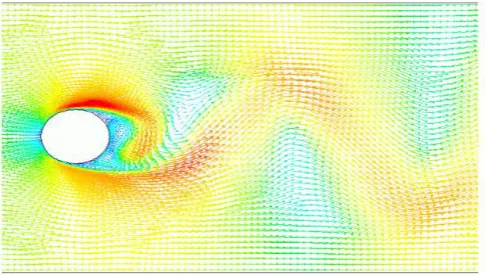
[image:18.595.151.488.360.475.2]Most of the interest in the flow around a cylindrical body oscillating transversely to a free stream is due to its relevance to vortex-induced vibration (VIV). The literature review shows that there is a collective opinion among experts regarding the VIV phenomenon that arises when a body is placed in a flow and the fluctuating lift force due the asymmetric formation of vortices in the wake causes the body to vibrate. The primary reason for the formation of these vortices is the frictional shear stress arising within the boundary layer, which denotes a very thin layer in the neighborhood of the body (Gamino., 2013; Schlichting 1968). This phenomenon of alternating vortex shedding is depicted in a two-dimensional plane as shown in Figure 2.1.
Figure 2.1: Velocity Vector Plot Depicting VIV (Gamino, 2013)
occur with high dangerous amplitudes as the continuous periodic vibration of the structure could make it susceptible to fatigue failure.
Computational fluid dynamics (CFD) simulations is presented as another option as an alternative to response models can be applied for VIV assessment to overcome the inherent limitations of the state-of-practice engineering approach (Gamino, 2013).
Generally modelling VIV riser behavior is dependent on a number of empirical parameter such as Strouhal number, correlation length and lift coefficient. Other related flow parameter such as Reynolds number, surface roughness, Keulegan- Carpenter number, and turbulent intensity. Commonly lift coefficient and Strouhal number is the most of the tests provide data for all parameter
2.2 VIV Force Direction
The vortex shedding induces fluctuating forces on the body and, if it is non-rigid, causes it to oscillate in the transverse and in-line direction, thus generating a periodic variation in the force components on the cylinder. The force components can be divided into cross-flow (CF) and in-line (IL) directions, which is important when doing further fatigue analysis. According to Hill (2013), each time a vortex sheds, a force is generated both in the in-line and cross-flow direction, causing an oscillatory multi-mode vibration as shown in Figure 2.2.
10 Consequently, as vortices are being shed on the cylinder surface, the cylinder experiences forces which are periodic in nature. These forces cause the cylinder to continuously vibrate as long as vortices are shed. Chakrabarti, (2005) listed that important hydrodynamic quantities that influence VIV are: Reynolds number, lift coefficient, correlation of force components, shedding frequencies and their interactions, added mass or mass ratio and damping
Dynamic force in CF (transverse) direction to the flow due to vortices reactions is referred to lift force. Transverse cylinder vibration has a large effect on vortex shedding. The correlation of vortex shedding along the cylinder axis increases by transverse cylinder vibration. Increased transverse vibration amplitude (Ay) also increases the ability of the vibration to lock in or synchronize the shedding frequency (Blevins, 2001).
According to Michael (1994), when motion of the cylinder organizes the wake and cause the shedding frequency to abruptly jump from its nominal value fst to
a value equal to the oscillation frequency, fex, the shedding frequency said to be in
locked-in, locked on or synchronized to the cylinder frequency. The first phenomenon reported by Bishop in 1964.
Vortices shed far from the cylinder when cylinder vibration near to its maximum displacement. Zdravkovic (1982) agrees that the vortex is shed from the side opposite the side experiencing maximum displacement when vibration frequency is below the natural shedding frequency and vortex is shed from the same side as the maximum displacement when vibration frequency above the shedding frequency (Blevins, 2001).
Stansby (1979) found that in several key point regarding lock-in phenomenon including shedding behavior at the edges of the lock-in frequency range is similar for uniform and shear flow while the minimum amplitude to ignite lock-in is increase with the increase of Re.
2.3 Flow around Cylinder Structure
bluff-body structure will try to vibrate in a direction normal to the flow direction (Akaydin et.al 2010). This flow induced vibration configuration is controlled by the Reynolds number (Re), could be caused by the turbulence generated by the flow around and in the wake of the cylinder.
When sufficiently large Reynolds number (Re) exceeds a critical value, somehow the cylinder might experience excitations or vibrations, as the unsteady flow around the cylinder separates from a wider section of the body giving rise to periodic vortex shedding from either side of the body, forming pressure differences causing a net force exerted on the bluff-body in the direction perpendicular to the flow and creating vortices in a repeating of swirling vortices known as the von Karman vortex street.
[image:21.595.216.460.463.601.2]Flow patterns around of bluff bodies under either steady or turbulent ongoing flows have been formed by either 1 shear layer or 2 shear layers on one side or both sides of bodies due to the flow-body interactions depends on characteristics of bluff bodies by means sectional shape and dimension and characteristics of ongoing flow such as steady or unsteady, wind velocity, attack angle and even in-flow movement of body, the around-body flow shear layer can be either stability or instability (Hoa, 2005).
12
2.4 Vortex Shedding
Reynolds (1883) was the first to propose a criterion for differentiation between laminar and turbulent flows in his classic dye visualization and suggested a critical value of for the upper limit of laminar flow. In a second paper in 1895, he showed by time-averaging the Navier-Stokes equations that new extra convection terms appeared in turbulence which have the units of stress and are therefore called Reynolds stresses.
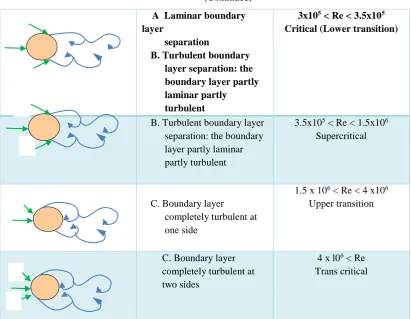
[image:22.595.107.515.463.766.2]Theodore von Kármán is the person who first stimulated widespread interest and published the first theoretical study of vortex streets in 1911. In 1981 Schatzman, who studied the analysis of a model for the Von Kármán Vortex Street found that the linear stability of the point vortex has been generalized to vortices of finite size and can stabilize the array (Azman, 2008).The vortex shedding around bluff bodies can be classified by some following kinds (Hoa, 2005; Matsumoto 1999):
Table 2.1: Flow regime around smooth, circular cylinder in steady current (Hall-Stinson, 2011; Asyikin, 2012)
No separation Creeping flow
Re < 5
A fixed pair of symmetric vortices 5 < Re < 40
Laminar vortex street 40 < Re <200
Transition to turbulence in the wake
.
200 < Re < 300
Wake completely turbulent
A. Laminar boundary layer
separation
(Continued)
A Laminar boundary layer
separation
B. Turbulent boundary layer separation: the boundary layer partly laminar partly turbulent
3x10⁵ < Re < 3.5x10⁵
Critical (Lower transition)
B. Turbulent boundary layer separation: the boundary layer partly laminar partly turbulent
3.5x10⁵ < Re < 1.5x10⁶ Supercritical
C. Boundary layer completely turbulent at one side
1.5 x 10⁶ < Re < 4 x10⁶ Upper transition
C. Boundary layer completely turbulent at two sides
4 x l06 < Re Trans critical
2.4.1 Von Kármán Vortex Street
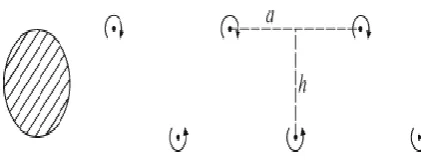
Numerous numerical and empirical methods have been studied in the analysis of uniform flow past a rigid 2D cylinder. One of the parameters engineers study is the formation of vortices behind the cylinders wake, which is illustrated in Figure 2.4:
Flow
Velocity Cylinder’s
[image:23.595.108.520.100.419.2]wake
14 A von Kármán vortex street is the description given to an alternating pattern of vortices. When a fluid flows over a blunt, 2 dimensional body, vortices are created and shed in an alternating fashion on the top and bottom of the body (Bjswe et.al, 2011). Given that the body is symmetrical, this phenomenon will initially be symmetrical but will eventually turn into the classical alternating pattern. Figure 2.4 and Figure 2.5 is a good depiction of a common von Kármán vortex street. This behavior was named after Theodore Von Kármán for his studies in the field.
[image:24.595.197.478.424.551.2]The frequency of Karman vortex shedding can be estimated by the Strouhal number. A vortex shed from the other side causes a force in the opposite direction. This alternate vortex shedding characterized by definite periodicity would cause fluctuating pressure forces on the surfaces of the body due to which the body undergoes vibrations. The turbulence represents the random fluctuations of the flow and is not periodic. The turbulence excited vibration can occur at any flow velocity with increasing amplitude, flow velocity and a frequency around the natural frequency of the bluff-body structure. Thus the bluff-body is set to vibrate due to the alternate shedding of vortices named as Vortex-Induced Vibration (VIV).
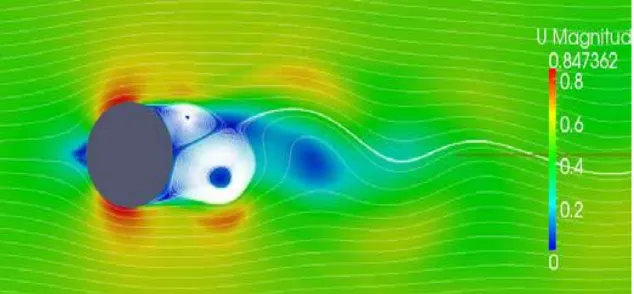
Figure 2.6: Von Kármán Vortex streets forming in the wake Of a Bluff-body on the onset of turbulence (Hill, 2013)
A research shown that when Reynolds number exceeded 100, the von Karman vortex street occurred. When the Reynolds number was higher, the von Karman vortices lasted for a shorter a period. As a result, the distance between the vortices decreased. As shown in Figure 2.6, the results of the analysis are in good agreement with the visualized outcome derived from the theoretical (Sato et al., 2012)
16
Figure 2.7: Kármán “Vortex Street” behind the circular cylinder (Wu & Kareem, 2012)
2.5 Drag Force and Lift Force
The drag force acts in a horizontal direction or in line flows on the cylinder surface, depends on shape and orientation of a body. The average drag on a cylinder vibrating at or near the vortex shedding frequency is also a function of vibration amplitude. The high in-line vibration amplitude will increase the drag force. Drag coefficient, Cd is calculated as follow number is used to describe the relationship between vortex shedding frequency and fluid velocity and is given by;
𝐶𝑑 = 2𝐹𝐷
𝜌 𝑈2𝐷 (2.1)
Where ⍴ is the fluid density, U is the flow velocity, D is the cylinder diameter and Fd is the sum of the pressure force
Lift coefficient, Cl is calculated similarly but vertical force is considered rather than horizontal force. The force of the cross-flow direction is commonly named as the lift force (FL) which is shown in Figure 2.8.
𝐶𝑙 = 2𝐹𝑙
𝜌𝑈2𝐷 (2.2)
lower lift coefficient value will be reported. In experiment, pressure transducer is replaced force transducer to obtain more accurate results because they measured the pressure distribution of the fluid around the cylinder’s circumference. Lift force frequency is characterized by the Strouhal number
Figure 2.8: Vibrations of forces acting around a circular cylinder submitted to vortex shedding. (Cunff et.al, 2002)
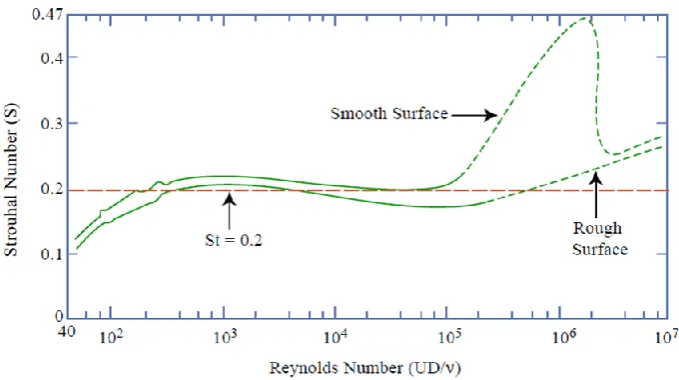
The Strouhal number is related to the Cd of the flow. In sub-critical Reynolds number region (100 < Re < 10,000), increase in the Strouhal number is generally accompanied by a decrease of the Cd (Pattel, 2010).
18
2.6 Strouhal Number
[image:28.595.147.487.349.539.2]The Strouhal number depends on Reynolds number, shape and dimension of body, and wind or water velocities. The increasing of Reynolds number will affect Strouhal number increases or decreases in certain range of Reynolds number. The increasing size or dimension (D) will increase the Strouhal number, the increasing of velocity (U) and change of attack angle will decreasing the Strouhal number (Hoa, 2005). It should be noted that the Strouhal number can be influenced by the Reynolds number in some cases, for circular cylinders, the Strouhal number seems to stay constant on the certain range of Reynolds number between 1.5x10² and 1.5x10⁵ (Hoa, 2005, Blevin 1977, Simui&Scanlan 1978).
Figure 2.10: Effect of Reynolds number on Strouhal number for 2D circular cylinder (Simui and Scanlan, 1978)
The technique for compensating of the influence of the Reynolds number difference between full scale structure and experimental model should be required due to difficulty and possibility to simulate the Reynolds number using tool of wind tunnel experiments, because it can effecting on evaluation of vortex-induced vibration (Hoa,2005;Shimada & Meng,1998).
2.7 VIV Equation
In the one degree of freedom vortex induced vibration problem, an elastically mounted circular cylinder is situated in a free stream of fluid shown in Figure 2.6
[image:29.595.209.413.610.740.2]20
The structure is conditioned as a vibration-free elastically cylinder by means the cylinder is free to respond the vibrations which is useful to find amplitude, frequency and phase angle of a vibrating cylinder and helpful in studying flow-visualization of the wake of the cylinder.
The differential motion equation of the system shown in Figure 2.11 is formulated as:
mÿ(t) + cẏ(t) + ky(t) = F(t) (2.3)
Where m is the total mass of the system and dot over the symbols indicates differentiation with respect to time, c is the coefficient of viscous damping and k denotes the stiffness of the spring.
𝑚∗ = 4𝑚
𝜋𝜌𝐷2 (2.4)
𝜁 = 𝑐
𝑐0 (2.5)
𝑉𝑟= 𝑈∞ 𝑓𝑛𝐷
(2.6)
Where the critical damping, C0
c 0 = 2√𝑘𝑚 (2.7)
And the natural frequency of the body in vacuum
𝑓𝑛 =√𝑘/𝑚
2𝜋 (2.8)
while in air it is usually one or two orders of magnitude larger. The excitation frequency in air has generally a value similar to the frequency of the cylinder’s response close to the body natural frequency fn.
The synchronization of vortex shedding and the body frequency takes place over a range of reduced velocities, whose width is proportional to the oscillation amplitude.
Table 2.2: Relationship of Amplitude and Frequency Mode (Asyikin, 2012)
For a free vibration system, such as no external forces working on the system (F=0), the solutions can, therefore, be differentiated into two conditions: without and with viscous damping.
According to King et al (1974), Vandiver (1987) have found that if a cylinder is mounted in the in-line direction, the oscillating drag produced by vortex shedding may induce in-line vibrations. In general these vibrations will occur at roughly twice the frequency for transverse vibration. These vibrations pose numerous problems with underwater pipelines because larger vibrations will typically occur at very low reduced velocities.
Studies by Naudascher (1987), Vandiver (1987), Torum et al, (1996) show that the in-line vibrations are an order of magnitude smaller than the transverse vibrations. Inline vibrations can also occur by themselves and constitute a fatigue problem for the free-span length of pipes on the seafloor. They are usually not a concern for risers since they appear at lower reduced velocity. Axial vibrations (Huse et al., 1998) are a by-product of cross-flow vibrations and are observed when the axial deformation due to the cross-flow vibrations triggers a resonant axial mode (Cunff et al., 2002)
Vibration motion Max Amplitude Oscillation Frequency mode
Cross Flow 𝑽𝒓 ≈ (𝟏/𝑺𝒕 ) f n = f s
22
2.8 Cross Flow and In Line Vibrations of Cylindrical Structure
[image:32.595.240.438.252.530.2]Vibrations of structure emerge as the result of periodic variations in the force components due to the vortex shedding. The vibrations can be differentiated into cross flow and in-line vibrations. The cross-flow vibration is caused by the lift force whilst the in-line one is caused by the drag force. Both vibrations are commonly called the vortex induced vibrations.
Figure 2.12: Definition sketch of vortex-induced vibrations (Asyikin, 2012)
A bluff body undergoes perfect vortex-shedding resonance if its inline natural frequency (fx) is twice the transverse natural frequency (fy), and the Strouhal
frequency is near or at the transverse natural frequency, resulting in fluid excited motions in both inline and transverse directions ( Dahl et al, 2007 ).
Numerical simulations was conducted by Tang in 2013 for VIV of an elastically mounted circular cylinder freely oscillating in both cross-flow and in-line directions. All of the numerical results herein were obtained at Re = 100, mass ratio
𝑚∗ = 10.0, and structural damping ratio 𝜉 = 0.01, low combined mass damping parameter 𝑚∗𝜉 = 0.1.The reduced velocity V𝑟 was varied from 3.0 to 10.2, by changing the natural frequency f𝑛 of the cylinder. One of the important phenomena associated with VIV is the synchronization defined as the vortex shedding frequency matches the natural frequency of the cylinder.
[image:33.595.166.499.498.659.2]This is well demonstrated in Figure 2.8 where the two vertical dashed lines illustrate the boundaries of the synchronization region. Over the synchronization range, it is observed that the vortex shedding frequency is modulated to the natural frequency of the elastically mounted circular cylinder and the oscillations are dominated by the oscillating frequency. In this reduced velocity range, multiple frequencies are presented in the spectra of the response making the lift and displacement fluctuations behave large deviation from the pure-tone oscillations (Tang et al, 2013).
24
2.9 Reynolds Number, Re
The flow around a stationary smooth circular cylinder depends on Re, one of the non dimensionless hydrodynamic numbers that is accounted, denotes the relationship between inertia forces and the viscous forces in the boundary layer and is categorized roughly by four regimes which is subcritical, critical, supercritical and trans critical.
In 1833, one of the earliest research by Osborne Reynolds was the first to systematically investigate the transition from laminar to turbulent flow by injecting a dye streak into flow through a pipe having smooth transparent walls. His observations led to identification of a single dimensionless parameter, now called the Reynolds number, and denoted Re
Re = Inertia Force Friction Force=
𝜌𝑈𝐷 𝜇 =
𝑈𝐷
𝜈 (2.9)
Where ρ is fluid density, µ is dynamic viscosity, D- is the cylinder diameter, and U is the fluid velocity. One of the reasons that the Reynolds number is so important is that its value determines the type of flow around a bluff body.
In 2001 Blevins shows that the composition of the vortex pattern from the bluff body will change depending on Reynolds number. The experiments examined here are in the regime where the vortex street is the fully turbulent and include examples up to a Reynolds number of 3.5 ×10⁵ (Swithenbank et.al, 2008). He proposed a crude division of the flow regimes is given by:
• 300 < Re < 1.5 ×10⁵ Subcritical regime • 1.5 ×10⁵ < Re < 3.5 ×10⁵Transitional regime • Re >3.5 ×10⁵Supercritical regime
REFERENCES
Akhavan, R., Kamm, R. D., & Shapiro, A. H. (1991). An investigation of transition to turbulence in bounded oscillatory Stokes flows Part 2. Numerical simulations. Journal of Fluid Mechanics, 225, 423-444.
Asyikin, M. T. (2012). CFD Simulation of Vortex Induced Vibration of a Cylindrical Structure.
Bearman, P. W. (2009). Understanding and predicting vortex-induced vibrations. Journal of Fluid Mechanics, 634, 1-4.
Bearman, P. W. (2011). Circular cylinder wakes and vortex-induced vibrations. Journal of Fluids and Structures, 27(5), 648-658.
Bershader, D. (1981). 9.3. Low Reynolds Number Flows. Methods of Experimental Physics, 18, 796-801.
Blevins, R. D., & Coughran, C. S. (2009). Experimental investigation of vortex-induced vibration in one and two dimensions with variable mass, damping, and Reynolds number. Journal of Fluids Engineering, 131(10), 101202.
Bourguet, R., & Triantafyllou, M. S. (2015). Vortex-induced vibrations of a flexible cylinder at large inclination angle. Philosophical Transactions of the Royal Society of London A: Mathematical, Physical and Engineering Sciences, 373(2033), 20140108.
Dahl, J. M., Hover, F. S., Triantafyllou, M. S., Dong, S., & Karniadakis, G. E. (2007). Resonant vibrations of bluff bodies cause multivortex shedding and high frequency forces. Physical review letters, 99(14), 144503.
De Vecchi, A., Sherwin, S. J., & Graham, J. M. R. (2009). Wake dynamics past a curved body of circular cross-section under forced cross-flow vibration. Journal of Fluids and Structures, 25(4), 721-730.
66 Bjswe, P., Johnson, B., & Phinney, B. Optimization of Oscillating Body for Vortex
Induced Vibrations. Worcester Polytechnic Institute; 2010.
Gabbai, R. D., & Benaroya, H. (2005). An overview of modeling and experiments of vortex-induced vibration of circular cylinders. Journal of Sound and Vibration, 282(3), 575-616.
Gamino, M., Abankwa, S., & Pascali, R. (2013, June). FSI Methodology for Analyzing VIV on Subsea Piping Components With Practical Boundary Conditions. In ASME 2013 32nd International Conference on Ocean, Offshore and Arctic Engineering (pp. V007T08A028-V007T08A028). American Society of Mechanical Engineers.
Hall-Stinson, A. (2011). Energy Generation From Vortex Induced Vibrations (Doctoral dissertation, Worcester Polytechnic Institute).
Haworth, D. C. (2005). A review of turbulent combustion modeling for multidimensional In-Cylinder CFD (No. 2005-01-0993). SAE Technical Paper Jauvtis, N., & Williamson, C. H. K. (2003). Vortex-induced vibration of a cylinder
with two degrees of freedom. Journal of Fluids and Structures, 17(7), 1035-1042.
1Jauvtis, N., & Williamson, C. H. K. (2004). The effect of two degrees of freedom on vortex-induced vibration at low mass and damping. Journal of Fluid Mechanics, 509, 23-62.
Kim, S., Wilson, P. A., & Chen, Z. M. (2014). Numerical simulation of force and wake mode of an oscillating cylinder. Journal of Fluids and Structures, 44, 216-225.
Kocabiyik, S., & Nguyen, P. (1998). On a translating and transversely oscillating cylinder: Part 2: Effect of the velocity ratio on the hydrodynamic forces and the near-wake structure. Ocean engineering, 26(1), 21-45.
Kumar, S., Lopez, C., Probst, O., Francisco, G., Askari, D., & Yang, Y. (2013). Flow past a rotationally oscillating cylinder. Journal of Fluid Mechanics, 735, 307-346.
Liaw, K. (2005). Simulation of flow around bluff bodies and bridge deck sections using CFD (Doctoral dissertation, University of Nottingham).
Le Cunff, C., Biolley, F., Fontaine, E., Etienne, S., & Facchinetti, M. L. (2002). Vortex-induced vibrations of risers: theoretical, numerical and experimental investigation. Oil & Gas Science and Technology, 57(1), 59-69
Lee, S. J., & Lee, J. Y. (2008). PIV measurements of the wake behind a rotationally oscillating circular cylinder. Journal of Fluids and Structures, 24(1), 2-17. Mastenbroek, J. J. (2010). Bluff body flow: wake behavior behind a heated circular
cylindeer.Kulkarni, A. A., Harne, M. S., & Bachal, A. (2014). Study of Vortex Shedding Behind Trapezoidal Bluff Body by Flow Visualization Method. In
International Journal of Engineering Research and Technology (Vol. 3, No. 9
(September-2014)). ESRSA Publications.
Mittal, S., & Kumar, V. (2001). Flow-induced oscillations of two cylinders in tandem and staggered arrangements. Journal of Fluids and Structures, 15(5), 717-736.
Michael, S. P. (1994). Vortex induced vibration parameters: critical review. OMAE Offshore Technology.
Nguyen, P., & Kocabiyik, S. (1997). On a translating and transversely oscillating cylinder. Part 1—The effect of the strouhal number on the hydrodynamic forces and the near-wake structure. Ocean engineering, 24(8), 677-693.
Patel, Y. (2010). Numerical investigation of flow past a circular cylinder and in a staggered tube bundle using various turbulence models.
Resvanis, T. L., Jhingran, V., Vandiver, J. K., & Liapis, S. (2012, July). Reynolds number effects on the vortex-induced vibration of flexible marine risers. In ASME 2012 31st International Conference on Ocean, Offshore and Arctic Engineering (pp. 751-760). American Society of Mechanical Engineers.
Rhie, C. M., & Chow, W. L. (1983). Numerical study of the turbulent flow past an airfoil with trailing edge separation. AIAA journal, 21(11), 1525-1532.
Samarbakhsh, S. (2014). Investigation of the Lock-in behavior of an eccentrically rotating cylinder in regard to turbomachinery application.
Sanchis, A., Saelevik, G., & Grue, J. (2008). Two-degree-of-freedom vortex-induced vibrations of a spring-mounted rigid cylinder with low mass ratio. Journal of Fluids and Structures, 24(6), 907-919
Sato, M., & Kobayashi, T. (2012). A fundamental study of the flow past a circular cylinder using Abaqus/CFD. In 2012 SIMULIA Community Conference.
Sellappan, P., & Pottebaum, T. (2014). Vortex shedding and heat transfer in rotationally oscillating cylinders. Journal of Fluid Mechanics, 748, 549-579 Song, J. N., Lu, L., Teng, B., Park, H. I., Tang, G. Q., & Wu, H. (2011). Laboratory
68 Srinil, N., Zanganeh, H., & Day, A. (2013). Two-degree-of-freedom VIV of circular cylinder with variable natural frequency ratio: Experimental and numerical investigations. Ocean Engineering, 73, 179-194.
Stavropoulos, M., Charlesworth, D., & Dixon, M. (2005). The Application of CFD for Vortex Induced Vibration Analysis of Marine Risers In Projects Marine 2005.
Swithenbank, S. B., Vandiver, J. K., Larsen, C. M., & Lie, H. (2008, January). Reynolds number dependence of flexible cylinder VIV response data. In ASME 2008 27th International Conference on Offshore Mechanics and Arctic Engineering (pp. 503-511). American Society of Mechanical Engineers.
Swithenbank, S. B., & Larsen, C. M. (2008, January). The importance of mode number on in-line amplitude of vortex-induced vibration of flexible cylinders. In ASME 2008 27th International Conference on Offshore Mechanics and Arctic Engineering (pp. 771-778). American Society of Mechanical Engineers. Tang, G., Lu, L., Teng, B., & Liu, M. (2013). Numerical Simulation of
Vortex-Induced Vibration with Three-Step Finite Element Method and Arbitrary Lagrangian-Eulerian Formulation. Advances in Mechanical Engineering, 5, 890423.
Van den Abeele, F., Boël, F., & Hill, M. (2013, June). Fatigue Analysis of Free Spanning Pipelines subjected to Vortex Induced Vibrations. In ASME 2013 32nd International Conference on Ocean, Offshore and Arctic Engineering (pp. V007T08A039-V007T08A039). American Society of Mechanical Engineers. Versteeg, H. K., & Malalasekera, W. (2007). An introduction to computational fluid
dynamics: the finite volume method. Pearson Education.
Wang, J., Fu, S., Baarholm, R., Wu, J., & Larsen, C. M. (2015). Fatigue damage induced by vortex-induced vibrations in oscillatory flow. Marine Structures, 40, 73-91.
Williamson, C. H. K., & Govardhan, R. (2004). Vortex-induced vibrations. Annu. Rev. Fluid Mech., 36, 413-455.
Williamson, C. H. K., & Jauvtis, N. (2004). A high-amplitude 2T mode of vortex-induced vibration for a light body in XY motion. European Journal of Mechanics-B/Fluids, 23(1), 107-114.
Williamson, C. H. K., & Govardhan, R. (2008). A brief review of recent results in vortex-induced vibrations. Journal of Wind Engineering and Industrial Aerodynamics, 96(6), 713-735.
Wu, W., Bernitsas, M. M., & Maki, K. (2011, January). RANS simulation vs. experiments of flow induced motion of circular cylinder with passive turbulence control at 35,000< Re< 130,000. In ASME 2011 30th International Conference on Ocean, Offshore and Arctic Engineering (pp. 733-744). American Society of Mechanical Engineers.
Xie, F. F., Jian, D. E. N. G., & Zheng, Y. (2011). Multi-mode of vortex-induced vibration of a flexible circular cylinder. Journal of Hydrodynamics, Ser. B, 23(4), 483-490.
Zahari, M. A., & Dol, S. S. (2014). Application of vortex induced vibration energy generation technologies to the offshore oil and gas platform: The preliminary study. International Journal of World Academy of Science, Engineering and Technology, 8(7), 1331-34.
Zahari, M. A., & Dol, S. S. (2014). Alternative energy using vortex-induced vibration from turbulent flows: theoretical and analytical analysis.
Zahari, M. A., & Dol, S. S. (2015). Effects of Different Sizes of Cylinder Diameter on Vortex-Induced Vibration for Energy Generation. Journal of Applied Sciences, 15(5), 783.
Zhou, C. Y., So, R. M. C., & Lam, K. (1999). Vortex-induced vibrations of an elastic circular cylinder. Journal of Fluids and Structures, 13(2), 165-189.
Zhang, X., & Perot, B. (2000). Turbulent Vortex Shedding From Triangle Cylinder Using the Turbulent Body Force Potential Model. In Proceedings of ASME
Fluids Engineering Division, FEDSM2000-11172 (pp. 1–6).