A FRAMEWORK FOR IMPROVING KNOWLEDGE SHARING IN THE PROVISION OF FLOATING SUPPORT SERVICES IN SHELTERED HOUSING FOR THE ELDERLY
JULIANA UKACHI EGBU
A FRAMEWORK FOR IMPROVING KNOWLEDGE SHARING IN THE PROVISION OF FLOATING SUPPORT SERVICES IN SHELTERED HOUSING FOR THE ELDERLY
JULIANA UKACHI EGBU
SCHOOL OF THE BUILT ENVIRONMENT THE UNIVERSITY OF SALFORD MANCHESTER UNITED KINGDOM
Submitted in Partial Fulfilment of the Requirements of the Degree of Doctor of Philosophy (PhD)
1
TABLE OF CONTENT
TABLE OF CONTENT ... I LIST OF TABLES ... VII LIST OF FIGURES ... IX LIST OF ABBREVIATIONS ... XII ACKNOWLEDGEMENTS ... XIII DEDICATION ... XIV DECLARATION ... XV ABSTRACT ... XVI
CHAPTER ONE………..………..1
1.1 Introduction ...1
1.2 Background of Research ...1
1.3 Statement of Research Problem ...5
1.4 Research Questions ...7
1.5 Research Aim ...7
1.6 Research Objectives ...7
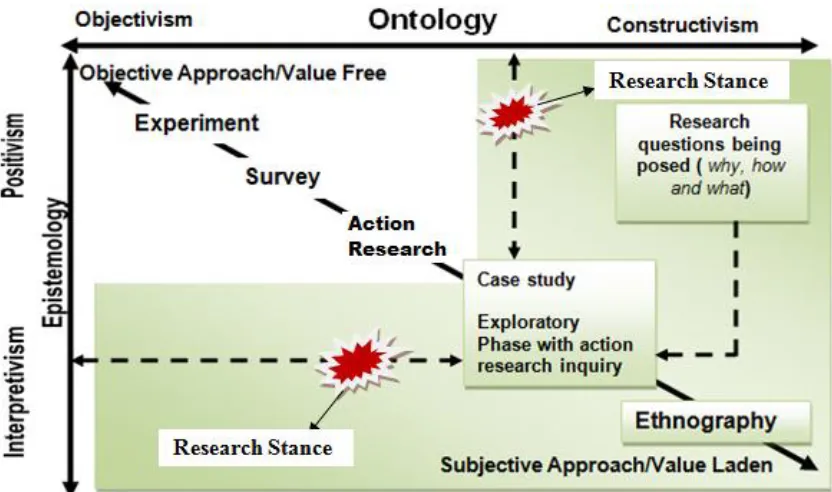
1.7 Research Methodology ...8
1.8 Structure of the thesis ... 10
CHAPTER TWO A REVIEW OF LITERATURE ON SHELTERED HOUSING AND FLOATING SUPPORT SERVICES……….………..………..13
2.1 Introduction ... 13
2.2 Demographic Context: The Aging Population in the UK ... 13
2.3 Housing Options For Elderly People ... 15
2.4 Concept of Sheltered Housing ... 20
2.5 The Historical Development of Sheltered Housing ... 21
2.6 Reasons for moving into Sheltered Housing ... 25
2.7 Sheltered Housing: The UK Policy Context ... 28
2.8 Sheltered Housing: An International Comparison ... 29
2.9 Provisions in Sheltered Housing ... 36
2.10 The Importance and problems of Floating Support Services in ... 46
Sheltered Housing ... 46
II CHAPTER THREE
KNOWLEDGE MANAGEMENT AND KNOWLEDGE SHARING………….……...50
3.1 Introduction ... 50
3.2 The Concept of Knowledge ... 50
3.3 Distinguishing Data, Information and Knowledge ... 52
3.4 Typologies of Knowledge ... 57
3.4.1 Tacit and Explicit Knowledge ... 59
3.4.2 Distinction Between Tacit and Explicit Knowledge ... 62
3.5 Background to Knowledge Management (KM) ... 67
3.6 Knowledge Management Processes ... 69
3.7 Why Knowledge Sharing? ... 74
3.8 Knowledge Sharing Theoretical Frameworks ... 77
3.9 Mechanisms for Knowledge Sharing ... 82
3.10 Ontologies of Knowledge Sharing ... 85
3.11 Knowledge Sharing Limitations ... 87
3.12 Critical Success Factors (CSFs) for Knowledge Sharing ... 88
3.12.1 Management Leadership and Support ... 89
3.12.2 Motivation ... 89
3.12.3 Reward and Recognition ... 90
3.12.4 Trust and Relationships ... 90
3.12.5 Communication and Staff Training ... 90
3.12.6 Technology and Information system... 91
3.12.7 Organisational Structure ... 91
3.13 The Challenges of Knowledge Sharing in Organisations ... 94
3.14 Knowledge Sharing Benefits to the Provision of Floating Support ... 97
Services ... 97
III CHAPTER FOUR
RESEARCH METHODOLOGY AND DESIGN………...102
4.1 Introduction ... 102
4.2 Research Paradigm ... 102
4.3 Justification for the selected Paradigm and Methodology ... 104
4.3.1. Ontological consideration ... 105
4.3.2 Epistemological consideration ... 106
4.3.3 Axiological Consideration ... 107
4.3.4 Philosophical position adopted in this research study ... 108
4.4 Research Approach ... 109
4.4.1 Deductive Approach ... 109
4.4.2 Inductive Approach ... 110
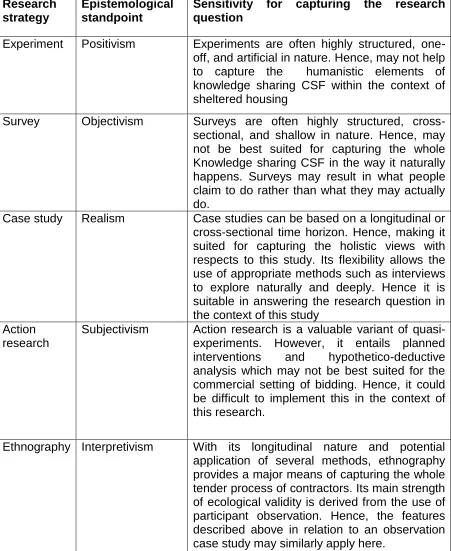
4.5 Research Strategy ... 112
4.5.1 The Choice of Research Strategy... 118
4.5.2 Case Study Design ... 120
4.5.3 Justification for the Multiple Case Study Research Strategy ... 121
4.5.4 Selection of Cases ... 122
4.6 Method of Data Collection ... 126
4.6.1 Semi- structured interview ... 129
4.6.2 Questionnaires ... 131
4.7. Triangulation ... 135
4.8. Data Analysis ... 136
4.8.1 Semi-Structured Interview Data Analysis ... 136
4.8.2 Survey Questionnaire Data Analysis ... 140
4.9 Ethical Approach to the Research ... 142
4.10 Reliability and Validity Issues ... 143
IV CHAPTER FIVE
THE ROLE OF KNOWLEDGE SHARING IN THE EFFECTIVENESS OF FLOATING
SUPPORT SERVICES ... 147
5.1 Introduction ... 147
5.2 Data Analysis from the Semi-Structured Interviews on the Role of ... 148
Knowledge Sharing to FSS ... 148
5.3 Data Analysis from the Survey Questionnaire on the Role of ... 153
Knowledge Sharing the Effectiveness of FSS ... 153
5.3.1 Job Role of Respondents ... 153
5.3.2 Age Profile of Respondents ... 155
5.3.3 Respondents Length of Service Experience ... 156
5.3.4 Respondents‟ Clear Understanding of the meaning of Knowledge sharing ... 158
5.3.5 Gender Profile of Respondents ... 160
5.4 Summary of Chapter ... 169
CHAPTER SIX ... 170
THE BENEFITS OF KNOWLEDGE SHARING AND HOW IT CAN IMPROVE FLOATING SUPPORT SERVICES 6.1 Introduction ... 170
6.2 Data Analysis from the Semi-Structure Interviews on the Benefits ... 171
of KS to FSS ... 171
6.3 Data Analysis from the Survey Questionnaire on the Benefits of KS To FSS ... 176
6.4 Summary of Chapter ... 182
CHAPTER SEVEN ... 183
CHALLENGES ASSOCIATED WITH EFFECTIVE KNOWLEDE SHARING IN PROVIDING FLOATING SUPPORT SERVICES 7.1 Introduction ... 183
7.2 Data Analysis from the Semi-structure Interviews and Survey ... 184
Questionnaires: The Challenges of KS to FSS ... 184
7.2.1 Communication and Information Restraints ... 185
7.2.2 Lack of Time to Share Knowledge ... 190
V
7.2.4 Lack of Trust to Share Knowledge ... 198
7.2.5 Confidentiality and Data Protection Issues ... 201
7.3 Summary of Chapter ... 205
CHAPTER EIGHT ... 206
CRITICAL SUCCESS FACTORS OF KNOWLEDGE SHARING IN THE PROVISION OF FLOATING SUPPORT SERVICES 8.1 Introduction ... 206
8.2 Data Analysis from the Semi-structure Interviews and Questionnaire.. 207
Survey Interviews on the Critical Factors of KS to FSS ... 207
8.2.1 Trust and Relationship ... 208
8.2.2 Team Networking ... 213
8.2.3 Management and Leadership Support ... 217
8.2.4 Information Technology (IT) ... 221
8.3 Summary of Chapter ... 225
CHAPTER NINE ... 226
DISCUSSIONS AND FINDINGS ... 226
9.1 Introduction ... 226
9.2 Re-addressing the Research Questions ... 226
9.2.1 RQ1: To what extent does knowledge sharing facilitate the ... 227
provision of floating support services to the elderly living in ... 227
sheltered housing? ... 227
9.2.2 RQ2: What factors of knowledge sharing are critical for the ... 229
successful implementation and provision of floating support services to the elderly living in sheltered housing? ... 229
9.3 Chapter summary... 233
CHAPTER TEN ... 234
DEVELOPMENT OF THE FRAMEWORK ... 234
10.1 Introduction ... 234
10.2 Aim of the Framework ... 234
10.3 Initiate Planning ... 236
10.3.1 Develop Standard Processes for KS ... 236
10.3.2 Identify where KS can improve FSS ... 237
10.4 Develop the People ... 237
10.4.1 Identify with Working Team ... 238
VI
10.4.3 Provide a Support Network for KS... 239
10.5 Understand Procedure ... 239
10.5.1 Carry out KS Knowledge Appraisal ... 240
10.5.2 Create Process Examination ... 240
10.5.3 Support Identified Networks ... 241
10.6 Technological Tools ... 241
10.6.1 Build on existing Technology ... 241
10.6.2 Expand Knowledge Repositories... 242
10.7 Chapter Summary ... 242
CHAPTER ELEVEN ... 243
CONCLUSIONS AND RECOMMENDATIONS ... 243
11.1 Introduction ... 243
11.2 Main Findings ... 243
11.3 The Research Conclusions ... 245
11.4 Research Contribution to Knowledge ... 250
11.5 Research Limitation ... 251
11.6 Recommendations for Practitioners ... 252
11.8 Chapter Summary ... 254
12.0 REFERENCES ... 255
Appendix A: List of Publications ... 288
Appendix B: Management Consent Letter ... 290
Appendix C: Research Invitation Letter ... 292
Appendix D: Research Participant Information Sheet ... 294
Appendix E: Participant Consent Form ... 297
Appendix F: Semi-structured Interview Guide ... 298
Appendix G: Questionnaire Survey ... 301
VII
LIST OF TABLES
TABLE PAGE
Table 2 1: Three Main Housing Options available to Elderly people ... 16
Table 2 2: Sheltered Housing Providers in the UK ... 23
Table 2 3: Reason for Moving into Sheltered Housing ... 26
Table 2 4: International Chart of Terms used to describe Sheltered housing ... 32
Table 2 5: Provisions in Sheltered Housing for the elderly ... 37
Table 2 6: Sheltered Housing Provision ... 38
Table 2 7: Floating Support Model ... 42
Table 3 1: Some Definitions of Data, Information and Knowledge ... 53
Table 3 2: Typologies of Knowledge ... 58
Table 3 3: Distinction between Tacit and Explicit Knowledge ... 63
Table 3 4: Definition of Explicit and Tact Knowledge ... 65
Table 3 5: Critical Success Factors of Knowledge Sharing ... 92
Table 4 1: Evaluation of Potential Research Strategy ... 113
Table 4 2: Distinction Between Qualitative and Quantitative Method ... 128
Table 4 3: Semi-structured interviews interviewee list ... 130
Table 4 4: Different Scale of Measurement ... 140
Table 4 5:Interpreting a Correction Coefficient ... 141
Table 4 6: Interpretation of Consistency ... 144
Table 4 7: Overall Reliability Statistics ... 145
Table 5 1 Job Role of Respondents ... 154
Table 5 2 Age Profile of Respondents ... 155
Table 5 3 Length of job Experience of Respondents ... 156
Table 5 4 Spearman's Correction test for relationship between respondent length of work experience and job role ... 157
Table 5 5 Respondents‘ Clear understanding of the meaning of KS ... 158
Table 5 6 Spearman‘s Correlation Test for relationship between respondent length of work experience and understanding of KS ... 159
VIII
Table 5 8: Aids the development of new ideas ... 161
Table 5 9: Improves collaboration between teams ... 162
Table 5 10: Provides an opportunity to share client details ... 164
Table 5 11: It reduces the need for repeated case meetings ... 165
Table 5 12: Service users get a quick and tailored service in ... 166
Table 5 13: Knowledge sharing provides new insight and ... 167
Table 5 14: Summary of the overall responses ... 168
Table 6 1: KS helps to improve productivity and performance in respect of clients‘ needs ... 177
Table 6 2: KS speeds up the process of client referral and aids the delivery of support services ... 178
Table 6 3: KS provides updates of current practices and valuable new information ... 179
Table 6 4: KS brings together diverse knowledge and ... 180
Table 6 5: Summary of the overall responses ... 181
Table 7 1: Communication and information restraints ... 189
Table 7 2: Timing and location provides me with the opportunity ... 193
Table 7 3:Lack of Motivation and Willingness to Share ... 197
Table 7 4: Lack of trust to share knowledge ... 200
Table 7 5: Confidentiality and data protection issues limit ... 204
Table 7 6: Summary of the overall Responses ... 205
Table 8 1: Trust and Relationship ... 212
Table 8 2: Team Networking ... 216
Table 8 3: Management and Leadership Support ... 220
Table 8 4: Information Technology ... 224
IX
LIST OF FIGURES
FIGURES PAGE
Figure 2 1: UK Mid Year Aging Population Estimate ... 14
Figure 2 2: Reasons for moving into Sheltered Housing ... 27
Figure 2 3: The Speed of Aging Population ... 30
Figure 2 4: 2010-2050: Percentage Change in the World Population ... 31
Figure 2 5: Core Floating support activities in Sheltered Housing ... 41
Figure 2 6: A Lynchpin-Floating Support's role within community Services ... 47
Figure 3 1: The Knowledge Pyramid ... 54
Figure 3 2: The SECI Model ... 61
Figure 3 3: Building Block of Knowledge Management ... 71
Figure 3 4: Knowledge Management Life Cycle ... 72
Figure 3 5: Knowledge Management Processes Model ... 73
Figure 3 6: A Receiver based model of Knowledge Sharing ... 79
Figure 3 7: Knowledge Management Framework ... 80
Figure 3 8: A Framework of Knowledge Sharing Research ... 81
Figure 4 1: Research Methodological Position ... 104
Figure 4 2: Deductive Approach ... 110
Figure 4 3: Inductive Approach ... 111
Figure 4 4: Basic Types of Case Studies design ... 120
Figure 4 5 Snap shot or Nvivo coding ... 138
Figure 4 6 Snapshot of Parent coding ( free node) ... 138
Figure 4 7 Snap shot of thematic coding in Nvivo ... 139
Figure 4 8:Summary of Survey Data Analysis Method ... 142
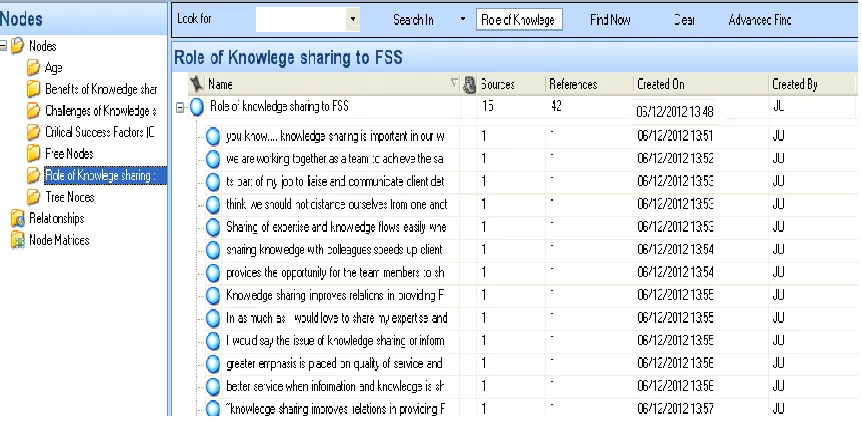
Figure 5 1: Screen shot of Nvivo showing the role of KS to FS ... 148
Figure 5 3 Distribution of Respondents Job Role ... 154
Figure 5 4 Age Profile of Respondents ... 155
Figure 5 5 Distribution of FSW and ASSW according to years of ... 156
Figure 5 6 Respondents‘ Clear understanding of the meaning of KS ... 158
X
Figure 5 8: Aids the development of new ideas ... 161
Figure 5 9: Improves collaboration between teams ... 162
Figure 5 10:Provides an opportunity to share client details and ... 164
Figure 5 11: It reduces the need for repeated case meetings ... 165
Figure 5 12: Service users get a quick and tailored service in... 166
Figure 5 13: Knowledge sharing provides new insight and ... 167
Figure 6 1 Screen short in Nvivo showing benefit of KS to FSS ... 172
Figure 6 2: KS Benefits to Floating Support Services ... 173
Figure 6 3: KS helps improve productivity and performance in ... 177
Figure 6 4: KS speeds up the process of client referral and ... 178
Figure 6 5: KS provides updates of current practises and ... 179
Figure 6 6: KS brings together diverse knowledge and expertise... 180
Figure 7 1 Screen shot showing Nodes on the Challenges of KS to FSS ... 184
Figure 7 2 Summary of Nodes on Challenges of KS to FSS ... 185
Figure 7 3: Screen shot showing the node on communication ... 186
Figure 7 4: Communication and information restraints ... 189
Figure 7 5: Screen shot showing the node on Lack of Trust ... 190
Figure 7 6: Timing and location provide me with the ... 193
Figure 7 7:Screen shot showing the node on Lack of Motivation ... 195
Figure 7 8: Lack of Motivation and Willingness to Share Knowledge ... 197
Figure 7 9: Screen shot showing the node on Lack of Trust ... 198
Figure 7 10: Lack of trust to share knowledge ... 200
Figure 7 11: Screen shot showing the node on Confidentiality ... 202
Figure 7 12: Confidentiality and data protection issues limit ... 204
Figure 8 1: Screen shot showing Nodes on the CSF of KS to FSS ... 207
Figure 8 2: Emerging Themes from Semi-structure Interview ... 208
Figure 8 3: Screen shot showing the node on Trust and relationship ... 209
Figure 8 4: Trust and Relationship ... 212
Figure 8 5: Screen shot showing the node on Team networking ... 213
Figure 8 6: Team Networking ... 216
Figure 8 7: Screen shot showing the node on Leadership support ... 217
XI
XII
LIST OF ABBREVIATIONS ASS - Adult Social Services
ASSW - Adult Social Service Worker
BGOP - Better Government for Older People CMHT - Community Mental Health Teams CLG - Communities and Local Government
DH - Department of Health
DCLG - Department for Communities and Local Government DWP - Department of Work and Pensions
FSS - Floating Support Service FSW - Floating Support Worker
KS - Knowledge Sharing
KM - Knowledge Management
ODPM - Office of Deputy Prime Minister ONS - Office of the National Statistics SEU - Social Exclusion Unit
XIII
ACKNOWLEDGEMENTS
Several people have directly and indirectly contributed to the successful completion of this research study. I would like to thank my supervisor- Dr Gerard Wood, for his support, expert advice and guidance, my co-supervisor Rita Newton, for her generous advice and support. A big thank you to individuals and organisations that provided tremendous input and support toward the completion of this study. I am very proud to have worked with you all. This research project would not have been possible without your unquantifiable support.
I am especially grateful to my loving husband-Professor Charles Egbu, whose love, support and encouragement got me through challenges and obstacles throughout every step of the PhD process. You always believed in me and provided this opportunity and taught me to follow my dreams without fear and with passion.
I would like to thank my research colleagues in the school of the Built Environment for their input and support and; staff of University of Salford for providing me the opportunity and expertise to generate the skills required to produce this research. Also thank you to families and friends too numerous to mention who have contributed morally and prayerfully to the successful completion of this research.
XIV DEDICATION
I dedicate this thesis to my family – Professor Charles Egbu, Charles (Jnr), Chelsea and to the loving memory of my late father-
XV
DECLARATION
This is to certify that the work presented in this thesis is original, except as acknowledged in the text, and that the material has not been submitted previously for a degree at any other university.
Print Name:...
Signature:………..
XVI ABSTRACT
1
CHAPTER ONE 1.1 Introduction
This chapter introduces the background and motivation for the research, the research statement of the problem, the research questions and the research aim and objectives. This is followed by the research methodology and after which it outlines the overall structure of thesis and concludes with a summary of the next chapter.
1.2 Background of Research
2
terms. In recent years, housing associations have been able to provide intensive housing management support known as ―floating support‖ to the elderly living in sheltered housing. ―Floating support‖ is providing housing related support to those who needs it and when required. Its aim is to ensure that services adapts and responds appropriately to the changing needs of elderly individuals in sheltered housing, to maximise their independence and prevent unnecessary admission into institutions. On the other hand, in providing these services, there is a view that there are difficulties surrounding information and knowledge sharing between the floating support worker and other agencies such as adult social services (Sharples et al., 2002; Johnson et al., 2010).
3
4
Nonaka and Taekuchi (1995) have argued that effective knowledge management, especially knowledge sharing, can play an important role in improving organisational performance in situations of limited resources. According to Sharples et al., (2002) the situation, of reducing financial resources with increasing demands for better housing provision for the elderly, calls for effective management, effective decision making, effective knowledge communication among key players, effective sharing of best practice and efficient utilisation of resources. The existing literature on knowledge sharing has shown that some researchers have focused their research on investigating how and what motivates knowledge sharing behaviour among teams (Wasko and Faraj, 2005; Chiu et al., 2006; Hsu et al., 2007). Knowledge sharing behaviour has been examined from various standpoints, ranging from technology to personally related viewpoints (Ardichvili, 2006). Thus, Floating support workers (FSW) employs intuition and tacit knowledge in order to provide floating support services (FSS) to the elderly living in sheltered housing. The use of intuition and tacit knowledge can include anticipating that a client needs to be referred for treatment for incontinence, the need to arrange for the client to visit a day centre or understanding when a client might need the services of a doctor. Burnard (1989) has defined intuition as a heightened sensitivity or ‗sixth sense‘, drawing on experience and knowledge to make careful decisions. FSW uses knowledge expertise to identify clients‘ needs, engaging in the delivery of holistic care to the service users, in the context of this research, the elderly living in sheltered housing. Whilst tacit knowledge is developed through expertise and experience achieved through the delivery of services; Gunilla et al., (2002) propose that tacit knowledge should be encouraged and incorporated into the delivery of the floating support service. It should be noted that intuition and tacit knowledge can shape the development of personal knowledge; which in turn may, eventually, form part of the knowledge that informs professional practice.
5
and FSWs may use personal knowledge and experience when making judgements and decisions about clients‘ needs. Once knowledge workers engage in knowledge sharing and developing, Orzano et al., (2008) identifies two strategies, decision making or sense making and organisational learning. Decision making is similar to problem solving or, more specifically, the caring process. As individual floating support worker visits clients, it is through the data collection process and knowledge sharing that conclusions regarding clients‘ needs occur. In the same way the outcomes of knowledge sharing provide the basis for organisational decision making regarding a particular client‘s needs. Some researchers (Bevan and Rugg, 2006; Cameron, 2010) have argued that the sustainability of the provision of floating support services to the elderly living in sheltered housing depends largely on the willingness of team members to continuously share their knowledge and expertise. Hence, by improving knowledge sharing between the providers of floating support services, not only will the service users get holistic services tailored to their needs but also information sharing will improve between teams.
1.3 Statement of Research Problem
6
services aim to provide better quality of life for vulnerable people to live more independently and maintain their tenancies. However, Sharples et al., (2002) and DCLG (2008) highlighted that floating support services in sheltered housing are often not coordinated and there are difficulties surrounding information and knowledge sharing between the floating support workers and other agencies such as adult social services. Hence, there is a need to explore and investigate the critical success factors that will aid the successful implementation of knowledge sharing practices between the floating support workers and adult social service workers.
7 1.4 Research Questions
The following research questions will form the focus of this research.
RQ1: To what extent does knowledge sharing facilitate the provision of floating support services to the elderly living in sheltered housing?
RQ2: What factors of knowledge sharing are critical for the successful implementation and provision of floating support services to the elderly living in sheltered housing?
1.5 Research Aim
The overall aim of the research is to develop a framework for improved knowledge sharing practices in the provision of floating support services to the elderly in sheltered housing.
1.6 Research Objectives
The following objectives will be used to achieve the research aim:
1. To critically examine extant literature on the development of sheltered housing in the UK and the future and potential benefits of sheltered housing.
2. To investigate and document extant literature on knowledge sharing theories, practices and techniques generally, and with the potential application in the area of sheltered housing.
3. To identify the role of knowledge sharing on effective provision of floating support services in sheltered housing for the elderly.
8
5. To explore the challenges associated with effective knowledge sharing in providing FSS in the context of sheltered housing.
6. To identify the CSFs of knowledge sharing that promotes successful provision of FSS
7. To develop a framework that will serve as guideline for sheltered housing practitioners for improved knowledge sharing practices in the provision of FSS.
1.7 Research Methodology
9
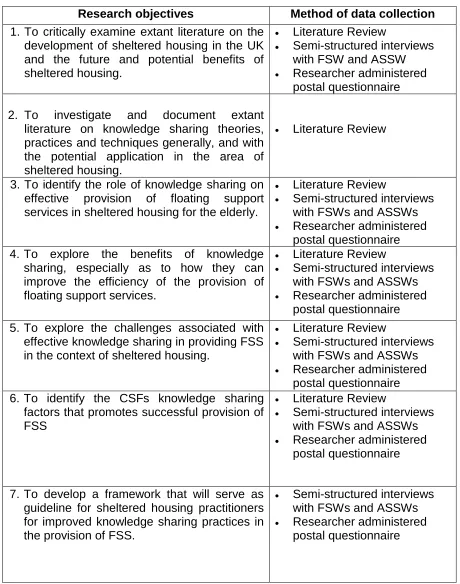
Table 1.1 Summary of research objectives and related methods of data collection
Research objectives Method of data collection 1. To critically examine extant literature on the
development of sheltered housing in the UK and the future and potential benefits of sheltered housing.
Literature Review
Semi-structured interviews with FSW and ASSW Researcher administered postal questionnaire 2. To investigate and document extant
literature on knowledge sharing theories, practices and techniques generally, and with the potential application in the area of sheltered housing.
Literature Review
3. To identify the role of knowledge sharing on effective provision of floating support services in sheltered housing for the elderly.
Literature Review
Semi-structured interviews with FSWs and ASSWs Researcher administered postal questionnaire 4. To explore the benefits of knowledge
sharing, especially as to how they can improve the efficiency of the provision of floating support services.
Literature Review
Semi-structured interviews with FSWs and ASSWs Researcher administered postal questionnaire 5. To explore the challenges associated with
effective knowledge sharing in providing FSS in the context of sheltered housing.
Literature Review
Semi-structured interviews with FSWs and ASSWs Researcher administered postal questionnaire 6. To identify the CSFs knowledge sharing
factors that promotes successful provision of FSS
Literature Review
Semi-structured interviews with FSWs and ASSWs Researcher administered postal questionnaire
7. To develop a framework that will serve as guideline for sheltered housing practitioners for improved knowledge sharing practices in the provision of FSS.
10 1.8 Structure of the thesis
This thesis will be divided into eleven chapters, as follows:-
Chapter 1: Introduction: Chapter one presents the background and motivation for conducting the research. It continues by highlighting the research problems, aim, objectives and research questions. Following on from this, the research methodology are presented together with the structure of the thesis and summary of chapter
Chapter 2: A Review of Literature on Sheltered Housing and Floating Support Services: Chapter two introduces the concept of sheltered housing, and
the development of sheltered housing. This is followed by the current demographic of the elderly population in the UK. It discusses the concept of floating support services and the benefits of floating support services. It also discusses the role of KS in the provision of FSW, and concludes with the potential benefits of KS to the provision of FSW.
Chapter 3: Knowledge Management and Knowledge Sharing: Chapter three focuses on the notion of knowledge and knowledge management. It is followed by examining the concept of knowledge management processes and knowledge sharing; and addressing both tacit and explicit knowledge sharing. This chapter concludes by identifying different critical success factors of knowledge sharing.
11
Chapter 5: The Role of Knowledge Sharing in the Effectiveness of Floating Support Services : The data analysis section begins in chapter five. The role of KS in the participating organisations will be examined and documented here. The analysis includes many aspects of the effectiveness of knowledge sharing to the provision of floating support services.
Chapter 6: The Benefits of Knowledge Sharing and how it Improves Floating Support Services: Continuing the data analysis section, chapter six will examine the benefits of knowledge sharing and how these have improved the floating support services in the participating organisations.
Chapter 7: Challenges Associated with Effective Knowledge Sharing in Providing Floating Support Services This chapter is also part of the data analysis section and will examine the challenges associated with KS in the provision of FSS that exist in the participating organisations. The issue of data protection, as a challenge, will be explored taking into account the attitudes to confidentiality issues.
Chapter 8: Critical Success Factors of Knowledge Sharing for the Provision of Floating Support Services: Chapter eight is the final data analysis chapter and presents the data analysis of the CSFs of knowledge sharing that are critical to the effective provision of floating support services as identified by the participating organisations.
Chapter 9: Discussions and Findings: Chapter nine readdressed the research questions and presents the overall findings from the data analysis based on the research questions.
12
Chapter 11: Conclusions and Recommendations: In the final chapter, a summary of the findings will be presented and recommendations will be made for housing associations, and their agents, providing floating support services on the factors that can aid the successful implementation of FSS for the elderly in sheltered housing.
1.9 Summary of Chapter
This chapter has outlined the basis for the development of the thesis. It sets out the background and motivation for the research, research statement of the problem, the research questions and the research aim and objectives. It also highlighted the scope of the research, the research methodology, and finally the structure of the thesis. The rationale for the research is to identify the CSFs of knowledge sharing that help improve the provision of floating support services to the elderly in sheltered housing.
13
CHAPTER TWO
A REVIEW OF LITERATURE ON SHELTERED HOUSING AND FLOATING SUPPORT SERVICES
2.1 Introduction
The general background for this thesis was introduced in the previous chapter, the motivation for the research was justified and the research aim and objectives were highlighted. This chapter begins by highlighting the demographic context of the aging UK population. It discusses the theoretical development of sheltered housing in the UK and the concept of sheltered housing. It explores the current sheltered housing options for the elderly and sheltered housing providers in the UK. The concept of floating support services are discussed as well as the challenges to the provision of floating support services.
2.2 Demographic Context: The Aging Population in the UK
14
As a result of these increases in the number of elderly people, the ageing population creates one of the greatest challenges to housing provision. A report by DCLG (2008) states that life expectancy for the elderly is increasing as more people are living with disabilities or life limiting conditions for longer. The aging population, combined with the need to control the national budget deficit, places high demands on meeting the needs of the elderly in the most efficient way. One of these needs is housing.
Source: (Office for National Statistics, 2011)
[image:32.612.128.491.211.458.2]
Elderly people with special needs are often excluded from the mainstream housing market by virtue of their specific housing requirements. Each of these groups can expect their needs to be met by special and purpose-designed housing. Housing for elderly people who cannot occupy mainstream housing is, therefore, treated as a ‗special needs‘ category within the One (1) two (2), two and half (2.5) and three (3) classification for local housing authority. As a result of people living longer, over half a million elderly people in the UK currently live in some sort of specialist accommodation. In the CLG (2008) report, the UK government defined it objectives for the accommodation of elderly people as
15
offering elderly people diversity and choice in housing, sustained quality of life, a sense of well being, independence and social inclusion.
2.3 Housing Options For Elderly People
16
Table 2 1: Three Main Housing Options available to Elderly people in the UK
Housing Type Definition Service
Sheltered Housing Congregate living arrangements for older person able to live independently
focused on provision of a secure supportive,
community environment and/or leisure and social activities
Active adult community
Extra care
Sheltered housing and residential care home
Living arrangements for older people where at least two, and usually no more than fifteen, related persons live together in a dwelling unit with a mix of shared and private facilities with the aim of providing a supportive and caring environment.
Group or shared housing
Nursing home and care home
Arrangements in which an organisation provides a range of home care services to a designated group of older persons living in their own homes in close proximity to one another
Naturally occurring care home
Source: (Jones et al., 2008)
(a) Sheltered Housing
17
that is secure. However, there is some housing within this category that only has a 24 hour, centrally controlled alarm system, no on-site wardens and, crucially, provides no communal facilities. According to (Jones et al., 2008) sheltered housing provides independent self-contained housing for elderly people that may be in the form of small cottages, units, or luxury apartment dwellings. Elderly people choosing to move into this form of dwelling rent them from housing associations, local governments or councils. A monthly service charge covers the cost of maintenance, staff and other services.
(b) Residential Home or Extra Care Sheltered Housing
18
(c) Nursing Home and Nursing Care home
The third category is nursing homes and care homes. Nursing homes offer 24 hour nursing care provided by qualified nurses to elderly people who are very frail, bedridden or have a medical condition. A nursing care home is similar to extra-care sheltered housing and residential homes but also offers accommodation, meals and personal care. The difference between nursing care homes, extra-care sheltered housing and residential homes is that a nursing care home offers 24 hour care carried out by qualified nurses to elderly people who, due to illness, require regular attention from nursing professionals.
Apart from these three main housing options, there are also other types of specialised housing provided for elderly people in the UK which includes: Abbeyfield supportive houses; intermediate care homes; shared homes or group homes; granny annexes; hostels and wheelchair housing (Howe et al., 2012). Housing options for the elderly have gained importance over recent years and a great deal of research has been carried out to identify needs and provide better housing (Gilleard et al., 2007; Torrington et al., 2004; Wahl et al., 2009). Providing housing which offers wider choices to meet the diverse needs of elderly people has become a priority for housing providers; and elderly people increasingly seek housing which offers extensive support. Support has become progressively more important to elderly people. The house where an elderly person lives and where they spend most of their time contributes significantly to their well-being. Hence, the range of supportive care is based on the premise that housing options can be distinguished by the types and level of services offered and the capabilities of the elderly individual. In order to access housing appropriate to their individual needs, elderly people are categorised as independent, semi-dependent and dependent (Gilleard et al., 2007).
19
bathing. While semi-dependent and dependent elderly persons can be found throughout the housing options, independent elderly people are very unlikely to reside in housing types such as extra-care housing, residential or care homes or nursing homes specifically designed and equipped to meet the needs of frail elderly people. There is evidence to suggest that better housing can enhance the performance of daily activities, improve safety, restore dignity and ultimately improve the quality of life of elderly people (Johansson et al., 2009; Gilleard et al., 2007). Housing plays a vital role in the lives of elderly people, but in the previous decade housing for the elderly was only regarded as shelter. Over time, it became obvious that frail, elderly persons who need special services and physically supportive features have had to move to housing such as care homes or nursing homes to receive appropriate support. Therefore, the most noticeable growth in the field of housing for frail, elderly people has been the development of private sector sheltered housing which is viewed by many elderly people as an alternative to residential or nursing homes. However, the emergence of sheltered housing along, with a variety of other forms of housing, offers assurance to elderly persons that a large range of choices, in terms of living arrangements, are available.
20 2.4 Concept of Sheltered Housing
21
wardens, 24hr care and centrally controlled alarm systems (Hanson, 2001; Tinker, 1997; Peace and Holland, 2001; Appleton and Porteus, 2003). Drawing from various definitions by different authors (Riseborough and Fletcher 2003; King, 2004; Bernard et al., 2007), sheltered housing usually consist of between 20 and 40 flats which may be bedsits, self-contained flats, bungalows or luxury apartments. Individuals living in sheltered housing are offered various support service provisions as highlighted by (Riseborough and Fletcher, 2003; Hanson et al., 2007; Cameron 2010). These definitions draw attention to the most important features of sheltered housing: to provide security, 24hr emergency cover, self-contained accommodation, communal facilities and is supported by scheme manager otherwise formerly known as a warden. However in recent times, there is now a wide variety within the model in design, size, accommodation types, choice of facilities and level of support offered (Dickinson and Whitting, 2002).
2.5 The Historical Development of Sheltered Housing
22
where, sometimes, physical and mental abuse were meted out to elderly people who lived in residential accommodation (Butler et al., 1979). Townsend view sheltered housing a place where elderly people can live independently and receive some support if needed. In some sense, sheltered housing was being advocated because it was an alternative to the inadequacy and inhumanity of residential care homes (Nocon and Pleace, 1999). It was viewed as a less expensive option for many elderly people who do not require the level of support and care provided in nursing homes and residential care (Heywood et al., 2002).
23
Table 2 2: Sheltered Housing Providers in the UK
Organisation Provision Percentage
Local Council Sheltered Housing
This is provided by the local council and it is only available to rent and there is no ‗right to buy‘.
56%
Housing Association Property
This is a non-profit making organisation which manages and provides homes for individuals who cannot afford to buy a suitable home on the open market. A housing association may be a registered trade, provident society or a charity
31%
Private Sheltered Housing
This is sheltered housing that is available to buy and has been built by private companies or developers who are registered with the National House-Building Council (NHBC). Once all the houses or flats have been sold, the scheme is usually run by a separate management organisation rather than directly by the developer.
13%
Source: (Age Concern, 2005)
24
25
2.6 Reasons for moving into Sheltered Housing
26
Table 2 3: Reason for Moving into Sheltered Housing
Key attribute Dimensions
Independence Living separate from family, having control over daily routines
Privacy and autonomy Access to and control over private space, freedom from restrictions on lifestyle
Affordability Concerns about current costs and
controlling future costs (e.g. maintenance)
Security of tenure Staying in a familiar environment. Lack of mobility and low-income can make it difficult to retain old ties if relocated
Safety Personal safety within the housing
unit (e.g. on call emergency buttons, lockable doors, a village
configuration) and feeling safe within the neighbourhood
Adaptability for future care Appropriate physical environments to compensate for sensory and mobility changes, limited housework,
maintenance and gardening
Location Familiarity and convenience access
to services (health, medical, post offices, recreation, retail, transport), proximity to families or other social cultural ties, integration with locality Suitability Includes life course stage, social and
cultural factors abilities and disabilities, preferred lifestyle Companionship and avoiding
isolation
Sociability and companionship-linked with gender and bereavement, social and recreational opportunities, a sense of community and social participation
Size Small scale, home like environments
are consistently valued
Amenity and space Good design that meets physical, emotional and social needs and provides for both privacy and social contact. Space for possessions, hobbies and visitors. Personalised spaces-territory
27
Another important reason elderly people choose sheltered housing schemes is because they do not wish to lose their independence, (Stokes, 1992) but at the same time they want the reassurance of knowing that assistance is on hand if there is an emergency. A report by CLG (2010) provides further reasons for moving into sheltered housing as shown in Figure 2.2.
Figure 2 2: Reasons for moving into Sheltered Housing Source: (Communities Local Government 2010)
28
the elderly in the UK. Furthermore, local authorities and housing associations are now experimenting by attempting to deliver suitable housing environments within the realm of sheltered housing (Butler et al., 1983).
2.7 Sheltered Housing: The UK Policy Context
The UK government is committed to meeting the needs of the elderly people in the UK and has introduced policies which emphasis the need to provide quality services and to include elderly people in the decision making process. For example, the Inter-Ministerial Coordinating Group for Elderly People was set up in 1998 to develop an interdepartmental response to the needs of the ageing population across the UK. Following this, the Better Government for Elderly People (BGOP) was set up in 2001. In 2008, the government published a national housing strategy giving elderly people greater choice and addressing the challenges of an ageing population. At the heart of the strategy are proposals to future proof new housing provision, a focus on age friendly neighbourhoods together with increased support for elderly people. The purpose of these policies is to help individuals living in sheltered housing to remain independent, and to have more control over how care is delivered to them. Many housing authorities and local authorities with social services responsibilities, and their housing partners, are actively seeking to enhance the housing with care supply in their region and to make better use of supported accommodation in the social and private housing sectors
29
needs, taking into account the views of elderly people. Quality; emphasising the importance of the quality of housing and support services, both in terms of ensuring homes are warm, safe and secure and in monitoring the services provided. And finally, joint working provides a unique opportunity for close working between agencies to ensure that there is greater co-ordination in providing more integrated services for vulnerable elderly people. The UK government has made a commitment to making all social housing decent and increasing to 70% the proportion of vulnerable people in decent private housing by 2013.
2.8 Sheltered Housing: An International Comparison
30
Figure 2 3: The Speed of Aging Population Source:( Kinsella, 2009)
31
Figure 2 4: 2010-2050: Percentage Change in the World Population by Age
Source: (United Nation: The 2010 Revision)
Ageing is often associated with increasing, multiple complex health problems. Elderly people often experience a combination of multiple, chronic diseases and social and functional impairments which may result in the need for long-term care. As a result of the demographic changes care for elderly people has become a policy priority in the USA, Canada, Japan and many European countries. The problem of ageing populations is a global issue and not just for the developed world. Some Western European countries expanded their community-based support services in order to maintain elderly people in their homes and to respond to their changing functional needs thereby delaying the onset of institutionalisation (United Nations, 2010).
32
terms used to describe housing with support has made international comparison difficult. Table 2.4 provides an overview of the different terms used to describe housing with support in different countries.
Table 2 4: International Chart of Terms used to describe Sheltered Housing
33
The multifaceted nature of sheltered housing provision can be clearly seen by the number of different terms used to describe it. The diversity in terms and meanings relating to housing with services for older people provides a logical analysis, particularly in international comparative research. For the purposes of this research, nine countries (United States of America, Canada, United Kingdom, India, Japan, Israel, Australia, Singapore and China) are compared on general aspects, care provision and quality of care. In addition, government regulation specific to each country is considered to provide information and an understanding of the different sheltered housing provision with care in each country.
In the United States, sheltered housing, also known as assisted living, was developed in the mid-1980s as part of continuing care retirement communities and has grown rapidly, in spite of concerns about quality and affordability. The growth was especially striking during the 1990s and there are now over 775,000 sheltered housing units in over 27,000 facilities (American Seniors Housing Association, 2000). Sheltered housing facilities in the US have become an important support and care component in accommodating the needs of elderly people. Facilities vary in size and can range from small residential houses for single residents to very large facilities providing services to hundreds of residents. According to Ball et al., (2000), the US government is promoting expansion of elderly care provision by maximising residents‘ independence and providing services to accommodate residents‘ changing needs. Elderly people living in sheltered housing have their own private apartment with no medical monitoring equipment. However, there is trained staff on-site 24 hour a day to provide other necessary services which include medication management, bathing assistance, dressing, escorting to meals and activities and toileting. There are also common areas for socialising as well as a central kitchen and dining room for preparing and eating meals.
34
programme that provides funding to assist in non-medical, social support services to elderly people with chronic illness and physical disabilities so that they can maintain functional independence and achieve greater self-reliance. Sheltered housing units in Canada differ in many ways from the U.S model. Unlike the US model, the units are standalone, but linked to a nursing home (Redfoot, 1993). There are no dedicated on-site staff to assist residents with their personal needs, but rather care services are subcontracted and outsourced to local homes and community care providers to meet residents‘ needs (Pynoos and Golant, 1996) The expected outcome for the sheltered housing provision in Canada is that individuals will maintain their independence for as long as possible while maximising the quality of their daily experience in the community.
35
Australians has received little policy recognition (Jones et al., 2008). Similarly, Singapore has a collection of ‗sheltered homes‘ located within apartment buildings which combine self-contained units and collective facilities (Harrison, 1997). However, the idea of ―sheltered housing‖ is still new in China as residents are open to a variety of arrangements including dormitory-style housing (Lai, 2004). Although western awareness has influenced the design of bedrooms, toilets and showers as sheltered housing reaches non-western cultures. But Chinese communities have different ideas about privacy.
36
housing includes on-site management, social and recreational activities, barrier-free environments, emergency call systems, general property maintenance and social support. The role played by the community, public and private sectors in sheltered housing provision can differ extensively from country to country. For instance, in the US and Canada, the public policy framework is relatively weak, and the private sector has played the main role in developing new forms of sheltered housing. Whereas, in the UK, the public sector has taken the leading role in the development of sheltered housing, which has mainly been provided by local authorities and housing associations operating within an explicit national policy framework. However, in China, India and Japan, the concept of sheltered housing is still a promising way forward when seeking to meet the challenges of an ageing society. In general, as in China, Israel, Japan and India but unlike in Australia, Canada and USA, sheltered housing provision is limited. Hence, the efforts made to maintain elderly people in the community are often disjointed and no one institution or organisation can be held accountable. As mentioned above, the concept of sheltered housing may be particularly suited to services for elderly people. However, in theory, tailored packages of care and services covering various aspects of life can assist them to maintain or restore the balance in their lives, thereby preventing future crises or deterioration.
2.9 Provisions in Sheltered Housing
37
sheltered housing is to enable elderly people, as far as possible, to enhance their quality of life and achieve or maintain a valued lifestyle.
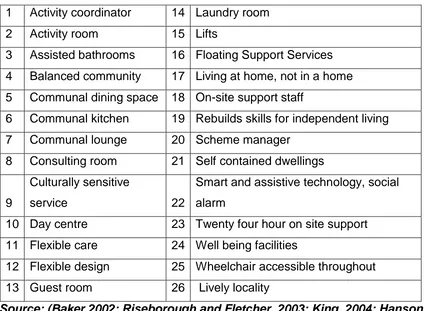
Table 2 5: Provisions in Sheltered Housing for the elderly 1 Activity coordinator 14 Laundry room
2 Activity room 15 Lifts
3 Assisted bathrooms 16 Floating Support Services 4 Balanced community 17 Living at home, not in a home 5 Communal dining space 18 On-site support staff
6 Communal kitchen 19 Rebuilds skills for independent living 7 Communal lounge 20 Scheme manager
8 Consulting room 21 Self contained dwellings
9
Culturally sensitive
service 22
Smart and assistive technology, social alarm
10 Day centre 23 Twenty four hour on site support 11 Flexible care 24 Well being facilities
12 Flexible design 25 Wheelchair accessible throughout 13 Guest room 26 Lively locality
Source: (Baker 2002; Riseborough and Fletcher, 2003; King, 2004; Hanson
2007)
[image:55.612.122.546.126.437.2]38 Table 2 6: Sheltered Housing Provision
Life activities Support and Care services
Property Maintenance and
modification Household repairs
Grounds and garden maintenance
Minor modifications( e.g. grab rails showers rails)
Meal preparation Delivered Meals
Cooking in person's house
Nutrition, food preparation and storage advice
Domestic Work Restaurant
House cleaning Washing and ironing Shopping
Linen Services
Household Management e.g. paying bills making telephone calls
Transport Individual Transport to and from appointments
(medical, banking, etc) shopping
Social activity and recreation Friendly visiting and companionship Centre-base social activity(day care)
Provision and maintenance of recreational facilities e.g. swimming pools, sporting facilities,
recreational areas
organised activities, outings trips, holidays
Self-care Bathing/showering
Toileting Dressing Eating
Personal grooming e.g. shaving,hairdressing,makeup
Health care Home Nursing in person's home, including post hospital Domiciliary nursing in community centre
Allied health, i.e. physiotherapy podiatry, dietician speech therapy, occupational therapy
Provision of goods and equipments, e.g. dressings wheelchairs
Medication assistance
On-call nursing care(call buttons)
Caring Substitute carer in home or home of relief carer(respite) Supported for carers
Specialised dementia and Alzheimer's care
Life planning and management Service coordination and case management Counselling, support, information, advocacy. Relating to the physical environment
Relating to the Household Task
Relating to sociability
Relating to personal and health care
39
As rapidly growing proportion of the ageing population is living with disabling illness. Many of such individuals are seeking housing with specific provision that enables the delivery of support services, particularly with the development of assistive technology (telecare and telemedicine), and provision of appropriate aids or adaptations to their dwelling. Assistive technology is the term given for a range of sensors that are installed in the home of the elderly in order to monitor their well-being and safety. The sensors are discreet and unobtrusive and are connected to 24 hours control centre, allowing the elderly to maintain their independence with the comfort of knowing that, should they need help in an emergency, these devices will alert the control centre enabling effective help to be obtained quickly and efficiently. Tele-care service is automatically provided to elderly living in sheltered, as the sensors are operated via a Home Alarm Unit, which simply plus into the telephone line next to the handset. An emergency trigger pendant is provided with the Home Alarm, which can be worn either on the wrist, on a neck cord or clipped to their clothing. The portability of the pendant enables the elderly living in sheltered housing to summon help from anywhere in home. There is potential for all types of assistive technology to support elderly people living in sheltered housing but of most immediate interest is telecare. From origins it was a simple pull cords, hard wired into sheltered schemes, although, in the last ten years there have been several linked developments which together have dramatically increased the potential for assistive technology to play a great part in supporting elderly living in sheltered housing to maintain their independence.
40
41
Figure 2 5: Core Floating support activities in Sheltered Housing Source: (Researcher)
Similarly, different authors (Pleace and Quilgars, 2003; Cousins and Saunders 2008; Oldman 2008) have described floating support as a service that provides housing support to vulnerable adults to enable them to maintain their independence while living in the community. However, Sharples et al., (2002) define floating support as a service that encourages interagency collaboration, acting as a bridge between services and coordinating the input among different agencies.
42 those leaving hospital and care institutions.
Table 2 7: Floating Support Model
First stage: Immediate prevention of homelessness when first on the scheme
Securing A Tenancy / Preventing Eviction
Help with finding a house
Setting up utilities & paying bills Sorting out benefits
Getting furniture
Mediating between tenant and landlord (e.g. local authority) Second stage: Ongoing support
Maintaining The Tenancy With The Help of Floating Support
Budgeting
Reporting repairs/damage Keeping the tenancy agreement
Addressing health problems Drug problems
Alcohol problems Relationship problems
Third stage: Long-term preparation for independent living Preparing people For
Independent Living After Floating Support
Building support networks Raising confidence
Gradual reduction in support Adapted from (Crellen, 2004)
43
44
living environment and adequate professional care which is crucial in maintaining their independence and preventing social crises.
Although the boundary between support and care is to some extent blurred. Besides taking many various forms, floating support service can also include the mixture of different types of care and support services. The support services are those services generally accessible to the elderly living in sheltered housing in order to promote their independence and improve their wellbeing both physically and socially and reduce their vulnerability to adverse events. Generally individuals have a choice as to how far they avail themselves of such services. The underlying beliefs is that elderly individuals will be sheltered, supported and cared for throughout their lives, no matter what their care needs may be. There is a priority on a well balanced lifestyle as well as on provision of support and care.
In the US, as well as in Australia, the concept of floating support services is tailored packages of care and services covering various aspects of life that can assist the elderly to maintain or restore the balance in their lives, thereby preventing future crises or deterioration. However, in Canada, the term "supportive housing" is frequently used to describe the conventional or typical real estate services to elderly living in an assisted dwelling (Kodner and Spreeuwenberg, 2002).It is a service to help enhance the quality of life, consumer satisfaction, and cutting across multiple services to service users with complex long-term problems. Supportive housing is a supportive, but not a health care environment, it excludes care services such as medication management, blood pressure monitoring, catheter changing, and wound care (Social Data Research, 2000). It is typically the provision of security, recreation, transportation, housekeeping, social activities, and service and health-need counselling.
45
diversification has been accompanied by an increase in other forms of supported housing, including an increase in the number and range of arrangements targeted at older people with high and special needs.
46
2.10 The Importance and problems of Floating Support Services in Sheltered Housing
47
Source: (Sharples et al., 2002)
Floating support services can be an effective way of sustaining tenancies and meeting elderly people‘s housing-related support needs. However, it is difficult to quantify the extent to which floating support service prevents tenancies from breaking down. A range of factors such as sufficient support, location, social networks, individual motivation, collaboration between agencies and timing of interventions can influence the successful implementation of floating support services to the elderly in sheltered housing.
48
However, a report by DCLG (2008) found that floating support services are often not co-ordinated, particularly for elderly people, and lack of communication and knowledge sharing between providers means that service users are not receiving an holistic service. Whilst floating support helps with the transition to independent living for those leaving hospital and respite institutions, the main purpose is to provide general, non-specialist support providing help with daily living skills, practical tasks or emotional support which promotes a person‘s ability to live independently in sheltered housing. Sharples et al., (2002) note that there is a lack of empirical research into floating support services, especially dealing with the development of the floating support worker‘s role alongside other professionals and difficulties surrounding confidentiality and information sharing between inter-professional and interagency working. Sharples et al., (2002) also point out that knowledge sharing between agencies providing floating support is believed to be a useful approach to facilitate effective communication between agencies, thereby creating a common understanding of organisational norms. However, Lovatt and Whitehead (2006) argue that floating support is capable of providing support tailored to the needs of the individual, but it is difficult to meet these in a single approach, as each individual has diverse need.
2.11 Summary of Chapter
49
50
CHAPTER THREE
KNOWLEDGE MANAGEMENT AND KNOWLEDGE SHARING 3.1 Introduction
This chapter begins with the theoretical description of knowledge which is the key concept that defines this research. It specifically explores the theoretical background to knowledge and further provides a distinction between data, information and knowledge. Following this, the typology of knowledge, whereby both types of knowledge: tacit and explicit knowledge are discussed and highlighted. It continues with background on knowledge management, knowledge management processes and a working definition of knowledge sharing is provided. The chapter concludes by identifying different critical success factors for knowledge sharing.
3.2 The Concept of Knowledge
51
one good, knowledge, and one evil, ignorance‖ While Sir Francis Bacon (1561– 1626) acknowledged that ―knowledge is power‖.
In recent times, post-modernists viewed knowledge as a fundamental truth. According to Probst et al., (2000) knowledge is a whole body of cognition and skills which individuals seek to solve problems, including theories and practical everyday rules and instructions for action. This view was later supported by Wilson (2002) who informs us that ―knowledge involves the mental processes of comprehension, understanding and learning that go on in the mind‖. However, Hildreth and Kimble, (2002) point out that knowledge is information which has been interpreted and is embedded within the beliefs and values of an individual. This agrees with Tsouka‘s (2003) definition of knowledge as information interpreted by the individual and applied to the purpose for which it is needed. It is then right to say that for knowledge to be of value it must be context specific, focused, current, tested and shared (Galup et al., 2002). Knowledge is also central to several different research traditions, such as organisational learning, the management of technology and managerial cognition (Grant, 1996).
Some theorists (Davenport and Prusak, 1998; Wiig, 2004) believe that knowledge resides in humans and it is used for the purpose of action. They argue that it is knowledge that allows humans to ―assess, decide, problem-solve, plan, act and monitor‖. Nonaka and Takeuchi, (1995) consider knowledge to be ―a dynamic human process of justifying personal belief toward the ‗truth‖. Fundamentally, they argue that knowledge constitutes a personal belief, the validity or truth of which is strengthened by a process of justification. This view is echoed by Drucker (1993), who suggests that knowledge is about action, which is always focused on some closure.