An Evaluation of the Impact of Gaming
Technology on Learning
Abdulaziz A M Alkandari
An Evaluation of the Impact of Gaming
Technology on Learning
Abdulaziz A M Alkandari
School of the Built Environment
College of Science and Technology
University of Salford, Salford, UK
i
Table of Contents
Acknowledgements... xx
Declaration... xxi
Abstract ...xxii
Chapter 1. Introduction...1
1.1 Motivation ...1
1.2 Aim...4
1.3 Objectives...4
1.4 Deployment content: ...4
1.5 Research process ...5
1.6 Research contribution ...6
1.7 Thesis structure ...7
1.8 Summary ...8
Chapter 2. Literature review...9
2.1 Introduction ...9
2.2 Learning ...10
2.2.1 Learning experience...10
2.3 Learning Theories ...12
2.3.1 Behaviourism ...13
2.3.2 Cognitivism...14
2.3.3 The humanism theory ...14
2.3.4 Experiential learning...15
2.3.5 The transformative learning theory ...15
2.3.6 The social theory of learning ...15
ii
2.3.8 Cognitive load theory ...17
2.4 Learning Factors ...20
2.4.1 Attitude ...21
2.4.1.1 Autonomous learning ...21
2.4.1.2 Curiosity...24
2.4.1.2.1 The Melbourne State-Trait curiosity inventory ...25
2.4.1.3 Motivation ...25
2.4.2 Cognition ...27
2.4.2.1 Higher-order thinking ...27
2.4.2.1.1 Bloom’s taxonomy ...28
2.4.2.1.2 Problem solving ...32
2.4.2.1.3 Critical thinking ...33
2.4.3 The structure of memory (cognitive load) ...34
2.4.3.1 Short-term memory ...34
2.4.3.2 Long-term memory ...35
2.5 Human-Computer Interaction (HCI)...36
2.5.1 Human factor ...37
2.5.1.1 Sensors ...37
2.5.1.2 Responders ...38
2.5.1.3 The brain ...38
2.6 Online learning (e- learning)...39
2.6.1 Technological tools and resources for e- learning ...41
2.6.1.1 E-books ...41
2.7 Gamification...43
2.7.1 Gaming technology...45
2.7.1.1 Influence of gaming technology on learning ...48
2.8 Academic Libraries’ role ...50
2.8.1 Academic libraries’ services ...50
iii
2.8.2 Academic libraries’ online learning services...52
2.8.3 Using gaming technology in academic libraries...54
2.8.4 Using gaming technology as an e-resource ...55
2.9 Summary ...56
Chapter 3. Research Methodology ...57
3.1 Philosophy...58
3.1.1 Ontology ...58
3.1.1.1 Objectivism ...59
3.1.1.2 Subjectivism...59
3.1.2 Epistemology: pragmatism ...59
3.1.3 Axiology ...61
3.2 Approach ...62
3.2.1 Deduction...63
3.2.2 Induction ...64
3.2.3 Abduction ...64
3.3 Methodological Choice ...66
3.3.1 Quantitative...66
3.3.2 Qualitative...66
3.3.3 Mixed Methods ...66
3.4 Research Strategies ...70
3.4.1 Experiment Research ...70
3.4.2 Experimental Design ...71
3.4.3 Sampling ...72
3.4.4 Participants ...75
3.4.5 Variables ...75
iv
3.4.6.1 Gaming technology platform ...76
3.4.6.2 E-book platform ...77
3.4.6.3 Snagit software...77
3.4.6.4 FaceReader system...77
3.4.7 Experimental Procedures ...78
3.4.8 Data collection and experiment steps ...79
3.5 Time Horizon ...81
3.6 Techniques and Procedure ...81
3.6.1 Data collection techniques ...81
3.6.2 Semi-structured interviews ...81
3.6.2.1 Questionnaire ...82
3.6.2.2 Observation ...82
3.6.3 Data Analysis ...83
3.6.3.1 Content analysis ...83
3.6.3.2 Statistical analysis ...84
3.7 Validity and reliability ...84
3.8 Ethical considerations ...87
3.9 Summary ...88
Chapter 4. Experimental Platform Design ...89
4.1 Conceptual framework ...89
4.2 Measurement framework ...91
4.3 Design platforms ...99
4.3.1 The Research Methodology Game Design ...100
4.3.1.1 Introduction ...100
4.3.1.2 Game design theories ...101
4.3.1.2.1 The flow theory ...104
4.3.1.2.1.1 Challenges ...105
v
4.3.1.2.1.3 Clear goals...106
4.3.1.2.1.4 Feedback ...106
4.3.1.2.1.5 Concentration on the task at hand ...106
4.3.1.2.1.6 A sense of control ...106
4.3.1.2.1.7 A loss of self-consciousness ...107
4.3.1.2.1.8 An altered sense of time...107
4.3.1.2.1.9 The flow zone...107
4.3.1.3 Challenges faced in developing the Research Methodology Game ...108
4.3.1.4 Game scenarios for learning research methodology ...108
4.3.1.5 The game’s objective ...110
4.3.1.6 The game’s storyboard...110
4.3.1.7 Game characteristics ...111
4.3.1.8 Game design elements ...113
4.3.1.8.1 Game Tasks ...115
4.3.1.8.2 The game’s design framework ...116
4.3.2 E-book design ...117
4.4 Summary ...118
Chapter 5. The impact of gaming technology on learners’ attitudes...120
5.1 Introduction ...120
5.2 Attitude...120
5.2.1 Autonomous Learning ...121
5.2.1.1 Willingness...128
5.2.1.2 Confidence ...133
5.2.1.3 Goals and plans ...137
5.2.1.4 Tactics ...138
5.2.1.5 Adaptation ...142
5.2.2 Curiosity ...142
5.2.2.1 Interest...148
5.2.2.2 Deprivation...152
vi
5.2.3.1 Emotional ...160
5.2.3.1.1 Emotional influence...169
5.2.3.1.1.1 Belief ...169
5.2.3.1.1.2 Goals ...170
5.2.3.1.1.3 Interest...172
5.2.3.1.1.4 Habits of thinking...172
5.2.3.1.1.5 Stimulation ...173
5.2.3.2 Intrinsic motivation ...174
5.2.3.2.1 Novelty ...174
5.2.3.2.2 Difficulty ...177
5.2.3.2.3 Personal interest...180
5.2.3.3 Effort ...185
5.2.3.4 Extrinsic motivation ...189
5.2.3.4.1 Challenges ...189
5.2.3.4.2 High score...189
5.2.3.4.3 Winning ...189
5.3 Discussion: ...190
5.4 Summary ...192
Chapter 6. Considering the influence of gaming technology on learners’ higher-order thinking 194 6.1 Introduction ...194
6.2 Cognition...194
6.2.1 Critical thinking ...200
6.2.1.1 Recognition of assumption ...200
6.2.1.2 Induction ...203
6.2.1.3 Deduction ...206
6.2.1.4 Interpretation ...210
6.2.1.5 Evaluation ...212
6.2.2 Problem solving ...218
vii
6.4 Summary ...225
Chapter 7. The impact of gaming technology on cognitive load ...226
7.1 Introduction ...226
7.2 Process: Cognitive Load ...226
7.2.1 Short-term memory...227
7.2.1.1 Effort ...229
7.2.1.2 Difficulty ...236
7.2.1.3 Performance ...244
7.2.1.4 Cognitive load ...254
7.2.2 Long-term Memory ...257
7.3 Discussion: ...258
7.4 Summary ...259
Chapter 8. Discussion ...260
8.1 Attitude...261
8.1.1 Autonomous learning...261
8.1.2 Curiosity ...263
8.1.3 Motivation...264
8.2 Cognition...266
8.2.1 Problem solving ...267
8.2.2 Critical thinking ...267
8.3 Cognitive load ...267
8.4 Relationship between e-book and gaming technology ...268
8.5 Using gaming technology as an e-resource in an academic library ...269
8.6 Summary ...271
Chapter 9. Conclusion ...273
viii
9.2 Thesis Summary...273
9.3 Research Assessment ...274
9.4 Research Contributions ...278
9.5 Future Research Recommendations...279
References...280
Appendix1- Session attendant & Publishing: ...291
Appendix 2- Melbourne A State- Trait Curiosity Inventory ...293
Appendix 3- How to play game? ...295
Appendix 4- Independent learning stage question before and after doing experiment ...300
ix
List of Figures
Figure 1.1 The research process followed in this study...6 Figure 2.1 Learning theories ...13 Figure 2.2 Learning Factors...20 Figure 2.3 Terminological changes from the old version of Bloom’s taxonomy to the new version (Source: Forehand, 2005)...29 Figure 2.4 Human factor: view of the human operator in a work environment (Source:
Mackenzie, 2013, p. 30) ...37 Figure 2.5American Public University System online library’s main portal, 2012 (Uzwyshyn et al., 2013). ...53 Figure 2.6 American Public University System online library user traffic: 2005–2012
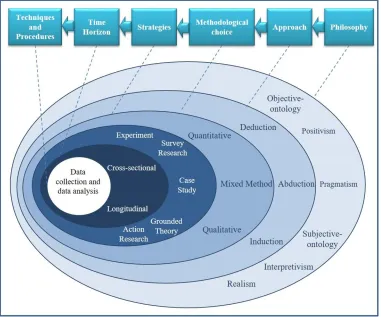
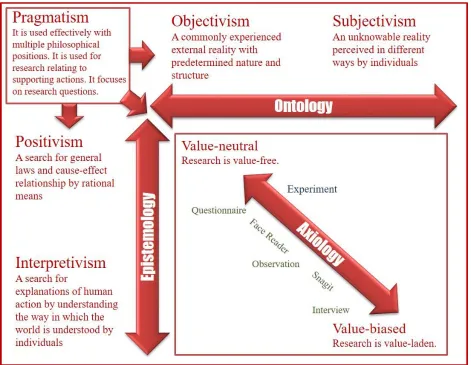
(Uzwyshyn et al., 2013). ...53 Figure 3.1 The Research O nion Model (Saunders et al., 2012 ). ...57 Figure 3.2 Relationship of research philosophy to methodology. This figure illustrates the relationship of the research philosophy to the methodology used for this research. ...62 Figure 3.3 Deduction approach. This figure outlines the deduction approach (John W.
Creswell, 2011, p. 57). ...63 Figure 3.4 Induction approach. This figure outlines the induction approach (John W.
Creswell, 2011, p. 63). ...64 Figure 3.5 The research approach. This figure outlines the research approach used. ...65 Figure 3.6 Intervention with explanatory mixed method design. This figure illustrates the intervention with explanatory design that was utilised in this research. ...69 Figure 3.7 Independent, dependent and control variables. This figure illustrates the
x
Figure 4.3 The flow theory (showing the flow zone). ...107
Figure 4.4 The game scenarios ...109
Figure 4.5 The Research Methodology Game ...109
Figure 4.6 The game’s objective screen ...110
Figure 4.7 The Research Methodology Game storyboard. ...111
Figure 4.8. Task 1 Screen ...115
Figure 4.9 The Research Methodology Game design framework. ...117
Figure 4.10 A sample of the e-book’s content and pages. ...118
Figure 5.1 Attitude factors. ...121
Figure 5.2 Differences between the autonomous learning stages before and after using gaming technology...123
Figure 5.3 Differences between the autonomous learning stages before and after reading the e-book. ...124
Figure 5.4 Results for the descriptive statistics for the factor ‘Gaming technology enhances autonomous learning’. ...125
Figure 5.5 Results for the descriptive statistics for the factor ‘E-books enhance autonomous learning’. ...125
Figure 5.6 Comparing the means of gaming technology with the e-book in terms of enhancing autonomous learning...127
Figure 5.7 The factor of Autonomous Learning and its sub- factors...127
Figure 5.8 Willingness elements for gaming technology and the e-book. ...133
Figure 5.9 Confidence elements for gaming technology and the e-book. ...136
Figure 5.10 Learning mode screen. ...141
Figure 5.11 Playing mode screen...141
Figure 5.12 The descriptive statistics for the trait of curiosity (gaming technology group). ..143
Figure 5.13 The descriptive statistics for the state of curiosity (gaming technology group). .144 Figure 5.14 The paired-sample t-test for the trait of curiosity and the state of curiosity for the gaming technology group. ...145
Figure 5.15 The descriptive statistics for the trait of curiosity (e-book group). ...145
Figure 5.16 The descriptive statistics for the state of curiosity (e-book group). ...146
xi
Figure 5.18 The factor of curiosity and its sub- factors...147
Figure 5.19 The descriptive statistics for interest (gaming technology group). ...148
Figure 5.20 The descriptive statistics for interest (e-book group). ...149
Figure 5.21 An independent-samples t-test result for the factor ‘interest’ with regard to gaming technology and the e-book. ...150
Figure 5.22 The descriptive statistics for deprivation (gaming technology group). ...152
Figure 5.23 The descriptive statistics for deprivation (e-book group). ...153
Figure 5.24 An independent-samples t-test result for the factor ‘deprivation’ with regard to gaming technology and the e-book. ...154
Figure 5.25 The descriptive statistics for motivation (gaming technology group). ...157
Figure 5.26 The descriptive statistics for motivation (e-book group). ...158
Figure 5.27 Comparison of the means for gaming technology and the e-book in terms of their motivation of learners to gain knowledge, experience and skills. ...159
Figure 5.28 The factor of motivation and its sub- factors. ...160
Figure 5.29 Means for emotions (gaming technology group). ...161
Figure 5.30 FaceReader analysis of participants’ emotion whilst using the gaming technology. ...161
Figure 5.31 Participants’ emotional stages and processes during learning via gaming technology...164
Figure 5.32 Means for emotions (e-book group). ...165
Figure 5.33 FaceReader analysis of participants’ emotions while reading the e-book. ...165
Figure 5.34 The independent-samples t-test showing the FaceReader results. ...169
Figure 5.35 The results as rated by the participants as to whether gaming technology is a new technology within learning. ...175
Figure 5.36 The results as rated by the participants as to whether e-books are a new technology within learning. ...176
Figure 5.37 Comparison of the means for ‘novelty’ with regard to gaming technology and the e-book in the area of learning. ...177
xii
Figure 5.39 Results showing the participants’ ratings of difficulty with regards to using the
e-book. ...179
Figure 5.40 Comparison of the amount of difficulty in learning about research methodology through gaming technology and the e-book. ...180
Figure 5.41 Results for the ratings of participants’ personal interest in learning (gaming technology group). ...181
Figure 5.42 Results for the ratings of participants’ personal interest in learning (e-book group). ...181
Figure 5.43 Comparison of the personal interest factor between the gaming technology and the e-book groups. ...183
Figure 5.44 The results (as rated by the participants) of the influence of gaming technology on intrinsic motivation. ...183
Figure 5.45 The results (as rated by the participants) of the influence of the e-book on intrinsic motivation. ...184
Figure 5.46 Comparison of intrinsic motivation when using gaming technology and the e- book. ...185
Figure 5.47 Participants’ ratings for effort required by gaming technology. ...186
Figure 5.48 Participants’ ratings for effort required by the e-book. ...186
Figure 5.49 Comparison of the amount of effort it takes to learn in terms of using gaming technology and the e-book. ...188
Figure 6.1 Results of the paired-sample t-test for the level of understanding of research methodology before and after the use of gaming technology...195
Figure 6.2 Results of the paired sample t-test showing the participants’ levels of understanding of research methodology before and after reading the e-book ...196
Figure 6.3 Impact of gaming technology on analysis ability...197
Figure 6.4 Impact of the e-book on analysis ability ...198
Figure 6.5 Results of the independent sample t-test for analysis ability ...199
Figure 6.6 the cognition factors ...200
Figure 6.7 The critical thinking factor and sub- factors ...200
Figure 6.8 Impact of gaming technology on recognition of assumption ability ...201
xiii
Figure 6.10 Results of the independent samples t-test for recognition assumption ability ...203
Figure 6.11 Impact of gaming technology on induction ability ...204
Figure 6.12 Impact of the e-book on induction ability ...205
Figure 6.13 Results of the independent samples t-test for induction ability ...206
Figure 6.14 Impact of gaming technology on deduction ability ...207
Figure 6.15 Impact of e-books on deduction ability ...208
Figure 6.16 Results of the independent-samples t-test for recognition of deduction ability ...209
Figure 6.17 Impact of gaming technology on interpretation ability ...210
Figure 6.18 Impact of the e-book on interpretation ability...211
Figure 6.19 Results of the independent samples t-test for interpretation ability ...212
Figure 6.20 Impact of gaming technology on evaluation ability, as rated by the participants 213 Figure 6.21 Impact of the e-book on evaluation ability...214
Figure 6.22 Results of the independent samples t-test for evaluation ability ...215
Figure 6.23 Impact of gaming technology on critical thinking ...216
Figure 6.24 Impact of the e-book on critical thinking ...216
Figure 6.25 Results of the independent samples t-test for critical thinking ...218
Figure 6.26 Impact of gaming technology on problem solving ability ...219
Figure 6.27 Impact of the e-book on problem solving ability ...220
Figure 6.28 Results of the independent samples t-test for problem solving...221
Figure 6.29 The problem solving factor and its sub- factors ...222
Figure 7.1 The memory process that affects cognitive load. ...227
Figure 7.2 Results as to whether or not gaming technology requires a low amount of mental effort. ...229
Figure 7.3 The results regarding the mental effort required during learning through gaming technology...230
Figure 7.4 The impact of gaming technology on mental effort. ...230
Figure 7.5 Results regarding whether or not e-books require a low amount of mental effort. 231 Figure 7.6 Mental effort expended during learning via the e-book. ...232
Figure 7.7 The impact of e-books on mental effort. ...232
xiv
Figure 7.10 Results from the independent-samples t-test regarding mental effort...236
Figure 7.11 Results as to whether or not gaming technology eases the understanding of difficult concepts. ...237
Figure 7.12 Statistics for participants’ rating of the difficulties faced while learning via gaming technology...237
Figure 7.13 Statistics as to whether or not gaming technology reduces learning difficulties. 238 Figure 7.14 Results as to whether or not e-books made it easier to understand concepts. ...239
Figure 7.15 The impact of e-books on reducing learning difficulties. ...239
Figure 7.16 The impact of e-books on reducing learning difficulties. ...240
Figure 7.17 The independent-samples t-test results concerning ease of use of both gaming technology and the e-book. ...241
Figure 7.18 The independent-samples t-test results in terms of rating the difficulties faced during learning. ...242
Figure 7.19 The independent-samples t-test results regarding the amount of difficulty faced during learning. ...244
Figure 7.20 Statistics showing whether or not gaming technology supports effective performance. ...244
Figure 7.21 Ratings as to whether or not gaming technology participants felt a sense of accomplishment. ...245
Figure 7.22 Ratings as to whether or not gaming technology made participants feel comfortable after performing tasks. ...246
Figure 7.23 Gaming technology’s impact on performance. ...246
Figure 7.24 E-books’ impact on supporting effective performance. ...247
Figure 7.25 The impact of e-books on the participants’ sense of accomplishment concerning task performance...248
Figure 7.26 The e-book’s impact on participants’ comfort level after performing tasks. ...248
Figure 7.27 E-books’ impact on performance. ...249
Figure 7.28 The independent-samples t-test results for effective performance. ...250
xv
Figure 7.30 The independent-samples t-test results for feeling comfortable after achieving
tasks. ...252
Figure 7.31 The independent-samples t-test results for supporting performance. ...253
Figure 7.32 The impact of gaming technology on cognitive load. ...254
Figure 7.33 The impact of e-books on cognitive load. ...255
xvi
List of Tables
Table 2.1 Grow’s Model for Independent Learning ...22
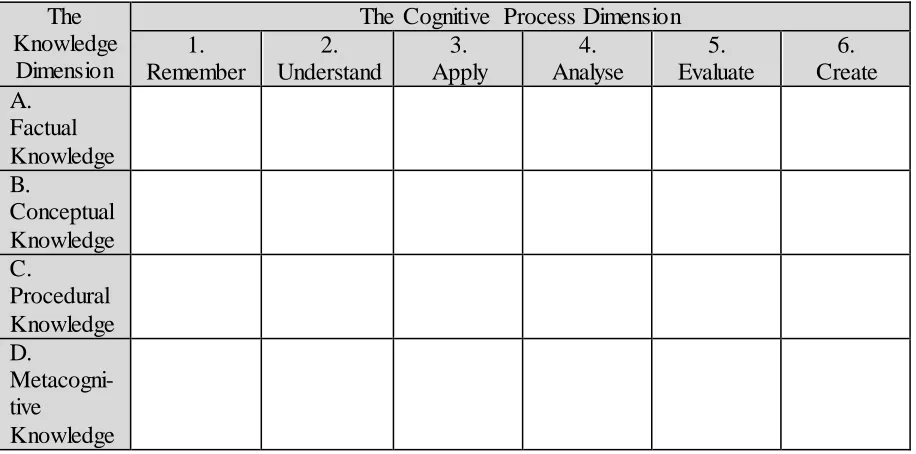
Table 2.2 Bloom’s taxonomy (Sources: Anderson & Krathwohl, 2001, p. 68; Bloom, 1956; Spring, 2010) ...30
Table 2.3 The two-dimensional version of Bloom’s taxonomy (Source: Anderson & Krathwohl, 2001, p. 92) ...31
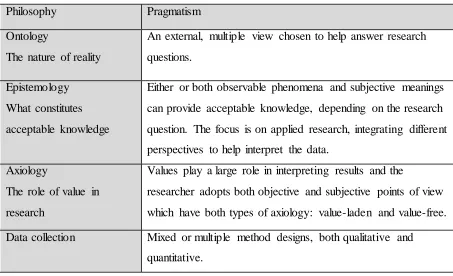
Table 3.1 Research Philosophies (Saunders et al., 2012, p. 140) ...61
Table 3.2 Data collection and experiment steps ...80
Table 4.1 Attitude: Autonomous learning ...93
Table 4.2 Attitude: Curiosity ...94
Table 4.3 Attitude: Motivation ...95
Table 4.4 Cognitive and higher-order thinking: critical thinking ...96
Table 4.5 Cognitive and higher-order thinking: problem solving ...97
Table 4.6 Cognitive load...98
Table 4.7 Platforms’ characteristics ...99
Table 4.8 Characteristics of the Research Methodology Game ...112
Table 4.9 Game design elements based on the flow theory ...113
Table 4.10 Supportive game design elements ...114
Table 5.1 Autonomous learning stages before and after using the gaming technology ...122
Table 5.2 Autonomous learning stages before and after reading the e-book. ...123
Table 5.3 Independent-samples t-test results when comparing gaming technology with the e-book in terms of whether they enhance autonomous learning. ...126
Table 5.4 Comparison of the elements that support willingness between gaming technology and the e-book...128
Table 5.5 Responses from participants in response to the question: Did (gaming technology/the e-book) enhance your willingness to learn independently? Why? How? ...129
Table 5.6 Comparison between gaming technology and the e-book in terms of the elements that support confidence. ...134
Table 5.7 Responses from participants with regard to the question: Did (gaming technology/e-book) enhance your confidence to learn independently? Why? How? ...134
xvii
Table 5.9 Tactics that were used to perform the tasks by the gaming technology group and the
e-book group. ...139
Table 5.10 The paired-sample t-test result that measured the trait and state of curiosity for the gaming technology group. ...144
Table 5.11 Paired-sample t-test result that measured the trait and state curiosity for the e-book group. ...146
Table 5.12 An independent-samples t-test result for the factor ‘interest’ with regard to gaming technology and the e-book. ...149
Table 5.13 Elements and participants’ responses regarding interest. ...151
Table 5.14 An independent-samples t-test result pertaining to the factor ‘deprivation’ with regard to gaming technology and the e-book. ...153
Table 5.15 The elements of deprivation that were found based on participants’ responses. ..155
Table 5.16 The differences between gaming technology and the e-book with regard to the factor ‘curiosity’, its sub-factors and elements. ...156
Table 5.17 The independent-samples t-test result concerning motivation when using gaming technology and the e-book. ...158
Table 5.18 The results for the independent-samples t-test from the FaceReader system. ...167
Table 5.19 Goals set by the gaming technology group and the e-book group. ...171
Table 5.20 Thinking habits used by the gaming technology group and the e-book group...173
Table 5.21 The independent-samples t-test result regarding the factor ‘novelty’ in terms of gaming technology and the e-book. ...177
Table 5.22 The independent-samples t-test results in the amount of difficulty of learning about research methodology through gaming technology and the e-book. ...179
Table 5.23 The independent-samples t-test results concerning participants’ personal interest with regard to gaming technology and the e-book. ...182
Table 5.24 The independent-samples t-test results for intrinsic motivation when using gaming technology and the e-book. ...185
Table 5.25 The independent-samples t-test results on rating the effort it take to learn through gaming technology and the e-book. ...187
xviii
Table 6.1 Results of the paired-sample t-test for the level of understanding of research
methodology before and after the use of gaming technology...194
Table 6.2 Results of the paired sample t-test showing the participants’ levels of understanding of research methodology before and after reading the e-book ...196
Table 6.3 Results of the independent sample t-test for analysis ability...199
Table 6.4 Results of the independent samples t-test for recognition assumption ability ...202
Table 6.5 Results of the independent samples t-test for induction ability ...205
Table 6.6 Results of the independent samples t-test for the recognition of deduction ability .209 Table 6.7 Results of the independent samples t-test for interpretation ability ...212
Table 6.8 Results of the independent samples t-test for evaluation ability ...215
Table 6.9 Results of the independent samples t-test for critical thinking...217
Table 6.10 The results of the independent-samples t-test for problem solving ...221
Table 6.11 Content analysis for problem solving ability ...222
Table 6.12 Comparison of all the results from the experiment, the questionnaire and the interview in relation to the studied technologies’ impacts on cognition ...224
Table 7.1 Cognitive load: The evaluation steps and process ...228
Table 7.2 Independent-samples t-test results for causes of low mental effort...233
Table 7.3 The independent-samples t-test results for the amount of mental effort required ...234
Table 7.4 The results from an independent-samples t-test regarding mental effort ...236
Table 7.5 The independent-samples t-test results concerning the ease of use of gaming technology and the e-book ...241
Table 7.6 The independent-samples t-test results regarding rating the difficulties faced during learning. ...242
Table 7.7 The independent-samples t-test results regarding the amount of difficulty faced during learning. ...243
Table 7.8 The independent-samples t-test results for effective performance ...250
Table 7.9 The independent-samples t-test results for making sense of the steps to perform tasks. ...251
Table 7.10 The independent-samples t-test results for feeling comfortable after achieving tasks. ...252
xix
xx
Acknowledgements
I would like to express my sincere appreciation to my supervisor, Professor Terrence Fernando, for his constant support, great cooperation, guidance and continued encouragement througho ut this research.
I would also like to thank the Kuwaiti government for their financial support for my PhD. In particular, I am indebted to the Public Authority for Applied Education and Training (PAAET) for giving me the opportunity to pursue my higher education.
A great “Thank you” goes out to my colleagues in the Thinklab: Hanneke van Dijk for her support, help, encouragement and proofreading of my thesis and her helpful disposition; project manager Simon Campion for the discussions and comments during this study; Dr May Bassanino and Dr Shamaila Iram for their help and support; and Carla Kocsis, Dulcidio Coelho, Dr Georgios Kapogiannis, Matar Alzehmi, Dr Kuo-Cheng Wu and Zihao Tan for their good personalities and friendly natures.
I wish to extend special gratitude and thanks to my mother for everything she has done for me during my life. Special tribute and appreciation must also go to my brothers Mahmoud and Ibrahim, who encouraged me during my studies, and to my wife for her understanding, tolerance and moral support throughout my work. Thanks to my children for their support and patience during this research.
xxi
Declaration
xxii
Abstract
Education systems continue to face extensive challenges stemming from the on-going technological revolution, and e-books have now become one of the most important resources for learning. The majority of university students today use e-books to perform their tasks and research. In addition to e-books, gaming technology is frequently thought of as a promising technology that can have a substantial effect on future learning. The gaming technology environment has the potential to make learning more engaging and interesting as well as to enhance learners’ knowledge, skills and experience.
Based on the literature review conducted for this study as well as previous academic discussio ns, there are gaps in the existing literature regarding the effects of gaming technology on learning. This research thus aims to explore whether game-based learning environments have a greater effect on learners’ attitudes, higher-order thinking and cognitive load than e-book-based learning. This research investigates and clarifies effects such as the impact of gaming technology on attitudes (autonomous learning, curiosity and motivation) and cognitions (critical thinking and problem solving), evaluates the cognitive load and then compares it to the e-book impact.
The study utilised mixed intervention methods with a mixed-methods sequential explanatory design to test and explore factors affecting the use of e-books and gaming technology. This approach enabled the creation of e-book and gaming technology platforms for an experime nt conducted by 30 doctoral students at the University of Salford (15 in the e-book group and 15 in the gaming technology group). Several data collection methods were also used, includ ing questionnaires, interviews and observations via the FaceReader system and the Snagit software. Statistical analyses were performed using the SPSS and Excel software, as well as the NVivo software for content analysis, in order to answer the research questions.
1
Chapter 1.
Introduction
1.1 Motivation
Most people continuously learn and enhance their knowledge and skills in an effort to gain experience and to succeed in life (Pecorino, 2015); this implies that learning is important for enhancing the quality of life. Learning is the result of students’ action and thinking (Ambrose, Bridges, DiPietro, Lovett, & Norman, 2010). Ambrose et al. (2010, p. 3) define learning as ‘a process that leads to change, which occurs as a result of experience and increases the potential for improved performance and future learning’. Learning is thus a development process that enhances students’ attitudes, beliefs, social aspects, emotions, experience, values, knowledge and thinking (Ambrose et al., 2010).
Various technological improvements in the twenty-first century have influenced learners’ thinking skills; learners now use digital tools and resources to acquire knowledge and improve their skills and experience. The field of higher education is on the verge of massive changes in future learning models due to various technological developments in recent years (Huer, 2015). As a result, higher education establishments need to research the effects that this new technology will have on learning and leaders in the field need to prepare for this change. As Holliday (2016, p. 54) argues, many higher education leaders are not prepared for the potential impact that technology will have on the ability to attract and retain students. Baseline technology has so far been a necessity but not a distinguishing feature of institutions. This may change as technology becomes more visible, differentiated and integral to teaching and learning.
2
E-books have become one of the most important resources for learning (Clay, 2012; Mulholla nd & Bates, 2014). The majority of students at universities today use e-books to perform their tasks and research (Clay, 2012; Mulholland & Bates, 2014). In addition to e-books, gaming technology is frequently thought of as a promising technology that could have a substantia l effect on learning in the future. The use of gaming technology for learning, however, has long been in need of further exploration. As Pivec and Dziabenko (2004) state, the specific ways in which gaming technology enhances and supports learning are not entirely clear; more research is necessary to make gaming a more practical and useful learning tool. As Dix, Roselli, and Sutinen (2006) note, the use of gaming technology for learning requires further evidence and exploration to determine its exact effects on learning. Previous research has also suggested that educational games must be well designed if an effective learning environment is to be built in the future (Gee, 2005).
Recent studies have focussed on testing and exploring the effects of using gaming technology for learning (Van Eck, 2015). Effective gaming environments for learning must be further explored because several researchers have found that the deployment of gaming technology to be lacking in learning. For example, Van Eck (2015) found that the gaming revolution of the past few years has focussed on providing fun at the expense of providing gaming technology for learning objectives; he discussed the need to prepare the education system to use gaming technology for learning. According to Van Eck (2015, p. 13), ‘Games could play a role in education,’. Van Eck found that there is currently no agreement or evidence that gaming technology promotes or enhances learning, he recommended that more research should be undertaken to explore the impact of gaming technology on learning – particularly on students’ attitudes and beliefs about learning through a gaming technology environment – and by exploring the influence of gaming technology on learners’ cognition (such as their problem-solving and critical-thinking abilities).
3
areas of focus; the areas where these are embraced are subjects typically taught in art and design schools, and in the information and library sciences’.
The digital-gaming environment has the potential to make learning more engaging and interesting and to enhance learners’ concentration levels (Yang & Chang, 2013). Gaming technology can also foster higher-order thinking and enhance learning outcomes, because gaming environments have the ability to display information and knowledge; they can also allow learners to explore ‘what-if’ scenarios and to gain experience in solving problems or conducting tests within an attractive format (Martin, 2013; Rettig, 2013; Yang & Chang, 2013). In digita l-game learning, students are at the centre of learning and can adopt a problem-solving approach, both of which can help learners to improve their critical-thinking abilities (Yang & Chang, 2013, pp. 3-4).
According to McBride (2014), learning in the future must embrace several important cognitio n skills (such as critical thinking and problem solving) as well as various collaboration activit ies. It is thus necessary to explore the effects of gaming technologies on cognitive skills and how they can enhance learning
E-books have now become the norm. Does gaming technology provide better learning outcomes (such as attitude (autonomous learning, curiosity and motivation), cognition ability (critical thinking and problem solving), and memory process by reducing cognitive load) over and above e-books? This is the subject of this research.
This research is attempting to answer:
4
1.2 Aim
The aim of this research is to establish whether game-based learning environments have a greater effect on learners’ attitude, higher-order thinking and cognitive load than e-book based learning.
1.3 Objectives
The objectives of this research are:
To investigate the learning factors which are impacted upon by gaming technology and e-book technology by defining a framework that provides a basis for measuring learners’ attitudes, higher-order thinking and cognitive load, both subjectively and objectively;
To design and establish a technology-based learning environment to compare the learning differences via e-books versus gaming technology;
To explore gaming technology’s impact on learning by conducting experiments to compare outcomes when using based learning versus e-books to establish the benefit of game-based learning.
1.4 Deployment content:
The author believes that gaming technology can be used as an addition to the e-book resources provided by libraries. There are numerous reasons for this goal.
Academic libraries play a significant role in supporting learning in the academic community. As they provide the main source of information and the core tool for most academic subjects, such libraries may be described as instruments for learning (Nwofor & IIorah, 2006).
Academic libraries provide organised programmes, service delivery and a variety of collections.
Academic libraries are major learning spaces for improving knowledge and for promoting student self-development in universities and wider academic communit ies (Okeke, 2000).
5
Knowledge and information are widely considered to be valuable components for future developments that have the potential to provide the impetus to advance both people and entire nations (Daluba & Maxwell, 2013).
Games are already used in many libraries to gain a variety of advantages (such as enhanced engagement with the library) and have a positive effect on enhancing users’ knowledge, skills and experience (Nicholson, 2013).
Games can support courses and sessions in universities and are a valuable tool that instructors can use to teach more effectively. Nicholson (2013) suggests using gaming technology in libraries in order to enhance learning outcomes and learning performances.
In summary, the results of this research can enhance the use of gaming technology as an e-resource within academic libraries.
1.5 Research process
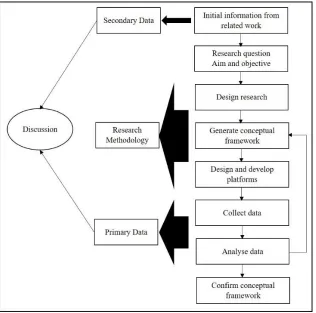
The research process for this study followed the steps shown in Figure 1.1. Firstly, the init ia l data was collected via the secondary data relating to the research area; this concerned which technologies enhance of learning in order that appropriate technologies may be used for online learning in an academic library system setting. The secondary data led to the discovery of a gap in previous research in this area. This, in turn, led to the establishment of a research question. A research design was then developed that would answer the research question and achieve the aim and objective; this involved the development of a conceptual framework that was created to test and explore the effects of gaming technology on learning. Both a gaming technology platform and an e-book platform were designed and developed for this research in order to compare the effect of gaming technology with that of e-books; this is because e-books are currently the main resource for online learning in an academic library setting. Both platforms were employed in a data-collection experiment; several processes and instruments (including a questionnaire, semi-structured interviews and observation) were used.
6
[image:30.612.86.402.119.432.2]In summary, this study has tested and explored the effects of gaming technology and e-books on learning and has built a relationship between technologies and enhanced learning.
Figure 1.1 The research process followed in this study
1.6 Research contribution
The aim of this research was to explore whether game-based learning environments have a greater effect than e-books-based learning on learners’ attitudes, higher order thinking skills and cognitive loads. The following contributions were made while fulfilling this aim.
Establishment of a conceptual framework. The framework resulting from this research demonstrates and presents the important factors that are needed to evaluate the
7
Through primary and secondary research this research established that:
Gaming technology enhances autonomous learning, curiosity and motivation and gaming technology has a more positive impact on learners’ attitudes than an e-book.
Gaming technology reduces the cognitive load and has a positive influence on cognitive load, more so than an e-book.
Gaming technology and e-books have a similar impact on critical thinking and problem solving ability.
1.7 Thesis structure
8
presents a discussion of the research and its outcomes. Finally, Chapter 9 presents conclusio ns and recommendations for further research.
1.8 Summary
This chapter has provided an outline of the research and has laid the foundations for the study by explaining the main motivations of the research. This chapter has focussed on the study’s aim, objectives and its contribution to knowledge, as well as delineating the research question in section 1.1.
9
Chapter 2.
Literature review
2.1 Introduction
This research looks at the use of gaming technology in learning and examines various learning theories that support gaming technology as a learning tool and as an e-resource for learning. This chapter primarily discusses the main concepts that have been explored in previous research. A review and explanation of the most important learning theories is provided, focusing on the constructivism theory and the cognitive load theory and their uses. This chapter then explores learning factors based on the constructivism theory and the cognitive load theory. These factors include: (1) attitude, which includes autonomous learning, curiosity and motivation; (2) cognition, which includes higher-order thinking based on problem solving and critical thinking, and (3) cognitive load, which supports memory to acquire knowledge effectively. By studying the use of gaming technology in learning, this chapter explores the connections between the constructivism and the cognitive load learning theories to discover the effect of gaming technology on learners’ attitude and cognition as a learning tool. The focus then switches to human-computer interaction (HCI) to explain how learners interact with systems by using human sensors, responders and the brain.
This research also focuses on e-learning and discusses some of the effective technology tools that are used in such learning, such as e-books and gaming technology. Subsequently, the gamification concept is explained, followed by a review of previous research on the impact of gaming technology.
This chapter also explores the role of an academic library in providing services and resources for online learning. An academic library can provide an essential destination for learners who are searching for effective resources and learning services. Academic libraries use games, virtual reality and e-books for several purposes such as improving reference services, enhancing engagement and improving learning services and resources. This chapter looks at the use of gaming technology within academic libraries to support learning and academic performance based on academic library targets.
10
services, collections and programmes by using gaming technology to support lear ning approaches and objectives.
2.2 Learning
Learning is undertaken by people to help them enhance their lives by going through processes to change and increase their understanding and improve their abilities in order to enhance their experiences. According to Ambrose et al. (2010, pp. 3-4) learning is a developmental process that intersects with other developmental processes in a student’s life, and students enter our classrooms not only with skills, knowledge and abilities, but also with social and emotiona l experience that influence what they value, how they perceive themselves and others, and how they will engage in the learning process. In addition, information is a fundamental human need and enhances the quality of civilisation whereby people obtain appropriate information in a timely manner (E. A. Fox & Marchionini, 1998). Learning which increases learner knowledge is defined by the Cambridge dictionary (2016) as ‘the understanding of information about a subject that you get by experience or study, either known by one person or by people generally’. Moreover, learning develops people’s skills. Skill is defined by the Cambridge dictionary (2016) as ‘an ability to do an activity or job well especially because you have practised it’. Knowledge and skills support a learner’s experience and enables him/her to be a proactive member in a community because learning focuses on changing the level of knowledge and skills; this experience will endure over the time (Schunk, 2012).
2.2.1 Learning experience
Experience is ‘the process of getting knowledge or skills from doing, or feeling things’ (Cambridge dictionary, 2016). According to the Oregon College of Education (1970, p. 123), learning experiences are elicited through the following four categories: orienting experience, foundation experience, synthesising experience and consolidating experience. These are described as follows:
11
Moreover, it can be used at any level of a learning system based on the needs of the learner.
Foundation experience: this involves learning experiences that guide learners to the cleverness of knowledge, to conceptual frameworks and achievement capabilities, which require the demonstration of a standard competency. Bloom’s Taxonomy is an example of this.
Synthesising experience: here, learning experiences are established through the following approaches:
o The synthesis of two or more types of knowledge and skills that enhance the foundation activities, for example, using questions to enhance various levels of thinking by sharing with classmates.
o The synthesis of total learning, knowledge and skills developed in the foundatio n activities, for example, when the teacher combines approaches in a geography lesson and requires students to see and recognise what was on a map reviewed in the lesson.
o Using syntheses to standardise a problem’s solution in the same situation and position of the problem; for example, in giving students a mathematics problem to solve so that they must use their experience, knowledge and thinking processes in order to solve the mathematical problem.
Consolidating experience: this gives learners the opportunity to practice the knowled ge that has been obtained and the syntheses that have been established. For example, an instructor may create a group and give the members a practicum setting and objective to practice solving problems. In such a case, the students are the ones who diagnose the problems. Since each student has a different background, the students will each have different perspectives on coming to a solution and they will apply these ideas and then evaluate the solutions. This will help the students to develop experience and practice their knowledge.
12
cognition and visual aspects. Thus, the learning process assesses and explains through learning theories which can enhance the creation of an effective learning environment for learning. To understand the learning process, several learning theories need to be reviewed. The next section will do so and then some theories will be selected that will help to test and explore the impact of gaming technology in learning.
2.3 Learning Theories
Learning theories demonstrate the process of learning through answering questions such as how can we learn and know? How can we gain and learn new knowledge? What are the sources of information and knowledge? (Schunk, 2012). ‘A theory is a scientifically acceptable set of principles offered to explain a phenomenon. Learning Theories supply a framework for explaining environmental observations and building a relationship between research and education’ (Suppes, 1974). Based on this definition, learning theories provide factors to explain the learning process which can also be used to explain the learning phenomena and to assess and test learning principles.
In addition, learning theories help to explain the impact of gaming technology in learning and explain the appropriate situation of learning through using gaming technology.
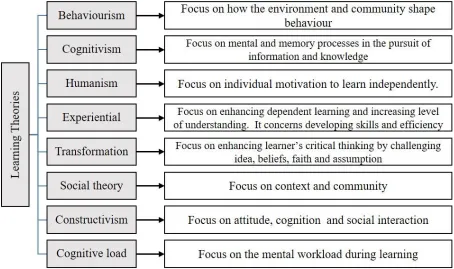
13 Figure 2.1 Learning theories
2.3.1 Behaviourism
Researchers employ behavioural theory when developing curricula and training sessions in order to improve user experience and competency (Skinner, 1954; Thordike, 1911). Accordingly, new user behaviour leads to the use of learning theories and behaviour theories for measuring an event or phenomenon with standard outcomes (Taylor & Hamdy, 2013). The behaviourism theory makes three major assumptions: learning is evident by its effects upon behaviour; environment and community shape behaviour; communication and fostering are required to demonstrate the method of learning (Grippin & Peters, 1984; Shlechter, 1991; Watson, 2013). Behaviourism has three representative requirements:
(1) Direct instruction: general learning by lecture rather than discovery.
14
(3) Social learning theory: learning from other people via ‘observation, imitation and modelling’ (W. H. Wu, Hsiao, Wu, Lin, & Huang, 2012, p. 267).
2.3.2 Cognitivism
Cognitive learning focuses on mental and memory processes in the pursuit of information and knowledge (Ausubel, 1968; J. S. Bruner, 1966; Gagne, Briggs, & Wagner, 1992; P. Moore & Fitz, 1993; Piaget, 1952). Cognitivism consists of four essential theories: the attribution theory, the elaboration theory, the stage theory of cognitive development and conditional learning. The attribution theory, created by Weiner (1974), attempts to discover the reasons behind behaviour by observing the learning process. The attribution theory includes two sets of attributes: external attributes that concentrate on outside factors such as success and chance, and internal attributes that are closely related to a learner’s abilities, intelligence and talents. The elaboration theory, established by Reigeluth (1983), holds that the learning content should be ordered and organised from easy to difficult, from basic to complex (Learning Theories Knowledgebase, 2008). Moreover, the elaboration theory assumes three principles: (1) guidelines and instruct io n encourage understanding, build meaning and motivate the learner; (2) a planned approach to learning enhances the speed at which a learner may gain understanding and knowledge, and (3) fast prototyping improves the pedagogical improvement process. The stage theory of cognitive development, established by Piaget in 1969, explains the four cognitive improvement periods of children: ‘sensorimotor, preoperational, concrete operational and formal operational’ (W. H. Wu et al., 2012, p. 267). The conditional learning theory, developed by Gagné (1965), suggests that there are a number of learning types and stages and that these classifications are important when developing specific learning instructions for each level or type. Gagne defined the five categories of learning as ‘verbal information, intellectual skills, cognitive strategies, motor skills and attitude’ (W. H. Wu et al., 2012, p. 267). In addition, internal and external situations play an important role in the different types of learning.
2.3.3 The humanism theory
15
develop their skills. Humanism is especially important and useful for experiential learning (Kolb, 1984) which requires no teacher; it offers instead a process of gaining knowledge based on individual experiences through the learning environment. According to Kolb (1984), the humanism theory allows for several learning styles: the diverger style that originates out of solid experience and pensive observation; the assimilator style that strives for understanding through thoughtful observation; the converger style in which concepts are confirmed through experiments, and the accommodator style that features both solid experience and active experimentation.
2.3.4 Experiential learning
Experiential learning enhances dependent learning and increases the level of understanding and knowledge within a social environment (Hart, 1992). It is often used in medical learning because it is helpful for developing skills and promoting efficiency in that context (Yardley, Teunisse n, & Dornan, 2012). Moreover, experiential learning offers learners the opportunity to monitor their educational progress. The learner is empowered to create, organise and experience in ways that aid learning (Taylor & Hamdy, 2013).
Experiential learning is also supported by Kolb (1984). It is a learning style that is mentioned in the humanism theory.
2.3.5 The transformative learning theory
The transformative learning theory creates a path to enhance a learner’s critical thinking by challenging ideas, beliefs, faiths and assumptions (Mezirow, 2000). This theory includes three distinct processes. Firstly, there is a disorienting dilemma, which is a method used to empower learners to express their perspectives. Next, there is a context formed by social, communit y, expert, professional and personal factors. A critical reflection occurs that leads to the transformation of rules, ideas, processes, meanings and premises. Finally, premise reflectio n provides a critical test of long-used axioms (Brookfield, 2000).
2.3.6 The social theory of learning
16
However, Land and colleagues mulled over the methods that learners use to share the community of learning in order to satisfy their needs and improve their knowledge (Meyer et al., 2008).
2.3.7 Constructivism
17
(J. Bruner, 1973). Constructivism was promoted by Vygotsky (1962). To connect learning to the social and cultural impacts of shared experience, it focuses on social interaction (Crawford, 1996). Learners use conversation and writing to build up culture and a community (Vygotsky, 1962). Furthermore, in 1962, Vygotsky established the concept of a zone of proximal development (ZPD) which examines the ability of a learner to accomplish an assignment under an instructor’s direction as compared with a team’s ability to find that solution independently (Nassaji & Cumming, 2000). The process in the ZPD that supports student learning is called ‘scaffold learning’ (Vygotsky, 1962).
Constructivism focuses on how people learn by concentrating on behaviours when interacting with the learning system, and on cognitive outcomes by discovering and finding solutions for game tasks. Learners enhance their experience by comparing new and current knowledge with their previous experience which leads them to develop and discover new experiences (K. J. Kiili, Perttula, Lindstedt, Arnab, & Suominen, 2014).
According to Mayer (2004), constructivism is the main theory that can be used to explain how people obtain knowledge and learn. Moreover, the constructivism learning theory is an excellent theory to use for developing a learning environment (such as a gaming technology environme nt for teaching and learning) in order to make learning efficient and useful (Overby & Jones, 2015). The constructivism theory is an effective theory for developing a gaming technology environment for learning because the constructivism theory supports discovery and interacting with a system to build knowledge, experience and skills. Furthermore, discovery supports higher-order thinking, such as critical thinking and problem solving. As a result, constructivis m can cover most of the concepts of gaming technology that are needed to support learning at universities and within academic libraries.
Overall, the previous explanation justifies the use of the constructivism learning theory to create a research methodology game.
2.3.8 Cognitive load theory
18
game, an understanding of the structure of memory and the cognitive process is required in order to build an effective learning environment (Kirschner, Sweller, & Clark, 2006). The cognitive load theory puts forward the structure of the memory process which helps in understanding how memory works through the three parts of the cognitive process (which are sensory memory, short-term memory and long-term memory).
The cognitive load theory defines memory types, long-term memory and short-term memory and their relationships in order to gain information and acquire knowledge (Van Merriënboer & Kirschner, 2012). Moreover, the cognitive load theory explains the processes and capacity of short-term memory (Chandler & Sweller, 1991), then uses a strategy to reduce cognitive load by transferring load to learning or by sending information to long-term memory.
The cognitive load theory divides the mental workload of obstructed learning into three parts. The first part is the intrinsic load which focuses on the complications of what learners are trying to learn. The second part is the extraneous load which gives attention to the complication of the system and the device from which the students are learning. The last part is the germane load which is essential in merging new information with current information and switching it to the long-term memory (K. Kiili, Lainema, de Freitas, & Arnab, 2014; Wilson & Wilson, 2013). Indeed, if a learner’s cognitive load is high, it may negatively affect the learner’s performance and learner behaviour while playing the game (K. J. Kiili et al., 2014). If learners have diffic ult y in learning and obtaining new information - or cannot learn and gain new information because of overloaded intrinsic and extraneous loads - technology tools can be used to assist these learners by decreasing intrinsic and extraneous loads because the learners interact with a system to gain knowledge (Mayer & Moreno, 2003). Hence, cognitive load is important because it affects a learner’s ability to understand.
19
during acquisition and in the future (Sweller et al., 2011). Sweller et al. (2011) pointed out that a high cognitive load may have a negative effect on learning time and on achieving tasks accurately.
The other measure of cognitive load is mental effort. It is based on a five-point Likert Scale starting with very high and ending with very low mental effort. Learners rate the mental effort at several points during tests (mental effort depends on the research questions and their variables). This helps to measure the effect that cognitive load has on achieving well in the learning stage; in addition, learners can rate the difficulty of the learning task (Sweller et al., 2011).
Paas and Van Merriënboer (1993) established an effective cognitive load measurement which is an efficiency measure. They combined self-rating efforts and task performance aspects to measure cognitive load (Sweller et al., 2011).
After the participants complete the task, effective performance needs to be measured. (Sweller et al., 2011). A sense of accomplishment enhances performance (Behn, 2003). Furthermore, performance in a comfortable environment makes a learner feel at ease during learning and enhances an effective performance (Lynch & Dembo, 2004).
The use of new technologies, such as gaming technology, in learning may help to reduce cognitive load and make learning more interesting and fun when building knowledge and improving learning skills and experience. Thus, it is worthwhile to rate the effect of gaming technology and e-books on participants’ effort, difficulties and performance in order to measure cognitive load.
20
2.4 Learning Factors
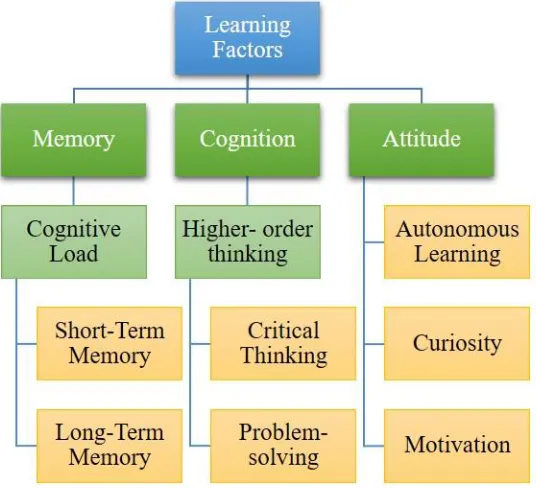
[image:44.612.180.448.359.603.2]Learning theories provide significant factors that can be used to measure learning and the acquisition of knowledge. Effective and complex learning requires knowledge, skills and attitude (Van Merriënboer & Kirschner, 2012). Based on the constructivism theory, this research demonstrates that attitude within learning (including autonomous learning, curiosity and motivation) enhances learners’ capabilities to develop their knowledge and abilities. Furthermore, this research infers cognitive aspects and focuses on higher-order thinking, namely the problem-solving skills and critical thinking skills that lead to effective academic performance. The cognitive load theory interprets the psychological aspects of learning by explaining the information processing within the mind and its effect on cognitive learning. Hence, it is important to choose and define suitable tools and the environment for effective learning. A combination of learning theories can help in interpreting the learning process due to their different aspects and concepts.
21
2.4.1 Attitude
Attitude includes the behaviour that a learner needs in order to acquire knowledge, skills and experience for the future. Past research has discussed the main attitudes that are required for future learning (such as autonomous learning) which helps learners improve themselves by obtaining knowledge independently (Biggs & Tang, 2007; Grasha & Yangarber-Hicks, 2000; Luke & Hogarth, 2011; M. G. Moore, 1973). Moreover, learners need curiosity to discover new information and to increase their ability and talents to create innovations (Arnone, 2003; Loewenstein, 1994; Reio, 2013). In addition, curiosity leads to motivation which enhances learners’ educational skills and encourages learners to undertake learning and acquire information, knowledge and skills.
Hence, attitude can explain the effect of the learning environment on learners’ autonomy, curiosity and their motivation to achieve success in the future which, in turn, leads to creating and utilising an effective technology for future learning.
2.4.1.1 Autonomous learning
With regard to independent learning, there is an important question: what is the main issue concerning independent learning if learners do not have or cannot improve their independent learning skills (Luke & Hogarth, 2011)? This issue is based on an individual’s ability for self-discovery and self-reliance in order to gain knowledge, experience and skills (Dempster, 1993). According to M. G. Moore (1973), independent learning concerns ‘what students learn and how they learn’.
22
Grow (1991) sketched a model for independent learning. Grow created four stages for learning: dependent, interested, involved and self-directed. The first stage is ‘dependent’ covering learners who are not able to gain knowledge without supported instruction from a teacher who provides lectures, directions and specific tasks (Heresy & Blanchard, 2001). The second stage is ‘interested’ wherein learners are ready and confident to learn and make an effort to achieve tasks. However, learners still need direction and support from an instructor to guide them. This means that learners do not have the ability to achieve tasks until they have received direct and specific explanations (Heresy & Blanchard, 2001; Warring, 2013). The third stage is ‘involved’ which means that the learners are clever and able to achieve tasks but have a need for motivat io n and confidence in order to perform tasks. In this stage, learners need encouragement and motivation and instructors need to be involved in decision making (Heresy & Blanchard, 2001). Stage-three learners have the opportunity to succeed with support from an instructor because they have talent and ability (Warring, 2013). The fourth stage of independent learning is ‘self-directed’ which incorporates a high level of independent learning. The learner at this level does not need direction and support because the learner has confidence and ability. In the fourth stage, learners can plan their own systems/techniques in order to achieve the learning outcomes they desire (Heresy & Blanchard, 2001).
Table 2.1 Grow’s Model for Independent Learning
1 Dependent Learners are unable/unwilling and/or insecure. Decisions are made by the teacher.
2 Interested Learners are unable but are willing and/or confident. Decisions are made by the teacher with explanation and support given to the learners.
3 Involved Learners are able but are unwilling and/or insecure. Decisions are shared.
4 Self-directed Learners are able/willing and/or confident. Decisions are made by the learners.
23
Independent learning has a variety of benefits. Independent learning increases and encourages the ability to learn autonomously and allows learners to create a framework to analyse and solve problems (Dawkins & Holding, 1987). Furthermore, independent learning enhances learners’ critical thinking and supports the understanding of deep and complex concepts (Percy & Salter, 1976). In addition, independent learning supports learners in maintaining life- long education (Koper & Tattersall, 2004). Although independent learning is fruitful for students, it also helps to develop organisations, employers and professional people (Luke & Hogarth, 2011).
The information processing theory enhances independent learning by providing a self-regula t io n model and by supporting this model with learning strategies. The information processing theory has improved the connection between the cognitive and self-regulation processes (Schunk, 2012). This research adopts theory concepts to measure independent learning by using gaming technology. The information processing theory is based on the encoding of information in the long-term memory. Learners retrieve information from the long-term memory and transfer it to the short-term memory which utilises existing information in order to understand and recognise new knowledge as well as organising and storing knowledge in the long-term memory for future use (Schunk, 2012).
24
All in all, autonomous learning requires willingnes s and confidence as well as manageme nt skills and memory processing in order to perform learning successfully via this learning system. This leads to using effective tools for future learning.
2.4.1.2 Curiosity
Curiosity empowers learners to discover, interact and make meaning of their environme nt. Teachers and educators enhance curiosity in learners to encourage their disposition to dig for information to improve their awareness; it is the first step in motivating learners. In addition, curiosity is a key component for fostering creativity (Arnone, 2003; Loewenstein, 1994). Furthermore, any improvement in learning is related to two factors which are cognitivism and curiosity (Piaget, 1952). Fostering learners’ curiosity is a significant means of enhancing learning (Arnone, 2003). Curiosity incorporates seeking and exploring behaviour that helps to develop cognitivism (Giambra, Camp, & Grodsky, 1992). Thus, a researcher needs to understand aspects of curiosity in order to measure curiosity successfully.