© 2016, IRJET | Impact Factor value: 4.45 | ISO 9001:2008 Certified Journal | Page 730
An emotion recognition system based on autistic facial expression using SIFT
descriptor with Genetic Algorithm
Rupinder kaur
---***---Abstract: In these days, emotion recognition is frequently used from the face recognition system but there problems occurred during classification of autistic person face by using the feature extraction technique because in emotion detection system we need more appropriate feature set of extracted face. We proposed Emotion recognition system based on autistic facial expression using SIFT descriptor with genetic algorithm (GA). In proposed work, we use back propagation neural network (BPNN) for the classification of emotion using extracted feature set from SIFT descriptor. SIFT descriptor is used to extract the key points from the face; if the facial expression is different than the feature set will varied. So, we can easily distinguish between different types of facial expression and after that we can optimize the SIFT key points using genetic algorithm. By using the proposed module, we got the accuracy near of around 95% and for the implementation of proposed work, we use Image Processing Toolbox under the MATLAB Software.
Keywords: Face Recognition System ● Autistics data● SIFT Descriptor ● Genetic Algorithm ● Back Propagation Neural Network ● Image Processing Toolbox
1 Introduction
Face is the primary prominence of thought in social dealings, which additionally assumes a most imperative part in transmission of identity and emotions. In spite of the fact that the capacity to induce knowledge or character from facial look is questionable, the human ability to recognize face is shocking. We can perceive a large number of confronts learnt all through our lifespan and recognize familiar appearances at a solitary impression even after such a variety of years of partition. This capacity is practically versatile, notwithstanding the reality there are to some degree gigantic deviations happen in the optical boost because of review circumstances, appearance, matured and impedances, for example, displays or changes done in facial hair or haircut [1].
Computational models of face-acknowledgment are extremely consideration getting in light of the fact that they can contribute especially in hypothetical bits of knowledge furthermore helps us to utilize its application. A few PCs are utilized for diagnosing faces that could be valuable to a boundless scope of confusions, which incorporates criminal ID, useful in security frameworks, photo and also movie preparing, and it is additionally useful in connection amongst human and PC. Unfavorably, it is exceptionally testing to build up a computational model of face acknowledgment [2].
The client would do well to accentuation the thought towards advancing a sort of opportune, pre-perceptive shape acknowledgment capability with the goal that it doesn't be dependent upon three-dimensional certainties or thorough geometry. One would do well to make a computational model of face acknowledgment that is quick accordingly giving, it ought to be sensibly easy to utilize and cognize, notwithstanding this must give the user exact final result denied of any misstep.
Eigen face is one sort of a face acknowledgment approach that can be confine and trail a subject's head, and by then distinguish the individual by method for partner elements of the individual face to those of recognized people.
© 2016, IRJET | Impact Factor value: 4.45 | ISO 9001:2008 Certified Journal | Page 731 two-dimensional (2-D) acknowledgment issue as opposed to require the recovery of three-dimensional geometry, by taking advantage of the given data that is countenances are commonly upright and therefore, might be characterized by a little arrangement of 2-D trademark sees.
Individuals express feelings in regular exercises. Feelings assume crucial part and regularly thought about the face. Late research has demonstrated that most expressive method for indicating feelings is by means of face appearances [3].
The significance of outward appearance framework is broadly perceived in social connection and social brains. Since nineteenth century, the framework examination has been a dynamic exploration topic. In 1978, the outward appearance affirmation framework was exhibited. The fore most issue happens in developing an outward appearance acknowledgment framework is face location in addition to position, picture standardization, highlight extraction, and recording. There are few numbers of techniques which we can use for perceiving the outward appearance. A portion of the specialists [4] presented the framework that can perceive the distinctive human motion in shading picture.
2
Related Work
This section illustrates the overall relation between previous proposed technique with our proposed Emotion recognition system based on autistic facial expression using SIFT descriptor with genetic algorithm technique.
S. No.
Author Advantages Technique Used
1 S.Kner et.al [21] It is flexible in nature. Single layer neural network.
2 John John et.al [22] Representation of robots w.r.t behavioral
patterns.
High level efficiency.
3 Kerstin et.al [23] Potential of using natural environment in
autism therapy.
Virtual environment
usage.
4 S.L Happy et.al [24] CK+ and JAFEE based effectiveness of the
system.
Salient feature patches
5 IndraAjdi et.al [25] Effective recognition of four types of expressions.
Neural network.
6 Golijeh et.al [26] Face recognition will provide good help in
© 2016, IRJET | Impact Factor value: 4.45 | ISO 9001:2008 Certified Journal | Page 732 autism.
7 Joshua et.al [27] Outlined the method to enhance the vitality of
method.
Analyzing robot based behaviors.
8 Neil et.al [28] Face recognition at good rate.
Trajection method.
9 Terrence et.al [29] Taxonomy of designed methods.
Survey of designs and applications of
face.
10 Nabeelkan et.al [30] General purpose methods are not good.
SIFT
11 Marco leo et.al [31] Good recognition rate. HOG an SVM 12 Lundy Lewis et.al [32] Need to learn co- robot
technique
Intelligent agents.
3
Proposed algorithm
We proposed Emotion recognition system based on autistic facial expression using SIFT descriptor with genetic algorithm technique and classification using back propagation neural network for autistic image. There are various steps of proposed algorithm that are given below:
Step 1: Upload Autistic Person Image with fixed size for Training of proposed module.
Step 2: Apply SIFT Descriptor for the feature extraction (SIFT Key Points) from the loaded autistic image.
Step 3: Initialized Genetic Algorithm to optimized SIFT Key Points and remove the unwanted feature value.
Step 4: Apply Back Propagation Neural Network on optimized for finding the appropriate key points value to
enhance the recognition accuracy using following steps:
a. Select GA Key Points as an input of back propagation neural network for training and testing data.
b. Compute the total categories which are generated by the training of GA Key Points using back propagation neural network.
Step 5: After that upload autistic person image for the testing of proposed module and repeat the above steps.
Step 6: At last of module, we classify the test data on the basis of facial expression of loaded image and
© 2016, IRJET | Impact Factor value: 4.45 | ISO 9001:2008 Certified Journal | Page 733
4
Result and Analysis
To verify the effectiveness (qualities and robustness) of the proposed Emotion recognition system based on autistic facial expression using SIFT descriptor with genetic algorithm, we conduct several experiments with this procedure on several images. The main performance parameters of proposed work are given below:
a. FRR: False rejection ratio is ratio of rejected samples to total number of samples. b. FAR: False acceptance ratio is ratio of accepted samples to total number of samples. c. MxPV: It is the maximum pixel value of extracted SIFT feature.
d. MnPV: It is the minimum pixel value of extracted SIFT feature. e. APV: It is the average pixel value of extracted SIFT feature. f. AdPV: It is the adjacent pixel value of extracted SIFT feature. g. Accuracy: It is the total efficiency of proposed system.
4.1 Database Preparation
The main purpose of this work is to recognize the facial emotions of autistic person from the facial expression of person and the whole implementation is done in two phases: training as well as testing. For proposed work, implementation we need Database of autistic person which are taken from the Cohn-Kanade AU-Coded Facial Expression (2000). Below images show the database images.
Fig.1.Database used in propsoed work
Simulation: We proposed Emotion recognition system based of autistic facial expression using SIFT descriptor
© 2016, IRJET | Impact Factor value: 4.45 | ISO 9001:2008 Certified Journal | Page 734
Fig. 2. Main figure window of propsoed work
Above figure shows the main figure window (Title Window) of proposed work. In main figure window, two push-buttons are used: first is START and second is EXIT. START button is used for the switching in proposed working window and EXIT is use to terminate the proposed module.
Fig.3. Working figure window of propsoed work
[image:5.595.39.388.324.489.2]© 2016, IRJET | Impact Factor value: 4.45 | ISO 9001:2008 Certified Journal | Page 735
Fig.4. Feature extraction and optimisation process
In above figure, we load a test image for the testing purpose of proposed module. In this step, we extract the feature of loaded autistic person image for the testing purpose. Sift discriptor is used for the feature extraction from the loaded image and after feature extracton steps, the optimised featurre is find out by using the Genetic Algorithm (GA). There are three types of optimization algorithm:
i. Natural Computing ii. Swarm Intelligence iii. Medical Computing
Algorithms like PSO, ACO, BFO falls under the category of swarm intelligence. They are area bounded
algorithms. If the weak area of work load is increased upto an extent, the performance of there algorithms will decrease. Genetic Algorithm is an algorithm which is inspired by nature and by its framwork .It adjusts itself according to the work load. In medical, Computing algorithms consumed a lot of time to evaluate result as the era of error margin in very low. Genetic Algorith works on the basis of fitness function. In proposed work, we described the fitness function as given below.
Fitness function is critical to the performance of GA. In our approach, fitness function is defined by two-step process. During the first step, the optimized transformation is used to check the global consistency between two sets of feature points. In the second step, local properties of the feature point are used to verify the detailed matching. In proposed work, Fs is the current selected feature and Ft is the threshold value of feature points. On the basis of given condition, we check the fit value which can exist in new feature set.
( ) {
© 2016, IRJET | Impact Factor value: 4.45 | ISO 9001:2008 Certified Journal | Page 736
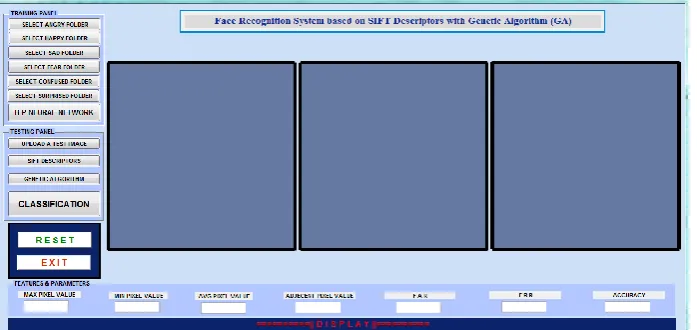
Fig.5.Classification process
In above figure, we load a test image for the testing purpose of proposed module. For the classification of the test data, several steps like feature extraction are used using the SIFT discriptor function and feature
optimisation using the Genetic Algorith (GA) and at last, back propagation neural netowrk classification technique is used to classify the emotion of loaded test autastic image from their facial expression.
Classification is the final stage of any processing system where each unknown pattern is assigned to a category. The degree of difficulty of the classification problem depends on the variability in feature values for objects in the same category, relative to the difference between feature values for objects in different categories. In the classification section, neural network analyze the testing data. For the classification we use test data which operates on the basic of training net structure. In proposed module, we classify the test data as “Angry” by using neural network structure.
© 2016, IRJET | Impact Factor value: 4.45 | ISO 9001:2008 Certified Journal | Page 737 This structure contains all of the information concerning the training of the network.
Fig.7. Neural Network Training Performance
Above graph shows the performance parameters of training section. Green color cirlce denotes the best
performance value (2.547) at number 11 iteration. In backpropagation neural network, performance criteria is checked on the basis of Mean Square Error (mse). This figure does not indicate any major problems with the training. The validation and test curves are very similar. If the test curve had increased significantly before the validation curve increased, then it is possible that some over fitting might have occurred.
The next step in validating, the network is to create a regression plot, which shows the relationship between the outputs of the network and the targets. If the training is perfect, the network outputs and the targets would be exactly equal, but the relationship is rarely perfect in practice.
© 2016, IRJET | Impact Factor value: 4.45 | ISO 9001:2008 Certified Journal | Page 738 Above graph shows the different types of parameter which are generated during training of dataset. We check the existence of best gradient value, mutation value and validation checks.
Fig.9. Neural Network Regression
Above graph shows the description of datasets which are used for the training purpose of dataset. There are four graphs: first for trainig data, second for validation, third for test data which are automatically taken from the training dataset and last for ouput of training. In the graph, tow lines are present first is solid line and second is doted line which represents the accuacy of training. The three plots represent the training,
validation, and testing data. The dashed line in each plot represents the perfect result – outputs = targets. The solid line represents the best fit linear regression line between outputs and targets. The R value is an indication of the relationship between the outputs and targets. If R = 1, this indicates that there is an exact linear
relationship between outputs and targets. If R is close to zero, then there is no linear relationship between outputs and targets.
4.2 Parameters
False Accept Rate (FAR): FAR is the type of error in the pattern recognition system which is measured by:
False rejection rate (FRR): The percentage of times a valid user is rejected by the system. Its formula is given as:
© 2016, IRJET | Impact Factor value: 4.45 | ISO 9001:2008 Certified Journal | Page 739 Accuracy: Accuracy is a general term used to describe how accurate a biometric system performs. Its formula is given as:
[image:10.595.126.475.181.564.2]( )
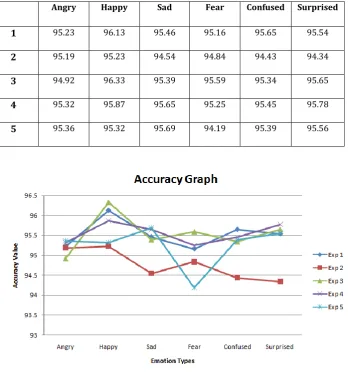
Table 1.Accuracy Table
Angry Happy Sad Fear Confused Surprised
1 95.23 96.13 95.46 95.16 95.65 95.54
2 95.19 95.23 94.54 94.84 94.43 94.34
3 94.92 96.33 95.39 95.59 95.34 95.65
4 95.32 95.87 95.65 95.25 95.45 95.78
5 95.36 95.32 95.69 94.19 95.39 95.56
Fig.10. Accuracy Graph
© 2016, IRJET | Impact Factor value: 4.45 | ISO 9001:2008 Certified Journal | Page 740
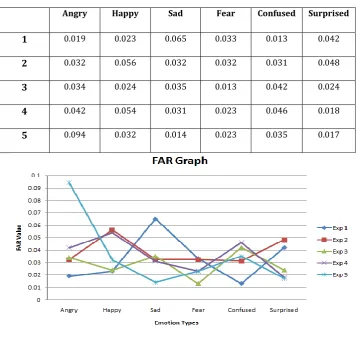
Table 2. FAR Table
Angry Happy Sad Fear Confused Surprised
1 0.019 0.023 0.065 0.033 0.013 0.042
2 0.032 0.056 0.032 0.032 0.031 0.048
3 0.034 0.024 0.035 0.013 0.042 0.024
4 0.042 0.054 0.031 0.023 0.046 0.018
5 0.094 0.032 0.014 0.023 0.035 0.017
Fig.11. FAR Graph
The above table and graph represents the false acceptance ratio (FAR) of the proposed work process. We use five experiments to evaluate the FAR of the proposed work for different types of autistic test data. From the graph we observe the average FAR of proposed module is near about 0.045.
Table 3. FRR Table
Angry Happy Sad Fear Confused Surprised
1 0.99 0.97 0.99 0.99 0.97 0.99
2 0.96 0.95 0.97 0.96 0.95 0.95
3 0.94 0.96 0.94 0.93 0.97 0.98
4 0.97 0.93 0.94 0.95 0.98 0.94
[image:11.595.67.547.581.762.2]© 2016, IRJET | Impact Factor value: 4.45 | ISO 9001:2008 Certified Journal | Page 741
Fig.12. FRR Graph
The above table and graph represents the false rejection ratio (FRR) of the proposed work process. We use five experiments to evaluate the FRR of the proposed work for different types of autistic test data. From the graph we observe the average FRR of proposed module is near about 0.99.
5
Conclusion and Future Scope
Face emotion detection is very helpful in all ways. In proposed work, we present Emotion recognition system based on autistic facial expression using SIFT descriptor with genetic algorithm. But, in proposed work face emotion recognition is being used for help of the autism based children. In this work, six emotions have been recognized from face like sad, angry, happy, confused, fear and surprised. In proposed work, three important methods has been used like SIFT for feature extraction, GA for feature optimization and reduction and back propagation neural network for classification of emotions. Large dataset of autistic person has been utilized for proposed work implementation. From result simulation, it has been seen that proposed algorithm has provided good results in terms of FAR, FRR and Accuracy. We achieved the accuracy near about the 95% by using proposed emotion recognition system for autistic database.
© 2016, IRJET | Impact Factor value: 4.45 | ISO 9001:2008 Certified Journal | Page 742
References
1.
J. L. Raheja and U. Kumar:Human Facial Expression Recognition from Detected in Captured Image Using Back Propagation Neural Network: International Journal of Computer Science and Information Technology, February (2010).2.
Qiuxiawu, Zhiyong Wang, member, IEEE, Feiqi Deng, member, IEEE, Zheru Chi, member, IEEE, and David Dagan Feng, Fellow : Realistic human action recognition with multimodal feature selection and fusion: IEEE transactions on systems, man, and cybernetics: systems: Vol.43, No, 4, July (2013).3.
T. Baltrusaitis, D. McDuff, N. Banda et al.: Real-time inference of mental states from facial expressions and upper body gestures:in Proceedings of the IEEE International Conference on Automatic Face and Gesture Recognition and Workshops (FG '11), pp. 909–914 (2011).4.
G. Littlewort, M. S. Bartlett, L. P. Salamanca, and J. Reilly: Automated measurement of children’s facial expressions during problem solving tasks: in Proceedings of the IEEE International Conference on Automatic Face and Gesture Recognition and Workshops, pp. 30–35 (2011).5.
M. Agrawal, N. Jain, M. Kumar and H. Agrawal: Face Recognition using Eigen Faces and Artificial Neural Network: International Journal of Computer Theory and Engineering (2010).6.
P. Lucey, J. F. Cohn, T. Kanade, J. Saragih, Z. Ambadar, and I. Matthews: The extended Cohn-Kanade dataset (CK+): a complete dataset for action unit and emotion-specified expression: in Proceedings of the IEEE Computer Society Conference on Computer Vision and Pattern Recognition Workshops (CVPRW '10), pp. 94–101 (2010).7.
Z. Wang, S. Wang, and Q. Ji,: Capturing complex spatiotemporal relations among facial muscles for facial expression recognition: in Proceedings of the IEEE Conference on Computer Vision and Pattern Recognition, pp. 3422–3429 (2013).8.
Amminger, G.P., Schäfer, M.R., Papageorgiu, K. et al: Emotion recognition in individuals at clinical high-risk forschizophrenia:.Schizophr Bull. 38:1030–1039 (2011).
9.
Comparelli, A., Corigliano, V., De Carolis, A. et al : Emotion recognition impairment is present early and is stable throughout the course of schizophrenia : SchizophrRes. 143:65–69 (2013).10.
C. Shan, S. Gong, and P. W. McOwan : Beyond facial expressions: learning human emotion from body gestures: in Proceedings of the British Machine Vision Conference (2007).11.
S. Uzun, C. Oflazoglu, S. Yildirim, and E. Yildirim: Emotion estimation from eeg signals using wavelet transform analysis: in Signal Processing and Communications Applications Conference (SIU), pp. 1–4 (2012).12.
V. A. Petrushin: Emotion recognition in speech signal: experimental study, development, and application: in Proceeding of the 6th International Conference on Spoken Language Processing, pp. 222–225 (2000).13.
T. Baltrušaitis, D. McDuff, N. Banda et al.: Real-time inference of mental states from facial expressions and upper body gestures: in Proceedings of the IEEE International Conference on Automatic Face and Gesture Recognition and Workshops, pp. 909–914 (2011).14.
M. Pantic, A. Pentland, A. Nijholt, and T. Huang: Human computing and machine understanding of human behavior: a survey: in Proceedings of the 8th International Conference on Multimodal Interfaces, pp. 239–248, ACM, New York, NY, USA (2006).15.
A. Wendemuth and S. Biundo :A companion technology for cognitive technical systems,” in Cognitive Behavioural Systems: A. Esposito, A. Esposito, vol. 7403 of Lecture Notes in Computer Science, pp. 89–103, Springer, Berlin, Germany (2012).16.
G. Littlewort, M. S. Bartlett, L. P. Salamanca, and J. Reilly: Automated measurement of children’s facial expressions duringproblem solving tasks: in Proceedings of the IEEE International Conference on Automatic Face and Gesture Recognition and Workshops, pp. 30–35 (2011).
17.
M.-C. Hwang, L. T. Ha, N.-H. Kim, C.-S. Park, and S.-J. Ko :Person identification system for future digital TV with intelligence: IEEE Transactions on Consumer Electronics, vol. 53, no. 1, pp. 218–226 (2007).18.
P. Corcoran, C. Iancu, F. Callaly, and A. Cucos: Biometric access control for digital media streams in home networks: IEEE Transactions on Consumer Electronics, vol. 53, no. 3, pp. 917–925 (2007).19.
E. Vural, M. Cetin, A. Ercil, G. Littlewort, M. Bartlett, and J. Movellan: Drowsy driver detection through facial movement analysis: in Proceedings of the IEEE International Conference on Human computer Interaction (HCI '07), pp. 6–18, Springer, Berlin, Germany (2007).© 2016, IRJET | Impact Factor value: 4.45 | ISO 9001:2008 Certified Journal | Page 743
21.
S. Knerr, L. Personnaz, G. Dreyfus: Single-layer learning revisited: a stepwise procedure for building and training a neuralnetwork: Neuro Computing (1990).
22.
John-John Cabibihan · HifzaJaved · Marcelo Ang Jr. · Sharifah Mariam Aljunied: Why Robots? A Survey on the Roles and Benefits of Social Robots in the Therapy of Children with Autism: Int J Soc Robot (2013).23.
Kerstin Dautenhahn and IainWerry: Towards interactive robots in autism therapy: Pragmatics & Cognition 12:1 pp 1-35 (2004).24.
S L Happy, and Aurobinda Routray Automatic:Facial Expression Recognition Using Features of Salient Facial Patches: IEEEtransactions on affective computing (2013).25.
IndraAdjiSulistijono, ZaqiatudDarojah: Facial Expression Recognition Using Backpropagation.26.
GolijehGolarai a, Kalanit Grill-Spector a,b, Allan L. Reiss: Autism and the development of face processing”, Clinical Neuroscience Research 6 (2006) 145–160.27.
Joshua J. Diehl , Lauren M. Schmitt, Michael Villano, Charles R. Crowel: The clinical use of robots for individuals with Autism Spectrum Disorders: A critical review: Research in Autism Spectrum Disorders ,249–262 (2012).28.
Louise Neil a, Giulia Cappaglia,b, ThemelisKaraminis a, Rob Jenkins c, Elizabeth Pellicano: Recognizing the same face in different contexts: Testing within-person face recognition: Journal of Experimental Child Psychology 143,139–153 (2016).29.
Terrence Fong a,b, IllahNourbakhsh a, Kerstin Dautenhahn c: A survey of socially interactive robots, Robotics andAutonomous Systems, 143–166 2003).