English Theses Department of English
5-3-2007
Teaching Media Literacy in the Composition Classroom: Are We
Teaching Media Literacy in the Composition Classroom: Are We
There Yet?
There Yet?
Misty Dawn Carmichael
Follow this and additional works at: https://scholarworks.gsu.edu/english_theses
Part of the English Language and Literature Commons
Recommended Citation Recommended Citation
Carmichael, Misty Dawn, "Teaching Media Literacy in the Composition Classroom: Are We There Yet?." Thesis, Georgia State University, 2007.
https://scholarworks.gsu.edu/english_theses/21
This Thesis is brought to you for free and open access by the Department of English at ScholarWorks @ Georgia State University. It has been accepted for inclusion in English Theses by an authorized administrator of
ARE WE THERE YET?
by
MISTY DAWN CARMICHAEL
Under the Direction of Lynée Lewis Gaillet
ABSTRACT
Despite the prevalence and ubiquity of media in North American culture,
educators still show reluctance to embrace media literacy as a necessary literacy. This
study examines two media literacy activities using descriptive teacher research, and
defining usefulness based on student response and applicability to composition objectives
in the English 1101 classroom. Both lessons produce useful findings, with students rating
the second activity as more useful than the first activity. This research lends sample
assignments and confidence to instructors seeking to employ simple media-literacy
tactics in the introductory composition classroom.
INDEX WORDS: Media Literacy, Media Education, Visual Analysis, Visual
ARE WE THERE YET?
by
MISTY DAWN CARMICHAEL
A Thesis Submitted in Partial Fulfillment of the Requirements for the Degree of
Master of Arts
in the College of Arts and Sciences
Georgia State University
Copyright by Misty Dawn Carmichael
ARE WE THERE YET?
by
MISTY DAWN CARMICHAEL
Major Professor: Lynée Lewis Gaillet Committee: Mary Hocks
Elizabeth Sanders Lopez
Electronic Version Approved:
ACKNOWLEDGEMENTS
I would like to acknowledge the spring semester students enrolled in my
Composition 1101 class at Georgia State in 2007 for being patient with me, and my thesis committee for enduring my inane questions and giving me badly-needed corrections. I’d be a fool not to mention my family, who gave me hugs and listened to me gripe on the phone about things they didn’t even pretend to understand. Also, Brian Hall kept me from living in filth and managed to meet all my lower-level hierarchy needs, and I will spend the rest of my life trying to compensate for his labors. I must send a sincere “meow” to Beans and Gerardo or their feelings will be deeply hurt, and a textual high-five to Gina Prescott. I’d like to send a big hug to the country of Spain, which provided the
TABLE OF CONTENTS
ACKNOWLEDGEMENTS. . . iv
LIST OF TABLES. . . vii LIST OF FIGURES. . . viii
CHAPTER 1 INTRODUCTION. . . 1
Methodology and Purpose of the Study . . . 3
Bias and Expected Results . . . 4
2 WHY MEDIA LITERACY IS UNDER-VALUED IN LITERACY EDUCATION. . . 6
Reluctance Born from Classical Attitudes. . . 9
Revival of Negative Attitudes. . . 13
3 MEDIA LITERACY’S PLACE IN THE COMPOSITION CLASSROOM: AN ARGUMENT IN FAVOR. . . 16
Media Immersion as a Teaching Opportunity. . . 17
Putting Media Literacy to Work for Educators. . . 21
4 PRACTICAL MEDIA LITERACY IN THE COMPOSITION CLASSROOM. . . 25
Analysis Summarizations and Critiques. . . 24
Media Literacy Activities in Action: Discovering Effective Teaching Strategies. . . 32
Die Hard/DeMott – Activity 1. . . 33
Bebe®/Browning – Activity 2. . . 38
Factors to Consider When Teaching Visual Analysis . . . 43
WORKS CITED. . . 50
APPENDICES
A FRAMEWORK FOR VISUAL ANALYSIS. . . 54
B FORMS AND TALLIED RESPONSES. . . 56
LIST OF TABLES
TABLE 1: Silverblatt’s “Worldview” Media Literacy Tips. . . 29
TABLE 2: Silverblatt’s “Ideology and Stereotypes” Media Literacy Tips. . . 29
TABLE 3: Responses from the Die Hard/DeMott activity . . . 36
LIST OF FIGURES
FIGURE 1: Audience Timeline Using Dates from James Porter’s Audience and Rhetoric. . .
7
FIGURE 2: Fleming’s “The field of media theory in relation to practical
criticism”. . . 27
FIGURE 3: Comparison of Extreme Responses between the Die Hard/DeMott
INTRODUCTION
Many American parents and educators feel the sting of acknowledging that our
culture is media-sated. The living room television provides a particularly convenient
means for our students to avoid homework, chores, listening to others, and exercise.
Seeing a relationship between television and our culture’s commercialization, concerned
parents and educators have even gone so far as to badmouth television as the cause of
laziness, ADHD, obesity, etc. Echoing John Milton’s wisdom, name-calling and
censorship are not the answer to this media-spurred dilemma. Also, we’re not very good
at our jobs if we are unable to turn our lemons into lemonade. Media isn’t the adversary,
our negative attitudes and persnickety old prejudices are.
I should first clear the air by admitting that I currently don’t own a television.
Who needs one? Any program I deem of value I can access on the internet, oftentimes
commercial-free. Despite the crucial omission of an actual TV set from my home, I can
still generally name the five most popular shows at any given time. How? Our culture is
that immersed in television. Monitors are everywhere; you don’t need to own a television
to watch television. My point is: commercially biased media isn’t going anywhere
because it’s already everywhere. As instructors we’re stuck with commercialized media’s
presence, and educators must cast off the idea that media is too compromised or not
scholarly enough to use in the classroom. I’m not suggesting that we replace “Ode on a
Grecian Urn” with American Idol, but rather that we use the more accessible medium to
illuminate that ideas of fame are recycled from generation to generation. Perhaps such
pedagogical plans sound absurd to us, but they may not sound quite so ridiculous to those
As an instructor, I seek to make each class as easy as possible for myself. I’m not
lazy; I simply want the most effective means to communicate my lessons in a way that
doesn’t confuse or alienate my students. Embracing media-influenced communication
entails some degree of resilience, including doing a few things that some of my
colleagues still find unscholarly, despite that my approaches and analytical methods are
far from novel. After all, it is only through “examining rhetorical and cultural uses of
word and image, both historically and currently” that scholars first came to understand
the symbolism that is text (Hocks and Kendrick 1). By integrating these media literacy
lessons, I feel confident that I’m teaching my students skills they can use beyond the
walls of the classroom. Besides, what better place to understand culture and how the
individual is situated within that culture than in the composition classroom? What better
place to learn analysis that students can continually practice? What better place to
understand yourself and others as audience and the rhetorical triangle? And I can’t think
of a better arena to introduce visual analysis as a means of understanding prevalent
societal exclusion or stereotypes. It is with this personal motivation that I embrace media
literacy as an integral part of composition curriculum. As an instructor immersed in
media culture teaching students immersed in media culture, media literacy seems a
natural way to approach meeting composition objectives.
Along with personal convictions about media messages, I also acknowledge the
importance of studying visual rhetoric and its implications for composition instruction.
“Visual Rhetoric” remains an often-contested phrase, and this complication arises from
the many impacts visuals have on our culture. Visual rhetoric “is intertwined with how
making a definition difficult to follow. Visual rhetoric communicates different messages
simultaneously to different individuals, cultures, genders, etc. (Hocks and Kendrick 5).
Despite dissention over an exact definition, technological innovations across mediums
calls for rhetoricians and composition scholars to further examine this ubiquitous
communication and its relation to our culture.
Methodology and Purpose of the Study
I initially sought to discover how my media literacy tactics “work” for me in the
composition classroom, specifically concerning ways that I have previously implemented
them in my teaching career as a Graduate Teaching Assistant at Georgia State University.
My goal was and still is to better understand how I can implement media literacy in the
composition classroom setting in the form of visual analysis while yielding positive
student response. I wanted to know whether or not my personal preferences for teaching
visual analysis are interpreted as helpful to my students in relation to the standard
objectives for the composition classroom as defined by Georgia State University’s
English department. At the end of the day, my goal was to be able to say to my fellow
colleagues “this lesson works for me; maybe it will work for you.”
Using primarily feminist methods, this study entails mainly descriptive research.
First, I research historical rhetoric and audience, going back to Classical definitions of
rhetoric and determining how ancient definitions effect modern views on rhetoric and
communications. I employ methodological pluralism by conducting some primary
research with my students, research consisting of open-ended free-writes and Likert scale
rating questions. Free-writing, Peter Elbow’s infamous expressionist classroom tool
attempt to force introspection, gives the students a chance to vent about the assignments.
Since “the best words come from deep down inside, from one’s voice,” I wanted to tap
into this personal honesty by making students write their initial impressions about the
assignments (Myers, 450). I chose to combine methods and methodologies because I
want my research to be as thorough as possible within the given constraints of my
specific classroom setting. I also chose these methods because they allow me to get
feedback from students in quick, unencumbering ways. Although the results of my study
are extremely specialized and tailored to suit my own rhetorical style of teaching, I am
still in the process of learning much about myself as an instructor and much about the
dynamics of the composition classroom setting. I hope to offer other instructors new to
teaching media literacy some companionship by testing the effectiveness and popularity
of these assignments. My purpose involves “examin[ing] the evolving relationships
among images, visual culture, and the text-based traditions of research” through my own
teacher research (Hocks and Kendrick 8). This research gives me cues to how I should or
should not approach media literacy and visual analysis praxis in the future.
Bias and Expected Results
I am biased. I entered this study with the preconceived notion that media literacy
is a valuable teaching tool that composition teachers should use to teach analysis. My
teaching goals include the desire to make students more aware of American consumer
culture, following the praxis of visual and social constructivist pedagogies. I also believe
students benefit most from lessons employing Writing Across the Curriculum (WAC)
applications, since seldom do composition instructors have more than one or two
about consumerism and what I perceive to be the epidemic of “affluenza” in North
American society (Kasser, xii). Addressing consumer culture and showing students how
to interpret capitalist ideologies in a social context is a part of, if not the crux of, my
teaching goals. I interpret Americans’ insatiable consumption and the resulting
“affluenza” as a result of students’ inability to read media messages with a discerning
eye. Media’s prevalence also necessarily means advertisements’ prevalence, and students
need skills to decode covert messages (such as commercially-sponsored product
placement in movies) as persuasive attempts. As an instructor, I use my biases as
motivation to help students achieve the intertextual objectives of the composition
curriculum.
With these personal and professional goals in mind, I encourage and participate in
teacher research. Instructors should approach every lesson as an experiment in the
ever-changing context of the classroom. Teaching is oftentimes hit-or-miss with each lesson
depending on the classroom dynamic: therefore, I choose to gauge personal success based
on student response. Using these responses, supported by both traditional research and
Elbow’s theories on the benefits of free-writing, I can justify teaching media literacy
using visual analysis, even if only to myself. In addition, every lesson in which I seek out
student response helps me discover which strategies produce the most positive student
response in classes with similar energy levels and/or with similar class sizes. Ideally, the
results of this study encourage me to devise similar media literacy activities. However, if
this teacher research only helps me to better understand myself in relation to my
I’d like to see other first-year composition teachers use the results of this study as
encouragement to create their own lessons addressing media literacy. Why is this study
worthwhile, despite the limited applications and my severe bias? As Jane Tompkins puts
it, my continuance comes “from a need to finally trust myself. . .to my own experience I
need to turn for enlightenment” (xii).
WHY MEDIA LITERACY IS UNDER-VALUED IN LITERACY EDUCATION
“One may well ask: what is meant by the rhetoric of vision, why should it be studied now
and of what use or interest might it be?” – Stanley Meltzoff, 1970.
Since the prevalence of television in the educational system circa 1980,
composition has shifted towards progressive pedagogy, namely cognitivism,
expressionism, and social constructivism. With the rise of these trends also came an
undercurrent of ideological views simply because current traditional practices were under
attack. Although these composition theories did not all arise simultaneously and were not
entirely new ideas, the accompanying praxis came as a tsunami to the United States’
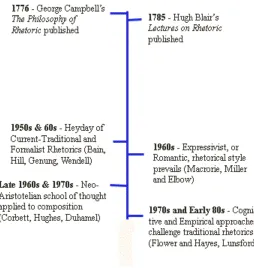
educational system. The figure below serves as a small-scale attempt to show general
Figure 1: Audience Timeline Using Dates from James Porter’s Audience and Rhetoric
Scholars embraced the idea of multiple literacies in the 1980s with the
acknowledgement of family and cultural dialects that made too much grammatical sense
to ignore (Smagorinsky 132). Media literacy, however, is still a relatively new idea,
arising not because scholars had not contemplated visual rhetoric before, but because of
the drastic increase in Households Using Television (HUTs) and integration of literacy
programs such as The Letter People, Sesame Street, and later, Reading Rainbow,into
public education classrooms. From 1970 to 1977, the sale of television sets doubled from
2.5 to 5 million a year, and by 1978 78% of households in the United States owned a
color television (http://www.tvhistory.tv/facts-stats.htm).
Educators recognized relatively early on that television was a powerful teaching
medium. In 1983, a report by the UK’s Popular Television and Schoolchildren asserted
argued, ‘should be involved in examining and discussing television programmes with
young people” (Buckingham 89). What educators did not foresee in the 1980s was that
television would eventually become almost solely controlled by commercial enterprises.
Like Vanevar Bush’s “Memex,” where he envisions the internet as an entirely academic
machine, television became yet another scholarly idea cum commercial enterprise.
An increase of commercial dominance in television, meaning more advertising
spots and the launching (and success) of advertising-only networks such as the Home
Shopping Network, prompted inquiry as to how education could compete with television.
Realizing television’s influence over people, the demand for commercial spots increased
– as did prices for those spots – to such an extent that the “business” of television became
far more profitable than educational motives. Television programming’s commoditization
left little room for educational programs, aside from the haven of the Public Broadcasting
Service, simply because the educational system has relatively little purchasing power
compared to commercial moguls.
With this shift came resentment; educators began to see television as a
competitor. Even today many seasoned college educators see television as something of a
“guilty pleasure.” With the mass consumption of television sets comes an aversion to
taking the medium seriously. One can easily draw parallels to the novel and comics.
Bronwyn T. Williams points out the absurdity of this argument:
Television as it currently exists is [not] equivalent to print. Such comparisons of
the two media strike me as reductive and irrelevant. I am also not interested in
engaging in a subjective debate as to whether what is considered high-quality
advantage of print is that it allows for kinds of thinking and reflection that are not
available on the screen; that’s why I am a writing teacher. (Williams 109)
Many educators still see television as an obstacle to thought; “if not through the
elite media of literature and the arts, [nothing] is worth thinking, feeling, or saying”
(O’Neill 21) . A colleague of mine even recently stated, “I don’t use T.V. in the
classroom; they get enough of that at home.” This statement is disturbing on many levels,
but it should not be surprising. Dismissal of persuasive/commercial communication as
part of education has strong classical roots.
Reluctance Born from Classical Attitudes
Ideas towards popular media and mediums are held over from Classical time. As far back
as 340 B.C., scholars tagged rhetoric as inferior and frivolous, denying that the
communication had any sway over their lives or lines of thinking.
Now I myself am beginning to lose heart, and I should like, with your permission,
to pass over the question of possibility at present. Assuming therefore the
possibility of the proposal, I shall now proceed to enquire how the rulers will
carry out these arrangements, and I shall demonstrate that our plan, if executed,
will be of the greatest benefit to the State and to the guardians. First of all, then, if
you have no objection, I will endeavour with your help to consider the advantages
of the measure; and hereafter the question of possibility. (Republic)
The acknowledged founder of modern Western philosophical thought, Plato advocated a
strange optimism, often “consider[ing only] the advantages” once he had stated his
opinions on a subject (Republic). Plato often refutes rhetoric’s usefulness in favor of
teaching rhetoric. He argues that rhetoric should not be taught because it is inferior to
philosophy, and the pathos of such crafts is dangerous to society. This Platonic method of
teaching has impeded the progress of media literacy groups to educate young students
how to interpret visual rhetorical appeals. Wysocki attributes this halt of progress to our
scholarly “assumption behind the critique of the visual,” saying, “we each take in what
we see, automatically and immediately, in the exact same way as everyone else, so that
the visual requires no interpretation and in fact functions as though we have no power
before it” (Wysocki 43). Visual rhetoric’s power lies in our own simple self-deception
concerning its ability to communicate deeply, made more potent by our arrogance. Here
commercialism of the medium comes in – the commodification of television through
advertising spots allows visual rhetoric to influence us and our students through ubiquity,
and media literacy becomes a necessary tool for textual analysis.
Neither Plato nor Aristotle considered how visual rhetoric could complement and
reinforce even mildly persuasive arguments, both men only considering the power of
speech. A primary school audience is possibly more vulnerable than older student bodies
to the rhetoric of educationally-supported commercial advertising broadcasts during
class. It would be foolish to assert that Plato and Aristotle’s dismissal of simple,
relatively unconvincing rhetorical methods was intended to impede the teaching of media
literacy, as it would have been impossible in 400 BCE to predict the inventions of the
technology so commonplace now. However, by making their teachings the foundation of
Western thought, we have not given simple rhetoric the respect of efficacy that occurs
and prevalence, scholars must reevaluate the teaching of rhetoric and expand it to adapt
to the ways in which it applies to the communication of modern ubiquitous media.
Although Aristotle addressed how rhetoric can be used to deceive or misguide the
public to some extent in On Rhetoric, he could not possibly have foreseen how visual our
society would become with the invention of television and various forms of graphical
advertising. Scholars often dispute the persuasiveness of visual elements based on
individual perceptions. Has Aristotle and Plato’s “brushing off” even of Gorgias’
rhetorical teaching lead us to the level of confusion we now face in dealing with extended
forms of rhetoric? Yes. Aristotle undermined the effectiveness of blatant attempts to
persuade by structuring rhetoric and assuming that “moral” people would identify
manipulative rhetoric as “unjust” and simply ignore it. Because Aristotle and Plato did
not consider those who do not pursue “honesty” in discourse and knowledge, they left
Western society vulnerable to “bad” rhetoric – T.V. advertising and other commodified
communications. The dilemma then becomes how to combat “bad” rhetoric, now so
omnipresent and integrated into our culture that few, regardless of educational level, are
immune to its influence. O’Neill notes that, “none of us escapes [media’s] assault upon
the mind and body. Yet, it is extraordinarily difficult to discipline ourselves in the proper
exercise of that analytic and aesthetic thinking which needs to be fed by an imaginative
grasp of the ordinary events that determine our lives” (7). Western society need’s
Neitzche’s “idols,” to escape the mundane nature of existence, but teaching why these
idols are so influential is taboo. Why? Education is under-funded, and computers and
Realizing the prominence and teaching power capable in these two mediums,
under-funded schools turned to commercial sources for monetary aid. In exchange for
technological supplies such as television sets and computers, schools often allow
companies to sponsor a building. This compromising of educational standards started
with disadvantaged public schools, then crept its way into schools without funding issues.
For example, at the University of Georgia, Coca-Cola created a “refreshment area” in the
Terry College of Business, complete with internet access. Many companies realize that
sponsoring an educational building is a philanthropic way to advertise in a school and
associate the companies’ brand with the educational system, thereby building ethos.
Oftentimes companies build this ethos visually, simply by associating their brand and/or
logo alongside the school mascot.
Unlike Plato, Aristotle does address persuasive rhetoric, even if only in an attempt
to scientifically categorize it. In On Rhetoric he characterizes rhetoric as “tekhnē,”
making an exception for the “pisteis,” or means of persuasion involved in a “logical
proof” (Kennedy 29, 30). The term “artfully deceived” not yet coined, Aristotle classifies
art only as what is good and true, following his teacher Plato. Aristotle continues his
didactic, optimistic view of rhetoric by qualifying that orators must only be “good men,
bending the truth only when necessary,” and by arguing that the main reason “rhetoric is
useful” is because “the true and the just are by nature stronger than their opposites, so
that if judgments are not made in the right way they are necessarily defeated” (Kennedy
34, 83). Aristotle reiterates that persuasive rhetoric should only be effective for a good
and noble man, neglecting any in-depth commentary on how a man can use persuasive
dishonest deviance – a stance many use to appear self-righteous in their ethos. Surely
Aristotle has done a disservice by not equipping his students with the tools available to
identify and combat pathos-only appeals that lead to illogical decisions.
Aristotle’s approach to teaching rhetoric is evident in modern-day media literacy
approaches. Media literacy, by nature, exposes advertising appeals as a form of untruthful
persuasive rhetoric. Examining how some television programs and advertisements
embody untruthful rhetoric would inadvertently reveal how to create untruthful rhetorical
appeals. By Aristotelian standards, canvassing manipulative rhetoric acknowledges that
untruthful rhetoric is capable of being effective, thus undermining the Platonic tenet that
the only effective orator is a “good” orator.
Revival of Negative Attitudes
But how does philosophy from circa 400 B.C. become directly related to modern
praxis? Perhaps Classical modes of thinking would have died out if not for the
Reformation and ensuing revival of rhetorical culture. In the sixteenth and early
seventeenth centuries, Protestant Christianity imposed on revived Platonic ideals led us to
our current Western philosophical views. Castiglione’s The Courtier paints a picture of a
“Ladder of Love” which imposes Christian ideals onto Platonic visions of love by
defining a “good” woman in biblical terms (Castiglione 648). Classical thought was
somewhat hijacked by religious courtiers, hoping to back their Platonic ideals with divine
providence. At this time church and state were in great turmoil in England due to Henry
VIII’s sudden Protestant inclinations after the Catholic Church would not grant him a
divorce from Catherine of Aragon to marry Ann Boleyn (Greenblatt 491). In the late
religious and monarchial upheaval, a renewed interest in science due to Darwinism, and
the advent of the industrial revolution. This unwieldy trio prompted the public to seek
security by resurrecting Classical ideals. At a time nothing was absolute, the public found
solace in Platonic and Aristotelian lines of reasoning.
The Renaissance and Tudor styles emphasized proper manners and
then-antiquated respect for the ancients. A revival of chivalry and adherence to the polite and
acceptable mores of the day was a must for courtiers and court-attending officials, who
were also the arbiters of educational standards that consequently influenced the fairly
recently settled United States as well. Some scholars refer to this period as the height of
rhetorical acknowledgement; many manuals on etiquette and proper manners were
published at this time. Despite this renewed interest in rhetoric, the emphasis on political
correctness stunted extensive examination of what was perceived to be deceptive rhetoric.
Rhetoricians since then have unsuccessfully fought this obstacle of associating rhetoric
with “good,” as James Porter notes:
Rhetoric must have an aim, and not simply an internal or tautological aim either.
It is not enough to say that I am writing to persuade my readers. Why am I writing
to persuade them? Why should they accept my position? Because it is good for
them. To exercise rhetoric, the rhetor needs a notion of “the good” – at least a
selfish notion of what is good for the self, if not a sense of what is good for “all.”
(120).
Here Porter links rhetorical ethics to the dilemma of defining audience. Not only has this
difficulty created divisions among composition theorists, it also adds to the aversion
audience is the self? The complexities of visual rhetoric and, therefore, media literacy are
easier to shelve away than to tackle this, most basic of questions. Porter argues that the
audience question is what has led modern universities to simultaneously teach rhetoric in
both English and Communications disciplines in post-secondary education. In
communications departments, scholars define audience using user statistics and
demographics, while the more philosophically-geared English sect tends to treat audience
as author-centered, in which case audience is sometimes of no importance. Scholars
further dispute audience’s importance within English studies. If both the term “rhetoric”
and the importance of audience are still so disputed, how can we build on such a shaky
foundation? The answer is simply that we must find a way in order to deconstruct the
messages that persuasive images convey.
One approach to understanding the messages within visual rhetorical appeals
comes by way of culture theories. The culture theory of hermeneutic imperialism seeks to
“decode or unpack existing texts” using context-sensitive analysis and “interest in the
sociological and the material” (Sánchez 62, 63). Sánchez asserts that “this claim” of
importance “allows English to bid for conceptual and political centrality in the
humanities” to “regain position” (63). This move to accept cultural theory further
complicates literary studies by resurrecting the question concerning definition of the
cannon, along with the question of what is art. Due to many scholars’ unwillingness to
open this Pandora’s Box, the study of media and media literacy often hangs in limbo
between composition and communication departments in many colleges and universities.
Regardless of where audience and media studies should be placed within the
composition classroom. Teaching media literacy is crucial to understanding of the various
ubiquitous texts-turned visuals in our culture, including but definitely not limited to
sitcoms, advertisements, animated series and movies. These texts are the new “novels” of
our youths’ culture, and are so commonplace and familiar that their social impact is often
overlooked by scholars. Popular technology and media influence is so embedded and
reflected in every self that it has become hard to notice. Teaching media literacy is the
only feasible way to unpack the highly contextual messages sent to today’s specialized
audiences. Fortunately for current composition trends, media literacy and visual
pedagogy make the classroom more interesting for students and teachers alike because of
the constant newness of strategies and constant stream of fodder for lessons. Regardless
of the ethical stance, pedagogical theory, and praxis the composition teacher adopts,
media literacy enhances the practical usefulness of composition by providing avenues for
students to better understand and analyze their worlds. I argue that media literacy doesn’t
displace any lessons in the first year sequence, but rather serves as a tool capable of
meeting several objectives at once, creating a more efficient classroom.
MEDIA LITERACY’S PLACE IN THE COMPOSITION CLASSROOM: AN
ARGUMENT IN FAVOR
Many otherwise “illiterate” people are already fluent in media language.
Compositionists must rethink the boundaries of literacy, and embrace what John F.
Szwed calls “a plurality of literacies” (423). Victoria Purcell-Gates’ article “A World
Without Print” traces an otherwise illiterate adult woman’s literacy: “I asked her to look
through a newspaper and its advertisements to find something she could read. With great
Purcell-Gates includes that her subject commented that the items she was able to identify were
“’things [she] knew what they mean even if I can’t read the words’” (Purcell-Gates 410).
In this adult woman’s case, interviews assessing her media-based fluency reveal a
complex literacy. In this sense, Americans are more literate than they’ve ever been –
unfortunately, it’s a literacy of which they are unaware. Purcell-Gates’ test subject had
been interpreting visual cues from sales fliers and had been making purchasing decisions
based on those interpretations. Teaching media literacy is crucial for people to understand
what factors influence their decisions and why they make them.
This understanding is necessary for children as well. Purcell-Gates analyzes
Denny Taylor’s study of “highly literate” children, and notes that the children Taylor
studied “daily confronted store signs and advertisements both in the environment and on
television” (408). She goes on to note that it was “within this literate context that these
children learned much about the nature and forms of written language” (Purcell-Gates
408). Whether educators like it or not, children and adults alike learn much about social
language from media sources, specifically advertisements. In “The Development of
Initial Literacy,” Yetta Goodman noticed that “many children develop conscious
knowledge about written language before they receive formal instruction in school” while
interacting with a four year-old boy. Goodman showed the boy a card with the word
Ivory on it and the boy’s response was, “It says soap” (319).
Media Immersion as a Teaching Opportunity
In addition to Purcell-Gates, Yancey, and Goodman’s media-influenced test
subjects, many of us have felt Dennis Barron’s frustration when trying to do something as
The physical effort of handwriting, crossing out, revising, cutting and pasting
(which I couldn’t very well do at a meeting without giving away my inattention),
in short, the writing practices I had been engaged in regularly since the age of
four, now seemed to overwhelm and constrict me, and I longed for the flexibility
of digitized text. (71)
The debate over whether this dependency is a positive or negative shift continues, but
either way the fact remains: technology makes us dependent.
With the advent of the printing press, the novel proliferated throughout Europe.
The rise of literacy, albeit slow, created a high demand for the novel and made the
medium a popular genre with the middle class. Although novels were popularly
circulated as early as the sixteenth century, scholars did not embrace literary criticism of
this new medium until almost a hundred years later (Davis 11). From a scholarly
perspective, novels equaled recreation, which in no small part was due to the public’s
residual fear from the monarchy’s censorship laws in the early Seventeenth century,
which rewarded rogue publishers with beheadings (Greenblatt 1246).
The media of television, movies, and internet have received similar criticisms
from modern-day academics. Scholars show an aversion to pop culture studies despite
that “linguistic meaning is produced culturally via a set of shared conventions”
(Schoenfeldt 116). Schoenfeldt is not alone in his progressive thinking. Compositionist
Susan Brown Carlton calls for composition scholars to adapt a poststructuralist approach.
Carlton notes that “Poststructuralists do not reject the insights of structuralism but
identify within structuralism’s very assertions a need to think beyond its limits. The need
methodological blind spots” (78-79). Disciplines thrive on this type of debate. Isn’t
poetry a variation on syntax, created best by those with a deep understanding of
grammatical structures? Once one has learned the foundational principles of any artistic
discipline, one has a duty to keep the discipline fresh by challenging and manipulating
those foundational principles until finding what way best allows for self-expression.
Although the mention of television brings tawdry imagery of network exploitation
of everyman on reality shows, such shows reflect our consumer culture. Many
academics’ reluctance to accept television as a viable medium for study reveals a
disconnect from life: proof that the ivory tower still exists and is well-populated.
Considering the aversion, one would think academics never watch television, much less
advertisements! The truth is that few, if any, of us are exempt from the influence of
television’s cultural cues. Companies spent over 6.5 billion dollars in advertising
television spots in 2005 (Outsell). It is naïve to think that that immunity from influence is
possible when advertisers and companies spend such an exorbitant amount of money and
energy on this industry. How does advertising affect us? Advertisements create “affect
transfer,” a psychological device that elicits emotional responses from people when they
encounter certain objects due to successful advertising (Hill 37). Advertisers are able to
successfully manipulate peoples’ minds by showing complex visual images that cause
people to associate certain feelings with their product. Charles Hill comments that “what
bothers many of us [about the process of affect transfer] is that our attitudes, opinions,
and even our actions are influenced without any conscious processing on our part. In fact,
most people are probably convinced that such manipulations do not work on them. But
us would no doubt like to think that we are not so easily manipulated. Nevertheless,
classical conditioning has been shown to work in humans” (37).
Fortunately for composition teachers and rhetoricians, this phenomenon is a
teaching opportunity. Students are already subconsciously deconstructing and applying
these complex visual rhetorical messages to their everyday lives; why not reveal this
mental process to students? Composition scholars and educators alike must accept that
“literacy is more than the act of reading and writing. In this view, literacy is given an
extended definition to include ways of perceiving, thinking, speaking, evaluating, and
interacting that characterize a group of individuals and set them apart from others”
(Akinnaso 139). Accepting this view, praxis that reflects these multiple literacy avenues
will open up. Unfortunately, television’s consumer-influencing nature gives the medium
a bad reputation in the academic realm. However, using television as a teaching tool is
often seen in opposition to teaching more prestigiously viewed texts, and Bronwyn T.
Williams says this phenomenon occurs “because [television’s] content is different from
that of print media” (Williams 109). Williams conducted various studies in early 2000
examining how students perceive and experience television, specifically how they “read”
television as texts. He addresses the scholars who deny the value of television as a
complex communicative text, saying:
Television programs are regarded as shallow, manipulative, and broadcast only as
a means to get viewers to stick around long enough for commercials. This is
obviously true and was obvious to students I interviewed. It is worth noting that
many print texts are no less manipulative, shallow, and devoted to the propagation
grocery store or the bookstore at any airport. Both media also offer texts that are
not provocative and intelligent, and whose value transcends the imperative of
capitalist markets. (109)
However, history tells us that we can overcome our judgment and recognize the teaching
opportunities the medium offers. “When writing was introduced as a means of recording
land transfer in eleventh-century England, it was initially perceived (and often rightly so)
as a nasty Norman trick for stealing Saxon land,” according to Michael Clanchy (Baron
76). The medium of television faces similar biases. Many programs marketed for their
entertainment value embed various product advertisements in the show. Marketers often
pay for product placement in popular sitcoms. Media literacy would make viewers more
adept at noticing such subconscious attempts at advertising, thereby making viewers both
more literate and aware of their present literacy. Still, many scholars see television in
opposition to print. Williams retorts,
To criticize television watching, in comparison to reading print, for its isolating
effect and for its limitations on viewer response is a shaky argument and distracts
from the more important issue of teaching people how to watch television, and to
read print, more critically, more selectively, and with an eye toward making
connections to other texts and experiences (Williams 109).
Putting Media Literacy to Work for Educators
Cast in the setting of American culture, media literacy transforms television into a
tool that reflects and highlights the social nature of text, which can be a particularly
powerful means to introduce cultural analysis. When teaching media literacy to a
awareness of Pratt’s “contact zones,” as well as provide opportunities for students to see
where contact zones do and don’t exist (34). Media discussion and analysis create these
“contact zones” by analyzing the representations of different races and cultures. These
“contact zones” are simply “social spaces where cultures meet, clash and grapple with
each other, often in contexts of highly asymmetrical relations of power, such as
colonialism, slavery, or their aftermaths as they are lived out in many parts of the world
today.” Many television sitcoms touch on modern cultural power dynamics by
mentioning the hot topics of race relations and homosexuality to get ratings. Obviously
these programs don’t resolve such issues, but if students view these television programs
as a text to discuss, they could examine how these issues affect their own lives. For
example, some schools in the United States still have segregated proms (CNN.com).
Students could analyze channel segregation, evident in separate networks for separate
groups on public television such as the Black Entertainment Network (BET) and the
Spanish network Telemundo. Educators might ask questions such as “why are these
networks necessary,” and “when do viewers violate these boundaries (assuming
boundaries exist) and why?” Such analysis would allow students to talk about segregation
without necessarily pointing fingers inside the classroom. Discussing these issues would
also give students a forum to voice concerns on issues that they feel are beyond their
control, empowering them. In this way, media literacy teaching emphasizes the public
and social nature of writing.
Luis C. Moll and Norma González’s studies of language-minority children reveal
that “capitalizing on cultural resources for teaching allows both teachers and students to
literacy as a tool for inquiry and thinking, and to refurbish their learning with new topics,
activities, and questions” (Moll and González 168). Television is one such readily
available cultural resource, and Native Americans are spectacularly absent from
television programs. Moll and González’s also found that “emphasis on inquiry generated
active participation and verbalization in both languages from the children – that it
allowed the children, through their own interactions and explorations, to use their
knowledge to solve new problems” (Moll and González 168). Emphasis on inquiry
combined with viewing of popular culture would provide a diversity that otherwise would
not exist in a reservation classroom. It would also allow reservation students to regularly
interact with a segment of the popular culture that they otherwise would not encounter.
Students could discuss how the media/medium did or did not reflect their personal
interactions with non-Native Americans.
In the composition classroom, television is incredibly useful as a teaching tool for
students even if they are already aware of how the medium effects their decisions.
Bronwyn T. Williams comments that many students he interviewed “watched some of the
best programming on television and could make insightful comments about its content
and structure” (109). If that happens to be the case, Williams says, great! He adds that, as
educators, we should still study television because “if my students read television texts
often, and often well, I have to consider how that will affect my work as a writing
teacher” (109). In “A New Framework for Understanding Cognition and Affect in
Writing,” John R. Hayes describes the social environment of writing:
The act of writing is not social just because of its communicative purpose. It is
we write, how we write, and who we write to is shaped by social convention and
by our history of social interaction. . . The genres in which we write were
invented by other writers and the phrases we write often reflect phrases earlier
writers have written. 177
Television is an excellent example of a universally-engaging social artifact with a
communicative purpose. Colloquial phrases frequently appear in formal papers, and
teaching media literacy reveals to students how much they are affected by pop culture in
their thoughts and writing. This awareness would ideally lead to a better understanding of
codeswitching and discourse communities. An analysis of a sitcom also provides cues to
help students better understand the rhetorical situation. Pitting a comedy up against a
drama and analyzing the mood of the audience emphasizes the context-sensitive nature of
identical lines of text. Audience identification of such mediums alone helps students to
achieve a higher level of understanding about the social nature of writing. And television
shows and movies provide a bevy of rhetorical situations to discuss.
David Buckingham argues that media education has a place in WAC initiatives as
well, citing applications in throughout various disciplines. In History class, examining
media shows how “events and periods can be represented in different genres as media
texts” in the area of Science, media analysis reveals “how appeals to scientific credibility
are used in advertising sales pitches,” and in Music studies, “students should study how
generic forms of music are used to create atmosphere and ‘cue’ emotional responses
among audiences” (90-91). Television effects the way people perceive our present and
our past, our educational disciplines, and how students relate to instructors. Also,
certain educational dynamics, but also keeps the instructor aware of how s/he is portrayed
in popular media.
In essence, media literacy teaches analysis, and deeper levels of analysis are
necessary to interpret more complex texts. In teaching higher thinking, media literacy not
only reveals a new world to students, but also reveals to them a social aspect of their
world that was previously too difficult to unpack. Once students are able to interpret
complex visual texts, they will more easily be able to interpret denser literature. In
addition, revealing to students their capacity for analysis provides a sense of confidence
in approaching further analysis, making composition even more useful across curricula.
Regardless of the chosen discipline, understanding how to analyze the ubiquitous media
in her life allows the student to continuously practice this analysis in new and diverse
situations.
PRACTICAL MEDIA LITERACY IN THE COMPOSITION CLASSROOM
When engaging in media education, it is important to for the instructor to understand
that “the competencies that are involved in making sense of the media are socially
distributed, and that different social groups have different orientations towards the media,
and will use them in diverse ways” (Buckingham 39). Teaching media literacy should be
viewed as a learning experience for both the instructor and the students in the spirit of
social exchange. In his recount of Sue Turnbull’s study of instructors using media in an
Australian high school, Buckingham offers a cautionary tale to instructors seeking to
expose the evils of media:
The teachers’ views reflected both a feminist critique of the ‘objectification of
ideology of the media (as the teachers supposed), the students adopted a much more
complex attitude. While occasionally ridiculing romance, they also valued it because
it addressed them as sexualized adults rather than (like school) as children; and
because it represented a gesture of independence in relation to their parents’
aspirations for arranged marriages. Rather than constructing these students as deluded
and in need of teacherly liberation, therefore, Turnbull suggests that their uses of
media provided one way of ‘living the contradictions’ of their current social
experiences. (116)
The lesson here is that the teacher can expect only to show students what messages the
medium conveys. The students must then analyze what those messages mean from their
individual perspectives as audience or perceived audience members. Media literacy
teaching requires some humility on the part of the instructor, and an open mind towards
understanding the ever-reactive nature of all texts to the ones that precede them. Dan
Fleming goes so far to say that “the expertise of the media teacher” should be “kept
separate” so that no “separation then divides teacher from learner and marginalizes what
the learner already knows about the media” (16). Because of this teacher-student
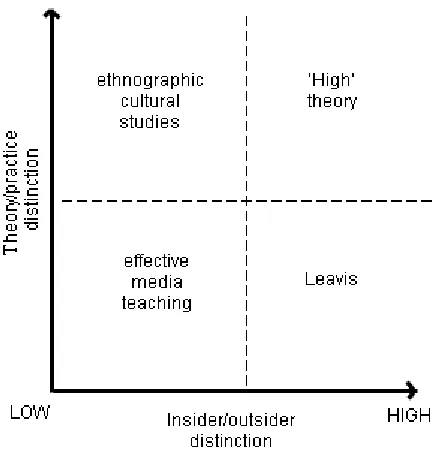
dynamic, media literacy is necessarily low theory. Fleming calls this the “the degree of
insider/outsider distinction,” and couples this factor with “theory/practice distinction” in
Figure 2: “The field of media theory in relation to practical criticism” (Fleming 16)
This dynamic makes teaching media analysis ideal for composition classrooms, where
instructors must focus on praxis taken from theory and not discussion of theory itself in
order to be effective. Figure 2 posits low insider/outsider distinction, which Fleming
defines as “the extent to which the expertise of the media teacher, academic researcher or
writer is kept separate from the common knowledge of the classroom or the t.v.-saturated
domestic environment”, and low theory/practice distinction, which Fleming defines as
“the extent to which thinking and doing are kept separate” (16). Fleming asserts that
media teaching requires low distinction in both of these elements to maximize
effectiveness.
Because effective media teaching requires low theory/practice and low
insider/outsider distinctions, many scholars avoid media analysis altogether. Educators
must approach media teaching with the understanding that “the languages we are born
language just as much as (if not more so than) the instructors. Therefore, in order to teach
media educators must accept the social nature of media literacy. Often reluctance to teach
media literacy comes from instructors’ inability to see themselves as “equals” with their
students, not that this fault rests entirely with instructors. It’s not always easy to get
students outside of the primary school-mindset where current-traditional praxis prevails.
Teaching media literacy requires effort on the instructor’s part to allow students some
degree of social power in the classroom: the power to express their views with authority
and/or to guide discussion. More than once while analyzing visuals students have
mentioned a detail that I had missed in my own analysis. Rather than make an “oh, that’s
nice, but we can only discuss what I have previously had time to ruminate over”
approach, the class took time to examine previously unnoticed visual facet that piqued the
students’ interest. Instructors must allow the students to “own” the lesson with the
instructor so that they are able to discuss the medium with confidence. With this cultural
and social pedagogical foundation, media literacy lessons naturally fall within the scope
of composition curriculum.
Analysis Summarizations and Critiques
After examining the chosen medium, the instructor’s next step is to proceed with
analysis. Fortunately media literacy advocates have extensively researched ways to
analyze various media, so novices don’t need to reinvent the wheel when designing
assignments.
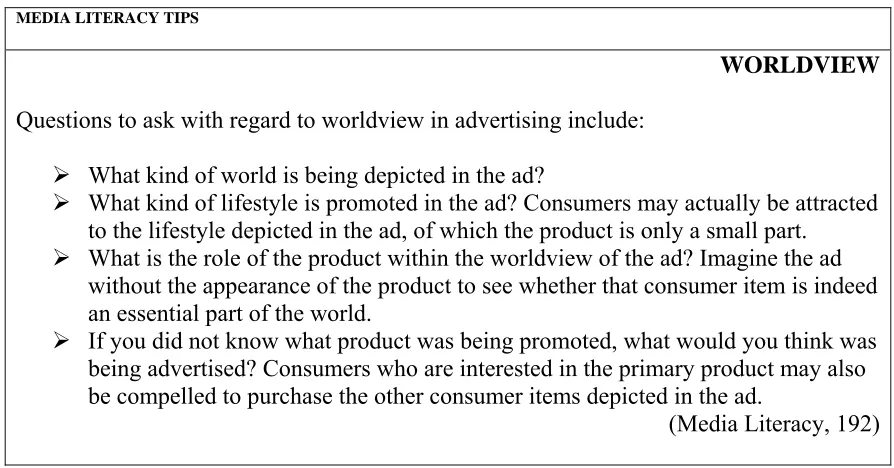
As to deciphering the actual media message, Art Silverblatt provides the
Table 1: Silverblatt’s “Worldview” Media Literacy Tips
MEDIA LITERACY TIPS
WORLDVIEW
Questions to ask with regard to worldview in advertising include:
¾ What kind of world is being depicted in the ad?
¾ What kind of lifestyle is promoted in the ad? Consumers may actually be attracted to the lifestyle depicted in the ad, of which the product is only a small part.
¾ What is the role of the product within the worldview of the ad? Imagine the ad without the appearance of the product to see whether that consumer item is indeed an essential part of the world.
¾ If you did not know what product was being promoted, what would you think was being advertised? Consumers who are interested in the primary product may also be compelled to purchase the other consumer items depicted in the ad.
(Media Literacy, 192)
This guide is both simple and concise. Students can easily understand the information
without feeling daunted by advertising or literary jargon. Silverblatt also provides a more
ideologically-focused chart:
Table 2: Silverblatt’s “Ideology and Stereotypes” Media Literacy Tips
MEDIA LITERACY TIPS
IDEOLOGY AND STEREOTYPES
As you analyze ads, ask the following questions with regard to ideology and stereotype:
¾ To what groups (or subgroups) do the characters belong?
¾ In what settings are they presented?
¾ Are they the primary or secondary characters?
o Are they at home or at work?
o What kinds of products do they promote?
¾ What do the stereotypes reveal about cultural attitudes toward these groups? (Media Literacy, 192)
Guidelines such as Silverblatt’s give students condensed, focused information matching
be helpful in stimulating conversation once students have recorded their initial
impressions, working card-by-card would be very time-consuming and the instructor
might have a hard time coalescing all of the visual elements. This in-depth analysis
would be helpful if the students were working on one or two specific elements of a visual
(i.e. ideological message and stereotypes), but the questions are rather intense and require
some knowledge that basic writers might have a hard time grasping (i.e. what do the
stereotypes reveal about cultural attitudes towards these groups). Not all first year
students are ready to jump to this level of analysis in such a condensed format.
Marguerite Helmers proposes that students begin analysis by creating a blank
chart that they can easily complete for every image they assess. First students fill in the
literal design elements: color, value, line, shape, form, texture and space (34-35). Next
students fill in a chart of the arrangement principles of design: perspective, angle and
vantage, point of view, framing, dominance (emphasis), balance, proportion, pattern,
contrast, and grid (36). Helmers provides detailed definitions of all of these terms of
literal design elements and arrangement principles of design, but these definitions are
artistic and formal. These definitions are workable for the advanced design student, but
this level of analysis would be overwhelming for students who have never deconstructed
visuals before. These complex definitions coupled with the limited time (one semester)
an instructor has to work with first-year composition students makes Helmers’ approach a
bit difficult to follow.
This study employs the elements of analysis defined in the composition textbook
typically used in English 1101 classes at Georgia State University (fall 2006 – spring
Images” begins with a short explanation explaining why analysis is important. The
chapter continues and gives a “framework for analysis” that students can apply to images.
Below is an abbreviated list of the framework.
Subject: Who or what is in the image?
Number: How many figures or objects appear in the image
Placement: How are the figures or objects arranged?
Pose: Do figures appear naturally, or do they seem posed?
Gaze: If there are people or animals in the picture, where are they looking?
Mouth: Are figures smiling or unsmiling?
Clothing: How are the people in the image dressed?
Color: If the image is in color, what does the color communicate?
Light: How is the image illuminated?
Size: How large is the image?
Context: Where and when did the image originally appear?
Association: Does the image seem similar to other images you’ve seen?
(Miller 306-307)
The entire framework is available in Appendix A. This model for analysis is particularly
helpful in the introductory composition classroom because it does not require the
instructor to provide a new vocabulary for discussing the visual elements. Students at the
introductory level can begin analyzing visuals immediately with this list, and even when
viewed out of context these elements make sense.
Unfortunately the Motives for Writing textbook introduces these elements and
strategy works well in a text with many chapters, the visuals compete with the text.
Students are likely to privilege the written text and allow the essayist’s message to
influence their perception of the image rather than share their own opinions. Therefore
students are more likely to agree with the opinions of the educated author in discussion,
taking on the author’s bias. However, these elements for visual analysis are succinct and
effective in an introductory classroom, and encourage students to expand on definitions
and interpretations of certain aspects – i.e. for “mouth,” what is the significance of a
genuine smile vs. forced smile – while giving them guidelines for analysis.
Media Literacy Activities in Action: Discovering Effective Teaching Strategies
In my study, I used the Motives for Writing analysis. I asked fourteen students
whether or not they thought visual analysis helped them better understand analysis and
whether or not they felt visual analysis helped them meet composition objectives both
before and after they were given the guidelines for visual analysis. I also asked them to
write several statements addressing whether or not they liked the exercise, having
students respond in the form of a free write exercise or as part of answering a series of
questions. These students were all enrolled in the English 1101 composition course at that
time, which covers different types of writing and is the mandated introductory English
course for incoming freshmen.
I wanted to use a Likert scale for the questionnaire (available in Appendix B)
because it renders the students’ responses easy to quantify, and because I also felt the
perceived “scientific formality” of rating their experience would mentally distance them
from the friendly classroom atmosphere. The Likert scale includes values from 0 to 4,
little, 3 = A little, 4 = Somewhat, 5 = A lot (see sample form in Appendix C.) I chose
informal wording for the ratings so that students wouldn’t be intimidated by the language
– for example, somewhat instead of moderately – and was sure to include the category
“Not sure” in case any of the students were confused about either the rating system or the
objectives. Although I am aware that generalizing one of the responses as “Not sure”
further complicates making assertions about the results, this project is admittedly biased
and informal, and I did not want to force students to answer questions about which they
were unsure. The standard objectives for Composition 1101 at Georgia State for the
2006-2007 academic year are listed in the GTA Handbook and serve as the basis for the
questionnaire. I asked students to rate whether or not they felt the lessons involving
visual analysis gave them practice with/helped them meet the composition objectives, and
then handed them the form. After the students rated how well the lesson met their
objectives, I had them “free-write” on whether or not they liked the lesson, which was
prefaced each time with the disclaimer that I was researching the lesson’s usefulness to
them as students and simply did not want to continue the lesson if they found it
unhelpful. I also stated that this research would in no way effect their grade and hoped
they would be honest both for the sake of research and for future students.
Die Hard/DeMott – Activity 1
For the first activity, I wanted to help students understand how visuals can
enhance text, and I wanted them to read a scholarly essay that commented on a movie.
Students read an essay titled “Putting on a Happy Face: Masking the Differences
Between Blacks and Whites” by Benjamin DeMott after they read a series of essays both
scene at the opening of the movie Die Hard With a Vengeance as a primary example of
how modern media visually assert that “racial injustice has been amicably resolved” (53).
As a complement to this essay, I brought in Die Hard With a Vengeance and showed the
opening scenes to which DeMott refers, asking students to keep in mind the claims
DeMott makes in his essay. Because this movie was released in mid-1995, most of my 18
year-old students had never heard of this movie. When I asked how many of them had
seen this movie, three (3) students raised their hands. What I hoped to achieve in this
activity was to get students to connect the medium to the scholarly essay, and see how the
two texts both addressed a cultural issue – the way that different races cooperate in the
arena of film versus in real life. I anticipated that students would rate this activity as
helpful with the following composition objectives: “use language to explore and analyze
contemporary multicultural, global, and international questions,” “critique your own and
others' work in written and oral formats,” and “engage in the collaborative, social aspects
of writing, and use writing as a tool for learning.” Although I do not limit the
applicability of the Die Hard/DeMott activity to these three objectives, these are the three
main objectives I think the activity most obviously meets.
I began the activity by showing the first scene in Die Hard. After showing the
movie clip, I then asked students to answer two questions at the end of the essay that refer
directly to the movie clip and DeMott’s interpretation in their peer review groups of three
(3) and four (4) students. I instructed the students that they would be turning in these
questions for a daily participation grade and, told them I would not assess this assignment
for correctness. Despite the low stakes of this assignment, students answered the
racial harmony like the one in Die Hard With a Vengeance that match DeMott’s
description of falsely-represented harmonious race relations. After the students answered
the questions, I had them fill out the form asking them to rank how well the Die
Hard/DeMott activity matched up with the composition 1101 objectives. After they rated
the objectives, I had students free-write for five minutes with the prompt “how did you
feel about this activity,” for the purpose of allowing students to express themselves with
words rather than numbers. The results of the objective ratings are as follows, with each
objective and the number of respondents that rated the objective as by its helpfulness in
Table 3: Responses from Die Hard/DeMott Activity
Objective: Respondents’ Ratings:
Not sure Not at all A little Somewhat A lot engage in writing as a process,
including various invention heuristics
0 2 2 5 5
gather evidence, consider audience, draft, revise, edit, and proofread
2 2 4 4 2
engage in the collaborative, social aspects of writing, and use writing as a tool for learning
0 1 4 8 0
use language to explore and analyze contemporary multicultural, global, and international questions
2 2 4 6 0
demonstrate how to use writing aids, such as handbooks, dictionaries, online aids, and tutors
2 8 1 3 0
gather, summarize, synthesize, and explain information from various sources
0 0 6 5 2
use grammatical, stylistic, and mechanical formats and conventions appropriate for a variety of audiences
3 4 4 2 1
critique your own and others' work in written and oral formats
3 1 6 1 3
produce coherent, organized, readable prose for a variety of rhetorical situations
2 2 2 6 2
reflect on what contributed to your writing process and evaluate your own work
3 1 3 4 3
What I initially found most disturbing about these responses was the high number of “not
sure” ratings each objective received. Nineteen students indicated that they were “not
sure” whether or not the activity aided them in achieving a specific objective, while
practice with an objective. The high occurence of “not sure” responses could result from
students’ confusion over several different unaccounted-for variables:
misunderstanding/lack of understanding concerning the objectives, lack of confidence in
a lesson asking them to relate a movie to a text, or uncertainty about which outcomes
applied to the activity. Of course, some students may have been unsure about or
uninterested in the lesson entirely. Whatever the cause, students generally appeared a
little daunted and confused about the connections I was trying to get them to make
between the text and the film.
With the students’ confusion in mind, the three objectives I felt the activity most
applied to received relatively high ratings. Students gave two of the objectives, “engage
in the collaborative, social aspects of writing”, and “use writing as a tool for learning and
use language to explore and analyze contemporary multicultural, global, and international
questions,” no ratings of helping “A lot,” but gave eight and six ratings of helping
“Somewhat.” The other objective I singled out, “critique your own and others' work in
written and oral formats,” received 3 “A lot” ratings, but also received three “Not sure”
ratings, indicating to me that students were not confident in analyzing or critiquing either
the film or the essay. The objectives that students rated as the most helpful was “gather,
summarize, synthesize, and explain information from various sources,” with only two
ratings of “A lot,” five of “Somewhat,” and six of “A little,” but zero ratings of “Not
sure” or “Not at all.” Students’ confidence with this objective may lie in the confidence
of their ability to gather, summarize and explain more than their application of the lesson