International Journal of Scientific and Research Publications, Volume 4, Issue 3, March 2014 1 ISSN 2250-3153
www.ijsrp.org
LOW-POWER AND LOW-AREA ADAPTIVE FIR
FILTER BASED ON DISTRIBUTED ARITHMETIC
AND LMS ALGORITHM
K.JEBIN ROY*, R.RAMYA**
*M.E. VLSI Design, Department of ECE, Anand Institute of Higher Technology, Chennai-603103, India **M.Tech. VLSI Design, Department of ECE, Sathyabama University, Chennai-600119, India
Abstract-In this manuscript, an unusual adaptive FIR filter using distributed arithmetic (DA) for area efficient design is implemented. DA is bit-serial computational action and uses parallel look-up table (LUTs) apprise and equivalent implementation of filtering and weight-update operations to appliance high throughput filter rates irrespective of the filter length. The full adder based conditional signed carry save accumulation for DA-based inner product computation is swapped and design by using 10 transistor full adder based carry save accumulation of shift accumulation, with the intention of the proposed design, it can reduce the area complexity and power consumption. The least-mean-square (LMS) algorithm adaptation is functioned to update the weight and abate the mean square error between the assessed and
chosen output. The weight increment block based
adder/subtractor cells is exchanged by carry save adder in order to reduce area difficulty. It comprises of multiplexors, smaller LUT, and practically half the number of adders contrasted to the present DA-based design.
Index Terms: Adaptive Filter, Distributed Arithmetic (DA), Finite Impulse Response (FIR), Least Mean Square (LMS) Algorithm, Lookup table (LUT).
I. INTRODUCTION
Adaptive filters find extensive use in many signal processing applications such as channel equalization, echo cancellation, noise cancellation [1]. The finite impulse response (FIR) filters whose weights are updated by the famous Widrow-Hoff least mean square (LMS) algorithm is the most popularly used adaptive filter not only due to its simplicity but also due to its satisfactory convergence performance [5]. The direct form configuration on the onward path of the FIR filter results in a long critical path due to an inner product computation to obtain a filter output. Consequently, it is required to reduce the critical path of the structure if the input signal has high sampling rate. By reducing the
critical path of the structure, thereby, the critical path could not exceed the sampling period.
Distributed arithmetic (DA) is so named because it performed arithmetic operation. DA is bit serial computation in nature and it eliminates the need for hardware multipliers and is capable of implementing large order filters with very high throughput. A lot of study has been done to implement the DA based adaptive FIR filter for area efficient design, the multiplier-less distributed arithmetic (DA) based technique has achieved plenteous popularity for its high throughput, but it results are increased in cost-effective, area and time efficient computing
structures [8]. DA based hardware efficient adaptive FIR filter inner product has been suggested by Allred et al. [2] using two separate lookup tables (LUTs) Filtering lookup table and Auxiliary lookup table for filtering and weight updating module. Later, Guo and DeBrunner [3], [4] have improved the design structure in [2] by using only one lookup table instead of two LUTs for both filter and weight updating module. On the other hand, the design process in [2], [3], [4] and [8] require more cycles for lookup table (LUT) update for each new sample, hence it do not support high sampling rate. Meher and Park have improved the design with low adaptation delay for high speed DA based adaptive filter [6]. In a recent paper, Meher and Park proposed a new DA based adaptive filter architecture for low power, low area and high throughput with very low adaptation delay [7].
This brief proposes an adaptive FIR filter using distributed arithmetic for area efficient design. High Throughput is achieved by using a parallel lookup table update and equivalent implementation of filtering and weight-updating operations. The conditional signed carry saved accumulation for DA-based inner product computation is designed by using 10 transistor full adder based carry saved accumulation of shift accumulation. The use of the proposed design helps to reduce the area complexity and power consumption.
In the next section, a brief study of the least mean square (LMS) adaptive algorithm, followed by the description of the proposed DA based technique filter in Section III. The structure of the proposed adaptive filter and description of the proposed DA based adaptive FIR filter in Section IV. Results and Conclusions are given in Section V and VI.
II. Review of LMS Adaptive Algorithm
The LMS algorithm computes a filter output and an error value that is equal to the difference between the current filter output and the desired response for every clock cycle. In every training cycle, the estimated error is then used to update the filter weights. The weights of LMS adaptive filter during the
nth iteration is updated according to the following equations [6]:
( ) ( ) ( ) ( ) (1a) Where
( ) ( ) ( ) (1b)
ISSN 2250-3153
www.ijsrp.org The input vector ( ) and the weight vector ( ) at the nth
training iteration are respected given by
( ) [ ( ) ( ) ( )]T
(2a)
( ) [ ( ) ( ) ( )]T
(2b)
( ) is the desired response, and ( ) is the filter output of the iteration. ( ) denotes the error value generated during the iteration, which is used to update the weights, is the convergence factor, and N is the filter length.
In the case of filter designs, the feedback error ( ) becomes available after certain number of cycles, called the “adaptation delay”. The pipelined architectures therefore use the delayed error ( ) for updating the current weight instead of the most recent error, where is the adaptation delay. The weight update equation of such delayed LMS adaptive filter is given by
( ) ( ) ( ) ( ) (3)
III. Proposed DA-Based Approach for Inner Product Computation
In each cycle, the LMS adaptive filter needs to perform an inner-product computation which contributes to the most of the critical path. Let the inner product computation of (1c) be given by
∑
(4)
Where and for form the N – point vectors corresponding to the current weights and most recent
input respectively. Let us assume be the bit width of the weight, every component of the vector weight may be expressed in 2’s complement representation
∑ (5)
Where denotes the bit of . Substituting (5), we can write (4) in an expanded form
∑ ∑ [∑ ]
(6)
To convert the sum-of-product form of (4) into a distributed form, the order of summations over the indices and in (6) can be interchanged to have
∑ ∑ [∑ ]
(7)
and the inner product given by (7) can be computed as
[∑
] , ∑
(8)
Meanwhile any element of the N-point bit sequence
{ } can either be 1 or 0, the partial sum
for = 0,1,…, can have possible values. If all the possible values sum are precomputed and stored in a LUT, the partial sum can be read out from the LUT using the bit sequence { } as address bits for computing the inner
product.
[image:2.595.308.506.153.389.2]Figure 1: DA-based implementation of four point inner product
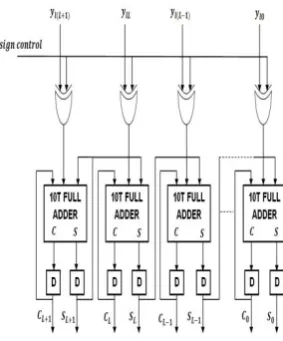
Fig 2: Carry save implementation of shift accumulation
The inner product of (8) can therefore be calculated in cycles of carry save implementation of shift accumulation, followed by LUT-read operations corresponding to number of bit slices { } for , as shown in Fig. 1. Since the
[image:2.595.360.502.426.597.2]International Journal of Scientific and Research Publications, Volume 4, Issue 3, March 2014 3 ISSN 2250-3153
[image:3.595.63.234.71.262.2]www.ijsrp.org
[image:3.595.355.523.78.299.2]
Figure 3: 10T 1-Bit Full Adder
Figure 4: Carry save adder accumulation
The carry save implementation of shift accumulation based full adder is design by using 10 transistor one bit-full adder [9] as shown in Fig. 4. The bit slices of vector are fed one after the next in the LSB to the MSB order to the carry save accumulator. Finally, the sum and carry output of the carry save accumulator is obtained after clock cycle are required to be added by a final adder. The content of the LUT location can be expressed as
∑
(9)
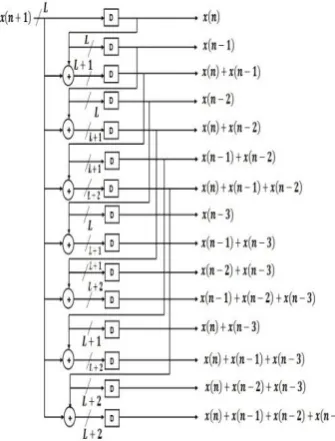
[image:3.595.80.219.302.451.2]where is the ( )th bit of the - bit binary representation of integer for can be precomputed and stored in RAM based LUT of words. However, instead of storing words in LUT, we store ( ) words in a DA table of ( ) registers.
Figure 5: Distributed arithmetic table
Figure 6: Proposed structure of DA-based LMS adaptive filter length
DA table for N=4 is shown in Fig. 5. DA table contains only 15 registers to store the precalculated sums of input words. In DA table, seven new values of are computed by seven adders in parallel.
4 ISSN 2250-3153
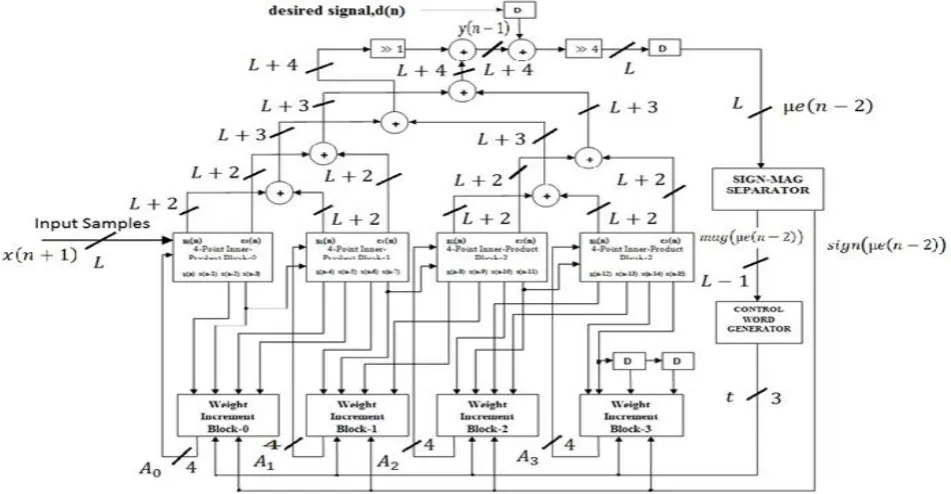
[image:4.595.66.542.81.328.2]www.ijsrp.org Figure 7: Proposed structure of DA-based LMS adaptive filter of length N=16
The structure of DA-based adaptive filter of length N=4 comprises of a four-point inner-product block and a weight-increment block along with additional circuits for the computation of error value ( ) and control word for the barrel shifters. The four-point inner-product block [shown in Fig. 1] contains a DA table consisting of an array of 15 registers [shown in Fig. 5] which stores the partial inner products for and a 16:1 multiplexor to select the content of one of those registers from the DA table. Bit slices of weights A = { } for
[image:4.595.350.560.375.494.2]are fed to the MUX as control in LSB –to- MSB order, and the output of the MUX is fed to the carry save accumulator using 10T full adder as shown in Fig. 4. After bit cycles, the carry save accumulator shift accumulates all the partial inner products and generates a sum and carry output word of size ( +2) bit each. The carry and sum words are shifted added with an input carry “1” to generate filter output which is subsequently subtracted from the desired output ( ) to obtain the error ( ).
Figure 8: Structure of the weight-increment block for
if r6=1 then t= “000”; else if r5 = 1 then t= “001”; else if r4 = 1 then t= “010”; else if r3 = 1 then t= “011”; else if r2 = 1 then t= “100”; else if r1 = 1 then t= “101”; else if r0 = 1 then t= “110”;
( ( ))
Figure 9: Logic used for generation of control word for the barrel shifter for
[image:4.595.74.252.612.744.2]International Journal of Scientific and Research Publications, Volume 4, Issue 3, March 2014 5 ISSN 2250-3153
[image:5.595.39.265.63.220.2]www.ijsrp.org Figure 10: DA-based LMS adaptive FIR filter of length
N=16
V. Results
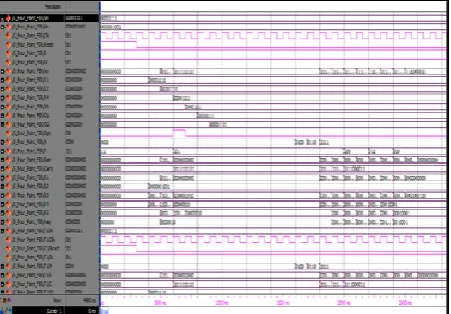
Thus the existing and proposed designs in [7] and [8] are implemented in Xilinx 14.1 using verilog code. Along with area and power of corresponding design are measured using Tanner 15.1 EDA in 250nm CMOS technology.
Table 1: Implementation Results Using Xilinx 14.1 and Tanner 15.1
Designs Filter
Length
Area (sq.µs)
Power (mW)
Existing N = 16 18264 9.41
Proposed N = 16 17220 8.49
VI. Conclusion
In this script, an adaptive FIR filter using distributed arithmetic (DA) for area efficient design is implemented. High throughput is drastically enriched by parallel (LUTs) update and equivalent implementation of filtering and weight-update operations. The proposed carry save accumulation using 10 transistor full adder schemes of signed partial inner products for the computation of the filter output and also modified in weight increment block. By this way it utilizes low area, low power consumption and the throughput of the filter rates increases irrespective of the filter length.
REFERENCES
[1] B. Widrow and S. D. Stearns, Adaptive signal processing. Prentice Hall, Englewood Cliffs, NJ, 1985.
[2] D. J. Allred, H. Yoo, V. Krishnan, W. Huang, and D. V. Anderson, “LMS adaptive filters using distributed arithmetic for high throughput,” IEEE Trans. Circuits Syst. I, Reg. Papers, vol. 52, no.7,pp. 1327–1337, Jul. 2005.
[3] R. Guo and L. S. DeBrunner, “Two high-performance adaptive filter implementation schemes using distributed arithmetic,” IEEE Trans. Circuits Syst. II, Exp. Briefs, vol. 58, no. 9, pp. 600–604, Sep. 2011.
[4] R. Guo and L. S. DeBrunner, “A novel adaptive filter implementation scheme using distributed arithmetic,” in Proc. Asilomar Conf. Signals, Syst., Comput., , pp. 160–164, Nov. 2011.
[5] S. Haykin and B. Widrow “Least-Mean-Square Adaptive Filters” Hoboken, NJ, USA: Wiley, 2003.
[6] P. K. Meher and S. Y. Park, “High-throughput pipelined realization of adaptive FIR filter based on distributed arithmetic,” in VLSI Symp. Tech. Dig., Oct. 2011, pp. 428–433.
[7] Sang Yoon Park, Member, IEEE, and Pramod Kumar Meher, Senior Member, IEEE “Low-Power, High-Throughput, and Low-Area Adaptive FIR Filter Based on Distributed Arithmetic” IEEE Transactions On Circuits And Systems—Ii: Express Briefs, Vol. 60, No. 6 June 2013.
[8] S. A. White “Applications of the distributed arithmetic to digital signal processing: A tutorial review,” IEEE ASSP Mag., vol. 6, no. 3, pp. 4–19, Jul. 1989.
[9] Hanan A.Mahmoud and Magdy.A. Bayoumi, “ A 10-Transistor Low Power High Speed Full Adder Cell”.
AUTHORS
K. Jebin Roy B.E (M.E. VLSI Design)
Anand Institute of Higher Technology,
Chennai – 603103, India. E-mail: [email protected]
R.Ramya B.E (M.Tech. VLSI Design)