An Image Encryption Technique based on DNA
Encoding and Round-reduced AES Block Cipher
Eman Shehab
Faculty of Computers and Information, Menofia University, Shebin El-kom, Menofia, Egypt
AbdelAlim K. Farag
Faculty of Computers and Information, Menofia University, Shebin El-kom, Menofia, Egypt
Arabi Keshk
Faculty of Computers and Information, Menofia University, Shebin El-kom, Menofia, Egypt
ABSTRACT
Despite the difficulties of applying DNA computational tool on cryptography, a new direction in DNA cryptography research is performed to provide data and information security. DNA can be used to store and transmit the information and also to perform com-putation. Using block ciphers, images have poor encryption effect due to their intrinsic features such as bulky data capacity and high data redundancy. In this paper, a combination of DNA computing and round-reduced AES block cipher is proposed. The proposed technique can be used not only to achieve a high level of security but also to obtain fast implementation.
General Terms:
Information Security, Cryptography
Keywords:
AES, DNA, Image Encryption
1. INTRODUCTION
Information security is the science of protecting information from unauthorized access or use. Confidentiality, integrity and availabil-ity are the key principals of information securavailabil-ity, which should be guaranteed the security of the system. Cryptography is the tech-nique which provides these information security principals. It has become a very critical aspect of modern computing systems to se-cure the data transmission and storage [1]. The main processes in cryptography are encryption and decryption; encryption is the pro-cess of encoding information (plaintext) such that the only autho-rized persons can access it. A cryptographic algorithm is used to encode the information and turning it to (ciphertext). On the other hand, decryption is the decoding process in which the ciphertext can be converted back to the plaintext based on the decryption al-gorithm. The Advanced Encryption Standard (AES) has become the default choice for various applications since its adoption as a new encryption standard by NIST in 2001 [7]. It is a symmetric block cipher that processes data blocks of 128-bits using a cipher
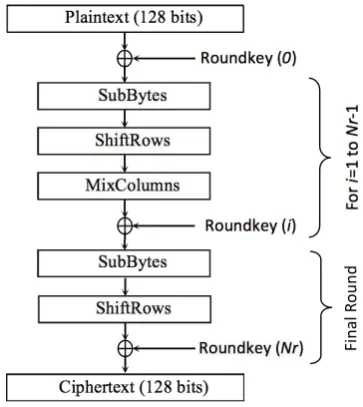
key of length 128, 192 or 256 with number of roundsN r=10, 12, or 14 respectively. Fig. 1 shows the AES encryption algorithm.
!
Plaintext (128 bits)
SubBytes
ShiftRows
MixColumns
SubBytes !
Ciphertext (128 bits) ShiftRows !
"#$%&'()!*!+!
"#$%&'()!*"+!
"#$%&'()!*#$+!
,
#
-!
"
.
/
!0
#
!
#
$
1/
!
,
2%
3
4!
"
#
$
%
&
[image:1.595.345.527.317.521.2]!
Fig. 1: 128-bits AES encryption algorithm.
In this figure, the data block consists of an array of 4x4 bytes called a state. Four different transformations are applied on the state: Sub-Bytes, ShiftRows, MixColumns and add RoundKey. The four trans-formation are described briefly as follows:
(1) Add round key transformation: The XOR operation is applied between the state and the round key. In decryption process, this transformation is its own inverse.
!
S0,0 S0,1 S0,2 S0,3
S1,0 S1,1 S1,2 S1,3
S2,0 S2,1 S2,2 S2,3
S3,0 S3,1 S3,2 S3,3
S'0,0 S'0,1 S'0,2 S'0,3
S'1,0 S'1,1 S'1,2 S'1,3
S'2,0 S'2,1 S'2,2 S'2,3
[image:2.595.70.279.67.128.2]S'3,0 S'3,1 S'3,2 S'3,3 !"#$%&
Fig. 2: SubByte in each byte in the state matrix.
!
S0,0 S0,1 S0,2 S0,3
S1,0 S1,1 S1,2 S1,3
S2,0 S2,1 S2,2 S2,3
S3,0 S3,1 S3,2 S3,3
S0,0 S0,1 S0,2 S0,3
S1,1 S1,2 S1,3 S1,0
S2,2 S2,3 S2,0 S2,1
[image:2.595.344.529.69.210.2]S3,3 S3,0 S3,1 S3,2
Fig. 3: ShiftRows transformation.
!
Fig. 4: MixColumns transformation.
(3) ShiftRows transformation: The bytes in the last three rows of the state are cyclically shifted to left; the left shift varies from one to three bytes. Fig. 3 shows the ShiftRows transformation. The cyclical right shift can be used in the decryption process.
(4) MixColumns transformation: In this transformation each col-umn of the state multiplied by a fixed matrix. In this multiplica-tion, the bytes are treated as polynomials rather than numbers. Fig. 4 shows the MixColumns transformation. In the decryp-tion process, the inverse MixColumns can be used in which the fixed matrix is different.
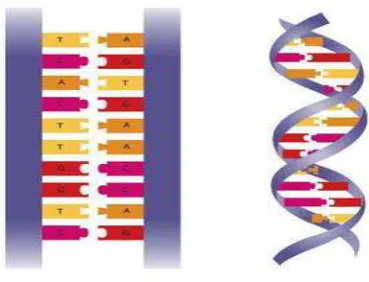
Deoxyribo nucleic acid (DNA) is a nucleic acid that represents the genetic blueprint of living creatures. The main advantage of DNA molecules is that it can store huge amount of information. DNA is made up of two twisted strands of nucleotides. Each nucleotide composed of a phosphate group, a deoxyribose sugar, and four bases: A-Adenine, C-Cytosine, T-Thymine and G-Guanine. Theses four bases represent the genetic code where ’A’ and ’T’ are com-plementary, and ’G’ and ’C’ are complementary [3]. Fig. 5 shows the structure of double stranded DNA sequence [9]. This paper is organized as follows: The related work is introduced in section 2. The proposed image encryption scheme is described in section 3. In section 4, the results and the security analysis of the proposed scheme are presented. Finally, The conclusion of the paper is pre-sented.
! Fig. 5: Structure of double stranded DNA.
2. RELATED WORK
In this section related methodologies and techniques to design a secure symmetric image encryption are presented. In [13], Zeghid et al.presented a modified AES based algorithm in which a key stream generator (A5/1, W7) is added to AES to ensure improving the encryption performance. In [10], Wadi and Zainal modified the AES algorithm to be used for images ciphering especially the HD images. Their modifications are applied by decreasing the number of rounds to one and by replacing the S-box with a new S-box to decrease the hardware requirements. Their experimental results en-sure that the proposed work make AES algorithm faster while fulfill the security requirements.
In [5], an RGB image encryption algorithm based on DNA encod-ing and chaos map is proposed. The proposed algorithm effectively eliminates the pixels correlation of the RGB image in the spatial do-main by using DNA addition operation. Also, in order to increase security, a combined chaotic system is used to disturb the value of the pixels. In [6], Mandalet al.presented an image encryption pro-cess based on chaotic logistic map. The XOR operations and pixel shuffling of the image are used to confuse and defuse the pixel value and pixel position. In [11] a novel color image encryption algo-rithm based on DNA sequence operation and hyper-chaotic system is proposed. The positions of pixels are scrambled by Chens hyper-chaotic system and the pixel grey values of the original image are scrambled by DNA sequence addition operation.
3. PROPOSED WORK
[image:2.595.55.292.220.399.2]The DNA-sequence can be exchanged between different parities using key exchange scheme. In this scheme the parities can agree on the type of entirely sequenced genomes databases from different organisms and on the starting index and the size of this sequence. The main advantage of using this method is that it achieves high level of security and also it fulfills fast implementation.
Algorithm 1The pseudo code for the proposed encryption
algo-rithm
Require: Plain-image[n×m], key[N r][4×4], and DNA-key[4×
m] bytes.
Ensure: Cipher-image[nxm] bytes.
1: Suppose that the plain-image size isn×mpixels and the state size is [4×4] bytes.
2: fori= 1step 1 ton/4do 3: forj= 1step 1 tom/4do
4: AddRoundKey(state[i, j], key[0][4×4]); 5: forr= 1step 1 toN r−1do
6: SubBytes(state[i, j]); 7: ShiftRows(state[i, j]); 8: MixColumns(state[i, j]);
9: AddRoundKey(state[i, j], key[r][4×4]);
10: end for
11: SubBytes(state[i, j]); 12: ShiftRows(state[i, j]);
13: AddRoundKey(state[i, j], key[N r][4×4]);
14: end for
15: end for
16: //Note that: The DNA-key size is4×mbytes, consequently, the state size will be changed to4×mbytes.
17: fori= 1step 1 ton/4do 18: xor(state[i], DNA-key);
19: end for
4. EXPERIMENTAL RESULTS 4.1 Experimental Results
This section describes the simulations carried out to evaluate the proposed encryption scheme and discusses their results. The exper-iments run on MatlabR
software tool to implement the proposed en-cryption technique. Fig. 6 shows original and encrypted gray scale images used in the simulations. In these simulations, all images have dimensionsn×m= 256×256pixels.
Our experiments show that two rounds of AES block cipher is enough to achieve high level of security with low encryption time in comparison with the all rounds AES algorithm.
5. SECURITY ANALYSIS
The performance of our method is evaluated using different quanti-tative measures such as key space, statistical, and differential anal-ysis.
5.1 Key Space Analysis
The key space is the total number of different keys that can be used for encryption. The key space must be large enough to re-pel the brute force attack. Nowadays, the scale of DNA gene-bank becomes larger and larger with the fast development in this branch of science. In our approach, DNA sequences are used as secret keys
with sequence size4×256. In addition to 128-bits for the round-reduced AES block cipher. So the key space of our approach is large enough to resist brute-force attacks.
5.2 Statistical Analysis
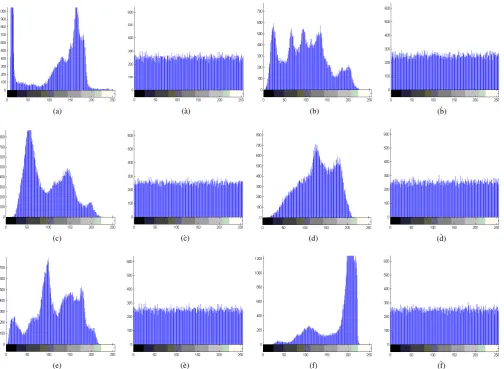
5.2.1 Histogram Analysis. Considering the statistical analysis of the original image and the encrypted image, Fig. 7 shows the his-tograms of original and encrypted image, respectively. In this fig-ure, pixel values of original image are tortuous, but the correspond-ing histograms of encrypted image are very uniform which makes the statistical attacks difficult to recover the original images.
5.2.2 Correlation Analysis of the Adjacent Pixels. It is known that the original image have high correlation between its adjacent pixels so we must reduce that in encrypted image to resist statis-tical attack. In this section, correlation coefficient of two adjacent pixels in original image and encrypted image is studied. In order to test the correlation between two adjacent pixels, we randomly se-lect 5000 pairs (horizontal, vertical and diagonal) of adjacent pixels from the original image and the encrypted image, using the follow-ing equations to calculate the correlation coefficient:
ρ=pcov(x, y)
D(x)p
D(y),where
D(x) =1
n n X
i=1
(xi−E(x))2
E(x) =1
n n X
i=1
(xi)
cov(x, y) =1
n n X
i=1
(xi−E(x))(yi−E(y))
Wherexandyare the values of two adjacent pixels of the plain images or the encrypted images,nis the number of pixel pairs. Fig. 8 shows the horizontal correlation of original and encrypted gray scale images used in the simulations. It provides that correlation in original image has high value but it is close to zero in the encrypted image. In other words, the proposed image encryption algorithm has strong ability against the statistical attack.
5.2.3 Correlation Analysis of Original and Encrypted Image. The correlation coefficient between the original and the encrypted images can be defined as
ρ=
n P i=1
m P i=1
(X(i, j)−E(X))(Y(i, j)−E(Y))
s n P i=1
m P i=1
(X(i, j)−E(X))2
n P i=1
m P i=1
(Y(i, j)−E(Y))2
Where,X(i, j),Y(i, j)are theithrow andjthcolumn pixel values
of plain image and cipher image respectively.E(X), E(Y) rep-resent the average of plain image and cipher image respectively.
(n, m)is the image dimension. The result in Table 1 shows that there is a negligible correlation between the plaintext and the cipher image. So, the proposed scheme possesses high security against sta-tistical attacks.
(a)
(b)
(c)
(d) (e) (f)
(`a) (`b)
(`c) (`d)
[image:4.595.53.557.76.365.2]
(`e) (`f)
[image:4.595.357.514.451.530.2]Fig. 6: Original and encrypted gray scale images used in the simulations. (a), (`a) cameraman; (b), (`b) lena; (c), (`c) monalisa; (d), (`d) mandril; (e), (`e) peppers; (f), (`f) plane. All images have dimensions256×256pixels. 2-rounds of AES followed by XOR-ing the results with a DNA sequence are used for encryption
Table 1. : The correlation of plain-image and cipher-image. The images are encrypted using: 2-rounds of AES only and using 2-rounds of AES followed by XOR-ing the results with a DNA sequence
2-rounds AES only 2-rounds AES&DNA
Cameraman 0.0088 -0.0076
Lena -0.0036 -0.0014
Monalisa -0.0128 0.0046
mandrill -0.0060 -0.0019
peppers 0.00072 0.00039
plane -0.00042 -0.00010
age encryption algorithm [8]. The measure of entropy of a source mis defined as,
H(m) =X
i
p(mi)log2
1
p(mi)
Wherep(mi)represents the probability of the symbol (pixel value) mi. Therefore, according to the above equation the entropy of the
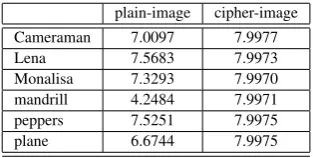
system will beH(m) = 8. Therefore, the higher the entropy value of an encrypted image, the better the security. Table 2 shows the entropy of the plain images and the encrypted images. From these data it is clear that the entropy of the encrypted images is slightly less than 8, which proves the ability against the entropy attack.
Table 2. : Entropy of original and encrypted images
plain-image cipher-image Cameraman 7.0097 7.9977
Lena 7.5683 7.9973
Monalisa 7.3293 7.9970 mandrill 4.2484 7.9971 peppers 7.5251 7.9975 plane 6.6744 7.9975
5.3 Differential Analysis
[image:4.595.67.278.470.549.2]!
(a)
!
(`a)
!
(b) (`b)
!
(c) (`c)
!
(d) (`d)
!
(e) (`e)
!
[image:5.595.55.560.75.444.2](f) (`f)
Fig. 7: Histograms of original and encrypted gray scale images used in the simulations. (a), (`a) cameraman; (b), (`b) lena; (c), (`c) monalisa; (d), (`d) mandril; (e), (`e) peppers; (f), (`f) plane.
NPCR=
n P i=1
m P i=1
D(i, j)
n×m ×100
UACI= 1
n×m× n P i=1
m P i=1
|C1(i, j)−C2(i, j)|
255 ×100
whereC1, C2 are two images with the same size n×mand if
C1(i, j)6=C2(i, j)thenD(i, j) = 1otherwiseD(i, j) = 0.
Table 3 shows the NPCR and UACI values for the different images. This table indicates that our method possesses high level of security against differential attacks.
6. CONCLUSION
[image:5.595.75.278.512.591.2]In this paper, a new encryption/decryption of image ciphering method is proposed. The new method is based on DNA sequence
Table 3. : NPCR and UACI performance of the corresponding images that are scrambled using 2-rounds of AES followed by XOR-ing the results with a DNA sequence
NPCR UACI
Cameraman 99.62% 31.16% Lena 99.62% 30.48% Monalisa 99.60% 29.64% mandrill 99.59% 27.36% peppers 99.62% 29.19% plane 99.62% 32.40%
[image:5.595.372.498.539.618.2]our algorithm has good encryption effect. Furthermore, it has high resistance to most of the known attacks such as exhaustive search, statistical analysis, and differential analysis. We conclude that our method achieves high level of security and fast implementation.
7. REFERENCES
[1] Manoj B and Manjula N Harihar. Image encryption and de-cryption using AES. International Journal of Engineering and Advanced Technology (IJEAT), 1(5):290–294, 2012. [2] Shahram Etemadi Borujeni and Mohammad Eshghi. Chaotic
image encryption design using tompkins-paige algorithm. Hindawi Publishing Corporation Mathematical Problem in Engineering, 2009:1–22, 2009.
[3] Kritika Gupta and Shailendra Singh. DNA based crypto-graphic techniques: A review.International Journal of Ad-vanced Research in Computer Science and Software Engi-neering, 3(3):607–610, 2013.
[4] H.S. Kwok and Wallace K.S. Tang. A fast image encryption system based on chaotic maps with finite precision represen-tation.Chaos Solitons Fractals, 32(4):1518–1529, 2007. [5] Lili Liu, Qiang Zhang, and Xiaopeng Wei. A RGB image
en-cryption algorithm based on DNA encoding and chaos map. International Journal of Computers & Electrical Engineer-ing, 38(5):1240–1248, 2012.
[6] Mrinal K. Mandal, Gourab D. Banik, Debasish Chattopad-hyay, and Debashis Nandi. An image encryption process based on chaotic logistic map. IETE Technical Review, 29(5):395–404, 2012.
[7] National Institute of Standards and Technology. FIPS 197. National Institute of Standards and Technology, November, pages 1–51, 2001.
[8] Claude E. Shannon. Communication theory of secrecy sys-tems.Bell System Technical Journal, 28(4):656–715, 1949. [9] Siddaramappa V. Data security in DNA sequence using
ran-dom function and binary arithmetic operations.International Journal of Scientific and Research Publications, 2(7):1–3, 2012.
[10] Salim M. Wadi and Nasharuddin Zainal. Rapid encryption method based on AES algorithm for grey scale HD image en-cryption.Procedia Technology, 11:51–65, 2013.
[11] Xiaopeng Wei, Ling Guo, Qiang Zhang, Jianxin Zhang, and Shiguo Lian. A novel color image encryption algorithm based on DNA sequence operation and hyper-chaotic system. Jour-nal of Systems and Software, 85(2):290–299, 2011.
[12] Rasmus Wernersson and Henrik Nielsen. Exercise: Searching the genbank database, April 2008.
0 50 100 150 200 250 300 0 50 100 150 200 250
0 50 100 150 200 250 300 0 50 100 150 200 250
0 50 100 150 200 250 300 0 50 100 150 200 250 300 (a)
0 50 100 150 200 250 300 0 50 100 150 200 250 300
0 50 100 150 200 250 300 0 50 100 150 200 250 300
0 50 100 150 200 250 300 0 50 100 150 200 250 300 (`a)
0 50 100 150 200 250 0 50 100 150 200 250
0 50 100 150 200 250 0 50 100 150 200 250
0 50 100 150 200 250 0 50 100 150 200 250 (b)
0 50 100 150 200 250 300 0 50 100 150 200 250 300
0 50 100 150 200 250 300 0 50 100 150 200 250 300
0 50 100 150 200 250 300 0 50 100 150 200 250 300 (`b)
20 40 60 80 100 120 140 160 180 200 220 0 50 100 150 200 250
0 50 100 150 200 250 0 50 100 150 200 250
0 50 100 150 200 250 0 50 100 150 200 250 (c)
0 50 100 150 200 250 300 0 50 100 150 200 250 300
0 50 100 150 200 250 300 0 50 100 150 200 250 300
0 50 100 150 200 250 300 0 50 100 150 200 250 300 (`c)
0 50 100 150 200 250 20 40 60 80 100 120 140 160 180 200 220
20 40 60 80 100 120 140 160 180 200 220 20 40 60 80 100 120 140 160 180 200 220
20 40 60 80 100 120 140 160 180 200 220 20 40 60 80 100 120 140 160 180 200 220 (d)
0 50 100 150 200 250 300 0 50 100 150 200 250 300
0 50 100 150 200 250 300 0 50 100 150 200 250 300
0 50 100 150 200 250 300 0 50 100 150 200 250 300 (`d)
0 50 100 150 200 250 0 50 100 150 200 250
0 50 100 150 200 250 0 50 100 150 200 250
0 50 100 150 200 250 0 50 100 150 200 250 (e)
0 50 100 150 200 250 300 0 50 100 150 200 250 300
0 50 100 150 200 250 300 0 50 100 150 200 250 300
0 50 100 150 200 250 300 0 50 100 150 200 250 300 (`e)
0 50 100 150 200 250 0 50 100 150 200 250
0 50 100 150 200 250 0 50 100 150 200 250
0 50 100 150 200 250 0 50 100 150 200 250 (f)
0 50 100 150 200 250 300 0 50 100 150 200 250 300
0 50 100 150 200 250 300 0 50 100 150 200 250 300
[image:7.595.57.558.123.608.2]0 50 100 150 200 250 300 0 50 100 150 200 250 300 (`f)