CONTRACTION SHOWN IN
THREE-DIMENSIONAL SPACE-TIME
FRAMES
Tower Chen
Division of Mathematical Sciences
University of Guam
e-mail:[email protected]
Zeon Chen
e-mail: zeon [email protected]
(Received 9 December 2008; accepted 18 February 2009)
Abstract
1
Introduction
In classical Newtonian physics, the concepts of space and time are absolute. Space is composed of three orthogonal dimensions, and time is represented as a fourth dimension, perpendicular to each of the spatial axes. Both space and time are free to be discussed in-dependent of the other. Einstein demonstrated that space and time are, in reality, dependent and inseparable by assuming the velocity of light is constant. He accomplished this through a thought experi-ment, where an illumination source at the center of a moving boxcar emits a pulse of light towards the front and towards the rear of the boxcar. Observers on the train see the two pulses of light hit the front and the rear walls of the box her one hits the front. This in-deed demonstrated that time, i.e. the simultaneity of two events, had to be placed in the context of space, i.e. the reference frame of the observer. In kinetic physics, we can use a Cartesian frame (x,
t) to describe the motion of a particle moving along one dimension, where the horizontal axis designates position and the vertical axis designates time. To describe the motion of that particle in the other two spatial dimensions, thus completely representing the particle’s motion in time, an additional two sets of Cartesian frames (y,t) and (z, t) must be constructed. Because the three frames cannot be tied together physically, i.e. 4 mutually orthogonal axes (three spatial and 1 time) cannot be represented as a single entity, they must be bound together with an external constraint. In order to derive the Lorentz transformation between the coordinates xyzt of a system S and the coordinatesx′y′z′t′of another system S’ which is moving with veloc-ity v relative to S, we need add the constrain x2
+y2
+z2
= c2
t2
in S and the constrainx′2
+y′2
+z′2
=c2
t′2
in S’ for describing the wave-front of the light emitted from the common origin which two systems coincide att=t′= 0.
medium with which messages are transmitted in the system. Any particle’s motion in space and time can be described by choosing a 3-D S-T frame with the velocity of a suitable medium. Time dilation and length contraction, two important concepts from Special Relativity, can easily be visualized and derived with intuitive, geometric graphs generated using two 3-D S-T inertial frames, which have a constant relative velocity with respect to one another and where light is chosen as the communication medium for the systems.
2
Construction of a 3-D S-T Frame
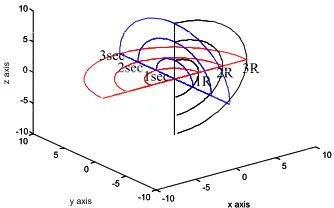
In this proposed 3-D S-T frame, space is represented by three perpendicular axes (x, y, and z), and time is represented by con-centric spheres of different radii with the origin of the spatial axes as their center [1]. The radius of the sphere representing a time of 1sec is 1R=Vm×1 sec, the radius of the sphere representing 2sec is 2R =Vm×2 sec, and etc., where Vm is the velocity of the medium used for relaying messages. The motion of any particle in space can be decomposed into its x,y, and z directions. Its components along thex-axis,y-axis,z-axis can be described as functions of time, which are represented by the time circles created from the intersections be-tween the concentric time spheres and thex-y plane, y-z plane, and
z-x plane, respectively. It is important to note that although the spatial coordinates are bi-directional, time cannot assume negative value, having only an outgoing direction in this 3-D S-T frame. The construction of a 3-D S-T frame is shown in Fig.1.
As an example, if sound with a velocity Vm = 350m/sec was selected as the medium used for relaying messages, then the radius of the sphere representing one second would beVm×1 sec = 350m, the radius of the sphere representing two seconds would beVm×2 sec = 700m, etc.
If message were instead transmitted by light with velocity Vm=
c ≈ 3×10⁸m/sec, then the radius of the sphere representing one
second would be 1R=c×1 sec = 3×10⁸m, the radius of the sphere
representing two seconds would be 2R=c×2 sec = 6×10⁸m, etc.
When light is the medium for the frame, the periodTand wavelength
10 10 0 5 0 5 x is 2R 3R 1 2sec 3sec -5 0 -5 0 z a x
[image:5.420.131.298.93.197.2]1R2R 3R 1sec 2sec 10 -10 10 -10 -5 0 5 10 -5 0 5 -5 0 5 10 -5 0 5 -10 -5 -10 x axis -10 -5 -10 x axis y axis
Figure 1: In this proposed 3-D S-T frame, space is represented by three perpendicular axes (x, y, and z), and time is represented by concentric spheres of different radii with the origin of the spatial axes as their center.
one period, T, would be 1R=c×1T = (λ/T)×1T =λ, the radius
of the sphere representing two periods, 2T, would be 2R=c×2T =
(λ/T)×2T = 2λ, etc. The units of time-spheres and the units of
spatial axes remain the same. Since the velocity of light is the limiting velocity, all possible motions of a particle can be described using this 3-D S-T frame, where light is the medium for the frame.
3
Description of the Motion of a Particle in a 3-D
S-T Frame
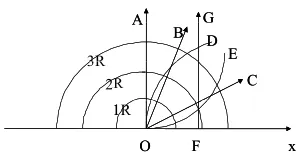
The following graph (see Fig.2) illustrates how to utilize this new 3-D S-T Frame to describe the motion of objects moving along the x-axis with different velocities [2]. If the velocity of the medium is
Vm, then the radius of the circle representing 1sec would be 1R =
Vm×1 sec, the radius of the circle representing 2sec would beR =
A G
A G
A B
D E G
3R A
B D
E G
C 2R
3R
C
1R 1
O F x
[image:6.420.130.278.98.177.2]O F x
Figure 2: OA represents an object that remains stationary at O, OB represents an object moving with a relatively slow constant velocity, OC represents an object moving with a relatively fast constant ve-locity, OD represents an object moving with a constant acceleration, OE represents an object moving with a constant deceleration, and FG represents an object that remains stationary at F.
4
Time Dilation and Length Contraction
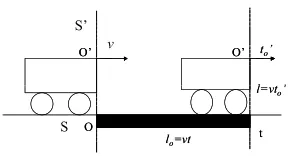
Before discussing time dilation and length contraction, we will first need to define a pair of inertial frames [3]. If two frames have a constant relative velocity with respect to each other, then the two frames are said to be inertial to one another. For this discussion, we will conceive a scenario where a train bypasses by a station platform at a constant velocity. Kinetically, we are allowed to choose either the platform or the moving train to be the stationary (inertial) frame and the other to be the moving (inertial) frame. Dynamically, we should construct a stationary frame S on the platform and a moving frame S’ on the train.
t ’ t ’
S’
v
O’ O’ to’
l ’
O’ O’ to’
l ’ v
O
l=vto’
O
l=vto’
S O
lo=vt t
O
lo=vt t
[image:7.420.125.269.86.164.2]S
Figure 3: A rod is laid alongside the station platform. There is an observer on the platform and another observer on the train and both measure the rod’s length using a sensor attached to the front of the train, i.e. the origin O’ of the moving frame S’.
as measured by an observer in the stationary frame S, is defined as proper (original) length,l0, while the length of the rod as measured
by an observer in the moving frame S’, is defined as regular length,l′. When the sensor touches the left edge of the rod, the time is recorded as 0 for both observers. When the sensor touches the right edge of the rod, the time is recorded ast for the observer in the stationary frame S and ast′
0 for the observer in the moving frame S’.
The movement of the train’s sensor from one end of the rod to the other end can be considered an event. This event occurs at the same location, i.e. at the front of the train, for the observer in the moving frame S’, hence the period of the event as measured by this observer is defined as the proper (original) time,t′
0. This event occurs
at different locations, i.e. at two different points on the platform, for the observer in the stationary frame S, hence the period of the event as measured by this observer is defined as the regular time,
t. The proper length of the rod, l0, is calculated by multiplying the
train’s velocity by the regular time, l0 =vt, and regular length,l′,
l′=vt′
0.
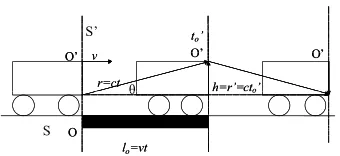
At the same time the sensor touches the left end of the rod, the observer in the moving frame S’ sends a pulse of light towards the ceiling of the car, where a mirror is placed. To the observer in the moving frame S’, the light travels vertically up towards the ceiling and is then reflected straight down. The ceiling height of the boxcar is adjusted such that the pulse of light reaches the ceiling at the same time that the sensor reaches the right end of the rod (see Fig.4).
O’ O’
to’
O’
O’ O’
to’
O’
S’
O’ O
h=r’=cto’
O
v
r=ct
O’ O
h=r’=cto’
O
v
r=ct
ș
O
o
O
o ș
S O
lo=vt
O
lo=vt
[image:8.420.126.296.204.282.2]S
Figure 4: The ceiling height of the boxcar is adjusted such that the pulse of light reaches the ceiling at the same time that the sensor reaches the right end of the rod.
If it takes an amount of time t′
0 for the pulse light to reach the
ceiling then the height of ceiling is equal to the distance traveled by the light, which is h=r′ =ct′
0 as measured by the observer in the
r=
q l2
0+h 2
=p(vt)2
+h2
=p(vt)2
+r′2
=
q
(vt)2
+ (ct′
0) 2
.
(1) From Fig.4, we can derive the following property for sinθ:
sinθ=h/r=
q r2
−l02/r=
p
(ct)2
−(vt)2/ct=p1−v2/c2. (2)
From Fig.4, we can also derive the following relation for sinθknowing thatr=ctandh=r′=ct′
0:
sinθ=h/r=r′/r=ct′
0/ct=t′0/t. (3)
By combining Eq.(2) and Eq.(3), we arrive at the time dilation for-mula
t= t′0
p
1−v2/c2. (4)
This equation shows that the regular time, t, is always larger than or equal to the proper (original) time,t′
0. This result states that the
time interval as measured by an observer in a stationary frame is longer than the one measured by an observer in a moving frame.
Multiplying both the numerator and the denominator of Eq.(3) byv , we can derive the following formula for :
sinθ=t′
0/t=vt′0/vt=l′/l0. (5)
By combining Eq.(2) and Eq.(5), we arrive at the length contraction formula
l′=l0p
1−v2/c2. (6)
This equation shows that the regular length, l′, is always less than or equal to the proper (original) length, l0. This result states that
5
Presenting Time Dilation and Length
Contrac-tion in 3-D S-T Frames
Length contraction and time dilation between two inertial frames were discussed in the last section. In the following example, we will construct 3-D S-T frames, selecting blue light as the medium for transmitting messages. We will specifically choose a wavelength
λ= 5000Ao
= 5×103×(10−10m) = 5×10⁻⁷m (7)
as the unit of length and a period
T =λ
c ≈
5×10⁻⁷m
3×10⁸
m/sec ≈1.667×10
−15
sec (8)
as the unit of time for the construction of these 3-D S-T frames. If a rod of length isl0= 70mlain on the platform of a station and
a train bypasses the station platform at velocityv= 0.6c, the proper length of the rod as measured from observers on the stationary frame S (the platform) is l0 = 70m, and the regular length of the rod as
measured from observers on the moving frame S’ (the moving train) is
l′ =l0p
1−v2/c2= 70mp1−(0.6c)2/c2= 70m×0.8 = 56m (9)
which is shorter as a result of length contraction.
In order to depict these lengths graphically, we can change the unit of length from m (meters) to λ3bb (wavelengths of blue light). From
l0
λ =
70m
5×10⁻⁷m = 14×10 7
(10)
we can derive thatl0= 14×10 7
λ= 14×(107
λ), and from
l′
λ =
56m
5×10⁻⁷m = 11.2×10 7
(11)
we can derive thatl′ = 11.2×10⁷
λ= 11.2×(107λ). Both lengths
50
30
40 107T
20 30
23.33
0
10 18.66
23.33
18.66 14.925
ș ș’
-10
14 2.8
11.2
107Ȝ
O O’
[image:11.420.144.267.77.176.2]-40 -30 -20 -10 0 10 20 30 40 50
Figure 5: Two inertial 3-D S-T frames (one stationary frame and one moving frame) with λ3bb = 5×10⁻⁷m as their unit of length and
T = 1.667×10⁻¹⁵sec as their unit of time.
Despite the change in units, these values still satisfy the formula for length contraction discussed earlier:
l′ =l0p1−(v/c)2= (14
×(107λ))p1−(0.6c)2/c2= 11.2×(107λ).
(12) Based on the conditions set forth earlier, it takes a regular time
t= l0
v =
70m
0.6c =
70m
0.6×3×108
m/sec = 38.89×10
−8
sec (13)
for the origin O’ of the moving frame S’ to pass from the left end of the rod to the right end of the rod as measured by observers on the stationary frame S. Thus the proper time, as measured by observers on the moving frame S’, is
t′
0=t
p
1−v2/c2= (38.89×10⁻⁸sec)p1−(0.6c)2/c2= 31.11×10⁻⁸sec.
fromsec toT (periods of blue light). From
t
T =
38.89×10⁻⁸sec
1.667×0−15sec = 23.33×10 7
(15)
we can derive thatt= 23.33×(107T), and from
t′
0
T =
31.11×10⁻⁸sec
1.667×10⁻¹⁵sec = 18.66×10 7
(16)
we can derive thatt′
0 = 18.66×(10 7
T). Both times have also been represented in Fig.5.
Despite the change in units, these values still satisfy the formula for time dilation:
t=t′
0/
p
1−v2
/c2
= (18.66×10⁷
T)/p1−(0.6c)2
/c2
= 23.33×(107
T).
(17) From Fig.5, we also see thatθ′=θ, as
sinθ= 18.66/23.33 = 0.799828546 (18)
and
sinθ′ = 14.925/18.66 = 0.799839228 (19)
henceθ′≈53.110
≈θ.
6
Discussion
demonstrated the inseparability of space and time. We should not delude ourselves into believing that time and space possess innate properties in and of themselves. In actuality, without movement, we would not be able to measure the passage of time nor would be able to ascertain the amount of space occupied by an object. It is the movement of objects that generates the concepts of time and space. Only with movement, can time dilation and length contraction be measured.
The phenomenon is defined as a temporal or spatiotemporal ob-ject of sensory experience as distinguished from a noumenon. The phenomenon is also defined as a fact or event of scientific interest susceptible to scientific description and explanation [5]. Since the concept of the movement phenomenon of an object is more funda-mental than the concepts of space and time, its unit of velocity is more fundamental than the units of space (length) and time, which are derivations. Furthermore, without gravitational force, we would be unable to measure the gravitational mass of an object; without spring force, we would be unable to measure the inertial mass of an object. Since the concept of the force phenomenon applied to an ob-ject is more fundamental than the concept of mass, the unit of force is more fundamental that the unit of mass, which is also a derivation. We should also refrain from deluding ourselves into believing that mass also possess innate properties in and of itself. In special relativ-ity, the moving mass of an object is different from its stationary mass. The properties of an object are defined from the phenomenon and not from the object itself. As phenomena are more fundamental than ob-jects, the universe should be viewed as a collection of phenomena and not an assortment of objects.
7
Conclusion
In classical physics, space and time are independent and can be treated separately. Einstein demonstrated that, in actuality, space and time are dependent and inseparable. Though inseparable, there is a distinct difference between space and time in that space is bidirec-tional and time is unidirecbidirec-tional, i.e. an object can proceed forward and backward in space but can only proceed forward in time. In the proposed 3-D S-T frame, the representation of time as concentric spheres of different radii centered about the original of the spatial axes inherently restricts time to a single direction, i.e. negative time (circles with negative radii) has no meaning.
In Special Relativity, two inertial 3-D S-T frames can be con-structed with the choice of light as the medium for transmitting mes-sages. With this, the concepts of time dilation and length contraction can easily be visualized with intuitive, geometric graphs. Further-more, the actual values of time dilation and length contraction are actually depicted on these 3-D S-T frames. These certainly demon-strate the value of 3-D S-T frames.
Acknowledgements
We would like to thank E. Chen, M. Chou, Z. F. Chow, L. S. Hsu, B. Liu, C. Z. Wu, L. Wu, W. Z. Zhaw for their support and suggestions.
References
[1] T. Chen, Z. Chen: The Paradox of Twins Described in a Three-Dimensional Space-Time Frame, The Proceeding of The Thirteenth Asian Technology Conference in Mathematics; Suan Sunandha Rajabhat University, Thailand; Dec 15 – Dec 19, (2008).
[2] T. Chen and Z. Chen: Motions of Particles Described in a Three-Dimensional Space-Time Frame, The Proceeding of The Tenth Asian Technology Conference in Mathematics; Korea National University of Education, South Korea; Dec 12 – Dec 16, (2005).
[4] L. Smolin L: The Trouble with Physics, Houghton Mifflin Com-pany, New York, p.256-258, (2006).