Full Length Review Article
ENHANCING THE PERFORMANCE OF MIGRATION PROCESS USING ACO ALGORITHM AND RSA
ENCRYPTION OVER CLOUD ENVIRONMENT
*Deepika and Amanpreet Kaur
Department of Information Technology, Chandigarh Engineering College, Landran, Mohali, India
ARTICLE INFO ABSTRACT
Data transfer from one server to another needs a great ontology process in which data from one server to another gets migrated with a protocol service in which three layers are minimum required. In this work, focus on migrating the particular application data. Cloud creates a series of mechanical, architectural and legal challenge that the State of the Art attempts to address. Arrange such efforts into a set of migration scenarios and connect them with a list of reusable results for the application data migration in the form of patterns. In proposed work, implement the RSA security encryption algorithm using ENCRYPTION algorithm and ACO algorithm creates the multiple solutions and choose the one best solution for time reduction for better migration. Now evaluate the performance parameters like Accuracy, error rate and compare with existing work. The entire work has been performed using Development too visual studio 2010 with data base connectivity with SQL SERVER.
Copyright©2016, Deepika and Amanpreet Kaur. This is an open access article distributed under the Creative Commons Attribution License, which permits unrestricted use, distribution, and reproduction in any medium, provided the original work is properly cited.
INTRODUCTION
Cloud computing
“Cloud computing” was coined for what occurs when applications and facilities are stimulated into the internet “cloud.” Cloud computing is not something that unexpectedly appeared overnight; in some form it may suggestion back to a time when processor systems distantly time-shared computing resources and applications. More currently by, cloud computing mentions to the several dissimilar types of services and applications being transported in the internet cloud, & the fact that, in various cases, the Devices used to access these facilities and applications do not need any special applications.
Cloud computing has a variability of characteristics, with the main ones being:
1. Shared Infrastructure — Usages a virtualized software model, allowing the sharing of bodily services, storage, and networking capabilities. The cloud substructure, regardless of placement model, seeks to make the maximum of the available infrastructure across a number of users (Shuo et al., 2014).
*Corresponding author: Deepika,
Department of Information Technology, Chandigarh Engineering College, Landran, Mohali, India.
2. Dynamic Provisioning — Allows for the provision of facilities based on current demand requirements. This dynamic scaling requirements to be done while upholding high levels of reliability and security. 3. Network Access — wants to be accessed across the
internet from a comprehensive range of devices such as PCs, laptops, and mobile. Deployments of services in the cloud include.
4. Managed Metering — uses metering for managing & optimizing the service & to provide reporting and billing data. In this way, consumers are billed for services rendering to how much they have really used during the billing period.
In short, cloud computing permits for the sharing & scalable disposition of services, as needed, from almost any place, & for which the customer can be billed based on real usage.
Data migration
Data migration is a process of resettling between storage types, formats and computers systems. Basically it is programmatically preformed to achieve automated migration, which freeing up human resource from tedious tasks. Applications are typically built using a three layer architecture pattern consisting of a performance layer, a business logic layer, & a data layer. So migration of application data required proper architecture or palming for migrating data from one
ISSN: 2230-9926
International Journal of Development Research
Vol. 06, Issue, 12, pp.10545-10549, December,2016
DEVELOPMENT RESEARCH
Article History:
Received 25th September, 2016
Received in revised form 22nd October, 2016
Accepted 19th November, 2016 Published online 30th December, 2016
Key Words:
server to another. Data migration process has different phases to migrate the data from one server to another: Design, Extraction, Cleaning, Loading and Verification (Chai, Yunpeng et al., 2012)
Importance of data migration
The data migration is essential in cloud computing because of following reasons:
Server or storage equipment replacements
Maintenance or upgrades
Application migration
Website consolidation
Data centre relocation
The user assembles the synchronization and migration service via web interface and migration of data is implemented using locally installed secure agents and encryption. Different solutions and approaches can therefore be used for migrating application data to the Server (Shuo, Cui et al., 2014). Migration in the situation of enterprise and web based requests means moving (Miyamoto et al., 2014) from one platform to another. Database Immigrations are mainly complicated as you have all the experiments of changing your software platform, where some old structures are missing, or behave otherwise and some new features are offered and you’d like to take benefit of those (KoongWah Yan et al., 2013).
Optimization and Security techniques for Data migration
RSA Encryption: This algorithm is founded on the difficulty of factorizing large numbers that have 2 and only 2 factors (Prime numbers). The system works on a public & private key system. The public key is made available to everyone. With this key a user can encrypt data but then cannot decrypt it, the only person who can decrypt it is the one who possesses the private key. It is theoretically possible but extremely problematic to generate the private key from the public key; this makes the RSA algorithm a very popular best in data encryption.
A. Algorithm and Working
First of all, two large distinct prime numbers p and q must be generated. The creation of these, we call n is a component of the public key. It must be large sufficient such that the numbers p and q cannot be extracted from it - 512 bits at least i.e. numbers greater than 10154. We then produce the encryption key e which must be co-prime to the number m = ϕ (n) = (p 1) (q 1). We then create the decryption key d like that de mod m = 1. We now have both the public and private keys.
i. Encryption we let y = E(x) be the encryption the function where x is an integer and y is the encrypted form of x y = x e mod n
ii. Decryption we let x = D(y) be the decryption the function where y is an encrypted integer and X is the decrypted form of y X = y d mod n 1.5 Simple
B. Pseudo Code of RSA Algorithm
The algorithm for developing key, encoder, decoder, the signing is the similar like decoder and identification is the same like encode
These three major steps are very easy.
Step 1: Producing Keys:
a. Generate two large prime numbers ( r and s) b. Evaluate m= r s
c. Evaluate o – phi(m) = (r-1)(s-1) = (Euler totient Function)
d. Choose any integer I, the rules to choose I are: 1) i is the positive Integer
2) 0<i<o
3) GCD (o, i) = 1… (GCD = Greater Common Divisor). e. Evaluate a use Mod Inverse
(i *a) = 1(mod o) (i *a) mod o=1
Step 2: Encode/ Identify:
Real plain text = x …..x < N Cipher text = C….C = (X^i) mod M Step 3: Decoder
Cipher text = C De-cipher text = Y Step 4: Stop
ACO Algorithm
Swarm intelligence studies the cooperative performance of unsophisticated agents that interact locally through their situation (Karnitis, Girts and GuntisArnicans, 2015).
It is motivated by social insects, such as ants and termites, or previous animal societies, such as fish train& bird flocks.
Although each separate has only limited capabilities, the whole swarm exhibitions complex on the whole activities. Therefore, the intelligent behaviour can be seen as an emergent unique of the swarm.
When spotlight on ant colonies, it can be perceived that ants communicate only in an indirect method through their surroundings by dropping a material called pheromone.
Paths with higher pheromone levels will more possible be preferred & thus reinforced, while the pheromone intensity of pathways that are not chosen is decreased by desertion.
This form of not direct statement is identified as stigmergy, and offers the ant colony shortest-path finding capacity.
ACO employs imitation ants that work together to find good solutions for discrete optimization difficulties. These software agents mimic the foraging performance of their biological complements in finding the shortest-path to the food source.
ACO algorithm
Init pheromone ;
Repeat for all ants i: construct solution (i);
For all ants i: global pheromone update (i); For all ant edge: evaporate pheromone; ( = (1- ) )
Construct_solution (i): Init ant;
While not yet a solution:
expand the solution by one probabilistically according to the pheromone:
/∑ , , ;
global_pheromone_update(i): for all edges in the solution:
increase pheromone according to the quality; ( ′ :=1/ length of path stored)
Example and Formula of pseudo code:
Procedure ACO_MetaHeuristic generateSolutions ( ) daemonAction ( ) pheromoneUpdate( ) end while
end procedure
Related work
Shen et al. (2011) define security issue in data migration in different clouds. They have some steps for security: firstly, during migration process define some threats. After that implement a mechanism which deal with threats during migrate data from one server to another one. In last, design a prototype which based on Hadoop distributed file system (HDFS). In which series of test evaluate for prototype implementation. Basically the security of data migration carry out by SSL negotiation, migration ticket design and block encryption in distributed file system and cluster parallel computing. In (2011) Chadi Kari, et al. assumed that each storage node can achieve only one data transfer at a time. A storage node, conversely, can typically handle multiple assignments concurrently and this can reduce the total migration time knowingly. Moreover, storage devices tend to have varied capabilities as devices may be added over time due to storage request increase. In this paper, they consider the assorted data migration problematic, where they assume that each storage node v has different transfer constraint CV, which characterizes how many instantaneous transfers, can handle. They develop algorithms to minimize the data migration time. As discuss Yunpeng Chai, et al (2012) described new energy-efficient technique called Explicit Energy Saving Disk Cooling or EESDC. EESDC suggestively reduces data migration above because of two reasons. First, a set of disks discussed to Explicit Energy Saving Disks was obviously fixed according to temporal system load. Subsequent, all the migrated data in EESDC directly back on extending the idle time of EESD to reservation more energy efficiently. Therefore, the EESDC technique is conducive to saving more energy by quickly accomplishing energy-efficient data layouts without redundant data migrations. They instrument EESDC in a simulated disk system, which is authenticated against a prototype system mechanical by our EESDC. Hui Liu et al. (2012) define characteristics of delivery model of cloud computing. In scarce table, one of the most general multi-tenant data storage schemas for Saas, all tenants’ data are stored into sparse table and plotted to tenant’s logical view by metadata. Throughout the data storage scheme advancement in SaaS, all tenants’ data need to be travelled into the new data schema before it becomes operative to ensure the integrity of the tenants’ data. However, the migration is composite and brings overhead workload. Inferior still, it may cause the system unusable. In this paper, they recommend metadata evolution technology. They can understand the mapping from the old data schema to
new data scheme smoothly via. Yanling Du et al. (2012)
planned a hybrid cloud storage explanation in view of high performance, high retreat of private cloud and the large capacity features of public cloud. With the measurable expressing of the real-time property, compassion, decentralization and data access heat of aquatic data, they assumed the model of marine data migration between the hybrid clouds. Temporarily, the data migration method was improved to avoid the restraint of the traditional data migration process which is built just according to the data access. Pawan Nahar et al. (2012) using active cloud engine in data migration. Data rate increase day by day, so big data analysis is needed which is challenge, That’s why organization search cloud based storage having highly efficient storage infrastructure in place to support high scale operation, without losing data.IBM active cloud engine, which comes with that features enhances the process of data migration by caching the world wide data and make it available locally with zero down time. In (2013) Koong wah yan, et al. defined data migration ecosystem for big data is the production set of interacting process, practices and environments to collection data from one location storage, medium or one location, storage medium or to cleanse, transform and transfer to another. The process and practices are governed by rules and disciplines with complete information with high accuracy and consistency. Jianzhe Tai, et al. (2014) work on live data migration so reduce service level agreements (SLA).
To store process and query large scale data sets is big challenges. In multi-tiered storage system, the new approach of automatic data movement used, where lively data migrate to support SLA’s for application with low cost. LMT’s enhance average I/O response time, I/O violation time and I/O violation ratio with minor degradation on performance of highly priority applications. Cui Shuo et al. in 2014 studied the mass data storage data migration knowledge to meet business continuousness, data security, data integrity necessities, while research massive data replication technology based on storage block asynchronous migration method. Steve Strauch, et al., 2014 says that cloud computing requires either an application to be built especially for it, or for existing application to migrated to it. Migrating data to the cloud creates a series of technical, architectural and legal challenges that the state of the art attempts to address. A set of migration scenarios and connect them with a list of reusable solution for application data migration in form of patterns.
Problem Formulation
1) Migration should be secure (use confidential pattern) 2) Migration should be accurate
3) Live data migration perform (virtual machine without off continue work)
4) Optimize migration technique ACO use (time, accuracy and data transfer define).
METHODOLOY
The various steps used for the migration process over various cloud servers. There are following phases which make the migration process accurate and secure over various different cloud servers.
Use ACO optimization technique which deals with route optimization process
The RSA algorithm make the transmission process secure with provide an authentication layer while it transferred.
System generates a request to check another server’s availability.
After that it trace the protocols for create a bridge to transmit data between two clouds.
Create an intermediate code between two servers to match their input and output to design an error free transmission.
First packet transmit over them is used to make handshaking process between two servers.
After that it launch the migration process for transmit data over two different locations on internet.
Process works with selected and optimized path over various other routes.
Once the transmission process complete the system calculate parameters for check the performance of the system
RESULTS
Data migration should be secure, accurate and fast. In this
work, improved accuracy and speed using ACO, security using RSA and reduce error rate. To evaluate the result of performance of migration using this parameter in terms of accuracy based on error rate, throughput related to transfer rate, error and probability check by secure transmission.
[image:4.595.339.527.49.236.2]Results of data migration process:
Fig. 1. Result of data migration process
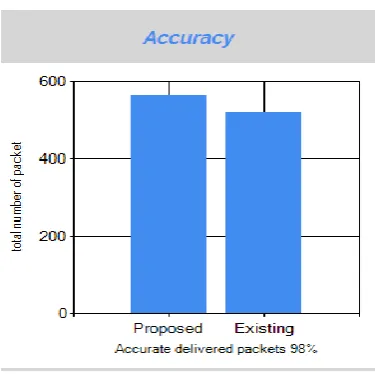
Measure Accuracy
The accuracy factor defines the working performance of any algorithm. The high accuracy rate shows better performance of an algorithm. Here in the results section it shows better output as per transmission accuracy as compare to traditional systems. This parameters define with the help of percentage out of hundred. The formula for calculation accuracy in this environment is as:
Accuracy= 100 ( )
Fig. 2. Compare new accuracy with previous
Measure Error Rate
Error rate is used to check the transmission problem while the data transmit over different cloud server. Maximum Error Rate can destroy the data on receiver end. So main task is to optimize the transmission and reduce the error rate per frame. Here the proposed system shows better performance in case of error rate as compare to existing approach in same environment. The calculations of Error Rate are as:
[image:4.595.322.548.403.570.2]ErrorRate= 100 ∑ ErrorRate per frame + = ER(k)
Fig. 3. Compare error rate with previous
Fig. 4. Compare security with previous one
[image:4.595.334.533.599.784.2]Measure Security
The security mainly used for sensitive data transmission. Because here the main task is to migrate data from one to another location so that all the packets transmit over a network. Here security is main issue to complete the migration process. The proposed approach provides high security as compare to others. The calculation for this is as:
Security=
100 ( )
Compare the results with previous reusable pattern techniques used earlier.
Conclusion
Data migration is process of transfer data from one cloud server to another. Process seems to be simple and easy but it is not. Because every cloud server have their different protocols and rules. In transmission time possibility of data loss, data theft and transmission take more time. These are following challenges data migration process faced so for resolution use different techniques. To adjoin two different protocol clouds
server using mediator protocol in between as bridge. ACO
Algorithm used for optimization data so take less time in transmission. RSA Encryption applies on bit stream so securely and accurately data migrate one cloud to another. By this way make data migration process correct and fast.
Future scope
Further effort in augmenting and refining both scenarios and patterns is required in the future. Providing tooling support for applying the application data migration methodology discussed in Section , Data migration provide significant help in this direction. A decision support system built for this purpose, could be an important contribution on its own, guiding practitioners and researchers through the migration of their application to the Cloud. Finally, the discussion in this work has to be positioned within a larger framework dealing with the migration of applications to the Cloud, and the adaptations that could result from this migration. In future, the planned the hybrid approach using AES and DES algorithm and BFO for optimization result calculation can use for better migration.
REFERENCES
Amanpreet kaur, Dheerendra Singh define exploring data security issue and scrutinizing them in cloud computing environment, IJITKM volume 8 number 1 June - dec 2014 Amanpreet kaur, Dheerendra Singh, Kanika minhas,
”mitigation of high rate shrew DDOS attack ’international
Journal of Modern Computer Science : Issued 3, October,
2015
Chai, Yunpeng, et al. "Efficient data migration to conserve energy in streaming media storage systems." Parallel and Distributed Systems, IEEE Transactions on 23.11 (2012): 2081-2093.
Du, Yanling, et al. "Study of migration model based on the massive marine data hybrid cloud storage."
Agro-Geoinformatics (Agro-Geoinformatics), 2012 First International Conference on. IEEE, 2012.
Kari, Chadi, Yoo-Ah Kim, and Alexander Russell. "Data migration in heterogeneous storage systems." Distributed Computing Systems (ICDCS), 2011 31st International Conference on. IEEE, 2011.
Karnitis, Girts, and GuntisArnicans. "Migration of Relational Database to Document-Oriented Database: Structure Denormalization and Data Transformation." Computational Intelligence, Communication Systems and Networks (CICSyN), 2015 7th International Conference on. IEEE, 2015.
KoongWah Yan et al. ”Data Migration Ecosystem for Big Data”, 978-1-4799-0786-1/13/$31.00 ©2013 IEEE
Liu, Hui, and Shengqi Wu. "Data storage schema upgrade via metadata evolution in SaaS." Consumer Electronics, Communications and Networks (CECNet), 2012 2nd International Conference on. IEEE, 2012.
Miyamoto, Naoyuki, Kenichi Higuchi, and Takao Tsuji. "Incremental Data Migration for Multi-database Systems Based on MySQL with Spider Storage Engine." Advanced Applied Informatics (IIAIAAI), 2014 IIAI 3rd International Conference on. IEEE, 2014.
Nahar, Pawan, Abhidnya Joshi, and Alexander Saupp. "Data migration using active cloud engine." Cloud Computing in Emerging Markets (CCEM), 2012 IEEE International Conference on. IEEE, 2012.
Ou, Jiaxin, et al. "EDM: An endurance-aware data migration scheme for load balancing in SSD storage clusters." Parallel and Distributed Processing Symposium, 2014 IEEE 28th International. IEEE, 2014.
Shen, Qingni, et al. "SecDM: Securing data migration between cloud storage systems." Dependable, Autonomic and Secure Computing (DASC), 2011 IEEE Ninth International Conference on. IEEE, 2011.
Shuo, Cui, et al. "Research and application on mass data storage replication technology." Electricity Distribution (CICED), 2014 China International Conference on. IEEE, 2014.Miyamoto, Naoyuki, Kenichi Higuchi, and Takao Tsuji. "Incremental Data Migration for Multi-database Systems Based on MySQL with Spider Storage Engine." Advanced Applied Informatics (IIAIAAI), 2014 IIAI 3rd International Conference on. IEEE, 2014.
Steve Strauch, Vasilios Andrikopoulous, Thomas Bachmann and Frank leymann migrating application data to the cloud using cloud data patterns 2014 IEEE ROMAN: Issued 9, June 2014.paris France computer science and technologies. Tai, Jianzhe, et al. "Live data migration for reducing sla
violations in multi-tiered storage systems." Cloud Engineering (IC2E), 2014 IEEE International Conference on. IEEE, 2014.
Tan, Zhenyu, et al. "ALDM: Adaptive Loading Data Migration in Distributed File Systems." Magnetics, IEEE Transactions on 49.6 (2013): 2645-2652.
Wu, Chentao, et al. "Sdm: A stripe-based data migration scheme to improve the scalability of raid-6." Cluster Computing (CLUSTER), 2012 IEEE International Conference on. IEEE, 2012.
Wu, Suzhen, Hong Jiang, and Bo Mao. "Proactive Data Migration for Improved Storage Availability in Large-Scale Data Centers." Computers, IEEE Transactions on 64.9 (2015): 2637-2651.