
6981
CONTRIVING THE IS/IT MANEUVERS TO ENHANCE
BUREAUCRATIC REFORM IN INDONESIAN
GOVERNMENT
1ARFIVE GANDHI, 2YOVA RULDEVIYANI, 3YUDHO GIRI SUCAHYO
1, 2, 3Faculty of Computer Science, Universitas Indonesia, Indonesia
E-mail: 1[email protected], 2[email protected], 3[email protected]
ABSTRACT
Information System/Information Technology (IS/IT) has important role to accelerate and enhance bureaucratic reform in government institutions. Ministry of Energy and Mineral Resources (MEMR) Republic of Indonesia requires IS/IT to improve accountability and reduce complexity of bureaucratic in public services. To ensure optimization on IS/IT resources and alignment with MEMR’s strategic objectives, all IS/IT maneuvers should be prepared using a Strategic Information Systems Planning. This study performs advance exploration regarding on how MEMR contrive IS/IT maneuvers to enhance bureaucratic reform in four IT domains: IT governance, IS application, IT infrastructure and IT human resources. The contrived maneuvers refer to the principles of bureaucratic reform and also business principles: Automation, Continuity, and Standardized, then organized in a roadmap which encompasses 2016 until 2020. Without neglecting other maneuvers, this study promotes IT Steering Committee and integration of similar IS applications as concern to enhance bureaucratic reform in MEMR.
Keywords: Bureaucratic Reform, Electronic Government, Strategic Information Systems Planning,
Strategic Planning for Information Systems, Public Service
1. INTRODUCTION
Accountability assessment in 2015 results BB index for Ministry of Energy and Mineral Resources (MEMR) [1]. Initial investigation [2] exposes some activities that are still processed manually, such as licensing and auditing. MEMR realizes to immediately reinforce bureaucratic reform for the whole organization. This ministry has understood that bureaucratic reform is important to achieve public satisfaction [3], budget
optimization, and improve accountability.
Accountable MEMR becomes manifestation of good governance [4]. If bureaucratic complexity is reduced, it affects the positive performance of the organization and prevents the corruption behavior [5].
Inspired by how private sector has enhanced its business using Information System/Information Technology (IS/IT), MEMR has an initiative to empower IS/IT for its bureaucratic reform. IS/IT accelerates bureaucratic reform by establishing more effective and efficient public service [4] [6] [7]. IS/IT also facilitates the fundamental function of bureaucratic organization by providing flexibility and agility [8]. Many governments have been
successfully taking advantage of IS/IT to enhance their bureaucratic reform and improving trust. Online media for public administration can be leveraged to increase trust. The quality of online media in e-government relies on time efficiency, cost efficiency, and flexibility [9]. Combination of digital record and discipline procedure has increased rate of employee’s attendance in public service [10]. Gracia and Arino [11] had also reminded e-service as an IS/IT maneuver to manage public administration based on citizens’ needs. Moreover, [12] emphasizes the usage of IS/IT to support various strategic objectives, including creating the innovative applications, changing the business processes, linking with business partners, and reducing cost.
6982 study is motivated by MEMR’s requirement to optimize the IS/IT maneuvers and ensure their alignment with bureaucratic reform initiative. IS/IT should be designed and prepared into an integrated plan. Hence, MEMR should contrive IS/IT maneuvers in a Strategic IS Planning (SISP) to enhance bureaucratic reform as entailed before.
This study is organized as follows. Section 2 extracts literature review on SISP and bureaucratic reform. Section 3 presents the systematic methods performed in this study. Process of formulating IS/IT maneuver is discussed in Section 4 which includes business strategy interpretation, gap analysis, and roadmap formulation. Finally, Section 5 summarizes this study and Section 6 promotes decent recommendations.
2. LITERATURES REVIEW
2.1. Strategic Information Systems Planning
Importance of SISP derived from potential value offered by IS/IT. It can encourage and support a variety of strategic objectives, including creation of innovative applications, changes in business processes, links with business partners,
reduction of costs, acquiring competitive
intelligence, and others [12]. It pushes various and large investment to establish IS/IT maneuvers. In order to align the specified requirement and optimize the investment, an enterprise should define IS/IT maneuvers in an integrated planning, called as strategic IS planning.
SISP is described as systematic process to formulate IS/IT strategy based on identified business goals and available IS/IT assets [2]. SISP promotes IS/IT maneuvers as innovations enhancement or problem solving for an enterprise.
Embarked by enterprise’s requirement
identification, SISP should be adaptable for priorities alignment [13] [14] and deliver value of IT [15]. Basically, it carries on these issues: aligning IS/IT plan with business plan [14]; designing IS/IT architecture for an organization involving integration of user, applications and databases; efficiently allocating IS development and operational resource among competing applications.
In the MEMR context, SISP aims to optimize value of IS/IT maneuvers to achieve bureaucratic reform. Based on experience in e-service development, [11] has reminded that
sufficient investment is required to ensure quality. Therefore, MEMR must govern the IS/IT budget efficiently and reflect it in a feasible SISP.
2.2. Bureaucratic Reform
Bureaucratic reform demonstrates
fundamental transformation to simplify the complexity of hierarchical business process in the public sector. Ministry of Administrative and Bureaucratic Reform has defined bureaucratic reform as effort to reform and fundamental changes to the system of government administration, especially relates with organization, business process, and human resources aspects [16] [17]. Bureaucratic reform is tailored through following principles [16]: outcome-oriented, measurable, efficient, effective, realistic, consistent, synergic, innovative, compliance, and monitored; as detailed in Table 1. In Indonesia, inefficient bureaucratic, especially in licensing and taxing, becomes inhibiting factors. Therefore, administrative style and culture need to be considered as main concerns of the reform [18] [19].
Digital era drives most of governments to deliver bureaucratic reform using IS/IT maneuvers which then formalized as e-government [4]. They are actualized as IT procedures and IS applications [3]. IS/IT maneuvers reflect how ICT supports bureaucratic reform [7] in realizing transparency and accountability of government [4]. Its roles should be ensured through top management’s commitment and formalized in a SISP so that bureaucratic reform can be amplified and accelerated.
Quality of IS/IT maneuver is strongly related to contributing factors on the success of
bureaucratic reform implementation. These
6983
Table 1: Description of BR Principle [16].
Principle Description
(P1)
Outcome-oriented All programs and activities should achieve outcome for institutional quality improvement with mind set and culture set changing.
(P2) Measurable BR should be implemented
using measurable and assertive target with definitive timeline.
(P3) Efficient BR should be designed by
considering the available resources efficiently and professional.
(P4) Effective BR should be performed
effectively depends on achievement target.
(P5) Realistic Outputs and outcomes should
be determined and optimally achieved.
(P6) Consistent BR performed consistently
and covers entire levels in the government.
(P7) Synergic Programs and activities
should be synergic and contribute positive impact.
(P8) Innovative BR allows government to
conduct improvement and innovation for better performance.
(P9) Compliance BR should comply with the
laws and regulation.
(P10) Monitored BR should be monitored to
supervise milestone and improvement.
3. METHODS
3.1. Research Systhematics
This study practices the methodology explained in [2]. It encompasses four domains as exhibited in Figure 1: IT governance, IS application, IT infrastructure, and IT human resource. Those domains are derived through synthesis of TOGAF Architecture Development Method (ADM) and IS/IT Strategic Model in Ward and Peppard methodology [21]. TOGAF ADM is used to propose IS/IT maneuvers in IS architecture, technology architecture, and implementation governance [22]. IS/IT Strategic Model in Ward and Peppard methodology promotes business IS strategies, IS/IT management, IT strategy, and application portfolio. Research in [2] has elaborated implementation governance and IS/IT management strategy into IT governance layer and IT human resources; IS architecture and application portfolio
into IS applications layer; and also technology architecture and technology strategy into IT infrastructure layer.
Figure 1: Enhanced Methodology for SISP
This methodology is initiated by business strategy identification then emerging business architecture and business principles. They reflect landscape of MEMR ecosystem related to bureaucratic reform as main requirement. Those initial finding become inputs for COBIT 5 cascading to elect relevant processes in gap analysis later. Using cascading scheme from [23], COBIT 5 has been proven to provide a solid foundation for IT strategic goals alignment [24]. Several processes are produced from cascading and become baseline to guide this study exploits necessary information for every layer. Those processes also become best-practice for MEMR to determine how IS/IT maneuvers should be formulated and aligned with bureaucratic reform. Gap analyses are conducted for every layer by comparing current and future
situation. In order to produce holistic
understanding, this methodology is enriched by Enterprise Architecture to design business and
IS/IT ecosystem in entire layers.This study stresses
[image:3.612.315.511.137.398.2]6984
3.2. Data Colletion
This study requires qualified data through qualitative approach. Primary data are collected using observation and FGD (Focus Group Discussion). Observation portrays existing IT infrastructures and IS applications. FGD conducted by involving top-management, CDIT, and entire directorate/unit since they are represented stakeholder in the MEMR ecosystem. FGD is represented as strategy workshop to capture stakeholder needs and formulate business strategies [24]. FGD aims to discover the following goals:
To understand how actually IS/IT role in the
business processes;
To unveil culture and regulation of IS/IT
management;
To investigate IS/IT risk and compliance;
To capture stakeholder’s though, aspiration, and
advice on IS/IT services.
Secondary data also collected from documents and regulations on IS/IT domain. This study needs to identify top-management concern on IS/IT domain. Policies, standards, and procedures are reviewed and examined to test their suitability. This study also evaluates the quality of IT projects management by reviewing their artifacts.
3.3. Limitations and Assumptions
This study is conducted with following limitations, assumptions, and constraints that influence the scope of this research:
This study accommodates strategic objective
taken from strategic plan of MEMR 2015-2019.
This study assumes that CDIT’s role, function
and its organizational structure will not be changed until 2019.
This study leverages COBIT 5 as the newest
version.
4. ANALYSIS
4.1. Business Understanding
4.1.1. Identification of Business Strategies
Business strategy is fundamental component to compose SISP. Silvius has demonstrated 16 experiments in [25] to expose that specificity and comprehensiveness of strategies and goals decisions in an organization has a positive effect on the success of SISP. It has been stressed that a clear business strategy is an important initial step for IT alignment as one of the main goals in SISP formulation [25]. MEMR holds fundamental role to establish Indonesia energy sovereignty [26]. In order to realize the role, MEMR has 12 strategic objectives [26] as its business strategies. These business strategies have strong correlation to bureaucratic reform that should be performed by MEMR. For example, SS-08 (Actualize the energy subsidies for the right target) represents P1, P3, P4, and P5 in bureaucratic reform principles. SO-10 (Actualize professional management and human resources) demonstrates P2, P6, and P10.
6985
Figure 2: Identified Relationship among Strategic Objectives [2]
4.1.2. Business Architecture and Principles Identification
[image:5.612.286.512.73.286.2]After defining business strategies using strategic objectives, the next step is develop the business architecture of MEMR. Business architecture is developed using value chain by identification general tasks and functions of MEMR that has been mandated in [27]. They represent activities operated by each unit in MEMR. This study has divided two types of activities, i.e. Main Activities and Supporting Activities. There are three functions in Main Activities: Regulator, Execution of Policies, and Monitoring. Five other functions are classified in Supporting Activities: IT Service, Assets management, Administration, Human Resources Management, and Research and Development. Figure 3 shows the business architecture including the units that are in charge for each activity.
[image:5.612.94.323.75.363.2]Business strategies are then synthesized with business architecture to formulate business principles. FGD involving stakeholders also conducted to derive requirements in the business principles As a result, three business principles have been identified which have to be referred by all IS/IT maneuvers in MEMR [2].
Figure 3: Identified Relationship among Strategic Objectives [2]
Automation: reinforce spirit of transformation
from manual business processes to IS/IT based processes;
Continuity: envision sustainability of IS/IT
ability through integration among IS/IT maneuvers.
Standardized: establish qualified holistic IS/IT
ecosystem by considering the diversity of requirements.
These business principles are also consistent with the business principles identified in [28].
4.1.3. COBIT 5 Utilization
6986
Table 2: Distribution of Elected COBIT 5 Processes [2].
Process Layer
L-1 L-2 L-3 L-4 [EDM01] Ensure governance
framework setting and maintenance
√ - - -
[EDM04] Ensure resource optimization
- - - √
[APO01] Manage the IT management framework
√ - - -
[APO02] Manage strategy* √ √ √ √ [APO03] Manage enterprise
architecture
- √ √ -
[APO05] Manage portfolio - √ √ - [APO07] Manage human
resources
- - - √
[APO09] Manage service agreement
- - √ -
[APO11] Manage quality - √ √ - [BAI02] Manage
requirements definition
- √ √ -
[BAI08] Manage knowledge - - - √ [DSS04] Manage continuity - - √ [MEA01] Monitor, evaluate
and assess performance and conformance
√ - - -
* [APO02] Manage Strategy is leveraged to guide strategies formulation and coverage all layers.
4.2. Gap Analysis
4.2.1. IT Governance Layer
IT governance is leveraged to guide and control IT investment, decision and practice within the organization in order to achieve desired objectives [29]. IT governance is essential to an organization’s success due to IT rapid evolution [29]. IT governance amplifies organizational IT agility when by aligning IT implementation within IT units and line functions [30]. It also ensures the board’s knowledge about what is going on with IT, how risks are being managed and whether IT is being implemented to the best use for the organization
[31]. Furthermore, IT governance needs
institutionalization process to decrease the negative impact of political issues on IT results, especially through the behavioral pillar [32]. Management commitment and involvement are believed as the most critical factor for IT governance [33]. According to the experiment in [33], IT governance is trusted to provide these benefits: (1) determining responsibilities and accountabilities, (2) defining and explaining IT value, (3) aligning IT projects with strategic business objectives, (4) facilitating decision making. IT governance reflects several
contributing factors on the success of bureaucratic reform as described in section 2.2: (F2) provide a plan; (F3) build internal support for change and overcome resistance; (F4) ensure top-management support and commitment; and (F8) pursue comprehensive change.
By using EDM01, APO01, and MEA01 as baselines, IT governance layer promotes IT Steering Committee (ITSC) as the main milestone. ITSC is a necessity since top-management has low commitment and support on IS/IT issues. Through ITSC, all units can realize the role of IS/IT for bureaucratic reform so that IS/IT maneuvers can be optimized. Moreover, most of units in MEMR have decentralization culture due to separated locations. Decentralization has been suspected as primary barrier to implanting IT governance [33]. Hence, ITSC formalization becomes priority in the beginning of SISP. IT governance layer also stresses information security management system as holistic maneuvers which requires top-management’s support also and shall be actualized in other layers.
4.2.2. IS Application Layer
IS application layer determine proper IS applications that should be developed in the MEMR. Following APO03, APO05, APO11, and BAI02 in COBIT 5; MEMR optimizes IS application function to conform to the business processes. IS applications are currently being operated by each unit to support business processes with limited integration among them. Initial investigation in [2] finds some MEMR’s employee need to submit same data using several different IS applications. This condition indicates inefficiency that could inhibits bureaucratic reform.
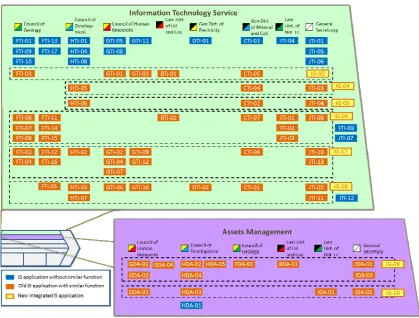
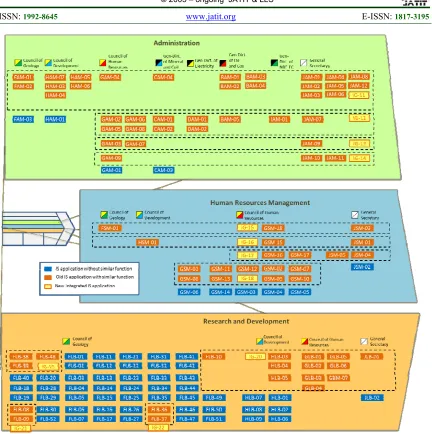
This layer proposes integration of similar IS applications across units referring to the categorization of the activities in the enterprise architecture. As main results, this layer produces an IS architecture for every activity including units in charge, and code of current IS applications as shown in Figure 4, Figure 5, and Figure 6 (Appendix A).
6987 integrated IS applications as indicated in Figure 4, Figure 5, and Figure 6. By implementing these new IS applications, business processes and IT investment are more efficient to achieve bureaucratic reform. Detail of these new integrated IS application is described in Table 4.
Table 3: Similarity Comparison for Current IS Applications [2].
Related Activity Number of IS
Application Similar Non-Similar
IT service 45 20
Assets management 14 1
Administration 38 4
Human resources management
20 6
Research and development
19 51
Regulator 0 1
Execution of policies 10 16
Monitoring 0 4
[image:7.612.90.300.402.659.2]Total 146 103
Table 4: Proposed Integration of Similar IS Applications.
Code Scope of Integration
IG-01 Licensing system
IG-02 Registration and certification system IG-03 Server of geographic IS
IG-04 Helpdesk system
IG-05 Network configuration system IG-06 Spatial databases
IG-07 Repository system IG-08 Email system
IG-09 Assets maintenance system IG-10 Assets procurement system IG-11 Financial administration IG-12 Letter affair system
IG-13 Official expedition administration IG-14 Planning administration system IG-15 Employee attendance log system IG-16 Employee profile system
IG-17 Employee performance monitoring system IG-18 Employee education and training system IG-19 Ground movement system
IG-20 e-Learning system
IG-21 Rainfall management system IG-22 TILT management system
In the context of public service, these new integrated IS applications assist stakeholders to access ‘one door service’ using shared service among units. Therefore, complexity of bureaucratic for business licensing can be reduced and trust on
public services can be enhanced. Integration also brings challenges for entire units in technical aspect. Currently, various databasae mangement systems are being used by MEMR. Therefore, CDIT needs to develop IS/IT standards and determine IS development procedure for smoother integration.
4.2.3. IT Infrastructure Layer
IT infrastructure layer describes reliable technology to achieve required performance. This layer aims to confirm (F3) and (F6) contributing factors on the success of bureaucratic reform. This layer focuses on understanding and providing computer system based on application architectures that have been designed in the IS applications layer. The computer system is envisioned using these COBIT 5 processes: APO03, APO05, APO09, APO11, BAI02, and DSS04. The IS/IT maneuvers on this layer encompasses initiatives in storage and network systems. Although their impact is indirect to the public, IS/IT maneuvers on this layer contributes significantly to the stability of IS applications and provide Service Level Agreement for e-government system of MEMR.
As declared in [2], separated storages have been operated by several units. Poor integration among them becomes its disadvantages beside high cost for operational activities. Most of them do not consider backup mechanism and therefore backup availability should be planned and implemented [28]. Centralization of data center (DC) and disaster recovery center (DRC) have been proposed in MEMR [2] using ISO27001 as targeted standard. ISO27001 is adopted to ensure confidentiality, availability, and integrity of information that owned, managed, and circulated entirely in MEMR. Centralized DC and DRC also provide technical support for integration on IS application layers. Based on the result of FGD, all units agree with centralization and ready to migrate their data from separated storage into centralized DC and DRC.
6988
4.2.4. IT Human Resources Layer
IT human resources layer concerns in preparing the competence of IT personnel in CDIT. This layer is manifestation of two contributing factors in the bureaucratic reform success: (F3) build internal support for change and overcome resistance; and (F6) provide resources. As mandated in [27], CDIT hold important responsibility to provide all IT services in MEMR. Lack of competence may reduce CDIT’s credibility and ability to handle IS/IT maneuvers.
By using EDM04, APO01, and BAI08 as baselines, CDIT is expected to be capable of delivering appropriate IT services based on the proposed IS/IT maneuvers on IS applications and IT infrastructure layers. This study identifies that contriving IS/IT maneuvers on this layer are dependent to maneuvers on IS applications and IT infrastructure layers. It means required competences enrichment must follow how IS/IT maneuvers on IS applications and IT infrastructure layers are arranged. As an example, personnel of CDIT should be trained for data center management before the establishment of data center is accomplished.
4.3. Roadmap Formulation
This research emerges roadmap guided by APO02 (Manage Strategy). It contrives all IS/IT maneuvers from all layers that have been defined before and blended them into an integrated planning. Initially, this roadmap is spanned from 2016 to 2019, similar to period of current minister as top-management of MEMR. To ensure sustainability of IS/IT ability and assist new minister in preparing new strategic IS plan, this roadmap is extended until 2020. Roadmap of SISP as contrived IS/IT maneuvers exhibited in Figure 7 (Appendix B).
4.3.1. IS/IT Maneuvers in the Discover Phase
Performed in 2016, this phase encourages problem
understanding through business strategy
interpretation, business architecture construction, and business principles identification. By those activities, MEMR realizes comprehensive list of problems regarding the business processes and IS/IT ability. MEMR has enlisted important activities to be enhanced as part of bureaucratic reform actualization.
This study has been conducted to prepare required IS/IT maneuvers into an integrated planning. This phase produces SISP as initial maneuvers to enhance bureaucratic reform. It also release issue on the roles of IS/IT to bring transformation on the work culture in MEMR.
4.3.2. IS/IT Maneuvers in the Explore Phase
Explore phase encompasses top-management awareness on IS/IT through ITSC establishment as main maneuver in IT governance layer. In the first semester of 2017 ITSC composes policies regarding IT governance and IT service management, also formalize them into regulation. Then, standardized IS applications and IT infrastructure become target in second semester beside adoption of ISO 27001 for information security management system as mandated by [34].
Standardization of IS applications delivers easier integration which is initiated by categorize IS applications as shown in Figure 5 (Appendix A). These integration include implementation of single-sign on (SSO) as proposed in [2]. Another important IS/IT maneuver is DC establishment using standardized IT infrastructure and ISMS policy while network management is repaired. In completing these maneuvers, CDIT personnel’s competence need to be improved by training and certification in several related subjects, such as server management and information security.
4.3.3. IS/IT Maneuvers in the Exploit Phase
Allocated in 2018, Exploit phase promotes continuity of integrated IS applications. For this phase, similar IS applications on administration, human resources, and assets management are combined respectively as planned in Figure 5 and 6 (Appendix A). Connectivity among IS applications should be escalated in which the data architecture is build to support efficient business processes. Since the ISO 27001 initiative has been started in 2017, this phase carries MEMR to be ISO 27001 certified.
6989
4.3.4. IS/IT Maneuvers in the Enhance Phase
At the end of 2019, current top-management will accomplish their period as mandated by president. Therefore all integration for IS applications should be accomplished in this phase. As the ultimate maneuvers on IS application layer, MEMR perform one door service for public service, especially regarding licensing, registration, and certification. Hence, relationship for all business services with other stakeholders corporates, society, and other government institutions should be enhanced as part of bureaucratic reform.
After performed in 2017, next trainings and certifications for CDIT personnel are scheduled in 2019. It accomodates new employee’s basic competence and current employee’s enrichment. Moreover, the next trainings and certifications absorb latest technology that required by MEMR to improve IS/IT ability.
New top-management may have different strategic objectives and initiatives in accelerating MEMR bureaucratic reform, therefore IS/IT assessment need to be included in the roadmap to measure holistic achievement and problems on IS/IT domain. This assessment becomes IS/IT maneuvers to initiate new SISP formulation for new top-management in 2020.
4.3.5. IS/IT Maneuvers in the Infinity Phase
This phase only proposes SISP formulation as maneuver in 2020. Using IS/IT assessment in 2019, SISP becomes maneuver to interpret and formulate relevant solutions. It also mandates new top-management to formalize its initiaves on IS/IT domain. Hence, awareness to support IT role can be kept and adjusted to the new strategic objectives.
5. CONCLUSION
IS/IT has important role to reinforce public service in government institution. Through this potential benefit, MEMR contrive IS/IT maneuvers to enhance its bureaucratic reform. By interpreting strategic objectives and principles of bureaucratic reform, three business principles are produced: Automation, Continuity, and Standardized. They become baseline to inspire IS/IT maneuvers that composed as SISP.
IS/IT maneuvers contrived using several processes adopted from COBIT 5 as best practice, which then classified into following IT domains: IT governance, IS application, IT infrastructure, and IT human resource. They are appeared as result of gap
analysis between expectations versus reality. After IS/IT maneuvers collected, they are mapped by considering their dependency. As the final product of SISP, a five year roadmap is organized to allocate IS/IT maneuvers into proper timing.
On IT governance layer, one of the main proposed IS/IT maneuvers is ITSC to engage organizational awareness on IT issues. Despite ITSC is internal maneuver, its existence becomes enabler for MEMR to realize the importance and benefits of other IS/IT maneuvers. Since there are 146 out of 249 IS applications (59%) identified with similar functions, they should be integrated on IS application layer. This study proposes 22 new integrated IS applications. In order to support reliability of IS applications, centralized DC and DRC are listed as IS/IT maneuvers on IT infrastructure. Considering many IS/IT maneuvers on those layers above, CDIT should perform trainings and certifications for personnel as maneuvers on IT human resource layer. By arranging them in an integrated roadmap, all IS/IT maneuvers are expected to enhance the bureaucratic reform in MEMR.
6. FUTURE RESEARCH DIRECTIONS
Despite this study has proposed several new integrated IS applications, MEMR should conducts deep investigation in evaluating accurateness of this
proposal through data architecture. Data
architecture is designed for all circulated data in the entire IS applications. By recognizing interaction among IS applications in circulated data, reliability of integration can be ensured so that IS/IT maneuvers becomes more effective.
This study advises researchers to consider models of bureaucratic reform, especially level of maturity model. Researchers can adopt relevant attributes or properties as guideline to assist the organization contrive more enhanced IS/IT maneuvers depends on bureaucratic reform model. Therefore, IS/IT maneuvers for other case study can adjust local requirements on bureaucratic reform.
6990 Considering limitations and assumptions that introduced in Section 3, this study promotes further research in the change management. Dynamics ecosystem in the MEMR may cause MEMR requires amendment of IS/IT maneuvers. MEMR should mandate procedure of amendment of IS/IT maneuvers, including clear statement about authority in the amendments.
ACKNOWLEDGMENT
This research was supported by Universitas Indonesia under PITTA Grant 2018 No: 1899/UN2.R3.1/HKP.05.00/2018. We gratefully thank Faculty of Computer Science and Directorate of Research and Community Engagement, Universitas Indonesia.
REFRENCES:
[1] Ministry of Minister of Administrative and Bureaucratic Reform, 15 Dec 2015, [online] https://www.menpan.go.id/berita-terkini/4170- rapor-akuntabilitas-kinerja-k-l-dan-provinsi-meningkat.
[2] A. Gandhi, Y. Ruldeviyani, Y.G. Sucahyo, “Strategic Information Systems Planning for Bureaucratic Reform: A Case Study at Ministry of Energy and Mineral Resources”, Proceedings of 5th International Conference on Research and Innovation in Information Systems (Langkawi, Malaysia), 2017.
[3] F. Sá, Á. Rocha, M.P. Cota, “Preliminary Dimensions for a Quality Model of Electronic
Local Government Services”, Proceedings of
10th Iberian Conference on Information Systems and Technologies (Águeda), 2015. [4] A.S. Dewi, “The Role of Local e-Government
in Bureaucratic Reform in Terong, Bantul District, Yogyakarta Province, Indonesia”, Internetworking Indonesia Journal, Volume 3, No.2, 2011, pp. 49-56.
[5] L.T. Seim, T. Søreide, “Bureaucratic
Complexity and Impacts of Corruption in
Utilities”, Journal of Utilities Policy 17, 2009,
pp. 176–184.
[6] Regulation of Minister of Administrative and Bureaucratic Reform No. 11 year 2015, “Roadmap of Bureaucratic Reform 2015-2019”. [7] A. Cordella, “E-government: Towards the e-Bureaucratic Form?” Journal of Information Technology 22, 2007, pp. 265–274.
[8] A. Cordella, N. Tempini, “E-Government and Organizational Change: Reappraising the Role of ICT and Bureaucracy in Public Service
Delivery”, Government Information Quarterly
32, 2015, pp. 279–286.
[9] European Commission, 28 May 2013, [online].
Brussels.
http://europa.eu/rapid/press-release_IP-13-466_en.htm
[10] I. Dhaliwal, R. Hanna, “The Devil is in the Details: The Successes and Limitations of
Bureaucratic Reform in India”, Journal of
Development Economics 124, 2017, pp. 1-21. [11] D.B. Gracia, L.V.C. Arino, “Rebuilding Public
Trust in Government Administrations through
e-Government Actions”, Revista Española de
Investigación de Marketing (ESIC) 19, 2015, pp. 1-11.
[12] M. Hemmatfar, M. Salehi, M. Bayat,
“Competitive Advantages and Strategic
Information Systems”, International Journal of
Business Management 5 (7), 2010, pp. 158-169. [13] I.S. Abdisalam, M. Ahmed, K. Aloufi, M.
Kabir, “Strategic Information Systems
Alignment: Alignment of IS/IT with Business
Strategy”, Journal of Information Processing
Systems, Volume 6, No.1, 2010.
[14] C.L. Wilkin, N. Cerpa, “Strategic Information Systems Planning: An Empirical Evaluation of
its Dimensions”, Journal of Technology
Management & Innovation, 2012, pp. 52-62. [15] F. Kitsiois, M. Kamariotou, “Decision Support
Systems and Business Strategy: A Conceptual Framework for Strategic Information Systems
Planning”, Proceedings of 6th International
Conference on IT Governance and Security, 2016.
[16] Regulation of President Republic of Indonesia No. 81 year 2010, “Grand Design of Bureaucratic Reform 2010-2025”.
[17] Regulation of Minister of Administrative and Bureaucratic Reform No. 11 year 2015, “General Guidelines of Bureaucratic Reform”. [18] Pratiwi, “Bureaucratic Reform in Indonesia:
Innovations, Challenges and Typologies”, International Institute of Administrative Science-Asian Group for Public Administration Conference (Jakarta, Indonesia), 2014.
[19] Y. Wihantoro, A. Lowe, S. Cooper, M. Manochin, “Bureaucratic Reform in Post-Asian Crisis Indonesia: The Directorate General of
Tax”, Critical Perspectives on Accounting 31,
6991 [20] S. Fernandez, H.G. Rainey, “Managing
Successful Organizational Change in Public Sector in Public Administration Review”, Wiley & Blackwell, 2006, pp. 168-176.
[21] J. Ward, J. Peppard, “Strategic Planning for Information System, 3rd ed”, 2002.
[22] The Open Group Architecture Framework TOGAF, “TOGAF version 9”, 2009.
[23] ISACA, “COBIT 5, Enabling Processes”, 2012. [24] S. Ali, “Strategic Planning Using COBIT 5”,
COBIT Focus, Volume 2, April 2014.
[25] A.J.G. Silvius, J. Stoop, “The Relationship between the Process of Strategic Information Systems Planning and its Success; An
Explorative Study”, Proceedings of 46th
Hawaii International Conference on System Sciences (USA), 2013, pp. 4495-4501.
[26] Regulation of Minister of Energy and Mineral Resources No. 13 year 2015, “Strategic Plan of MEMR”.
[27] Regulation of Minister of Energy and Mineral Resources No. 13 year 2016, “Organization and Functional Work of MEMR”.
[28] Y. Ruldeviyani, E. Wisnuwardhani, Y.G. Sucahyo, “Designing Enterprise Architecture: Case Study of the Ministry of Energy and
Mineral Resources”, Journal of Engineering
and Applied Science 12 (8), 2017, pp. 2185-2188.
[29] Z. Alreemy, V. Chang, R. Walters, G. Wills.
“Critical Success Factors (CSFs) for
Information Technology Governance (ITG)”, International Journal of Information Management 36, 2016, pp. 907–916.
[30] A. Tiwana, B. Konsynski, N. Venkatraman, “Information Technology and Organizational Governance: The IT Governance Cube”, Journal of Management Information Systems 30 (3), 2013, pp.7-12.
[31] A. Ilmudeen, B.H. Malik, “A Review of Information Technology Governance, Business Strategy and Information Technology Strategy”, International Journal of Advanced Research in Computer Science and Software Engineering, Volume 6, Issue 6, 2016.
[32] G.C. Wiedenhöft, E.M. Luciano, G.V. Pereira, “Institutionalization of Information Technology Governance and the Behavior of Individuals in
the Public Organization Context”, Proceedings
of Twenty-Fifth European Conference on Information Systems (Guimarães, Portugal), 2017.
[33] H.J. Hejase, A.J. Hejase, G. Mikdashi, A. Al-Halabi, K. Alloud, R. Aridi, “Information
Technology Governance in Lebanese
Organizations”, African Journal of Business
Management, Volume 10 (21), 2016, pp. 529-545.
6992
[image:12.612.118.487.76.330.2]APPENDIX A:
Figure 4: IS Architecture for Main Activities with Proposed Integrated IS Applications
[image:12.612.92.511.358.676.2]6993
6994
[image:14.612.146.465.100.656.2]APPENDIX B:
![Table 1: Description of BR Principle [16].](https://thumb-us.123doks.com/thumbv2/123dok_us/8901783.955181/3.612.315.511.137.398/table-description-of-br-principle.webp)
![Figure 3: Identified Relationship among Strategic Objectives [2]](https://thumb-us.123doks.com/thumbv2/123dok_us/8901783.955181/5.612.94.323.75.363/figure-identified-relationship-strategic-objectives.webp)
![Table 2: Distribution of Elected COBIT 5 Processes [2].](https://thumb-us.123doks.com/thumbv2/123dok_us/8901783.955181/6.612.92.297.119.420/table-distribution-elected-cobit-processes.webp)

![Figure 7: Proposed Roadmap as SISP, modified from [2]](https://thumb-us.123doks.com/thumbv2/123dok_us/8901783.955181/14.612.146.465.100.656/figure-proposed-roadmap-as-sisp-modified-from.webp)
