ORIGINAL RESEARCH ARTICLE
ISOLATION AND SELECTION FOR EDIBLE MUSHROOM PRODUCTION BY LIQUID
FERMENTATION AS LACCASE BIOLEACHING SAGO STARCH
1,*
Bambang Hariyanto,
1Reksohadiwinoto B.S.,
1Purwa T. Cahyana,
2
Rosmalawati, S. and
1Rosadi, I.
1
Pusat Teknologi Agroindustri, Badan Pengkajian dan Penerapan Teknologi
2
Balai Bioteknologi, Badan Pengkajian dan Penerapan Teknologi, Gedung 610 (Laptiab) dan 630 (Biotek)
Puspiptek Serpong Tangerang Selatan
ARTICLE INFO ABSTRACT
Production sago starch from Indonesia reached 585,000 tons in 2015 has become the largest in the world. However sago starch has a weakness that is brownish color, unpleasant smells and soft texture. The weaknes can be overcome by adding laccase in the bleaching process. The purpose of this study is production of laccase from edible mushroom from market in liquid fermentation. Materials used are Plurotusostreatus mushroom, Agaricusbisporus and Rhyzopusoligosporus
obtained from the market. The results showed that Pleurotusostreatus on petri dish led to a thick brownish red ring zone showing the ability of laccase to oxide guaicol and syringaldazine compounds. The result of 21st days fermentation of laccase production from Pleurotus, Agaricus,
Rhyzopusrespectively is 774 U/L, 484 U / L and 480 U / in 500 ml, erlenmeyer flask. Laccase
production in 500 mL erlenmeyer flask Pleurotus have the highest result. These result indicate that Pleurotus has a potensial as a fungi for laccase production through liquid fermentation.
Copyright © 2018, Bambang Hariyanto et al. This is an open access article distributed under the Creative Commons Attribution License, which permits
unrestricted use, distribution, and reproduction in any medium, provided the original work is properly cited.
INTRODUCTION
The vast potential of sago forests in Indonesia is estimated to reach 4.18 million hectares (Bintoro, 2010) but only a small portion is used for the production of sago starch. Indonesian sago starch production reached 585 thousand tons in 2015 and is the largest production in the world (Naim, 2016), along with Papua New Guinea controlled 94.6 percent of the world production of sago starch. Although Indonesia's largest production of sago starch, sago starch but less good quality because the color tends to be off-white (brownish). The quality of sago starch is determined by the color, viscosity and particle size (Hariyanto, 1992). Indonesia sago starch manufacturers face constraints in terms of starch that tend brownish color. This is because the content of polyphenol compounds in sago starch produced. All this time sago starch craftsmen using chemical bleaches such as alum, benzoyl, peroxide,
*Corresponding author: Bambang Hariyanto,
Pusat Teknologi Agroindustri, Badan Pengkajian dan Penerapan Teknologi.
potassium bromate, calcium iodate and ascorbic acid. Some phenol compounds are not allowed in food and chemical bleach can be harmful to health. It is necessary for sago processing that can meet the standards and maintained food
security. Konuma et al. (2012) mention the color of the sago
starch extraction results are affected by the condition of the soil acidity and sulfur where the sago palms grow. Acidity and sulfur content which leads to high ash and high phenolic compounds sago starch so that starch color becomes pink to brown. Laccase is a natural enzyme which can oxidize aromatic and non-aromatic compounds in a broad spectrum, formed by the activity of microbes and plants. Laccase is widespread in high-level plants, fungi Ascomycetes, Deuteromycetes, and Basidiomycetes, and bacteria (Brijwani
et al., 2010). Study of several types of fungi and bacteria that
produce laccase that have the ability to reduce the color of the
phenol compound mikropolutanwas done by Forootanfar et al.
(2012) and Margot et al. (2013). Some types of fungi or
bacteria that produce laccase include Pleurotusostreatus,
Penicilliumchrysogenum, Agaricusbisporus, Fusariumsolani
(Kumar et al., 2011), Aspergillus sp., Rhizopus sp., Fusarium
ISSN: 2230-9926
International Journal of Development Research
Vol. 08, Issue, 05, pp.20184-20190, May,2018
Article History:
Received 22nd February, 2018 Received in revised form 26th March, 2018 Accepted 20th April, 2018 Published online 30th May, 2018
Available online at http://www.journalijdr.com
Key Words:
Pleurotusostreatus, Agaricusbisporus, Rhyzopusoligosporus, laccase, Bioleaching.
Citation: Bambang Hariyanto, Reksohadiwinoto B.S., Purwa T. Cahyana et al., 2018. “Isolation and selection for edible mushroom production by liquid
fermentation as laccase bioleaching sago starch”, International Journal of Development Research, 8, (05), 20184-20190.
sp., Penicillium sp., Alternaria sp. (More et al., 2011),
Lentinulaedodes (Cavallazzi et al., 2005), Trametesversicolor
(Minussi et al., 2007), Trichoderma, Leptosphaerulina,
Bacillus substilis (Sheiki et al., 2012), Pseudomonas
aeruginosa, Pseudomonas fluorescens (Peter et al., 2014), and
Lactobacillus, which produce oxidoreductase compounds that
are bioleaching. laccase is the main lignolitikenzyme capable of oxidizing Cu, involved in cross linking monomers, degradation of polymer compounds and opening aromatic complex compound rings (Pannu and Kapoor, 2014). Edible mushrooms can produce laccase and can be isolated from nature and cultivated to produce laccase used for bioleaching.
Isolation and selection of Pleurotusostreatus mushroom,
Agaricusbisporus, Volvarielavolvacea and mushrooms
Rhyzopusoligosporus used as a model for the production of
liquid fermentation fungal laccase bioleaching. Laccase enzyme has been applied to some stabilization in the food industry including the beverage industry fruit juice, tea, wine, and beer, improve the quality of starch in the bread industry, improving the performance and quality of overall food
(Brijwani et al., 2010).
Furthermore, Osma et al (2010) reported laccase can be promoted to control odors, improve taste and reduce the by-products (polyphenol compounds) that are not desired in some food products. Laccase is also used to reduce the bitter taste, improve the quality of the aroma and taste of chocolate based products and relieve unpopular in chocolate and enhance the flavor of the soybean oil product by removing the polyphenol compounds, improve the quality of aroma oils of plants by removing dissolved oxygen to prevent oxidation. Laccase can have new functionality, to improve quality, or lower production costs due to the reactivity of the components of food-related compounds such as carbohydrates, unsaturated fatty acids, phenol compounds and thiol-containing proteins. Some of them Suberzyme laccase formula and Flavoustar, used in the beer industry to eliminate polyphenol thereby extending the shelf life (Taylor & Francis, 2014). This study will perform the isolation and selection of edible mushroom fungus to produce laccase bioleaching sago. The purpose of this study is to obtain microbial laccase used to bioleaching sago starch and see the resulting enzyme activity.
MATERIALS AND METHODS
Chemical material
Chemicals for analysis using analytical grade materials: ABTS (Merck), Syringaldazine (Sigma), Guaiacol (Sigma), KH2PO4 (Merck), K2HPO4 (Merck), Ammonium sulfate (Merck), Sodium phosphate (Merck). While the fermenting materials used are combinations of pro analysis (PA) chemicals and technical materials.
Isolation of edible fungi on PDA (Potato Detrose Agar)
Isolation of edible mushrooms of the oyster mushroom (Pleurotusostreatus), button mushrooms (Agaricusbisporus), and (Rhyzopusoligosporus) that exist in the market, based on the method Desai et al (2011) and Das et al (2015) that were modified, using the potato dextrose agar (PDA) media containing 20% potato extract, dextrose 2% and agar 2% that dissolved in distilled water with a pH of 7.0 and a static incubation in a dark room with a temperature of 25 ± 2°C for 7 days.
Mycelia which grew further wassubcultured to obtain pure isolate of the fungus in question. Sub-culture fungal isolates of
A. bisporus, P. ostratus, and R. oligosporus performed on
Potato Dextrose Agar (PDA) refers to a modified Desai et al (2011) method. On the PDA 24 gL-1 enriched 0.5% yeast
extract and micromineral planted pieces of A. bisporus, P.
ostratus, and R. oligosporus, incubated at 30° C for 7 days.
The results of the sub-fungal cultures were used as inoculum in liquid fermentation.
Laccase test on agar plate
Laccase test on agar using guaiacol and syringaldazine. Selection of edible mushroom fungus carried out based on the Kumar et al (2011) method. Pieces edible oyster mushroom
(Pleurotusostreatus), button mushrooms (Agaricusbisporus),
and fungi tempeh (Rhyzopusoligosporus) planted on Potato
Dextrose Agar with addition of 0.02% guaiacoland 0.1% syringaldazine. Red-brown or orange color around the colony are positive indicator on the existence of laccase in guaiacol and purple on syringaldazine.
Liquid fermentation culture of edible mushrooms in the PDB (Potato Detrose Broth) media
Liquid fermentation culture of A. bisporusand P. ostratus
edible mushroom using Potato Dextrose Broth (PDB) refers to the modified method of Kumar et al (2011). Media GDP enriched with micromineral dissolved in 100 mL of distilled water in a 250-ml Erlenmeyer flask. Media containing
dextrose 1%, peptone 0.3%, KH2PO4 0.06%, 0.0001% ZnSO4,
K2HPO4 0.04%, FeSO4 0.0005%, MnSO40.5% and MgSO4
0.05% with a pH of 6.0 sterilized at 121° C for 15 minutes.
Furthermore Erlenmeyer flask is inoculated with 1 cm2A.
bisporus and P. ostratus of PDA (each 3 pieces) and incubated
at 30° C in a water bath incubator shaker 100 rpm in dark conditions for 7 days. Sampling is done from day 4 to day 7 after fermentation for laccase analysis. Tests were also performed on laccase fermentation on fungal cultures
ofP.ostretus, A.bisporus, and R.oligosporus using liquid
fermentation medium referring to Kumar et al (2011) method modified by substituting a carbon source and a source of
protein as follows (g/L): dextrose 5, yeast extract 3, KH2PO4
1.05, K2HPO4 0.7, MgSO4 0.5, soy flour 2.5, corn flour 1.5,
tempeh flour 1.5, add demineralized water 1000 mL, pH 6, 0 to 6.5 sterilization at 121° C for 15 minutes. Furthermore
Erlenmeyer flask is inoculated with A. bisporus and P. ostratus
mycelium fungal from PDA (at size of 1cm2, 3pieces for each
fungal and incubated at 30°C in 100 rpm water bath shaker incubator in dark condition for 21 days by the sampling period 0, 3, 6, 9, 12, 15, 18, and 21.
Laccase Extraction
Laccase Assay
[image:3.595.322.545.198.354.2]Analysis of the filtrate by using a spectrophotometer refers to methods of Sandhu and Arora (1985), Okamoto et al (2000), Trejo-Hernandez (2001), Desai et al (2011), and Kalra et al (2013) that was modified. Analysis on the Thermo Scientific spectrophotometers carried out in a solution that is mixed in two ways: first, mixing 1 mL of laccase enzyme filtrate, 2 mL of 50 mMpH 6.0 phosphate buffer, and 1 mL of 2 mMGuaicol with incubation time of 20 minutes at room temperature and wave length of 470 nm. Second, mix 1 mL of laccase enzyme filtrate, 2 mL of 50 mMpH 6.0 phosphate buffer, and 1 mL of 0.45 mMABTS with incubation time of 20 minutes at room temperature and a wavelength of 420 nm. Calculation of enzyme activity is done in accordance with the method of Desai et al (2011), namely Enzyme Activity (U/mL) = Absorbance spectrophotometer x Total volume of solution / (volume
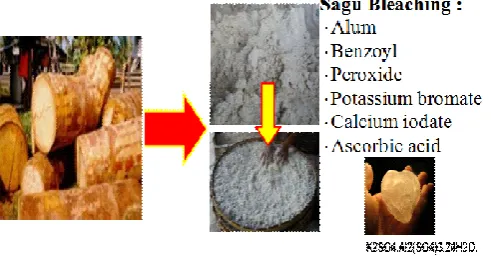
Figure 1. Schematic Process of Sago Tualto Sago Starch Using Chemical Bleaches
Sago pith naturally contains in digeneousmicrobes that function in the biosynthesis of natural materials sago through natural degradation process. Indigenous sago microbes can be isolated and cultured to be utilized in accordance with the potential, including the potential for the production of laccase enzyme. Selection and analysis of microbial diversity sago to do with approach bioleaching microbial DNA isolation metagenomik sago and isolation of edible mushroom fungi that produce laccase as bioleaching. The next test laccase production on agar and fermentation as well as analysis of laccase activity. Best strains isolated from both approaches are used as a starter inoculum in the fermenter scale production and purification laccase. enzyme x incubation time x
coefficient guaiacolenzyme (12,100 M-1cm-1) or ABTS
(36,000 M-1cm-1). Enzyme Activity (U/mL) = Absorbance
spectrophotometer x Total volume of solution / (volume enzyme x incubation time x coefficient guaiacol enzyme
(12,100 M-1cm-1) or ABTS (36,000 M-1cm-1)
RESULTS AND DISCUSSION
Sago starch is produced by grating sago, followed by extraction using running water. In sago starch extraction process, the color changes from white to pink pith and finally red-brown due to the oxidation reaction of polyphenol compounds in the pith of sago. The color change is very affected by soil conditions and acidity that occurs due to metal elements Mn, Fe, Mg and sulfur containing water to form the oxidation reaction. This phenomenon has been investigated by
Konuma et al (2012) who mentioned the color of the sago
starch extraction process is influenced by the condition of the
[image:3.595.41.287.277.406.2]soil acidity and sulfur where the sago palms grow. Acidity and high sulfur content lead to ash content and high phenolic compounds that make sago starch color becomes pink to brownish red and finally become dark brown/gray. Dark color of sago starch can be removed by oxidation using bleach. All these times traditional craftmendo sago starch bleaching using several chemical compounds such as alum, benzoyl, peroxide, potassium bromate, calcium iodate and ascorbic acid. Although classified in the food whitening chemicals, however large amounts usage can be detrimental to health. Bleaching sago schematically shown in Figure 1
Figure 2. Schematic process of selection and analysis of microbial laccase bioleaching sago
Edible Mushroom Exploration
Button mushrooms (Agaricusbisporus) or champignon is
edible mushroom-like white round buttons. Button mushrooms are most widely cultivated mushrooms in the world. In English referred to as table mushroom, or white mushroom, common mushroom or cultivated mushroom. Button mushrooms are harvested at 2-4 cm in diameter. Button mushrooms are sold in the form of fresh or canned mushroom, are used in a variety of Western dishes such as omelette, pizza, casserole, gratine, and salad. Button mushrooms can grow in obsolescentor husk wood by utilizing carbon eftover as an energy source. Because of that, it is also known as compost mushroom due to its ability to decipher lignosellulosa button mushrooms into a carbon source for the growth of mycelium and fruiting body formed into a button mushroom. Bioconversion capability lignosellulosa button mushroom button mushrooms is due to an enzyme capable of producing lignolitik groups, one of which is a laccase which is a multi copperextra cellular enzyme capable of oxidizing aromatic and non-aromatic structure components in lignin structure (Kumar, 2011).
Oyster mushroom (Pleurotusostreatus) is an edible
Basidiomycota group mushroom, class Homobasidiomycetes with the general characteristics of the fruit body is white to cream and a semicircular oyster shells like hood with the middle slightly concave. The oyster mushroom has same
family with Pleurotuseryngii and often known as the King
Oyster Mushroom. Oyster mushrooms fruiting bodies have
stalks that grow sideways (Latin: Pleurotus) and shaped like an oyster (ostreatus) so that the oyster mushroom have a
Pleurotusostreatusbinomial name. Covering part of the
mushrooms colortransforms from black, gray, brown, to white, with a nearly smooth surface, 5-20 cm diameter smooth edged slightly curved hood.
In addition, oyster mushrooms also have a rod
[image:4.595.38.269.110.192.2]measuring 8-11 × 3-4 μm and white mycelia that can grow quickly. In the wild, oyster mushrooms can be found almost throughout the year in cool mountainous jungle area.
Figure 3. Oyster Mushroom (Pleurotusostreatus
Fruiting bodies overlap each other on the surface of the rotten tree trunk or main trunks of trees that have been cut down because of the oyster mushroom is one type of wood mushrooms. Media commonly used for oyster mushroom farming is sawdust which is a waste of the sawmill. mushrooms also have the production capability in the extracellular laccase purified and molecularly characterized (Okamoto, 2000). Result of literature exploration has defined two types of edible mushrooms that will be used as a model in liquid culture fermentation and extraction of laccase. Further regeneration methods have been obtained edible mushroom
bisporus and P. ostreatus as can be seen in the image below.
Mushroom mycelial growth both aforementioned glance look the same, however, when observed more in the mikroskospis there is a difference in the form miselianya. Furthermore, the
mycelia growth of P. ostreatus remain white while
mycelia turn black. Speed A. bisporus mushroom mycelial
growth faster than the fungus P. ostreatus. Karena mushroom
A. bisporus faster form spores when nutrients are limited, the
need for further mycelial growth. The study of kinetic mycelial growth of A. bisporus been done by Straatsma et al (1991), where the speed of mycelial growth could reach 30 mmd the exponential growth phase while stasionernya only accounted for 7.2 mmd-1.
Isolates edible mushroom fungi laccase test is then performed on the media agar plate containing 0.02% guaiacol and 0.1% syringaldazine. Testing the activity of laccase can also be done on a PDA medium plate so by adding a solution guaicol and syringaldehide. Furthermore, the sub-culture of fungal mycelia
A. bisporus and P. ostreatus and incubated at 30 ° C for 7
[image:4.595.327.538.248.411.2]days. Laccase activity is indicated by the formation of a yellowish brown color zones that are the result guaicol and syringaldehida substrate oxidation by laccase as can be seen in the image below. The greater the concentration of laccasenya will form a reddish brown zones are more extensive. The same method can also be done using paper disk dipped in laccase extract and put it on a paper disk media PDA agar plate added guaicol and syringaldehide.
Figure 4. Testing laccase activity usingguaiacol on a saucer In addition, oyster mushrooms also have a rod-shaped spores
4 μm and white mycelia that can grow quickly. In the wild, oyster mushrooms can be found almost throughout the year in cool mountainous jungle area.
Pleurotusostreatus)
lap each other on the surface of the rotten tree trunk or main trunks of trees that have been cut down because of the oyster mushroom is one type of wood mushrooms. Media commonly used for oyster mushroom farming is sawdust which is a waste of the sawmill. Oyster mushrooms also have the production capability in the extracellular laccase purified and molecularly characterized Result of literature exploration has defined two types of edible mushrooms that will be used as a model in ture fermentation and extraction of laccase. Further
regeneration methods have been obtained edible mushroom A.
as can be seen in the image below. Mushroom mycelial growth both aforementioned glance look served more in the mikroskospis there is a difference in the form miselianya. Furthermore, the
remain white while A. bisporus
mushroom mycelial Karena mushroom faster form spores when nutrients are limited, the need for further mycelial growth. The study of kinetic mycelial A. bisporus been done by Straatsma et al (1991), where the speed of mycelial growth could reach 30 mmd-1 in the exponential growth phase while stasionernya only
Isolates edible mushroom fungi laccase test is then performed media agar plate containing 0.02% guaiacol and 0.1% syringaldazine. Testing the activity of laccase can also be done on a PDA medium plate so by adding a solution guaicol and culture of fungal mycelia and incubated at 30 ° C for 7 days. Laccase activity is indicated by the formation of a yellowish brown color zones that are the result guaicol and syringaldehida substrate oxidation by laccase as can be seen in concentration of laccasenya will form a reddish brown zones are more extensive. The same method can also be done using paper disk dipped in laccase extract and put it on a paper disk media PDA agar plate added
ting laccase activity usingguaiacol on a saucer
The test results showed that
ability to produce laccase and perform the oxidation of guaiacol and syringaldazine as can be seen in Figure 4.
Edible Mushroom Fermentation Test
At the trial,` liquid fermentation using
mushroom A. bisporus and P. ostreatus
fermentation media did not succeed. This is due to the mycelia that is not able to grow or use a carbon source derived from simple sugars such as sucrose and dextrose. Fermentation media remained clear after fermentation lasts for four days, while the fermentation using inoculum from the second sub cultured mycelia fungi on PDA agar media showed mycelial growth that is characterized by turb
[image:4.595.312.561.641.762.2]fermentation culture medium as can be seen in the image below.
Figure 5. Pleurotusostreatus liquid fermentation culture, pre
fermentation and post-fermentation remain clear (left), post fermentation is turbid (middle) and
despite of mycelia growing (right)
However, the level of turbidity liquid fermentation culture media does not always reflect the growth of fungal mycelia, but also influenced by the growth of bacterial contaminants symbiosis on fungal mycelia. In the culture of sterile fungal fermentation, showing no turbidity even though the growth of fungal mycelia looked lush and liquid fermentation culture medium remains clear. This phenomenon illustrates that the mushroom liquid fermentation culture do
the turbidity in the fermentation liquid media which showed growth of fungal mycelia but can also be liquid fermentation culture media may remain clear as can be seen in the picture above. Meanwhile, on a microscopic examination of the culture medium turbid liquid fermentation, does not indicate clearly the existence of bacteria, such as can be seen in Figure 6
Figure 6. Liquid Culture of
Microscopic Agaricusbisporus mycelia (right) spectrophotometer
The test results showed that Pleurotus laccase test has the
ability to produce laccase and perform the oxidation of guaiacol and syringaldazine as can be seen in Figure 4.
Edible Mushroom Fermentation Test
At the trial,` liquid fermentation using of a piece of edible
P. ostreatus directly on liquid
fermentation media did not succeed. This is due to the mycelia that is not able to grow or use a carbon source derived from such as sucrose and dextrose. Fermentation media remained clear after fermentation lasts for four days, while the fermentation using inoculum from the second sub-cultured mycelia fungi on PDA agar media showed mycelial growth that is characterized by turbidity in the liquid fermentation culture medium as can be seen in the image
liquid fermentation culture, pre-fermentation remain clear (left), post
fermentation is turbid (middle) and A. bisporus remains clear
mycelia growing (right)
However, the level of turbidity liquid fermentation culture media does not always reflect the growth of fungal mycelia, but also influenced by the growth of bacterial contaminants lia. In the culture of sterile fungal fermentation, showing no turbidity even though the growth of fungal mycelia looked lush and liquid fermentation culture medium remains clear. This phenomenon illustrates that the mushroom liquid fermentation culture does not always show the turbidity in the fermentation liquid media which showed growth of fungal mycelia but can also be liquid fermentation culture media may remain clear as can be seen in the picture above. Meanwhile, on a microscopic examination of the ulture medium turbid liquid fermentation, does not indicate clearly the existence of bacteria, such as can be seen in Figure
Figure 6. Liquid Culture of Agaricusbisporus (left) and
[image:4.595.53.275.682.776.2]Meanwhile, the results of laccase concentration testing in the extract liquid fermentation culture can be seen in the above table and graph below. The charts show an increase in the concentration of laccase since the days of fermentation 4th through 6th. While on the 7th day of fermentation the laccase concentration decreased sharp possibly due to laccase has run out or decomposed due to heat ambient temperature. The room temperature reached 34° C during spectrophotometer analysis, whereas the reccomended room temperature for analysis in the enzymatic reaction is 25° C. Another possibility is the
production of laccase by A. bisporus is indeed small due to
bacteria contaminated fungal growth A. bisporus when seen
from the turbidity level of liquid fermentation culture medium. In the Erlenmeyer flask with JB code experienced turbidity in the media, while the Erlenmeyer flask A mycelial growth did not experienced contamination when viewed from the clarity of their liquid culture medium. The same thing is seen from the absorbance at spectrophotometer analysis showed a higher concentration of laccase when compared to culture with the JB code.
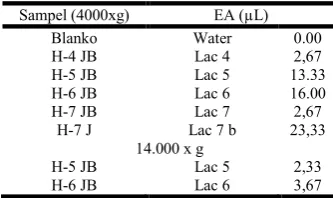
[image:5.595.321.548.300.445.2]Results of analysis of the concentration on the absorbance of spectrophotometers laccase fermentation culture 5JB and H-6JB by centrifuging speed difference provides significant influence. It can be seen in Table 1 above, which at 4000 xg centrifugation speed-H and H-6JB 5JB laccase concentration consecutively were 13.33 mL and 16.00 mL, while at the speed of 14,000 xg centrifugation were 2.33 µL and 3.67 µL. The differences in concentration values at that centrifugation speed mentioned above are caused by differences in the volume of centrifuged culture. At a speed of 4,000 x g using 50 mL falcon tube with 25 ml culture volume, whereas at a speed of 14,000 x g using ependof 2 mL filled with 1.5 mL volume. Although the results of the spectrophotometer analysis showed differencebased on the comparison figures in general percentage on using Eppendorf centrifuges laccase can harvest three times more compared to centrifuged culture volume. It shows speed centrifugation gives significant effect to produce a laccaseconcentrate.
Tabel 1. Laccase Analiysis Data on Spektrofotometer
Sampel (4000xg) EA (µL)
Blanko Water 0.00
H-4 JB Lac 4 2,67
H-5 JB Lac 5 13.33
H-6 JB Lac 6 16.00
H-7 JB Lac 7 2,67
H-7 J Lac 7 b 23,33
14.000 x g
H-5 JB Lac 5 2,33
H-6 JB Lac 6 3,67
Source: spectrophotometer analysis results batch 1, 2016
Meanwhile, the results of testing the concentration of laccase in the extract liquid fermentation culture can be seen in the above table. The room temperature reached 34° C during spectrophotometer analysis, whereas the recommended room temperature for analysis in the enzymatic reaction is 25° C.
Another possibility is the production of laccase by A. bisporus
is small, this is due to fungal growth A. bisporus contaminated
with bacteria when seen from the turbidity level of liquid fermentation culture medium. In the Erlenmeyer flask with code JB experienced turbidity in the media, while mycelial growth in the Erlenmeyer flask A did not experienced contamination when viewed from the clarity of their liquid culture medium.
The same thing is seen from the absorbance at spectrophotometer analysis showed a higher concentration of laccase when compared to culture with the JB code. Results of analysis of the concentration on the absorbance of spectrophotometers laccase fermentation culture 5JB and H-6JB by centrifuging speed difference provides significant influence. It can be seen in Table 1 above, which at 4000 xg centrifugation speed-H and H-6JB 5JB laccase concentration of each sequence was 13.33 µL and 16.00 µL, while the speed of 14,000 xg centrifugation was 2.33 µL and 3.67 µL. The difference in speed centrifugation concentration values mentioned above is caused by differences in the volume of centrifuged culture. At a speed of 4,000 x g using 50 mL falcon tube with 25 ml culture volume, whereas at a speed of 14,000 x g using ependof 2 mL with 1.5 mL volume. Although the results of the spectrophotometer analysis showed that different numbers, however the use of centrifuges using ependof can yield laccase compared to volume number of cultures that was centrifuged. It shows centrifugation speed give real effect in producing a laccaseconcentrate.
Figure 7. Test Result of A. Bisporus Laccase Activity on
Spectrophotometer using Guaiacol Substrate on 470 nm Wavelength
Development of edible mushroom fungus fermentation test
Isolation edible mushroom done by taking samples of
Pleurotusostreatus, Agaricusbisporus, Volvarielavolvacea and
Rhyzopusoligosporus obtained three best strains using
Pleurotusostreatus, Agaricusbisporus, and
Rhyzopusoligosporus. The test results and the activity of
laccase fermentation substrate ABTS showed the best activity
of each are Pleurotus 774 U/L day 21, Agaricus 484 U/L day
9, and Rhyzopus 480 U/L day 21. Data can be seen in Table 7
[image:5.595.77.244.534.633.2]and graph image 28. Generally fermentation test results mentioned above not yet using the precursor for the laccase induction is good enough when compared to results from other researchers.
Table 2. Spectrophotometer Laccase Data Analysis on Edible Mushroon Fermentation
Day of Fermentation Enzyme Activity (U/mL) Agaricus
bisporus
Rhyzopus oligosporus
Pleurotus ostreatus
0 0.000 0.000 0.000
3 0.368 0.297 0.288
6 0.441 0.355 0.391
9 0.484 0.398 0.319
12 0.436 0.349 0.426
15 0.423 0.327 0.376
18 0.447 0.436 0.459
21 0.378 0.480 0.774
Source: results of the analysis spectrophotometer
[image:5.595.325.543.682.788.2]laccase fungus Trichodermaspp which during the solid fermentation test laccase activity was 11.7 U / mL and 8.67 U/mL in the liquid fermentation with an incubation time of 9 days at the optimum temperature of 45-50° C and pH 4,5 enzyme activity ranges around 80%. While Kumar et al (2011) used Pleurotusostreatus fungi for the laccase production with 1
mM CuSO4 induction obtained the best results 910 U/L during
[image:6.595.49.538.58.235.2]the 9 days of fermentation increased from 570 U/L without induction of copper sulfate.
Table 3. Total Sugar LevelData Analysis as Result of Edible Mushroom Fermentation on Reffractometer
Day Fermentation Total Sugar Level Agaricus
bisporus
Rhyzopus oligosporus
0 6.50 6.40
3 6.12 6.01
6 5.32 5.90
9 4.63 5.98
12 4.32 6.39
15 4.38 6.24
18 4.22 6.66
21 4.70 7.52
Source: results of the analysis refractometer batch 3, 2016
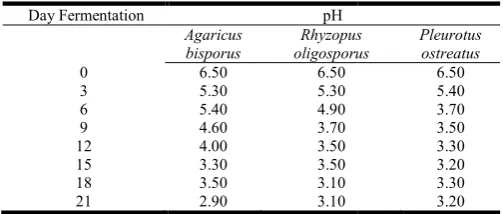
Table 4. Data Analysis pH fermented edible fungus mushroom on a pH meter
[Day Fermentation pH
Agaricus bisporus
Rhyzopus oligosporus
0 6.50 6.50
3 5.30 5.30
6 5.40 4.90
9 4.60 3.70
12 4.00 3.50
15 3.30 3.50
18 3.50 3.10
21 2.90 3.10
Resourch: Analysis Result on pH batch 3, 2016
Copper sulfateis a precursor compound that is better than alcohol veratril 7 mM and 10 mM benzyl alcohol. On the other hand, other researchers More et al (2011), using
PleurotusSspstrain got opposite result for tannic acid
induction, that is 83.83 U/mL and 112.88 U/mL without induction. This shows that not all types of precursors are suitable for the production of laccase. Kumar et al (2016) experimented on sourcing of carbon and nitrogen sources used
strains of Aspergillusflavus obtained the best results
[image:6.595.46.277.401.508.2]production of laccase cellulose 8% carbon source, nitrogen peptone 2%, temp 35° C and pH 7 inoculum size of 1.5 cm.
Figure 8. Edible Mushroom Fermentation in liquid fermentation
laccase fungus Trichodermaspp which during the solid fermentation test laccase activity was 11.7 U / mL and 8.67 U/mL in the liquid fermentation with an incubation time of 9 50° C and pH 4,5-5,5 y ranges around 80%. While Kumar et al (2011) used Pleurotusostreatus fungi for the laccase production with 1 induction obtained the best results 910 U/L during the 9 days of fermentation increased from 570 U/L without
Table 3. Total Sugar LevelData Analysis as Result of Edible Mushroom Fermentation on Reffractometer
Total Sugar Level (%) Rhyzopus oligosporus
Pleurotus ostreatus
6.60 6.05 4.43 4.80 5.29 6.14 7.02 7.63 Source: results of the analysis refractometer batch 3, 2016
Table 4. Data Analysis pH fermented edible fungus mushroom on
Rhyzopus oligosporus
Pleurotus ostreatus
6.50 5.40 3.70 3.50 3.30 3.20 3.30 3.20
Copper sulfateis a precursor compound that is better than alcohol veratril 7 mM and 10 mM benzyl alcohol. On the other hand, other researchers More et al (2011), using strain got opposite result for tannic acid nd 112.88 U/mL without induction. This shows that not all types of precursors are suitable for the production of laccase. Kumar et al (2016) experimented on sourcing of carbon and nitrogen sources used obtained the best results in the production of laccase cellulose 8% carbon source, nitrogen peptone 2%, temp 35° C and pH 7 inoculum size of 1.5 cm.
During fermentation 21 days there will be a decrease in pH, as a result of acid formation. A description of the de
of the media during fermentation is presented in Table 4.
Conclusions and recommendations
From these researches, it can be concluded
Based on laccase concentration analysis in the bioleaching test
mushroom broth fermentation, it yields th
Pleurotusostreatus, Agaricusbisporus
Rhizopusoligosporus can produce laccase. Result of
fermentation test and laccase activity on ABTS substrate shows that the best activity for each mushroom is Pleurotus
774 U/L on 21st day, Agaricus 484 U/L on 9
Rhyzopus 480 U/L on 21st day.
Suggestion
The extraction result of crude enzyme should be
followed by purification and characterization of laccase enzyme and tests of dye decolorizationand organoleptic
Lab-scale fermentation and extraction of te
should be followed up with a fermentor fermentation and a fermentor
laccase enzyme protype.
Laccase enzyme prototype results should be used in the
bleaching test to get sago which meets the quality standards of Codex Stan 301R
for Asian edible sago flour)
Acknowledgments
In this moment I would like to thank
Higher Education Program
activities and appreciate your help
REFERENCES
Bintoro, D. 2008. Bercocok Tanam Sagu. IPB. Pres. Bogor Bintoro, D. 2012. Potensi sagu di Papua dan Papua Barat.
HasilKajian UP4B dan IPB. Bogor
Brijwani, K., Rigdon, A., and Vadlani, P.V. 2010. Review Article. Fungal Laccases: Production, Function, and Applications in Food Processing. SAGE
to Research Enzyme Research Volume 2010, Article ID 149748, 10 pages doi:10.4061/2010/149748
ntation in liquid fermentation Before inoculation (left) and after inoculation
During fermentation 21 days there will be a decrease in pH, as a result of acid formation. A description of the decrease in pH of the media during fermentation is presented in Table 4.
onclusions and recommendations
it can be concluded
Based on laccase concentration analysis in the bioleaching test
mushroom broth fermentation, it yields that
Agaricusbisporus and
can produce laccase. Result of
fermentation test and laccase activity on ABTS substrate shows that the best activity for each mushroom is Pleurotus
day, Agaricus 484 U/L on 9th day and
day.
The extraction result of crude enzyme should be followed by purification and characterization of laccase enzyme and tests of dye decolorizationand organoleptic scale fermentation and extraction of test results should be followed up with a fermentor-scale fermentation and a fermentor-scale laccase to get laccase enzyme protype.
Laccase enzyme prototype results should be used in the bleaching test to get sago which meets the quality Stan 301R-2011 (regional standard for Asian edible sago flour)
In this moment I would like to thank SINasKemenristek
which has funded research activities and appreciate your help
cocok Tanam Sagu. IPB. Pres. Bogor Bintoro, D. 2012. Potensi sagu di Papua dan Papua Barat.
HasilKajian UP4B dan IPB. Bogor
Brijwani, K., Rigdon, A., and Vadlani, P.V. 2010. Review Article. Fungal Laccases: Production, Function, and rocessing. SAGE-Hindawi Access to Research Enzyme Research Volume 2010, Article ID 149748, 10 pages doi:10.4061/2010/149748
[image:6.595.36.288.555.662.2]Das, N., Dey, D., and Mishra, S. 2015. Isolation and physico-chemical characterization of extracellular lingo-cellulolytic
enzymes of Pleurotuspulmonarius in submerged
fermentation.International Journal of Applied Biology and Pharmaceutical Technology Volume-6, Issue-3, July-Sept-2015.Coden IJABFP-CAS-USA. Copyrights@2015, ISSN: 0976-4550. www.ijabpt.com
Demissie, A.G., Kumar, A. 2014. Isolation of Novel Bacteria Isolate from Soil for Production of Extra-Cellular Laccase Enzyme. International Journal of Emerging Technology and Advanced Engineering. Website: www.ijetae.com (ISSN 2250-2459, ISO 9001:2008 Certified Journal, Volume 4, Issue 11, November 2014)
Desai, S.S., Tennali, G.B., Channur, N., Anup, A.C., Deshpande, G., Azhar M, B.P.A. 2011. Isolation of laccase producing fungi and partial characterization of laccase. Research Article, Biotechnol. Bioinf.Bioeng. 2011. 1(4):543-549
Forootanfar, H., Moezzi, A., Aghaie-khozani, M.,
Mahmoudjanlou, Y., Ameri, A., Niknejad, F., and Faramarzi, M.A. 2012. Synthetic dye decolorization by three sources of fungal laccase. Iranian Journal of Environmental Health Sciences & Engineering 2012, 9-27. Hariyanto, B. 2014. Perkembangan Teknologi Produk Pangan
Berbasis Sagu Guna Mendukung Ketersediaan Pangan. Orasi Pengukuhan Profesor Riset Bidang Teknologi Pangan. BPPT-LIPI. Jakarta
Hariyanto, B. Dan, P. and Pangloli, 1992. Potensi dan Pemanfaatan Sagu. Kanisius. Yogyakarta
http://dx.doi.org/10.1155/2016/8319542 http://www.ijehse.com/content/9/1/27
José Renato, P., Cavallazzi, J.R.P., Catarina M. Kasuya, C.M., Marcos A. and Soares, M.A. 2005. Screening of inducers for laccase production by lentinulaedodes in liquid
medium. Brazilian Journal of Microbiology, (2005)
36:383-387 ISSN 1517-8382
Kalra, K., Chauhan, R., Shavez, M. and Sachdeva, S. 2013.
Isolation OfLaccase Producing Trichoderma Spp. And
Effect Of PH And Temperature On Its Activity.
International Journal of ChemTech Research, CODEN(
USA): IJCRGG ISSN : 0974-4290 Vol.5, No.5, pp 2229-2235, July-Sept 2013.
Konuma, H., Rolle, R. and Boromthanarat, S. 2012. Color characteristics of sago starch as they relate to the growth
environment of the sago palm (Metroxylon sago Robb).
Journal of Agricultural Technology 2012 Vol. 8(1): 273-287 Available online http://www.ijat-aatsea.com
Kumar, R. Kaur, J., Jain, S. and Kumar, A. 2016. Optimation
of laccase production from Aspergillusflavus by design of
experiment technique: Partial purification and
characterization. Journal of Genetic Engineering and Biotechnology (2016) 14, 125 – 131.
Kumar, V.V., Kirupha, S.D., Periyaraman, P. and Sivanesan, S. 2011. Screening and induction of laccase activity in
fungal species and its application in dye decolorization. African Journal of Microbiology Research Vol. 5(11), pp. 1261-1267, 4 June, 2011.
Margot, J., Bennati-Granier, C., Maillard, J., Blanquez, P., Barry, D.A. and Holliger, C. 2013. Bacterial versus fungal laccase: potential for micropollutant degradation. AMB
Express 2013, 3:63. http://www.amb-express.com
/content/3/1/63
Minussi, R.C., Miranda, M.A., Silva, J.A., Ferreira, C.V., Aoyama, H., Marangoni, S., Rotilio, D., Pastore, G.M. and Durán, N. 2007. Research P Purification, characterization and application of laccase from Trametesversicolor for
colour and phenolic removal of olive mill wastewater in the presence of 1hydroxybenzotriazole African Journal of Biotechnology Vol. 6 (10), pp. 1248-1254, 16 May 2007.http://www.academicjournals.org/AJB ISSN 1684– 5315 © 2007
More, S.S., Renuka, P.S., Pruthvi, K., Swetha, M., Malini, S.
and Veena, S.M. Isolation, Purification, and
Characterization of fungal Laccase from Pleurotus sp.
Enzyme Research Volume 2011, Article ID 248735, 7 pages doi:10.4061/2011/248735.SAGE-Hindawi Access to Research.
Naim, H.M., Yaakub, A.N. and Hamdan, D.A.A. 2016. Commercialization of Sago through Estate Plantation Scheme in Sarawak: The Way Forward. Hindawi Publishing Corporation International Journal of Agronomy Volume 2016, Article ID 8319542, 6 pages
Okamoto, K., Yanagi, S.O., Sakai, T. 2000. Purification and
characterization of extracellular laccase from
Pleurotusostreatus.Mycoscience 41: 7 – 13, 2000.
Osma, J.F., Toca-Herrera, J. and Rodr’iguez-Couto, S. 2010. Review Article Uses of Laccases in the Food Industry. SAGE-Hindawi Access to Research Enzyme Research
Volume 2010, Article ID 918761, 8 pages
doi:10.4061/2010/918761.
Pannu, J.S. and Kapoor, R.K. 2014. Microbial Laccases: A Mini-Review on Their Production, Purification and Applications. Review Article International Journal of Pharmaceutical Archive-3(12), 2014, 528-536.
Peter, J.K., Vandana, P., Masih, H. and Kumar, Y. 2014. Production Optimization and Partial Purification of Laccases from Bacterial Consortium. International Journal ofEngineering Research & Technology (IJERT) Vol. 3 Issue 6, June - 2014 ISSN: 2278-0181.
Sheikhi, F., Ardakani, M.R., Enayatizamir, N. and Rodriguez-Couto, S. 2012. The Determination of Assay for Laccase of Bacillus subtilis WPI with Two Classes of Chemical Compounds as Substrates. Indian J Microbiol (Oct–Dec 2012) 52(4):701–707 DOI 10.1007/s12088-012-0298-3 Trejo-Hernandez, M.R. and Lopez-Munguia, A., Quintero
Ramirez, R. 2001.Residual compost of Agaricusbisporus as
a source of crude laccase for enzymic oxidation of phenolic compounds. Process Biochemistry 36 (2001) 635–639.