http://dx.doi.org/10.4236/jamp.2015.32038
How to cite this paper: Ge, X.P., Wang, J., Ibrahim, K., Yang, W.B., Dong, X.G. and Li, Q. (2015) Influence of Doping on the Magnetic Properties and Local Microstructures in Fe-Doped YMnO3. Journal of Applied Mathematics and Physics, 3,
262-266. http://dx.doi.org/10.4236/jamp.2015.32038
Influence of Doping on the Magnetic
Properties and Local Microstructures in
Fe-Doped YMnO
3
Xiaopeng Ge1, Jiaou Wang2, Kurash Ibrahim2, Wenbo Yang1, Xueguang Dong1, Qi Li1*
1Department of Physics, Southeast University, Nanjing, China
2Beijing Synchrotron Radiation Facility, Institute of High Energy Physics, Chinese Academy of Sciences, Beijing,
China
Email: *[email protected]
Received 25 November 2014
Abstract
Polycrystalline YMn1−xFexO3 (0 < x < 0.1) samples are synthesized by solid-state reaction method
and characterized by X-ray diffraction. The X-ray diffraction patterns indicate that YMn1−xFexO3
compounds maintain hexagonal structure with space group of p63 cm. Ferromagnetism of
YMn1−xFexO3 increases with increasing doping concentration of Fe3+, attributed to the suppression
of the frustration and the change of the Mn-O bond length certificated by XAS analysis.
Keywords
Multiferroics, YMn1−xFexO3, Hybrid States, X-Ray Absorption Spectra
1. Introduction
Multiferroic materials simultaneously possess magnetic and ferroelectric orders which co-exist and couple with each other [1]. They are able to put the electrical, magnetic and optical properties together and suitable to design new multi-functional electronic information storage elements. Multiferroic materials have become one of the most active areas in the field of materials science. Hexagonal RMnO3 (R = Y, Ho-Lu) materials occupy a very
important position in the single-phase multiferroic materials. They have novel properties, indicating the potential in the material research and applications [2]. Therefore hexagonal manganites YMnO3 have attracted widespread
attention in recent years. However, because YMnO3 exhibits the coupling of antiferromagnetism and
ferroelec-tricity, such multiferroic is not very sensitive to the applied external electromagnetic fields [3]; thereby it is the purpose of many researchers to increase the ferromagnetic property of YMnO3.
As an effective research tool, ion doping in A site (i.e. Y site) or B site (i.e. Mn site) of YMnO3 is often used
to change the ferromagnetic property of YMnO3 [4]. Some research teams have selected kinds of ions replacing
the Y3+ to modulate the antiferromagnetic order of YMnO3, such as Lu3+, Sr2+. It will make partial
antiferro-magnetic order convert to ferroantiferro-magnetic properties in the compounds where Y3+ was replaced by Lu3+ or Sr2+ [5]
[6]. Transition metal ions replacing the Mn3+ in the B site of YMnO3 is another way to modulate the
antiferro-magnetic order. Several current experiments have successfully synthesized samples in which the Mn3+ in the B site of YMnO3 is replaced by kinds of ions, such as Fe3+, Al3+, Cu2+, Ti3+, etc. [7]-[10]. Y. J. Yoo et al., who
have synthesized polycrystalline Cr-doped YMnO3 with hexagonal structure and space group P63 cm, found that
the magnetic transition temperature increased as the concentration of Cr increased [11]. Indeed, it will make the ferromagnetic property of YMnO3 increase significantly by the substitution of the Mn3+ with transition metal
ions in the YMnO3 samples. However, the reason of the change of magnetism is still not explained clearly.
Compared to previous studies about YMnO3 samples, this paper will explain the change of magnetism when the
Fe3+ replaces the Mn3+ in the B site of YMnO3 samples according to XAS of O K edge and Mn L edge.
2. Experimental Details
Polycrystalline YMn1−xFexO3 (0 < x < 0.1) samples were prepared by a standard solid-state reaction. The
ana-lytical pure Y2O3, MnO2 and Fe2O3 were weighed according to stoichiometric proportion. The mixed powder
was put into an agate mortar milling 5 hours with petroleum ether. The milled powder was transferred into a co-rundum crucible in a tube furnace. The powder was sintered 2 h at 1100˚C then heated to 1370˚C, maintaining 24 hours. Taking out the powder and milling for 2 hours, we can obtain the YMn1−xFexO3 (0 < x < 0.1) samples.
The crystal structures of the samples were examined by X-ray diffraction (XRD) with Cu Kα radiation (Rigaku Smart Lab3, Japan). The magnetic properties of YMn1−xFexO3 were measured by SQUID-VSM (Quantum
De-sign, USA). In order to observe the change of Y-O, Mn-O hybrid states, the X-ray absorption spectroscopy (XAS) of O K edge and Mn L edge of YMn1−xFexO3 (0 < x < 0.1) samples were measured utilizing total electron
yield (TEY) mode in photoemission spectroscopy experiment station of Beijing Synchrotron Radiation Facility, Chinese Academy of Sciences.
3. Results and Discussion
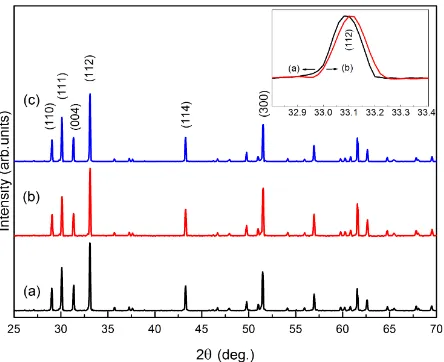
XRD patterns of powder samples YMn1−xFexO3 (0 < x < 0.1) at room temperature are measured as shown in
Figure 1. XRD patterns of YMn1−xFexO3 illustrate that all samples are in single phase with hexagonal lattice
structure, space group P63 cm. It illustrates that Fe3+ ion replaces the lattice position of Mn3+ ion and doesn’t
change the lattice structures of YMn1−xFexO3 samples, with the incorporation of Fe3+ ion. Because Fe3+ ionic
ra-dius (0.49 Å) is smaller than the Mn3+ ionic radius (0.58 Å), the lattice structures of YMn1−xFexO3 samples have
a slight contraction. This change can be found from the diffraction peaks of YMn1−xFexO3 samples. The
diffrac-tion peak (112) of YMn0.95Fe0.05O3 shifts toward the higher angle with respect to that of YMnO3 (as inset of
[image:2.595.188.410.512.693.2]Figure 1). The contraction of lattice structure will lead to the change of Y-O, Mn-O hybrid states and Y, Mn li-gand structure, which will affect the bond lengths of Y-O and Mn-O. These changes will affect the magnetic or-der of YMn1−xFexO3 (0 < x < 0.1) samples.
Figure 1. XRD patterns of YMn1−xFexO3 (0 < x < 0.1)
In order to observe the magnetism change of YMn1−xFexO3 samples, field cooled (FC) temperature dependent
magnetization (M-T) curves were measured from 30 K to 300 K with cooling field of 5000 Oe as shown in Fig-ure 2. The magnetism of YMn1−xFexO3 samples are significantly enhanced, which is attributed to the
incorpora-tion of Fe3+ ion. Since Mn trimer arrangement exists the magnetic frustration effect (shown in Figure 2(b)), the magnetic frustration effect is relieved when Fe3+ ions partially replace Mn3+ ions in the B-site of crystal lattice. And Fe3+ ion having five 3d electrons will enhance the magnetism of YMn1−xFexO3 samples. In addition, due to
Fe3+ ions doping, the lattice structures of YMn1−xFexO3 samples shrink slightly, causing the magnetic exchange
[image:3.595.114.482.277.474.2]interaction to be enhanced.
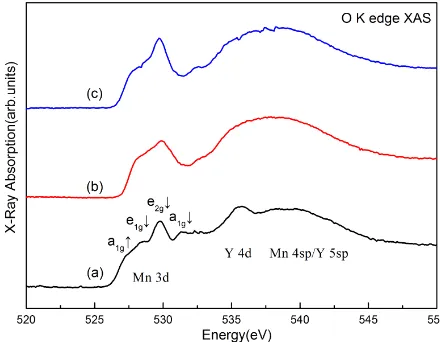
Figure 3 shows the XAS of O K edge of YMn1−xFexO3 samples which illustrate the hybrid states between O
2p and Mn 3d, Y 4d, Mn 4sp/Y 5sp. The absorption spectra of the O 2p-Mn 3d hybrid states can be refined to four peaks, namely a1g↑, e1g↓, e2g↓, a1g↓ [12]. O 2p-Y 4d electron orbitals also have a strong hybridization as
shown by the XAS of O K edge. Mn3+ ion is surrounded by 5 Oxygen atoms, forming bipyramid structure MnO5,
as shown in Figure 4(a).
The ferroelectric transition temperature TC of YMnO3 is about 900 K. When paraelectric phase is transformed
to ferroelectric phase for YMnO3, the bipyramid MnO5 will be tilted, as shown in Figure 4(b) [13]. The ferroe-
[image:3.595.186.406.522.693.2]
(a) (b)
Figure 2. (a) The field cooled (FC) temperature dependent magnetization (M-T) curves of YMn1−xFexO3
(0 < x < 0.1) samples. (1) x = 0, (2) x = 0.05, (3) x = 0.08; (b) Schematic diagram of the magnetic frustra-tion effect in Mn trimer arrangement of YMnO3.
Figure 3. The X-ray absorption spectroscopy (XAS) of O K edge of YMn1−xFexO3 (0 < x < 0.1) samples.
lectric order of YMnO3 is induced by the inclined bipyramid MnO5 which leads to the orbital hybridization of O
2p-Y 4d enhanced. As shown in Figure 3, due to Fe3+ ion doped, the intensity of e1g↓ and e2g↓ peaks are
en-hanced which indicates the orbital hybridization of O 2p-Mn 3d is enen-hanced. The change in the intensity of e1g↓
and e2g↓ peaks also shows that the structural distortion of MnO5 has been minorly changed. The structural
dis-tortion of MnO5 will also affect the coordination environment of Y3+ ion, resulting in the change of O 2p-Y 4d
orbital hybridization. The absorption spectra of O 2p-Y 4d are enhanced in intensity, as shown in Figure 3, con-sistent with our discussion.
Because O 2p-Mn 3d orbital hybridization is changed, the electronic orbital of Mn 3d presents a more com-plex structure in YMn1−xFexO3 (0 < x < 0.1) samples. The electronic orbital of Mn 3d splits into e1g, e2g, a1g (as
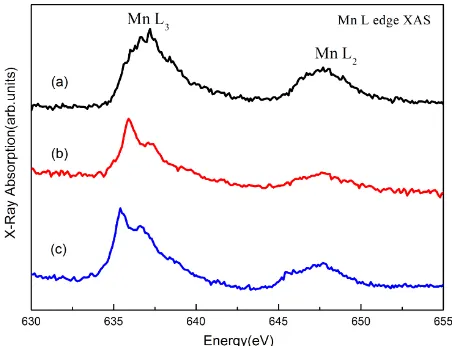
shown in Figure 4(c)) [12]. As shown in Figure 5, the lower energy segments of Mn 3d L3 absorption spectra
peak are significantly enhanced in YMn0.95Fe0.05O3 and YMn0.92Fe0.08O3 samples compared to that of YMnO3
sample. This shows that there are more empty electronic states in the low energy states (such as e1g, e2g), due to
Fe3+ doping, which is consistent with the situation of O K edge absorption spectra. The electronic orbital of Mn 3d is closely related to magnetic exchange interaction and lattice distortion of MnO5.
4. Conclusion
Polycrystalline YMn1−xFexO3 (0 < x < 0.1) samples were prepared by a standard solid-state reaction. The lattice
structures of hexagonal YMn1−xFexO3 (0 < x < 0.1) samples are unchanged with Fe3+ doping. The magnetic
properties of YMn1−xFexO3 samples are significantly enhanced, and can be attributed to doping Fe3+ ion in
YMnO3. According to XRD patterns, it can be obtained that the lattice structures of YMn1−xFexO3 (0 < x < 0.1)
(a) (b) (c)
Figure 4. (a) Crystal structure of hexagonal of YMnO3 with paraelectric phase; (b) Crystal structure of
[image:4.595.121.481.347.474.2]hexagonal of YMnO3 with ferroelectric phase; (c) Schematic crystal field splittings for MnO5 (D3h).
Figure 5. The X-ray absorption spectroscopy (XAS) of Mn L edge of YMn1−xFexO3 (0 < x < 0.1) samples. (a) x = 0; (b) x =
[image:4.595.184.410.510.683.2]samples slightly shrink. Based on O K edge and Mn L edge XAS absorption spectra of YMn1−xFexO3 (0 < x <
0.1) samples, it can be obtained that distortion occurs on the surrounded ligand structures of Y3+ and Mn3+ and that the orbital hybridization of Y-O and Mn-O are enhanced as Fe3+ ions doped, explaining the magnetic en-hancement of YMn1−xFexO3 (0 < x < 0.1) samples.
Acknow
ledgements
This work is supported by the National Natural Science Foundation of China (U1232133). We are in debt to photoemission spectroscopy experiment station of Beijing Synchrotron Radiation Facility for their help in mea-suring the XAS spectra.
References
[1] Spaldin, N.A .and Fiebig, M. (2005) Science, 309, 391. http://dx.doi.org/10.1126/science.1113357
[2] Serrao, C.R., Krupanidhi, S.B., Bhattacharjee, J., Waghmare, U.V., Kundu, A.K. and Rao, C.N.R. (2006) J. Appl. Phys., 100, 076104. http://dx.doi.org/10.1063/1.2356093
[3] Lee, S., Pirogov, A., Han, J.H., Park, J.G., Hoshikawa, A. and KaMiyama, T. (2005) Phys. Rev. B, 71, 180413.
http://dx.doi.org/10.1103/PhysRevB.71.180413
[4] Nugroho, A., Bellido, N., Adem, U., Nenert, G., Simon, Ch., Tjia, M.O., Mostovoy, M. and Palstra, T.T.M. (2007)
Phys. Rev. B, 75, 174435. http://dx.doi.org/10.1103/PhysRevB.75.174435
[5] Chatterjee, S. and Nigam, A.K. (2002) Phys. Rev. B, 66, 104403. http://dx.doi.org/10.1103/PhysRevB.66.104403
[6] Park, J. and Lee, S. (2010) Phys. Rev. B, 82, 054428. http://dx.doi.org/10.1103/PhysRevB.82.054428
[7] Asokan, K., Chen, Y.S., Pao, C.W., Tsai, H.M., Lee, C.W.O., Lin, C.H., Hsueh, H.C., et al. (2009) Appl. Phys. Lett.,
95, 131901. http://dx.doi.org/10.1063/1.3224905
[8] Namdeo, S., Sinha, A.K., Singh, M.N. and Awasthi, A.M. (2013) J. Appl. Phys., 113, 104101.
http://dx.doi.org/10.1063/1.4794831
[9] Asaka, T., Nemoto, K., Kimoto, K., Arima, T. and Matsui, Y. (2005) Phys. Rev. B, 71, 014114.
http://dx.doi.org/10.1103/PhysRevB.71.014114
[10] Park, J., Kang, M., Kim, J., Lee, S., Jang, K.H., Pirogov, A., Park, J.G., et al. (2009) Phys. Rev. B, 79, 064417.
http://dx.doi.org/10.1103/PhysRevB.79.064417
[11] Yoo, Y.J., Lee, Y.P., Park, J.S., Kang, J.H., Kim, J., Lee, B.W. and Seo, M.S. (2012) J. Appl. Phys., 112, 013903.
http://dx.doi.org/10.1063/1.4731631
[12] Cho, D.Y., Kim, J.Y., Park, B.G., Rho, K.J., Park, J.H., Noh, H.J., et al. (2007) Phys. Rev. L, 98, 217601.
http://dx.doi.org/10.1103/PhysRevLett.98.217601