AUTOMATED GUIDED VEHICLE SYSTEM
Mr. Virendra Patil
1, Prof .Bhatwadekar S.G
21
Scholar, M.Tech. Mechanical, Digital Manufacturing, Sanjay Ghodawat University, Kolhapur.
2Department of Mechanical Engineering, Sanjay Ghodawat Institutes, Kolhapur.
---***---
Abstract:
In this paper, we study the of automated guided vehicle (AGV) systems. The issues of designing and installing a system
of Automated Guided Vehicles (AGVs) in a Flexible Manufacturing System (FMS) are examined in this work. The development, advantages and future trends of AGVs are briefly reviewed. Then the basic features of an AGV in an FMS environment, as well as a
computerized procedure for the optimum vehicle selection, are discussed.
Keywords: AGV, FMS, Guidance Methods, Path Decision, Charging Method.
Introduction:
Automated guided vehicles (AGVs) are self-driven vehicles. Early types of AGVS were introduced around 1954. They are used to transport material from one location on the facility floor to another without any accompanying operator, and are widely used in material handling systems, flexible manufacturing systems, and container handling applications. With the advance of technology, more sophisticated machines are available, which considerably reduce machining and internal setup time [1]. The aim of production planning includes along with fast production, efficient transportation of material between the workstations and in and out of storage. Flexible material handling systems are required to perform an efficient routing of material with random handling capability. The use of AGVs increases flexibility, since the flow path can easily be selected from number of alternative paths, or, can be reconfigured to accommodate new locations. The design of material handling guide path has a significant implication on the overall system performance and reliability, since it has a direct impact on the travel time, the installation cost, and the complexity of the control system software.
Advantages of an automated guided vehicle system
1. Reduced Labor Costs.
2. Increased Accuracy and Productivity. 3. High availability/reliability.
4. Random material handling capability due to programmability. 5. Integrated operation of all AGVs.
Different Types of AGVS
1.Fork Lifts.
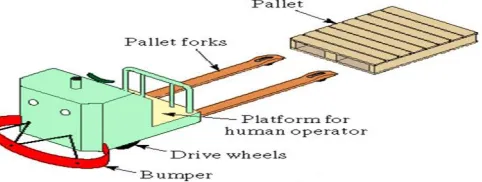
[image:1.612.188.429.628.719.2]AGVS fork lift truck applications are relatively new. Guided fork trucks are used when the system requires automatic pickup and drop off of loads from floor or stand level and where the heights of load transfer vary at stop locations. The guided fork truck has the ability to automatically pick up a load or discharges the load without any human interface. The vehicle can position its forks to about one to two meters height so that conveyors or load stands of varying height in a given system can all be serviced. [6]
2. Tow/Tugger. (Driverless train)
AGVS towing applications were the earliest and are still the most numerous AGV type. Towing applications can involve the bulk movement of product into and out of warehouse areas or direct service to a manufacturing/assembly operation. Usually side path spurs are placed in receiving or shipping areas so that trains can be loaded or unloaded off the main line and thereby not hinder the movement of other trains on the main path. Chain movement of product with AGVS trains is also popular. In this case, the AGVS trains are loaded with product destined for specific destinations along the guide path route. The train will make several stops in order for the product to be unloaded at the correct locations. Trains systems are generally used where movement of product is over long distances, sometimes between buildings, outdoors or in very large distributed systems where the runs are long. Since each train can as much as 16 pallet loads at a given time, this becomes a very efficient method and can usually be justified easily based on the elimination of fork trucks or manual trains and operators. [6]
Fig2. Driverless train
3. Unit Load.
AGVS unit load applications – usually involve specific mission assignments for individual load movement. Unit load carriers are quite popular in applications integrating conveyors with manufacturing/assembly operations or storage retrieval systems. Here they are a very efficient means for horizontal transportation between hardware intensive material handling subsystems. The unit load carrier, over moderate distances, can move high volumes of material linking other automated subsystems in a totally integrated facility. Usually the unit load systems involve an automatic pickup and delivery of product with remote management of the vehicles in the system. Unit load carriers are normally used in warehousing and distribution systems where the guide path lengths are relatively short, but the volumes are high. Here the unit load carriers have the ability to maneuver in tight areas where AGVS trains would be too awkward to use. Load transfer to conveyors or load stands is easily accomplished with unit load carriers either using roller decks or lift/lower decks. The unit load carriers allow good system versatility for product movement because they usually operate independent of one another and can pass each other to get to specific destinations. [6]
Fig.3 Unit Load.
Literature Review
2. Glover et al. (1985) developed a polynomially bounded shortest path algorithm, called the partitioning shortest path (PSP) algorithm, which finds the shortest distance from one node to another in a network.
3. Kim et al. (2002) presents a construction algorithm for designing a guide path of an AGV system. The total travel time is used as a decision criteria and the direction of the path segments on a unidirectional path layout is determined.
4. Huang et al. (1989) proposed a polynomial time labeling algorithm to find the shortest time path for routing a single vehicle in a bi-directional path network. This algorithm allows the path segments to be shared within their free time windows.
Vehicle functions
Man / vehicle functions
1. Inputs made via operator panel with its keyboard and display. 2. Destination input to the vehicle.
Data exchange:
1. Infrared. 2. Radio.
Guidance Methods
1. Wire –Embedded in floor: A slot is cut in to the floor and a wire is placed approximately 1 inch below the surface. This slot is cut along the path the AGV is to follow. This wire is used to transmit a radio signal. A sensor is installed on the bottom of the AGV close to the ground. The sensor detects the relative position of the radio signal being transmitted from the wire. This information is used to regulate the steering circuit, making the AGV follow the wire.[5]
2. Guide tape (magnetic or colored): AGVs use tape for the guide path. The AGV is fitted with the appropriate guide sensor to follow the path of the tape. One the major advantage of tape over wired guidance is that can be easily removed and relocated if the course needs to change. Colored tape is initially less expensive, but lacks the advantage of being embedded in high traffic areas where the tape may become damaged or dirty. The flexible magnetic bar can also be embedded in the floor like wire but works under the same provision as magnetic tape and so remains unpowered or passive. Another advantage of magnetic guide tape is the dual polarity.[5]
3. Inertial (Gyroscopic) navigation: Another method of AGV guidance is inertial navigation. With inertial guidance, a computer control system directs and assigns tasks of the vehicles. Transponders are embedded in the floor of the work place. The AGV uses these transponders to verify that the vehicle is on course. A gyroscope is able to detect the slightest change in the direction of the vehicle and corrects it in order to keep the AGV on its path. The margin of error for the inertial method is ±1 inch. Inertial can operate in nearly any environment including tight aisles or extreme temperatures. Inertial navigation can include use of magnets embedded in the floor of the facility that the vehicle can read and follow.[5]
4. Laser – Triangulation from reflective target: The navigation is done by mounting reflective tape on walls, poles or fixed machines. The AGV carries a laser transmitter and receiver on a rotating turret. The laser is transmitted and received by the same sensor. The angle and (sometimes) distance to any reflectors that in line of sight and in range are automatically calculated. This information is compared to the map of the reflector layout stored in the AGV's memory. This allows the navigation system to triangulate the current position of the AGV. The current position is compared to the path programmed in to the reflector layout map. The steering is adjusted accordingly to keep the AGV on track. It can then navigate to a desired target using the constantly updating position. [5]
Path Decision:
1. Frequency select mode: Frequency select mode bases its decision on the frequencies being emitted from the floor. When an AGV approaches a point on the wire which splits the AGV detects the two frequencies and through a table stored in its memory decides on the best path. The different frequencies are required only at the decision point for the AGV. The frequencies can change back to one set signal after this point. This method is not easily expandable and requires extra cutting meaning more money. [3]
2. Path select mode: AGV using the path select mode chooses a path based on preprogrammed paths. It uses the measurements taken from the sensors to values given to them by programmers. When an AGV approaches a decision point it only has to decide whether to follow path 1, 2, 3, etc. This decision is rather simple since it already knows its path from its programming. This method can increase the cost of an AGV because it is required to have a team of programmers to program the AGV with the correct paths and change the paths when necessary. This method is easy to change and set up.[3]
3. Magnetic tape mode: The magnetic tape is laid on the surface of the floor or buried in a 10mm channel; not only does it provide the path for the AGV to follow but also strips of the tape in different combinations of polarity, sequence, and distance laid alongside the track tell the AGV to change lane, speed up, slow down, and stop.[3]
Charging Method
1. Standard Charging (Battery swap): Battery swap technology requires an operator to manually remove the discharged battery from the AGV and place a fully charged battery in its place after approximately 8 – 12 hours about one shift of AGVs operation.5-10 minutes is required to perform this with each AGV in the fleet.
2. In-Vehicle (Opportunity) Charging: Automatic and opportunity battery charging allows for continuous operation. On average an AGV charges for 12 minutes every hour for automatic charging and no manual intervention is required. If opportunity is being utilized the AGV will receive a charge whenever the opportunity arises. When a battery pack gets to a predetermined level the AGV will finish the current job that it has been assigned before it goes to the charging station.
3. Automatic battery swap: Automatic battery swap is an alternative to manual battery swap. It requires an additional piece of automation machinery, an automatic battery changer, to the overall AGV system. AGVs will pull up to the battery swap station and have their batteries automatically replaced with fully charged batteries. The automatic battery changer then places the removed batteries into a charging slot for automatic recharging. The automatic battery changer keeps track of the batteries in the system and pulls them only when they are fully charged. While a battery swap system reduces the manpower required to swap batteries, recent developments in battery charging technology allow batteries to be charged more quickly and efficiently potentially eliminating the need to swap batteries
Application:
Efficient, cost effective movement of materials is an important and common element in improving operations in many manufacturing plants and warehouses. Because automatic guided vehicles (AGVs) can deliver efficient, cost effective movement of materials, AGVs can be applied to various industries in standard or customized designs to best suit an industry’s requirements.
Industries Application:
1. Manufacturing. 2. Chemical. 3. Pharmaceutical. 4. Paper and print. 5. Food and beverage. 6. Hospital.
7. Warehousing. 8. Theme parks
Common applications:
1. Repetitive movement of materials over a distance. 2. Regular delivery of stable loads.
3. Medium throughput/volume.
4. When on-time delivery is critical and late deliveries are causing inefficiency. 5. Operations with at least two shifts.
6. Processes where tracking material is important.
Handling raw materials, Work-in-process movement, Pallet handling, Finished product handling, Trailer loading, Roll handling, Container handling.
Safety elements:
Automated Guided Vehicles often share factory aisles and roadways with other traffic and people, so built-in safety systems
must be upto the task. Naturally, our AGV systems meet and exceed the demands of the relevant European safety standards.
And because we only supply open systems with the most modern and standard components, additional safety features can easily be integrated to meet site-specific needs.[13]
Fig4.Safety elements in AGVS
Conclusions:
Hence it concluded that AGV’S plays a major role in engineering industries to mass production factory with large area to improve the material handling technique to faster rate, Increase efficiency and minimize the transportation costs and time.
References:
1. Hassan haleh, Arman Bahari,“Automated Guided Vehicles Routing” 2014 TJEAS Journal-2014-4-2/60-66. INT
2.Broadbent AJ, Besant CB, Premi SK, Walker S P. 1985, “Free ranging AGV Systems: Promises, Problems and Pathways,” Proceeding of the 2nd International Conference on Automated Materials Handling, (IFS Publication Ltd., UK), pp. 221-237.
3.Glover F, Klingman DD, Phillips NV. 1985, “A New Polynomially Bounded Shortest Path Algorithm,” Operations Research, 33(1) pp. 65-73.
4.Kim CW, Tanchoco JMA. 1991, “Conflict Free Shortest Time Bi-Directional AGV Routing,” International Journal of Production Research, 29 (12), pp. 2377-2391
5.S. PREMI and C. BESANT, A review of various guidance techniques that can be used by mobile robotsor AGVs. Proc. 2nd Int. Conf. on AGVS, Stuttgart, p. 195. IFS Publications (1983).
6.T. MUELLER, in Automated Guided Vehicles (International Trends in Manufacturing Technology) (edited by R. H. Hollier) p. 277. IFS Publications/Springer Verlag (1987).
8.J. M. Evers and S. A. J. Koppers. Automated guidedvehicle traffic control at a container terminal. TransportantionResearch Part A: Policy and Practice, 30:21–34, 1996.
9.Qiu L, Hsu WJ. 2001, “A bi-directional path layout for conflict free routing of AGVs,” International Journal of Production Research, 39(10), pp. 2177-2195.
10. M.A.Rahaman “Design And Fabrication Of Line Follower Robot” Asian journal of applied science and engineering voluem2 2013
11. Bajestani, S.E.M., Vosoughinia, A., “Technical Report of Building a Line Follower Robot” International Conference on Electronics and Information Engineering (ICEIE 2010), vol 1,pp v1-1 v1-5,2010
11.Lothar schulze ,Sebasitian Behiling “ Automated Guided Vehicle System: a Driver for Increased Business Performance” IMECS 2008 19-21 March 2008 hongkong .
12. Malhotra Rajiv, Sarkar Atri; ―Development of a Fuzzy Logic Based Mobile Robot for Dynamic Obstacle Avoidance and Goal Acquisition in an Unstructured Environment‖; Proceedings of IEEE/ASME, International Conference on Advanced Intelligent Mechatronics, pp.235-247, 2003