Training MRF-Based Phrase Translation Models using Gradient Ascent
Jianfeng Gao
Microsoft Research Redmond, WA, USA [email protected]
Xiaodong He
Microsoft Research Redmond, WA, USA [email protected]
Abstract
This paper presents a general, statistical framework for modeling phrase translation via Markov random fields. The model al-lows for arbituary features extracted from a phrase pair to be incorporated as evidence. The parameters of the model are estimated using a large-scale discriminative training approach that is based on stochastic gradi-ent ascgradi-ent and an N-best list based expected BLEU as the objective function. The model is easy to be incoporated into a standard phrase-based statistical machine translation system, requiring no code change in the runtime engine. Evaluation is performed on two Europarl translation tasks, German-English and French-German-English. Results show that incoporating the Markov random field model significantly improves the perfor-mance of a state-of-the-art phrase-based machine translation system, leading to a gain of 0.8-1.3 BLEU points.
1 Introduction
The phrase translation model, also known as the
phrase table, is one of the core components of a
phrase-based statistical machine translation (SMT) system. The most common method of constructing the phrase table takes a two-phase approach. First, the bilingual phrase pairs are extracted heuristical-ly from an automaticalheuristical-ly word-aligned training da-ta. The second phase is parameter estimation, where each phrase pair is assigned with some scores that are estimated based on counting of words or phrases on the same word-aligned train-ing data.
There has been a lot of research on improving the quality of the phrase table using more princi-pled methods for phrase extraction (e.g., Lamber and Banchs 2005), parameter estimation (e.g., Wuebker et al. 2010; He and Deng 2012), or both (e.g., Marcu and Wong 2002; Denero et al. 2006). The focus of this paper is on the parameter estima-tion phase. We revisit the problem of scoring a phrase translation pair by developing a new phrase translation model based on Markov random fields (MRFs) and large-scale discriminative training. We strive to address the following three primary concerns.
First of all, instead of parameterizing a phrase translation pair using a set of scoring functions that are learned independently (e.g., phrase translation probabilities and lexical weights) we use a general, statistical framework in which arbitrary features extracted from a phrase pair can be incorporated to model the translation in a unified way. To this end, we propose the use of a MRF model.
Second, because the phrase model has to work with other component models in an SMT system in order to produce good translations and the quality of translation is measured via BLEU score, it is de-sirable to optimize the parameters of the phrase model jointly with other component models with respect to an objective function that is closely re-lated to the evaluation metric under consideration, i.e., BLEU in this paper. To this end, we resort to a large-scale discriminative training approach, fol-lowing the pioneering work of Liang et al. (2006). Although there are established methods of tuning a handful of features on small training sets, such as the MERT method (Och 2003), the development of discriminative training methods for millions of fea-tures on millions of sentence pairs is still an ongo-ing area of research. A recent survey is due to Koehn (2010). In this paper we show that by using stochastic gradient ascent and an N-best list based
expected BLEU as the objective function, large-scale discriminative training can lead to significant improvements.
The third primary concern is the ease of adop-tion of the proposed method. To this end, we use a simple and well-established learning method, en-suring that the results can be easily reproduced. We also develop the features for the MRF model in such a way that the resulting model is of the same format as that of a traditional phrase table. Thus, the model can be easily incorporated into a stand-ard phrase-based SMT system, requiring no code change in the runtime engine.
In the rest of the paper, Section 2 presents the MRF model for phrase translation. Section 3 de-scribes the way the model parameters are estimated. Section 4 presents the experimental results on two Europarl translation tasks. Section 5 reviews pre-vious work that lays the foundation of this study. Section 6 concludes the paper.
2 Model
The traditional translation models are directional models that are based on conditional probabilities. As suggested by the noisy-channel model for SMT (Brown et al. 1993):
∗=argmax
|
=argmax
()| (1)
The Bayes rule leads us to invert the conditioning of translation probability from a foreign (source) sentence to an English (target) translation .
However, in practice, the implementation of state-of-the-art phrase-based SMT systems uses a weighted log-linear combination of several models
ℎ(,,) including the logarithm of the phrase probability (and the lexical weight) in source-to-target and source-to-target-to-source directions (Och and Ney 2004)
∗=argmax
∑ ℎ(,,) (2)
=argmax
(,)
where in ℎ(,,) is a hidden structure that best derives from , called the Viterbi derivation
afterwards. In phrase-based SMT, consists of (1)
the segmentation of the source sentence into phrases, (2) the segmentation of the target sentence
into phrases, and (3) an alignment between the source and target phrases.
In this paper we use Markov random fields (MRFs) to model the joint distribution (,)
over a source-target translation phrase pair (,),
parameterized by . Different from the directional
translation models, as in Equation (1), the MRF model is undirected, which we believe upholds the spirit of the use of bi-directional translation proba-bilities under the log-linear framework. That is, the agreement or the compatibility of a phrase pair is more effective to score translation quality than a directional translation probability which is mod-eled based on an imagined generative story does.
2.1 MRF
MRFs, also known as undirected graphical models, are widely used in modeling joint distributions of spatial or contextual dependencies of physical phe-nomena (Bishop 2006). A Markov random field is
constructed from a graph . The nodes of the
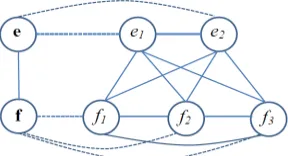
graph represent random variables, and edges define the independence semantics between the random variables. An MRF satisfies the Markov property, which states that a node is independent of all of its non-neighbors, defined by the clique configura-tions of . In modeling a phrase translation pair, we define two types of nodes, (1) two phrase nodes and (2) a set of word nodes, each for a word in the-se phrathe-ses, such as the graph in Figure 1. Let us denote a clique by and the set of variables in that clique by ,. Then, the joint distribution over the random variables in is defined as
(,) =
∏()(,;), (3) where =, … ,||, =, … ,|| and () is the set of cliques in , and each (,;) is a non-negative potential function defined over a
clique that measures the compatibility of the
var-iables in , is a set of parameters that are used within the potential function. in Equation (3), sometimes called the partition function, is a nor-malization constant and is given by
=∑ ∑ ∏ ()(,;) (4)
=∑ ∑ (,),
pres-ence of is one of the major limitations of MRFs because it is generally not feasible to compute due to the exponential number of terms in the summa-tion. However, we notice that is a global con-stant which is independent of and . Therefore, in ranking phrase translation hypotheses, as per-formed by the decoder in SMT systems, we can
drop and simply rank each hypothesis by its
unnormalized joint probability. In our implementa-tion, we only store in the phrase table for each translation pair , its unnormalized probability,
i.e., (,) as defined in Equation (4).
It is common to define MRF potential functions
of the exponential form as ,;=
exp (), where is a real-valued feature function over clique and is the weight of the feature function. In phrase-based SMT systems, the sentence-level translation probability from to is decomposed as the product of a set of phrase translation probabilities. By dropping the phrase segmentation and distortion model components, we have
(|) ≈max
(|,) (5)
(|,) =∏(,)∈(|),
where is the Viterbi derivation. Similarly, the
joint probability (,) can be decomposed as
,≈max
(,,) (6)
,,=∏(,)∈(,)
∝∑,∈log,
∝∑,∈∑∈((,܍))()
=∑,∈∙(,)
which is essentially proportional to a weighted lin-ear combination of a set of features.
To instantiate an MRF model, one needs to de-fine a graph structure representing the translation dependencies between source and target phrases, and a set of potential functions over the cliques of this graph.
2.2 Cliques and Potential Functions
The MRF model studied in this paper is construct-ed from the graph in Figure 1. It contains two types of nodes, including two phrase nodes for the source and target phrases respectively and word nodes, each for a word in these phrases. The cliques and their corresponding potential functions (or features) attempt to abstract the idea behind those translation models that have been proved ef-fective for machine translation in previous work. In this study we focus on three types of cliques.
First, we consider cliques that contain two phrase nodes. A potential function over such a clique captures phrase-to-phrase translation de-pendencies similar to the use the bi-directional translation models in phrase-based SMT systems. The potential is defined as ,=(,), where the feature (,), called the phrase-pair
feature, is an indicator function whose value is 1 if is target phrase and is source phrase, and 0 oth-erwise. While the conditional probabilities in a di-rectional translation model are estimated using rel-ative frequencies of phrase pairs extracted from word-aligned parallel sentences, the parameter of the phrase-pair function is learned discrimina-tively, as we will describe in Section 3.
Second, we consider cliques that contain two word nodes, one in source phrase and the other in target phrase. A potential over such a clique cap-tures word-to-word translation dependencies simi-lar to the use the IBM Model 1 for lexical weighting in phrase-based SMT systems (Koehn et al. 2003). The potential function is defined as
,=(,), where the feature (,),
called the word-pair feature, is an indicator func-tion whose value is 1 if is a word in target phrase
and f is a word in source phrase , and 0 other-wise.
The third type of cliques contains three word nodes. Two of them are in one language and the third in the other language. A potential over such a clique is intended to capture inter-word dependen-Figure 1: A Markov random field model for phrase
[image:3.612.111.255.60.138.2]cies for selecting word translations. The potential function is inspired by the triplet lexicon model (Hasan et al. 2008) which is based on lexicalized triplets (,,’). It can be understood as two source (or target) words triggering one target (or source) word. The potential function is defined as
,,=(,,), where the feature
(,,), called the triplet feature, is an
indica-tor function whose value is 1 if is a word in
tar-get phrase and and ’ are two different words in source phrase , and 0 otherwise.
For any clique that contains nodes in only one
language we assume that = 1 for all setting
of the clique, which has no impact on scoring a phrase pair. One may wish to define a potential over cliques containing a phrase node and word nodes in target language, which could act as a form of target language model. One may also add edges in the graph so as to define potentials that capture more sophisticated translation dependencies. The optimal potential set could vary among different language pairs and depend to a large degree upon the amount and quality of training data. We leave a comprehensive study of features to future work.
3 Training
This section describes the way the parameters of the MRF model are estimated. Although MRFs are by nature generative models, it is not always ap-propriate to train the parameters using convention-al likelihood based approaches mainly for two rea-sons. The first is due to the difficulty in computing the partition function in Equation (4), especially in a task of our scale. The second is due to the metric divergence problem (Morgan et al. 2004). That is, the maximum likelihood estimation is unlikely to be optimal for the evaluation metric under consid-eration, as demonstrated on a variety of tasks in-cluding machine translation (Och 2003) and infor-mation retrieval (Metzler and Croft 2005; Gao et al. 2005). Therefore, we propose a large-scale dis-criminative training approach that uses stochastic gradient ascent and an N-best list based expected BLEU as the objective function.
We cast machine translation as a structured classification task (Liang et al. 2006). It maps an input source sentence to an output pair (,)
where is the output target sentence and the Viterbi derivation of . is assumed to be con-structed during the translation process. In
phrase-based SMT, consists of a segmentation of the source and target sentences into phrases and an alignment between source and target phrases.
We also assume that translations are modeled using a linear model parameterized by a vector . Given a vector (,,) of feature functions on
(,,), and assuming contains a component for each feature, the output pair (,) for a given
input are selected using the argmax decision rule
(∗,∗) =argmax
(,)
(,,) (7)
In phrase-based SMT, computing the argmax ex-actly is intractable, so it is performed approximate-ly by beam decoding.
In a phrase-based SMT system equipped by a MRF-based phrase translation model, the parame-ters we need to learn are = (,), where is a vector of a handful parameters used in the log-linear model of Equation (2), with one weight for
each component model; and is a vector
contain-ing millions of weights, each for one feature func-tion in the MRF model of Equafunc-tion (3). Our meth-od takes three steps to learn :
1. Given a baseline phrase-based SMT system
and a pre-set , we generate for each source
sentence in training data an N-best list of translation hypotheses.
2. We fix , and optimize with respect to an
objective function on training data.
3. We fix , and optimize using MERT (Och
2003) to maximize the BLEU score on de-velopment data.
Now, we describe Steps 1 and 2 in detail.
3.1 N-Best Generation
Given a set of source-target sentence pairs as train-ing data ,,= 1 …, we use the baseline phrase-based SMT system to generate for each
source sentence a list of 100-best candidate
translations, each translation coupled with its Viterbi derivation , according to Equation (7).
We denote the 100-best set by GEN(). Then, each
output pair , is labeled by a sentence-level
BLEU score, denoted by sBLEU, which is
comput-ed according to Equation (8) (He and Deng 2012),
sBLEU(,) = ×
∑ log!
where is the reference translation, and !,= 1 … 4, are precisions of n-grams. While precisions of lower order n-grams, i.e., ! and !, are com-puted directly without any smoothing, matching counts for higher order n-grams could be sparse at the sentence level and need to be smoothed as
!=
#("#$ℎ%&#") +'!
#(&#") +' , for = 3,4
where ' is a smoothing parameter and is set to 5, and ! is the prior value of !, whose value is
computed as !=!/! for = 3 and 4.
in Equation (8) is the sentence-level brevity
penalty, computed as = exp(1 −)
*, which differs from its corpus-level counterpart (Papineni et al. 2002) in two ways. First, we use a
non-clipped , which leads to a better approximation
to the corpus-level BLEU computation because the
per-sentence might effectively exceed unity in
corpus-level BLEU computation, as discussed in Chiang et al. (2008). Second, the ratio between the length of reference sentence r and the length of translation hypothesis c is scaled by a factor ) such that the total length of the references on training data equals that of the 1-best translation hypothe-ses produced by the baseline SMT system. In our
experiments, the value of ) is computed, on the
N-best training data, as the ratio between the total length of the references and that of the 1-best translation hypotheses
In our experiments we find that using sBLEU
defined above leads to a small but consistent im-provement over other variations of sentence-level BLEU proposed previously (e.g., Liang et al. 2006). In particular, the use of the scaling factor )
in computing makes of the baseline’s
1-best output close to perfect on training data, and has an effect of forcing the discriminative training to improve BLEU by improving n-gram precisions rather than by improving brevity penalty.
3.2 Parameter Estimation
We use an N-best list based expected BLEU, a var-iant of that in Rosti et al. (2011), as the objective function for parameter optimization. Given the
cur-rent model , the expected BLEU, denoted by
xBLEU(), over one training sample i.e., a labeled N-best list GEN() generated from a pair of source and target sentences (,), is defined as
xBLEU
=∑∈ (!)|sBLEU(,), (9)
where sBLEU is the sentence-level BLEU, defined
in Equation (8), and | is a normalized
trans-lation probability from to computed using
softmax as
|=
"#$(%&'ી!,) ∑ಶᇲ"#$(%&'ી!,ᇲ)
, (10)
where . is the translation score according
to the current model
,=∙,, (11)
+∑(,)∈∙(,).
The right hand side of (11) contains two terms. The first term is the score produced by the baseline sys-tem, which is fixed during phrase model training. The second term is the translation score produced by the MRF model, which is updated after each training sample during training. Comparing Equa-tions (2) and (11), we can view the MRF model yet another component model under the log linear
model framework with its being set to 1.
Given the objective function, the parameters of the MRF model are optimized using stochastic gradient ascent. As shown in Figure 2, we go through the training set + times, each time is con-sidered an epoch. For each training sample, we up-date the model parameters as
') =&*++,∙-(&*+) (12) where , is the learning rate, and the gradient - is computed as
ሺܟሻ=,xBLEU()
, (13)
1 Initialize , assuming is fixed during training 2 For t = 1…T (T = the total number of iterations)
3 For each training sample (labeled 100-best list)
4 Compute ી| for each translation
hypothe-sis based on the current model = (,)
5 Update the model via =+∙(), where is the learning rate and the gradient computed according to Equations (12) and (13)
=∑(,)U(,)|(,,),
where U(,) = sBLEU,− xBLEU.
Two considerations regarding the development of the training method in Figure 2 are worth men-tioning. They significantly simplify the training procedure without sacrificing much the quality of the trained model. First, we do not include a regu-larization term in the objective function because we find early stopping and cross valuation more ef-fective and simpler to implement. In experiments we produce a MRF model after each epoch, and test its quality on a development set by first com-bining the MRF model with other baseline compo-nent models via MERT and then examining BLEU score on the development set. We performed
train-ing for T epochs (+= 100 in our experiments) and
then pick the model with the best BLEU score on the development set. Second, we do not use the leave-one-out method to generate the N-best lists (Wuebker et al. 2010). Instead, the models used in the baseline SMT system are trained on the same parallel data on which the N-best lists are generat-ed. One may argue that this could lead to over-fitting. For example, comparing to the translations on unseen test data, the generated translation hy-potheses on the training set are of artificially high quality with the derivations containing artificially long phrase pairs. The discrepancy between the translations on training and test sets could hurt the training performance. However, we found in our experiments that the impact of over-fitting on the quality of the trained MRF models is negligible1.
4 Experiments
We conducted our experiments on two Europarl translation tasks, German-to-English (DE-EN) and French-to-English (FR-EN). The data sets are pub-lished for the shared task in NAACL 2006 Work-shop on Statistical Machine Translation (WMT06) (Koehn and Monz 2006).
For DE-EN, the training set contains 751K sen-tence pairs, with 21 words per sensen-tence on average. The official development set used for the shared
1
As pointed out by one of the reviewers, the fact that our training works fine without leave-one-out is probably due to the small phrase length limit (i.e., 4) we used. If a longer phrase limit (e.g., 7) is used the result might be different. We leave it to future work.
task contains 2000 sentences. In our experiments, we used the first 1000 sentences as a development set for MERT training and optimizing parameters for discriminative training, such as learning rate and the number of iterations. We used the rest 1000 sentences as the first test set (TEST1). We used the WMT06 test data as the second test set (TEST2), which contains 2000 sentences.
For FR-EN, the training set contains 688K sen-tence pairs, with 21 words per sensen-tence on average. The development set contains 2000 sentences. We used 2000 sentences from the WMT05 shared task as TEST1, and the 2000 sentences from the WMT06 shared task as TEST2.
Two baseline phrase-based SMT systems, each for one language pair, are developed as follows. These baseline systems are used in our experi-ments both for comparison purpose and for gener-ating N-best lists for discriminative training. First, we performed word alignment on the training set using a hidden Markov model with lexicalized dis-tortion (He 2007), then extracted the phrase table from the word aligned bilingual texts (Koehn et al. 2003). The maximum phrase length is set to four. Other models used in a baseline system include a lexicalized reordering model, word count and phrase count, and a trigram language model trained on the English training data provided by the WMT06 shared task. A fast beam-search phrase-based decoder (Moore and Quirk 2007) is used and the distortion limit is set to four. The decoder is modified so as to output the Viterbi derivation for each translation hypothesis.
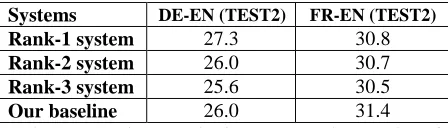
The metric used for evaluation is case insensi-tive BLEU score (Papineni et al. 2002). We also performed a significance test using the paired t-test. Differences are considered statistically signif-icant when the p-value is less than 0.05. Table 1
2
The official results are accessible at
http://www.statmt.org/wmt06/shared-task/results.html
Systems DE-EN (TEST2) FR-EN (TEST2)
Rank-1 system 27.3 30.8
Rank-2 system 26.0 30.7
Rank-3 system 25.6 30.5
[image:6.612.320.544.54.118.2]Our baseline 26.0 31.4
Table 1: Baseline results in BLEU. The results of top ranked systems are reported in Koehn and Monz (2006)2.
presents the baseline results. The performance of our phrase-based SMT systems compares favora-bly to the top-ranked systems, thus providing a fair baseline for our research.
4.1 Results
Table 2 shows the main results measured in BLEU evaluated on TEST1 and TEST2.
Row 1 is the baseline system. Rows 2 to 5 are the systems enhanced by integrating different ver-sions of the MRF-based phrase translation model.
These versions, labeled as MRFf, are trained using
the method described in Section 3, and differ in the feature classes (which are specified by the sub-script f) incorporated in the MRF-based model. In this study we focused on three classes of features, as described in Section 2, phrase-pair features (p), word-pair features (t) and triplet features (tp). The statistics for these features are given in Table 3.
Table 2 shows that all the MRF models lead to a substantial improvement over the baseline system across all test sets, with a statistically significant margin from 0.8 to 1.3 BLEU points. As expected, the best phrase model incorporates all of the three classes of features (MRFp+t+tp in Row 2). We also
find that both MRFp and MRFt, although using
only one class of features, perform quite well. In TEST2 of DE-EN and TEST1 of FR-EN, they are in a near statistical tie with MRFp+t and MRFp+t+tp.
The result suggests that while the MRF models are very effective in modeling phrase translations, the features we used in this study may not fully realize the potential of the modeling technology.
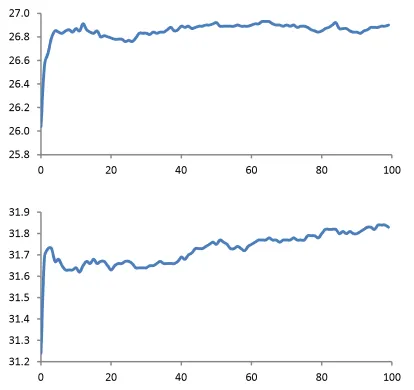
We also measured the sensitivity of the discrim-inative training method to different initializations and training parameters. Results show that our method is very robust. All the MRF models in Ta-ble 2 are trained by setting the initial feature vector to zero, and the learning rate ,=0.01. Figure 3 plots the BLEU score on development sets as a function of the number of epochs t. The BLEU score im-proves quickly in the first 5 epochs, and then either remains flat, as on the DE-EN data, or keeps in-creasing but in a much slower pace, as on the FR-EN data.
4.2 Comparing Objective Functions
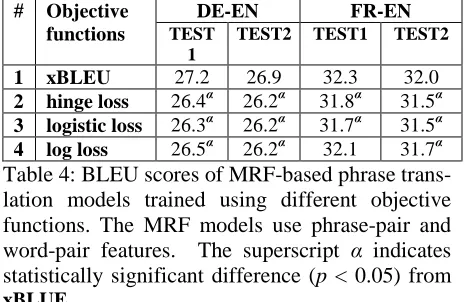
This section compares different objective functions for discriminative training. As shown in Table 4,
xBLEU is compared to three widely used convex loss functions, i.e., hinge loss, logistic loss, and log loss. The hinge loss and logistic loss take into ac-count only two hypotheses among an N-best list
GEN: the one with the best sentence-level BLEU score with respect to its reference translation, de-noted by (∗,∗), called the oracle candidate henceforth, and the highest scored incorrect candi-date according to the current model, denoted by
(,), defined as
# Systems DE-EN FR-EN
TEST1 TEST2 TEST1 TEST2
1 Baseline 26.0 26.0 31.3 31.4
2 MRFp+t+tp 27.3α 27.1α 32.4α 32.2α
3 MRFp+t 27.2α 26.9α 32.3α 32.0α
4 MRFp 26.8αβ 26.7αβ 32.2α 31.8αβ
5 MRFt 26.8αβ 26.8α 32.1α 31.9αβ
Table 2: Main results (BLEU scores) of MRF-based phrase translation models with different feature classes. The superscripts α and β indicate statistically significant difference (p < 0.05) from Baseline and MRFp+t+tp, respectively.
Feature classes # of features (weights)
DE-EN FR-EN
phrase-pair features (p) 2.5M 2.3M
word-pair features (t) 12.2M 9.7M
triplet features (tp) 13.4M 13.8M
Table 3: Statistics of the features used in build-ing MRF-based phrase translation models.
Figure 3: BLEU score on development data (y axis) for DE-EN (top) and FR-EN (bottom) as a function of the number of epochs (x axis).
25.8 26.0 26.2 26.4 26.6 26.8 27.0
0 20 40 60 80 100
31.2 31.3 31.4 31.5 31.6 31.7 31.8 31.9
[image:7.612.328.535.52.247.2] [image:7.612.66.289.54.219.2](,) =
argmax,∈ (!)\{(∗,∗)}-(,,),
where -(. ) is defined in Equation (11). Let
.=,∗,∗−,,. The hinge loss
under the N-best re-ranking framework is defined as max (0,1 −.). It is easy to verify that to train a model using this version of hinge loss, the update rule of Equation (12) can be rewritten as
') =/&*+, if 0=∗
&*++,., $ℎ123 (14)
where 0 is the highest scored candidate in GEN.
Following Shalev-Shwartz (2012), by setting =
1, we reach the Perceptron-based training algo-rithm that has been widely used in previous studies of discriminative training for SMT (e.g., Liang et al. 2006; Simianer et al. 2012).
The logistic loss log(1 + exp(−.)) leads to an update rule similar to that of hinge loss
') =/&*+, if 0=∗
&*++,
(.)., $ℎ12
3
(15)
where ી= 1/(1 + exp(
் )).
The log loss is widely used when a probabilistic interpretation of the trained model is desired, as in conditional random fields (CRFs) (Lafferty et al. 2001). Given a training sample, log loss is defined as log∗|, where ∗ is the oracle translation hypothesis with respect to its reference translation.
∗| is computed as Equation (10). So, unlike
hinge loss and logistic loss, log loss takes into ac-count the distribution over all hypotheses in an N-best list.
The results in Table 4 suggest that the objective functions that take into account the distribution
over all hypotheses in an N-best list (i.e., xBLEU
and log loss) are more effective than the ones that
do not. xBLEU, although it is a non-concave
func-tion, significantly outperforms the others because it is more closely coupled with the evaluation metric under consideration (i.e., BLEU).
5 Related Work
Among the attempts to learning phrase translation probabilities that go beyond pure counting of phrases on word-aligned corpora, Wuebker et al. (2010) and He and Deng (2012) are most related to our work. The former find phrase alignment direct-ly on training data and update the translation prob-abilities based on this alignment. The latter learn phrase translation probabilities discriminatively, which is similar to our approach. But He and Deng’s method involves multiple stages, and is not
straightforward to implement3. Our method differs
from previous work in its use of a MRF model that is simple and easy to understand, and a stochastic gradient ascent based training method that is effi-cient and easy to implement.
A large portion of previous studies on discrimi-native training for SMT either use a handful of fea-tures or use small training sets of a few thousand sentences (e.g., Och 2003; Shen et al. 2004; Watanabe et al. 2007; Duh and Kirchhoff 2008; Chiang et al. 2008; Chiang et al. 2009). Although there is growing interest in large-scale discrimina-tive training (e.g., Liang et al. 2006; Tillmann and Zhang 2006; Blunsom et al. 2008; Hopkins and May 2011; Zhang et al. 2011), only recently does some improvement start to be observed (e.g., Simianer et al. 2012; He and Deng 2012). It still remains uncertain if the improvement is attributed to new features, new training algorithms, objective functions, or simply large amounts of training data. We show empirically the importance of objective functions. Gimple and Smith (2012) also analyze objective functions, but more from a theoretical viewpoint.
The proposed MRF-based translation model is inspired by previous work of applying MRFs for information retrieval (Metzler and Croft 2005), query expansion (Metzler et al. 2007; Gao et al. 2012) and POS tagging (Haghighi and Klein 2006).
3
For comparison, the method of He and Deng (2012) also achieved very similar results to ours using the same experi-mental setting, as described in Section 4.
# Objective functions
DE-EN FR-EN
TEST 1
TEST2 TEST1 TEST2
1 xBLEU 27.2 26.9 32.3 32.0
2 hinge loss 26.4α 26.2α 31.8α 31.5α
3 logistic loss 26.3α 26.2α 31.7α 31.5α
[image:8.612.66.300.56.207.2]4 log loss 26.5α 26.2α 32.1 31.7α
Table 4: BLEU scores of MRF-based phrase trans-lation models trained using different objective functions. The MRF models use phrase-pair and word-pair features. The superscript α indicates statistically significant difference (p < 0.05) from
Another undirected graphical model that has been more widely used for NLP is a CRF (Lafferty et al. 2001). An MRF differs from a CRF in that its par-tition function is no longer observation dependent. As a result, learning an MRF is harder than learn-ing a CRF uslearn-ing maximum likelihood estimation (Haghighi and Klein 2006). Our work provides an alternative learning method that is based on dis-criminative training.
6 Conclusions
The contributions of this paper are two-fold. First, we present a general, statistical framework for modeling phrase translations via MRFs, where dif-ferent features can be incorporated in a unified manner. Second, we demonstrate empirically that the parameters of the MRF model can be learned effectively using a large-scale discriminative train-ing approach which is based on stochastic gradient ascent and an N-best list based expected BLEU as the objective function.
In future work we strive to fully realize the po-tential of the MRF model by developing features that can capture more sophisticated translation de-pendencies that those used in this study. We will also explore the use of MRF-based translation models for translation systems that go beyond sim-ple phrases, such as hierarchical phrase based sys-tems (Chiang 2005) and syntax-based syssys-tems (Galley et al. 2004).
References
Bishop, C. M. 2006. Patten recognition and
ma-chine learning. Springer.
Blunsom, P., Cohn, T., and Osborne, M. 2008. A discriminative latent variable models for statisti-cal machine translation. In ACL-HLT.
Brown, P. F., Della Pietra, S. A., Della Pietra, V. J., and Mercer, R. L. 1993. The mathematics of sta-tistical machine translation: parameter estimation.
Computational Linguistics, 19(2): 263-311.
Chiang, D. 2005. A hierarchical phrase-based model for statistical machine translation. In ACL, pp. 263-270.
Chiang, D., Knight, K., and Wang, W. 2009. 11,001 new features for statistical machine trans-lation. In NAACL-HLT.
Chiang, D., Marton, Y., and Resnik, P. 2008. Online large-margin training of syntactic and structural translation features. In EMNLP.
DeNero, J., Gillick, D., Zhang, J., and Klein, D. 2006. Why generative phrase models underper-form surface heuristics. In Workshop on
Statisti-cal Machine Translation, pp. 31-38.
Duh, K., and Kirchhoff, K. 2008. Beyond log-linear models: boosted minimum error rate train-ing for n-best ranktrain-ing. In ACL.
Galley, M., Hopkins, M., Knight, K., Marcu, D. 2004. What's in a translation rule? In
HLT-NAACL, pp. 273-280.
Gao, J., Xie, S., He, X., and Ali, A. 2012. Learning lexicon models from search logs for query ex-pansion. In EMNLP-CoNLL, pp. 666-676.
Gao, J., Qi, H., Xia, X., and Nie, J-Y. 2005. Linear discriminant model for information retrieval. In
SIGIR, pp. 290-297.
Gimpel, K., and Smith, N. A. 2012. Structured ramp loss minimization for machine translation. In NAACL-HLT.
Haghighi, A., and Klein, D. 2006. Prototype-driven learning for sequence models. In NAACL.
Hasan, S., Ganitkevitch, J., Ney, H., and Andres-Fnerre, J. 2008. Triplet lexicon models for statis-tical machine translation. In EMNLP, pp. 372-381.
He, X. 2007. Using word-dependent transition models in HMM based word alignment for sta-tistical machine translation. In Proc. of the
Se-cond ACL Workshop on Statistical Machine Translation.
He, X., and Deng, L. 2012. Maximum expected bleu training of phrase and lexicon translation models. In ACL, pp. 292-301.
Hopkins, H., and May, J. 2011. Tuning as ranking. In EMNLP.
Koehn, P. 2010. Statistical machine translation.
Cambridge University Press.
Koehn, P., and Monz, C. 2006. Manual and auto-matic evaluation of machine translation between European languages. In Workshop on Statistical
Koehn, P., Och, F., and Marcu, D. 2003. Statistical phrase-based translation. In HLT-NAACL, pp. 127-133.
Lafferty, J., McCallum, A., and Pereira, F. 2001. Conditional random fields: probablistic models for segmenting and labeling sequence data. In
ICML.
Lambert, P., and Banchs, R.E. 2005. Data inferred multi-word expressions for statistical machine translation. In MT Summit X, Phuket, Thailand.
Liang, P., Bouchard-Cote, A. Klein, D., and Taskar, B. 2006. An end-to-end discriminative approach to machine translation. In
COLING-ACL.
Marcu, D., and Wong, W. 2002. A phrase-based, joint probability model for statistical machine translation. In EMNLP.
Metzler, D., and Croft, B. 2005. A markov random field model for term dependencies. In SIGIR, pp. 472-479.
Metzler, D., and Croft, B. 2007. Latent concept expansion using markov random fields. In
SIGIR, pp. 311-318.
Morgan, W., Greiff, W., and Henderson, J. 2004.
Direct maximization of average precision by hill-climbing with a comparison to a maximum entropy approach. Technical report. MITRE.
Moore, R., and Quirk, C. 2007. Faster beam-search
decoding for phrasal statistical machine
translation. In MT Summit XI.
Och, F., and Ney, H. 2004. The alignment template approach to statistical machine translation.
Com-putational Linguistics, 29(1): 19-51.
Och, F. 2003. Minimum error rate training in statistical machine translation. In ACL, pp. 160-167.
Papinein, K., Roukos, S., Ward, T., and Zhu W-J. 2002. BLEU: a method for automatic evaluation of machine translation. In ACL.
Rosti, A-V., Hang, B., Matsoukas, S., and Schwartz, R. S. 2011. Expected BLEU training for graphs: bbn system description for WMT system combination task. In Workshop on
Statistical Machine Translation.
Shalev-Shwartz, Shai. 2012. Online learning and online convex optimization. Foundations and
Trends in Machine Learning, 4(2):107-194.
Shen, L., Sarkar, A., and Och, F. 2004.
Discriminative reranking for machine
translation. In HLT/NAACL.
Simianer, P., Riezler, S., and Dyer, C. 2012. Joint feature selection in distributed stochasic learning for large-scale discriminative training in SMT. In
ACL, pp. 11-21.
Tillmann, C., and Zhang, T. 2006. A
discriminative global training algorithm for statistical MT. In COLING-ACL.
Watanabe, T., Suzuki, J., Tsukada, H., and Isozaki, H. 2007. Online large-margin training for statistical machine translation. In EMNLP.
Wuebker, J., Mauser, A., and Ney, H. 2010. Training phrase translation models with leaving-one-out. In ACL, pp. 475-484.
Zhang, Y., Deng, L., He, X., and Acero, A., 2011. A Novel decision function and the associated
decision-feedback learning for speech