3558
ELI5: Long Form Question Answering
Angela Fan1,2 Yacine Jernite⇤1 Ethan Perez⇤3
David Grangier4 Jason Weston1 Michael Auli1 1Facebook AI Research 2LORIA 3NYU‡ 4Google AI‡
[angelafan,yjernite,jase,michaelauli]@fb.com, [email protected], [email protected]
Abstract
We introduce the first large-scale corpus for long-form question answering, a task requir-ing elaborate and in-depth answers to open-ended questions. The dataset comprises 270K threads from the Reddit forum “Explain Like I’m Five” (ELI5) where an online community provides answers to questions which are com-prehensible by five year olds. Compared to ex-isting datasets, ELI5 comprises diverse ques-tions requiring multi-sentence answers. We provide a large set of web documents to help answer the question. Automatic and human evaluations show that an abstractive model trained with a multi-task objective outper-forms conventional Seq2Seq, language mod-eling, as well as a strong extractive baseline. However, our best model is still far from hu-man perforhu-mance since raters prefer gold re-sponses in over 86% of cases, leaving ample opportunity for future improvement.1
1 Introduction
Existing question answering datasets have enabled significant progress in models that provide ex-tractive or unambigious short answers. However, less attention has been paid to open-ended ques-tions that require explanaques-tions. In this work, we present ELI5: a Long Form Question Answer-ing dataset that emphasizes the dual challenges of isolating relevant information within long source documents and generating paragraph-length ex-planations in response to complex, diverse
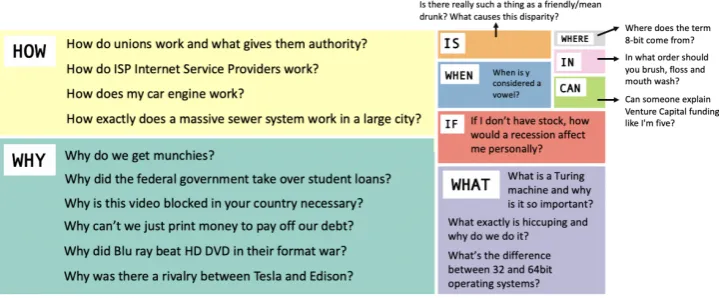
ques-tions (see illustraques-tions in Figures1and 2).
The first challenge of ELI5 is the length and di-versity of answers that span multiple sentences:
⇤Equal contribution
‡Work done while at Facebook AI Research
1Dataset, Pretrained Models, and Additional Informa-tion is available: https://facebookresearch.
github.io/ELI5, https://github.com/
facebookresearch/ELI5
Question: How do Jellyfish function without brains or ner-vous systems? [...] (60 words)
Answer:Jellyfish may not have a brain, but they have a rough nervous system and innate behaviours. However, they are very simple creatures. They’re invertebrate: creatures with-out a backbone. Most jellyfish have really short life spans. Sometimes just a couple of hours. [...] As their name im-plies, they are largely composed of basically jelly inside a thin membrane. They’re over 95% water. (327 words) Documents: [...] Jellyfish do not have brains, and most barely have nervous systems. They have primitive nerve cells that help them orient themselves in the water and sense light and touch. [...] While they dont possess brains, the animals still have neurons that send all sorts of signals throughout their body. [...] They may accomplish this through the as-sistance of their nerve rings. Jellyfish don’t have brains, and that’s just where things begin. They don’t have many of the body parts that are typical in other animals. [...] (1070 words)
Figure 1: ELI5 example. Models must write multi-sentence answers given questions and supporting web documents.
questions are complex and cannot be easily
ad-dressed by a short response (Nguyen et al.,2016)
or by extracting a word or phrase from an evidence
document (Rajpurkar et al.,2016). Answers also
represent one of several valid ways of addressing the query. Many state-of-the-art question answer-ing models perform well compared to human
per-formance for extractive answer selection (Radford
et al., 2018;Devlin et al., 2018). However, their success does not directly carry over to our setting. The second challenge is the length and diversity of the content from knowledge sources required to answer our questions. We leverage evidence queried from the web for each question. In con-trast to previous datasets where the human written answer could be found with lexical overlap
meth-ods (Weissenborn et al.,2017), ELI5 poses a
knowl-Figure 2: ELI5 questions by starting word, where box size represents frequency. Questions are open ended and diverse.
edge such as TriviaQA (Joshi et al., 2017), their
answers are still short.
We benchmark the performance of several ex-tractive, retrieval, and generative models. Evalua-tion of our task, and of multi-sentence text genera-tion in general, is challenging. We draw upon sev-eral evaluation metrics that quantify performance on intermediary fill-in tasks that lead up to the full answer generation. The overall answer generation
quality is measured with ROUGE (Lin,2004) and
various human evaluation studies.
We develop a strong abstractive baseline by training a Seq2Seq model on multiple tasks over the same data: language modeling, masked word
prediction (Devlin et al.,2018) and answer
genera-tion. We show this approach outperforms conven-tional Seq2Seq and language modeling, as well as
a strong extractive baseline based on BidAF (Seo
et al.,2017) but generalized to multi-sentence out-put. However, our best-performing model is still far from the quality of human written answers, with raters preferring the gold answers 86% of the time. Further, we show that model performance is strongly limited by the ability to comprehend long multi-document input and generate long out-puts to form a comprehensive answer, leaving this challenge for future research.
2 Related Work
Various QA datasets have been proposed in roughly two categories: extractive answers and
short abstractive answers (see Table1).
Extractive QA Extractive question
an-swering datasets such as TREC (Voorhees,
2003), SQuAD (Rajpurkar et al., 2016, 2018),
NewsQA (Trischler et al.,2017), SearchQA (Dunn
et al., 2017), and QuAC (Choi et al.,2018)
con-strain the answer to a word or short phrase from the input and evaluate using exact match or F1
with the ground truth span. HotpotQA (Yang
et al., 2018) extends this approach by building questions which challenge models to conduct multi-hop reasoning across multiple paragraphs, but the answer is still a short span. Further, the answer must be straightforward, as it needs to be copied from the supporting evidence — precluding most “how” or “why” type questions.
Abstractive QA Abstractive datasets include
NarrativeQA (Kocisky et al., 2018), a dataset of
movie and book summaries and CoQA (Reddy
et al., 2018), a multi-domain dialogue dataset. Both collect responses with crowdworkers and find that written answers are mostly extractive
and short. MS MARCO (Nguyen et al., 2016),
a dataset of crowdsourced responses to Bing queries, has written answers around 1 sentence
long with short input passages. TriviaQA (Joshi
et al.,2017) contains longer multi-document web input, collected using Bing and Wikipedia. As the dataset is built from trivia, most questions can be answered with a short extractive span.
Multi-document summarization The ELI5 task of writing a paragraph length response from multiple supporting documents can be seen as a form of query-based multi-document
summarization (Tombros and Sanderson, 1998).
Summarization tasks such as DUC 20042involve
long input and multi-sentence generation, but contain much less training data compared to
ELI5. WikiSum (Liu et al., 2018) proposes
writing Wikipedia articles as a multi-document summarization task. ELI5 requires more directed
[image:2.595.119.479.64.213.2]Dataset Average # of Words 1st Question Word Frequency (%)
Question Document(s) Answer Why How What When Where Who Which OTHER # Q-A Pairs ELI5 42.2 857.6 (212K) 130.6 44.8 27.1 18.3 11.3 2.0 1.8 0.8 6.1 272K MS MARCO v2(Nguyen et al.,2016) 6.4 56 13.8 1.7 16.8 35.0 2.7 3.5 3.3 1.8 35.3 183K TriviaQA(Joshi et al.,2017) 14 2895 2.0 0.2 3.9 32.6 2.0 2.1 16.8 41.8 0.6 110K NarrativeQA(Kocisky et al.,2018) 9.8 656 4.7 9.8 10.7 38.0 1.7 7.5 23.4 2.2 6.8 47K
CoQA(Reddy et al.,2018) 5.5 271 2.7 2 5 27 2 5 15 1 43 127K SQuAD (2.0)(Rajpurkar et al.,2018) 9.9 116.6 3.2 1.4 8.9 45.3 6.0 3.6 9.6 4.4 17.6 150K HotpotQA(Yang et al.,2018) 17.8 917 2.2 0.1 2.6 37.2 2.8 2.2 13.8 28.5 12.8 113K
Table 1: Comparing large-scale QA datasets. ELI5 has answers an order of magnitude longer and more open-ended questions.
text generation to answer a question, rather than to write about a general topic. In addition, ELI5 contains a diverse set of questions which can involve more than one Wikipedia concept.
3 Making a Long Form QA Dataset
3.1 Creating the Dataset from ELI5
There are several websites which provide forums to ask open-ended questions such as Yahoo An-swers, Quora, as well as numerous Reddit forums,
or subreddits. We focus on the subredditExplain
Like I’m Five(ELI5) where users are encouraged to provide answers which are comprehensible by a
five year old.3 ELI5 is appealing because answers
are supposed to be entirely self contained, and thus rely less on pre-existing knowledge of the world and use simpler language that is easier to model.
Questions and answers. We select a set of ques-tions and answers from the ELI5 forum up to July 2018 and then filter it based on how users rated these pairs. First, we only retain questions which have a score of at least two, that is two more ‘up-votes’ than ‘down-‘up-votes’. Second, there must be at least one answer with a score of at least two. This yields a final number of 272K questions, and en-sures that at least one person other than the author has read the thread and deemed it appropriate. For each thread, we select the answer with the high-est voting score as the reference. Note that 63% have one or more other valid answers by our up-vote criteria, potentially doubling the size of the available training data.
Preparing supporting information. Next, we collect web sources for every question to pro-vide relevant information that a system can draw upon when generating an answer. Wikipedia has been found effective for factoid-oriented questions (Joshi et al., 2017;Chen et al.,2017). However,
3https://www.reddit.com/r/
explainlikeimfive
early experiments in our setting showed it to be in-sufficient to cover the wide range of topics present in ELI5 and to address the open-ended nature of the questions. Instead, we use web data
pro-vided by Common Crawl.4 Specifically, we
con-sider each of the individual pages in the July 2018 archive (roughly one per URL) as a single
docu-ment. The data is tokenized with Spacy5 and we
select English documents with FastText language
identification (Bojanowski et al., 2017). Finally,
we index the data with Apache Lucene.6
Creating support documents. We query the in-dex for the 272K questions and gather the 100
most relevant web sourcesfor each question,
ex-cluding Reddit. Eachweb source is the extracted
text of one page in Common Crawl. This leads to supporting text for each question of a few hundred thousand words. There is a good chance that the supporting text contains the necessary information to answer the question, but the sheer amount of data is far beyond the scope of what many mod-ern models can handle. We therefore filter the 100 web sources by selecting specific passages using a simple heuristic: we split each web source into sentences, find sentences with the highest TFIDF similarity with respect to the question, add some local context for each of these, and concatenate
the result into a single support document, with
special tokens indicating non-contiguous passages
and document shifts. Each support document is
the result of this processing to concatenate rele-vant information from the web sources.
We find that extracting 15 passages with a con-text of one sentence before and after the initial se-lection provides the best trade-off between support document length and likelihood of containing rel-evant information, where relevance is measured as the likelihood of containing a sentence which has
4http://commoncrawl.org
5https://spacy.io
% Correct Human Answers 94.5 % Correct Human Answers with Explanation 90.2
% Support Document contains Answer 65.0 % Support Document contains Relevant Info 92.0
Table 2: Annotated subset of ELI5 to assess answerability.
high ROUGE with the answer. We release all 100 Common Crawl IDs for each question and a script to create the support document so future research can use the support document or choose to further investigate the information retrieval problem.
Finalizing the data set. If the training data con-tains questions that are too similar to the valida-tion and test data, a model may perform well on these examples by memorizing related examples. We prevent this by building the validation and test set to contain questions that are sufficiently differ-ent from the training data. We compute the TFIDF similarity between each pair of questions in the entire dataset and sample the validation and test set from the subset which has no close neighbor by TFIDF score. The final dataset contains 237K train examples, 10K for valid, and 25K for test.
3.2 Dataset Analysis
Table1compares ELI5 to related datasets in terms
of the length of the question, support document, answer, as well as statistics on the question types. First, ELI5 questions are much longer than in other datasets. This is because the initial question is often followed by a clarifying paragraph detail-ing what aspect of the general theme should be addressed or the question’s starting assumptions, which need to be considered to answer well. To get a rough idea of the different questions, we cat-egorize them based on interrogative words. ELI5 focuses on open-ended queries which are less rep-resented in other extractive or abstractive datasets.
Figure2 shows examples of ELI5 questions split
by type and Appendix Figure11displays random
examples from the ELI5 training set. Interestingly,
even What questions tend to require
paragraph-length explanations (What is the difference. . .).
Support documents contain 22-60 sentences or
on average 858 words, which puts ELI5 on the
higher end of published datasets for document length. ELI5 contains long-form answers with an
average length of6.6sentences, or130words.
Next, we analyze a random subset of ELI5 to assess the feasability of answering the questions
in the dataset. We judge if the question is answer-able by reading each question, the gold answer, and the support document we have created with TF-IDF extraction. Note that questions can have multiple parts and all parts of the question must be answered. We sample 500 randomly question-answer pairs from the training set and find that 94.5% of gold answers fully address the question
(Table2) based on the information in the support
document. Figure12in Appendix Fdisplays
ex-amples of human answers that do not correctly an-swer the question. A small proportion of anan-swers are correct but do not explain the answer. On the support document side, 65% of the support docu-ments we construct provide the answer to the ques-tion, and 92% of support documents provide infor-mation relevant to the question.
4 Evaluation Methods
Evaluating long-form answers. There are sev-eral aspects to quality: answers should be topi-cal and accurate, fluent, and coherent from start to end. We judge the accuracy aspect by comparing
to the gold answer. ROUGE (Lin,2004) measures
similarity between a model output and one or sev-eral references, and is often used in summariza-tion. While our task presents different challenges, such as the diversity of possible answers to a ques-tion, we still find the corpus-level metric to be
use-ful to rank different related models (§6). We report
F1 for ROUGE-1, ROUGE-2, and ROUGE-L.
Extractive:But none of these hypotheses make much sense for a jellyfish because they do nt have brains at all. They just have a nerve net — a loose ring of neurons that runs around the rim of their pulsating bells. They have an unusual nervous system, because jellyfish are not bilaterally symmetrical — that is, they dont have a left side and a right side. Jellyfish don’t have brains, but their nervous systems detect smells, light and other stimuli, and they coordinate their physical responses.
Language Model:They don’t have brains. They have a nervous system. They do not have a brain. They are not conscious. They can not move. They move. Their nervous system is not a muscle. They use their muscles to move. The nervous system does not have any nerves. They just have a nerve. They also have a muscle that is very similar to a muscle in that it is very much like a muscle, but instead of a muscle it is a muscle and it is like a nerve, but it is not muscle. The nerve is like the muscle, it is just a muscle but it has a nerve and it has nerves. The nerves are like the muscles, but they have nerves.
Multi-task Seq2Seq: Jellyfish don’t have brains. Jellyfish have a nervous system. They know how to swim, they don’t even know what to do with their bodies. They have a “nervous system”, which is basically a bunch of nerve cells that connect to the body. The nervous system is made up of neurons, neurons, nerves, etc. Each neuron doesn’t have a specific set of “neurons”, it just has a different set of nerves. It has a set of sensory neurons, which are all connected to each other. It just knows that it does react to the stimulus, and it knows that the stimulus is there. They have a bunch of nervous systems that act like a filter to get information back.
Figure 3: Example answers from the extractive BidAF model, Question + Document + Answer language model, and Multi-task Seq2Seq model for the question “How do Jellyfish function without brains or nervous systems?” (cf. Figure1).
Human evaluation. We use crowdworkers to conduct three assessments. First, evaluators rate thefluencyof human and model generated answers on a 5-point Likert Scale, from “very poorly writ-ten” to “easily readable” (500 evaluations). Sec-ond, evaluators are given question-answer pairs
and are asked if the answer iscorrect (500
eval-uations) 7. We also evaluated a smaller subset
ourselves while additionally looking at the support documents (100 evaluations) to assess answer ac-curacy. Lastly, crowdworkers are given the ques-tion and answers from two models and asked to
decide which answer theyprefer while
consider-ing readability and accuracy (1000 evaluations). Each crowdworker assessment is made by 3 dif-ferent evaluators. The same questions are used for all models and must be at least 5 words long.
5 Models
5.1 Extractive and Retrieval Models
Retrieval baseline and oracle. We report ROUGE for a retrieval system that returns the answer of the closest question in the training set. Specifically, we perform a nearest
neigh-bor search (Johnson et al., 2017) over the
aver-age word embeddings of the question usingFAST
-TEXT(Bojanowski et al.,2017). We also compute
an approximate oracle score for extractive systems by using the reference answer to select similar sen-tences from the support document to maximize ROUGE. Computing ROUGE between the ref-erence and all sets of sentences from the source
7We experimented with a variant where crowdworkers were allowed to select a thirdI don’t knowoption, but found it was used only around 8% of the time.
is intractable. Instead, we perform a beam search that adds sentences maximizing TFIDF with re-spect to the answer. The final beam is re-ranked using ROUGE with respect to the reference an-swer. We run this algorithm on our support doc-ument and on the full set of web sources for each validation and test question, selecting up to 10 sen-tences with a beam of size 10.
Extractive models. The first baseline we
ex-plore simply returns the7sentences from the
sup-port document which have the highest TFIDF sim-ilarity with the question. We also evaluate mod-els which score sentences from the support doc-ument based on the question and return the high-est scoring sentences in their original order (the number is tuned on the validation set to maximize
ROUGE). We train a model based on BidAF (Seo
et al.,2017). We create an extractive training set
by finding the span of up to5contiguous sentences
in the support document which have the highest ROUGE with respect to the reference answer, and sub-sample other support document sentences so
that the final training document is shorter than400
words. We then train a BidAF model to predict the extracted span in the sub-sampled support docu-ment based on the question. For test, we compute the span score for each individual sentence, and
return the5with the highest score as it performed
best compared to returning 3 or 7 sentences.
5.2 Abstractive Models
Language and Seq2Seq models. We train sev-eral models based on the Transformer
architec-ture (Vaswani et al., 2017), both in its language
con-Model PPL ROUGE
1 2 L
Support Document - 16.8 2.3 10.2
Nearest Neighbor - 16.7 2.3 12.5
Extractive (TFIDF) - 20.6 2.9 17.0
Extractive (BidAF) - 23.5 3.1 17.5
Oracle support doc - 27.4 2.8 19.9
Oracle web sources - 54.8 8.6 40.3
LM Q + A 42.2 27.8 4.7 23.1
LM Q + D + A 33.9 26.4 4.0 20.5
Seq2Seq Q to A 52.9 28.3 5.1 22.7
Seq2Seq Q + D to A 55.1 28.3 5.1 22.8
[image:6.595.82.280.63.211.2]Seq2Seq Multi-task 32.7 28.9 5.4 23.1
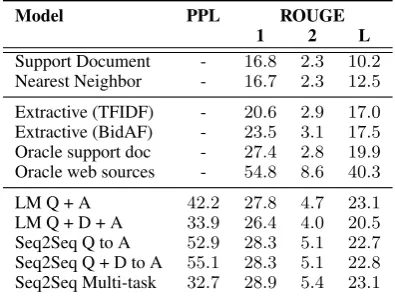
Table 3: Comparison of oracles, baselines, retrieval, extrac-tive, and abstractive models on the full proposed answers.
Model FILL-1 acc. ROUGE-20%
N V A 1 2 L
LM Q + A 31.0 29.6 20.6 26.5 7.0 21.1 LM Q + D + A 30.9 28.9 19.9 26.3 7.8 21.3 S2S Q to A 21.7 23.0 15.5 33.6 11.5 29.5 S2S Q + D to A 27.6 26.3 19.4 32.7 10.7 28.6 S2S Multi-task 27.9 26.7 19.9 37.2 14.6 33.0
Table 4: Intermediary fill-in tasks for sequential generation.
figurations. To investigate how much information from the document the model uses, we train a
lan-guage model on the concatenation of Question,
Support Document, and Answer (Q + D + A) as
well as on theQuestionandAnswer(Q + A).
Sim-ilarly, one Seq2Seq configuration goes from Q to A, and the other from Q + D to A. In all cases, Q, D, and A are separated by special tokens.
Multi-task training. Language models are trained to predict all tokens in the question, web source, and answer. However, the standard Seq2Seq model only receives training signal from predicting the answer which is much less than the language model gets. This can contribute to learning poor quality representations compared to language models. To address this, we train a multi-task Seq2Seq model: during training, we multi-task between several generation tasks, including language modeling of Q + D + A by the decoder and variations of source/target pairs (see
AppendixA). We add a masked word prediction
task (Devlin et al.,2018) where 15% of tokens in
the input are masked and must be recovered by the model in the correct order, and append a marker at the start of each sequence to indicate the task.
Data processing. To reduce the vocabulary, we
apply byte-pair encoding (Sennrich et al., 2016)
to generate 40K codes which are applied to all datasets. We model a vocabulary of 52,863 to-kens for answer generation. We use the
Trans-former implementation of fairseq-py (Gehring
et al.,2017) and train with the big architecture
fol-lowing the details in (Vaswani et al.,2017). Given
our data length, we train with a large batch size by delaying gradient updates until a sufficient number
of examples have been seen (Ott et al.,2018).
Generation. We generate from abstractive mod-els using beam search with beam 5. We disal-low repeated trigrams to prevent repetition, a tech-nique commonly used in multi-sentence
summa-rization (Paulus et al.,2017;Fan et al.,2018). For
the full answer generation task, we tune a mini-mum and maximini-mum length for generation on the valid set and apply these settings to the test set.
6 Results
6.1 Overview of Model Performance
Full answer ROUGE. Table 3 shows that the nearest neighbor baseline performs similarly to simply returning the support document which in-dicates that memorizing answers from the train-ing set is insufficient. For extractive models, the oracle provides an approximate upper bound
of 27.4 ROUGE-1. The BidAF model is the
strongest (23.5), better than TFIDF between the
question and the support document to select sen-tences. However, these approaches are limited by the support document, as an oracle computed on
the full web sources achieves54.8.
Abstractive methods achieve higher ROUGE, likely because they can adapt to the domain shift between the web sources and the ELI5 subreddit. In general, Seq2Seq models perform better than language models and the various Seq2Seq settings
do not show large ROUGE differences. Figure3
shows an example of generation for the language model and the best Seq2Seq and extractive settings
(see AppendixFfor additional random examples).
Perplexity and fill-in tasks. Tables 3 and 4
present metrics specific to sequential generation models: perplexity of the answer, accuracy of the model’s FILL-1 word prediction for Nouns, Verbs, and Adjectives, and ROUGE of the
con-ditional generation of the last20%answer words.
Figure 4: Human evaluation of answer fluency and accuracy — with and without access to supporting evidence documents
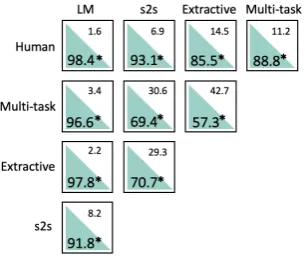
Figure 5: Human preferences for pairwise comparisons. The better model’s % preference is bolded. * indicates statistical significance.
is required to predict at training time. The multi-task Seq2Seq experiment, in which the Seq2Seq decoder is trained to predict the question and the document, in addition to the answer, can reach the same perplexity as the language model. ROUGE-20% shows a much starker contrast between lan-guage modeling and Seq2Seq, as well as between standard Seq2Seq and multi-task training. The
lat-ter achieves strong performance of37.2
ROUGE-1. However, both versions of the language model are still better at FILL-1. These results suggest that the Seq2Seq model is better than the language model in maintaining coherence and that Seq2Seq relies on information over many time steps.
Human evaluation. Human answers are rated
highest in terms of fluency (Figure4, left). The
ex-tractive model outputs human-written text which is likely fluent but with the failure mode of con-catenating unrelated sentences. The multi-task model performs similarly to the extractive model which indicates that abstractive methods can gen-erate coherent answers. The language model and standard Seq2Seq trail behind.
To get a sense of the stability of our results, we analyzed the standard deviation of three indepen-dent fluency trials conducted on separate days and
we find low variation (Appendix E, Figure 10).
We also measure agreement between
crowdwork-ers in selecting positive (scores 4 and 5), negative (1 and 2), or neutral (3) choices on the 5-point Likert scale, and find that 2 crowdworkers agree
almost 100% of the time (AppendixE, Figure10).
In answer accuracy (Figure4, middle), there is
a large gap between human performance and all models. The language model is almost never accu-rate, while the extractive model is slightly more so than the multi-task model. Crowdworkers assess-ing accuracy do not have the support document. We evaluate accuracy ourselves with the support
document in Figure 4, right. Similar to
crowd-workers, we find 40% of extractive answers to be accurate. We find only 19% of multi-task model answers are fully accurate; even if the model out-put answers the question, it can generate a sen-tence with an incorrect statement. In contrast, the extractive model copies sentences from human-written text. However, the multi-task model is bet-ter at generating relevant answers (84% relevancy compared to 68% for extractive), as the extractive model is constrained by the support document.
Figure 5 presents pairwise preference
judg-ments of human annotators shown answers from two of the five systems. The reference answer is preferred over the output of all of our trained
mod-els in at least 85.5%of cases, indicating there is
substantial room for improvement. The multi-task abstractive setting comes next, closely followed by
the extractive (multi-task is only preferred in57%
of comparisons), then the standard Seq2Seq and finally the language model, considered worse than
any other setting in at least91%of cases.
We use a two-tailed binomial test to test statis-tical significance of the pairwise judgments and it shows that all judgments are statistically signifi-cant atp= 0.05.
Figure 6: Attention over the question and supporting evidence for the Multi-task Seq2Seq model and Question + Document + Answer language model. Attention is shown for the first word of answer generation.
future work to report full ROUGE and ROUGE-20%. Perplexity and FILL-1 focus on local prediction and are poor indicators of overall appropriateness for the full task. Full answer ROUGE discriminates reasonably well between models with the same general architecture, but cannot rate an abstractive system against an
extractive one. The ROUGE-20% measure
abstracts away some variability and focuses on coherence between the beginning and end of an answer. This metric correlates with human judgments of quality but can only be reported for sequential generation.
Analysis of extractive, LM and Seq2Seq models. Language models perform better than Seq2Seq in terms of perplexity and FILL-1, while being significantly worse at ROUGE-20% and human evaluations. To investigate this, we visu-alize the attention mechanism at the start of
an-swer generation in Figure 6. The attention of
the language model is strongly focused on nearby context when generating the first word of the an-swer, whereas the multi-task Seq2Seq model at-tends more evenly to relevant information in the question and the document. This validates our as-sumption that the language model’s focus on local context is insufficient for high quality answers.
In Figure7(left), we further investigate how the
relevance and quality of the support document ex-traction step affects the answers provided by the extractive and abstractive setting. The ROUGE score is displayed for data subsets, partitioned by percentile of word overlap of the answer with the support document (e.g. how many answer words appear). While both models perform better for documents with higher ROUGE overlap between support document and human answer, the abstrac-tive setting is much better at compensating for when the support document has lower relevance.
[image:8.595.306.524.181.249.2]Data size and initial selection. There is a large difference between the extractive oracle ROUGE using our support document and the oracle on full
Figure 7: (left) Model score by document-answer similarity. (right) Seq2Seq multi-task score by amount of training data.
Figure 8: (left) TFIDF rank of source passage for oracle sen-tences. (right) Highest rank used per question.
web sources. This suggests that the initial selec-tion of our support document severely limits ac-cess to relevant information. To assess the impact of support document size, we re-run the selection
step for1000examples to extract500passages
in-stead of20, and run the oracle on these new inputs.
Figure 8 shows the TFIDF rank of the passages
from which sentences are selected. While slightly more sentences are extracted from the higher
rank-ing passages, less than9%come from the first20,
and most oracles have at least one sentence from
the last100. For a model to perform best, it would
have to handle inputs tens of thousands of words
long. In Table 3, we show an oracle computed
on the full web sources has much higher ROUGE than an oracle computed on the support document. We analyze the impact of data size on
perfor-mance in Figure7. We train the multi-task model
on 25%, 50%, and 75%, and the all of the data to compare performance. ROUGE increases as a function of the data used and even though ELI5 is
one of the larger QA datasets (§3), this shows that
[image:8.595.309.523.292.356.2]Combining challenges. Our task blends the inter-dependent challenges of retrieving informa-tion, reasoning, and writing long outputs. Study-ing each of these aspects in context is particularly important. For example, we show that the abstrac-tive model’s ability to compensate for a (realisti-cally) imperfect support document is essential to its relative success over extractive methods. The fluency gap between the reference and the extrac-tive system in human evaluation also suggests that the latter may require sequential decision capabil-ities. This kind of decision making is necessary to address the dual challenges of reasoning over sev-eral supporting facts and generating long coherent outputs. We see our task’s need to combine com-plementary systems as critical to gaining insights into their individual behaviors.
7 Conclusion
We introduce the first large-scale long form ques-tion answering dataset of open-ended queries with explanatory multi-sentence answers. We show that abstractive models generate coherent answers and are competitive with extractive models in hu-man evaluation. Proposed models are far from human performance, in part due to the inability to exploit the long full web text. We hope ELI5 will inspire future work in all aspects of long-form QA, from the information extraction problem of obtaining information from long, multi-document input to generating more coherent and accurate paragraph-length answers.
References
Piotr Bojanowski, Edouard Grave, Armand Joulin, and Tomas Mikolov. 2017. Enriching word vectors with subword information. TACL, 5:135–146.
Danqi Chen, Adam Fisch, Jason Weston, and Antoine Bordes. 2017. Reading wikipedia to answer open-domain questions. InACL.
Eunsol Choi, He He, Mohit Iyyer, Mark Yatskar, Wen tau Yih, Yejin Choi, Percy Liang, and Luke Zettle-moyer. 2018. Quac: Question answering in context.
InEMNLP.
Jacob Devlin, Ming-Wei Chang, Kenton Lee, and Kristina Toutanova. 2018. Bert: Pre-training of deep bidirectional transformers for language understand-ing. CoRR, abs/1810.04805.
Matthew Dunn, Levent Sagun, Mike Higgins, V. Ugur G¨uney, Volkan Cirik, and Kyunghyun Cho. 2017. Searchqa: A new q&a dataset augmented with con-text from a search engine.CoRR, abs/1704.05179.
Angela Fan, David Grangier, and Michael Auli. 2018. Controllable abstractive summarization. In ACL Workshop on Neural Machine Translation and Gen-eration.
Jonas Gehring, Michael Auli, David Grangier, Denis Yarats, and Yann N Dauphin. 2017. Convolutional Sequence to Sequence Learning. InProc. of ICML.
Jeff Johnson, Matthijs Douze, and Herv´e J´egou. 2017. Billion-scale similarity search with gpus. CoRR, abs/1702.08734.
Mandar Joshi, Eunsol Choi, Daniel Weld, and Luke Zettlemoyer. 2017. Triviaqa: A large scale distantly supervised challenge dataset for reading comprehen-sion. InACL.
Tomas Kocisky, Jonathan Schwarz, Phil Blunsom, Chris Dyer, Karl Moritz Hermann, Gabor Melis, and Edward Grefenstette. 2018. The narrativeqa reading comprehension challenge.TACL.
Chin-Yew Lin. 2004. Rouge: a package for automatic evaluation of summaries. InACL Workshop on Text
Summarization Branches Out.
Peter J. Liu, Mohammad Saleh, Etienne Pot, Ben Goodrich, Ryan Sepassi, Lukasz Kaiser, and Noam Shazeer. 2018. Generating wikipedia by summariz-ing long sequences. InICLR.
Tri Nguyen, Mir Rosenberg, Xia Song, Jianfeng Gao, Saurabh Tiwary, Rangan Majumder, and Li Deng. 2016.Ms marco: A human generated machine read-ing comprehension dataset.CoRR.
Myle Ott, Sergey Edunov, David Grangier, and Michael Auli. 2018. Scaling neural machine trans-lation. InWMT, pages 1–9. Association for Compu-tational Linguistics.
Romain Paulus, Caiming Xiong, and Richard Socher. 2017. A deep reinforced model for abstractive sum-marization.arXiv preprint arXiv:1705.04304.
Alec Radford, Karthik Narasimhan, Tim Salimans, and Ilya Sutskever. 2018. Improving language under-standing by generative pre-training.
Pranav Rajpurkar, Robin Jia, and Percy Liang. 2018. Know what you don’t know: Unanswerable ques-tions for squad. InACL.
Pranav Rajpurkar, Jian Zhang, Konstantin Lopyrev, and Percy Liang. 2016. Squad: 100,000+ questions for machine comprehension of text. InEMNLP.
Rico Sennrich, Barry Haddow, and Alexandra Birch. 2016. Neural machine translation of rare words with subword units. InACL.
Minjoon Seo, Aniruddha Kembhavi, Ali Farhadi, and Hannaneh Hajishirzi. 2017. Bidirectional attention flow for machine comprehension. InICLR.
Anastasios Tombros and Mark Sanderson. 1998. Ad-vantages of query biased summaries in information retrieval. InSIGIR.
Adam Trischler, Tong Wang, Xingdi Yuan, Justin Har-ris, Alessandro Sordoni, Philip Bachman, and Ka-heer Suleman. 2017. Newsqa: A machine compre-hension dataset. In ACL Workshop on Representa-tion Learning for NLP.
Ashish Vaswani, Noam Shazeer, Niki Parmar, Jakob Uszkoreit, Llion Jones, Aidan N Gomez, Łukasz Kaiser, and Illia Polosukhin. 2017. Attention is all you need.NIPS.
Ellen M. Voorhees. 2003. Overview of the TREC 2003 question answering track. InTREC.
Dirk Weissenborn, Georg Wiese, and Laura Seiffe. 2017. Making neural qa as simple as possible but not simpler. InCoNLL.