Abstract— The number of African families living in extreme poverty has continued to increase even though the proportion of the citizens in such situation in this region declined in recent years. This is traceable to unemployment, underemployment, and income inequalities that have generated social unrest as joblessness persist. However, entrepreneurship through small and medium-scale enterprises (SMEs) has the capacity to drive economic growth and national development through job creation, income empowerment, and poverty eradication. Roadside vulcanizing business in towns and cities of Africa is a viable job that can be run by any age group and it requires no formal training or long apprenticeship to develop expertise. Unfortunately, the cost of running the fossil fuel-powered vulcanizing machine will leave the technician with little or no profit due to the recent fuel subsidy removal by some countries like Nigeria. In addition, overdependence on fossil fuel as a primary source of energy promotes the negative effects of carbon dioxide and other global warming emissions on environment, climate, and public health. In this paper, considering the abundant solar energy potential across all the Sub-Saharan countries, we designed and constructed a solar photovoltaic vulcanizing machine as a practical means of eradicating extreme poverty in line with the 2030 Sustainable Development Goals (SDGs) agenda. The implementation of this project will create employment opportunities for millions of Africans, reduce social violence and crime, provide affordable and clean energy, and save our planet.
Index Terms—poverty eradication, renewable energy, solar photovoltaic, sustainable development, vulcanizing machine.
I. INTRODUCTION
THOUGH the percentage of African population in extreme poverty declined from 57 percent in 1990 to 43 percent in 2012, the number of people living in extreme poverty still increases by more than 100 million due to continuous rapid population growth [1, 2]. In addition, it is projected that the extreme poor in the world will be increasingly concentrated in Africa [3]. Paradoxically,
Manuscript received July 15, 2016; revised August 8, 2016
V. O. Matthews, A. A. Atayero, and S. I. Popoola are with the Department of Electrical and Information Engineering, Covenant University, Ota, Nigeria (corresponding author’s phone contact: +234-802-329-4903; e-mail: [email protected]).
African families in countries with abundant natural resources currently experience lower performance in all human welfare indicators controlling for their income level [1]. Not surprising, all developing regions have successfully reduced the number of citizens living in poverty by half in line with the Millennium Development Goal (MDG) except Africa [4]. Therefore, there is a global attention on Africa with a view of eradicating extreme poverty for all the citizens measured as people living on less than $1.25 a day in line with the new sustainable development agenda [5, 6].
In addition, the global economic crisis that began in 2008 has widened the employment and social gaps, further worsening the challenges of unemployment and underemployment in most developing economies. Meanwhile, the group of people that are directly affected with this situation are mostly youth, despite the trend improvement in educational attainment, thereby fuelling social discontent. In sub-Saharan Africa, underemployment and informal employment may become increasingly high over the next five years [7]. Consequently, drastic fall in income inequalities, accompanied with declining incomes, will lead to social unrest if joblessness persists [8-12].
Entrepreneurship has the potential of driving economic growth and development through job creation, income empowerment, and poverty reduction in an economy [13, 14]. One of the readily available small and medium-sized enterprises (SMEs) in Africa is roadside tyre vulcanizing. A vulcanizer is one that pumps deflated tyres by the roadside. In urban centers of Nigeria, the average daily income of a vulcanizer is ₦ 3 000 (about $ 10 a day). This work is a business that can be run by any age group (say 16 years upward). Interestingly, it requires no formal training nor special experience to start up. Two weeks apprenticeship under an experienced vulcanizer is sufficient to learn how to work on vehicle tyres. In addition, there is no need to rent a shop space/room; the technician stays by the major roadside, waiting for his/her customers, especially in cases of emergency.
Development of a Solar Photovoltaic
Vulcanizing Machine towards Extreme Poverty
Eradication in Africa
Victor O. Matthews, Aderemi A. Atayero, Member,IAENG, Segun I. Popoola, Member, IAENG
However, the cost of running the fossil fuel-powered vulcanizing machine will leave the technician with little or no profit due to the recent fuel subsidy removal by the Federal Government of Nigeria [15-17]. Unavailability and hike in price of the petroleum commodity will definitely hamper the business. Also, the use of fossil fuel is dangerous to the health of the operator and the society as it contributes to greenhouse emission (carbon footprint). Therefore, a sustainable means of powering the business must be designed and implemented as a way to ending poverty, protecting the planet, and ensuring prosperity for all as part of a new sustainable development agenda [5, 6].
This paper provides a practical means of eradicating extreme poverty, reducing social violence and crime, providing clean and affordable energy, and preserving the planet, in line with the 2030 Sustainable Development Goals (SDGs) agenda by the design and construction of a solar photovoltaic vulcanizing machine. The rest of the paper is arranged as follows: section II shows the solar energy potentials of different countries in sub-Saharan Africa towards sustainable development; section III explains the design methodology of the solar photovoltaic vulcanizing machine; section IV presents the results of the implementation and testing of the system; section V summarizes the feasibility and viability of the machine to fulfil its design objectives based on the test results.
II. SOLAR ENERGY POTENTIAL IN SUB-SAHARAN AFRICA
Continuously increasing global demand for energy is an indication that it is one of the key drivers of economic growth and national development.
However, overdependence on fossil fuel as a primary source of energy promotes the negative effects of carbon dioxide and other global warming emissions on environment, climate, and public health [18-21].
Meanwhile, renewable energy sources are abundantly available and they are safe for the environment and public health, along with other benefits [23, 24]. Solar energy is one of the readily and abundantly available renewable energy sources of enormous potential in sub-Saharan African countries. In Nigeria, the peakdaily solar radiation is about 7 kW h/m2 in the northern part of the country and approximately 4 kW h/m2 in the southern region [25, 26]. Most part of this country receives an average of 6.5 sunshine hours per day [27]. Details of solar radiation in other sub-Saharan African countries can be found in [28-45].
In applications, solar photovoltaic directly converts sunlight into electrical energy. It has an advantage of generating electrical power in all season, with reduced capacity during winter [46]. Also, it operates with less human intervention and has an average life span of about 25 years [47]. The supply of solar energy cannot be used up and it produces neither waste product nor carbon emissions [48-50]. Therefore, it has the capacity of creating new opportunities for better livelihood of millions of African families in a more sustainable manner [51].
III. DESIGN METHODOLOGY
In sharp contrast to the traditional fossil fuel-powered vulcanizing machine, the two-stroke petrol engine was completely replaced with a 1.5-hp, 24-V direct current (DC) solar-powered electric motor which have a similar mechanical speed of 1750 rpm. This makes the system to be relatively affordable as it requires no running/maintenance cost, environmentally friendly, and self-reliant. The battery bank comprises of a four-battery of 12 V, 18 Ah UPS sealed lead acid type each with three numbers 40N, 120 V, 2.28 A series connection to give a 36 V, 2.28 A output.
The solar photovoltaic system is designed to augment the energy demands by the prime-mover while in operation as well as enable battery bank charging processes during the daytime. When the vulcanizing machine is not in use, the battery charging mode becomes active, thereby maintaining a state of charge, giving an absolute zero emission and a self-reliance battery run system without any need for conventional source of energy.
Energy supplied to the battery is controlled by a subsystem called the solar charge controller device. This device coordinates all the activities involved in charging and regulating its state of charge even at a rare 100% state of charge and to prevent it from discharging when it is not in use. Solar controller regulates the energy supplied to the vulcanizing machine in order to avoid overcharging, and protects against over-voltage. In the evenings, the machine would be using energy that has been stored in the air compressor. When the solar panel has completely charged the 12-V DC motor the remaining charge is stored in the air compressor so the machine can be used at any time.
Air compressor is a device that converts power into potential energy stored in pressurized air. In the case of a vulcanizing unit, it forces more air into the storage tank, increasing the pressure. When the tank reaches the upper limit the compressor shuts off and when there is no air it turns on again and re-pressurizes the tank. The battery is needed to store the charge so that at any point in time, especially when there is no sunlight, the vulcanizing unit operates on the already stored energy. The 12-V DC motor is mounted on a small air compressor and pumps air into the compressor. The machine is in turn used to pump air into a deflated tyre after the machine has been powered by the solar energy.
In pump and regulator subsystem, the pump unit is regulated with air gauge and regulator attached to its output side for proper monitoring of the pumping process before reaching the punctured tyre tube inlet-valve. The pump outlet reading is approximately 3-4 bars without load and 1.5-2.0 bars on load. Located next to the regulator outlet is a normal 12-mm outside diameter, 3-ft hose with a manual valve at its tail-end to discharge compressed air into the tyre-tube.
Belt and pulley driving approach was employed to create a more flexible driving arrangement. It minimizes imbalance and reduce friction when the DC motor (driver) is coupled to the air compressor pump (driven) to form a unit body. The pulley of the DC motor and the pump is a 3.1-inch alloyed aluminium pulley type with ratio 1:1. This maintains a speed of 1750rpm at pump shaft.
structure for the vulcanising machine. This gives it a more attractive look.
A. Battery State of Charge
[image:3.595.362.507.98.162.2]Before starting the solar-powered vulcanizing machine, there is need to check the battery state of charge (SOC). The battery maximum voltage level (52 V) is the best to run the machine for a longer period of time; the compressed air pressure should be up to four bars. In the case of battery level below a minimum of 48 V, the machine can still perform with compressed air supply of 2.5 bars which eventually drops to 1.5 bars. This can still pump a tyre but takes a longer time to achieve full tube inflation.
Table 1: Battery Charge Parameters
Constant Voltage Charge with Voltage Regulation at 27
degree Celsius
Standby Use 13.6-13.8 V
Cycle Use 14.1-14.4 V
Maximum Initial Current 3.4 A
B. Solar DC Charging Operation
Normally, solar DC charging approach enables the battery to maintain its state of charge always, except at night when sunlight is no longer readily available. This operation harnesses the abundantly available solar energy in most places in Africa to runs from 8 am to 6 pm every day, regardless of the weather or season. Although optimum performance is lower whenever the intensity of sunlight, there is always energy at the output terminal to charge the battery connected. When the state of charge has reached a better energy level of storage, the system is so dynamic that it would partially cut-off energy from the battery but resume a float charge operation just to sustain the battery even if it is not used throughout the day. To this extent there is no period that DC energy is not available in its energy storage system-battery.
Table 2: Solar Panel Specifications
DESCRIPTIONS SPECIFICATIONS
Product Type 40 W Photovoltaic
Solar Panel (3) Rated Output Voltage 17.5 V (x 3) Solar Cell Grade (A, B, C) Grade A
Cell Type Polycrystalline
Silicon
Life Time 25 years
Rated Power (Pmax) 40 W
Current at Pmax (Irmp) 2.28 A Voltage at Pmax (Vrmp) 17.5 V Short Circuit Current (Isc) 2.55 A
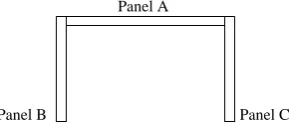
Three solar panels of 40 watts each, with a total energy of 120 watts, were used in the design of this machine with a strategic sun tracking arrangement as shown in Fig. 1 below. Each panel (namely panel A, B, C) receives optimal sun rays. The panel that receives the most sun rays in the morning is the one facing the east (panel A) while panel B
and C obtain the minimum sunlight rays to augment power available from panel A.
Panel A
[image:3.595.330.535.211.384.2]Panel B Panel C
Fig. 1: Solar Panel n-Shaped Arrangement for a unique Frame Structure
MID-DAY
SUNSET SUNRISE
Fig. 2: Optimum Performance at Sunrise, Mid-day, and Sunset
At noon (the peak sunlight period of the day), sun ray supply shifts to the northern direction and panel B is at the best performance, complimented by panel A and C which would in turn receive minimum solar energy. The overall output of the DC energy supply from each panel depends on the sunlight angle of supply. At sunset, panel C in the western direction will be at the best performance with panels A and B receiving the minimum solar energy. Panel C continues the charging of the battery till dusk (6 pm) of the same day. This is illustrated in Fig. 2.
This n-shaped framework approach serves two functions: it generates DC energy continuously and; it acts as a supportive mechanism for the integral body structure in the fabrication of the machine.
C. Principles of Working Operation
[image:3.595.70.271.223.298.2]At 40 V charge level, the machine is ready for operation. The manual switch is turned on and DC energy is passed through the connection cables. An electrical power of 10 A, 48 V is supplied to the DC motor which serves as the main prime mover. This translates into a mechanical speed of 1750 rpm that drives the air compressor/pump through the belt and pulley mechanism. As the compressor/pump rotates via its input shaft, up to 4 bars of compressed air at full load is delivered through the elbow connector into the air regulator (pressure gauge). The air is measured with the air gauge meter and should be rated between 0-6 bars. The maximum rating for the compressed air is normally 4 bars at a state of charge of 52 volts. This can only be achieved if the SOC is kept at 52 volts at all times, which is rather impossible because of the continuous battery discharge that occurs. The compressed air pressure drops down to 2-3 bars under normal operating conditions and is equivalent to the conventional petrol (gasoline) engine type.
Meanwhile, the compressed air mixture enters another air gap connector through the black 2-ft connection rubber hose. As it flows through the rubber hose, air immediately enters the outlet double flow valve unit. This unit is designed to supply compressed air to inflate the already deflated vehicle tyre through one valve while the other valve remains at rest. When the machine is operated freely, the valve at rest is made active, and the main outlet valve is now inactive. The active valve supplies the compressed air at high pressure bars to the atmosphere, thus preventing the main compressor/pump from being internally damaged. Therefore, the double compressed air valve unit supplies air to the tyre or houses the air and discharges it immediately into the atmosphere when it is not in use at that particular moment.
On reaching a satisfactory inflation point, the switch is turned off in order to disengage the machine. The solar panels resumes charging the battery for the next time of time. On cloudy days, the solar photovoltaic system would still continue to supply energy to sustain the battery for continued use.
IV. SYSTEM IMPLEMENTATION AND TESTING
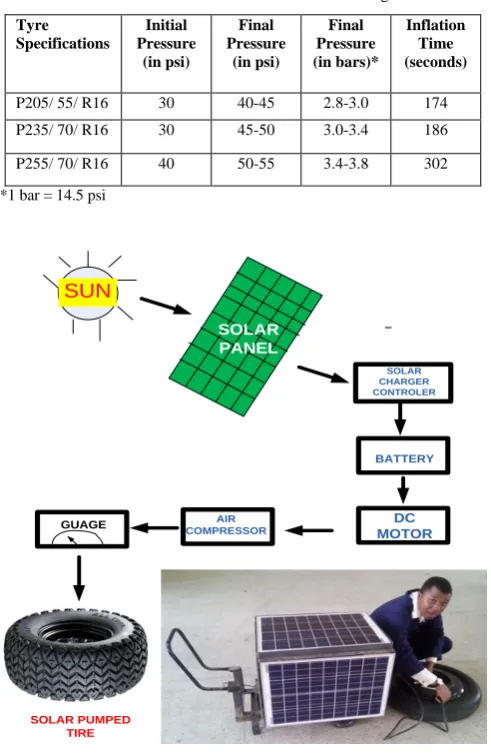
The solar photovoltaic vulcanizing machine was implemented and tested to guarantee that its working principle and efficiency satisfy the design objectives. Fig. 3 shows the flow of working operation of the machine. In view of this, a deflated tyre tube was prepared to be pumped. After all the necessary checks and precautions ensured, the initial pressure of the tyre tube was measured using pressure gauge. Turning the switch on, the DC motor started running immediately, passing out pressurized air through the connecting hose. Having pumped the tyre tube, it was tested for leakage by direct immersion of the inflated tube in a solution of detergent and water. When the tube was carefully observed, no air bubble was visible. This shows that there was no leakage in the tube. The time taken to inflate the tube was measured and recorded.
[image:4.595.305.551.58.435.2]The test procedure was repeated for different vehicle tyres and the results were presented in Table 3. Also, the results obtained were compared to that of a conventional vulcanizing air pump shown in Table 4.
Table 3: Test Results of Solar Photovoltaic Vulcanizing Machine
Tyre Specifications
Initial Pressure
(in psi)
Final Pressure
(in psi)
Final Pressure (in bars)*
Inflation Time (seconds)
P205/ 55/ R16 30 40-45 2.8-3.0 174
P235/ 70/ R16 30 45-50 3.0-3.4 186
P255/ 70/ R16 40 50-55 3.4-3.8 302
*1 bar = 14.5 psi
SUN
SOLAR PANEL
SOLAR CHARGER CONTROLER
BATTERY
DC MOTOR
AIR COMPRESSOR
GUAGE
SOLAR PUMPED TIRE
Fig. 3: Solar Photovoltaic Vulcanizing Machine
Table 4: Test Results of Conventional Vulcanizing Machine
Tyre Specifications
Initial Pressure
(in psi)
Final Pressure
(in psi)
Final Pressure (in bars)*
Inflation Time (seconds)
P205/ 55/ R16 30 40-45 2.8-3.0 358
P235/ 70/ R16 30 45-50 3.0-3.4 417
P255/ 70/ R16 40 50-55 3.4-3.8 485
*1 bar = 14.5 psi
V. CONCLUSION
The incredible level of poverty in most African countries is alarming and unprecedented; it actually requires an unconditional approach. The development of a photovoltaic vulcanizing unit will reduce the running cost of vulcanizers; reduce air pollution as well as noise pollution in the environments. Roadside vulcanizing business in towns and cities of Africa is a viable job that can be run buy any age group and it requires no formal training or long apprenticeship to develop expertise.
running the fossil fuel-powered vulcanizing machine will leave the technician with little or no profit due to the recent fuel subsidy removal by some countries like Nigeria. In addition, overdependence on fossil fuel as a primary source of energy promotes the negative effects of carbon dioxide and other global warming emissions on environment, climate, and public health.
Considering the abundant solar energy potential across all the Sub-Saharan countries, the adoption and use of the solar photovoltaic vulcanizing machine will practically eradicate extreme poverty in line with the 2030 Sustainable Development Goals (SDGs) agenda. Also, the implementation of this project will create employment opportunities for millions of Africans, reduce social violence and crime, provide affordable and clean energy, and also save our planet from self-destruction.
REFERENCES
[1] Beegle Kathleen, Luc Christiaensen, Andrew Dabalen, and Isis Gaddis, Poverty in a Rising Africa. Washington, DC: World Bank. March, 2016. doi:10.1596/978-1-4648-0723-7. License: Creative Commons Attribution CC BY 3.0 IGO
[2] Bhorat, Haroon, Karmen Naidoo, and Kavisha Pillay. 2015. ―Growth, Poverty and Inequality Interactions in Africa: An Overview of Key Issues.‖ University of Cape Town, South Africa.
[3] Deaton, Angus S. 2005. ―Measuring Poverty in a Growing World (or Measuring Growth in a Poor World).‖ Review of Economics and Statistics 87 (1): 1–19
[4] United Nations, The Millenium Development Goals Report, New
York, 2015. Available online:
http://www.un.org/millenniumgoals/2015_MDG_Report/pdf/MDG% 22015%20rev%20(July%201).pdf
[5] United Nations, United Nations Summit on Sustainable Development, United Nations Headquarters, New York, 25-27 September, 2015.
Available online:
https://sustainabledevelopment.un.org/content/documents/8521Inform al%20Summary%20%20UN%20Summit%20on%20Sustainable%20 Development%202015.pdf
[6] United Nations Economic and Social Council, Progress Towards the Sustainable Development Goals, Report of the Secretary General, June, 2016.
[7] International Labour Organization, World Employment Social Outlook (Trends 2015), International Labour Office, Geneva, 2015.
[8] African Development Bank Group. 2012. Income inequality in Africa, Briefng Note 5, briefng notes for AfDB’s long-term strategy. [9] Alvaredo, F.; Gasparini, L. 2013. Recent trends in inequality and
poverty in developing countries, Working Paper No. 151, Center for Distributive, Labor and Social Studies (Universidad Nacional de la Plata, La Planta).
[10] Cingano, F. 2014. Trends in income inequality and its impact on economic growth, OECD Social, Employment and Migration Working Paper No. 163 (Paris, Organisation for Economic Co-operation and Development).
[11] Kapsos, S.; Bourmpoula, V. 2013. Employment and economic class in the developing world, ILO Research Paper, No. 6 (Geneva, ILO). Available online: http://www.ilo.org/wcmsp5/groups/public/---dgreports/--inst/documents/publication/wcms_216451.pdf
[12] Deaton, Angus S. 2005. ―Measuring Poverty in a Growing World (or Measuring Growth in a Poor World).‖ Review of Economics and Statistics 87 (1): 1–19
[13] Deodat E. Adenutsi, ―Entrepreneurship, job creation, income empowerment and poverty reduction in low-income economies,‖ Munich Personal RePEc Archive, 2009. Online at http://mpra.ub.uni-muenchen.de/29569/MPRA Paper No. 29569, posted 28. March 2011 10:17 UTC
[14] Steven Si, Xuebao Yu, Aiqi Wu , Shouming Chen, Song Chen, Yiyi Su, ―Entrepreneurship and poverty reduction: A case study of Yiwu, China,‖ Asia Pacific Journal of Management, Volume 32, Issue 1, pp 119-143, March 2015.
[15] ENABLE, ―Nigeria: Fuel Subsidy,‖ A desktop study by the center for public policy alternatives, A DFID Program Managed By Adam Smith International, 2015.
[16] Stephen Ikani Ocheni, ―Impact of Fuel Price Increaseon the Nigerian Economy,‖ Mediterranean Journal of Social Sciences MCSER Publishing, Rome-Italy, Vol 6 No 1 S1, pp. 560-569. January 2015.
[17] Anthony Obayi Onyishi, Okechukwu Innocent Eme, Ikechukwu Eke Jeffrey Emeh, ―The Domestic and International Implications of Fuel Subsidy Removal Crisis in Nigeria,‖ Kuwait Chapter of Arabian Journal of Business and Management Review Vol. 1, No.6; pp. 57-80, February 2012.
[18] Anderson CJ. Greatest fossil fuel disasters in human history.
〈 http://io9.gizmodo.com/5526826/greatest-fossil-fuel-disasters-in-human-history〉; 2010.
[19] The Guardian. BP's reckless conduct caused Deepwater Horizon oil
spill, judge rules. Available from:
〈http://www.theguardian.com/environ ment/2014/sep/04/bp-reckless-conduct-oil-spill-judge-rules〉; 2014.
[20] CBC News. Executive convicted in West Virginia coal mine explosion that killed 29. Available from
〈 http://www.cbc.ca/news/business/mine-explosionconviction-1.3349392〉; 2015.
[21] Keating M. Cradle to grave: The environmental impacts from coal. Boston, USA; 2001.
[22] REN21. Renewables 2015 Global Status Report. France; 2015 [23] Machol B, Rizk S. Economic value of U.S. fossil fuel electricity
health impacts. Environ Int 2013;52:75–80.
[24] Grassroots Marketing Alliance. The advantages and disadvantages of
renewable energy. Available from:
〈http://www.solarschools.net/resources/stuff/advantages_and_disadva ntages.aspx〉; 2015
[25] Mas’ud AA, Vernyuy Wirba A, Muhammad-Sukki F, Mas’ud IA, Munir AB, Md Yunus N. An assessment of renewable energy readiness in Africa: case study of Nigeria and Cameroon. Renew Sustain Energy Rev 2015;51:775–84.
[26] Mohammed YS, Mustafa MW, Bashir N, Mokhtar AS. Renewable energy resources for distributed power generation in Nigeria: a review
of the
potential. Renew Sustain Energy Rev 2013;22:257–68.
[27] Chineke T, Igwiro EC. Urban and rural electrification: enhancing the energy sector in Nigeria using photovoltaic technology. Afr J Sci Technol., 2008;9:102–8.
[28] Tansi BN. An assessment of Cameroon's renewable energy resource and prospects for sustainable economic development [MSc thesis]. Germany: Brandenburg Technical University; 2011.
[29] Laurea University of Applied Science. Cameroon report; 2012 [30] Gyamfi S, Modjinou M, Djordjevic S. Improving electricity supply
security in Ghana—the potential of renewable energy. Renew Sustain Energy Rev 2015;43:1035–45.
[31] EDUSA. South Africa. Education South Africa (EDUSA). Available from: 〈http://www.edusouthafrica.com/south-africa/〉; 2015 [last accessed 24 Dec 2015].
[32] Department of Energy – Republic of South Africa. Available from:
〈http://www.energy.gov.za/〉; 2015
[33] Mwanyasi GM, Adonis M. A PV power supply module for a portable Cubesat satellite ground station. J Energy South Afr 2014;25:28–38 [34] Kiplagat JK, Wang RZ, Li TX. Renewable energy in Kenya: resource
potential and status of exploitation. Renew Sustain Energy Rev 2011;15:2960–73.
[35] Omuto CT, Olago DO, Paron P. Kenya: A natural outlook – Geo-environmental resources and hazards. Kenya. 1st Edn. Oxford, UK: Elsevier; 2013.
[36] BBC. Senegal. BBC. Available from:
〈http://www.bbc.co.uk/weather/features/18036974〉; 2007
[37] REEEP. Senegal. Available from: 〈 http://www.reegle.info/policy-and-regulatory-overviews/SN〉; 2014
[38] AfDB. Renewable energy in Africa – Tanzania country profile; 2015. [39] Mking’imle V. Assessing the potential of solar energy utilization in
Central Tanzania [Postgraduate diploma thesis]. Kenya: University of Nairobi; 2013
[40] Tucho GT, Weesie PDM, Nonhebel S. Assessment of renewable energy resources potential for large scale and standalone applications in Ethiopia. Renew Sustain Energy Rev 2014;40:422–31.
[41] Kebede KY. Viability study of grid-connected solar PV system in Ethiopia. Sustain Energy Technol Assess 2015;10:63–70
[43] BBC. Angola. BBC. Available from:
〈http://www.bbc.co.uk/weather/features/17913805〉; 2012
[44] Safari B. A review of energy in Rwanda. Renew Sustain Energy Rev 2010;14:524–9
[45] Climate Concern. Rwanda and the African great lakes region. Available from: 〈http://www.climateconcern.rw/why-rwanda.html〉; 2015
[46] Chu Y. Review and comparison of different solar energy technologies. 2011.
[47] REEEP & UNIDO. Module 7: Renewable energy technologies. REEEP/UNIDO TRaining Package – Sustainable Energy Regulation and Policymaking for Africa; 2008.
[48] Yue C-D, Huang G-R. An evaluation of domestic solar energy potential in Taiwan incorporating land use analysis. Energy Policy 2011;39:7988–8002.
[49] Bazilian M, Nussbaumer P, Rogner H-H, Brew-Hammond A, Foster V, Pachauri S, et al. Energy access scenarios to 2030 for the power sector in sub-Saharan Africa. Util Policy 2012;20:1–16.
[50] Ahmed F, Al Amin AQ, Hasanuzzaman M, Saidur R. Alternative energy resources in Bangladesh and future prospect. Renew Sustain Energy Rev 2013;25:698–707.
[51] Abdullahi Abubakar Mas’ud, Asan Vernyuy Wirba, Firdaus Muhammad-Sukki, Ricardo Albarracín, Siti Hawa Abu-Bakar, Abu Bakar Munir, Nurul Aini Bani, ―A review on the recent progress made on solar photovoltaic in selected countries of sub-Saharan Africa,‖ Renewable and Sustainable Energy Reviews, 62, pp. 441– 452, 2016. http://dx.doi.org/10.1016/j.rser.2016.04.055