J ¨
urgen Wedekind
∗ University of CopenhagenRonald M. Kaplan
∗∗ Nuance Communications, Inc.This article describes an approach to Lexical-Functional Grammar (LFG) generation that is based on the fact that the set of strings that an LFG grammar relates to a particular acyclic f-structure is a context-free language. We present an algorithm that produces for an arbitrary LFG grammar and an arbitrary acyclic input f-structure a context-free grammar describing exactly the set of strings that the given LFG grammar associates with that f-structure. The individual sentences are then available through a standard context-free generator operating on that grammar. The context-free grammar is constructed by specializing the context-free backbone of the LFG grammar for the given f-structure and serves as a compact representation of all generation results that the LFG grammar assigns to the input. This approach extends to other grammatical formalisms with explicit context-free backbones, such as PATR, and also to formalisms that permit a context-free skeleton to be extracted from richer specifications. It provides a general mathematical framework for understanding and improving the operation of a family of chart-based generation algorithms.
1. Introduction
Algorithms providing compact representations of alternative syntactic analyses have been the state-of-the-art in parsing for many years. For context-free grammars, for example, the well-known chart parsing algorithms have been used for more than four decades. These assign to a sentence not just one possible analysis but a chart that compactly represents all possible syntactic analyses. Algorithms have also been developed that extend packing to the functional specifications of unification grammars by producing compact representations of feature-structure ambiguities as well. One that is pertinent to (but not restricted to) Lexical-Functional Grammar (LFG) is the con-texted constraint satisfaction method developed by Maxwell and Kaplan (1991). These algorithms lead to better average time performance because they carefully manage the ambiguities that are rampant in natural language. They work by dividing the parsing problem into two phases, a recognition or satisfiability phase that creates the compact representation and determines whether there is at least one parse, and an enumeration phase in which the alternative parses are produced one by one. Parsing performance
∗ Center for Language Technology, University of Copenhagen, Njalsgade 140, 2300 Copenhagen S, Denmark. E-mail:[email protected].
∗∗ Nuance Communications, Inc., 1198 East Arques Avenue, Sunnyvale, CA 94085, USA. E-mail:[email protected].
is typically identified with the complexity of the first phase (e.g., the cubic bound for context-free parsing), because the collection of all parses can be delivered to a client ap-plication merely by presenting the compact representation. A client may be able to select a limited number of particularly desirable parses, perhaps the smallest or the most prob-able, without doing a full enumeration (Johnson and Riezler 2002; Kaplan et al. 2004).
Lang (1994) gives a clear formal characterization of the first phase of context-free chart parsing.1 He observes that the recognition problem consists of finding the intersection of the language of the grammar with the input string, and then testing to see whether that intersection is empty. Many language classes are closed under intersection with a regular set, and the result of the intersection of a languageL(G) with a regular language αis describable as a specializationGα ofGthat assigns to all and only the
strings inαeffectively the same parse trees asGwould assign. Lang argues that a chart for an input strings(a trivial regular language) and a context-free grammarGcan be regarded as a specialization Gs ofGthat derives either the empty language (ifsdoes not belong toL(G)) or a language consisting of just that input. In this view a parsing chart/grammar is a representation that makes it possible to enumerate all the derivation trees of the string, guaranteeing that each tree can be produced in a backtrack-free way in time proportional to its size. This guarantee holds even for an infinitely ambiguous string: It would take forever to enumerate all valid derivations, but any particular one can be read out in linear time. The procedure for tree enumeration follows directly from the standard context-free generation algorithm applied to the grammarGs.
The generation problem for LFG and other description-based grammatical for-malisms can also be viewed from this perspective. Several algorithms have been pro-posed for generation that avoid redundant recomputation by storing intermediate processing results in a chart-like auxiliary data structure (e.g., Shieber 1988; Kay 1996; Shemtov 1997; Neumann 1998; Carroll et al. 1999; Moore 2002; Carroll and Oepen 2005; Cahill and van Genabith 2006; White 2006; de Kok and van Noord 2010). Most of them can be construed as having a first phase that provides a compact representation for alternative results, in this case for the strings that the grammar provides for a given functional or semantic input. The individual generated strings are then produced by an enumeration procedure operating on this compact representation.
In this article we observe that the edges of a generation chart can be interpreted as rules of a specialized context-free grammar, just as in Lang’s (1994) characterization of parsing. We present a generation algorithm that specializes the context-free backbone of a given LFG grammar to a grammar that describes exactly the strings that the LFG gram-mar relates to a given acyclic f-structure. Derivations of the resulting gramgram-mar simulate all and only those derivations of the LFG grammar whose derived strings are assigned to that input.2Thus the generated string set is a context-free language compactly repre-sented by the specialized grammar, and the individual members of that language can be enumerated, just as for parsing, by using standard context-free generation algorithms.
Our approach can be seen as a generalization and formalization of other chart-based generation algorithms, producing all and only correct outputs for larger combinations of grammars and inputs. It extends to unification grammars with explicit context-free backbones, such as PATR (Shieber et al. 1983), and also to formalisms that permit a context-free skeleton to be extracted from richer specifications. But it does not extend
1 Dymetman (1997) extends this characterization to unification grammars.
Figure 1
The components of an LFG representation: string, constituent structure, functional structure.
to cyclic input structures because, as we will show by example, an LFG grammar might relate to a cyclic structure a set of strings that is not context-free. Because acyclic structures are normally assumed to be the only f-structures that are motivated for linguistic analysis (Kaplan and Bresnan 1982), this restriction does not seem to limit the applicability of our algorithm for natural language generation.
We begin with some background so that we can make the problem and its solution more explicit. Along with many other description-based grammar formalisms, an LFG grammarGassigns to every stringsin its language at least one f-structure. This situation can be characterized in terms of a derivation relation∆G, defined as follows:
(1) ∆G(s,F) iffGassigns to the stringsthe f-structureF
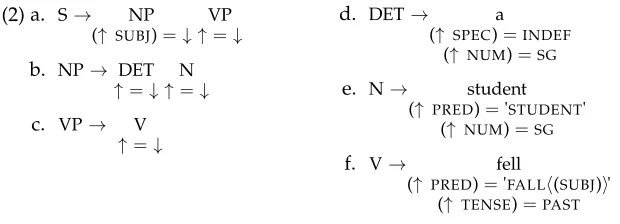
In the LFG approach a sentences and its f-structureF are not directly related. Their relation is mediated by a valid c-structure fors(Kaplan 1995). The arrangement of the three components of an LFG representation is illustrated in Figure 1. This representation is derivable by a grammar that includes the annotated (nonterminal) rules in (2a–c) and lexical expansions in (2d–f). Annotated lexical c-structure rules are just notational variants of traditional LFG lexical entries.
(2) a. S→ NP VP (↑ SUBJ)=↓ ↑=↓
b. NP→ DET N ↑=↓ ↑=↓
c. VP→ V ↑=↓
d. DET→ a
(↑ SPEC)=INDEF (↑ NUM)=SG
e. N→ student
(↑ PRED)='STUDENT' (↑ NUM)=SG
f. V→ fell
(↑ PRED)='FALL(SUBJ)' (↑ TENSE)=PAST
In accordance with the basic architecture of LFG, an LFG grammar provides a set of licensing conditions that determine grammatical representations by descriptive, model-based rather than procedural methods. The well-formedness of the representation in Figure 1 with respect to the grammar in (2) is thus characterized as follows.
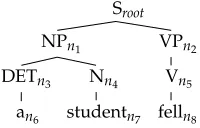
The c-structure is valid or well-formed because we can assign to each nonterminal node a grammar rule that licenses or justifies the local mother–daughters configuration constituted by the node and its immediate daughters. If we assume that the c-structure of Figure 1 consists of the nodesroot,n1,..,n8 and these nodes are related and labeled
as depicted in Figure 2, then the rule-mappingρ that justifies the c-structure is given by (3).
(3) ρroot=(2a),ρn
Sroot
NPn1 VPn2
DETn3 Nn4 Vn5
[image:4.486.49.149.64.128.2]an6 studentn7 felln8
Figure 2
The c-structure of Figure 1 with explicitly specified nodes.
A description of the f-structure (called the f-description) for this tree and rule-mapping is constructed by instantiating the annotations of all justifying rules in the following way. For each rule justifying a local mother–daughters configuration, all occurrences of the ↑ symbol (called ametavariable) in the functional annotations of the daughters are replaced by the mother node, and for each of the daughter cat-egories, all occurrences of the ↓metavariable in its annotations are replaced by the corresponding daughter node.3 Thus, the↓of the annotations on a daughter category of a rule and the ↑of the annotations of the rule that further expands that category are always instantiated with the same node. The complete f-description is the union of the instantiated descriptions of all the justifying rules. The f-description obtained from the c-structure in Figure 1 and the rules of the justifying mapping in (3) is given in (4).
(4)
(rootSUBJ)=n1,root=n2, n1=n3,n1=n4,
n2=n5,
(n3 SPEC)=INDEF, (n3 NUM)=SG,
(n4PRED)='STUDENT', (n4NUM)=SG,
(n5PRED)='FALL(SUBJ)', (n5 TENSE)=PAST
The f-structure in Figure 1 is associated with the given c-structure because it satisfies the f-description in (4), and furthermore, it is the unique minimal solution for this description. In general, LFG requires the f-description of a grammatical sentence to be satisfiable and thus to have at least one model. Each such satisfying model consists of a universe and an interpretation function that assigns unary (partial) functions to the attributes (SUBJ, NUM, SPEC, etc.) and elements of the universe to the atomic feature values (SG,INDEF, etc.), as well as to the nodes in the description. Among the models satisfying a given f-description there is an (up to isomorphism unique) minimal model, one that is not properly subsumed by other satisfying models.4 This minimal model represents the f-description’s minimal solution, the one from which the f-structure for the sentence is obtained. Conventional attribute–value matrices where the nodes (or node numbers) are attached to the left brackets are LFG-typical representations of
3 Our instantiation procedure uses the nodes themselves instead of the related f-structure variables of Kaplan and Bresnan (1982) or the more complexφ-terms of Kaplan (1995). This is mathematically equivalent to the other representations but simplifies our illustrations.
exactly such minimal models. The attribute–value matrix representation of the minimal model of the f-description (4) is given in (5).
(5) root n2 n5
SUBJ
n1 n3 n4
PREDNUM 'SGSTUDENT' SPEC INDEF
PRED 'FALL(SUBJ)' TENSE PAST
The solution in (5) is converted to the f-structure representation in Figure 1 by removing the node labels that record the relation of the f-structure to the c-structure. From a formal point of view, an f-structure is obtained from the minimal model of an f-description by restricting its interpretation function to the attributes and atomic fea-ture values of the grammar, thus disregarding the nodes and their interpretation.5
We now turn to the generation problem. A generator forGprovides for any given f-structureFthe set of strings that are related to it by the grammar:
(6) GenG(F)={s|∆G(s,F)}
The algorithm presented in this article accomplishes the generation task by pro-ducing a context-free grammar forGenG(F), for a given LFG grammarGand any acyclic input f-structureF.
The abstract generator characterization in (6) is of course dual to the one for a parser forG, since a parser produces for any given terminal stringsthe set of f-structures that are assigned to it byG:
(7) ParG(s)={F|∆G(s,F)}
For parsing, the Kaplan and Bresnan (1982) proscription of nonbranching dominance chains guarantees thatParG(s) will contain only a finite number of f-structures, but this condition does not ensure the finiteness of the set of stringsGenG(F) that are related to an f-structureF. This is illustrated by the simple grammar in (8):
(8) S→ a S b ↑=↓
S→ c
(↑ H)=V
S→ a b
(↑ H)=V
This generates for the input (9) (9) [H V]
the infinite context-free language{anbn|1≤n}.
From a cognitive point of view it seems unrealistic that the number of sentences that a natural language grammar relates to an f-structure is infinite. As a minimum, there should be some relationship that bounds the size of the c-structure of a sentence
by the size of the f-structures associated with it. Such a structural relationship would then force the related sentences to form a finite set. Studies to determine intuitively plausible restrictions are rather scarce, however, and proposals for such restrictions are not yet generally accepted. It is thus still an open question whether grammars of actual natural languages satisfy the particular resource-boundedness restrictions on which termination of some existing chart-based generators depends.
Even if only finite sets of sentences are related to the f-structures, these sets might still be very large. Experiments with a broad-coverage German LFG grammar (Dipper 2003; Rohrer and Forst 2006) have shown that, because of the scrambling that German allows, a given f-structure might be related to a huge set of long sentences.6 This has consequences at least for those approaches that assume the output of generation to be a word lattice (Langkilde and Knight 1998) or a finite-state machine representing the (finite) set of all generated sentences. A lattice can represent a large collection of strings compactly only if they are characterized by independent sets of alternative substrings. Scrambling languages, however, have alternative substrings that reappear in different positions with complex cooccurrence dependencies and therefore cannot be shared in a lattice representation (see Langkilde [2000] for discussion). Our context-free grammars (and also Langkilde’s [2000] and Knight and Langkilde’s [2000] forest representations) offer a much more compact encoding under these circumstances, and their structure and formal properties are as well understood as lattices and finite-state machines.
Our approach might also be more appropriate than existing chart-based approaches for optimality-theoretic generation (Kuhn 2001, 2002, 2003). An optimality-theoretic LFG system consists of two components: a universal LFG grammar and a language-specifically ordered set of violable constraints (Bresnan 2000). The universal LFG gram-mar is used to produce the candidate space of possible analyses (consisting of the c-structure/f-structure pairs that are derivable by the grammar). The optimal and thus grammatical analyses are those candidates that violate the fewest constraints. A tech-nical problem comes from the fact that the universal grammar by design may assign an infinite number of c-structures and string realizations to a given f-structure, and the optimal outputs can be identified only by evaluating all of these against the collection of constraints. Our context-free characterization provides a finite evaluation procedure even for an infinite candidate space. By virtue of the pumping lemma for context-free languages (Bar-Hillel, Perles, and Shamir 1961; see also Hopcroft and Ullman 1979) we can enumerate the c-structure trees assigned to an input f-structure one by one in order of increasing depth. Because the number of constraint violations increases beyond a certain number of recursive category expansions, the optimal results from the infinite space can be chosen after examining only a finite number of relatively small structures (see Kuhn [2003] for details).
Similar to Lang’s approach to parsing (see also Billot and Lang 1989), we provide a general framework encompassing all forms of chart generation in a single formalism. This is because existing chart-based generators can be understood as concrete but some-how restricted algorithm/datastructure implementations of our context-free grammar construction. These restrictions may lead them to produce incorrect outputs in some situations. Because we show the correctness of the output grammar for unrestricted
6 The German grammar was developed as part of the Parallel Grammar project (ParGram), a research and development consortium that has produced large-scale LFG grammars for several languages (Butt et al. 1996, 2002). These grammars are developed on the XLE system, a high-performance platform for LFG parsing and generation. More information on the ParGram project and XLE can be found at:
LFG grammars, our framework allows us to examine, compare, and improve on existing chart-based generation techniques.
The organization of this article is as follows. In the next section we define the fundamental formal objects of LFG theory and the relevant relationships among them. Section 3 is the technical core of the article. There we present and prove the correctness of the context-free grammar-construction algorithm for LFG grammars with arbitrary equational constraints and acyclic input f-structures. The grammar construction ab-stracts away from specific details of data structure and computational strategy not es-sential to the mathematical argument. Performance and computational strategy are then briefly considered in Section 4, and Section 5 compares our approach to other generation algorithms. In Section 6 we identify a fundamental limitation of our approach, demon-strating that the context-free property does not hold for elementary equational con-straints if the input f-structure contains cycles. On the other hand, if the input is acyclic, the basic context-free construction can be extended beyond simple equations to the additional descriptive devices proposed by Kaplan and Bresnan (1982) and still in common use. This is shown in Section 7. The last section highlights some additional consequences of this approach.
The present article elaborates on ideas that we first presented in Kaplan and Wedekind (2000). In that paper we outlined a context-free grammar construction for a subclass of LFG grammars with restricted functional annotations and single-rooted input structures. Here we consider a more general class of grammars and inputs that requires a more rigorous mathematical analysis.
2. Preliminaries
We start with a formal characterization of LFG grammars with equational statements. LetV∗ denote the set of all finite strings overV. An LFG grammar Gover a setΣof attribute and value symbols is defined as follows:
Definition 1
AnLFG grammarG(over attribute–value set Σ) is a 4-tuple (N,T, S,R) where Nis a finite set of nonterminal categories,T is a finite set of terminal symbols, S∈Nis the root category, andRis a finite set of annotated productions of the form
A→X1.. Xm D1 Dm
with A∈N and X1..Xm∈(N∪T)∗. (Note that R might contain -productions, al-though these do not appear in most current linguistic descriptions.) Each annotated descriptionDj(j=1,..,m) is a (possibly empty) finite set of equalities between expres-sions of the form (↑ σ), (↓ σ), orvwherevis a value of Σandσis a possibly empty sequence of attributes ofΣ. Whenσis empty, (↑ σ), (↓ σ) are equivalent to ↑and↓, respectively.7
We next define how instantiated descriptions are obtained from the rules by sub-stituting for the ↑ and ↓ metavariables elements drawn from a collection of terms. C-structure nodes are included among the terms, but later on we also make use of addi-tional elements. We define a functionInstthat assigns to each m-ary ruler, termt, and term sequencet1..tm the instantiated description that is obtained from the annotations ofrand the terms by substitutingtfor↑andtjfor↓in the annotations of allj=1,..,m daughters. In the following definition we use the (more compact) linear rule notation A→(X1,D1)..(Xm,Dm) that we prefer in more formal specifications.
Definition 2
Letrbe an m-ary LFG ruleA→(X1,D1)..(Xm,Dm) (m≥0) andτ=(t,t1..tm) be a pair of a term and a sequence of terms of lengthm. Then theinstantiated descriptionthat results fromrandτis given by
Inst(r,τ)=
m
j=1
Inst(Dj,t,tj)
where Inst(Dj,t,tj) is the instantiated description produced by substituting t for all occurrences of↑inDjand substitutingtjfor all occurrences of↓inDj.
The derivation relation for LFG grammars (∆G) is defined as already described informally in the previous section. This is based on context-free derivation trees. Let us assume thatrootis the root node of any c-structurec, and thatdtsis a function that assigns to each nonterminal nodenofcthe sequence of its immediate daughters (dts(n)). Context-free derivations are then defined as follows:
Definition 3
A labeled treecand a rule-mappingρfrom the nonterminal nodes ofcinto the rules of context-free grammarGis acontext-free derivationof stringsfrom nonterminalBin Giff
(i) the label (category) ofrootisB, (ii) the yield iss,
(iii) for each nonterminal nodenwith labelAanddts(n)=n1..nmwith labelsX1,..,Xm, respectively,ρn=A→X1..Xm.
When we informally described LFG derivations, we pointed out that we obtain the f-structure from the (up to isomorphism) unique minimal model of the f-description by restricting it to the attribute–value set Σ. This is formalized in the following def-inition by requiring the f-structure to be isomorphic (∼=) toM|Σ, the restriction to Σ
Definition 4
A labeled treecand a mappingρfrom the nonterminal nodes ofcintoRis anLFG deri-vationof stringswith functional descriptionFDand f-structureFin LFG grammarGiff
(i) the label ofrootis S, (ii) the yield iss,
(iii) for each nonterminal nodenwith labelAanddts(n)=n1..nmwith labelsX1,..,Xm, respectively,ρn=A→(X1,D1)..(Xm,Dm),
(iv) FD=
n∈Dom(ρ)
Inst(ρn, (n,dts(n))), (v) FDis satisfiable,
(vi) FDa=vifvis an atomic feature value andais any other constant (atomic feature value or node) occurring inFD,
(vii) FD(v σ)=(v σ) ifvis an atomic feature value andσis a nonempty sequence of attributes,
(viii) M|Σ∼=FwhereMis a minimal model ofFD.
Conditions (vi) and (vii) are syntactic versions of the constant/constant and con-stant/complex clash conditions that together capture LFG’s functional uniqueness condition (the denotations of an atomic feature value and any other distinct atomic feature value or node constant have to be distinct (vi); atomic feature values have no attributes (vii)).8A model of an f-description, like the restricted one in (viii), is a pair (U,I) consisting of a universe U and an interpretation function I. The interpretation function assigns to each constant occurring in the f-description an element ofU and to each attribute a unary partial function onU.
Note that we create the f-description by instantiating the↑’s and↓’s by the nodes of a given c-structure. Thus, we conceive of these terms as constants and will refer to them on the f-description level sometimes as node constants rather than nodes. Because the instantiating nodes are uniquely determined if we have a mappingρlicensing a given c-structure, in the following we abbreviateInst(ρn, (n,dts(n))) byInst(ρn).
In general, two descriptionsD and D are said to be equivalent (D≡D) iff the restrictions of their minimal models toΣare isomorphic.
Definition 5
Let Dand D be two descriptions with minimal models Mand M. Then D≡D iff M|Σ∼=M|Σ.
From Definition 4 we obtain the derivability relation∆as follows.
Definition 6
A terminal stringsisderivablewith f-structureFinG(∆G(s,F)) iff there is a derivation ofswithF(with some f-descriptionFD) inG.
In this context we repeat the definition of the set of stringsGenG(F) that an LFG grammar Grelates to a given f-structureF:
Definition 7
For any LFG grammarGand any f-structureF
GenG(F)={s∈T∗|∆G(s,F)}.
In the next section we establish the basic result of this article: We present an al-gorithm to construct for an arbitrary LFG grammarGand any acyclic f-structureF a particular context-free grammar that provides a formal representation for the language GenG(F).
3. Constructing the Specialized Grammar forGenGGG(FFF)
In the process of generation, the c-structures and the f-descriptions for an input f-structureFare the unknowns that must be discovered to confirm that a given string belongs to the setGenG(F). The set of valid c-structures thatGprovides forFis clearly a subset of the trees that are generated by the context-free backbone of G. But this subset might be infinite, as we have already seen with the input (9) and the grammar in (8), because there is in general no fixed finite upper bound on the length of the strings related to F or the size of their c-structures. Whether or not a given tree is a valid c-structure for F then depends on the properties of the f-description that arises by instantiating with the proper node constants the annotations on the individual rules that license the derivation of that tree. The valid c-structures are just those trees for whichFis the f-structure of the resulting f-description.
Because of the possibly unbounded size of the c-structures, there is also no fixed upper bound on the number of node constants that may occur in an f-description for F. However, because the number of f-structure elements to which the node constants actually refer is bounded by the size ofF, it must be possible to obtain for any derived f-description FD an equivalent description whose constants are drawn from a fixed finite set. For instance, if we introduce a distinct canonical constant for each element of F, we can create an equivalent description by substituting for each node constant inFDthe canonical constant associated with the functional element corresponding to that node. This substitution typically reduces the number of distinct terms needed for instantiation, and its usual effect is to replace several different node constants with a single canonical term. But these replacements will provide an equivalent description because we substitute a given term for two node constants if and only if it logically follows from FD that those two nodes map to the same element of F. Thus, if FD discriminates between two elements ofF, so will the description that results from such a reducing substitution.
The set of terms that correspond directly to the elements of F is large enough to enforce all functional discriminations for an f-description associated with a com-plete c-structure, as we have suggested. But unfortunately that set may not be large enough to keep track of all necessary distinctions as an f-description is created in an incremental context-free derivation process. For some f-structures and some grammars it may not follow from the description associated with one portion of a derivation tree that two nodes map to the same functional element, even though that identity does follow when equations in the f-description for the entire tree are taken into account.
Suppose that a three-daughter LFG start rule provides the instantiated annotations (rootF)=n1, (rootG)=n2, and root=n3. Based only on this information we cannot tell whethern1 andn2 can map to the same element of the f-structure and therefore whether it is correct to substitute the same canonical constant for both of them. It depends on whether the larger description that incorporates the expansion of the third daughter implies the identity of then1andn2structures. The same-constant substitution
would preserve equivalence only if the larger description implies that (n3 F)=(n3 G).
We must have two distinct constants available until that implication is deduced in the course of the derivation, even if the input f-structure does not contain separate ele-ments for those constants to correspond to.
Thus the set of constants needed to correctly reduce an arbitrary description as a derivation proceeds incrementally may be larger than the number of elements in the input f-structure and larger than what is required for an equivalent description for a complete derivation. However, for each acyclicFwe show that there is always a finite set of canonical terms that can maintain all necessary functional discriminations as a derivation unfolds. We use this set to construct a reducing substitution that permits generation to be carried out under finite control. In contrast, we observe in Section 6 that the partial descriptions of cyclic structures cannot safely be reduced without an unbounded number of canonical terms.
For the derivations that the simple LFG grammar in (8) provides for the input [H V], we can accomplish the reduction of the f-description space with only two terms, the canonical constantrootand a separate canonical constant⊥that serves as a value for all nodes that do not occur in an f-description. Let us start with the shortest derivation for the given input. This consists of the c-structure in (10), which is licensed by the rule-mappingρroot=S→(↑Ha)=Vb.
(10) Sroot
an1 bn2
If we pair the licensing rule with its instantiating nodes (root,n1n2), we arrive at the instantiated ruleS→(↑Ha)=Vb, (root,n1n2)
. The reduction can be accomplished by apply-ing to the instantiatapply-ing nodes a substitution that replacesrootbyrootand bothn1 and
n2 by⊥. This produces the instantiation
S→ a b
(↑H)=V , (root,⊥ ⊥)
Figure 3
Schematic representation of the derivations of length>1 with f-structure [H V] admitted by the grammar in (8). The right-hand side shows the instantiated descriptions produced by appropriately instantiating metavariables by node constants in column (a) and by particular canonical canonical terms in column (b).
the f-description of each derivation of the input inGreduces to the description (11a) and that this is the description that results for any derivation with the set of instantiated rules depicted in (11b).
(11) a. root=root, (rootH)=V
b.
S→a S b
↑=↓ , (root,⊥root⊥)
,
S→ a b
(↑H)=V , (root,⊥ ⊥)
The reducibility of the f-description space for F provides the key insight for our context-free grammar construction. The construction is accomplished in three steps. In the first step we identify (as illustrated earlier) a finite set of canonical terms that can serve in reducing the f-description space thatGprovides forF.
In the second step we use these terms to construct a set of instantiated rules of G. These instantiations are “appropriate” in the sense (to be made precise later) that they maintain all necessary distinctions. They are formed by associating with the metavariables canonical terms that can legitimately be used to reduce the corre-sponding nodes of a local tree of a potential derivation of F. For the grammar (8) and the termsrootand⊥, for example, there are only three appropriately instantiated rules, the two rules contained in (11b) and S→(↑Hc)=V, (root,⊥)
. We then determine all collections of appropriately instantiated rules that together provide descriptions of Fwithout mistakenly collapsing a functional discrimination. For our particular ex-ample there are just two collections of instantiated rules that provide a description of [H V], namely,S→ a b
(↑H)=V , (root,⊥ ⊥)
from the power set of the appropriately instantiated rules, so there is only a finite number of them and each contains a finite number of instantiated rules. This ensures that we can determine the f-description space thatGprovides forFwithout knowing the details of the derivations forFand their reductions.
In the third and final step we create the context-free grammar that simulates exactly those derivations inGwhose strings are assigned the f-structureF. The categories of this new grammar consist of refinements of the categories of the context-free backbone ofGtogether with a distinct root category SF. The original categories are augmented with two additional components, a canonical instantiation term as used in the first step, and a subset of one of the instantiated-rule collections determined in the second step. The term component is used to encode the reducing substitution for the f-description of a simulated derivation, and the rule component is used to record the reduced in-stantiations of the licensing LFG rules whose application must still be simulated in order to complete that derivation. The productions of the new grammar are created from the rules contained in the instantiated-rule collections by replacing the original categories by a certain number of their refinements, and then adding a particular set of start rules. The start rules expand the root category of the new grammar to the original start symbol augmented byrootand one of the instantiated-rule collections determined in the second step.
The context-free grammar thus constructed has a much larger set of categories and many more rules thanG. It is organized so that the normal matching of categories in a context-free derivation globally ensures that the refined rules simulate all derivations of F in G whose f-description is reducible to a description provided by one of the instantiated-rule collections determined in the second step. Because we have already indicated that every f-description ofFmust be reducible to a description provided by one of these instantiated-rule collections, the constructed grammar simulates exactly the set of derivations that G provides for F. The strings of GenG(F) are obtained by removing the additional components from the categories of the terminal strings. With r1abbreviating
S→a S b
↑=↓ , (root,⊥root⊥)
andr2abbreviating
S→ a b
(↑H)=V , (root,⊥ ⊥)
our construction produces for the LFG grammar in (8) and the input [H V] a context-free grammar that contains the rules in (12).
(12) a. SF→ S:root:{r1,r2} b. SF→ S:root:{r2} c. S:root:{r1,r2} → a:⊥:∅ S:root:{r1,r2} b:⊥:∅
d. S:root:{r1,r2} → a:⊥:∅ S:root:{r2} b:⊥:∅ e. S:root:{r2} → a:⊥:∅ b:⊥:∅ These derive the set of terminal strings{a:⊥:∅nb:⊥:∅n|1≤n}. By removing the terminal refinements we obtain{anbn|1≤n}and thus exactly the set of strings that the gram-mar in (8) relates to [H V]. The rules (12b,e) simulate the derivation with the c-structure in (10) and the rules (12a,c–e) simulate the derivations of length>1. Rule (12c) simulates recursions of the S rule of (8) and an application of rule (12d) terminates a recursion because it consumesr1. An application of rule (12e) consumes r2 and terminates the derivations.
3.1 Identifying the Reducing Terms
Our reduction of the f-description space makes use of the fact that we can eliminate cer-tain node constants from an f-descriptionFDwithout risk of producing a description not equivalent to the original. This is because some node constants can be defined in terms of others. We proceed rule-wise top–down based on the following definability relation.
Definition 8
Letrbe an m-ary LFG rule,tbe a term, anda1..ambe a sequence of constants of lengthm, each of them not occurring int. A constantajism(other)-definableinInst(r, (t,a1..am)) iff there is a (possibly empty)σsuch thatInst(r, (t,a1..am))aj=(tσ).
If the constantajthat instantiates the↓for a particular daughter is m-definable in terms of (tσ) inInst(r, (t,a1..am)), then all functional discriminations will be preserved ifajis eliminated in favor of the term (tσ) from any description containing this instantiated description ofr.
To illustrate the elimination process, let us assume that our grammar includes among its rules the ones in (13).
(13) a. S→ NP VP (↑ SUBJ)=↓ ↑=↓
b. VP→ V ADVP ↑=↓ ↑=↓
c. ADVP→ ADV ADVP
(↑ ADJ)=(↓ ELE) ↑=↓
d. ADVP→ ADV
(↑ ADJ)=(↓ ELE)
e. NP→ John (↑ PRED)='JOHN'
f. V→ fell
(↑ PRED)='FALL(SUBJ)' (↑ TENSE)=PAST
g. ADV→ today
(↑ PRED)='TODAY'
h. ADV→ quickly
(↑ PRED)='QUICKLY'
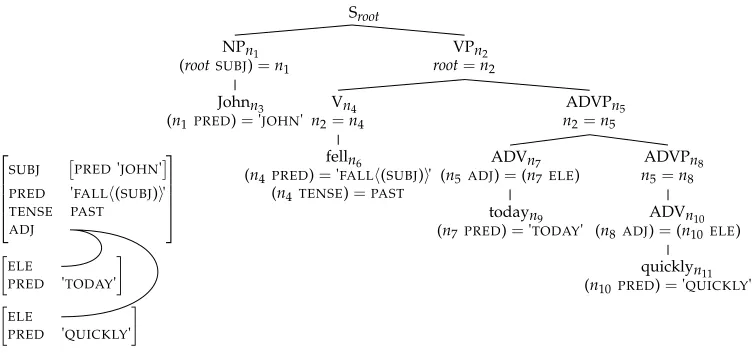
In this grammar fragment we use equational annotations in the adverbial phrase rules (13c) and (13d) instead of the more traditional set-membership statements (Kaplan and Bresnan 1982). This is another way of allowing for multi-valued attributes that was the original motivation for introducing set representations into LFG theory. We use the equational treatment here to illustrate the fact that undefinable and hence ineliminable constants can arise even when equality is the only formal device in an f-description. The adverbial rules also illustrate that undefinable constants can figure in the description of multiply rooted f-structures. The rules in (13) provide, for example, the derivation depicted in Figure 4. The figure shows the f-structure on the left-hand side and the instantiated descriptions of the licensing rules associated with the nodes of the c-structure on the right-hand side. This more conventional way of depicting derivations (Kaplan and Bresnan 1982) makes it easy to see the mother-definability relation and at the same time permits the licensing rule-mapping to be read from the annotated c-structure. The complete f-description is shown as a set in (14).
(14)
(rootSUBJ)=n1, (n1PRED)='JOHN', root=n2,n2=n4,n2=n5,n5=n8,
(n4PRED)='FALL(SUBJ)', (n4TENSE)=PAST,
(n5ADJ)=(n7ELE), (n7 PRED)='TODAY',
Sroot
NPn1
(rootSUBJ)=n1
VPn2 root=n2
Johnn3
(n1 PRED)='JOHN' Vn4 n2=n4
ADVPn5 n2=n5
felln6
(n4 PRED)='FALL(SUBJ)' (n4 TENSE)=PAST
ADVn7
(n5 ADJ)=(n7 ELE)
ADVPn8 n5=n8
todayn9
(n7 PRED)='TODAY'
ADVn10
(n8 ADJ)=(n10 ELE)
quicklyn11
(n10 PRED)='QUICKLY'
SUBJ PRED'JOHN' PRED 'FALL(SUBJ)' TENSE PAST ADJ
ELE
PRED 'TODAY'
ELE
[image:15.486.53.431.61.240.2]PRED 'QUICKLY'
Figure 4
The derivation ofJohn fell today quicklywith the rules in (13).
In this derivation, the node constantsn1,n2,n4,n5, andn8 are m-definable whereas
root, the adverbial nodesn7andn10, and the terminal nodes are not. For all m-definable
constants, we can construct definitions rule-wise top–down in the following way. We begin with the start rule and derive from its instantiated description{(root SUBJ)=n1,
root=n2}the definitionsn1=(rootSUBJ) andn2=rootfor the m-definable daughtersn1
andn2. We then continue with the rules that expandn1andn2. Let us consider the VP
rule that expandsn2. For the m-definablen2 we use the already constructed definition to replace n2 by its defining term rootin the instantiated description of the VP rule. FromInst(VP→(V,{↑=↓})(ADVP,{↑=↓}), (root,n4n5)) we then derive the definitions n4=rootandn5=rootfor its m-definable daughters, and so forth. If we run like this through the whole derivation, for all m-definable daughters we obtain defining terms that do not contain mother-definable node constants. For our example these are the ones in (15).
(15) n1=(rootSUBJ) n2=root n4=root n5=root n8=root
By substituting all mother-definable node constants by their defining terms we can then produce from the original f-description the equivalent description in (16).
(16)
(rootSUBJ)=(rootSUBJ), (root SUBJ PRED)='JOHN', root=root,
(rootPRED)='FALL(SUBJ)', (rootTENSE)=PAST, (rootADJ)=(n7ELE), (n7 PRED)='TODAY',
(rootADJ)=(n10ELE), (n10 PRED)='QUICKLY'
Notice that for each acyclic f-structureF the maximal length of theσ in the defining terms is bounded by the depth ofF.
through the f-structure. The constants that are not eliminable are the root constantroot(if it occurs inFD) and all daughter constants that occur inFDbut are not mother-definable. At least for acyclic f-structures, however, we can show that there is an upper bound on the number of these remaining constants. This is because the remaining constants must each denote one of the elements of the given f-structure, but no two of them can denote the same element. This is a consequence of LFG’s instantiation procedure and functional uniqueness condition, and the acyclicity of the f-structure.
Given LFG’s instantiation procedure, as formalized in Definition 2, two distinct node constants can be related in a single equation only if the nodes stand in a mother– daughter relationship. Thus a daughter and a node external to the mother cannot be related directly by instantiation but only as a consequence of a deduction involving at least one instantiated annotation of some other licensing rule. Because of LFG’s functional uniqueness condition the equations involved in such a deduction cannot contain atomic feature values. The constant/complex clash condition (vii) of Defini-tion 4 prevents atomic values from being substituted for proper subterms and the constant/constant clash condition (vi) prevents them from being equated to nodes. Thus such a deduction can only involve equations relating a daughter to its mother (or a node to itself).
If an undefinable daughter corefers with a node external to the mother, then the deduction that relates them must involve an instantiated annotation of that daugh-ter that is (up to symmetric permutation) of the form (↑ σ)=(↓ σ) with |σ|>0 (such as the adverbial annotations previously mentioned), and there must be deduc-tions from other equadeduc-tions that induce a cycle. This is demonstrated in the following lemma.
Lemma 1
Let c andρbe a derivation with f-description FD for an acyclic f-structure in G. If njis a daughter of n and njis not m-definable in Inst(ρn)then FDnj=(nχ)for all nnot dominated by nj and all (possibly empty) sequences of attributesχ.
Proof
Letnjbe a daughter ofnthat is not m-definable inInst(ρn) and suppose thatnj=(nχ) would follow from FDfor nodennot dominated by nj. Assume further thatFDand the instantiated descriptions of the licensing rules are closed under symmetry. Now recall that the rule of substituting equals for equals has the form
e t=t e
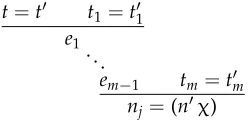
whereeis an equation containing subtermtandeis obtained fromeby replacing one occurrence oftinebyt. Then we know that there is an equation t=t that is either inFD(or follows fromFDby partial reflexivity9) such thatnj=(nχ) is derivable from t=tby a left-branching substitution proof of the form
9 It may be the case that such a left-branching proof must start with a reflexive equationt=tthat is not in
•
• •
•
t=t
(nσζ) (nχ)
(njσζ)
•
• •
• (nσζ)
(nχ)
(njσζ) t=t
[image:17.486.56.437.60.197.2] [image:17.486.183.307.302.362.2](i) (ii)
Figure 5
Possible dominance relations betweennjand the node occurring int. (i) The node occurring in tis dominated bynj. Note thatnmight occur int. (ii) The node occurring intis not dominated bynj. As a special case,tmight be (njσ). The dashed and dotted arrows indicate the tree traversal performed in the rewriting proofs ofnj=(nχ) fromt=t, that is, the sequences of nodes that must appear in the equations used to rewritettonjandtto (nχ), respectively.
t=t t1=t1
e1
. ..
em−1 tm =tm nj=(nχ)
wheretis rewritten tonj andtto (nχ) by a sequence of substitutions all justified by equationsti=ti∈FD,i=1,..,m(cf. Statman 1977; Wedekind 1994, Section 4). Because of LFG’s instantiation procedure and the constant/constant and constant/complex clash conditions, each premise of this proof must have the form ( ¯n σ¯)=( ˇnσˇ) where either ¯nand ˇnare in a mother–daughter relation or ¯n=nˇ. Depending on the dominance relation between nj and the node occurring int there are two possible cases. These are illustrated in Figure 5. (i) If the node occurring int is dominated bynj then there must be a premise (nj σ)=(nσ) fromInst(ρn) such thattis rewritten to (nj σζ) and (njσζ) to (nσζ). Because FDt=nj and hence FDnj=(nj σζ), |σ|=0 due to acyclicity. Thusnj=(nσ)∈Inst(ρn), contradicting the undefinability assumption. (ii) If the node occurring intis not dominated bynjthere must be a premise (nσ)=(njσ) fromInst(ρn) such that eithertis rewritten to (nσζ) and then to (nj σζ), ort=(nj σ). SinceFDt=nj, we get in both cases|σ|=0 because of acyclicity and thus the same contradiction as in (i).
The following corollary follows directly from Lemma 1.
Corollary 1
Let c andρbe a derivation with f-description FD for an acyclic f-structure in G. If njis a daughter of n and njis not m-definable in Inst(ρn)then
(i) FDnj=root, and
(ii) FDnj=ni for any distinct node n
From Corollary 1 it immediately follows that the denotations ofFD’s undefinable node constants are biunique. So, their number must be less than or equal to the size of the universe of a minimal modelMofFD. SupposeFis the f-structure for a derivation with f-description FD. Because F is isomorphic toM|Σfor any minimal modelM of FD, andM|ΣandMshare the same universe, we can useF’s (finite) universe to define the constants that we require. Thus for each element aof the universe ofFthat is not denoted by an atomic value we introduce a constantaa.10
Definition 9
LetFbe an f-structure withF=(U,I). We define the set of constantsCFby
CF={aa |a∈Uand there is no atomic feature valuevwithI(v)=a}.
The setCFprovides a sufficient number of constants to produce an equivalent reduced description by a biunique renaming of the node constants that remain after the m-definable ones are eliminated.
The renaming of the remaining undefinable constants can be accomplished, for example, if we map in the natural way each mother-undefinable daughtern correspond-ing to a in the isomorphic imageFofM|Σto the constantaa. Because of Corollary 1, such a mapping must be biunique. Hence it can be used to rename all undefinable daughters occurring in FDand will thus produce an equivalent description where all nodes exceptrootare replaced by constants drawn fromF.
As an illustration we pick for the f-structure depicted in Figure 4 the structure with the universe in (17a) and the interpretation function whose directed acyclic graph representation is given in (17b).11
(17) a. {a,b,c,d,e,f,g,h,i,j}
b. a
PRED
TENSE ADJ
SUBJ
b c d e
'FALL (SUBJ)' PAST
PRED
ELE ELE
f g h
PRED PRED
'JOHN'
i j
'TODAY' 'QUICKLY'
The constants we obtain from the structure (17) by Definition 9 are the ones in (18). (18) {aa,ad,ae,af,ag}
10 From a computational point of view a constantaacan be regarded as the address ofaor a pointer toa. 11 According to our formalization, attribute symbols are interpreted by unary partial functions over the
universe and atomic value symbols by elements of the universe. Thus the graph indicates, for example, that the interpretation function assigns to the attribute symbolPREDthe (unary) partial function
Now, letMbe a minimal model of our original f-description. Because an isomor-phism betweenM|Σand our structure (17) must map the denotation ofn7inMtofand
the denotation ofn10tog, we can renamen7byafandn10byagand obtain from (16) the equivalent description (19).
(19)
(rootSUBJ)=(root SUBJ), (rootSUBJ PRED)='JOHN', root=root,
(root PRED)='FALL(SUBJ)', (rootTENSE)=PAST, (root ADJ)=(afELE), (af PRED)='TODAY',
(rootADJ)=(ag ELE), (ag PRED)='QUICKLY'
We next compose the substitution that is induced by the definitions of the definable daughters and the substitution that we used to rename the undefinable daughters. This provides a substitution that allows us to produce from the original f-description an equivalent description in a single transformation. If we compose the two sub-stitutions of our example, that is, the one induced by the definitions in (15) and the renaming substitution {(n7,af), (n10,ag)}, we arrive at the reducing substitution in (20).
(20) {(n1, (rootSUBJ)), (n2,root), (n4,root), (n5,root), (n7,af), (n8,root), (n10,ag)}
We now give a precise specification of a (finite) set of terms that can serve as the range of the reducing substitutions for all derivations of an f-structure F. This set is obtained from the constants in CF and the attributes of F in the following way. We first provide the constantsCFwith their intended interpretation by expandingFin the natural way to the canonical structure ˆFforΣ∪CF.
Definition 10
Let F be an f-structure withF=(U,I). We define the canonical expansion Fˆ of F to
Σ∪CFby
ˆ
F=(U, ˆI) with ˆI=I∪ {(aa,a)|aa∈CF}.
In the canonical expansion ˆF, each element of the universe is denoted by exactly one constant. Each new constantaa is interpreted byaand each atomic feature value by its original denotation.
A setTFof canonical terms that includes the ranges of the reducing substitutions for all possible derivations ofFis a set that contains all terms of the form (aa σ) that are defined in ˆFbut do not denote an element already designated by an atomic feature value. It also contains all terms that we obtain from those by substitutingrootfor their constant symbols. This set includes all constants ofCF(becauseσcan be empty) and thus all possible constant values for the mother-undefinable daughters of a derivation forF. Because each element in the universe of ˆF is denoted by a constant,TF also contains all possible defining terms for the mother-definable nodes of that derivation. Terms referring to the denotation of an atomic feature value are not required, since there are (because of the constant/constant clash condition) no node constants with the same denotation as any atomic feature value.
in addition the S and VP rules (21a,b) and alternatively derives the adverbials with the rules (21c,d).
(21) a. S→ S ADVP ↑=(↓ ADJ) ↑=↓
b. VP→ V ↑=↓
c. ADVP→ ADV ADVP ↑=(↓ ELE) ↑=↓
d. ADVP→ ADV ↑=(↓ ELE)
With such a grammar we can derive the f-structure of Figure 4 also with an f-description whererootdenotes theADJvalue and where the top of the f-structure is denoted by the mother-undefinable S node that is expanded by the original start rule. As this example indicates, a grammar might produce several f-descriptions for the same f-structure by anchoring the description at different f-structure elements and then moving along different paths through the structure. This is why the term set must contain the entire set of constantsCF(and the terms containing them) and not just the ones for the f-structure roots.
Thus TF contains sufficiently many constant symbols and defining terms for the reducing substitutions to make all the distinctions that could arise from any c-structure and f-description for the givenF. It is defined formally in the following way.
Definition 11
LetF=(U,I) be an f-structure. On the basis of the canonical expansion ˆF=(U, ˆI) ofFto
Σ∪CFwe first define the set of termsTF
TF={(aa σ)∈Dom( ˆI)|aa∈CFand there is no valuev∈Σs.t. ˆI(v)=Iˆ(aa σ)}. The set of termsTFthat we will use for the grammar construction is then defined by
TF=TF∪ {(rootσ)|there is a term (aa σ)∈TF} ∪ {⊥}.
For mathematical convenience we add the dummy constant⊥as a value for those nodes of the c-structure that are not interpreted in a minimal model of the f-description. These are just the ones that do not occur in the f-description. The complete set of terms for the structure in (17) is given in (22).
(22) aa,ad,ae,af,ag,
(aa ADJ), (aa SUBJ),
(af ELE), (ag ELE)
∪
root,
(rootADJ), (rootSUBJ), (root ELE)
∪ {⊥}
We have illustrated that we can reduce the f-description of every derivation of an acyclic f-structure F to an equivalent description if we replace the node constants by terms of TF. But this assumes that the c-structure and the f-description are already known. Our grammar construction requires us to simulate this reduction without knowing in advance the details of either the c-structure or a particular f-description. And that means only on the basis of the possible values of the reducing substitutions, namely
TF, and the rules ofG.
3.2 Reducing the f-Description Space
instantiating terms (t,t1..tm). Let us call such a pair aninstantiationofr, or sometimes simply aninstantiated rule. Let us further extend the reducing substitutions that we constructed for the derivations ofF to total functions by assigningroottorootand ⊥ to each non-denoting node constant. Now recall that the f-description of a particular derivation forFconsists of the union of the instantiated descriptions of the rules that together license that derivation. If we consider these licensing rules together with their node instantiation, that is, pairs of the form (r, (n,n1..nm)), and use a reducing substitution for that derivation to replace the node constants in the instantiations by canonical terms, then we obtain a collection of instantiated rules of the form (r, (t,t1..tm)) all of which are instantiated by terms ofTF. The union of the instantiated descriptions of these rules is identical to the description that the reducing substitution produces from the original f-description. Because R and TF are finite, the set of all instantiated-rule collections that we obtain from the (possibly infinite) set of derivations ofFby reducing their node-instantiated licensing rules must be finite too. This fact is crucial for our grammar construction.
We further observe that the instantiated rules that result from this substitution are also appropriate in the following sense.
Definition 12
Letrbe an m-ary LFG rule inRofG(m≥0),Fbe an f-structure, (t,t1..tm)∈TF×TFm, and a1..am be a sequence of length mof pair-wise distinct constants not in TF. Then the instantiated rule (r, (t,t1..tm)) isappropriately instantiated(by terms ofTF) iff the following conditions are satisfied:
(i) iftj=⊥thenajis not interpreted in a minimal model ofInst(r, (t,a1..am)), (ii) ifajis m-definable inInst(r, (t,a1..am)) thenInst(r, (t,a1..am))aj=tj, (iii) otherwisetj∈CF,tj=tandtj=tifor alli=1,..,mwithi=j.
In the following the set of all appropriately instantiated rules is denoted byIRF(IRF= {(r,τ)∈R×(TF×TF∗)|(r,τ) is appropriately instantiated}).
The constantsa1..amin this definition provide the same discriminations as the daughter nodes of any local tree licensed by the rule. This definition is satisfied by rules that result from eliminating node constants in favor of terms in the way that we have described. Such term-instantiated rules satisfy condition (ii), because whenever the mother is instantiated bytand an m-definable daughternj is reduced to a term (tσ)∈TF then alsoInst(r, (t,a1..am))aj=tj(=(tσ)). Condition (iii) is satisfied, because of the pair-wise distinctness of the values for the mother-undefinable nodes, due to Corollary 1. And condition (i) holds, because non-denoting node constants are mapped to⊥.12 The setIRFof all possible appropriately instantiated rules is large but finite, becauseRand
TFare finite.
For our start rule (13a) S→(NP,{(↑ SUBJ)=↓})(VP,{↑ =↓}), only the two instan-tiations in (23) are appropriate.
(23) a. S→ NP VP
(↑SUBJ)=↓↑=↓, (root, (rootSUBJ)root)
b. S→ NP VP
(↑SUBJ)=↓↑=↓, (aa, (aaSUBJ)aa)
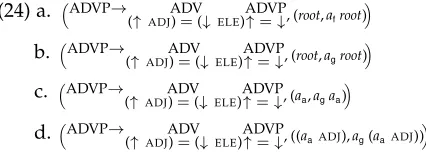
The rule ADVP→(ADV,{(↑ ADJ)=(↓ ELE)})(ADVP,{↑ =↓}), on the other hand, has many appropriate instantiations, among them the ones in (24).
(24) a. ADVP→ ADV ADVP
(↑ADJ)=(↓ELE)↑=↓, (root,afroot)
b. ADVP→ ADV ADVP
(↑ADJ)=(↓ELE)↑=↓, (root,agroot)
c. ADVP→ ADV ADVP (↑ADJ)=(↓ELE)↑=↓, (aa,agaa)
d.ADVP→ ADV ADVP
(↑ADJ)=(↓ELE)↑=↓, ((aaADJ),ag(aaADJ))
Instantiations that are not appropriate for this rule are, for example, the ones in (25). (25) a. ADVP→ ADV ADVP
(↑ADJ)=(↓ELE)↑=↓, (root,root root)
b.ADVP→ ADV ADVP (↑ADJ)=(↓ELE)↑=↓, (aa,aaaa)
They are not properly discriminating, because the ADV node of any derived f-description must denote an entity distinct from the denotation of the mother and the other daughter node.
[image:22.486.52.265.145.221.2]The instantiations in (23a) and (24a) are the ones obtained from the derivation in Figure 4 and the reducing substitution (20). Note that the appropriately instantiated rule (23b) that does not associate the S node with the root constant might result from derivations where the top of the f-structure is not denoted by the root node of the c-structure, as illustrated with the rules in (21).
So far we have considered only the individual instantiated rules that we obtain from the licensing rules of a derivation forF by replacing the node constants as described by terms of TF. As a consequence of Corollary 1, we also observe that our reducing substitutions never replace undefinable daughters of two distinct node-instantiated licensing rules by one and the same constant. That is, the term-instantiated rules that result from two distinct node-instantiated licensing rules always satisfy the following compatibility relation.
Definition 13
Two appropriately instantiated rules (r, (t,t1..tm)) and (r, (t,t1..tl)) ofIRFare
compati-bleiff
ti=tjfor allti,tj∈CFwithti= tandtj=t(1≤i≤m, 1≤j≤l).
by a constant fromCFis mother-definable. As a consequence of Corollary 1, only an in-stantiated rule that is compatible with itself can emerge from two separate applications ofrin a derivation ofF.
The instantiated rules in (26a–c), for example, are compatible while the ones in (26d) are not. The latter rules mistakenly introduce an identity that, because of Corollary 1, can never be derived by the grammar. The rules in (26a) result from reducing the licensing rules of the derivation in Figure 4 with the reducing substitution (20).
(26) a. ADVP→ ADV ADVP
(↑ADJ)=(↓ELE)↑=↓, (root,afroot)
ADVP→ ADV
(↑ADJ)=(↓ELE), (root,ag)
b. ADVP→ ADV ADVP
(↑ADJ)=(↓ELE)↑=↓, (root,agroot) ADVP→(↑ADJADV)=(↓ELE), (root,af)
c. ADVP→ ADV ADVP
(↑ADJ)=(↓ELE)↑=↓, (root,aaroot) ADVP→(↑ADJADV)=(↓ELE), (root,af)
d.ADVP→ ADV ADVP
(↑ADJ)=(↓ELE)↑=↓, (root,afroot)
ADVP→ ADV
(↑ADJ)=(↓ELE), (root,af)
Our observations lead to a definition that characterizes reducing substitutions en-tirely in terms of the identified properties of the TF-instantiated rules and thus in a way that will permit us to simulate their construction by a refinement of the context-free backbone ofG. In the following definition we useNc to denote the nodes of a c-structurec andγ[ψ] to indicate the expression that is obtained from an expressionγ (term, sequence of terms, formula, set of formulas, etc.) and a substitutionψ(mapping from constants to terms) by replacing all occurrences of constantsainγsimultaneously byψ(a).
Definition 14
Letcandρbe a derivation of f-structureFinGandψbe a mapping fromNc intoTF. Thenψis areducing substitutionfor the given derivation iffψ(root)=root, and for all n,n∈Dom(ρ) withn=n
(i) (ρn, (n,dts(n))[ψ]) is appropriately instantiated, and (ii) (ρn, (n,dts(n))[ψ]) is compatible with (ρn, (n,dts(n))[ψ]).
That reducing substitutions in fact preserve equivalence is then established by the following lemma.
Lemma 2
Let c andρ be a derivation with f-description FD and f-structure F in G. Ifψis a reducing substitution for c andρ, then FD≡FD[ψ].
Proof