Energy Efficient Data Aggregation Approach for
Wireless Sensor Networks
Sonam Bhatia1, Jagjit Singh2
1
Mtech Scholar, 2Assistant Professor, Doaba group of college, Kharar, Mohali
Abstract: A distributed type of network in which there are large numbers of sensor nodes deployed such that the surroundings of the area can be monitored and important information can be gathered is known as wireless sensor network. The sensor nodes present within the network are very small in size and have very less power for processing the tasks. The power consumption is minimized by applying the energy efficient clustering algorithm known as CTNR. There are several clusters of sensors in which CTNR is partitioned the localized coordination and control is utilized for constructing this approach. In this research work, the cache nodes are deployed in the network for the data aggregation from the wireless sensor nodes. The proposed algorithm is implemented in MATLAB and results are analyzed in terms of certain parameters. It is analyzed that in the proposed algorithm number of dead nodes are less, alive nodes are more and number of packets transmitted to base station are also high as compared to existing algorithm.
Keywords: CTNR, Cache, Dead Nodes
I. INTRODUCTION
network is affected due to this. In comparison to conventional routing that was used in fixed networks, the routing of wireless sensor networks is very different. There are unreliable wireless links since the network is infrastructure less. There is failure of sensor nodes and strict energy-saving needs are to be provided through the routing protocols. Generally, there are several routing protocols introduced by different researchers. There are various categories into which all these routing protocols are categorized. The information about location of sensor nodes plays an important role within the location-based protocols. Initially, this routing protocol was proposed for MANETs. However, due to its property of providing energy conservation, WSNs also use this type of protocol. Depending on an energy model that provides energy consumption, the Geographic Adaptive Fidelity (GAF) protocol is generated [6]. In order to route the queries to the target regions present within the sensor field, Geographic and Energy-Aware Routing (GEAR) routing protocol is proposed. The equipment of a localized hardware is important here by the sensors. Since the data is transmitted here from the source sensors towards the sink, the data-centric protocols are very different from other protocols. The data is sent independently by each sensor to the sink by each source in which appropriate data is available in case of the address-centric protocols [7]. A protocol through which the classic flooding protocols were enhanced and several problems being faced by them were solved is known as Sensor Protocols for Information via Negotiation (SPIN). There are several viewpoints with respect to which the hierarchical clustering in WSN has been studied by different researchers over time. For transmitting the sensed data towards the sink, an energy-efficient communication protocol known as clustering is utilized. The power consumption is minimized by applying the energy efficient clustering algorithm known as Low-energy adaptive clustering hierarchy (LEACH). Depending upon the duration, the task of performing clustering is rotated amongst the nodes through this approach.
II. LITERATURE REVIEW
A. RaminYarinezhada, et.al (2018) presented the closeness of sensor nodes towards the sink leads to more traffic loads in the wireless sensor network, due to which large amount of energy is depleted. It is also required to know the position of the mobile sink prior to senor nodes in order to transfer their data into it [8]. There is more consumption of energy and increase in the delay of network when the nodes are informed about the sink position. They proposed a routing algorithm in this paper based on the virtual grid infrastructure and mobile sink. With the help of this proposed method and with the use of virtual infrastructure some of the nodes are selected using which the position of the sink is maintained. On the basis of obtained results, it is concluded that better performance is shown by the proposed method as compared to the other methods in terms of energy efficient and compared delay.
B. Hassan Oudani, et.al (2017) presented the lifetime of the network is affected due to the more consumption of the energy by each node within the wireless sensor network. Therefore, reduction in the network traffic toward the sink is possible by developing some hierarchical protocols to deal with this and to increase the lifetime of the network. The performed the survey on the energy-efficient using hierarchical cluster-based approach namely LEACHES which is their main objective in this paper [9]. They also proposed a new method in order to maximize the lifetime of network sensor. With the help of this method large amount of energy is consumed when data is transmitted to the base station. The evaluated the performance of the LEACH protocol with the proposed method on the basis of obtained simulation results. They utilized the Matlab Simulink for the purpose of simulation.
C. NukhetSazak, et.al (2017) presented the most significant design issues faced while deploying the nodes in the constrained of resources in the remote location, issue is energy efficiency as these nodes are left unattended for long time within the wireless sensor network [10]. Therefore, in order to improve the energy efficiency, they proposed an active node determination method (ANDM) in this paper for WSN MAC design. They presented the integration of ANDM with ETDMA and compared it with E-TDMA concluded that it provides better energy usageup to 31 %approximately.
D. Harshita Jain, et.al (2017) presented the limited lifetime of the battery is considered as the major issue in the wireless sensor networks. It is not an easy task to change the battery of WSN all the time as it is not possible for a human to reach in the region of difficult area where nodes are deployed. They discussed the some energy efficient routing protocols of WSN in this paper. The frequently updation of the routing tables leads to the reduction in packet overhead due to which energy consumption can also reduced [11]. In this paper, they combined the dynamic source routing (DSR) with power efficient gathering in sensor information system (PEGASIS) with the help of which optimal path is determined as it used the GA and BFO.
paper using which the life of sensor in wireless sensor network can be enhanced, make more reliable and energy efficient using new cluster based approach. The prevention of the crashes of cluster head node means the network reliability and the election of cluster head is take care by energy efficiency within the new cluster technique.
F. Sheikh Tahir Bakhsh, et.al, (2017) proposed Adaptive Sleep Efficient hybrid medium access control (AEH-MAC) algorithm which is widely used for making improvements in the wireless sensor networks. In this paper, the approach minimizes the scheduling time which adjusts the sleep time of the nodes. The proposed [13] technique increases the network lifetime and energy efficiency in a very effective manner. The sleep time can be adjusted dynamically with the help of this introduced approach on the basis of the traffic load and wakeup timing of the neighboring nodes. Further improvements are required for in which ACK packets re generated which can be transferred to the receiver as they consume very less time. According to the simulations performed, it has been concluded that the proposed algorithm has high performance in terms of runtime, energy consumption and slot reservation.
III. RESEARCH METHODOLOGY
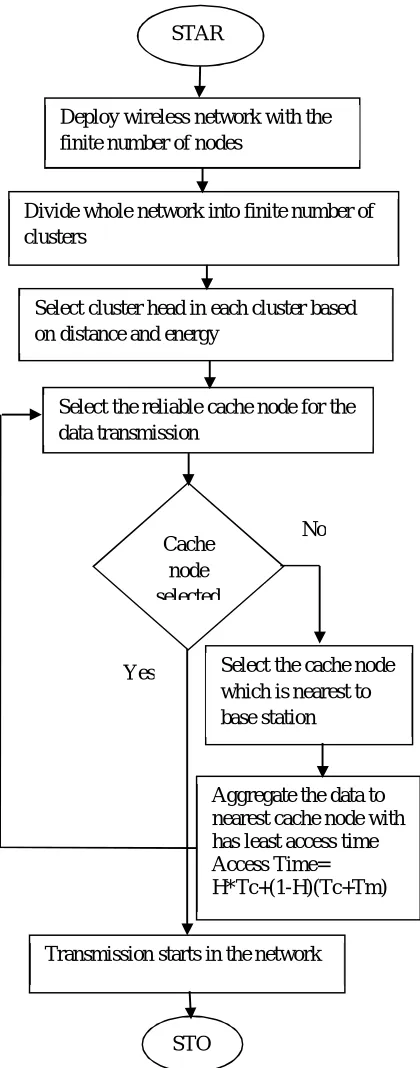
The proposed technique is particularly based on the selection of cluster head for the transmission of data, the selected cache nodes aggregate to the base station.
1) Step 1: Cluster head selection: The random distribution of nodes is one of the basic requirements of the clustered wireless sensor network’s application. The cluster heads are created due to this random distribution of sensor nodes which further creates several issues. Due to the energy consumption, there is a need to avoid disposability for the cluster head. Also, the long distance communication in the cluster head is prevented and the addition of nodes below them is also done here. The nodes are not selected by the intended standards which are not perfect in any way and are called cluster head. The conditions of nodes made the nodes difficult to available in the network and almost impossible for them to be available at remote a area which further causes inappropriate nodes. When the intra-cluster energy is increased then these nodes are used as cluster heads. The genuine node consumes less amount of energy in comparisons to the receiver and the sender nodes. When the extensive spectrum are provided to the system in synchronized manner then the battery power consumption is very less as consumed by the nodes. The parent node is selected for ever cluster head so that the actions can be separated and there is increase in productivity. Two value functions are proposed for the competence of each sensory node which further helps the node to be chosen as the cluster head. For calculating the cluster head RCH, the calculation method used by the node is shown in equation (1):
= ∗[1 + ( )] …(1)
Rmin here denotes the minimum size of cluster which is used as one of the parameters of the protocol, denotes the distance of the nearest node and base station, and represents the distance present inside the farthest node and base station. a value is calculated for every node using the value function in order to make the node appropriate enough to be chosen as cluster head.
= ∗ + + … (2)
α, β and written in the above equation are called constant weights which have values varying from zero to one. all the nodes available in the networks having similar and adjustable values. denotes the radius of the number of neighboring nodes. represent the mean square distance amongst the neighboring nodes. here denotes the distance present between the base station and every node.
The expected values help in determining the values of total number of cluster heads present in a particular time. Therefore, is known to be the improved value achieved for each node. Every node notices other nodes for the improved values being varied from zero to one. Moreover, each node generates a random value which falls from zero to one. When the value is less than the , then the node is considered as a candidate for being selected as a cluster head. After being chosen as a cluster head, comparisons are made amongst the nodes on the basis of radius and residual energy.
2) Step 2: Cache node Selection: The intra-cluster communication which exists inside the energy cluster relies on the appropriate factors. Cluster is one of them factors. The energy consumption of node radio and distance and the communication in the cluster is very expensive, and due to this the intra-cluster energy will be increased. Centrality is another important mechanism described in the paper. When the distance is less amongst the central cluster and receiver node, then the second power average is minimized which minimizes the intra-cluster energy. The energy is affected because of the other several factors. The nodes are not selected by the intended standards which are popularly known as cache nodes under unsuitable conditions. The value of every step is calculated for every non-cluster head node in such a manner that any node can be chosen as a volunteer node.
STAR T
Deploy wireless network with the finite number of nodes
Divide whole network into finite number of clusters
Select cluster head in each cluster based on distance and energy
Select the reliable cache node for the data transmission
Cache node selected
Select the cache node which is nearest to base station
Aggregate the data to nearest cache node with has least access time Access Time= H*Tc+(1-H)(Tc+Tm)
Transmission starts in the network
STO
No
[image:4.612.192.402.175.709.2]IV. EXPERIMENTAL RESULTS
[image:5.612.189.424.119.360.2]The proposed work is implemented in MALTAB and the results are evaluated by making comparisons against proposed and existing approaches in terms of several parameters.
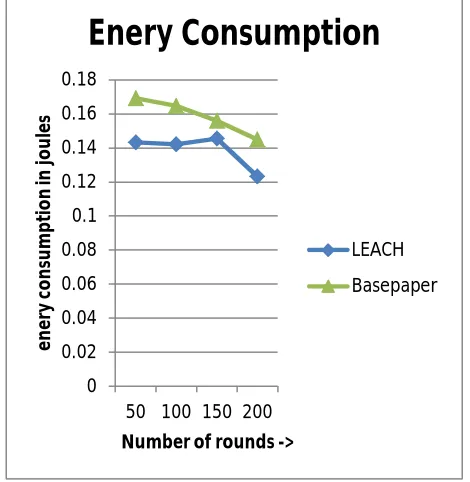
Fig 2: Energy Consumption
[image:5.612.193.422.413.656.2]Figure 2 represents the comparison of basepaper and proposed technique. It results that the proposed protocol has minimum amount of energy consumption in comparison to the other techniques.
Fig 3: Number of dead Node Comparison
Figure 3 demonstrates the comparison between LEACH protocol and cache technique in terms of the dead nodes. The proposed technique has fewer amounts of dead nodes in the give amount of rounds.
0 0.02 0.04 0.06 0.08 0.1 0.12 0.14 0.16 0.18
50 100 150 200
e
n
e
ry
c
o
n
su
m
p
ti
o
n
in
jo
u
le
s
Number of rounds ->
Enery Consumption
LEACH
Basepaper
0 5 10 15 20 25 30 35
50 100 150 200
N
u
m
b
e
r
o
f
d
e
ad
n
o
d
e
s
Number of Rounds ->
Dead Node
Comparision
Basepaper
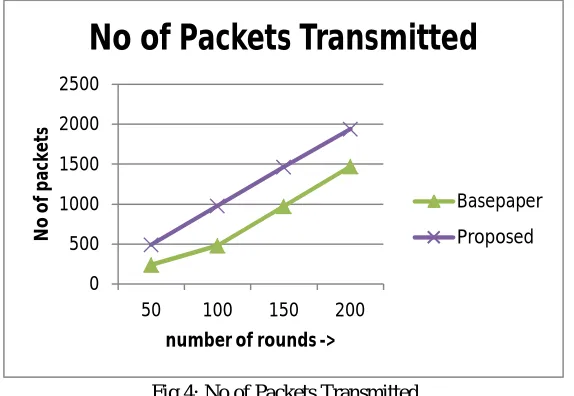
Fig 4: No of Packets Transmitted
Figure 4 shows the comparison between the number of packet transmitted to the base station, proposed technique, base paper, LEACH and cache technique. The proposed technique transmits the large number of packet in comparison to the other techniques.
V. CONCLUSION
The wireless sensor network is the decentralized and self-configuring type of network in which sensor nodes sense information and pass it to base station. Due to such type of network, energy consumption and security are major issues of WSN. The clustering is the efficient approach which increase lifetime of the wireless sensor networks. In the approach of the clustering, the cluster heads are selected on the basis of distance and energy. The cluster heads transmit data to the base station. In this research work, the cache nodes are deployed which aggregate data from sensor nodes and cache nodes with forward data to base station. The proposed algorithm is implemented in MATLAB and results are analyzed in terms of certain parameters. It is analyzed that proposed algorithm performs well as compared to existing algorithm in terms of certain parameters.
REFERENCES
[1] Sanjeev Saini, Ram Sewak Singh & V. K. Gupta,” Analysis of Energy Efficient Routing Protocols in Wireless Sensor Networks, International Journal of Computer Science &Communication , Vol. 1, No. 1, pp. 113-118, June 2010.
[2] W. Heinzelman, A. Chandrakasan and H. Balakrishnan, "Energy- Efficient Communication Protocol for Wireless Mi-crosensor Networks," Proceedings of the 33rd Hawaii International Conference on System Sciences (HICSS '00), January 2000.
[3] RajniMeelu&RohitAnand, " Performance Evaluation of Cluster- based Routing Protocols used in Heterogeneous Wireless Sensor Networks", International Journal of Information Technology and Knowledge Management, Vol. 4, pp. 227-231.
[4] Shio Kumar Singh, M P Singh, and D K Singh," Routing Protocols in Wireless Sensor Networks –A Survey”, International Journal of Computer Science & Engineering Survey (IJCSES), ,vol.1, Issue.No.2, November 2010.
[5] Ming Liu, Jiannong Cao, Guihai Chen and Xiaomin Wang,” An Energy-Aware Routing Protocol in Wireless Sensor Networks, in International Journal of Sensors, vol.9, pp. 445-462,2009.
[6] DjallelEddineBoubiche and AzeddineBilami ,” HEEP (Hybrid Energy Efficiency Protocol) based on chain clustering”, International Journal on Sensor Networks, vol. 10,2010.
[7] M. Merck.“Theicecube detector: A large sensor network at the south pole”. IEEE Pervasive Computing, 2010,vol. (4), pp 43-47.
[8] Ramin Yarinezhada, Amir Sarabi, “Reducing delay and energy consumption in wireless sensor networks by making virtual grid infrastructure and using mobile sink”, 2018, Int. J. Electron. Commun. (AEÜ) 84,144–152
[9] Hassan Oudani, Salahddine Krit, Mustapha Kabrane, Kaoutar Bandaoud, Mohamed Elaskri, Khaoula Karimi, Hicham Elbousty, Lahoucine Elmaimouni, “Energy Efficient in Wireless Sensor Networks Using Cluster-Based Approach Routing”, International Journal of Sensors and Sensor Networks 2017
[10] Nukhet Sazak, Ismail Erturk, Etem Koklukaya, Murat Cakiroglu, “Impact of Active Node Determination Approach for Energy Efficiency in WSN MAC Protocol Design”, IEEE, 2017
[11] Harshita Jain, Rekha Jain, Shekhar Sharma, Improvement of Energy Efficiency Using PDORP Protocol in WSN”, IEEE, 2017
[12] Vivek Kumar Singh, Rajesh Kumar, subrata Sahana, “To Enhance the Reliability and Energy Efficiency of WSN using New Clustering Approach”, International Conference on Computing, Communication and Automation, 2017
[13] Sheikh Tahir Bakhsh, Rayed AlGhamdi, Abdulrahman H. Altalhi, Sabeen Tahir and Muhammad Aman Sheikh, “Adaptive Sleep Efficient Hybrid Medium Access Control algorithm for next generation wireless sensor networks” , EURASIP Journal on Wireless Communications and Networking, vol.84, pp.1-15, 2017.
0 500 1000 1500 2000 2500
50 100 150 200
N
o
o
f
p
ac
ke
ts
number of rounds ->
No of Packets Transmitted
Basepaper