402
Lessons learned in multilingual grounded language learning
Ákos Kádár
Tilburg University [email protected]
Desmond Elliott∗
University of Copenhagen [email protected]
Marc-Alexandre Côté
Microsoft Research Montreal [email protected]
Grzegorz Chrupała
Tilburg University [email protected]
Afra Alishahi
Tilburg University [email protected]
Abstract
Recent work has shown how to learn better visual-semantic embeddings by leveraging im-age descriptions in more than one languim-age. Here, we investigate in detail which conditions affect the performance of this type of grounded language learning model. We show that multi-lingual training improves over bimulti-lingual train-ing, and that low-resource languages benefit from training with higher-resource languages. We demonstrate that a multilingual model can be trained equally well on either translations or comparable sentence pairs, and that annotating the same set of images in multiple language en-ables further improvements via an additional caption-caption ranking objective.
1 Introduction
Multimodal representation learning is largely mo-tivated by evidence of perceptual grounding in hu-man concept acquisition and representation ( Barsa-lou et al.,2003). It has been shown that visually grounded word and sentence-representations (Kiela et al.,2014;Baroni,2016;Elliott and Kádár,2017;
Kiela et al.,2017;Yoo et al.,2017) improve perfor-mance on the downstream tasks of paraphrase iden-tification, semantic entailment, and multimodal ma-chine translation (Dolan et al.,2004;Marelli et al.,
2014;Specia et al.,2016). Multilingual sentence representations have also been successfully applied to many-languages-to-one character-level machine translation (Chung et al.,2016) and multilingual dependency parsing (Ammar et al.,2016).
Recently,Gella et al.(2017) proposed to learn both bilingual and multimodal sentence represen-tations using images paired with captions indepen-dently collected in English and German. Their results show that bilingual training improves image-sentence ranking performance over a monolingual
∗
Work carried out at the University of Edinburgh.
baseline, and it improves performance on semantic textual similarity benchmarks (Agirre et al.,2014,
2015). These findings suggest that it may be benefi-cial to consider another language as another modal-ityin a monolingual grounded language learning model. In the grounded learning scenario, descrip-tions of an image in multiple languages can be considered as multiple views of the same or closely related data. These additional views can help over-come the problems of data sparsity, and have prac-tical implications for efficiently collecting image-text datasets in different languages. In real-life applications, many tasks and domains can involve code switching (Barman et al., 2014), which is easier to deal with using a multilingual model. Fur-thermore, it is more convenient to maintain a single multilingual system than one system for each con-sidered language. However, there is a need for a systematic exploration of the conditions under which it is useful to add additional views of the data. We investigate the impact of the following conditions on the performance of a multilingual grounded language learning model in sentence and image retrieval tasks:
Additional languages. Multilingual models have not been explored yet in a multimodal set-ting. We investigate the contribution of adding more than one language by performing bilin-gual experiments on English and German (Section 5) as well as adding French and Czech captioned images (Section6).
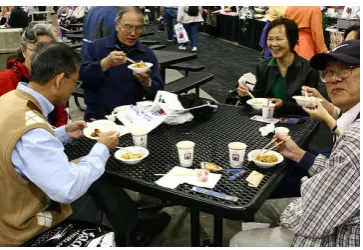
En: A group of people are eating noodles. De:Eine Gruppe von Leuten isst Nudeln. Fr:Un groupe de gens mangent des nouilles. Cs:Skupina lidí jedí nudle.
(a) A translation tuple
En: Several asian people eating around a table. De:Drei Männer und zwei Frauen südostasiatischen Aussehens sitzen, aus Schälchen essend, an einem schwarzen, Tisch, auf dem sich u.a. auch Pappbecher und eine Tasche befinden, im Hintergrund sind weitere Personen und Tische.1
[image:2.595.209.391.60.185.2](b) A comparable pair
Figure 1: An example taken from theTranslationandComparableportions of the Multi30K dataset. The translation portion (a) contains professional translations of the English captions into German, French, and Czech. The comparable portion (b) consists of five independently crowdsourced English and German descriptions, given only the image. Note that the sentences in (b) convey different information from the English–German translation pair in (a).
captions are collected in different languages. Such disjoint settings have been explored in pivot-based multimodal representation learn-ing (Funaki and Nakayama,2015;Rajendran et al.,2015) or zero-shot multi-modal machine translation (Nakayama and Nishida, 2017). We compare translated vs. independently col-lected captions in Sections5.2and6.1, and overlapping vs. disjoint images in Section5.3.
High-to-low resource transfer: In Section 6.2
we investigate whether low-resource lan-guages benefit from jointly training on larger data sets from higher-resource languages. This type of transfer has previously been shown to be effective in machine translation (e.g.,Zoph et al.,2016).
Training objective: In addition to learning to map images to sentences, we study the effect of also learning relationships between captions of the same image in different languagesGella et al. (2017). We assess the contribution of such a caption–caption ranking objective throughout our experiments.
Our results show that multilingual joint
train-ing improves upon biltrain-ingual joint traintrain-ing, and that grounded sentence representations for a low-resource language can be substantially improved with data from different high-resource languages. Our results suggest that independently-collected captions are more useful than translated captions, for the task of learning multilingual multimodal sentence embeddings. Finally, we recommend to collect captions for the same set of images in multi-ple languages, due to the benefits of the additional caption–caption ranking objective function.
2 Related work
Learning visually grounded word-representations has been an active area of research in the fields of multi-modal semantics and cross-situational word-learning. Such perceptually-grounded word repre-sentations have been shown to lead to higher corre-lation with human judgements on word-similarity benchmarks such as WordSim353 (Finkelstein et al.,2001) or SimLex999 (Hill et al.,2015) com-pared to uni-modal representations (Kádár et al.,
1Gloss: Three men and two women with a South-East
2015;Bruni et al.,2014;Kiela and Bottou,2014).
Grounded representations of sentences that are learned from image–caption data sets also improve performance on a number of sentence-level tasks (Kiela et al.,2017;Yoo et al.,2017) when used as additional features to skip-thought vectors (Kiros et al., 2015). The model architectures used for these studies have the same overall structure as our model and coincide with image–sentence retrieval systems (Kiros et al.,2014;Karpathy and Fei-Fei,
2015): a pre-trained CNN is fixed or fine-tuned as image feature extractor, followed by a learned transformation, while sentence representations are learned by a randomly initialized recurrent neural network. These models are trained to push the true image–caption pairs closer together, and the false image–caption pairs further from each other, in a joint embedding space.
In addition to learning grounded representations for image-sentence ranking, joint vision and lan-guage systems have been proposed to solve a wide range of tasks across modalities such as image cap-tioning (Mao et al.,2014;Vinyals et al.,2015;Xu et al.,2015), visual question answering (Antol et al.,
2015;Fukui et al.,2016;Jabri et al.,2016), text-to-image synthesis (Reed et al.,2016) and multimodal machine translation (Libovicky and Helcl, 2017;
Elliott and Kádár,2017).
Our work is also closely related to multilingual joint representation learning. In this scenario, a sin-gle model is trained to solve a task across multiple languages. Ammar et al.(2016) train a multilin-gual dependency parser on the Universal Depen-dencies treebank (Nivre et al.,2015) and show that on average the single multilingual model outper-forms the monolingual baselines. Johnson et al.
(2016) present a zero-shot neural machine transla-tion model that is jointly trained on language pairs
A ↔ B andB ↔ Cand show that the model is capable of performing well on the unseen language pairA↔C.Lee et al.(2017) find that jointly train-ing a many-languages-to-one translation model on unsegmented character sequences improves BLEU scores compared to monolingual training. They also show evidence that the model can handle intra-sentence code-switching.Peters et al.(2017) train a multilingual sequence-to-sequence translation ar-chitecture on grapheme-to-phoneme conversion us-ing more than 300 languages. They report better performance when adding multiple languages, even those which are not present in the test data. Finally,
Require: p: task switching probability.
Dc2i: datasetsD1. . . Dkof image-caption pairs
< c, i >for allklanguages.
Dc2c: data set of all possible caption pairs
< ca, cb >for allklanguages.
φ(c, θφ): caption encoder
ψ(i, θφ): image encoder
whilenot stopping criteriondo
T ∼Bern(p) ifT = 1 then
Dn∼ Dc2i
< c, i >∼Dn a←φ(c, θφ) b←ψ(i, θψ)
else
< ca, cb>∼Dc2c a←φ(ca, θφ) b←φ(cb, θφ)
end if
[θφ;θψ]←SGD(∇[θφ;θψ]J(a,b))
[image:3.595.313.511.90.359.2]end while
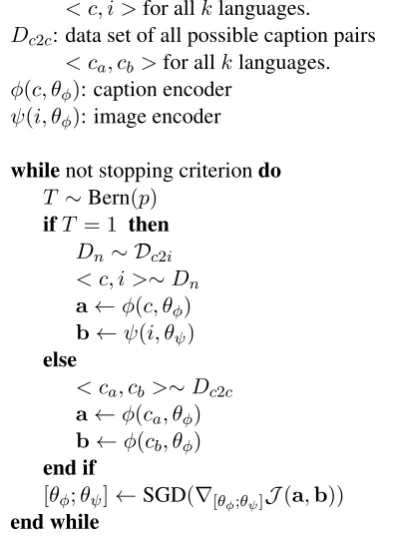
Figure 2: Pseudo-code of the training procedure used to train our multilingual multi-task model.
massively multilingual language representations trained on over 900 languages have been shown to resemble language families (Östling and Tiede-mann,2016) and can successfully predict linguistic typology features (Malaviya et al.,2017).
In the vision and language domain, multilingual-multimodal sentence representation learning has been limited so far to two languages. The joint training of models on English and German data has been shown to outperform monolingual baselines on image-sentence ranking and semantic textual similarity tasks (Gella et al.,2017;Calixto et al.,
2017). RecentlyHarwath et al.(2018) also showed the benefit of joint bilingual training in the domain of speech-to-image and image-to-speech retrieval using English and Hindi data.
3 Multilingual grounded learning
We train a standard model of grounded language learning which projects images and their textual descriptions into the same space (Kiros et al.,2014;
ψ(i, θψ), and captionscare encoded by a randomly
initialized RNNφ(c, θφ). The model learns to
min-imize the distance between pairs <a, b> using a max-of-hinges ranking loss (Faghri et al.,2017):
J(a, b) = max
<ˆa,b>[max(0, α−s(a, b) +s(ˆa, b))] +
max
<a,ˆb>
[max(0, α−s(a, b) +s(a,ˆb))]
where< a, b >are the true pairs, and < a,ˆb >
and<a, b >ˆ are all possible contrastive pairs in the mini-batch. The pairs either consists of image-caption pairs< i, c >, where the model solves a caption-imagec2iranking task, or pairs of captions in multiple languages belonging to the same im-age< ca, cb >, where the model solves a
caption-captionc2cranking task (Gella et al.,2017). Our monolingual models are trained to minimize the caption-image ranking objectivec2ion the training set. The multilingual models are trained to mini-mize the ranking loss for the set of all languages
Lin the collection: at each iteration the model is either updated for thec2iobjective or the caption-captionc2cobjective given either < cl, i >or a
< cka, cmb >pair in languagesl, k, m, . . .∈ L. All models are trained by first selecting a task, either c2iorc2c. In thec2icase, a language is sampled at random followed by sampling a random batch; in thec2ccase, all possible< ca, cb >pairs across
all languages are treated as a single data set. All of the model parameters are shared across all tasks and languages.
Implementation. We build our model on the Py-Torch implementation of the VSE++ model (Faghri et al.,2017). Images are represented by the 2048D average-pool features extracted from the ResNet50 architecture (He et al.,2016) trained on ImageNet (Deng et al., 2009); this is followed by a trained linear layerWI ∈R2048×1024. Other
implementa-tion details follow (Faghri et al.,2017): sentences are represented as the final hidden state of a GRU (Chung et al.,2014) with 1024 units and 300 di-mensional word-embeddings trained from scratch. We use a single word embedding matrix containing the union of all words in all considered languages. The similarity functionsin the ranking loss is co-sine similarity. We`2normalize both the caption
and image representations. The model is trained with the Adam optimizer (Kingma and Ba,2014) using default parameters and learning-rate of 2e-4. We train the model with an early stopping
crite-En De Fr Cz
En 1.0 0.04 0.06 0.02
De – 1.0 0.03 0.01
Fr – – 1.0 0.01
[image:4.595.345.491.63.162.2]Cz – – – 1.0
Table 1: Vocabulary overlap as measured by the Jaccard coefficient between the different languages on the translation portion of the Multi30K dataset.
rion, which is to maximise the sum of the image– sentence recall scores R@1, R@5, R@10 on the validation set with patience of 10 evaluations. In the monolingual setting the stopping criterion is evaluated at the end of each epoch, whereas in the multilingual setup it is evaluated every 500 itera-tions. The probability of switching between the c2iand c2ctasks is set to 0.5. Batches from all data sets are sampled by shuffling the full dataset, going through each batch and re-shuffling when exhausted. The sentence-pair dataset used to train thec2cranking model for`languages is generated as follows. For a given imagei, a set of languages 1· · · `, and a set of captionsC1i, . . . , C`iassociated with an imagei, we generate the set of all possible combinations of size 2 from caption setsCiand add
the Cartesian product between all resulting pairs
Cmi ×Cni inCito the training set.
4 Experimental setup2
Datasets. We train and evaluate our models on the translation and comparable portions of the Multi30K dataset (Elliott et al.,2016,2017). The translation portion (a low-resource dataset) con-tains 29K images, each described in one English caption with German, French, and Czech transla-tions. The comparable portion (a higher-resource dataset) contains the same 29K images paired with five English and five German descriptions collected independently. Figure1presents an example of the translation and comparable portions of the data. We used the preprocessed version of the dataset, in which the text is lowercased, punctuation is nor-malized, and the text is tokenized3. To reduce the vocabulary size of the joint models, we replace all words occurring fewer than four times with a
spe-2
Code to reproduce our results is available at
https://github.com/kadarakos/mulisera.
cial “UNK” symbol. Table1shows the overlap be-tween the vocabularies of thetranslationportion of the Multi30K dataset. The total number of tokens across all four languages is 17,571, and taking the union of the tokens in these four languages results in vocabulary of 16,553 tokens – a 6% reduction in vocabulary size. On thecomparableportion of the dataset, the total vocabulary between English and German contains 18,337 tokens, with a union of 17,667, which is a 4% reduction in vocabulary size.
Evaluation. We evaluate our models on the 1K images of the 2016 test set of Multi30K either using the 5K captions from the comparable data or the 1K translation pairs. We evaluate on image-to-text (I→T) and text-to-image (T→ I) retrieval tasks. For most experiments we report Recall at 1 (R@1), 5 (R@5) and 10 (R@10) scores averaged over 10 randomly initialised models. However, in Section6
we only report R@10 due to space limitations and because it has less variance than R@1 or R@5.
5 Bilingual Experiments
5.1 ReproducingGella et al.(2017)
We start by attempting to reproduce the findings of Gella et al. (2017). In these experiments we train our multi-task learning model on the
comparableportion of Multi30K. Our models re-implement their setups used for VSE (Monolin-gual) and bilingual models Pivot-Sym (Bilin-gual) andParallel-Sym(Bilingual + c2c). The
OE,Pivot-Asym andParallel-Asym mod-els are trained using the asymmetric similarity mea-sure introduced for the order-embeddings (Vendrov et al.,2015). The main differences between our models and Gella et al. (2017) is that they use VGG-19 image features, whereas we use ResNet50 features, and we use the max-of-hinges loss instead of the more common sum-of-hinges loss.
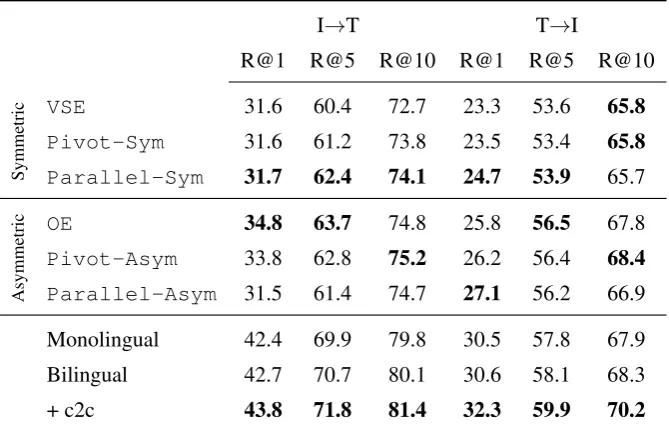
Table2shows the results on the English compa-rable 2016 test set. Overall our scores are higher thanGella et al.(2017), which is most likely due to the different image features (Faghri et al.(2017) also report a large performance gain when they use the ResNet instead of the VGG image features). Nevertheless, our results show a similar trend to the symmetric cosine similarity models fromGella et al. (2017): our best results are achieved with bilingual joint training with the added c2c objective. Their models trained with an asymmetric similarity
measure show a different trend: the monolingual model is stronger than the bilingual model, and the c2c loss provides no clear improvement.
Table3presents the German results. Once again, our implementation outperformsGella et al.(2017), and this is likely due to the different visual features and max-of-hinges loss. However, our Bilingual model with the additional c2c objective performs the best for German, whereasGella et al. (2017) reports the overall best results for the monolingual baselineVSE. Their models that use the asymmet-ric similarity function are clearly better than the Monolingual OE model. In general, the results from Gella et al. (2017) indicate the benefits of bilingual joint training, however, they do not find a clear pattern between the model configurations across languages. In our implementation, we only focused on the symmetric cosine similarity func-tion and found a systematic pattern across both languages: bilingual training improves results on all performance metrics for both languages, and the additional c2c objective always provides fur-ther improvements.
5.2 Translations vs. independent captions
We now study whether the model can be trained on either translation pairs or independently col-lected bilingual captions. Gella et al.(2017) only conducted experiments on independently collected captions. However, it is known that humans have equally strong preference for translated or indepen-dently collected captions of images (Frank et al.,
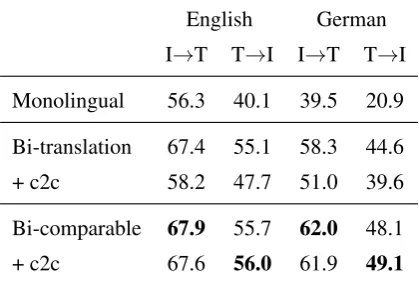
2018), which has implications for the difficulty and cost of collecting training data. Our baseline is a Monolingual model trained on 29K single-captioned images in the translation portion of Multi30K. The Bi-translation model is trained on both German and English, with shared parame-ters. Table4shows that there is a substantial im-provement in performance for both languages in the bilingual setting. However, the additional c2c loss degrades performance here. This could be because we only have one caption per image in each language and it is easier to find a relationship between these views of the translation pairs.
Cru-I→T T→I
R@1 R@5 R@10 R@1 R@5 R@10
Symmetric
VSE 31.6 60.4 72.7 23.3 53.6 65.8
Pivot-Sym 31.6 61.2 73.8 23.5 53.4 65.8
Parallel-Sym 31.7 62.4 74.1 24.7 53.9 65.7
Asymmetric
OE 34.8 63.7 74.8 25.8 56.5 67.8
Pivot-Asym 33.8 62.8 75.2 26.2 56.4 68.4
Parallel-Asym 31.5 61.4 74.7 27.1 56.2 66.9
Monolingual 42.4 69.9 79.8 30.5 57.8 67.9
Bilingual 42.7 70.7 80.1 30.6 58.1 68.3
[image:6.595.132.467.63.278.2]+ c2c 43.8 71.8 81.4 32.3 59.9 70.2
Table 2: English Image-to-text (I→T) and text-to-image (T→I) retrieval results on thecomparablepart of Multi30K, measured by Recall at 1, 5 at 10. Typewriterfont shows performance of two sets of symmetric and asymmetric models fromGella et al.(2017).
I→T T→I
R@1 R@5 R@10 R@1 R@5 R@10
Symmetric
VSE 29.3 58.1 71.8 20.3 47.2 60.1
Pivot-Sym 26.9 56.6 70.0 20.3 46.4 59.2
Parallel-Sym 28.2 57.7 71.3 20.9 46.9 59.3
Asymmetric
OE 26.8 57.5 70.9 21.0 48.5 60.4
Pivot-Asym 28.2 61.9 73.4 22.5 49.3 61.7
Parallel-Asym 30.2 60.4 72.8 21.8 50.5 62.3
Monolingual 34.2 63.0 74.0 23.9 49.5 60.5
Bilingual 35.2 64.3 75.3 24.6 50.8 62.0
+ c2c 37.9 66.1 76.8 26.6 53.0 64.0
Table 3: German Image-to-text (I→T) and text-to-image (T→I) retrieval results on thecomparablepart of Multi30K, measured by Recall at 1, 5 at 10. Typewriterfont shows performance of two sets of symmetric and asymmetric models fromGella et al.(2017).
cially, it is still better than training on monolingual data. In the Bi-comparable setting, the c2c loss does not have a detrimental effect on model per-formance, unlike in the Bi-translation experiment. Overall we find that thecomparabledata leads to larger improvements in retrieval performance.
5.3 Overlapping vs. non-overlapping images
In a bilingual setting, we can improve an image-sentence ranking model by collecting more data in
a second language. This can be achieved in two ways: by collecting captions in a new language for the same overlapping set of images, or by us-ing a disjoint set of images and captions in a new language. We compare these two settings here.
In the Bi-overlap condition, we collect captions for the existing images in a new language, i.e. we use all of the English and German captions paired with a random selection of 50% of the images in
English German
I→T T→I I→T T→I
Monolingual 56.3 40.1 39.5 20.9
Bi-translation 67.4 55.1 58.3 44.6
+ c2c 58.2 47.7 51.0 39.6
Bi-comparable 67.9 55.7 62.0 48.1
[image:7.595.75.285.66.207.2]+ c2c 67.6 56.0 61.9 49.1
Table 4: R@10 retrieval results on thecomparable
part of Multi30K. Bi-translation is trained on 29K
translation pairdata; bi-comparable is trained by downsampling thecomparabledata to 29K.
dataset of 14.5K images with 145K bilingual tions. In the Bi-disjoint condition, we collect cap-tions for new images in a new language, i.e. we use all of the English captions from a random selection of 50% of the images, and all of the German cap-tions for the remaining 50% of the images. This results in a training dataset on 29K images with a total of 145K bilingual captions.
Table5shows the results of this experiment. The upper-bound is to train a Monolingual model on the fullcomparablecorpus. For the lower bound, we train Half Monolingual models by randomly sam-pling half of the 29K images and their associated captions, giving 72.5K captions over 14.5K images. Unsurprisingly, the Half Monolingual models per-form worse than the Full Monolingual models. In the Bi-overlap experiment, the German model is improved by collecting captions for the existing images in English. There is no difference in the performance of the English model, echoing the results from Section 5.1. The Bi-overlap model also benefits from the added c2c objective. Finally, the disjoint model performs as well as the Bi-overlap model without the c2c objective. (It was not possible to train the Bi-disjoint model with the additional c2c objective because there are no cap-tion pairs for the same image.)
Overall, these results suggest that it is best to collect additional captions in the original language, but when adding a second language, it is better to collect extra captions for existing images and exploit the additional c2c ranking objective.
English German
I→T T→I I→T T→I
Full Monolingual 79.8 67.9 74.0 60.5
Half Monolingual 73.7 61.6 66.4 53.9
Bi-overlap 73.6 62.2 67.6 54.9
+ c2c 76.0 65.9 71.2 59.1
[image:7.595.306.532.67.209.2]Bi-disjoint 73.1 62.1 67.9 54.9
Table 5: R@10 retrieval results on the compara-ble part of Multi30K. Full model trained on the 29K images of thecomparablepart, Half model on 14.5K images using random downsampling. For Bi-overlap, both English and German captions are used for 14.5K images. For Bi-disjoint, 14.5K im-ages are used for English and the remaining 14.5K images for German.
6 Multilingual experiments
We now turn out attention to multilingual learning using the English, German, French and Czech anno-tations in thetranslationportion of Multi30K. We only report the text-to-image (T→I) R@10 results due to space limitations.
We did not repeat the overlapping vs. non-overlapping experiments from Section5.3in a mul-tilingual setting because this would introduce too much data sparsity. In order to conduct this exper-iment, we would have to downsample the already low-resource French and Czech captions by 50%, or even further for multi-way experiments.
6.1 Translation vs. independent captions
En De Fr Cz
Monolingual 50.4 39.5 47.0 42.0
Multi-translation 58.7 51.2 57.0 51.0
+ c2c 56.3 52.2 55.0 51.6
Multi-comparable 59.2 49.6 57.2 50.8
+ c2c 61.8 52.7 59.2 55.2
Table 6: The Monolingual and joint Multi-translation models trained ontranslation pairs, and the Multi-comparable trained on the downsampled
comparableset with one caption per image.
These results clearly demonstrate the advantage of jointly training on more than two languages. Text-to-image retrieval performance increases by more than 11 R@10 points for each of the four languages in our experiment.
6.2 High-to-low resource transfer
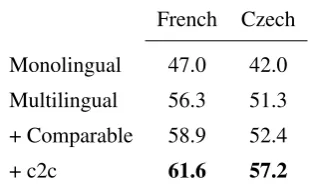
We now examine whether the lower-resource French and Czech models benefit from training with the full complement of the higher-resource English and German comparable data. Therefore we train a joint model on the translationas well ascomparableportions of Multi30K, and examine the performance on French and Czech.
Table7shows the results of this experiment. We find that the French and Czech models improve by 8.8 and 5.5 R@10 points respectively when they are only trained on the multilingual translation pairs (compared to the monolingual version), and by an-other 2.2 and 2.8 points if trained on the extra 155K English and Germancomparabledescriptions. We also find that the additional c2c objective improves the Czech model by a further 4.8 R@10 points (this improvement is likely caused by training the model on 46 possible caption pairs). Our results show the impact of jointly training with the larger En-glish and German resources, which demonstrates the benefits of high-to-low resource transfer.
6.3 Bilingual vs. multilingual
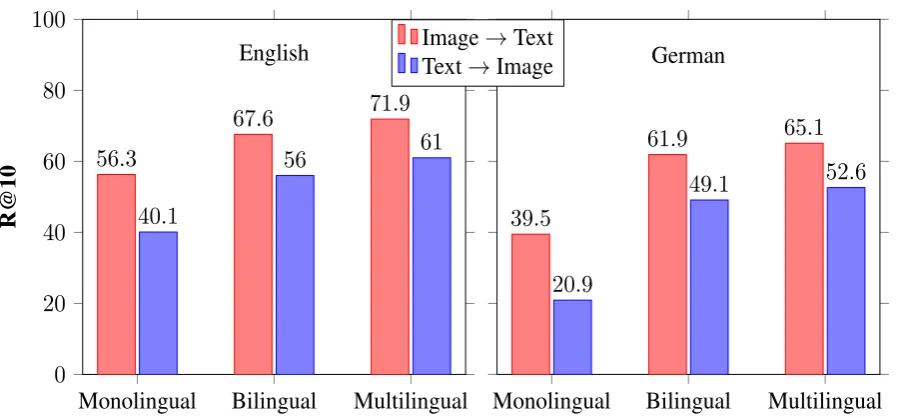
Finally, we investigate how useful it is to train on four languages instead of two. Figure3presents the image-to-text and text-to-image retrieval results of training Monolingual, Bilingual, or Multilingual models. The Monolingual and Bilingual models are trained on a random single-caption-image
subsam-French Czech
Monolingual 47.0 42.0
Multilingual 56.3 51.3
+ Comparable 58.9 52.4
[image:8.595.72.289.64.196.2] [image:8.595.340.495.66.160.2]+ c2c 61.6 57.2
Table 7: Multilingual is trained on alltranslation pairs, + Comparable adds thecomparabledata set.
ple of thecomparabledataset with the additional c2c objective, as this configuration provided the overall best results in Sections5.2and 6.1. The Multilingual models are trained with the additional French and Czechtranslationdata. As can be seen in Figure3, the performance on both tasks and for both languages improves as we move from using data from one to two to four languages.
7 Conclusions
We learn multilingual multimodal sentence em-beddings and show that multilingual joint training improves over bilingual joint training. We also demonstrate that low-resource languages can bene-fit from the additional data found in high-resource languages. Our experiments suggest that either translation pairs or independently-collected cap-tions improve the performance of a multilingual model, and that the latter data setting provides fur-ther improvements through a caption–caption rank-ing objective. We also show that when collectrank-ing data in an additional language, it is better to col-lect captions for the existing images because we can exploit the caption–caption objective. Our re-sults lead to several directions for future work. We would like to pin down the mechanism via which multilingual training contributes to improved per-formance for image-sentence ranking. Addition-ally, we only consider four languages and show the gain of multilingual over bilingual training only for the English-German language pair. In future work we will incorporate more languages from data sets such as the Chinese Flickr8K (Li et al.,2016) or Japanese COCO (Miyazaki and Shimizu,2016).
Acknowledgements
Monolingual
Bilingual
Multilingual
0
20
40
60
80
100
English
56
.
3
67
.
6
71
.
9
40
.
1
56
61
R@10
Monolingual
Bilingual
Multilingual
German
39
.
5
61
.
9
65
.
1
20
.
9
49
.
1
52
.
6
[image:9.595.78.531.61.270.2]Image
→
Text
Text
→
Image
Figure 3: Comparing models from the Monolingual, Bilingual and Multilingual settings. The Monolingual and Bilingual models are trained on the downsampled English and Germancomparablesets with additional c2c objective. The Multilingual model uses the French and Czechtranslation pairsas additional data. The results are reported on the full 2016 test set of thecomparableportion of Multi30K.
References
Agirre, E., Banea, C., Cardie, C., Cer, D., Diab, M., Gonzalez-Agirre, A., Guo, W., Lopez-Gazpio, I., Maritxalar, M., Mihalcea, R., et al. (2015). Semeval-2015 task 2: Semantic textual similarity, english, spanish and pilot on interpretability. InProceedings of the 9th international workshop on semantic eval-uation (SemEval 2015), pages 252–263.
Agirre, E., Banea, C., Cardie, C., Cer, D., Diab, M., Gonzalez-Agirre, A., Guo, W., Mihalcea, R., Rigau, G., and Wiebe, J. (2014). Semeval-2014 task 10: Multilingual semantic textual similarity. In Proceed-ings of the 8th international workshop on semantic evaluation (SemEval 2014), pages 81–91.
Ammar, W., Mulcaire, G., Ballesteros, M., Dyer, C., and Smith, N. A. (2016). Many languages, one parser. arXiv preprint arXiv:1602.01595.
Antol, S., Agrawal, A., Lu, J., Mitchell, M., Batra, D., Lawrence Zitnick, C., and Parikh, D. (2015). Vqa: Visual question answering. In Proceedings of the IEEE International Conference on Computer Vision, pages 2425–2433.
Barman, U., Das, A., Wagner, J., and Foster, J. (2014). Code mixing: A challenge for language identifica-tion in the language of social media. InProceedings of the first workshop on computational approaches to code switching, pages 13–23.
Baroni, M. (2016). Grounding distributional semantics in the visual world. Language and Linguistics Com-pass, 10(1):3–13.
Barsalou, L. W., Simmons, W. K., Barbey, A. K., and Wilson, C. D. (2003). Grounding conceptual knowl-edge in modality-specific systems. Trends in cogni-tive sciences, 7(2):84–91.
Bruni, E., Tran, N.-K., and Baroni, M. (2014). Multi-modal distributional semantics. Journal of Artificial Intelligence Research, 49:1–47.
Calixto, I., Liu, Q., and Campbell, N. (2017). Multilin-gual multi-modal embeddings for natural language processing.arXiv preprint arXiv:1702.01101.
Chung, J., Cho, K., and Bengio, Y. (2016). A character-level decoder without explicit segmenta-tion for neural machine translasegmenta-tion. arXiv preprint arXiv:1603.06147.
Chung, J., Gulcehre, C., Cho, K., and Bengio, Y. (2014). Empirical evaluation of gated recurrent neu-ral networks on sequence modeling. arXiv preprint arXiv:1412.3555.
Deng, J., Dong, W., Socher, R., Li, L.-J., Li, K., and Fei-Fei, L. (2009). Imagenet: A large-scale hier-archical image database. In Computer Vision and Pattern Recognition, 2009. CVPR 2009. IEEE Con-ference on, pages 248–255. IEEE.
Dolan, B., Quirk, C., and Brockett, C. (2004). Un-supervised construction of large paraphrase corpora: Exploiting massively parallel news sources. In Pro-ceedings of the 20th international conference on Computational Linguistics, page 350. Association for Computational Linguistics.
task on multimodal machine translation and multi-lingual image description. InProceedings of the Sec-ond Conference on Machine Translation, Volume 2: Shared Task Papers.
Elliott, D., Frank, S., Sima’an, K., and Specia, L. (2016). Multi30k: Multilingual english-german im-age descriptions. arXiv preprint arXiv:1605.00459.
Elliott, D. and Kádár, A. (2017). Imagination im-proves multimodal translation. arXiv preprint arXiv:1705.04350.
Faghri, F., Fleet, D. J., Kiros, J. R., and Fidler, S. (2017). Vse++: Improved visual-semantic embed-dings. arXiv preprint arXiv:1707.05612.
Finkelstein, L., Gabrilovich, E., Matias, Y., Rivlin, E., Solan, Z., Wolfman, G., and Ruppin, E. (2001). Placing search in context: The concept revisited. In
Proceedings of the 10th international conference on World Wide Web, pages 406–414. ACM.
Frank, S., Elliott, D., and Specia, L. (2018). Assessing multilingual multimodal image description: Studies of native speaker preferences and translator choices.
Natural Language Engineering, 24(3):393–413.
Fukui, A., Park, D. H., Yang, D., Rohrbach, A., Darrell, T., and Rohrbach, M. (2016). Multimodal compact bilinear pooling for visual question answering and visual grounding.arXiv preprint arXiv:1606.01847.
Funaki, R. and Nakayama, H. (2015). Image-mediated learning for zero-shot cross-lingual document re-trieval. In Proceedings of the 2015 Conference on Empirical Methods in Natural Language Processing, pages 585–590.
Gella, S., Sennrich, R., Keller, F., and Lapata, M. (2017). Image pivoting for learning multilin-gual multimodal representations. arXiv preprint arXiv:1707.07601.
Harwath, D., Chuang, G., and Glass, J. (2018). Vision as an interlingua: Learning multilingual semantic embeddings of untranscribed speech.arXiv preprint arXiv:1804.03052.
He, K., Zhang, X., Ren, S., and Sun, J. (2016). Deep residual learning for image recognition. In Proceed-ings of the IEEE conference on computer vision and pattern recognition, pages 770–778.
Hill, F., Reichart, R., and Korhonen, A. (2015). Simlex-999: Evaluating semantic models with (genuine) similarity estimation. Computational Linguistics, 41(4):665–695.
Jabri, A., Joulin, A., and van der Maaten, L. (2016). Revisiting visual question answering baselines. In
European conference on computer vision, pages 727–739. Springer.
Johnson, M., Schuster, M., Le, Q. V., Krikun, M., Wu, Y., Chen, Z., Thorat, N., Viégas, F., Wattenberg, M., Corrado, G., et al. (2016). Google’s multilingual neural machine translation system: enabling zero-shot translation. arXiv preprint arXiv:1611.04558.
Kádár, Á., Alishahi, A., and Chrupała, G. (2015). Learning word meanings from images of natural scenes.Traitement Automatique des Langues, 55(3).
Karpathy, A. and Fei-Fei, L. (2015). Deep visual-semantic alignments for generating image descrip-tions. In Proceedings of the IEEE conference on computer vision and pattern recognition, pages 3128–3137.
Kiela, D. and Bottou, L. (2014). Learning image em-beddings using convolutional neural networks for improved multi-modal semantics. InProceedings of the 2014 Conference on Empirical Methods in Natu-ral Language Processing (EMNLP), pages 36–45.
Kiela, D., Conneau, A., Jabri, A., and Nickel, M. (2017). Learning visually grounded sentence repre-sentations.arXiv preprint arXiv:1707.06320.
Kiela, D., Hill, F., Korhonen, A., and Clark, S. (2014). Improving multi-modal representations using image dispersion: Why less is sometimes more. In Pro-ceedings of the 52nd Annual Meeting of the Associa-tion for ComputaAssocia-tional Linguistics (Volume 2: Short Papers), volume 2, pages 835–841.
Kingma, D. P. and Ba, J. (2014). Adam: A method for stochastic optimization. arXiv preprint arXiv:1412.6980.
Kiros, R., Salakhutdinov, R., and Zemel, R. S. (2014). Unifying visual-semantic embeddings with multi-modal neural language models. arXiv preprint arXiv:1411.2539.
Kiros, R., Zhu, Y., Salakhutdinov, R. R., Zemel, R., Ur-tasun, R., Torralba, A., and Fidler, S. (2015). Skip-thought vectors. InAdvances in neural information processing systems, pages 3294–3302.
Lee, J., Cho, K., and Hofmann, T. (2017). Fully character-level neural machine translation without explicit segmentation. Transactions of the Associ-ation for ComputAssoci-ational Linguistics, 5:365–378.
Li, X., Lan, W., Dong, J., and Liu, H. (2016). Adding chinese captions to images. In Proceedings of the 2016 ACM on International Conference on Multime-dia Retrieval, pages 271–275. ACM.
Libovicky, J. and Helcl, J. (2017). Attention strate-gies for multi-source sequence-to-sequence learning. In Proceedings of the 55th Annual Meeting of the Association for Computational Linguistics (Volume 2: Short Papers), pages 196–202, Stroudsburg, PA, USA. Association for Computational Linguistics.
Malaviya, C., Neubig, G., and Littell, P. (2017). Learn-ing language representations for typology prediction.
Mao, J., Xu, W., Yang, Y., Wang, J., Huang, Z., and Yuille, A. (2014). Deep captioning with multimodal recurrent neural networks (m-rnn). arXiv preprint arXiv:1412.6632.
Marelli, M., Menini, S., Baroni, M., Bentivogli, L., Bernardi, R., Zamparelli, R., et al. (2014). A sick cure for the evaluation of compositional distribu-tional semantic models. InLREC, pages 216–223.
Miyazaki, T. and Shimizu, N. (2016). Cross-lingual image caption generation. In Proceedings of the 54th Annual Meeting of the Association for Compu-tational Linguistics (Volume 1: Long Papers), pages 1780–1790. Association for Computational Linguis-tics.
Nakayama, H. and Nishida, N. (2017). Zero-resource machine translation by multimodal encoder–decoder network with multimedia pivot. Machine Transla-tion, 31(1-2):49–64.
Nivre, J., Agi´c, Ž., Aranzabe, M. J., Asahara, M., Atutxa, A., Ballesteros, M., Bauer, J., Bengoetxea, K., Bhat, R. A., Bosco, C., et al. (2015). Universal dependencies 1.2.
Östling, R. and Tiedemann, J. (2016). Continuous mul-tilinguality with language vectors. arXiv preprint arXiv:1612.07486.
Peters, B., Dehdari, J., and van Genabith, J. (2017). Massively multilingual neural grapheme-to-phoneme conversion. In Proceedings of the First Workshop on Building Linguistically Generalizable NLP Systems, pages 19–26.
Rajendran, J., Khapra, M. M., Chandar, S., and Ravin-dran, B. (2015). Bridge correlational neural net-works for multilingual multimodal representation learning.arXiv preprint arXiv:1510.03519.
Reed, S., Akata, Z., Yan, X., Logeswaran, L., Schiele, B., and Lee, H. (2016). Generative ad-versarial text to image synthesis. arXiv preprint arXiv:1605.05396.
Specia, L., Frank, S., Sima’an, K., and Elliott, D. (2016). A shared task on multimodal machine trans-lation and crosslingual image description. In Pro-ceedings of the First Conference on Machine Trans-lation, pages 543–553, Berlin, Germany. Associa-tion for ComputaAssocia-tional Linguistics.
Vendrov, I., Kiros, R., Fidler, S., and Urtasun, R. (2015). Order-embeddings of images and language.
arXiv preprint arXiv:1511.06361.
Vinyals, O., Toshev, A., Bengio, S., and Erhan, D. (2015). Show and tell: A neural image caption gen-erator. InComputer Vision and Pattern Recognition (CVPR), 2015 IEEE Conference on, pages 3156– 3164. IEEE.
Xu, K., Ba, J., Kiros, R., Cho, K., Courville, A., Salakhudinov, R., Zemel, R., and Bengio, Y. (2015). Show, attend and tell: Neural image caption gener-ation with visual attention. InInternational Confer-ence on Machine Learning, pages 2048–2057.
Yoo, K. M., Shin, Y., and Lee, S.-g. (2017). Improving visually grounded sentence representations with self-attention. arXiv preprint arXiv:1712.00609.