BhatMeer Inspirational Model for Student-centered
Teaching & Learning
Anjum Zameer Bhat
Abstract— In the predominant era of education, teaching & learning must transform to help students foster aptitudes to prosper in 21st century. Classroom tasks assigned to students at all levels of teaching & learning are extremely essential and it is mandatory for students to consistently follow and present assignments not only for recording commendable grades in exams but for holistic development of strong conjectural and pragmatic skills associated to a particular subject. Revising the curriculum topics is an important aspect of effective teaching & learning alongside pinpointing those topics which learners have not been able to comprehend because of numerous reasons. Effective teaching & learning necessitates improvements in lecture delivery which can bring enormous improvements to learners understanding of concepts. This research paper proposes three innovative practices of teaching & learning that consider above aspects of teaching & learning and not only assist to deal with concerns related to teaching & learning but originate a competitive atmosphere which augments performance of apprentices and faculty members.
Index Terms— BMIM (BhatMeer Inspirational Model), Inspirational Model for teaching & learning, Innovative teaching practice, student-centered teaching & learning.
I. INTRODUCTION
1. Golden S for novices
One of the well-known approaches in self-learning environment is to allow students to research at individual levels about a particular concept or a topic and show their work to the teacher for a realistic/ honest feedback. The approach proves to be very beneficial for overall conceptual development of the students about a specific topic and can be equally helpful for the students’ vis-à-vis module assessments.
However due to the absence of any academic benefits like marks or grades, student participation is an area of concern. The above student-centered practice can yield benefits beyond expectation, if it is carried out properly with a motivating factor to encourage maximum participation of students in a particular cohort. Students can research from multiple sources about a particular task or a concept and may achieve information more than what is illustrated in the module curriculum.
Manuscript received June 26 2012, revised July 22 2012. This research paper ―BhatMeer Inspirational Model for Student-centered Teaching & Learning‖ is supported by Middle East College Muscat Oman. Anjum Zameer Bhat teaches advanced networking and Hardware in Department of Computer Science ―Middle East College‖ Muscat, P.B. No. 79, Al Rusayl, P.C. 124, Sultanate of Oman, Tel: 00 968 24446698, [email protected]. His main areas of research are system and network virtualization, cloud computing, artificial intelligence, use of information technology in education, educational games & software.
[image:1.595.305.550.247.417.2]This helps students to comprehend concepts holistically which is essential for overall development of professional and academic competence. Fig. 1 & Fig. 2 shows participation of students in the above student-centered learning environment in a cohort of 35 where students were assigned tasks at different times in an academic semester.
[image:1.595.308.552.465.624.2]Fig. 1 week-wise participation of students in student-centered learning
Fig. 2 Average participation of students in student-centered learning
Fig. 1 & Fig. 2 clearly illustrate lack of interest & motivation in students to participate in a student-centered learning process apart from other issues of plagiarism, inappropriateness and incompleteness of tasks.
Human activities are driven by various types of motivations which can be autonomous or controlled motivations [9], One of the major reason of less student participation in student-centered learning environment is lack of appreciation and reward, students are not persuaded
33.43 10.14
3.00 1.14
1.86
Average
Total No. of Students present
Total submissions
Plagiarized
Incomplete
to work on any type of academic activity unless there are benefits or reasons in it, these benefits/ reasons can be
academic (marks/grades), appreciation, applaud,
recognition, competition with the peers, honor, avoid indignity and so on.
“Golden S for novices” is an innovative technique in which the performance of the students is closely monitored on regular basis and results of their assigned tasks are displayed and showcased in a proper manner regularly in the classroom. Showcasing the results creates an intrinsic motivation [7] [9] [13] amongst the students in a particular cohort to participate as they all can see performances of others. Those who are not performing and submitting their work, face a kind of humiliation as the results of their work are displayed to all in the classroom. On the other side, it
equally encourages those students who are actively
participating and performing well as they get appreciation, applaud & recognition in the classroom. The practice was tried on 6 cohorts of two different modules and results were incredible as the average participation of students increased from 28% to 79.5%. Although the participation of students increased to an incredible degree but other issues like plagiarism, inappropriateness and incompleteness of the
assigned tasks worsened. Maximum number of students
submitted the plagiarized, inappropriate and incomplete assignments. A concept of ―Golden S‖ was introduced to overcome this problem. Students were verbally informed that e.g. out 12 assigned tasks in an academic semester, if they are submitting at least 10 tasks and out of 10 they get “Good” in five, they acquire a ―Golden S‖ and all these students will be given a price/memento at the end of the semester [8]. Students were coached well in understanding the preconditions for an assigned task to be “accepted” or marked as “Good”. These preconditions are given as follows.
a. Submitted work should not be plagiarized.
b. Incomplete work will not be accepted.
c. Inappropriate work will not be considered.
d. Students should use proper referencing in the
submitted tasks.
e. Student should be willing to represent/explain his work to the entire classroom if instructed by the teacher.
2. Identify my misdirected teaches my Apprentice
Revising the curriculum topics is an important aspect of effective teaching & learning alongside pinpointing those topics which learners have not been able to comprehend because of numerous reasons, henceforth revision of curriculum topics and uncovering/identification of
unproductive teaches is utmost important for improved
performance of students. “Identify my misdirected teaches my Apprentice” is an effective student-centered learning activity which provides a suitable mechanism to the students to revise their curriculum syllabus in a competitive learning environment alongside ensures identification of those topics which students have not been able to comprehend and empathize to a reasonable degree.
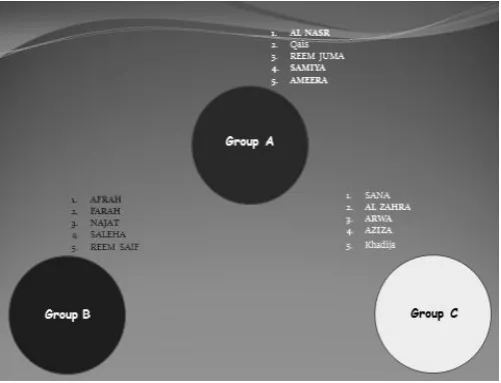
“Identify my misdirected teaches my Apprentice” is a simple but effective innovative practice in which a cohort is divided in to equal groups of 2, 3, 4 or 5 members depending upon the strength of a particular cohort. The members of each group are chosen by the module instructor following the logic that each group should have a combination of good, average and weak students.
A questionrelated to module curriculum is displayed on the screen for a specific member of a particular group. In case the respective member of the group answers the question correctly, 10 points are given to that particular group. In case the respective member fails to answer a question, -5 points are given to the group with IPP
(Individual Presentation Penalty) for the respective
member. IPP means that the student who has failed to answer the question will have to prepare a presentation for the topic in question in the next class. Moreover same question is asked to the group to which the respective member belongs and in case none of the group members could answer the question, there are two choices provided for the group.
i Accept GPP (Group Presentation Penalty) with -15
points.
Or
ii Opt. for RCP (Repeat Class Penalty to the teacher)
without any penalties to the group members or negative points to the group.
Repeat class penalty can be accepted by the module instructor only in case all the members in next group could not answer the question, and if case be so BIMT (Bonus for Identifying Misdirected Teaches) 15 bonus points are provided to the group for identifying misdirected teaches.
[image:2.595.305.556.539.730.2]Example: - The below given example explains “Identify my misdirected teaches my Apprentice” activity. The example displays the activity conducted on a classroom of 15 students, divided in to three groups. Group A, Group B and Group C.
Fig. 4 logical diagram of ―identify my misdirected teaches my apprentice‖
Fig. 3 & Fig. 4 show how the activity is carried out in the classroom. The group with highest number of points at the end is given price/memento as a token of appreciation; moreover the students who successfully answered all the questions asked to them also get a price/memento.
3. Relate & Deliver with Artificial Experience
Students tend to comprehend subject matter easily if it is
thoughtfully presented to them [3]. Students always
appreciate & commend teachers having enormous capabilities to correlate real life examples with the subject matter for better understanding & learning. Moreover teachers being the facilitators should be able to reduce the complexity involved in comprehending a particular concept. Although all educationalists at different levels of teaching & learning do provide students real life examples which most of the times are pictured & conceived by the teachers inside the classroom while delivering a lecture; however precision in successfully correlating real life examples so that students can easily comprehend subject matter comes with experience and teaching a particular subject persistently for longer period of time, otherwise this approach can lead to chaos and confusion in student’s mind with inexperienced faculty or a newly acquired subject matter. Moreover even with experienced faculty members it cannot be expected that they can provide easy & suitable examples for every concept related to a particular subject. ―Relate & Deliver with Artificial Experience‖ supports and recommends use of effective, easy and real life examples in a proper manner so that maximum outcome can be achieved.
Content-centered teaching focuses on and meets the requirements of the content [10] [11], Instructor-centered teaching focuses on the teacher and teachers determine the content and organization of the courses as per their wishes & needs [10] [11]. Student-centered teaching focuses on student and content are largely determined by student’s needs [10] [11]. The below given examples shows the supporting content determined by student needs to explain the Networking concept of Authentication, Authorization and Accounting.
Example
[image:3.595.47.308.49.252.2]Authentication
Fig. 5 process of authentication at an ATM
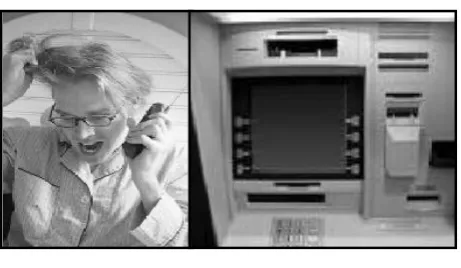
We are using Automated Teller Machines (ATM’s) in our day-to-day life, when we go to a particular ATM for withdrawal of cash or balance inquiry we are actually logging on to the bank’s network. ATM asks us a question ―Who are you‖ and we reply it by inserting our ATM card & entering pin (password) as shown in Fig. 5, this process of identifying ourselves to the bank’s network is called authentication. You need be a genuine user of the bank to log on to the banks network.
Authorization
Fig. 6 process of Authorization at an ATM
[image:3.595.312.546.65.209.2] [image:3.595.314.549.390.533.2]Accounting
Fig. 7 Accounting
You might have also faced a problem that when you were trying to withdraw the money from the ATM, your account got debited but in reality you never received the money in your hand. You usually give a call to the bank’s call center as illustrated in Fig. 7 and intimate them about the incident, but one important thing we need to notice is, where from the bank officials come to know whether you received the money or there was some error which occurred during the transaction. Actually whatever actions you perform i.e. money withdrawal, balance inquiry, transfer or any other transaction, all of these actions are monitored & archived and different logs/details are available with the system for future reference. The Accounting refers to storing of all the events which take place during a particular logon session which includes all successful & failure events. Accounting determines ―what you actually did‖ during a particular logon session on the network.
The above example if explained to the students as a supporting material before explanation of formal definitions for Authentication, Authorization & Accounting can help to a great extent to successfully convey the subject matter and students will feel substantial ease in comprehending the concepts. However there are certain holistic issues on which we need to have a minute analysis to make above practice much more beneficial for students as well as the teachers.
i. Maybe there are better examples available for the above concepts which my contemporaries are using in their classrooms. Maybe there was a better example of the above concepts available with my predecessor who used to teach this module before me and now he is not a part of the institution.
ii. A single teacher irrespective of his/her teaching experience & ability cannot conceive a good example for every concept he/she is teaching to his/her students. iii. Over a period of time when a teacher teaches a
particular subject matter persistently, apart from getting a better hold of the subject, teacher also acquires many unique/useful ways & examples to convey the subject matter to his/her students in a better manner. Unfortunately all his/her experiences and examples which he/she had conceived while teaching a particular module extinct and are useless after he/she discontinues teaching that module or leaves the institution.
iv. Newly recruited faculty members (with less experience)
usually face problems in providing suitable & appropriate examples as they are still in developmental phase.
Author provides a new concept of ―Artificial Experience‖ which may prove to be very beneficial in addressing the above issues. ―Artificial Experience‖ is a chronicled & documented experience & examples of a particular educationalist in a specific area of expertise. ―Artificial
Experience‖ may consist of documented examples which a
particular teacher used over the years of his teaching career for some specific module or modules. ―Artificial Experience‖ may also consist of recorded audio/video aids which will provide an idea of teacher’s elegance of teaching & delivery. These recorded & documented materials may be referred as ―Experience Base‖. The appropriateness and correctness of ―Experience Base‖ can be assured by multiple reviews by experts. The author has conceived this idea from the well build concept of ―Artificial Intelligence‖ [6].
II. ADDITIONAL RESOURCES USED
The innovative practices described above indeed require advanced resources to yield optimum results although first two practices i.e. ―Golden S for Novices‖ and ―Identify my misdirected teaches my apprentice‖ were conducted using some basic application software, it is highly recommended to have a proper packaged software to utilize the maximum efficiency, acquire desired outcome, avoid wastage of time and to automate the storage & retrieval of data & results. Author has developed software packages to support ―Golden S for novices” and “Identify my misdirected teaches my apprentice‖. These packages provide effective, easy & user-friendly interface to implement ―Golden S for Novices‖ and ―Identify my misdirected teaches my apprentice” in the classrooms. However these practices can well be implemented using basic applications like Microsoft word, Power point, excel etc. with some exertion which is proportional to the strength of a particular cohort. On the other hand we need to create a proper IT infrastructure to implement the concept of ―Artificial Experience‖. We need to have servers to host the ―Experience Base‖ and accordingly specific services need to be enabled so that people can gain appropriate access to the resources as desired. Moreover it is reasonably apparent that ―Experience Base” will not be developed within hours or days, it will certainly take some time and devoted efforts of various people in a particular institution. We can setup a team of persons consisting of one or more Departmental Heads, Senior Faculty members, members from IT support and administration who will be responsible for successful creation of ―Experience Base‖ and implementation of ―Artificial Experience‖.
III. RELATED WORK
the focus of learning is to gain information as it is proctored to the student. On the other hand, student-centered learning is now the norm where active learning is strongly encouraged [4]. Students are now researching material pertinent to the success of their academia and knowledge production is seen as a standard [4]. The combination of a few learning practices such as Bloom's Taxonomy [2] and
Howard Gardner’s Theory of Multiple intelligences [1] can
be valuable to a student-centered learning because they supports various modes of varied learning styles [1][2]. Student-centered learning is essential as it encourages discovery learning, promotes peer communication, enhances student motivation and enables students to take more responsibility for their learning [4][5].
According to James Henderson there are three basic principles of democratic living which are not yet established in our society in terms of education [3], these three basic principles which he calls three S’s of teaching are:
Self-Learning: Discovery learning processes from an autonomous viewpoint, engage oneself in generative process [3].
Social Learning: peer-to-peer interaction, collaborative thinking can lead to an abundance of knowledge [3]. Subject Learning: Subject matter thoughtfully prepared and presented [3].
BMIM (BhatMeer Inspirational Model for student-centered teaching & learning) provides an effective mechanism to promote above principles of teaching & learning and inspire students to participate in student-centered learning process.
IV. RESULTS
i. Golden S for Novices
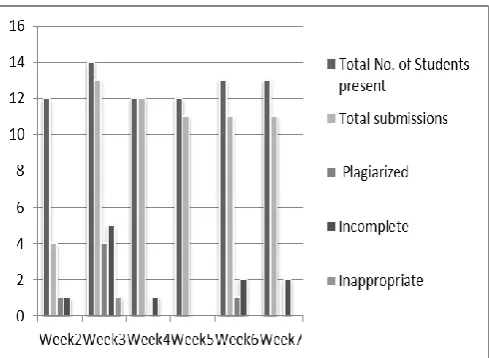
[image:5.595.306.551.48.227.2]Feed-back on work or rewards lead to feelings of competence and so enhance intrinsic motivations [7], the technique proved to be extremely beneficial in reducing the issues of plagiarism, incompleteness and inappropriateness of work assigned to students. Apart from enhancing student’s participation in a student-centered learning environment and reducing plagiarized, inappropriate and incomplete submissions, this technique also yields some hidden benefits. Teacher is well aware about the performance and improvement of students at individual levels, teacher exactly knows which student has poorly performed in which assigned task, and teacher also knows which student has missed which particular topic in the classroom because of a skipped class. The teacher can easily concentrate and allocate his attention to the students who are not performing to a satisfactory level and can arrange a separate meeting with them on one-one basis making ―Office Hours‖ more meaningful for the teacher.
Fig. 8 week-wise participation of students after implementing Golden S for novices
12.67 11.25
0.25 1.25
0.00
Average week 4 onwards
Total No. of Students present Total
submissions Plagiarized
Incomplete
[image:5.595.306.549.295.437.2]Inappropriate
Fig. 9 average participation of students after implementing Golden S for novices
Fig. 8 & Fig. 9 clearly indicate incredible increase in student’s participation week 3 onwards and drastic decrease in plagiarized, inappropriate and incomplete work week 4 onwards.
ii. Identify my misdirected teaches my Apprentice
iii. Relate & Deliver with Artificial Experience
By using the concept of ―Artificial Experience‖ we certainly can encourage & inspire teachers to take a more Student-centered approach of delivery for effective & successful Student-centered teaching & learning. Academic/ classroom experiences of senior faculty members can be utilized in an efficient way by a less experienced faculty member to enhance lecture delivery, reduce complexity of topics so that students may be benefitted as they feel much ease in comprehending the curriculum topics with real life examples. The ―Experience Base” proves to be very beneficial for new and less experienced faculty members as they acquire thoughtfully prepared supporting material and examples for the curriculum topics. ―Artificial Experience‖ also consists of recorded audio/video aids which provide an idea of teacher’s elegance of teaching & delivery, which provides new faculty members an idea of how they are supposed to deliver and conduct the classes. In addition the practice is very beneficial as the academic and classroom experiences of the faculty members who leave the institution or discontinue teaching a particular module are archived in a manner so that those can be reused for future purpose furthermore multiple faculty members handling different sessions of the same module can easily share their respective examples with each other and may adopt or use the examples of one another for the benefit of students.
V. CONCLUSION
Student-centered teaching & learning approach is being adopted worldwide in universities and colleges which has significantly transformed the education and helped students to foster skills in the modern era of education. Various innovative methods for student-centered teaching & learning have been proposed & practiced by the educationalists at different levels to benefit students however little work has been done to increase the participation and inspire students to actively involve themselves in student-centered teaching & learning especially in a learning environment where curriculum assessments are not student centered. Although we may not be able to modify curriculum assessments at various places due to restrictions from parent universities or affiliations, we still can certainly yield benefits of student-centered teaching & learning if we can encourage, inspire & motivate students to actively participate in student-centered learning and persuade faculty members to adopt student-centered teaching & learning approach. BMIM (BhatMeer Inspirational Model) is a mere effort to encourage the active participation of learners and at the same time convince & facilitate teachers to adopt student-centered approach for teaching & learning.
ACKNOWLEDGMENT
I am thankful to Almighty Allah for bestowing me knowledge to write this research paper. I am sincerely thankful to Department of Research Middle East College for their encouraging attitude & support for researchers. I thank HOD Computing Middle East College Mr. Arun for his continued support and assistance. I am very thankful to all my contemporaries and friends who supported and
encouraged me every time. I am greatly thankful to my family members especially my mother & my wife for their inspiration, support and guidance.
REFERENCES
[1]. Gardner, H. (1983). Frames of Mind: The Theory of multiple intelligences. New York. Basic Books
[2]. Bloom, Benjamin. (1956). Taxonomy of educational objectives. The classification of educational goals. Susan Fauer Company, Incorporation.
[3]. Henderson, J.G. (1992). Reflective teaching: Professional artistry through inquiry. Upper Saddle River, NJ: Merrill Prentice Hall.
[4]. Motschnig-Pitrik, R. & Holzinger, A. (2002). Student-Centered Teaching Meets New Media. Educational Technology & Society, 5(4), pp. 160-172.
[5]. Thomas Brush, John Saye, Implementation and Evaluation of a Student-Centered Learning, Educational Technology Research and Development, Vol. 48, No. 3.
[6]. Jackson, Peter (1998), Introduction to Expert Systems (3 ed.), Addison Wesley, p. 2, ISBN 978-0-201-87686-4.
[7]. Deci, E. L. (1975). Intrinsic motivation. New York: Plenum.
[8]. Deci, E. L. (1971). Effects of externally mediated rewards on intrinsic motivation. Journal of Personality and Social Psychology, 18, 105–115.
[9]. Deci, E., & Ryan, R. (Eds.), (2002). Handbook of self-determination research. Rochester, NY: University of Rochester Press.
[10]. Professional Development Module: Student-Centered Teaching. By Vicky Lara, El Paso
Community College.
http://www.uottawa.ca/academic/cut/options/De c_97/ Student_centered.htm .
[11]. Sergio Piccinin. Making our teaching more student-centered at http:// www.uottawa.ca
/academic / cut /options / Dec_97 /
Student_centered.htm.
[12]. BARNES, T., POWELL, E., CHAFFIN, A., AND LIPFORD, H. 2008. Game2Learn: Improving the motivation of CS1 Students. In
Proceedings of Game Development in
Computer Science Education (GDCSE’08). [13]. Ryan, R.M. and Deci, E.L. Self-determination